

Nitric oxide charged catheters as a potential strategy for prevention of hospital acquired infections
Open accessThe DOI matches its Crossref record; 25 of the 26 references it cites were found in a registry or an index.
Abstract
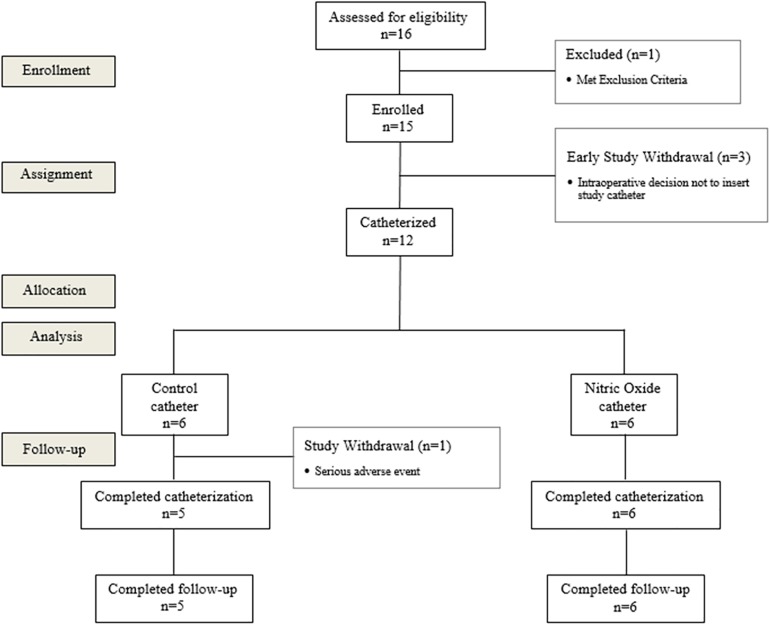
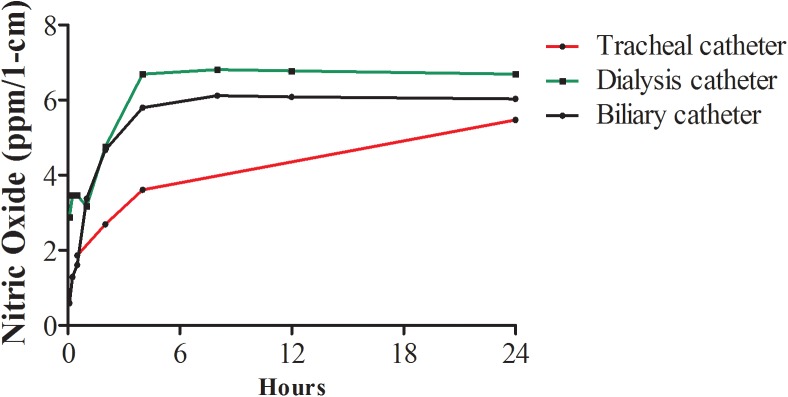
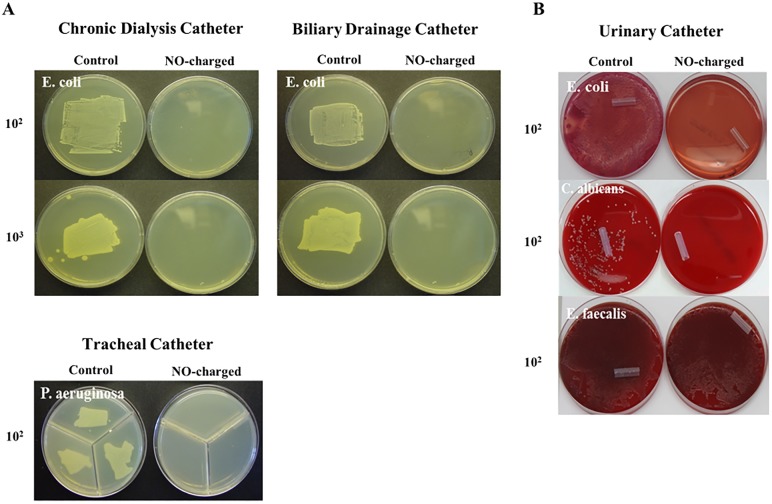
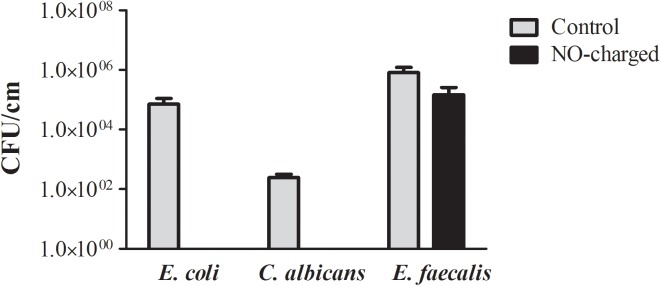
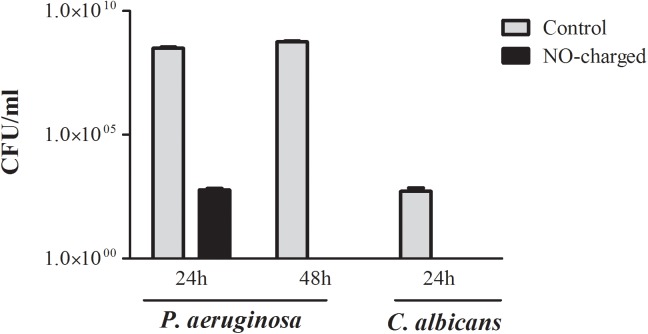
BACKGROUND: Catheter-Associated Hospital-Acquired Infections (HAI's) are caused by biofilm-forming bacteria. Using a novel approach, we generated anti-infective barrier on catheters by charging them with Nitric Oxide (NO), a naturally-produced gas molecule. NO is slowly released from the catheter upon contact with physiological fluids, and prevents bacterial colonization and biofilm formation onto catheter surfaces. AIMS AND METHODS: The aim of the study was to assess the anti-infective properties of NO-charged catheters exposed to low concentration (up to 103 CFU/ml) of microbial cells in-vitro. We assessed NO-charged tracheal tubes using Pseudomonas aeruginosa, dialysis and biliary catheters using Escherichia coli, and urinary catheters using E. coli, Candida albicans or Enterococcus faecalis. Safety and tolerability of NO-charged urinary catheters were evaluated in a phase 1 clinical study in 12 patients. Six patients were catheterized with NO-charged catheters (NO-group), followed by 6 patients catheterized with regular control catheters (CT-group). Comparison of safety parameters between the study groups was performed. RESULTS: NO-charged tracheal, dialysis biliary and urinary catheters prevented P. aeruginosa, E. coli and C. albicans attachment and colonization onto their surfaces and eradicated corresponding planktonic microbial cells in the surrounding media after 24-48 hours, while E. faecalis colonization onto urinary catheters was reduced by 1 log compared to controls. All patients catheterized with an NO-charged urinary catheter successfully completed the study without experiencing NO-related AE's or serious AE's (SAE's). CONCLUSION: These data highlight the potential of NO-based technology as potential platform for preventing catheter-associated HAI's.
Overview
The claims and statistics of this paper haven’t been checked yet.
Free: it reads the open-access text and checks the first 5 claims that cite a source we can check. Create a free account to check every claim.
Integrity signals
Registry
Cites
Statistics
Figures
Verification
Claims the paper makes
The claims and statistics of this paper haven’t been checked yet.
Free: it reads the open-access text and checks the first 5 claims that cite a source we can check. Create a free account to check every claim.
Claims other papers make about this one
Each is checked against this paper’s own text: does it say what the citing paper says it does?
The source backs part of the claim, not all of it — or backs it for a different population, condition or comparison.
In the citing paper
“NO has been evaluated as a therapy in a variety of bacterial and fungal infections, including infections by Pseudomonas aeruginosa in cases of cystic fibrosis and infections caused by dermatophytes (22–24).”
From Inhibition of Classical and Alternative Modes of Respiration in Candida albicans Leads to Cell Wall Remodeling and Increased Macrophage Recognition (2019) · cites this paper as [24]
Experimental — accuracy not yet measured
Self-check
Percentages, sums and reported differences re-computed from the paper’s own numbers.
The self-check needs the paper’s full text.
Citations
Cites
Bacterial Biofilms: A Common Cause of Persistent Infections
Costerton, J. W., Stewart, P. S., & Greenberg, E. P. (1999) · Science · doi:10.1126/science.284.5418.1318 · Cited by 12,167 · cited 1×
“Bacteria can adhere to the surface of the catheter within hours from catheterization and colonize, creating a persistent environment called a biofilm [4–6].”
Analysis of nitrate, nitrite, and [15N]nitrate in biological fluids
Green, L. C., Wagner, D. A., Glogowski, J., Skipper, P. L., Wishnok, J. S., & Tannenbaum, S. R. (1982) · Analytical Biochemistry · doi:10.1016/0003-2697(82)90118-x · Cited by 12,077
Antibiotic resistance of bacterial biofilms
Høiby, N., Bjarnsholt, T., Givskov, M., Molin, S., & Ciofu, O. (2010) · International Journal of Antimicrobial Agents · doi:10.1016/j.ijantimicag.2009.12.011 · Cited by 3,225
Biofilms as Complex Differentiated Communities
Stoodley, P., Sauer, K., Davies, D. G., & Costerton, J. W. (2002) · Annual Review of Microbiology · doi:10.1146/annurev.micro.56.012302.160705 · Cited by 3,158
Bacterial adhesion: seen any good biofilms lately
Dunne, W. M. (2002) · Clinical Microbiology Reviews · doi:10.1128/cmr.15.2.155-166.2002 · Cited by 1,516
The potential of nitric oxide releasing therapies as antimicrobial agents
Schairer, D. O., Chouake, J. S., Nosanchuk, J. D., & Friedman, A. J. (2012) · Virulence · doi:10.4161/viru.20328 · Cited by 573
Catheter associated urinary tract infections
Nicolle, L. E. (2014) · Antimicrobial Resistance and Infection Control · doi:10.1186/2047-2994-3-23 · Cited by 559
Ventilator-Associated Pneumonia: Diagnosis, Treatment, and Prevention
Koenig, S. M., & Truwit, J. D. (2006) · Clinical Microbiology Reviews · doi:10.1128/cmr.00051-05 · Cited by 539
Anti-biofilm efficacy of nitric oxide-releasing silica nanoparticles
Hetrick, E. M., Shin, J. H., Paul, H. S., & Schoenfisch, M. H. (2009) · Biomaterials · doi:10.1016/j.biomaterials.2009.01.052 · Cited by 406
Hermann, M., Flammer, A., & Lüscher, T. F. (2006) · The Journal of Clinical Hypertension · doi:10.1111/j.1524-6175.2006.06032.x · Cited by 354
Davidson, D., Barefield, E. S., Kattwinkel, J., Dudell, G., Damask, M., Straube, R., Rhines, J., Chang, C.-T., & the I-NO/PPHN Study Group (1998) · Pediatrics · doi:10.1542/peds.101.3.325 · Cited by 354
Bacterial biofilms: prokaryotic adventures in multicellularity
Webb, J. S., Givskov, M., & Kjelleberg, S. (2003) · Current Opinion in Microbiology · doi:10.1016/j.mib.2003.10.014 · Cited by 309
The Role of Nitric Oxide in Erectile Dysfunction: Implications for Medical Therapy
Burnett, A. L. (2006) · The Journal of Clinical Hypertension · doi:10.1111/j.1524-6175.2006.06026.x · Cited by 205
Topical Nitric Oxide Application in the Treatment of Chronic Extensor Tendinosis at the Elbow
Paoloni, J. A., Appleyard, R. C., Nelson, J., & Murrell, G. A. C. (2003) · The American Journal of Sports Medicine · doi:10.1177/03635465030310062901 · Cited by 188
WESSEL, D. L., Adatia, I., Marter, L. J. V., Thompson, J. E., Kane, J., Stark, A. R., & Kourembanas, S. (1997) · PEDIATRICS · doi:10.1542/peds.100.5.e7 · Cited by 160
Gries, A., Bode, C., Peter, K., Herr, A., Böhrer, H., Motsch, J., & Martin, E. (1998) · Circulation · doi:10.1161/01.cir.97.15.1481 · Cited by 155
Regev-Shoshani, G., Ko, M., Miller, C., & Av-Gay, Y. (2010) · Antimicrobial Agents and Chemotherapy · doi:10.1128/aac.00511-09 · Cited by 94
Self-citationWorley, B. V., Slomberg, D. L., & Schoenfisch, M. H. (2014) · Bioconjugate Chemistry · doi:10.1021/bc5000719 · Cited by 86
Worley, B. V., Schilly, K. M., & Schoenfisch, M. H. (2015) · Molecular Pharmaceutics · doi:10.1021/acs.molpharmaceut.5b00006 · Cited by 73
KERMARREC, N., ZUNIC, P., BELOUCIF, S., BENESSIANO, J., DROUET, L., & PAYEN, D. (1998) · American Journal of Respiratory and Critical Care Medicine · doi:10.1164/ajrccm.158.3.9709097 · Cited by 65
Olejníčková, K., Holá, V., & Růžička, F. (2014) · Pathogens and Disease · doi:10.1111/2049-632x.12188 · Cited by 53
Akbari, F., & Kjellerup, B. (2015) · Pathogens · doi:10.3390/pathogens4030457 · Cited by 50
Regev-Shoshani, G., Ko, M., Crowe, A. M., & Av‐Gay, Y. (2011) · Urology · doi:10.1016/j.urology.2011.02.063 · Cited by 47
Self-citationHerr, A., Motsch, J., Holzmann, A., Weimann, J., Taut, F., Erbe, N., Bode, C., Martin, E., & Gries, A. (2000) · Thrombosis and Haemostasis · doi:10.1055/s-0037-1613804 · Cited by 41
Wilbert, D. M., Schaerfe, C. W., Strohmaíer, W. L., & Bichler, K.-H. (1991) · Springer eBooks · doi:10.1007/978-3-642-75972-7_13 · Cited by 2
Cited by
Medical Device-Associated Biofilm Infections and Multidrug-Resistant Pathogens
Bouhrour, N., Nibbering, P. H., & Bendali, F. (2024) · Pathogens · doi:10.3390/pathogens13050393 · Cited by 194
Antibiofilm agents: A new perspective for antimicrobial strategy
Li, X.-H., & Lee, J.-H. (2017) · Journal of Microbiology · doi:10.1007/s12275-017-7274-x · Cited by 183
A Glance at Antimicrobial Strategies to Prevent Catheter-Associated Medical Infections
Ricardo, S. I. D. C., Anjos, I., Monge, N., Faustino, C. M. C., & Ribeiro, I. (2020) · ACS Infectious Diseases · doi:10.1021/acsinfecdis.0c00526 · Cited by 99
Xu, L., Meyerhoff, M. E., & Siedlecki, C. A. (2018) · Acta Biomaterialia · doi:10.1016/j.actbio.2018.11.035 · Cited by 97
Reactive nitrogen species in host–bacterial interactions
Fang, F. C., & Vázquez‐Torres, A. (2019) · Current Opinion in Immunology · doi:10.1016/j.coi.2019.05.008 · Cited by 78
Metadata
- Authors
- Margel, D., Mizrahi, M., Regev-Shoshani, G., KO, M., Moshe, M., Ozalvo, R., Shavit-Grievink, L., Baniel, J., Kedar, D., Yossepowitch, O., Lifshitz, D., Nadu, A., Greenberg, D., & Av-Gay, Y.
- Affiliations
- Tel Aviv University (IL)
- University of British Columbia (CA)
- Venue
- PLOS ONE
- Publisher
- Public Library of Science (PLoS)
- Published
- 2017-04-14
- Volume
- 12
- Issue
- 4
- Pages
- e0174443
- ISSN
- 1932-6203 (ISSN-L)
- PMC
- PMC5391919
- OpenAlex
- W2953405287
- Cited by
- 35
- References
- 26
- Citations by year
- 2026: 4 · 2025: 3 · 2024: 5 · 2023: 1 · 2022: 1 · 2021: 2 · 2020: 9 · 2019: 5 · 2018: 3 · 2017: 2
- FWCI
- 4.07
- Type
- journal article
- Language
- en
- Open access
- gold
- doi.org
- Licence
- Locations
- PLoS ONE (publishedVersion, cc-by)
- PubMed Central (publishedVersion, cc-by)
- PubMed (publishedVersion)
- DOAJ (DOAJ: Directory of Open Access Journals) (submittedVersion)
- Figshare (submittedVersion, cc-by)
- Topics
- Health Sciences › Medicine › Urology › Urinary Tract Infections Management
- Life Sciences › Biochemistry, Genetics and Molecular Biology › Molecular Biology › Bacterial biofilms and quorum sensing
- Health Sciences › Medicine › Infectious Diseases › Infection Control in Healthcare
- Keywords
- nitric oxide, catheter-related infection, nosocomial infections, biofilm inhibition, bacterial colonization, urinary catheter, endotracheal tube, dialysis catheter, Pseudomonas aeruginosa, Escherichia coli, Candida albicans, Enterococcus faecalis, safety and tolerability
- MeSH terms
- Aged, Bacterial Adhesion, Candida albicans, Escherichia coli, Follow-Up Studies, Hematuria, Hemoglobins, Humans, Male, Middle Aged, Nitric Oxide, Prospective Studies, Pseudomonas aeruginosa, Enterococcus faecalis, Case-Control Studies, Catheter-Related Infections, Urinary Catheters
About these checks
Registry, retraction, Cites and statistics results are computed, not judged, with one exception: a printed reference that no index lists is read once by a model before it counts as a citation error. Claims are extracted by a model and kept only when their quote appears verbatim in the text; each cited source is then checked, with a model’s help, for whether it says what the claim relies on. Those verdicts can be wrong — read the claim’s quote and the cited source before relying on one.
Statistics and arithmetic are recomputed, not judged.
Confidence bands are shown only for fields calibrated on our annotated test set. None is calibrated yet, so no band is shown.
What counts as a claim ›How we measure confidence ›How we check this ›
Are you an author, or do you see a problem with this page? Request a review
Data sources
Bibliographic data: Semantic Scholar, OpenAlex, Crossref.
Contains information from the Semantic Scholar Academic Graph Datasets, made available under the ODC Attribution License (ODC-BY 1.0).
Semantic Scholar’s data is described in: Kinney, R., et al. (2023). The Semantic Scholar Open Data Platform. arXiv:2301.10140.
