

The DOI matches its Crossref record; 39 of the 39 references it cites were found in a registry or an index.
Regulation of gut luminal serotonin by commensal microbiota in mice
Open accessAbstract
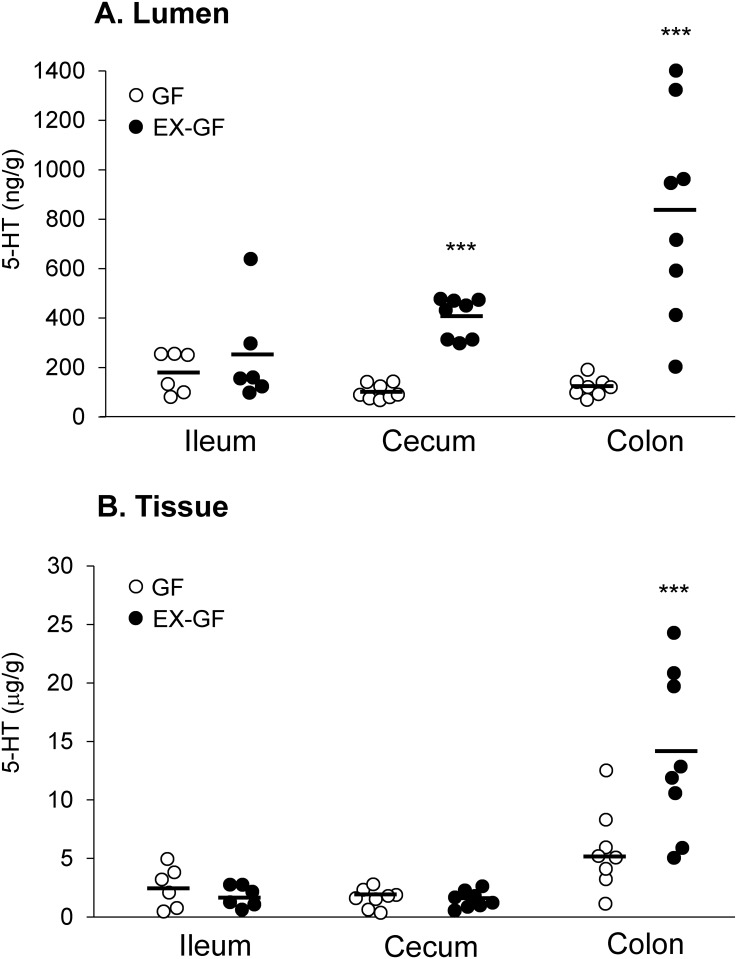
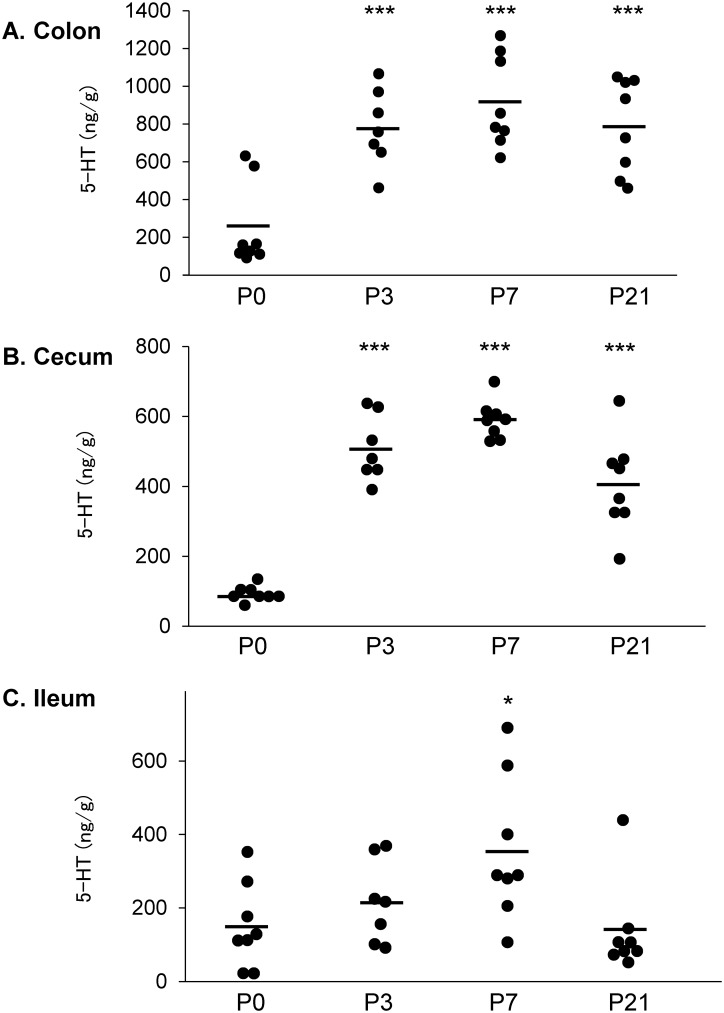
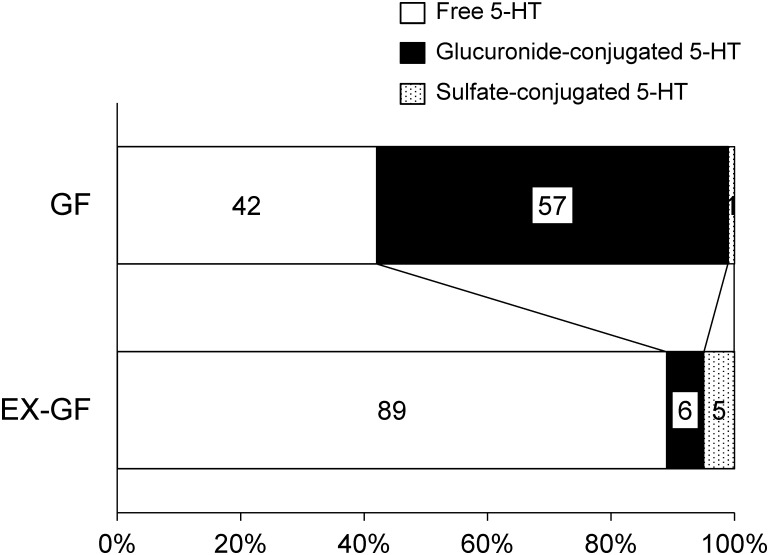
Gut lumen serotonin (5-hydroxytryptamine: 5-HT) contributes to several gastrointestinal functions such as peristaltic reflexes. 5-HT is released from enterochromaffin (EC) cells in response to a number of stimuli, including signals from the gut microbiota. However, the specific mechanism by which the gut microbiota regulates 5-HT levels in the gut lumen has not yet been clarified. Our previous work with gnotobiotic mice showed that free catecholamines can be produced by the deconjugation of conjugated catecholamines; hence, we speculated that deconjugation by bacterial enzymes may be one of the mechanisms whereby gut microbes can produce free 5-HT in the gut lumen. In this study, we tested this hypothesis using germ-free (GF) mice and gnotobiotic mice recolonized with specific pathogen-free (SPF) fecal flora (EX-GF). The 5-HT levels in the lumens of the cecum and colon were significantly lower in the GF mice than in the EX-GF mice. Moreover, these levels were rapidly increased, within only 3 days after exposure to SPF microbiota. The majority of 5-HT was in an unconjugated, free form in the EX-GF mice, whereas approximately 50% of the 5-HT was found in the conjugated form in the GF mice. These results further support the current view that the gut microbiota plays a crucial role in promoting the production of biologically active, free 5-HT. The deconjugation of glucuronide-conjugated 5-HT by bacterial enzymes is likely one of the mechanisms contributing to free 5-HT production in the gut lumen.
Overview
The claims and statistics of this paper haven’t been checked yet.
Run the check — free, no account needed. It reads the open-access text and checks the sources it cites.
Integrity signals
Registry
Cites
Statistics
Figures
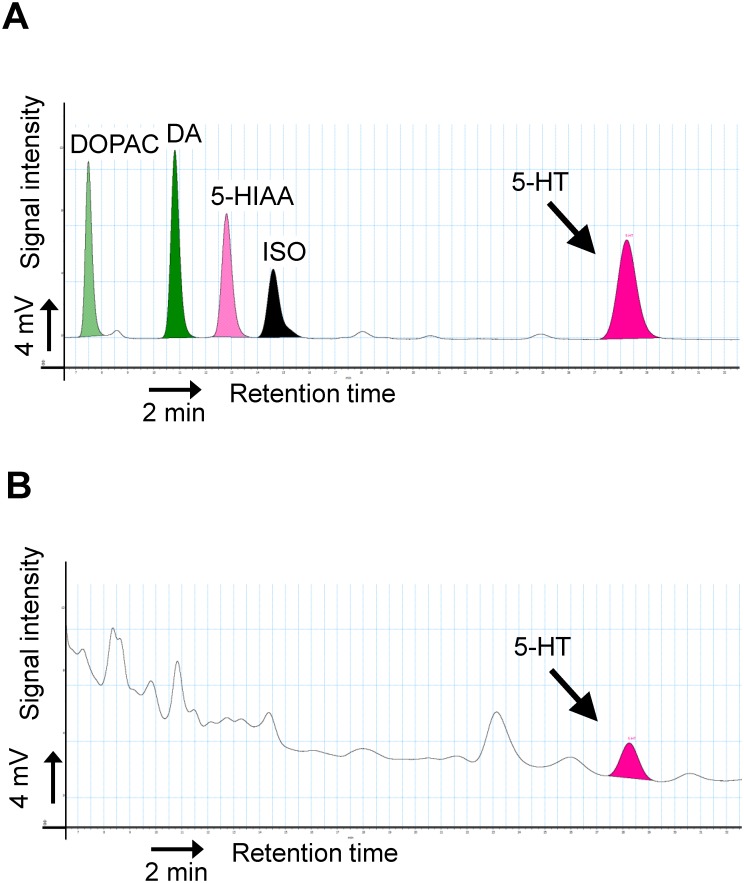
Verification
Claims the paper makes
The claims and statistics of this paper haven’t been checked yet.
Run the check — free, no account needed. It reads the open-access text and checks the sources it cites.
Claims other papers make about this one
Each is checked against this paper’s own text: does it say what the citing paper says it does?
The source backs part of the claim, not all of it — or backs it for a different population, condition or comparison.
In the citing paper
“gut bacteria were shown to deconjugate host-produced catecholamines via the β-glucuronidase enzyme pathway, and thus generate free luminal 5-HT (Asano et al., 2012;Hata et al., 2017).”
From The Microbiota-Gut-Brain Axis (2019) · cites this paper as Hata et al., 2017
Experimental — accuracy not yet measuredThe cited source says what the claim attributes to it.
In the citing paper
“Likewise, 5-HT concentrations in the cecal and colonic lumens are significantly reduced in GF mice (Hata et al., 2017).”
From The Microbiota-Gut-Brain Axis (2019) · cites this paper as Hata et al., 2017
The cited source says what the claim attributes to it.
In the citing paper
“Moreover, in the same study, the conjugated, biologically inactive form of 5-HT was found at a higher percentage in GF mice, whereas the unconjugated, biologically-active form of 5-HT was found in greater concentration in conventionalized GF mice.”
From The Microbiota-Gut-Brain Axis (2019) · cites this paper as Hata et al., 2017
The cited source says what the claim attributes to it.
In the citing paper
“the gut microbiota are understood to impact the host GI serotonergic system (Hata et al., 2017;O'Mahony et al., 2015).”
From The Microbiota-Gut-Brain Axis (2019) · cites this paper as Hata et al., 2017
The cited source says what the claim attributes to it.
In the citing paper
“The conventionalization of GF mice with a microbiota resulted in increased concentrations of intestinal luminal 5-HT.”
From The Microbiota-Gut-Brain Axis (2019) · cites this paper as Hata et al., 2017
In the citing paper
“In a rodent study, it was found that mice without an enteric microbiome had only half the amount of serotonin in the circulation when compared to mice with normal gut microbiota [48].”
From Role of diet and its effects on the gut microbiome in the pathophysiology of mental disorders (2022) · cites this paper as [48]
Self-check
Percentages, sums and reported differences re-computed from the paper’s own numbers.
The self-check needs the paper’s full text.
Citations
Cites
Indigenous bacteria from the gut microbiota regulate host serotonin biosynthesis
Yano, J. M., Yu, K., Donaldson, G. P., Shastri, G. G., Ann, P., Ma, L., Nagler, C. R., Ismagilov, R. F., Mazmanian, S. K., & Hsiao, E. Y. (2015) · Cell · doi:10.1016/j.cell.2015.02.047 · Cited by 3,614
Sudo, N., Chida, Y., Aiba, Y., Sonoda, J., Oyama, N., Yu, X., Kubo, C., & Koga, Y. (2004) · The Journal of Physiology · doi:10.1113/jphysiol.2004.063388 · Cited by 2,735
Self-citationMetabolomics analysis reveals large effects of gut microflora on mammalian blood metabolites
Wikoff, W. R., Anfora, A. T., Liu, J., Schultz, P. G., Lesley, S. A., Peters, E. C., & Siuzdak, G. (2009) · Proceedings of the National Academy of Sciences · doi:10.1073/pnas.0812874106 · Cited by 2,677
Serotonin, tryptophan metabolism and the brain-gut-microbiome axis
O’Mahony, S. M., Clarke, G., Borre, Y. E., Dinan, T. G., & Cryan, J. F. (2015) · Behavioural Brain Research · doi:10.1016/j.bbr.2014.07.027 · Cited by 2,012
The interplay between the intestinal microbiota and the brain
Collins, S. M., Surette, M., & Bercik, P. (2012) · Nature Reviews Microbiology · doi:10.1038/nrmicro2876 · Cited by 1,611
Induction of Protective IgA by Intestinal Dendritic Cells Carrying Commensal Bacteria
Macpherson, A. J., & Uhr, T. (2004) · Science · doi:10.1126/science.1091334 · Cited by 1,584
Principles and clinical implications of the brain-gut-enteric microbiota axis
Rhee, S. H., Pothoulakis, C., & Mayer, E. A. (2009) · Nature Reviews Gastroenterology & Hepatology · doi:10.1038/nrgastro.2009.35 · Cited by 1,342
Reigstad, C. S., Salmonson, C. E., III, J. F. R., Szurszewski, J. H., Linden, D. R., Sonnenburg, J. L., Farrugia, G., & Kashyap, P. C. (2015) · The FASEB Journal · doi:10.1096/fj.14-259598 · Cited by 1,335
Sudo, N., Sawamura, S., Tanaka, K., Aiba, Y., Kubo, C., & Koga, Y. (1997) · The Journal of Immunology · doi:10.4049/jimmunol.159.4.1739 · Cited by 1,070
Self-citationCoates, M. D., Mahoney, C. R., Linden, D. R., Sampson, J. E., Chen, J. C., Blaszyk, H., Crowell, M. D., Sharkey, K. A., Gershon, M. D., & Mawe, G. M. (2004) · Gastroenterology · doi:10.1053/j.gastro.2004.03.013 · Cited by 761
Asano, Y., Hiramoto, T., Nishino, R., Aiba, Y., Kimura, T., Yoshihara, K., Koga, Y., & Sudo, N. (2012) · American Journal of Physiology-Gastrointestinal and Liver Physiology · doi:10.1152/ajpgi.00341.2012 · Cited by 659
Self-citation5-Hydroxytryptamine (serotonin) in the gastrointestinal tract
Gershon, M. D. (2013) · Current Opinion in Endocrinology, Diabetes & Obesity · doi:10.1097/med.0b013e32835bc703 · Cited by 617
Collins, S. M., & Bercik, P. (2009) · Gastroenterology · doi:10.1053/j.gastro.2009.01.075 · Cited by 612
Gershon, M. D. (2004) · Alimentary Pharmacology & Therapeutics · doi:10.1111/j.1365-2036.2004.02180.x · Cited by 521
Bülbring, E., & LIN, R. C. Y. (1958) · The Journal of Physiology · doi:10.1113/jphysiol.1958.sp005940 · Cited by 430
Forsythe, P., Sudo, N., Dinan, T., Taylor, V. H., & Bienenstock, J. (2010) · Brain, Behavior, and Immunity · doi:10.1016/j.bbi.2009.05.058 · Cited by 429
Self-citationThe release of 5‐hydroxytryptamine in relation to pressure exerted on the intestinal mucosa
Bülbring, E., & Crema, A. (1959) · The Journal of Physiology · doi:10.1113/jphysiol.1959.sp006175 · Cited by 305
Serotonin release and uptake in the gastrointestinal tract
Bertrand, P. P., & Bertrand, R. L. (2009) · Autonomic Neuroscience · doi:10.1016/j.autneu.2009.08.002 · Cited by 278
Nishino, R., Mikami, K., Takahashi, H., Tomonaga, S., Furuse, M., Hiramoto, T., Aiba, Y., Koga, Y., & Sudo, N. (2013) · Neurogastroenterology & Motility · doi:10.1111/nmo.12110 · Cited by 266
Self-citationEnterochromaffin Cells of the Human Gut: Sensors for Spices and Odorants
Braun, T., Voland, P., Kunz, L., Prinz, C., & Gratzl, M. (2007) · Gastroenterology · doi:10.1053/j.gastro.2007.02.036 · Cited by 264
Mebolism of drugs and other xenobiotics in the gut lumen and wall
Ilett, K. F., Tee, L. B. G., Reeves, P. T., & Minchin, R. F. (1990) · Pharmacology & Therapeutics · doi:10.1016/0163-7258(90)90036-2 · Cited by 205
I. Receptors on visceral afferents
Kirkup, A. J., Brunsden, A. M., & Grundy, D. (2001) · American Journal of Physiology-Gastrointestinal and Liver Physiology · doi:10.1152/ajpgi.2001.280.5.g787 · Cited by 174
Microflora modulates endocrine cells in the gastrointestinal mucosa of the rat
Uribe, A., Alam, M., Johansson, O., Midtvedt, T., & Theodorsson, E. (1994) · Gastroenterology · doi:10.1016/0016-5085(94)90526-6 · Cited by 171
The peripheral actions of 5-hydroxytryptamine
(1990) · International Journal of Biochemistry · doi:10.1016/0020-711x(90)90329-2 · Cited by 161
Enteroendocrine cells and 5-HT availability are altered in mucosa of guinea pigs with TNBS ileitis
O'Hara, J. R., Ho, W., Linden, D. R., Mawe, G. M., & Sharkey, K. A. (2004) · American Journal of Physiology-Gastrointestinal and Liver Physiology · doi:10.1152/ajpgi.00090.2004 · Cited by 139
Selwyn, F. P., Cheng, S. L., Klaassen, C. D., & Cui, J. Y. (2016) · Drug Metabolism and Disposition · doi:10.1124/dmd.115.067504 · Cited by 138
Fujimiya, M., Okumiya, K., & Kuwahara, A. (1997) · Histochemistry and Cell Biology · doi:10.1007/s004180050151 · Cited by 107
Intestinal flora induces the expression of Cyp3a in the mouse liver
Toda, T., Saito, N., Ikarashi, N., Ito, K., Yamamoto, M., ISHIGE, A., Watanabe, K., & Sugiyama, K. (2009) · Xenobiotica · doi:10.1080/00498250802651984 · Cited by 102
Kerckhoffs, A. P. M., Linde, J. J. M. T., Akkermans, L. M. A., & Samsom, M. (2012) · American Journal of Physiology-Gastrointestinal and Liver Physiology · doi:10.1152/ajpgi.00153.2011 · Cited by 98
Murakami, T., & Furuse, M. (2010) · Amino Acids · doi:10.1007/s00726-009-0458-x · Cited by 87
Real‐time detection of serotonin release from enterochromaffin cells of the guinea‐pig ileum
Bertrand, P. P. (2004) · Neurogastroenterology & Motility · doi:10.1111/j.1365-2982.2004.00572.x · Cited by 84
Rodríguez, M. J., Saura, J., Billett, E. E., Finch, C. C., & Mahy, N. (2001) · Cell and Tissue Research · doi:10.1007/s004410100361 · Cited by 83
Hydrolysis of iodothyronine conjugates by intestinal bacteria
Hazenberg (1988) · FEMS Microbiology Letters · doi:10.1111/j.1574-6968.1988.tb02709.x-i1 · Cited by 55
5-HT system in the gut: roles in the regulation of visceral sensitivity and motor functions.
Grundy, D. (2008) · PubMed · Cited by 55
Luminally released serotonin stimulates colonic motility and accelerates colonic transit in rats
Tsukamoto, K., Ariga, H., Mantyh, C., Pappas, T. N., Yanagi, H., Yamamura, T., & Takahashi, T. (2007) · American Journal of Physiology-Regulatory, Integrative and Comparative Physiology · doi:10.1152/ajpregu.00856.2006 · Cited by 51
Enzymatic deconjugation of catecholamines in human and rat plasma and red blood cell lysate
Yoneda, S., Alexander, N., & Vlachakis, N. D. (1983) · Life Sciences · doi:10.1016/0024-3205(83)90749-x · Cited by 49
Zeng, F., Watson, R. P., & Nash, M. S. (2009) · Gastroenterology · doi:10.1053/j.gastro.2009.11.048 · Cited by 32
Hydrolysis of iodothyronine conjugates by intestinal bacteria
Mp, H. (1988) · FEMS Microbiology Letters · doi:10.1016/0378-1097(88)90238-8 · Cited by 6
[Importance of the liver and the digestive tract in the formation of catecholamine conjugates].
Shibata, O., Morooka, H., Hara, K., Nakamura, H., Fukuzaki, M., Gotoh, Y., & Ozaki, M. (1988) · PubMed · Cited by 3
Cited by
Sorted by citations
Cryan, J. F., O'Riordan, K. J., Cowan, C. S. M., Sandhu, K. V., Bastiaanssen, T. F. S., Boehme, M., Codagnone, M. G., Cussotto, S., Fulling, C., Golubeva, A. V., et al. (2019) · Physiological Reviews · doi:10.1152/physrev.00018.2018 · Cited by 5,286
Tryptophan Metabolism: A Link Between the Gut Microbiota and Brain
Gao, K., Mu, C.-L., Farzi, A., & Zhu, W.-Y. (2020) · Advances in Nutrition · doi:10.1093/advances/nmz127 · Cited by 1,029
Cannabinoids and the expanded endocannabinoid system in neurological disorders
Cristino, L., Bisogno, T., & Di Marzo, V. (2020) · Nature Reviews Neurology · doi:10.1038/s41582-019-0284-z · Cited by 970
Anxiety, depression, and the microbiome: A role for gut peptides
Lach, G., Schellekens, H., Dinan, T. G., & Cryan, J. F. (2018) · Neurotherapeutics · doi:10.1007/s13311-017-0585-0 · Cited by 573
Tryptophan metabolism and gut-brain homeostasis
Roth, W., Zadeh, K., Vekariya, R., Ge, Y., & Mohamadzadeh, M. (2021) · International Journal of Molecular Sciences · doi:10.3390/ijms22062973 · Cited by 519
Metadata
- Authors
- Hata, T., Asano, Y., Yoshihara, K., Kimura-Todani, T., Miyata, N., Zhang, X.-T., Takakura, S., Aiba, Y., Koga, Y., & Sudo, N.
- Affiliations
- Kyushu University (JP)
- Tokai University (JP)
- Corresponding author
- Sudo, Nobuyuki
- Venue
- PLOS ONE
- Publisher
- Public Library of Science (PLoS)
- Published
- 2017-07-06
- Volume
- 12
- Issue
- 7
- Pages
- e0180745
- ISSN
- 1932-6203 (ISSN-L)
- PMC
- PMC5500371
- OpenAlex
- W2725296099
- Cited by
- 211
- References
- 39
- Citations by year
- 2026: 5 · 2025: 19 · 2024: 26 · 2023: 22 · 2022: 30 · 2021: 35 · 2020: 33 · 2019: 30 · 2018: 9 · 2017: 2
- FWCI
- 8.26
- Type
- journal article
- Language
- en
- Open access
- gold
- doi.org
- Licence
- Locations
- PLoS ONE (publishedVersion, cc-by)
- PubMed Central (publishedVersion, cc-by)
- PubMed (publishedVersion)
- Kyushu University Institutional Repository (QIR) (Kyushu University) (submittedVersion, cc-by)
- DOAJ (DOAJ: Directory of Open Access Journals) (submittedVersion, cc-by-sa)
- Funders
- Japan Society for the Promotion of Science (16H05278, 16K15413)
- Topics
- Life Sciences › Biochemistry, Genetics and Molecular Biology › Molecular Biology › Gut microbiota and health
- Health Sciences › Medicine › Gastroenterology › Gastrointestinal motility and disorders
- Life Sciences › Agricultural and Biological Sciences › Food Science › Probiotics and Fermented Foods
- Keywords
- commensal microbiota, enterochromaffin cells, serotonin, glucuronidation, bacterial enzymes, gnotobiotic mice, germ-free mice, fecal microbiota transplantation, gut-brain axis, peristalsis
- MeSH terms
- Animals, Chromatography, High Pressure Liquid, Germ-Free Life, Intestinal Mucosa, Intestines, Mice, Inbred BALB C, Serotonin, Reverse Transcriptase Polymerase Chain Reaction, Mice, Microbiota
About these checks
Registry, retraction, Cites and statistics results are computed, not judged, with one exception: a printed reference that no index lists is read once by a model before it counts as a citation error. Claims are extracted by a model and kept only when their quote appears verbatim in the text; each cited source is then checked, with a model’s help, for whether it says what the claim relies on. Those verdicts can be wrong — read the claim’s quote and the cited source before relying on one.
Statistics and arithmetic are recomputed, not judged.
Confidence bands are shown only for fields calibrated on our annotated test set. None is calibrated yet, so no band is shown.
What counts as a claim ›How we measure confidence ›How we check this ›
Are you an author, or do you see a problem with this page? Request a review
