

The DOI matches its Crossref record; 73 of the 74 references it cites were found in a registry or an index.
A systematic review of the relationship between internet use, self-harm and suicidal behaviour in young people: The good, the bad and the unknown
Open accessAbstract
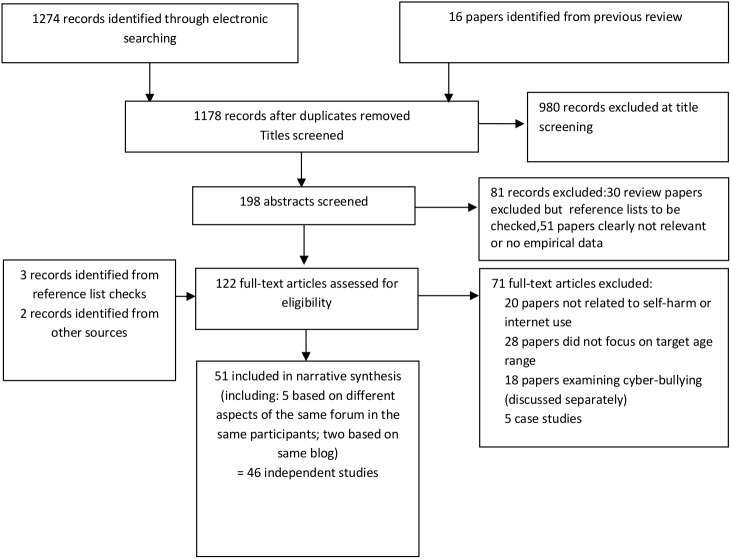
BACKGROUND: Research exploring internet use and self-harm is rapidly expanding amidst concerns regarding influences of on-line activities on self-harm and suicide, especially in young people. We aimed to systematically review evidence regarding the potential influence of the internet on self-harm/suicidal behaviour in young people. METHODS: We conducted a systematic review based on an electronic search for articles published between 01/01/2011 and 26/01/2015 across databases including Medline, Cochrane and PsychInfo. Articles were included if: the study examined internet use by individuals who engaged in self-harm/ suicidal behaviour, or internet use clearly related to self-harm content; reported primary empirical data; participants were aged under 25 years. New studies were combined with those identified in a previous review and subject to data extraction, quality rating and narrative synthesis. RESULTS: Forty-six independent studies (51 articles) of varying quality were included. Perceived influences were: positive for 11 studies (38191 participants); negative for 18 studies (119524 participants); and mixed for 17 studies (35235 participants). In contrast to previous reviews on this topic studies focused on a wide range of internet mediums: general internet use; internet addiction; online intervention/treatment; social media; dedicated self-harm websites; forums; video/image sharing and blogs. A relationship between internet use and self-harm/suicidal behaviour was particularly associated with internet addiction, high levels of internet use, and websites with self-harm or suicide content. While there are negative aspects of internet use the potential for isolation reduction, outreach and as a source of help and therapy were also identified. CONCLUSIONS: There is significant potential for harm from online behaviour (normalisation, triggering, competition, contagion) but also the potential to exploit its benefits (crisis support, reduction of social isolation, delivery of therapy, outreach). Young people appear to be increasingly using social media to communicate distress, particularly to peers. The focus should now be on how specific mediums' (social media, video/image sharing) might be used in therapy and recovery. Clinicians working with young people who self-harm or have mental health issues should engage in discussion about internet use. This should be a standard item during assessment. A protocol for this review was registered with the PROSPERO systematic review protocol registry: (http://www.crd.york.ac.uk/prospero/display_record.asp?ID=CRD42015019518).
Overview
The claims and statistics of this paper haven’t been checked yet.
Run the check — free, no account needed. It reads the open-access text and checks the sources it cites.
Integrity signals
Registry
Cites
Statistics
Figures
Verification
Claims the paper makes
The claims and statistics of this paper haven’t been checked yet.
Run the check — free, no account needed. It reads the open-access text and checks the sources it cites.
Claims other papers make about this one
Each is checked against this paper’s own text: does it say what the citing paper says it does?
In the citing paper
“In an additional review, up to 25% of studies suggested positive aspects of social/media internet use, revealing youth with a history of suicidal behavior used the internet as a form of support and sense of community to seek help and connect with others.33”
From Evidence-based youth suicide prevention and intervention in pediatric primary care settings. (2024) · cites this paper as [33]
Self-check
Percentages, sums and reported differences re-computed from the paper’s own numbers.
The self-check needs the paper’s full text.
Citations
Cites
Cochrane Handbook for Systematic Reviews of Interventions: Cochrane Book Series
(2008) · doi:10.1002/9780470712184 · Cited by 25,048
Qualitative methods for health research
Green, J., & Thorogood, N. (2009) · Choice Reviews Online · doi:10.5860/choice.47-0901 · Cited by 4,612
Checklists for improving rigour in qualitative research: a case of the tail wagging the dog?
Barbour, R. S. (2001) · BMJ · doi:10.1136/bmj.322.7294.1115 · Cited by 2,613
Popay, J., Roberts, H., Sowden, A., Petticrew, M., Arai, L., Rodgers, M., Britten, N., Roen, K., & Duffy, S. (2006) · Lancaster University · doi:10.13140/2.1.1018.4643 · Cited by 2,070
Online communication, social media and adolescent wellbeing: A systematic narrative review
Best, P., Manktelow, R., & Taylor, B. (2014) · Children and Youth Services Review · doi:10.1016/j.childyouth.2014.03.001 · Cited by 1,067 · cited 1×
“Internet use has a mixed effect on children and young people’s (CYP) well-being, with evidence of increased self-esteem and perceived social support alongside harmful effects such as increased exposure to graphic content and cyber-bullying [1].”
Kim, K., Ryu, E., Chon, M.-Y., Yeun, E.-J., Choi, S.-Y., Seo, J.-S., & Nam, B.-W. (2006) · International Journal of Nursing Studies · doi:10.1016/j.ijnurstu.2005.02.005 · Cited by 790
Guidance on the conduct of narrative synthesis in sytematic reviews
Popay, J., Roberts, H. M., Sowden, A. J., Petticrew, M. P., Arai, L., Rodgers, M., & Britten, N. (2006) · Cited by 690
The virtual cutting edge: The Internet and adolescent self-injury.
Whitlock, J. L., Powers, J. L., & Eckenrode, J. J. (2006) · Developmental Psychology · doi:10.1037/0012-1649.42.3.407 · Cited by 524
Daine, K., Hawton, K. E., Singaravelu, V., Stewart, A., Simkin, S., & Montgomery, P. (2013) · PLoS ONE · doi:10.1371/journal.pone.0077555 · Cited by 369
Self-citationKaess, M., Durkee, T., Brunner, R., Carli, V., Parzer, P., Wasserman, C., Sarchiapone, M., Hoven, C., Apter, A., Balazs, J., et al. (2014) · European Child & Adolescent Psychiatry · doi:10.1007/s00787-014-0562-7 · Cited by 298
Cited by
Sorted by citations
A future for the world's children? A WHO–UNICEF–Lancet Commission
Clark, H., Coll-Seck, A. M., Banerjee, A., Peterson, S., Dalglish, S. L., Ameratunga, S., Balabanova, D., Bhan, M. K., Bhutta, Z. A., Borrazzo, J., et al. (2020) · The Lancet · doi:10.1016/s0140-6736(19)32540-1 · Cited by 1,105
Smartphones, social media use and youth mental health
Abi-Jaoude, E., Naylor, K. T., & Pignatiello, A. (2020) · Canadian Medical Association Journal · doi:10.1503/cmaj.190434 · Cited by 627
Social media use and risky behaviors in adolescents: A meta-analysis
Vannucci, A., Simpson, E. G., Gagnon, S., & Ohannessian, C. M. (2020) · Journal of Adolescence · doi:10.1016/j.adolescence.2020.01.014 · Cited by 410
Manifesto for a European research network into Problematic Usage of the Internet
Fineberg, N., Demetrovics, Z., Stein, D., Ioannidis, K., Potenza, M., Grünblatt, E., Brand, M., Billieux, J., Carmi, L., King, D., et al. (2018) · European Neuropsychopharmacology · doi:10.1016/j.euroneuro.2018.08.004 · Cited by 334
Social media use and mental health and well-being among adolescents: a scoping review
Schønning, V., Hjetland, G. J., Aarø, L. E., & Skogen, J. C. (2020) · Frontiers in Psychology · doi:10.3389/fpsyg.2020.01949 · Cited by 288
Social media, internet use and suicide attempts in adolescents
Sedgwick, R., Epstein, S., Dutta, R., & Ougrin, D. (2019) · Current Opinion in Psychiatry · doi:10.1097/yco.0000000000000547 · Cited by 260
Fineberg, N. A., Menchón, J. M., Hall, N., Dell’Osso, B. M., Brand, M., Potenza, M. N., Chamberlain, S. R., Cirnigliaro, G., Löchner, C., Billieux, J., et al. (2022) · Comprehensive Psychiatry · doi:10.1016/j.comppsych.2022.152346 · Cited by 276
Beyond Screen Time: Identity Development in the Digital Age
Granic, I., Morita, H., & Scholten, H. (2020) · Psychological Inquiry · doi:10.1080/1047840x.2020.1820214 · Cited by 237
“…of recently published reviews and meta-analyses (e.g. Dickson et al., 2019; Elhai, Dvorak, Levine, & Hall, 2017; Hilgard, Engelhardt, & Rouder, 2017; Marchant et al., 2017; Marino, Gini, Vieno, & Spada, 2018; Mathur & VanderWeele, 2019; Prescott, Sargent, & Hull, 2018; Whitlock & Masur, 2019).”
Adolescent mental health in crisis
Gunnell, D., Kidger, J., & Elvidge, H. (2018) · BMJ · doi:10.1136/bmj.k2608 · Cited by 228
Griffin, E., McMahon, E. M., McNicholas, F., Corcoran, P. E., Perry, I. J., & Arensman, E. (2018) · Social Psychiatry and Psychiatric Epidemiology · doi:10.1007/s00127-018-1522-1 · Cited by 232
A machine learning approach predicts future risk to suicidal ideation from social media data
Roy, A., Nikolitch, K., McGinn, R., Jinah, S., Klement, W., & Kaminsky, Z. A. (2020) · npj Digital Medicine · doi:10.1038/s41746-020-0287-6 · Cited by 208
Van Meter, A. R., Knowles, E. A., & Mintz, E. H. (2023) · Journal of the American Academy of Child & Adolescent Psychiatry · doi:10.1016/j.jaac.2022.07.867 · Cited by 193
Social media usage and development of psychiatric disorders in childhood and adolescence: a review
Cataldo, I., Lepri, B., Neoh, M. J. Y., & Esposito, G. (2021) · Frontiers in Psychiatry · doi:10.3389/fpsyt.2020.508595 · Cited by 186
Social Media Use and Self-Injurious Thoughts and Behaviors: A Systematic Review and Meta-Analysis
Nesi, J., Burke, T. A., Bettis, A. H., Kudinova, A. Y., Thompson, E. C., MacPherson, H. A., Fox, K. A., Lawrence, H. R., Thomas, S. A., Wolff, J. C., et al. (2021) · Clinical Psychology Review · doi:10.1016/j.cpr.2021.102038 · Cited by 186
Relationship between internet addiction and depression among Japanese university students.
Seki, T., Hamazaki, K., Natori, T., & Inadera, H. (2019) · Journal of Affective Disorders · doi:10.1016/j.jad.2019.06.055 · Cited by 145
Clustering of suicides in children and adolescents
Hawton, K., Hill, N. T. M., Gould, M., John, A., Lascelles, K., & Robinson, J. (2020) · The Lancet Child & Adolescent Health · doi:10.1016/s2352-4642(19)30335-9 · Cited by 151
Self-citationO’Connor, R. C., & Portzky, G. (2018) · Frontiers in Psychology · doi:10.3389/fpsyg.2018.02139 · Cited by 166
Youth Internet Safety Education: Aligning Programs With the Evidence Base
Finkelhor, D., Walsh, K., Jones, L. M., Mitchell, K. J., & Collier, A. (2020) · Trauma Violence & Abuse · doi:10.1177/1524838020916257 · Cited by 177
Suicide in young people: screening, risk assessment, and intervention
Hughes, J. L., Horowitz, L. M., Ackerman, J. P., Adrian, M. C., Campo, J. V., & Bridge, J. A. (2023) · BMJ · doi:10.1136/bmj-2022-070630 · Cited by 135
Association of Internet Addiction With Nonsuicidal Self-injury Among Adolescents in China
Tang, J., Ma, Y., Lewis, S. P., Chen, R., Clifford, A., Ammerman, B. A., Gazimbi, M. M., Byrne, A., Wu, Y., Lu, X., et al. (2020) · JAMA Network Open · doi:10.1001/jamanetworkopen.2020.6863 · Cited by 137
Shen, Y., Meng, F., Xu, H., Li, X., Zhang, Y., Huang, C., Luo, X., & Zhang, X. Y. (2020) · Depression and Anxiety · doi:10.1002/da.23036 · Cited by 129
Serrano, B. G., Spiers, A. D. V., Ruotong, L., Gangadia, S., Toledano, M. B., & Simplicio, M. C. D. (2022) · European Child & Adolescent Psychiatry · doi:10.1007/s00787-022-02012-8 · Cited by 204
Smith‐Merry, J., Goggin, G. M., Campbell, A., McKenzie, K., Ridout, B., & Baylosis, C. (2019) · JMIR Mental Health · doi:10.2196/11084 · Cited by 119
The Lancet Commission on self-harm
Moran, P., Chandler, A., Dudgeon, P., Kirtley, O. J., Knipe, D. W., Pirkis, J., Sinyor, M., Allister, R., Ansloos, J. P., Ball, M. A., et al. (2024) · The Lancet · doi:10.1016/s0140-6736(24)01121-8 · Cited by 143
Self-citationArrivillaga, C., Rey, L., & Extremera, N. (2020) · Computers in Human Behavior · doi:10.1016/j.chb.2020.106375 · Cited by 148
Gilbey, D., Morgan, H., Lin, A., & Perry, Y. (2020) · Journal of Medical Internet Research · doi:10.2196/20158 · Cited by 112
“Evidence suggests that the internet (including social media and online communities in particular) can be harmful in this population (as well as young people more broadly) [31] due to the potential for toxic interactions and exposure to distressing content [48], such as the normalization of self-harm and suicidal behav…”
BackgroundLópez-Fernández, O., & Kuss, D. J. (2020) · International Journal of Environmental Research and Public Health · doi:10.3390/ijerph17113797 · Cited by 101
Link between excessive social media use and psychiatric disorders
Zubair, U., Khan, M. K., & Albashari, M. S. G. (2023) · Annals of Medicine and Surgery · doi:10.1097/ms9.0000000000000112 · Cited by 129
Social Media Use and Deliberate Self-Harm Among Youth: A Systematized Narrative Review
Biernesser, C., Sewall, C. J. R., Brent, D., Bear, T., Mair, C., & Trauth, J. (2020) · Children and Youth Services Review · doi:10.1016/j.childyouth.2020.105054 · Cited by 86
Lifestyle Interventions and Prevention of Suicide
Berardelli, I., Corigliano, V., Hawkins, M., Comparelli, A., Erbuto, D., & Pompili, M. (2018) · Frontiers in Psychiatry · doi:10.3389/fpsyt.2018.00567 · Cited by 80
Zeeni, N., Doumit, R., Kharma, J. A., & Sánchez‐Ruiz, M. (2018) · Worldviews on Evidence-Based Nursing · doi:10.1111/wvn.12298 · Cited by 74
Xu, D.-D., Lok, K.-I., Liu, H., Cao, X.-L., An, F., Hall, B. J., Ungvari, G. S., Lei, S., & Xiang, Y. (2020) · Scientific Reports · doi:10.1038/s41598-020-73023-1 · Cited by 79
Media reporting of suicide and adherence to media guidelines
McTernan, N., Spillane, A., Cully, G., Cusack, E., O'Reilly, T., & Arensman, E. (2018) · International Journal of Social Psychiatry · doi:10.1177/0020764018784624 · Cited by 78
Social Media and Suicide: A Review of Technology-Based Epidemiology and Risk Assessment
Pourmand, A., Roberson, J. L., Caggiula, A., Monsalve, N., Rahimi, M., & Torres-Llenza, V. (2018) · Telemedicine Journal and e-Health · doi:10.1089/tmj.2018.0203 · Cited by 70
Mining social networks to improve suicide prevention: A scoping review
López‐Castromán, J., Moulahi, B., Azé, J., Bringay, S., Deninotti, J., Guillaume, S., & Baca‐García, E. (2019) · Journal of Neuroscience Research · doi:10.1002/jnr.24404 · Cited by 69
Suicide in Northern Ireland: epidemiology, risk factors, and prevention
O'Neill, S., & O'Connor, R. C. (2020) · The Lancet Psychiatry · doi:10.1016/s2215-0366(19)30525-5 · Cited by 67
Social media use of adolescents who died by suicide: Lessons from a psychological autopsy study
Balt, E., Mérelle, S., Robinson, J., Popma, A., Creemers, D., van den Brand, I., van Bergen, D., Rasing, S., Mulder, W., & Gilissen, R. (2023) · Child and Adolescent Psychiatry and Mental Health · doi:10.1186/s13034-023-00597-9 · Cited by 66
The Association Between Internet Addiction and Adolescents’ Mental Health: A Meta-Analytic Review
Soriano-Molina, E., Gras, R. M. L., Patró-Hernández, R. M., & Rubio‐Aparicio, M. (2025) · Behavioral Sciences · doi:10.3390/bs15020116 · Cited by 97
Ethical Considerations for Mental Health Clinicians Working with Adolescents in the Digital Age
Sussman, N., & DeJong, S. M. (2018) · Current Psychiatry Reports · doi:10.1007/s11920-018-0974-z · Cited by 64
de la Torre, J. A., Puigdomènech, E., García, X. G., Valderas, J. M., Eiroá‐Orosa, F. J., Fernández‐Villa, T., Molina, A. J., Martín, V., Serrano‐Blanco, A., Alonso, J., et al. (2020) · Journal of Medical Internet Research · doi:10.2196/16388 · Cited by 68
Zhong, B., Jiang, Z., Xie, W., & Qin, X. (2020) · Journal of Medical Internet Research · doi:10.2196/23696 · Cited by 67
Hadar‐Shoval, D., Asraf, K., Mizrachi, Y., Haber, Y., & Elyoseph, Z. (2024) · JMIR Mental Health · doi:10.2196/55988 · Cited by 81
Susi, K., Glover‐Ford, F., Stewart, A., Knowles Bevis, R., & Hawton, K. (2023) · Journal of Child Psychology and Psychiatry · doi:10.1111/jcpp.13754 · Cited by 61
Self-citationPredicting acute suicidal ideation on Instagram using ensemble machine learning models
Lekkas, D., Klein, R. J., & Jacobson, N. C. (2021) · Internet Interventions · doi:10.1016/j.invent.2021.100424 · Cited by 59
Bailey, E., Alvarez-Jimenez, M., Robinson, J., D’Alfonso, S., Nedeljkovic, M., Davey, C. G., Bendall, S., Gilbertson, T., Phillips, J., Bloom, L., et al. (2020) · International Journal of Environmental Research and Public Health · doi:10.3390/ijerph17072435 · Cited by 58
Does social media use confer suicide risk? A systematic review of the evidence
Macrynikola, N., Auad, E., Menjivar, J., & Miranda, R. (2021) · Computers in Human Behavior Reports · doi:10.1016/j.chbr.2021.100094 · Cited by 57
Gardner, W. P., PAJER, K. A., Cloutier, P., Zemek, R. L., Currie, L. M., Hatcher, S., Colman, I., Bell, D., Gray, C., Cappelli, M., et al. (2019) · The Canadian Journal of Psychiatry · doi:10.1177/0706743719854070 · Cited by 59
Huang, L., Zhang, J., Duan, W., & He, L. (2023) · Current Psychology · doi:10.1007/s12144-021-01997-w · Cited by 55
Twigg, L., Duncan, C., & Weich, S. (2020) · Journal of Adolescence · doi:10.1016/j.adolescence.2020.02.002 · Cited by 55
Digital media use and subsequent self-harm during a 1-year follow-up of Chinese adolescents
Wang, L., Liu, X., Liu, Z., & Jia, C.-X. (2020) · Journal of Affective Disorders · doi:10.1016/j.jad.2020.05.066 · Cited by 54
Fatal Sodium Nitrite Poisoning: Key Considerations for Prehospital Providers
Neth, M. R., Love, J. S., Horowitz, B. Z., Shertz, M. D., Sahni, R., & Daya, M. R. (2020) · Prehospital Emergency Care · doi:10.1080/10903127.2020.1838009 · Cited by 53
Stijelja, S., & Mishara, B. L. (2022) · Sexuality & Culture · doi:10.1007/s12119-022-10031-5 · Cited by 52
Suicide and self-harm content on Instagram: A systematic scoping review
Picardo, J., McKenzie, S., Collings, S. C., & Jenkin, G. L. S. (2020) · PLoS ONE · doi:10.1371/journal.pone.0238603 · Cited by 51
Traditional and new media's influence on suicidal behavior and contagion
Ortiz, P., & Khin, E. K. (2018) · Behavioral Sciences & the Law · doi:10.1002/bsl.2338 · Cited by 50
Wang, J., Hao, Q.-H., Tu, Y., Peng, W., Wang, Y., Li, H., & Zhu, T.-M. (2022) · Frontiers in Public Health · doi:10.3389/fpubh.2022.809232 · Cited by 49
Prevalence and Risk Factors of Internet Addiction among Hungarian High School Students
Kapus, K., Nyulas, R., Nemeskéri, Z., Zádori, I., Muity, G., Kiss, J., Feher, A., Fejes, É., Tibold, A., & Fehér, G. (2021) · International Journal of Environmental Research and Public Health · doi:10.3390/ijerph18136989 · Cited by 49
Zhou, H., Luo, Y., Shi, L., & Gong, J. (2023) · Journal of Affective Disorders · doi:10.1016/j.jad.2023.05.089 · Cited by 49
Massing‐Schaffer, M., & Nesi, J. L. (2019) · Adolescent Research Review · doi:10.1007/s40894-019-00116-y · Cited by 53
Patterns of Social Media Use Among Adolescents Who Are Psychiatrically Hospitalized
Nesi, J. L., Wolff, J. C., & Hunt, J. (2019) · Journal of the American Academy of Child & Adolescent Psychiatry · doi:10.1016/j.jaac.2019.03.009 · Cited by 56
Massing‐Schaffer, M., Nesi, J. L., Telzer, E. H., Lindquist, K. A., & Prinstein, M. J. (2020) · Journal of Clinical Child & Adolescent Psychology · doi:10.1080/15374416.2020.1750019 · Cited by 50
Peng, C., Wang, M., Cheng, J., Tan, Y., Huang, Y., Rong, F., Kang, C., Ding, H., & Yu, Y. (2021) · Computers in Human Behavior · doi:10.1016/j.chb.2021.106949 · Cited by 51
Brown, R. C., Bendig, E., Fischer, T., Goldwich, A. D., Baumeister, H., & Plener, P. L. (2019) · PLoS ONE · doi:10.1371/journal.pone.0220623 · Cited by 50
Mérelle, S., Van Bergen, D., Looijmans, M., Balt, E., Rasing, S., van Domburgh, L., Nauta, M., Sijperda, O., Mulder, W., Gilissen, R., et al. (2020) · PLoS ONE · doi:10.1371/journal.pone.0238031 · Cited by 45
Liu, X., Huang, J., Yu, N. X., Li, Q., & Zhu, T. (2020) · Journal of Medical Internet Research · doi:10.2196/14940 · Cited by 49
Marchant, A. L., Hawton, K. E., Burns, L. C., Stewart, A., & John, A. M. (2021) · Journal of Medical Internet Research · doi:10.2196/18048 · Cited by 44
Self-citationAge, period, cohort trends of suicide in Japan and Korea (1986–2015): A tale of two countries
Kino, S., Jang, S., Gerő, K., Kato, S., & Kawachi, I. I. (2019) · Social Science & Medicine · doi:10.1016/j.socscimed.2019.112385 · Cited by 44
Social Media and Suicide Risk in Youth
Jaycox, L. H., Murphy, E. R., Zehr, J. L., Pearson, J. L., & Avenevoli, S. (2024) · JAMA Network Open · doi:10.1001/jamanetworkopen.2024.41499 · Cited by 42
Dell’Osso, L., Bertelloni, C. A., Paolo, M. D., Avella, M. T., Carpita, B., Gori, F., Pompili, M., & Carmassi, C. (2019) · International Journal of Environmental Research and Public Health · doi:10.3390/ijerph16071098 · Cited by 41
Prospective associations between internet use and poor mental health: A population-based study
Mars, B., Gunnell, D., Biddle, L., Kidger, J., Moran, P., Winstone, L., & Heron, J. (2020) · PLOS ONE · doi:10.1371/journal.pone.0235889 · Cited by 41
Robinson, J., Thorn, P., McKay, S., Hemming, L., Battersby-Coulter, R., Cooper, C., Veresova, M., Li, A. Y. C., Reavley, N. J., Rice, S., et al. (2023) · PLoS ONE · doi:10.1371/journal.pone.0289494 · Cited by 38
Lusar, A. C., Díaz-Moreno, A., Bonilla, I., Cladellas, R., Griffiths, M. D., Gómez-Romero, M. J., & Limonero, J. T. (2024) · BMC Public Health · doi:10.1186/s12889-024-17860-z · Cited by 56
Mészáros, G., Győri, D., Horváth, L. O., Szentiványi, D., & Balázs, J. (2020) · Frontiers in Psychiatry · doi:10.3389/fpsyt.2020.00814 · Cited by 39
McAllister, C., Hisler, G. C., Blake, A. B., Twenge, J. M., Farley, E., & Hamilton, J. L. (2021) · Research on Child and Adolescent Psychopathology · doi:10.1007/s10802-021-00832-x · Cited by 38
Suicídio e depressão na população LGBT: postagens publicadas em blogs pessoais
de Oliveira, E. T., & Vedana, K. G. G. (2020) · SMAD Revista Eletrônica Saúde Mental Álcool e Drogas (Edição em Português) · doi:10.11606/issn.1806-6976.smad.2020.168145 · Cited by 38
Park, I. Y., Speer, R., Whitfield, D. L., Kattari, L., Walls, N. E., & Christensen, C. (2022) · Children and Youth Services Review · doi:10.1016/j.childyouth.2022.106536 · Cited by 55
Zhang, Y., Lv, S., Li, C., Xiong, Y., Zhou, C., Li, X., & Ye, M. (2020) · Child and Adolescent Psychiatry and Mental Health · doi:10.1186/s13034-020-0309-9 · Cited by 38
Bailey, E., Mühlmann, C., Rice, S., Nedeljkovic, M., Álvarez‐Jiménez, M., Sander, L., Calear, A. L., Batterham, P. J., & Robinson, J. (2020) · BMC Medical Ethics · doi:10.1186/s12910-020-00479-1 · Cited by 43
Diggins, E., Heuvelman, H., Pujades‐Rodríguez, M., House, A. O., Cottrell, D. J., & Brennan, C. A. (2023) · Journal of Affective Disorders · doi:10.1016/j.jad.2023.10.106 · Cited by 35
Radović, A., Gmelin, T. A., Hua, J., Long, C. E., Stein, B. D., & Miller, E. P. (2018) · JMIR Mental Health · doi:10.2196/mental.9441 · Cited by 35
Bailey, E., Rice, S., Robinson, J., Nedeljkovic, M., & Álvarez‐Jiménez, M. (2018) · Journal of Affective Disorders · doi:10.1016/j.jad.2018.06.028 · Cited by 38
Kim, H. H., & Chun, J. (2019) · Journal of Adolescent Health · doi:10.1016/j.jadohealth.2019.07.006 · Cited by 39
Brennan, C. A., Saraiva, S., Mitchell, E., Melia, R., Campbell, L., King, N. V., & House, A. O. (2022) · Journal of Public Mental Health · doi:10.1108/jpmh-09-2021-0118 · Cited by 31
COVID-19 and adolescent mental health in India
Patra, S., & Patro, B. K. (2020) · The Lancet Psychiatry · doi:10.1016/s2215-0366(20)30461-2 · Cited by 33
The association between Twitter content and suicide
Sinyor, M., Williams, M., Zaheer, R., Loureiro, R., Pirkis, J., Heisel, M. J., Schaffer, A., Redelmeier, D. A., Cheung, A., & Niederkrotenthaler, T. (2020) · Australian & New Zealand Journal of Psychiatry · doi:10.1177/0004867420969805 · Cited by 35
Steeg, S., Carr, M., Mok, P. L. H., Pedersen, C. B., Antonsen, S., Ashcroft, D. M., Kapur, N., Erlangsen, A., Nordentoft, M., & Webb, R. T. (2019) · Social Psychiatry and Psychiatric Epidemiology · doi:10.1007/s00127-019-01794-8 · Cited by 32
Adolescent technology engagement: It is more complicated than a lack of self‐control
Shapka, J. D. (2019) · Human Behavior and Emerging Technologies · doi:10.1002/hbe2.144 · Cited by 31
Stänicke, L. I. (2021) · Frontiers in Psychology · doi:10.3389/fpsyg.2021.543303 · Cited by 42
Fan, T., Twayigira, M., Song, L., Luo, X., Huang, C., Gao, X., & Shen, Y. (2023) · Frontiers in Public Health · doi:10.3389/fpubh.2023.1172109 · Cited by 31
Thinking about suicidal thinking
House, A. O., Kapur, N., & Knipe, D. W. (2020) · The Lancet Psychiatry · doi:10.1016/s2215-0366(20)30263-7 · Cited by 29
Fong, T. C. T., Cheng, Q., Pai, C. Y., Kwan, I., Wong, C. L. H., Cheung, S. H., & YIP, P. S. F. (2023) · Social Science & Medicine · doi:10.1016/j.socscimed.2023.115774 · Cited by 29
Zhu, J., Qian, R., Zhong, H., Li, Y., Liu, X., & Ma, J. (2022) · Frontiers in Psychiatry · doi:10.3389/fpsyt.2022.1033242 · Cited by 28
Woolf, S. H. (2025) · PEDIATRICS · doi:10.1542/peds.2025-070849 · Cited by 33
Xiong, A., Liao, S., Luo, B., Luo, S., Tong, Y., & Zhao, L. (2023) · Addictive Behaviors · doi:10.1016/j.addbeh.2023.107808 · Cited by 28
Kruzan, K. P., Whitlock, J. L., Bazarova, N. N., Bhandari, A., & Chapman, J. (2022) · JMIR Formative Research · doi:10.2196/26526 · Cited by 27
Fekih‐Romdhane, F., Malaeb, D. N., Dine, A. S. E., Obeïd, S., & Hallit, S. R. (2022) · BMC Pediatrics · doi:10.1186/s12887-022-03808-y · Cited by 39
Marchant, A. L., Hawton, K. E., Stewart, A., Montgomery, P., Singaravelu, V., Lloyd, K. R., Purdy, N. J., Daine, K., & John, A. M. (2018) · PLoS ONE · doi:10.1371/journal.pone.0193937 · Cited by 26
Self-citationAssessing the impact of Instagram use and deliberate self‐harm in adolescents: A scoping review
Moss, C., Wibberley, C., & Witham, G. (2023) · International Journal of Mental Health Nursing · doi:10.1111/inm.13055 · Cited by 25
Wright, B., Garside, M., Allgar, V. L., Hodkinson, R., & Thorpe, H. (2020) · Clinical Child Psychology and Psychiatry · doi:10.1177/1359104520925873 · Cited by 24
Peng, C., Wang, M., Cheng, J., Tan, Y., Huang, Y., Rong, F., Kang, C., Ding, H., Wang, Y., & Yu, Y. (2021) · Epidemiology and Psychiatric Sciences · doi:10.1017/s2045796021000524 · Cited by 26
A nationwide study on time spent on social media and self-harm among adolescents
Tørmoen, A. J., Myhre, M. Ø., Kildahl, A. T., Walby, F. A., & Rossow, I. M. (2023) · Scientific Reports · doi:10.1038/s41598-023-46370-y · Cited by 31
Metadata
- Authors
- Marchant, A., Hawton, K., Stewart, A., Montgomery, P., Singaravelu, V., Lloyd, K., Purdy, N., Daine, K., & John, A.
- Affiliations
- Swansea University (GB)
- University of Oxford (GB)
- Oxford Health NHS Foundation Trust (GB)
- Corresponding author
- John, Ann
- Venue
- PLoS ONE
- Publisher
- Public Library of Science (PLoS)
- Published
- 2017-08-16
- Volume
- 12
- Issue
- 8
- Pages
- e0181722
- ISSN
- 1932-6203 (ISSN-L)
- PMC
- PMC5558917
- OpenAlex
- W2748736658
- Cited by
- 464
- References
- 74
- Citations by year
- 2026: 45 · 2025: 62 · 2024: 63 · 2023: 51 · 2022: 61 · 2021: 56 · 2020: 65 · 2019: 37 · 2018: 20 · 2017: 3
- FWCI
- 5.25
- Type
- journal article
- Language
- en
- Update notices
- correction (2018-03-01)
- Open access
- gold
- doi.org
- Licence
- Locations
- PLoS ONE (publishedVersion, cc-by)
- PubMed Central (publishedVersion, cc-by)
- PubMed (publishedVersion)
- DOAJ (DOAJ: Directory of Open Access Journals) (submittedVersion, cc-by-sa)
- Figshare (submittedVersion, cc-by)
- University of Birmingham Research Portal (University of Birmingham) (submittedVersion, cc-by)
- Funders
- Health and Care Research Wales (SC-14-11)
- Topics
- Social Sciences › Psychology › Clinical Psychology › Suicide and Self-Harm Studies
- Social Sciences › Sociology and Political Science › Impact of Technology on Adolescents
- Social Sciences › Psychology › Social Psychology › Mental Health via Writing
- Keywords
- self-harm, suicidal behavior, internet use, youth, internet addiction, social media, online forums, blogs, online intervention, social isolation, suicide contagion, peer support, crisis support, online therapy, mental health assessment, online help-seeking, self-harm prevention
- MeSH terms
- Adolescent, Adult, Age Factors, Female, Humans, Male, Population Surveillance, Registries, Suicide, Self-Injurious Behavior, Behavior, Addictive, Internet, Young Adult, Social Media
About these checks
Registry, retraction, Cites and statistics results are computed, not judged, with one exception: a printed reference that no index lists is read once by a model before it counts as a citation error. Claims are extracted by a model and kept only when their quote appears verbatim in the text; each cited source is then checked, with a model’s help, for whether it says what the claim relies on. Those verdicts can be wrong — read the claim’s quote and the cited source before relying on one.
Statistics and arithmetic are recomputed, not judged.
Confidence bands are shown only for fields calibrated on our annotated test set. None is calibrated yet, so no band is shown.
What counts as a claim ›How we measure confidence ›How we check this ›
Are you an author, or do you see a problem with this page? Request a review
