

The DOI matches its Crossref record; 46 of the 46 references it cites were found in a registry or an index.
Is mindfulness research methodology improving over time? A systematic review
Open accessAbstract
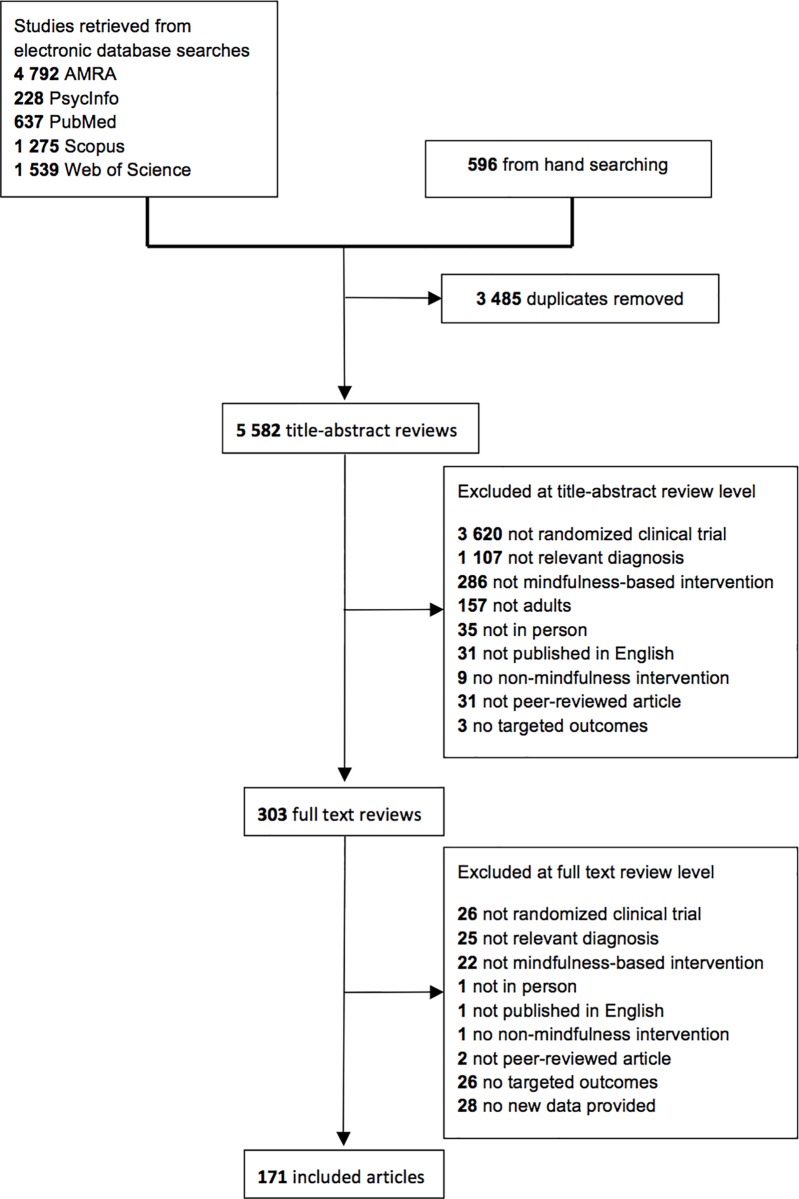
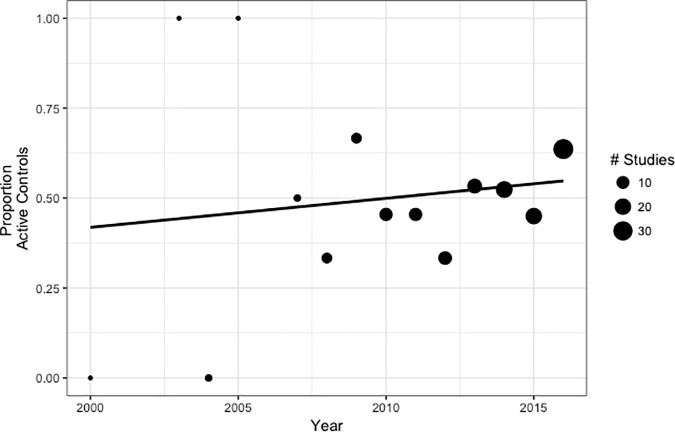
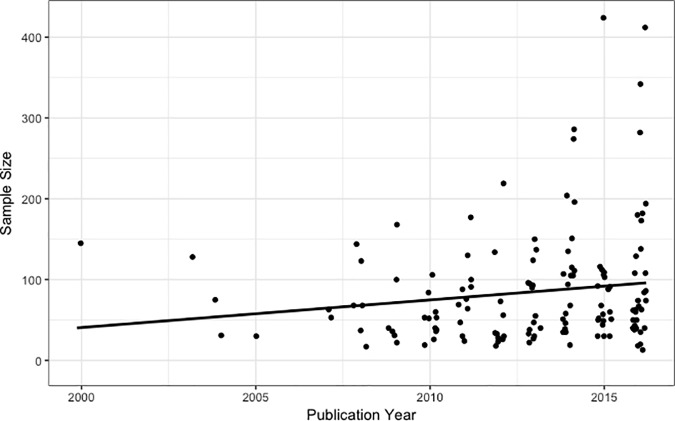
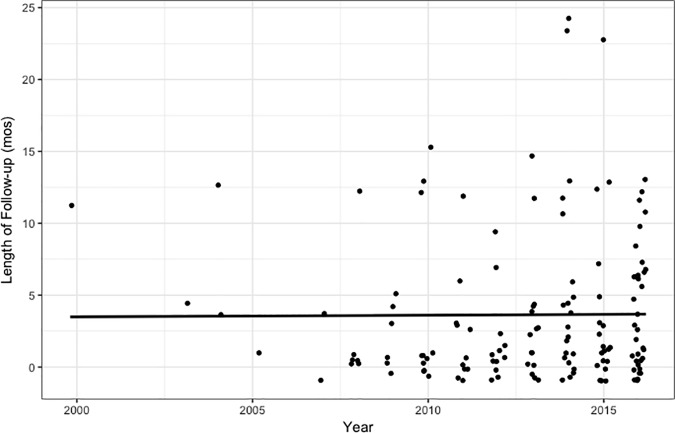
BACKGROUND: Despite an exponential growth in research on mindfulness-based interventions, the body of scientific evidence supporting these treatments has been criticized for being of poor methodological quality. OBJECTIVES: The current systematic review examined the extent to which mindfulness research demonstrated increased rigor over the past 16 years regarding six methodological features that have been highlighted as areas for improvement. These feature included using active control conditions, larger sample sizes, longer follow-up assessment, treatment fidelity assessment, and reporting of instructor training and intent-to-treat (ITT) analyses. DATA SOURCES: We searched PubMed, PsychInfo, Scopus, and Web of Science in addition to a publically available repository of mindfulness studies. STUDY ELIGIBILITY CRITERIA: Randomized clinical trials of mindfulness-based interventions for samples with a clinical disorder or elevated symptoms of a clinical disorder listed on the American Psychological Association's list of disorders with recognized evidence-based treatment. STUDY APPRAISAL AND SYNTHESIS METHODS: Independent raters screened 9,067 titles and abstracts, with 303 full text reviews. Of these, 171 were included, representing 142 non-overlapping samples. RESULTS: Across the 142 studies published between 2000 and 2016, there was no evidence for increases in any study quality indicator, although changes were generally in the direction of improved quality. When restricting the sample to those conducted in Europe and North America (continents with the longest history of scientific research in this area), an increase in reporting of ITT analyses was found. When excluding an early, high-quality study, improvements were seen in sample size, treatment fidelity assessment, and reporting of ITT analyses. CONCLUSIONS AND IMPLICATIONS OF KEY FINDINGS: Taken together, the findings suggest modest adoption of the recommendations for methodological improvement voiced repeatedly in the literature. Possible explanations for this and implications for interpreting this body of research and conducting future studies are discussed.
Overview
The claims and statistics of this paper haven’t been checked yet.
Run the check — free, no account needed. It reads the open-access text and checks the sources it cites.
Integrity signals
Registry
Cites
Statistics
Figures
Verification
Claims the paper makes
The claims and statistics of this paper haven’t been checked yet.
Run the check — free, no account needed. It reads the open-access text and checks the sources it cites.
Claims other papers make about this one
Each is checked against this paper’s own text: does it say what the citing paper says it does?
The source backs part of the claim, not all of it — or backs it for a different population, condition or comparison.
In the citing paper
“a systematic review published by Goldberg et al. (2017), corroborated that Mindfulness-Based Interventions (or MBI) are effective for depression, grief, and pain conditions, smoking, and other addictions.”
From A Self-Applied Multi-Component Psychological Online Intervention Based on UX, for the Prevention of Complicated Grief Disorder in the Mexican Population During the COVID-19 Outbreak: Protocol of a Randomized Clinical Trial (2021) · cites this paper as Goldberg et al., 2017
Experimental — accuracy not yet measuredIn the citing paper
“There have been several calls to improve the quality of mindfulness research, and of behavioural interventions research generally, with only modest improvement over time [39,285–287].”
Self-check
Percentages, sums and reported differences re-computed from the paper’s own numbers.
The self-check needs the paper’s full text.
Citations
Cites
R: A Language and Environment for Statistical Computing
R Core Team (2000) · doi:10.32614/r.manuals · Cited by 355,893
Applied Multiple Regression/Correlation Analysis for the Behavioral Sciences
Cohen, P., Cohen, P., West, S. G., & Aiken, L. S. (2014) · Psychology Press eBooks · doi:10.4324/9781410606266 · Cited by 20,870
Cicchetti, D. V. (1994) · Psychological Assessment · doi:10.1037/1040-3590.6.4.284 · Cited by 9,349
Applied Multiple Regression/Correlation Analysis for the Behavioral Sciences
Kemp, F. (2003) · Journal of the Royal Statistical Society Series D (The Statistician) · doi:10.1046/j.1467-9884.2003.t01-2-00383_4.x · Cited by 9,294
Cohen, J. (1992) · Psychological Bulletin · doi:10.1037//0033-2909.112.1.155 · Cited by 8,771
Power failure: why small sample size undermines the reliability of neuroscience
Button, K. S., Ioannidis, J. P. A., Mokrysz, C., Nosek, B. A., Flint, J., Robinson, E. S. J., & Munafò, M. R. (2013) · Nature Reviews Neuroscience · doi:10.1038/nrn3475 · Cited by 7,641
The American Psychological Association
Langfeld, H. S. (1919) · Science · doi:10.1126/science.49.1254.51 · Cited by 7,453
(1993) · Cited by 7,136
Cognitive-Behavioral Treatment of Borderline Personality Disorder
Cary, G. L. (1994) · American Journal of Psychotherapy · doi:10.1176/appi.psychotherapy.1994.48.1.155 · Cited by 6,299
(1999) · Cited by 5,934
Research works printed but not linked: 1
- American Psychological Association. Research-supported psychological treatments. 2017, 1:2. Available from https://www.div12.org/psychological-treatments/
Cited by
Sorted by citations
Mindfulness-based interventions for psychiatric disorders: A systematic review and meta-analysis
Goldberg, S. B., Tucker, R. P., Greene, P. A., Davidson, R. J., Wampold, B. E., Kearney, D. J., & Simpson, T. L. (2018) · Clinical Psychology Review · doi:10.1016/j.cpr.2017.10.011 · Cited by 1,145
Self-citationGoldberg, S. B., Riordan, K. M., Sun, S., & Davidson, R. J. (2022) · Perspectives on Psychological Science · doi:10.1177/1745691620968771 · Cited by 520
“In keeping with concerns regarding small sample sizes in RCTs testing MBIs (Baer, 2003; Goldberg et al., 2017), it appears that many meta-analyses are also underpowered.”
BackgroundSelf-citationMindfulness Meditation and Psychopathology
Wielgosz, J., Goldberg, S. B., Kral, T. R. A., Dunne, J. D., & Davidson, R. J. (2019) · Annual Review of Clinical Psychology · doi:10.1146/annurev-clinpsy-021815-093423 · Cited by 435
Self-citationGalante, J., Friedrich, C., Dawson, A. F., Modrego-Alarcón, M., Gebbing, P., Delgado-Suárez, I., Gupta, R., Dean, L., Dalgleish, T., White, I. R., et al. (2021) · PLOS Medicine · doi:10.1371/journal.pmed.1003481 · Cited by 319
“Consequently, in line with calls to improve mindfulness research quality, we conducted a comprehensive systematic review and meta–analysis of MBPs in nonclinical settings targeted at mental health that focused only on RCT data [38,39].”
BackgroundDawson, A. F., Brown, W. W., Anderson, J., Datta, B., Donald, J. N., Hong, K., Allan, S., Mole, T. B., Jones, P. B., & Galante, J. (2020) · Applied Psychology: Health and Well-Being · doi:10.1111/aphw.12188 · Cited by 312
Defining and Measuring Meditation-Related Adverse Effects in Mindfulness-Based Programs
Britton, W. B., Lindahl, J. R., Cooper, D. J., Canby, N. K., & Palitsky, R. (2021) · Clinical Psychological Science · doi:10.1177/2167702621996340 · Cited by 278
Goldberg, S. B., Tucker, R. P., Greene, P. A., Davidson, R. J., Kearney, D. J., & Simpson, T. L. (2019) · Cognitive Behaviour Therapy · doi:10.1080/16506073.2018.1556330 · Cited by 171
Self-citationStrohmaier, S. (2020) · Mindfulness · doi:10.1007/s12671-020-01319-4 · Cited by 163
The neuroscience of meditation: classification, phenomenology, correlates, and mechanisms
Brandmeyer, T., Arnaud Delorme, A., & Wahbeh, H. (2019) · Progress in brain research · doi:10.1016/bs.pbr.2018.10.020 · Cited by 164
The Way Forward in Mindfulness and Sustainability: a Critical Review and Research Agenda
Thiermann, U. B., & Sheate, W. R. (2020) · Journal of Cognitive Enhancement · doi:10.1007/s41465-020-00180-6 · Cited by 136
Hartley, M., Dorstyn, D., & Due, C. (2019) · Journal of Autism and Developmental Disorders · doi:10.1007/s10803-019-04145-3 · Cited by 99
Coping With COVID-19: Mindfulness-Based Approaches for Mitigating Mental Health Crisis
Antonova, E., Schlosser, K., Pandey, R., & Kumari, V. (2021) · Frontiers in Psychiatry · doi:10.3389/fpsyt.2021.563417 · Cited by 89
Tang, R., & Braver, T. S. (2020) · Frontiers in Psychology · doi:10.3389/fpsyg.2020.00818 · Cited by 91
Birchinall, L., Spendlove, D., & Buck, R. W. (2019) · Teaching and Teacher Education · doi:10.1016/j.tate.2019.102919 · Cited by 107
Kudesia, R. S., Pandey, A., & Reina, C. S. (2020) · Journal of Management · doi:10.1177/0149206320964570 · Cited by 81
A balanced view of mindfulness at work
Choi, E., Gruman, J. A., & Leonard, C. (2021) · Organizational Psychology Review · doi:10.1177/20413866211036930 · Cited by 80
Mindfulness-based interventions among people of color: A systematic review and meta-analysis
Sun, S., Goldberg, S. B., Loucks, E. B., & Brewer, J. A. (2022) · Psychotherapy Research · doi:10.1080/10503307.2021.1937369 · Cited by 64
Self-citationEggart, M., Todd, J., & Valdés‐Stauber, J. (2021) · PLoS ONE · doi:10.1371/journal.pone.0253913 · Cited by 76
Hoge, E. A., Acabchuk, R. L., Kimmel, H. J., Moitra, E., Britton, W. B., Dumais, T., Ferrer, R. A., Lazar, S. W., Vago, D. R., Lipsky, J., et al. (2020) · Mindfulness · doi:10.1007/s12671-020-01561-w · Cited by 67
Mantzios, M., & Giannou, K. (2018) · American Journal of Lifestyle Medicine · doi:10.1177/1559827618772036 · Cited by 57
Aizik-Reebs, A., Yuval, K., Hadash, Y., Gebremariam, S. G., & Bernstein, A. (2021) · Clinical Psychological Science · doi:10.1177/2167702621998641 · Cited by 57
Schulte‐Frankenfeld, P. M., & Trautwein, F. (2022) · Applied Psychology: Health and Well-Being · doi:10.1111/aphw.12328 · Cited by 51
Goldberg, S. B., Tucker, R. P., Greene, P. A., Simpson, T. L., Hoyt, W. T., Kearney, D. J., & Davidson, R. J. (2018) · Mindfulness · doi:10.1007/s12671-018-1032-y · Cited by 51
Self-citationMoreira, M. D. F., Gamboa, O. L., & Pinho Oliveira, M. A. (2022) · European Journal of Pain · doi:10.1002/ejp.1939 · Cited by 48
Promoting Mindfulness in African American Communities
Biggers, A., Spears, C. A., Sanders, K. D., Ong, J. C., Sharp, L. K., & Gerber, B. S. (2020) · Mindfulness · doi:10.1007/s12671-020-01480-w · Cited by 49
Asensio-Martínez, Á., Masluk, B., Montero-Marin, J., Olivan-Blázquez, B., Navarro-Gil, M. T., García-Campayo, J., & Magallón-Botaya, R. (2019) · PLOS ONE · doi:10.1371/journal.pone.0214503 · Cited by 45
Workplace spirituality, self-compassion and mindfulness as antecedents of employee mental wellbeing
Jnaneswar, K., & Sulphey, M. M. (2021) · South Asian Journal of Business Studies · doi:10.1108/sajbs-07-2020-0258 · Cited by 55
Zoogman, S., Goldberg, S. B., Vousoura, E., Diamond, M. C., & Miller, L. (2019) · Spirituality in Clinical Practice · doi:10.1037/scp0000202 · Cited by 41
Self-citationParsons, D. N., Gardner, P., Parry, S. P., & Smart, S. J. (2021) · Mindfulness · doi:10.1007/s12671-021-01740-3 · Cited by 44
Al-Hamad, N., James, O. O., Afolabi, J. O. A., Olatoye, F. O., & Eboigbe, E. O. (2023) · World Journal of Advanced Research and Reviews · doi:10.30574/wjarr.2023.20.3.2438 · Cited by 40
Abdoun, O., Zorn, J. V., Poletti, S., Fucci, E., & Antoine Lutz, A. (2019) · Consciousness and Cognition · doi:10.1016/j.concog.2019.01.004 · Cited by 40
Does mindfulness change the mind? A novel psychonectome perspective based on Network Analysis
Roca, P., Diez, G. G., Castellanos, N., & Vazquez, C. (2019) · PLOS ONE · doi:10.1371/journal.pone.0219793 · Cited by 37
Semple, R. J., & Burke, C. (2019) · OBM Integrative and Complementary Medicine · doi:10.21926/obm.icm.1901001 · Cited by 40
Müller, C., Dubiel, D., Kremeti, E., Lieb, M., Streicher, E., Oglou, N. S., Mickel, C., & Karbach, J. (2021) · Mindfulness · doi:10.1007/s12671-021-01601-z · Cited by 42
The effect of ten versus twenty minutes of mindfulness meditation on state mindfulness and affect
Palmer, R. L., Roos, C. R., Vafaie, N., & Hedy Kober, A. (2023) · Scientific Reports · doi:10.1038/s41598-023-46578-y · Cited by 40
Lecuona, O. Z., García‐Rubio, C., de Rivas, S., Moreno‐Jiménez, J. E., & Rodríguez‐Carvajal, R. (2022) · Mindfulness · doi:10.1007/s12671-022-01939-y · Cited by 40
Bartlett, L., Martin, A. J., Kilpatrick, M., Otahal, P., Sanderson, K., & Neil, A. L. (2022) · JMIR mHealth and uHealth · doi:10.2196/30272 · Cited by 28
Dominguez-Rodriguez, A., Sanz-Gomez, S., González Ramírez, L. P., Herdoiza-Arroyo, P. E., Trevino Garcia, L. E., de la Rosa-Gómez, A., González-Cantero, J. O., Macias-Aguinaga, V., & Miaja, M. (2023) · Journal of Medical Internet Research · doi:10.2196/43839 · Cited by 25
Grasmann, J., Almenräder, F., Voracek, M., & Tran, U. S. (2023) · International Journal of Molecular Sciences · doi:10.3390/ijms24054445 · Cited by 26
Westerman, G., McCann, E., & Sparkes, E. (2020) · Mindfulness · doi:10.1007/s12671-020-01340-7 · Cited by 32
Allegiance effects in mindfulness-based interventions for psychiatric disorders: A meta-re-analysis
Goldberg, S. B., & Tucker, R. P. (2020) · Psychotherapy Research · doi:10.1080/10503307.2019.1664783 · Cited by 21
Self-citationDavies, J. N., Sharpe, L., Day, M. A., & Colagiuri, B. (2020) · Psychosomatic Medicine · doi:10.1097/psy.0000000000000886 · Cited by 20
Mindfulness and Behavioural Insights
Lilley, R., Whitehead, M., & Midgley, G. (2022) · Journal of Awareness-Based Systems Change · doi:10.47061/jasc.v2i2.3857 · Cited by 21
Goldberg, S. B., Hanley, A. W., Baldwin, S. A., Bernstein, A., & Garland, E. L. (2020) · Psychotherapy · doi:10.1037/pst0000286 · Cited by 23
Self-citationDominguez-Rodriguez, A., Martínez-Luna, S. C., Hernández Jiménez, M. J., De La Rosa-Gómez, A., Arenas-Landgrave, P., Esquivel Santoveña, E. E., Arzola-Sánchez, C., Alvarez Silva, J., Solis Nicolas, A. M., Colmenero Guadián, A. M., et al. (2021) · Frontiers in Psychology · doi:10.3389/fpsyg.2021.644782 · Cited by 18
Guadalupe, L. A. O., Vásquez, D. E. S., Gómez, J. C. A., & Sánchez, A. A. A. (2019) · Terapia psicológica · doi:10.4067/s0718-48082019000200116 · Cited by 42
Blanco, I., Roca, P., Duque, A., Pascual, T., & Vázquez, C. (2019) · Mindfulness · doi:10.1007/s12671-019-01247-y · Cited by 18
Davies, J. N., Sharpe, L., Day, M. A., & Colagiuri, B. (2022) · Pain · doi:10.1097/j.pain.0000000000002593 · Cited by 18
Crawford, A., Sellman, E. M., & Joseph, S. (2021) · International Journal of Qualitative Methods · doi:10.1177/16094069211014771 · Cited by 22
Dariotis, J. K., Mabisi, K., Jackson‐Gordon, R., Rose, E. J., Fishbein, D. H., & Mendelson, T. (2023) · Mindfulness · doi:10.1007/s12671-023-02147-y · Cited by 24
Subjective Experiences of Committed Meditators Across Practices Aiming for Contentless States
Woods, T. J., Windt, J., Brown, L., Carter, O. L., & Dam, N. T. V. (2023) · Mindfulness · doi:10.1007/s12671-023-02145-0 · Cited by 17
Liebherr, M., Brandtner, A., Brand, M., & Tang, Y. (2024) · Annals of the New York Academy of Sciences · doi:10.1111/nyas.15095 · Cited by 31
Into the Moment: Does Mindfulness Affect Biological Pathways in Multiple Sclerosis?
Willekens, B. M. P., Perrotta, G., Cras, P. P., & Cools, N. (2018) · Frontiers in Behavioral Neuroscience · doi:10.3389/fnbeh.2018.00103 · Cited by 18
Crane, R. S. (2018) · Current Opinion in Psychology · doi:10.1016/j.copsyc.2018.09.009 · Cited by 18
A longitudinal, randomized and controlled study of app-delivered mindfulness in the workplace
Emory University, & Mascaro, J. (2020) · Journal of Wellness · doi:10.18297/jwellness/vol2/iss1/4 · Cited by 12
“In addition, this study used an intent-to-treat design and an active control group to examine both self-reported outcomes as well as objective performance ratings, features that are uncommon among studies of workplace mindfulness and of mindfulness more generally [20, 70].”
MethodShared Medical Appointments and Mindfulness for Type 2 Diabetes—A Mixed-Methods Feasibility Study
Ee, C., de Courten, B. V., Avard, N., de Manincor, M., Al‐Dabbas, M. A., Hao, J., McBride, K. A., Dubois, S., White, R. L., Fleming, C., et al. (2020) · Frontiers in Endocrinology · doi:10.3389/fendo.2020.570777 · Cited by 14
A mindful approach to controlling intrusive thoughts
Ashton, S. M., Sambeth, A., & Quaedflieg, C. W. E. M. (2023) · Scientific Reports · doi:10.1038/s41598-023-37447-9 · Cited by 16
Janssen, M., Heerkens, Y. F., HEIJDEN, B. I. J. M. V. D., Korzilius, H. P. L. M., Peters, P., & Engels, J. A. (2020) · Trials · doi:10.1186/s13063-020-4189-3 · Cited by 16
Making Mindfulness Meditation a Healthy Habit
Miles, E., Matcham, F., Strauss, C., & Cavanagh, K. (2023) · Mindfulness · doi:10.1007/s12671-023-02258-6 · Cited by 21
Linardon, J., Xie, Q., Swords, C. M., Torous, J. B., Sun, S., & Goldberg, S. B. (2025) · BMJ Mental Health · doi:10.1136/bmjment-2025-301595 · Cited by 13
Self-citationConsiderations for mood and emotion measures in mindfulness-based intervention research
Hoge, E. A., Philip, S. R., & Fulwiler, C. (2019) · Current Opinion in Psychology · doi:10.1016/j.copsyc.2019.02.001 · Cited by 13
Nardi, W. R., Loucks, E. B., Springs, S., Operario, D., Kronish, I. M., Gaudiano, B. A., & Sun, S. (2021) · Journal of Psychosomatic Research · doi:10.1016/j.jpsychores.2021.110585 · Cited by 11
Nature, Assessment, and Mechanisms of Mindfulness
Bravo, A. J., Lindsay, E. K., & Pearson, M. R. (2022) · Springer eBooks · doi:10.1007/978-3-030-77644-2_2-1 · Cited by 12
A randomized controlled pilot trial of brief online mindfulness training in young drivers
Albert, D. A., Ouimet, M. C., & Brown, T. G. (2023) · Accident Analysis & Prevention · doi:10.1016/j.aap.2023.107322 · Cited by 8
Contemplative science comes of age: Looking backward and forward 20 years after Baer (2003).
Goldberg, S. B., & Davidson, R. J. (2024) · Clinical Psychology Science and Practice · doi:10.1037/cps0000186 · Cited by 8
Self-citationGoldberg, S. B., Tucker, R. P., Greene, P. A., Davidson, R. J., Kearney, D. J., & Simpson, T. L. (2019) · MindRxiv (OSF Preprints) · doi:10.31231/osf.io/dxbmp · Cited by 9
Self-citationMin, Y., Choi, Y.-S., & Kim, B. (2023) · Current Psychology · doi:10.1007/s12144-023-05402-6 · Cited by 12
Borghi, O., Voracek, M., & Tran, U. S. (2024) · Frontiers in Psychology · doi:10.3389/fpsyg.2024.1272720 · Cited by 9
Leader Mindfulness: Well-Being Throughout the Organization
Decuypere, A., Audenaert, M., & Decramer, A. (2020) · Springer eBooks · doi:10.1007/978-3-030-02470-3_73-1 · Cited by 25
Tatar, B., Pázmányová, R., & Papies, E. K. (2021) · Appetite · doi:10.1016/j.appet.2021.105482 · Cited by 6
Lawrence, M., Davis, B., Clark, N. E., Booth, J., Donald, G., Dougall, N. J., Grealy, M., Jani, B., MacDonald, J., Mason, H., et al. (2024) · Pilot and Feasibility Studies · doi:10.1186/s40814-024-01545-w · Cited by 7
Is mindfulness a noticeable quality? Development and validation of the observed mindfulness measure
Bartlett, L., Martin, A. J., Bruno, R., Kilpatrick, M., Sanderson, K., & Neil, A. L. (2022) · Journal of Psychopathology and Behavioral Assessment · doi:10.1007/s10862-021-09936-6 · Cited by 6
The Effects of Clinical Meditation Programs on Stress and Well-Being
Seekircher, J., Burgard, T., & Bošnjak, M. (2023) · Zeitschrift für Psychologie · doi:10.1027/2151-2604/a000510 · Cited by 9
What is the evidence in evidence-based mindfulness programs for children?
Butterfield, K. M., Roberts, K. P., Feltis, L. E., & Kocovski, N. L. (2020) · Advances in child development and behavior · doi:10.1016/bs.acdb.2020.01.007 · Cited by 6
Leader Mindfulness: Well-Being Throughout the Organization
Decuypere, A., Audenaert, M., & Decramer, A. (2021) · Springer eBooks · doi:10.1007/978-3-030-30025-8_73 · Cited by 5
The Role of Mindfulness in Neurorehabilitation: From the Monastery to the Clinic
Smart, C. M. (2019) · Springer eBooks · doi:10.1007/978-3-030-14895-9_34 · Cited by 5
Goldberg, S. B., Tucker, R. P., Greene, P. A., Simpson, T. L., Hoyt, W. T., Kearney, D. J., & Davidson, R. J. (2019) · MindRxiv (OSF Preprints) · doi:10.31231/osf.io/p8gew · Cited by 5
Self-citationPuhlmann, L. M. C., & Engert, V. (2025) · Frontiers in Endocrinology · doi:10.3389/fendo.2025.1415081 · Cited by 5
Mindful Eating for Weight Loss: Try Before You Buy
Black, M. (2018) · The Journal of Clinical Endocrinology & Metabolism · doi:10.1210/jc.2018-02551 · Cited by 3
Cheng, D., Young, D. K. W., Carlbring, P., Petrus Yat-nam, N. G., & Hung, S. L. (2022) · Research on Social Work Practice · doi:10.1177/10497315221137137 · Cited by 3
Nyklı́ček, I., Ostafin, B. D., & Boekhorst, M. G. B. M. (2024) · Mindfulness · doi:10.1007/s12671-024-02351-4 · Cited by 3
Uchida, T., Takahashi, T., Sugiyama, F., 木甲斐, 智., Nitta, Y., & Kumano, H. (2022) · Psychological Reports · doi:10.1177/00332941221080410 · Cited by 6
Advancing the Study of Mindfulness-Based Interventions in Relation to Psychological Health
Lucas‐Thompson, R. G., & Moran, M. J. (2023) · International Journal of Environmental Research and Public Health · doi:10.3390/ijerph20085473 · Cited by 3
Observed Mindfulness Measure (OMM)
Bartlett, L., Martin, A. J., Sanderson, K. A., & Neil, A. L. (2025) · Springer eBooks · doi:10.1007/978-3-031-47219-0_89 · Cited by 2
Fisher, M. E., Phansikar, M., Teng, J., McPherson, N., Duraney, E. J., McKenna, M., Shankar, A., Blau, C., Canter, R., Roberts, C., et al. (2025) · The Journals of Gerontology Series B · doi:10.1093/geronb/gbaf235 · Cited by 2
Choi, Y., Cho, I., Chun, H.-R., Park, S., Cho, E.-Y., Park, S., & Cho, S. (2024) · Forests · doi:10.3390/f15030472 · Cited by 2
Mindfulness and Perceived Stress Among English Language Students in Uzbekistan
Wolfe, L. A., & Akhmedov, R. (2024) · The Interactive Journal of Global Leadership and Learning · doi:10.55354/2692-3394.1057 · Cited by 2
Assessing the effectiveness of a pilot test of a brief art-based mindfulness task on appraisal
Morris, B., & O’Kello, R. (2025) · Cogent Psychology · doi:10.1080/23311908.2025.2539468 · Cited by 2
Teacher Resilience During the Pandemic
Fathayatih, S., ., S., & Yamtinah, S. (2023) · KnE Social Sciences · doi:10.18502/kss.v8i2.12750 · Cited by 5
Preservice Teachers and Perceived Stress: A Comparative Study
Evans, K. (2019) · Journal of International Crisis and Risk Communication Research · Cited by 2
Skudder‐Hill, L., & Ghosh, S. D. S. (2020) · Encyclopedia of the UN sustainable development goals · doi:10.1007/978-3-319-69627-0_21-1 · Cited by 2
Liebherr, M., Brandtner, A., Brand, M., & Tang, Y. (2022) · Research Square · doi:10.21203/rs.3.rs-1669437/v1 · Cited by 2
Aizik-Reebs, A., Yuval, K., Hadash, Y., Gebremariam, S. G., & Bernstein, A. (2020) · doi:10.31231/osf.io/jyhwa · Cited by 3
The Applications of “Mindfulness” in Psychology and Medicine
Giraldi, T. (2019) · Springer eBooks · doi:10.1007/978-3-030-29003-0_5 · Cited by 2
Mindfulness-Based Interventions
Shamblaw, A. L., & Segal, Z. V. (2021) · Elsevier eBooks · doi:10.1016/b978-0-12-818697-8.00212-0 · Cited by 1
Online mindfulness-based interventions and their use in mental health practice
Parkinson, B., Lawrence, M., McElhinney, E., & Booth, J. (2022) · Mental Health Practice · doi:10.7748/mhp.2022.e1619 · Cited by 1
A Reliability Generalization Meta-Analysis of the Child and Adolescent Mindfulness Measure (CAMM)
Doğan, R. Y., Demir, E., Öz, S., & Demircioğlu, H. (2023) · Psychological Reports · doi:10.1177/00332941231212844 · Cited by 1
The Effects of Disruptive Thinking on the Food Industry*
Dairo, O. O., & Bekoe, B. B. (2024) · Advances in Bioscience and Biotechnology · doi:10.4236/abb.2024.156022 · Cited by 1
How to measure outcomes and individual differences in meditation
Tang, Y., & Tang, R. (2020) · Elsevier eBooks · doi:10.1016/b978-0-12-818266-6.00009-5 · Cited by 1
Caleshu, C., Campion, M., Austin, J. J., Goldin, P., Silver, J., & Tibben, A. (2026) · PubMed · doi:10.1002/jgc4.70241
“Despite these promising findings, a significant limitation of MM research is the reliance on passive control groups, which fail to control for nonspecific factors such as expectancy effects or structured self-care time (Bishop, 2002 ; Davidson & Kaszniak, 2015 ; Goldberg et al., 2017, 2019).”
Metadata
- Authors
- Goldberg, S. B., Tucker, R. P., Greene, P. A., Simpson, T. L., Kearney, D. J., & Davidson, R. J.
- Affiliations
- University of Wisconsin–Madison (US)
- Louisiana State University (US)
- VA Puget Sound Health Care System (US)
- Corresponding author
- Goldberg, Simon B.
- ORCID
- Venue
- PLOS ONE
- Publisher
- Public Library of Science (PLoS)
- Published
- 2017-10-31
- Volume
- 12
- Issue
- 10
- Pages
- e0187298
- ISSN
- 1932-6203 (ISSN-L)
- PMC
- PMC5663486
- OpenAlex
- W2766462050
- Cited by
- 125
- References
- 46
- Citations by year
- 2026: 4 · 2025: 8 · 2024: 16 · 2023: 16 · 2022: 11 · 2021: 23 · 2020: 19 · 2019: 19 · 2018: 8 · 2017: 1
- FWCI
- 1.97
- Type
- journal article
- Language
- en
- Open access
- gold
- doi.org
- Licence
- public-domain
- creativecommons.org/publicdomain/zero/1.0/ (vor)
- Locations
- PLoS ONE (publishedVersion, public-domain)
- Europe PMC (PubMed Central) (publishedVersion, public-domain)
- PubMed Central (publishedVersion, public-domain)
- PubMed (publishedVersion)
- Civil War Book Review (submittedVersion)
- RePEc: Research Papers in Economics (submittedVersion)
- DOAJ (DOAJ: Directory of Open Access Journals) (submittedVersion, cc-by-sa)
- Figshare (submittedVersion, cc-by)
- Funders
- National Center for Complementary and Alternative Medicine (P01AT004952)
- Mind and Life Institute (Varela Award)
- Topics
- Social Sciences › Psychology › Clinical Psychology › Mindfulness and Compassion Interventions
- Social Sciences › Decision Sciences › Statistics, Probability and Uncertainty › Meta-analysis and systematic reviews
- Social Sciences › Psychology › Clinical Psychology › Psychotherapy Techniques and Applications
- Keywords
- mindfulness-based interventions, methodological quality, active control, sample size, follow-up evaluation, intervention fidelity, intention-to-treat analysis, instructor training, reporting quality, clinical disorders, evidence-based treatment
- MeSH terms
- Humans, Randomized Controlled Trials as Topic, Mindfulness
About these checks
Registry, retraction, Cites and statistics results are computed, not judged, with one exception: a printed reference that no index lists is read once by a model before it counts as a citation error. Claims are extracted by a model and kept only when their quote appears verbatim in the text; each cited source is then checked, with a model’s help, for whether it says what the claim relies on. Those verdicts can be wrong — read the claim’s quote and the cited source before relying on one.
Statistics and arithmetic are recomputed, not judged.
Confidence bands are shown only for fields calibrated on our annotated test set. None is calibrated yet, so no band is shown.
What counts as a claim ›How we measure confidence ›How we check this ›
Are you an author, or do you see a problem with this page? Request a review
