

The DOI matches its Crossref record; 46 of the 46 references it cites were found in a registry or an index.
Is mindfulness research methodology improving over time? A systematic review
Open accessAbstract
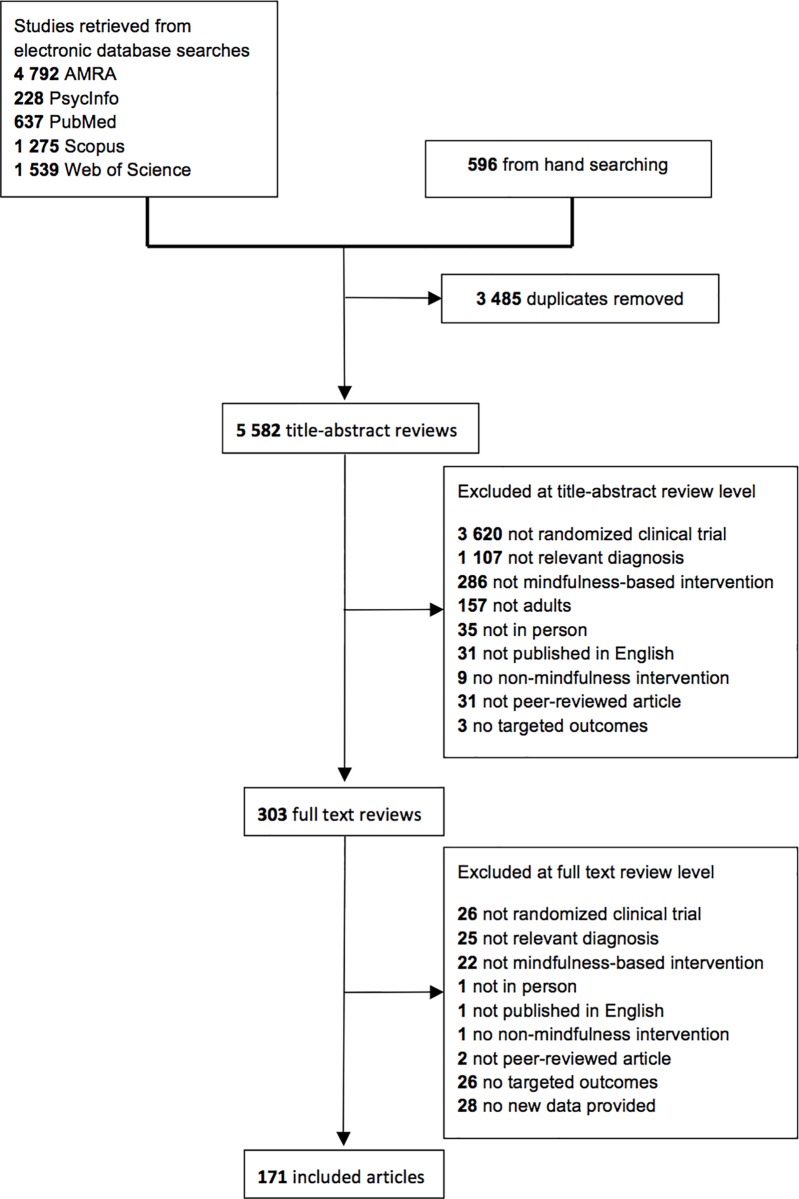
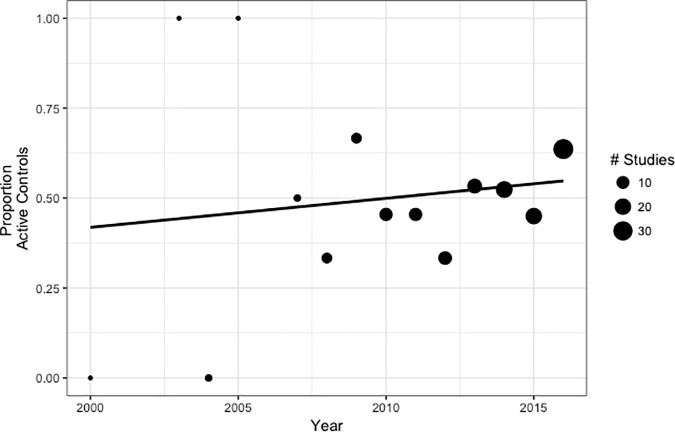
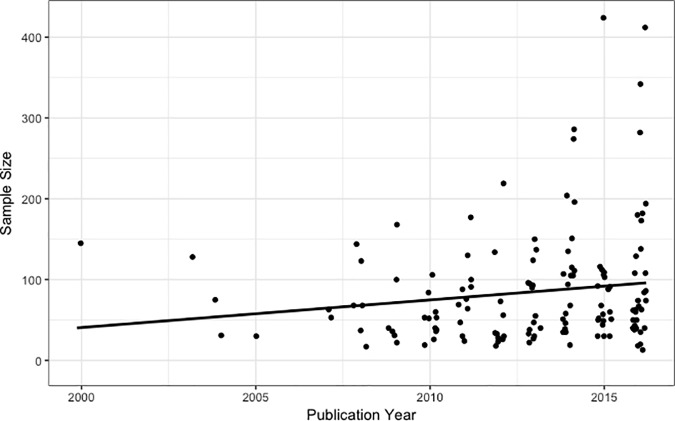
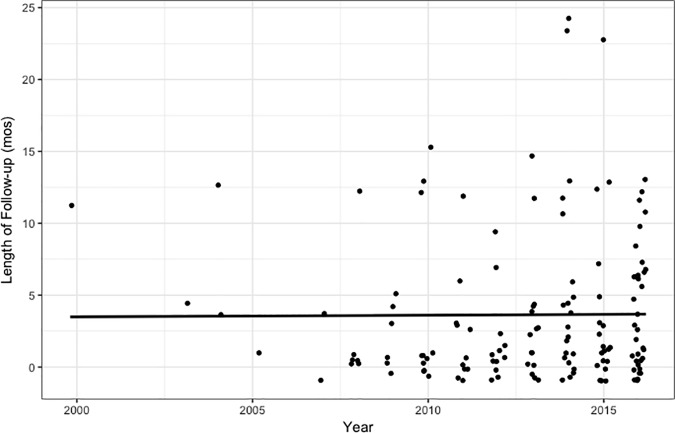
BACKGROUND: Despite an exponential growth in research on mindfulness-based interventions, the body of scientific evidence supporting these treatments has been criticized for being of poor methodological quality. OBJECTIVES: The current systematic review examined the extent to which mindfulness research demonstrated increased rigor over the past 16 years regarding six methodological features that have been highlighted as areas for improvement. These feature included using active control conditions, larger sample sizes, longer follow-up assessment, treatment fidelity assessment, and reporting of instructor training and intent-to-treat (ITT) analyses. DATA SOURCES: We searched PubMed, PsychInfo, Scopus, and Web of Science in addition to a publically available repository of mindfulness studies. STUDY ELIGIBILITY CRITERIA: Randomized clinical trials of mindfulness-based interventions for samples with a clinical disorder or elevated symptoms of a clinical disorder listed on the American Psychological Association's list of disorders with recognized evidence-based treatment. STUDY APPRAISAL AND SYNTHESIS METHODS: Independent raters screened 9,067 titles and abstracts, with 303 full text reviews. Of these, 171 were included, representing 142 non-overlapping samples. RESULTS: Across the 142 studies published between 2000 and 2016, there was no evidence for increases in any study quality indicator, although changes were generally in the direction of improved quality. When restricting the sample to those conducted in Europe and North America (continents with the longest history of scientific research in this area), an increase in reporting of ITT analyses was found. When excluding an early, high-quality study, improvements were seen in sample size, treatment fidelity assessment, and reporting of ITT analyses. CONCLUSIONS AND IMPLICATIONS OF KEY FINDINGS: Taken together, the findings suggest modest adoption of the recommendations for methodological improvement voiced repeatedly in the literature. Possible explanations for this and implications for interpreting this body of research and conducting future studies are discussed.
Overview
The claims and statistics of this paper haven’t been checked yet.
Run the check — free, no account needed. It reads the open-access text and checks the sources it cites.
Integrity signals
Registry
Cites
Statistics
Figures
Verification
Claims the paper makes
The claims and statistics of this paper haven’t been checked yet.
Run the check — free, no account needed. It reads the open-access text and checks the sources it cites.
Claims other papers make about this one
Each is checked against this paper’s own text: does it say what the citing paper says it does?
The source backs part of the claim, not all of it — or backs it for a different population, condition or comparison.
In the citing paper
“a systematic review published by Goldberg et al. (2017), corroborated that Mindfulness-Based Interventions (or MBI) are effective for depression, grief, and pain conditions, smoking, and other addictions.”
From A Self-Applied Multi-Component Psychological Online Intervention Based on UX, for the Prevention of Complicated Grief Disorder in the Mexican Population During the COVID-19 Outbreak: Protocol of a Randomized Clinical Trial (2021) · cites this paper as Goldberg et al., 2017
Experimental — accuracy not yet measuredIn the citing paper
“There have been several calls to improve the quality of mindfulness research, and of behavioural interventions research generally, with only modest improvement over time [39,285–287].”
Self-check
Percentages, sums and reported differences re-computed from the paper’s own numbers.
The self-check needs the paper’s full text.
Citations
Cites
R: A Language and Environment for Statistical Computing
R Core Team (2000) · doi:10.32614/r.manuals · Cited by 355,893
Applied Multiple Regression/Correlation Analysis for the Behavioral Sciences
Cohen, P., Cohen, P., West, S. G., & Aiken, L. S. (2014) · Psychology Press eBooks · doi:10.4324/9781410606266 · Cited by 20,870
Cicchetti, D. V. (1994) · Psychological Assessment · doi:10.1037/1040-3590.6.4.284 · Cited by 9,349
Applied Multiple Regression/Correlation Analysis for the Behavioral Sciences
Kemp, F. (2003) · Journal of the Royal Statistical Society Series D (The Statistician) · doi:10.1046/j.1467-9884.2003.t01-2-00383_4.x · Cited by 9,294
Cohen, J. (1992) · Psychological Bulletin · doi:10.1037//0033-2909.112.1.155 · Cited by 8,771
Power failure: why small sample size undermines the reliability of neuroscience
Button, K. S., Ioannidis, J. P. A., Mokrysz, C., Nosek, B. A., Flint, J., Robinson, E. S. J., & Munafò, M. R. (2013) · Nature Reviews Neuroscience · doi:10.1038/nrn3475 · Cited by 7,641
The American Psychological Association
Langfeld, H. S. (1919) · Science · doi:10.1126/science.49.1254.51 · Cited by 7,453
(1993) · Cited by 7,136
Cognitive-Behavioral Treatment of Borderline Personality Disorder
Cary, G. L. (1994) · American Journal of Psychotherapy · doi:10.1176/appi.psychotherapy.1994.48.1.155 · Cited by 6,299
(1999) · Cited by 5,934
Mindfulness training as a clinical intervention: a conceptual and empirical review
Baer, R. A. (2003) · Clinical Psychology: Science and Practice · doi:10.1093/clipsy.bpg015 · Cited by 4,577
Mindfulness training as a clinical intervention: A conceptual and empirical review.
Baer, R. A. (2003) · Clinical Psychology: Science and Practice · doi:10.1093/clipsy/bpg015 · Cited by 4,576
Kabat-Zinn, J. (1982) · General Hospital Psychiatry · doi:10.1016/0163-8343(82)90026-3 · Cited by 4,255
Prevention of relapse/recurrence in major depression by mindfulness-based cognitive therapy.
Teasdale, J. D., Segal, Z. V., Williams, J. M. G., Ridgeway, V. A., Soulsby, J. M., & Lau, M. A. (2000) · Journal of Consulting and Clinical Psychology · doi:10.1037/0022-006x.68.4.615 · Cited by 3,236
Raise standards for preclinical cancer research
Begley, C. G., & Ellis, L. M. (2012) · Nature · doi:10.1038/483531a · Cited by 2,979
Meditation Programs for Psychological Stress and Well-being: A Systematic Review and Meta-analysis
Goyal, M., Singh, S., Sibinga, E. M. S., Gould, N. F., Rowland-Seymour, A., Sharma, R., Berger, Z., Sleicher, D., Maron, D. D., Shihab, H. M., et al. (2014) · JAMA Internal Medicine · doi:10.1001/jamainternmed.2013.13018 · Cited by 2,380
Mindfulness-based therapy: a comprehensive meta-analysis
Khoury, B., Lecomte, T., Fortin, G., Masse, M., Therien, P., Bouchard, V., Chapleau, M.-A., Paquin, K., & Hofmann, S. G. (2013) · Clinical Psychology Review · doi:10.1016/j.cpr.2013.05.005 · Cited by 2,003
How Big is a Big Odds Ratio? Interpreting the Magnitudes of Odds Ratios in Epidemiological Studies
Chen, H., Cohen, P., & Chen, S. (2010) · Communications in Statistics - Simulation and Computation · doi:10.1080/03610911003650383 · Cited by 1,952
The statistical power of abnormal-social psychological research: A review.
Cohen, J. (1962) · The Journal of Abnormal and Social Psychology · doi:10.1037/h0045186 · Cited by 1,824
Is psychology suffering from a replication crisis? What does “failure to replicate” really mean?
Maxwell, S. E., Lau, M. Y., & Howard, G. S. (2015) · American Psychologist · doi:10.1037/a0039400 · Cited by 1,102
Wampold, B. E., Mondin, G. W., Moody, M., Stich, F., Benson, K., & Ahn, H.-N. (1997) · Psychological Bulletin · doi:10.1037/0033-2909.122.3.203 · Cited by 1,091
Mindfulness-Based Cognitive Therapy for Depression
Segal, Z. V. (2023) · PsycTHERAPY Dataset · doi:10.1037/v00751-001 · Cited by 1,043
Kuyken, W., Warren, F. C., Taylor, R. S., Whalley, B., Crane, C., Bondolfi, G., Hayes, R., Huijbers, M., Ma, H., Schweizer, S., et al. (2016) · JAMA Psychiatry · doi:10.1001/jamapsychiatry.2016.0076 · Cited by 821
Some Reflections on the Origins of MBSR, Skillful Means, and the Trouble with Maps
Kabat-Zinn, J. (2011) · Contemporary Buddhism · doi:10.1080/14639947.2011.564844 · Cited by 800
Conceptual and methodological issues in research on mindfulness and meditation.
Davidson, R. J., & Kaszniak, A. W. (2015) · American Psychologist · doi:10.1037/a0039512 · Cited by 773
Self-citationMindfulness Interventions with Youth: A Meta-Analysis
Zoogman, S., Goldberg, S. B., Hoyt, W. T., & Miller, L. (2015) · Mindfulness · doi:10.1007/s12671-013-0260-4 · Cited by 760
Self-citationWhat Do We Really Know About Mindfulness-Based Stress Reduction?
Bishop, S. R. (2002) · Psychosomatic Medicine · doi:10.1097/00006842-200201000-00010 · Cited by 748
Statistical Considerations in the Intent-to-Treat Principle
Lachin, J. M. (2000) · Controlled Clinical Trials · doi:10.1016/s0197-2456(00)00046-5 · Cited by 652
Kristeller, J. L., & Wolever, R. Q. (2010) · Eating Disorders · doi:10.1080/10640266.2011.533605 · Cited by 592
Garland, E. L., Manusov, E. G., Froeliger, B., Kelly, A., Williams, J. M., & Howard, M. O. (2014) · Journal of Consulting and Clinical Psychology · doi:10.1037/a0035798 · Cited by 431
Statistical power of psychological research: What have we gained in 20 years?
Rossi, J. S. (1990) · Journal of Consulting and Clinical Psychology · doi:10.1037//0022-006x.58.5.646 · Cited by 340
The validation of an active control intervention for Mindfulness Based Stress Reduction (MBSR)
MacCoon, D. G., Imel, Z. E., Rosenkranz, M. A., Sheftel, J. G., Weng, H. Y., Sullivan, J. C., Bonus, K. A., Stoney, C. M., Salomons, T. V., Davidson, R. J., et al. (2012) · Behaviour Research and Therapy · doi:10.1016/j.brat.2011.10.011 · Cited by 335
Self-citationStatistical power of psychological research: What have we gained in 20 years?
Rossi, J. S. (1990) · Journal of Consulting and Clinical Psychology · doi:10.1037/0022-006x.58.5.646 · Cited by 323
McHugh, R. K., Murray, H. W., & Barlow, D. H. (2009) · Behaviour Research and Therapy · doi:10.1016/j.brat.2009.07.005 · Cited by 320
Meditation Programs for Psychological Stress and Well-being: A Systematic Review and Meta-analysis
Goyal, M., Singh, S., Sibinga, E., Gould, N., Rowland-Seymour, A., Sharma, R., Berger, Z., Sleicher, D., Maron, D., Shihab, H., et al. (2014) · Deutsche Zeitschrift für Akupunktur · doi:10.1016/j.dza.2014.07.007 · Cited by 298
Prospects for a clinical science of mindfulness-based intervention
Dimidjian, S., & Segal, Z. V. (2015) · American Psychologist · doi:10.1037/a0039589 · Cited by 291
Publication Pressure and Scientific Misconduct in Medical Scientists
Tijdink, J. K., Verbeke, R., & Smulders, Y. M. (2014) · Journal of Empirical Research on Human Research Ethics · doi:10.1177/1556264614552421 · Cited by 226
Coronado-Montoya, S., Levis, A. W., Kwakkenbos, L., Steele, R. J., Turner, E. H., & Thombs, B. D. (2016) · PLOS ONE · doi:10.1371/journal.pone.0153220 · Cited by 107
MacCoon, D. G., MacLean, K. A., Davidson, R. J., Saron, C. D., & Lutz, A. (2014) · PLoS ONE · doi:10.1371/journal.pone.0097551 · Cited by 100
Self-citationRandomized trial on mindfulness training for smokers targeted to a disadvantaged population
Davis, J. M., Goldberg, S. B., Anderson, M. C., Manley, A. R., Smith, S. S., & Baker, T. B. (2014) · Substance Use & Misuse · doi:10.3109/10826084.2013.770025 · Cited by 96
Self-citationWhat is mindfulness-based therapy good for?
Farias, M., Wikholm, C., & Delmonte, R. (2016) · The Lancet Psychiatry · doi:10.1016/s2215-0366(16)30211-5 · Cited by 43
Kuyken, W., Warren, F. C., Taylor, R. S., Whalley, B., Crane, C., Bondolfi, G., Hayes, R., Huijbers, M., Ma, H., Schweizer, S., et al. (2016) · Archive ouverte UNIGE (University of Geneva) · Cited by 36
Mindfulness Research Guide: a New Paradigm for Managing Empirical Health Information
Black, D. S. (2010) · Mindfulness · doi:10.1007/s12671-010-0019-0 · Cited by 31
Liebherz, S., Schmidt, N., & Rabung, S. (2015) · Psychotherapy Research · doi:10.1080/10503307.2015.1044763 · Cited by 20
Why mindfulness belongs in counseling psychology: A synergistic clinical and research agenda
Goldberg, S. B. (2017) · Counselling Psychology Quarterly · doi:10.1080/09515070.2017.1314250 · Cited by 17
Self-citationObservational Study on a Mindfulness Training for Smokers within a Smoking Cessation Program
Davis, J. M., Goldberg, S. B., Angel, K. S., Silver, R. H., Kragel, E. A., & Lagrew, D. J. (2017) · Mindfulness · doi:10.1007/s12671-017-0744-8 · Cited by 6
Self-citation
Research works printed but not linked: 1
- American Psychological Association. Research-supported psychological treatments. 2017, 1:2. Available from https://www.div12.org/psychological-treatments/
Cited by
Sorted by citations
Mindfulness-based interventions for psychiatric disorders: A systematic review and meta-analysis
Goldberg, S. B., Tucker, R. P., Greene, P. A., Davidson, R. J., Wampold, B. E., Kearney, D. J., & Simpson, T. L. (2018) · Clinical Psychology Review · doi:10.1016/j.cpr.2017.10.011 · Cited by 1,145
Self-citationGoldberg, S. B., Riordan, K. M., Sun, S., & Davidson, R. J. (2022) · Perspectives on Psychological Science · doi:10.1177/1745691620968771 · Cited by 520
“In keeping with concerns regarding small sample sizes in RCTs testing MBIs (Baer, 2003; Goldberg et al., 2017), it appears that many meta-analyses are also underpowered.”
BackgroundSelf-citationMindfulness Meditation and Psychopathology
Wielgosz, J., Goldberg, S. B., Kral, T. R. A., Dunne, J. D., & Davidson, R. J. (2019) · Annual Review of Clinical Psychology · doi:10.1146/annurev-clinpsy-021815-093423 · Cited by 435
Self-citationGalante, J., Friedrich, C., Dawson, A. F., Modrego-Alarcón, M., Gebbing, P., Delgado-Suárez, I., Gupta, R., Dean, L., Dalgleish, T., White, I. R., et al. (2021) · PLOS Medicine · doi:10.1371/journal.pmed.1003481 · Cited by 319
“Consequently, in line with calls to improve mindfulness research quality, we conducted a comprehensive systematic review and meta–analysis of MBPs in nonclinical settings targeted at mental health that focused only on RCT data [38,39].”
BackgroundDawson, A. F., Brown, W. W., Anderson, J., Datta, B., Donald, J. N., Hong, K., Allan, S., Mole, T. B., Jones, P. B., & Galante, J. (2020) · Applied Psychology: Health and Well-Being · doi:10.1111/aphw.12188 · Cited by 312
Metadata
- Authors
- Goldberg, S. B., Tucker, R. P., Greene, P. A., Simpson, T. L., Kearney, D. J., & Davidson, R. J.
- Affiliations
- University of Wisconsin–Madison (US)
- Louisiana State University (US)
- VA Puget Sound Health Care System (US)
- Corresponding author
- Goldberg, Simon B.
- ORCID
- Venue
- PLOS ONE
- Publisher
- Public Library of Science (PLoS)
- Published
- 2017-10-31
- Volume
- 12
- Issue
- 10
- Pages
- e0187298
- ISSN
- 1932-6203 (ISSN-L)
- PMC
- PMC5663486
- OpenAlex
- W2766462050
- Cited by
- 125
- References
- 46
- Citations by year
- 2026: 4 · 2025: 8 · 2024: 16 · 2023: 16 · 2022: 11 · 2021: 23 · 2020: 19 · 2019: 19 · 2018: 8 · 2017: 1
- FWCI
- 1.97
- Type
- journal article
- Language
- en
- Open access
- gold
- doi.org
- Licence
- public-domain
- creativecommons.org/publicdomain/zero/1.0/ (vor)
- Locations
- PLoS ONE (publishedVersion, public-domain)
- Europe PMC (PubMed Central) (publishedVersion, public-domain)
- PubMed Central (publishedVersion, public-domain)
- PubMed (publishedVersion)
- Civil War Book Review (submittedVersion)
- RePEc: Research Papers in Economics (submittedVersion)
- DOAJ (DOAJ: Directory of Open Access Journals) (submittedVersion, cc-by-sa)
- Figshare (submittedVersion, cc-by)
- Funders
- National Center for Complementary and Alternative Medicine (P01AT004952)
- Mind and Life Institute (Varela Award)
- Topics
- Social Sciences › Psychology › Clinical Psychology › Mindfulness and Compassion Interventions
- Social Sciences › Decision Sciences › Statistics, Probability and Uncertainty › Meta-analysis and systematic reviews
- Social Sciences › Psychology › Clinical Psychology › Psychotherapy Techniques and Applications
- Keywords
- mindfulness-based interventions, methodological quality, active control, sample size, follow-up evaluation, intervention fidelity, intention-to-treat analysis, instructor training, reporting quality, clinical disorders, evidence-based treatment
- MeSH terms
- Humans, Randomized Controlled Trials as Topic, Mindfulness
About these checks
Registry, retraction, Cites and statistics results are computed, not judged, with one exception: a printed reference that no index lists is read once by a model before it counts as a citation error. Claims are extracted by a model and kept only when their quote appears verbatim in the text; each cited source is then checked, with a model’s help, for whether it says what the claim relies on. Those verdicts can be wrong — read the claim’s quote and the cited source before relying on one.
Statistics and arithmetic are recomputed, not judged.
Confidence bands are shown only for fields calibrated on our annotated test set. None is calibrated yet, so no band is shown.
What counts as a claim ›How we measure confidence ›How we check this ›
Are you an author, or do you see a problem with this page? Request a review
