

The relationship between greenspace and the mental wellbeing of adults: A systematic review
Open accessThe DOI matches its Crossref record; 90 of the 91 references it cites were found in a registry or an index.
Abstract
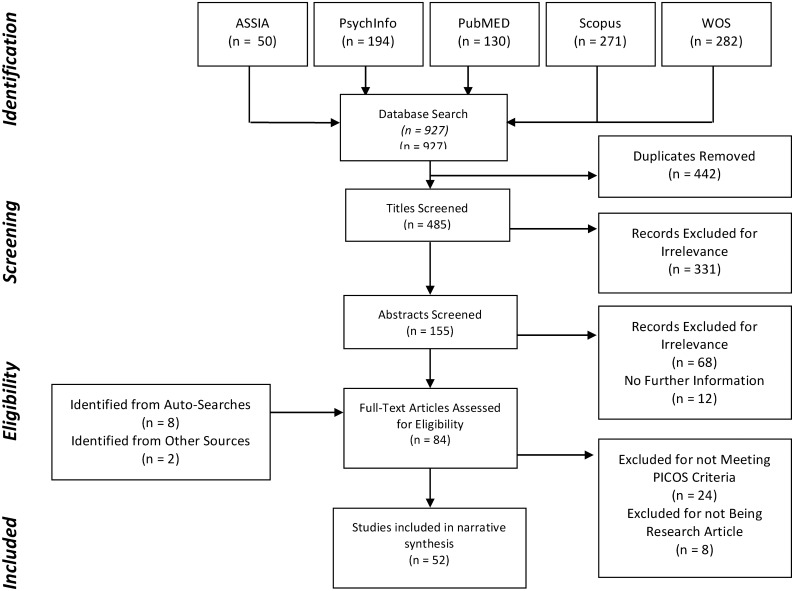
INTRODUCTION: The view that interacting with nature enhances mental wellbeing is commonplace, despite a dearth of evidence or even agreed definitions of 'nature'. The aim of this review was to systematically appraise the evidence for associations between greenspace and mental wellbeing, stratified by the different ways in which greenspace has been conceptualised in quantitative research. METHODS: We undertook a comprehensive database search and thorough screening of articles which included a measure of greenspace and validated mental wellbeing tool, to capture aspects of hedonic and/or eudaimonic wellbeing. Quality and risk of bias in research were assessed to create grades of evidence. We undertook detailed narrative synthesis of the 50 studies which met the review inclusion criteria, as methodological heterogeneity precluded meta-analysis. RESULTS: Results of a quality assessment and narrative synthesis suggest associations between different greenspace characteristics and mental wellbeing. We identified six ways in which greenspace was conceptualised and measured: (i) amount of local-area greenspace; (ii) greenspace type; (iii) visits to greenspace; (iv) views of greenspace; (v) greenspace accessibility; and (vi) self-reported connection to nature. There was adequate evidence for associations between the amount of local-area greenspace and life satisfaction (hedonic wellbeing), but not personal flourishing (eudaimonic wellbeing). Evidence for associations between mental wellbeing and visits to greenspace, accessibility, and types of greenspace was limited. There was inadequate evidence for associations with views of greenspace and connectedness to nature. Several studies reported variation in associations between greenspace and wellbeing by life course stage, gender, levels of physically activity or attitudes to nature. CONCLUSIONS: Greenspace has positive associations with mental wellbeing (particularly hedonic wellbeing), but the evidence is not currently sufficient or specific enough to guide planning decisions. Further studies are needed, based on dynamic measures of greenspace, reflecting access and uses of greenspace, and measures of both eudaimonic and hedonic mental wellbeing.
Overview
The claims and statistics of this paper haven’t been checked yet.
Free: it reads the open-access text and checks the first 5 claims that cite a source we can check. Create a free account to check every claim.
Integrity signals
Registry
Cites
Statistics
Figures
Verification
Claims the paper makes
The claims and statistics of this paper haven’t been checked yet.
Free: it reads the open-access text and checks the first 5 claims that cite a source we can check. Create a free account to check every claim.
Claims other papers make about this one
Each is checked against this paper’s own text: does it say what the citing paper says it does?
The source backs part of the claim, not all of it — or backs it for a different population, condition or comparison.
In the citing paper
“These show an association between exposure to greenspace and/or outdoor nature-based interventions, and reduced symptoms of stress, depression and anxiety, and increased wellbeing (Houlden et al., 2018;Corazon et al., 2019).”
From Exploring the role of exposure to green and blue spaces in preventing anxiety and depression among young people aged 14–24 years living in urban settings: A systematic review and conceptual framework (2022) · cites this paper as Houlden et al., 2018
Experimental — accuracy not yet measured
Self-check
Percentages, sums and reported differences re-computed from the paper’s own numbers.
The self-check needs the paper’s full text.
Citations
Cites
The Cochrane Collaboration's tool for assessing risk of bias in randomised trials
Higgins, J. P. T., Altman, D. G., Gotzsche, P. C., Juni, P., Moher, D., Oxman, A. D., Savovic, J., Schulz, K. F., Weeks, L., Sterne, J. A. C., et al. (2011) · BMJ · doi:10.1136/bmj.d5928 · Cited by 33,817
Development and validation of brief measures of positive and negative affect: The PANAS scales.
Watson, D., Clark, L. A., & Tellegen, A. (1988) · Journal of Personality and Social Psychology · doi:10.1037/0022-3514.54.6.1063 · Cited by 32,433
Cochrane Handbook for Systematic Reviews of Interventions: Cochrane Book Series
(2008) · doi:10.1002/9780470712184 · Cited by 25,048 · cited 3×
“For quality appraisal, risk of bias was assessed using Cochrane-recommended criteria [32]:”
BackgroundMethodDermyshi, E., Wang, Y., Yan, C., Hong, W., Qiu, G., Gong, X., & Zhang, T. (2017) · Neonatology · doi:10.1159/000454668 · Cited by 24,451
(2014) · Medical Entomology and Zoology · Cited by 17,633
On Happiness and Human Potentials: A Review of Research on Hedonic and Eudaimonic Well-Being
Ryan, R. M., & Deci, E. L. (2001) · Annual Review of Psychology · doi:10.1146/annurev.psych.52.1.141 · Cited by 11,567
The structure of psychological well-being revisited.
Ryff, C. D., & Keyes, C. L. M. (1995) · Journal of Personality and Social Psychology · doi:10.1037//0022-3514.69.4.719 · Cited by 10,285
Stress recovery during exposure to natural and urban environments
Ulrich, R. S., Simons, R. F., Losito, B. D., Fiorito, E., Miles, M. A., & Zelson, M. (1991) · Journal of Environmental Psychology · doi:10.1016/s0272-4944(05)80184-7 · Cited by 5,990 · cited 1×
“of the terms ‘nature’ and ‘natural’ [10, 16], and features that may appear ‘natural’ are often arti-”
Cochrane Handbook for Systematic Reviews of Interventions
Higgins, J. P. T., Green, S., & Ben Van Den, A. (2020) · International Coaching Psychology Review · doi:10.53841/bpsicpr.2020.15.2.123 · Cited by 5,670
The Warwick-Edinburgh Mental Well-being Scale (WEMWBS): development and UK validation
Tennant, R., Hiller, L., Fishwick, R., Platt, S., Joseph, S., Weich, S., Parkinson, J., Secker, J., & Stewart-Brown, S. (2007) · Health and Quality of Life Outcomes · doi:10.1186/1477-7525-5-63 · Cited by 5,031 · cited 1×
“new things”, and “close to others” [81]; there is also a reduced 7-item version, known as”
BackgroundSelf-citation
Research works printed but not linked: 2
- World Health Organisation. Urban green spaces and health—a review of evidence. 2016.
- Guðmundsdóttir D, editor The short Warwick-Edinburgh mental well-being scale (SWEMWBS): Internal validity and the relationship between SWEMWBS, age, gender and other health and well-being measures. 2nd Applied Positive Psychology Conference, Warwick; 2009.
Cited by
Items 401–467 of 467
A Correlational Study of Physical Environment and Happiness
Aşılıoğlu, F., Çay, R. D., & Şermet, R. (2025) · Chinese Journal of Urban and Environmental Studies · doi:10.1142/s2345748125500083
Lähde, E., Varumo, L., Nieminen, E., Jalkanen, J., Huttunen, S., Halme, P., Väätänen, K., & Tuomisaari, J. (2025) · Urban forestry & urban greening · doi:10.1016/j.ufug.2025.128963
Socio-cultural patterns in how residents value and use green space in new greenfield developments
Macaulay, R., Lavau, S., Williams, N. S. G., & Hahs, A. K. (2025) · Urban forestry & urban greening · doi:10.1016/j.ufug.2025.129030 · Cited by 2
Deepika, K., Venkateswaran, C., Singh, A., Tejaswini, B. D., & John, D. (2025) · Research Square · doi:10.21203/rs.3.rs-7183081/v1 · Cited by 1
Adil, T., Umna, F., Raza, A. A., Mansoor, F., Riaz, S., & Mirza, U. B. (2025) · The Egyptian Journal of Neurology Psychiatry and Neurosurgery · doi:10.1186/s41983-025-01039-3 · Cited by 1
“Additionally, integrating nature into daily routines has been associated with enhanced mental well-being; for instance, exposure to natural features such as trees and birdsong in urban environments can have lasting positive effects [42].”
de Oliveira, D. C. R. S., Gouveia, N., Tumas, N., Carolina Nazzal, N., Alfaro, T., Kroker-Lobos, M. F., Miranda, J. J., Ramírez‐Zea, M., Oliveira, T., Caiaffa, W. T., et al. (2025) · Journal of Global Health · doi:10.7189/jogh.15.04262 · Cited by 1
“Improving the urban environment and promoting healthier behaviours through social and health policy interventions may help reduce these disparities and enhance cardiovascular health in Latin America [ 50 , 55 , 56 ].”
The role of natural green spaces in enhancing neurocognition
Kapoor, D. S., Singh, K. J., Kaur, I., Thakur, K., Thirumalasetti, J. V., & Kada, M. (2025) · Elsevier eBooks · doi:10.1016/b978-0-443-41660-6.00009-0
Connecting with Local Greenspaces: Well-Being Pedagogies for Middle Years’ Students and Teachers
Sammel, A. J. (2023) · Emerald Group Publishing Limited eBooks · doi:10.1108/979-8-88730-203-420251007
de Wit, M. M., Ferriera, P. S. B., Begeer, S., Abdellaoui, A., Wagtendonk, A., Bartels, M., van de Weijer, M. P., & Polderman, T. J. C. (2025) · Journal of Autism and Developmental Disorders · doi:10.1007/s10803-025-07127-w
Baxter, L., Burton, A., & Fancourt, D. E. (2022) · Figshare · doi:10.6084/m9.figshare.19373424
Benton, J. S., Cotterill, S., Anderson, J., Macintyre, V. G., Gittins, M., Dennis, M., & French, D. (2021) · Figshare · doi:10.6084/m9.figshare.13655288
Petrunoff, N., Yi, N. X., Dickens, B., Sia, A., Koo, J. R., Cook, A. R., Lin, W. H., Lü, Y., Hsing, A. W., van Dam, R. M., et al. (2021) · Figshare · doi:10.6084/m9.figshare.14904060
Benton, J. S., Cotterill, S., Anderson, J., Macintyre, V. G., Gittins, M., Dennis, M., & French, D. (2021) · Figshare · doi:10.6084/m9.figshare.13655291
Petrunoff, N., Yi, N. X., Dickens, B. S. L., Sia, A., Koo, J. R., Cook, A. R., Lin, W. H., Lü, Y., Hsing, A. W., van Dam, R. M., et al. (2021) · Figshare · doi:10.6084/m9.figshare.14904057
Benton, J. S., Cotterill, S., Anderson, J., Macintyre, V. G., Gittins, M., Dennis, M., & French, D. (2021) · Figshare · doi:10.6084/m9.figshare.13655294
Powell, N., Dalton, H. E., Lawrence-Bourne, J., & Perkins, D. A. (2024) · Figshare · doi:10.6084/m9.figshare.26500298
Powell, N., Dalton, H. E., Lawrence-Bourne, J., & Perkins, D. A. (2024) · Figshare · doi:10.6084/m9.figshare.26500389
Benton, J. S., Cotterill, S., Anderson, J., Macintyre, V. G., Gittins, M., Dennis, M., & French, D. (2021) · Figshare · doi:10.6084/m9.figshare.13655300
Benton, J. S., Cotterill, S., Anderson, J., Macintyre, V. G., Gittins, M., Dennis, M., & French, D. (2021) · Figshare · doi:10.6084/m9.figshare.13655297
Accumulation of psychological problems in UK cities; A quantile regression approach
Finnemann, A., Freichel, R., van der Maas, H. L. J., Borsboom, D., & Wiers, R. W. H. J. (2025) · Cities · doi:10.1016/j.cities.2025.106630 · Cited by 2
Zirui, Y. A. O., Schirmer, J., Kanowski, P. J., & Xuemei, B. A. I. (2025) · Urban forestry & urban greening · doi:10.1016/j.ufug.2025.129247
The potential of Cycling Without Age on social isolation and loneliness among older adults
Gonçalves, B. A., & Lusher, J. M. (2025) · Journal of Biosocial Science · doi:10.1017/s002193202510045x
“An expanding body of evidence supports the mental and physical health benefits of nature-based interventions, which are structured activities conducted outdoors in green or urban spaces (Houlden et al. 2018).”
Poulsen, M. N., Nordberg, C. M., Bandeen‐Roche, K., DeWalle, J., Berrettini, W., & Schwartz, B. S. (2025) · Addictive Behaviors Reports · doi:10.1016/j.abrep.2025.100661
“…nature interaction and exposure has been associated with increased psychological well-being (e.g., life satisfaction, reduced mental distress) (Houlden et al., 2018), better cognitive function (improved attention and memory, executive function, impulse inhibition) (de Keijzer et al., 2016;…”
Cunha, P. H. A. (2025) · Revista do CAAP. · doi:10.69881/t9qr8m13
Built environment determinants of mental health in Mashhad metropolis, Iran
Hosseini, S. H., Zarei, M., & Ghodrati, H. (2026) · Cities & Health · doi:10.1080/23748834.2025.2589638 · Cited by 1
Eco-anxiété, changement climatique et santé mentale
Heeren, A. (2024) · Carrefour des psychothérapies · doi:10.3917/dbu.heere.2024.01.0201
Borroni, E., Giannico, V., Monti, P., Matsagani, R., Dariol, E., Elia, M., Buoli, M., Nosari, G., Ceresa, A., Antonangeli, L. M., et al. (2026) · Environmental Research · doi:10.1016/j.envres.2026.123886 · Cited by 1
Compton, S., Morton, K., Savage, L. D. R., Fredheim, H., Armitt, H. A., Tracey, L., & Blower, S. L. (2026) · Wellbeing Space and Society · doi:10.1016/j.wss.2026.100358 · Cited by 1
Scuba diving across cultures: motivation and well-being
Martens, J. P. (2026) · Journal of Adventure Education & Outdoor Learning · doi:10.1080/14729679.2026.2629254
Giuffrida, E. R., Licciardello, F., Popartan, L. A., & Graziano, T. (2026) · Natural Hazards · doi:10.1007/s11069-025-07912-x
“…in both urban and non-urban areas such as rain gardens, green roofs, bioswales, and more generally green spaces have also shown positive impacts on human health and well-being (Koutsovili et al. 2023); Navarrete-Hernandez and Laffan, 2019 ; Houlden et al. 2018 ; Suppakittpaisarn et al. 2017 ).”
Sentinel Series Applications on Urban Green Space: Current Progress and Future Research Pathway
Halder, B., Pereira, P., Al‐Areeq, A. M., & Yaseen, Z. M. (2026) · Ecosystem Health and Sustainability · doi:10.34133/ehs.0502
Dumbrell, J., Masterton, W., Carver, H., & Parkes, T. (2026) · BMC Public Health · doi:10.1186/s12889-026-26867-7 · Cited by 1
“Among their broad portfolio, the WHO [2] acknowledge the potential for greenspace (natural or vegetated areas accessible for recreation and relaxation), and nature-based interventions (NBIs) (therapeutic activities using nature) to enhance human physical and mental health [20, 21].”
Li, W., Wang, F., Wan, C. M., Chan, E. Y. Y., Wong, S. Y. S., & Tse, L. A. (2026) · Hygiene and Environmental Health Advances · doi:10.1016/j.heha.2026.100174 · Cited by 1
Neto, J., & NETO, F. M. A. (2026) · PsyEcology Bilingual Journal of Environmental Psychology · doi:10.1177/21711976261430267
“Un metanálisis evidenció asociaciones positivas entre espacios verdes y SV (Houlden et al., 2018).”
Impacts of Nature-based Health Tourism
Vashishtha, K., Tripathi, S., Joshi, R., & Dhankar, C. (2026) · Emerald Group Publishing Limited eBooks · doi:10.1108/978-1-83662-964-120261002
Leveraging Immersive Wellness Programmes and Green Spaces to Enhance Employees’ Mental Health
Jain, V. (2026) · Emerald Group Publishing Limited eBooks · doi:10.1108/978-1-83708-156-120261010
Benton, J. S., Anderson, J., Morley, A., Ye, J., Barker, E. A., Wu, T., Macintyre, V. G., Rothwell, J. J., Dennis, M., & French, D. (2026) · International Journal of Behavioral Nutrition and Physical Activity · doi:10.1186/s12966-026-01918-9
“Despite the plausibility of these pathways, robust natural experimental evidence examining the effects of park interventions on these broader wellbeing behaviours remains limited [31].”
Torrance, M., Masterton, W., Falzon, D., Carver, H., Parkes, T., Engstrom, S., Duncan, E., Dumbrell, J., Park, K., Lovell, R., et al. (2026) · Drugs Education Prevention and Policy · doi:10.1080/09687637.2026.2664439
Armour, L., Standley, E., Bramley, S., Blower, S. L., & Morton, K. (2026) · Wellbeing Space and Society · doi:10.1016/j.wss.2026.100418 · Cited by 1
Ramos, G. C. D., Blanco, H., Moreno, C., Leone, M. F., González-Guzmán, C. A., Sánchez, A. R. M., & Tollin, N. (2026) · Springer eBooks · doi:10.1007/978-981-95-6517-7_10 · Cited by 1
Conclusion: Toward Climate-Resilient Development in Cities
Oke, C., Tollin, N., Ranalder, L., Jance, B., Roberts, D., McGregor, M., Bouikidis, A., Spires, M., & Oluoch, J. (2026) · Springer eBooks · doi:10.1007/978-981-95-6517-7_12
Tiradossi, V., Corvaglia, C., & Menconi, M. E. (2026) · World · doi:10.3390/world7060098
Liu, X., Zhang, Y., Zhang, X., Chang, T., Zhao, Z., Zhang, Y., Li, Z., Li, Z., Yang, X., & Lu, M. (2026) · Aging & Mental Health · doi:10.1080/13607863.2026.2678989 · Cited by 1
Xu, J., Bloomfield, L. S. P., Sawe, N. A., Altaf, B., Ardoin, N. M., Murnane, E. L., & Billington, S. L. (2026) · Indoor Air · doi:10.1155/ina/1552884
Yang, J., Akafekwa, T., Williams, G., Elliott, J. C., Verma, A., & Greenhalgh, C. A. (2026) · Environmental Research · doi:10.1016/j.envres.2026.125141
Karaçam, S., Ekicioğlu, Ö. S., Yıldırım, F., & Ceylan, İ. (2026) · Physiotherapy Theory and Practice · doi:10.1080/09593985.2026.2695765
Ferdous, S. M., Taimisto, P., Musakka, E., Siponen, T., Täubel, M., & Hegarty, B. (2026) · Environmental Research · doi:10.1016/j.envres.2026.125245
Demirok, Z. N., Akça, E., Gürcan, M. B., Yılmaz, A., Tüzün, Ö. D., İPEK, M., & Altıntaş, M. (2026) · Journal of Clinical Medicine · doi:10.3390/jcm15155809
“Individuals with higher levels of MWB demonstrate greater capacity for realizing their potential, coping effectively with everyday stressors, and experiencing psychological flourishing [2].”
Emi, M., Kawai, S., Sasakabe, T., Okada, R., Kubo, Y., Mitsuda, Y., Kato, Y., Matsunaga, T., Nagayoshi, M., Tamura, T., et al. (2026) · International Journal of Environmental Research and Public Health · doi:10.3390/ijerph23081020
“A systematic review showed that green space has positive associations with mental well-being, and, in particular, there are associations between the amount of local-area green space and life satisfaction [46].”
“I could not do this job without my platoonmates”: coping strategies at a municipal police service
Stretton, S. M., & Ricciardelli, R. (2026) · Policing An International Journal · doi:10.1108/pijpsm-02-2026-0037
Morato, K. V., Leite, M. D. S., Giulio, G. M. D., Prist, P. R., Mauad, T., Targhetta, N., Rhodes, J. R., & Metzger, J. P. (2026) · Ecological Frontiers · doi:10.1016/j.ecofro.2026.08.003
Bacevičienė, M., Balčiūnienė, V., & Jankauskienė, R. (2026) · Behavioral Sciences · doi:10.3390/bs16081454
“The finding that nature exposure independently predicted PsyCap is consistent with the broader literature linking natural environments to positive psychological outcomes (Hartig et al., 2014; Houlden et al., 2018).”
Assessing the contribution of zoos to urban greenspace to support the Global Biodiversity Framework
Johnson, B., Hill, R., Moss, A., & Ward, S. J. (2026) · Urban Ecosystems · doi:10.1007/s11252-026-02122-0
“Life satisfaction is higher when there is more local greenspace available (Houlden et al. 2018 ).”
Benefit-Cost Analysis of the Slow the Spread Program: An Update Through 2045
Bruck, S. R., Sloggy, M., Foster, J., Thompson, M. J., & Coleman, T. W. (2026) · doi:10.2737/srs-gtr-289
Eudaimonic well-being in relation to urban nature: pathways to multiple nature values
Järekari, J., Eilola, S., & Fagerholm, N. (2026) · Ecosystems and People · doi:10.1080/26395916.2026.2725012
Zhu, J., Zhang, F., Ding, Y., Cao, K., Cao, Z., & Gao, X. (2026) · Geo-spatial Information Science · doi:10.1080/10095020.2026.2730047
Is compliance with the 3-30-300 rule associated with subjective citizens' well-being?
Sicard, P., Cordon, T., André, L., Marco, A. D., Paoletti, E., Pérez, S., Leca, Ș., Khaniabadi, Y. O., & Calatayud, V. (2026) · Journal of Environmental Management · doi:10.1016/j.jenvman.2026.131016
Sareminia, H., & Zandieh, M. (2026) · Journal of Asian Architecture and Building Engineering · doi:10.1080/13467581.2026.2722560
Zhao, C., & Liu, G. (2026) · Sustainability · doi:10.3390/su18199926
Meidenbauer, K. L., Pourkhalili, S., Schertz, K. E., Janey, E. A., & Berman, M. G. (2026) · Journal of Environmental Psychology · doi:10.1016/j.jenvp.2026.103229 · Cited by 1
Associations Between Biodiversity-Related Exposures and Mental Health: A Scoping Review
Moreau, M., Boroujeni, K. B., Cohen, C. G., & Hudon, A. (2026) · Psychiatry International · doi:10.3390/psychiatryint7050217
“In addition, a systematic review of 50 studies reported broadly positive associations between greenspace and life satisfaction, though study quality and effect sizes varied [6].”
Jin, Z., Liu, X., Shi, Y., & Peng, J. (2026) · Environmental Research · doi:10.1016/j.envres.2026.125827
Donnici, G., Papaleo, P., Mansi, S., Pace, G., & Frizziero, L. (2026) · Eng—Advances in Engineering · doi:10.3390/eng7100528
Trends Towards Transformation in Canadian Outdoor Health
Priest, S., & Ritchie, S. D. (2026) · Springer eBooks · doi:10.1007/978-981-92-0585-1_4
Bubalo, M., van den Broek, K. L., Helbich, M., & Labib, S. M. (2026) · Journal of Environmental Psychology · doi:10.1016/j.jenvp.2026.103254 · Cited by 1
Wagner, M., Mičulka, M., Zástavová, K., Trličíková, A., & Fiedor, D. (2026) · Wellbeing Space and Society · doi:10.1016/j.wss.2026.100491
Metadata
- Authors
- Houlden, V., Weich, S., Porto de Albuquerque, J., Jarvis, S., & Rees, K.
- Affiliations
- University of Warwick (GB)
- University of Sheffield (GB)
- Corresponding author
- Houlden, Victoria
- Weich, Scott
- Jarvis, Stephen
- Rees, Karen
- Venue
- PLOS ONE
- Publisher
- Public Library of Science (PLoS)
- Published
- 2018-09-12
- Volume
- 13
- Issue
- 9
- Pages
- e0203000
- ISSN
- 1932-6203 (ISSN-L)
- PMC
- PMC6135392
- OpenAlex
- W2889994901
- Cited by
- 471
- References
- 91
- Citations by year
- 2026: 52 · 2025: 79 · 2024: 60 · 2023: 73 · 2022: 84 · 2021: 73 · 2020: 31 · 2019: 18 · 2018: 1
- FWCI
- 3.24
- Type
- journal article
- Language
- en
- Open access
- gold
- doi.org
- Licence
- Locations
- PLoS ONE (publishedVersion, cc-by)
- Europe PMC (PubMed Central) (publishedVersion, cc-by)
- PubMed Central (publishedVersion, cc-by)
- PubMed (publishedVersion)
- White Rose Research Online (University of Leeds, The University of Sheffield, University of York) (acceptedVersion)
- Warwick Research Archive Portal (University of Warwick) (acceptedVersion)
- ENLIGHTEN (Jurnal Bimbingan dan Konseling Islam) (acceptedVersion, cc-by-sa)
- RePEc: Research Papers in Economics (submittedVersion)
- DOAJ (DOAJ: Directory of Open Access Journals) (submittedVersion, cc-by-sa)
- Figshare (submittedVersion, cc-by)
- University of Birmingham Research Portal (University of Birmingham) (submittedVersion, other-oa)
- University of Birmingham Research Portal (University of Birmingham) (submittedVersion, cc-by)
- Newcastle University ePrints (Newcastle Univesity) (cc-by)
- Funders
- Engineering and Physical Sciences Research Council (EP/L016400/1)
- Topics
- Social Sciences › Urban Studies › Urban Green Space and Health
- Social Sciences › Psychology › Social Psychology › Psychological Well-being and Life Satisfaction
- Social Sciences › Business, Management and Accounting › Tourism, Leisure and Hospitality Management › Recreation, Leisure, Wilderness Management
- Keywords
- green spaces, psychological well-being, hedonic well-being, eudaimonic well-being, life satisfaction, personal flourishing, nature connection, green space accessibility, nature exposure, urban green space, life stages, gender differences
- MeSH terms
- Adult, Humans, Mental Health, Nature, Self Report
About these checks
Registry, retraction, Cites and statistics results are computed, not judged, with one exception: a printed reference that no index lists is read once by a model before it counts as a citation error. Claims are extracted by a model and kept only when their quote appears verbatim in the text; each cited source is then checked, with a model’s help, for whether it says what the claim relies on. Those verdicts can be wrong — read the claim’s quote and the cited source before relying on one.
Statistics and arithmetic are recomputed, not judged.
Confidence bands are shown only for fields calibrated on our annotated test set. None is calibrated yet, so no band is shown.
What counts as a claim ›How we measure confidence ›How we check this ›
Are you an author, or do you see a problem with this page? Request a review
Data sources
Bibliographic data: Semantic Scholar, OpenAlex, Crossref.
Contains information from the Semantic Scholar Academic Graph Datasets, made available under the ODC Attribution License (ODC-BY 1.0).
Semantic Scholar’s data is described in: Kinney, R., et al. (2023). The Semantic Scholar Open Data Platform. arXiv:2301.10140.
