

The DOI matches its Crossref record; 47 of the 48 references it cites were found in a registry or an index.
Common psychiatric and metabolic comorbidity of adult attention-deficit/hyperactivity disorder: A population-based cross-sectional study
Open accessAbstract
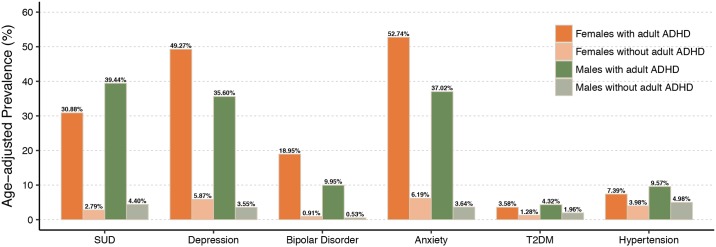
Attention-deficit/hyperactivity disorder (ADHD) is often comorbid with other psychiatric conditions in adults. Yet, less is known about its relationship with common metabolic disorders and how sex and ageing affect the overall comorbidity patterns of adult ADHD. We aimed to examine associations of adult ADHD with several common psychiatric and metabolic conditions. Through the linkage of multiple Swedish national registers, 5,551,807 adults aged 18 to 64 years and living in Sweden on December 31, 2013 were identified and assessed for clinical diagnoses of adult ADHD, substance use disorder (SUD), depression, bipolar disorder, anxiety, type 2 diabetes mellitus (T2DM), and hypertension. Logistic regression models and regression standardization method were employed to obtain estimates of prevalence, prevalence difference (PD), and prevalence ratio (PR). All comorbid conditions of interest were more prevalent in adults with ADHD (3.90% to 44.65%) than in those without (0.72% to 4.89%), with the estimated PRs being over nine for psychiatric conditions (p < 0.001) and around two for metabolic conditions (p < 0.001). Sex differences in the prevalence of comorbidities were observed among adults with ADHD. Effect modification by sex was detected on the additive scale and/or multiplicative scale for the associations of adult ADHD with all comorbidities. ADHD remained associated with all comorbidities in older adults aged 50 to 64 when all conditions were assessed from age 50 onwards. The comorbidity patterns of adult ADHD underscore the severity and clinical complexity of the disorder. Clinicians should remain vigilant for a wide range of psychiatric and metabolic problems in ADHD affected adults of all ages and both sexes.
Overview
The claims and statistics of this paper haven’t been checked yet.
Run the check — free, no account needed. It reads the open-access text and checks the sources it cites.
Integrity signals
Registry
Cites
Statistics
Figures
Verification
Claims the paper makes
The claims and statistics of this paper haven’t been checked yet.
Run the check — free, no account needed. It reads the open-access text and checks the sources it cites.
Claims other papers make about this one
Each is checked against this paper’s own text: does it say what the citing paper says it does?
The cited source says what the claim attributes to it.
In the citing paper
“Emerging evidence also suggests links between the condition in question and metabolic disorders, including obesity”
From ADHD in Adulthood: Clinical Presentation, Comorbidities, and Treatment Perspectives (2025) · cites this paper as [15]
Self-check
Percentages, sums and reported differences re-computed from the paper’s own numbers.
The self-check needs the paper’s full text.
Citations
Cites
R: A Language and Environment for Statistical Computing
R Core Team (2000) · doi:10.32614/r.manuals · Cited by 355,893
External review and validation of the Swedish national inpatient register
Ludvigsson, J. F., Andersson, E., Ekbom, A., Feychting, M., Kim, J.-L., Reuterwall, C., Heurgren, M., & Olausson, P. O. (2011) · BMC Public Health · doi:10.1186/1471-2458-11-450 · Cited by 5,055
Kessler, R. C., Adler, L., Barkley, R., Biederman, J., Conners, C. K., Demler, O., Faraone, S. V., Greenhill, L. L., Howes, M. J., Secnik, K., et al. (2006) · American Journal of Psychiatry · doi:10.1176/ajp.2006.163.4.716 · Cited by 3,886
Self-citationThe Swedish personal identity number: possibilities and pitfalls in healthcare and medical research
Ludvigsson, J. F., Otterblad-Olausson, P., Pettersson, B. U., & Ekbom, A. (2009) · European Journal of Epidemiology · doi:10.1007/s10654-009-9350-y · Cited by 2,437
Adipocyte dysfunctions linking obesity to insulin resistance and type 2 diabetes.
Guilherme, A., Virbasius, J. V., Puri, V., & Czech, M. P. (2008) · Nature Reviews Molecular Cell Biology · doi:10.1038/nrm2391 · Cited by 2,292
Genetic relationship between five psychiatric disorders estimated from genome-wide SNPs
Cross-Disorder Group of the Psychiatric Genomics Consortium (2013) · Nature Genetics · doi:10.1038/ng.2711 · Cited by 2,263
Self-citationThe Prevalence of DSM-IV Attention-Deficit/Hyperactivity Disorder: A Meta-Analytic Review
Willcutt, E. G. (2012) · Neurotherapeutics · doi:10.1007/s13311-012-0135-8 · Cited by 2,160
Registers of the Swedish total population and their use in medical research
Ludvigsson, J. F., Almqvist, C., Bonamy, A. E., Ljung, R., Michaëlsson, K., Neovius, M., Stephansson, O., & Ye, W. (2016) · European Journal of Epidemiology · doi:10.1007/s10654-016-0117-y · Cited by 1,718
Prevalence and correlates of adult attention-deficit hyperactivity disorder: meta-analysis
Simon, V., Czobor, P., Bálint, S., Mészáros, Á., & Bitter, I. (2009) · British Journal of Psychiatry · doi:10.1192/bjp.bp.107.048827 · Cited by 1,601
Recommendations for presenting analyses of effect modification and interaction
Knol, M. J., & VanderWeele, T. J. (2012) · International Journal of Epidemiology · doi:10.1093/ije/dyr218 · Cited by 1,494 · cited 2×
“There is general consensus among epidemiologists that assessing additive effect modification is most appropriate for public health decision-making [19].”
Background
Cited by
Sorted by citations
Faraone, S. V., Banaschewski, T., Coghill, D., Zheng, Y., Biederman, J., Bellgrove, M. A., Newcorn, J. H., Gignac, M., Al Saud, N. M., Manor, I., et al. (2021) · Neuroscience & Biobehavioral Reviews · doi:10.1016/j.neubiorev.2021.01.022 · Cited by 1,545
“Adolescents and young adults with ADHD were about three times more likely to develop type 2 diabetes mellitus (Chen et al., 2018b).”
InfluentialSelf-citationDemontis, D., Walters, G. B., Athanasiadis, G., Walters, R., Therrien, K., Nielsen, T. T., Farajzadeh, L., Voloudakis, G., Bendl, J., Zeng, B., et al. (2022) · Nature Genetics · doi:10.1016/j.euroneuro.2022.07.018 · Cited by 863
Self-citationAttention-deficit/hyperactivity disorder
Faraone, S. V., Bellgrove, M. A., Brikell, I., Cortese, S., Hartman, C. A., Hollis, C., Newcorn, J. H., Philipsen, A., Polanczyk, G. V., Rubia, K., et al. (2024) · Nature Reviews Disease Primers · doi:10.1038/s41572-024-00495-0 · Cited by 355
Self-citationSex and gender in neurodevelopmental conditions
Bölte, S., Neufeld, J., Marschik, P. B., Williams, Z. J., Gallagher, L., & Lai, M.-C. (2023) · Nature Reviews Neurology · doi:10.1038/s41582-023-00774-6 · Cited by 249
Choi, W.-S., Woo, Y. S., Wang, S.-M., Lim, H. K., & Bahk, W.-M. (2022) · PLOS ONE · doi:10.1371/journal.pone.0277175 · Cited by 221
Metadata
- Authors
- Chen, Q., Hartman, C. A., Haavik, J., Harro, J., Klungsøyr, K., Hegvik, T.-A., Wanders, R., Ottosen, C., Dalsgaard, S., Faraone, S. V., & Larsson, H.
- Affiliations
- Karolinska Institutet (SE)
- University Medical Center Groningen (NL)
- Haukeland University Hospital (NO)
- University of Tartu (EE)
- Norwegian Institute of Public Health (NO)
- Aarhus University (DK)
- SUNY Upstate Medical University (US)
- Örebro University (SE)
- Corresponding author
- Chen, Qi
- ORCID
- Venue
- PLOS ONE
- Publisher
- Public Library of Science (PLoS)
- Published
- 2018-09-26
- Volume
- 13
- Issue
- 9
- Pages
- e0204516
- ISSN
- 1932-6203 (ISSN-L)
- PMC
- PMC6157884
- OpenAlex
- W2893086897
- Cited by
- 236
- References
- 48
- Citations by year
- 2026: 28 · 2025: 31 · 2024: 41 · 2023: 35 · 2022: 29 · 2021: 30 · 2020: 29 · 2019: 12 · 2018: 1
- FWCI
- 14.12
- Type
- journal article
- Language
- en
- Open access
- gold
- doi.org
- Licence
- Locations
- PLoS ONE (publishedVersion, cc-by)
- Europe PMC (PubMed Central) (publishedVersion, cc-by)
- PubMed Central (publishedVersion, cc-by)
- PubMed (publishedVersion)
- University of Groningen research database (University of Groningen / Centre for Information Technology) (submittedVersion, cc-by)
- NORA - Norwegian Open Research Archives (submittedVersion, cc-by)
- DOAJ (DOAJ: Directory of Open Access Journals) (submittedVersion, cc-by-sa)
- NORA - Norwegian Open Research Archives (submittedVersion, other-oa)
- Funders
- Vetenskapsrådet (2014-3831)
- Swedish Initiative for Research on Microdata in the Social And Medical Sciences (SIMSAM) framework (340-2013-5867)
- The European Union’s Horizon 2020 research and innovation programme (667302)
- The K.G. Jebsen Centre for Research on Neuropsychiatric Disorders, University of Bergen, Bergen, Norway
- The European Union’s Seventh Framework Programme for research, technological development and demonstration (602805)
- The European Union’s Horizon 2020 research and innovation programme under grant agreements (728018)
- National Institute of Mental Health (5R01MH101519 & U01 MH109536-01)
- Aarhus University Foundation Associate Professor Starting Grant (AUFF-E-2015-FLS-8-61)
- The Novo Nordisk Foundation (NNF 22018)
- Topics
- Health Sciences › Medicine › Psychiatry and Mental health › Attention Deficit Hyperactivity Disorder
- Life Sciences › Neuroscience › Cognitive Neuroscience › Autism Spectrum Disorder Research
- Health Sciences › Medicine › Psychiatry and Mental health › Schizophrenia research and treatment
- Keywords
- adult ADHD, psychiatric comorbidity, metabolic comorbidities, substance use disorders, depression, bipolar disorder, anxiety, type 2 diabetes, hypertension, sex differences, aging, prevalence
- MeSH terms
- Adolescent, Adult, Anxiety, Attention Deficit Disorder with Hyperactivity, Mental Disorders, Bipolar Disorder, Cross-Sectional Studies, Depressive Disorder, Diabetes Mellitus, Type 2, Female, Humans, Hypertension, Male, Metabolic Diseases, Middle Aged, Sex Factors, Sweden, Comorbidity, Prevalence, Substance-Related Disorders, Young Adult
About these checks
Registry, retraction, Cites and statistics results are computed, not judged, with one exception: a printed reference that no index lists is read once by a model before it counts as a citation error. Claims are extracted by a model and kept only when their quote appears verbatim in the text; each cited source is then checked, with a model’s help, for whether it says what the claim relies on. Those verdicts can be wrong — read the claim’s quote and the cited source before relying on one.
Statistics and arithmetic are recomputed, not judged.
Confidence bands are shown only for fields calibrated on our annotated test set. None is calibrated yet, so no band is shown.
What counts as a claim ›How we measure confidence ›How we check this ›
Are you an author, or do you see a problem with this page? Request a review
