

Sex and gender differences in caregiving burden experienced by family caregivers of persons with dementia: A systematic review
Open accessThe DOI matches its Crossref record; 81 of the 83 references it cites were found in a registry or an index.
Abstract
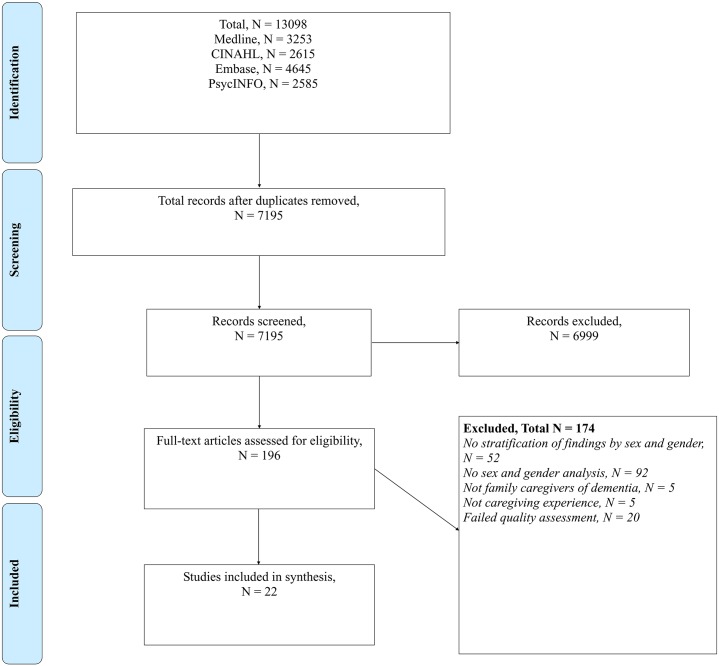
OBJECTIVES: Much is known about the demands of caregiving for persons with dementia (PWD) and its effects on family caregivers, however sex and gender aspects have received less attention. We synthesized the evidence on sex and gender distinctions in: (1) the caregiving burden and (2) the impact of caregiving on the physical and mental health of family caregivers of PWD. DESIGN: Systematic review. DATA SOURCES: Medline, Embase, PsycINFO and Cumulative Index to Nursing and Allied Health Literature between January 2007 and October 2019 were searched. ELIGIBILITY CRITERIA FOR SELECTING STUDIES: Included studies met the following criteria: (1) examine experiences and/or impacts of caregiving among family caregivers of individuals with any form of dementia; (2) report sex and/or gender distribution of study population and/or report results stratified by sex and/or gender, and (3) include both male and female family caregivers. DATA EXTRACTION AND SYNTHESIS: Two independent reviewers extracted the data and assessed risk of bias using the Critical Appraisal Skills Program checklist and National Institutes of Health Quality Assessment Tool for Observational Cohort and Cross-sectional Studies. Data were synthesized using a narrative synthesis approach. RESULTS: A total of 22 studies were included. Caregiving burden was measured using various methods. A majority of studies reported higher burden among females. All studies that did not report a sex and gender difference in caregiving burden accounted for confounders. Findings on sex and gender differences on physical and mental health conditions were inconsistent with most studies failing to account for confounders in their analyses. CONCLUSIONS: Current evidence on sex and gender differences in caregiving burden, mental and physical health is limited. Findings suggest presence of sex and gender differences in caregiving burden. Given the variety of mental and physical health constructs that were examined, further research is required to substantiate the evidence. PROPSERO Registration Number: CRD 42018070032.
Overview
The claims and statistics of this paper haven’t been checked yet.
Free: it reads the open-access text and checks the first 5 claims that cite a source we can check. Create a free account to check every claim.
Integrity signals
Registry
Cites
Statistics
Figures
Verification
Claims the paper makes
The claims and statistics of this paper haven’t been checked yet.
Free: it reads the open-access text and checks the first 5 claims that cite a source we can check. Create a free account to check every claim.
Claims other papers make about this one
Each is checked against this paper’s own text: does it say what the citing paper says it does?
The source backs part of the claim, not all of it — or backs it for a different population, condition or comparison.
In the citing paper
“Similarly, caregivers who are women may experience slightly higher levels of burden, impaired mood, depression and impaired health than caregivers who are men, with evidence suggesting that these differences arise because female caregivers tend to spend more time caregiving, assume more caregiving tasks, and care for someone with more cognitive, functional and/or behavioral problems.”
From 2023 Alzheimer's disease facts and figures (2023) · cites this paper as [417]
Experimental — accuracy not yet measured
Self-check
Percentages, sums and reported differences re-computed from the paper’s own numbers.
The self-check needs the paper’s full text.
Citations
Cites
Preferred Reporting Items for Systematic Reviews and Meta-Analyses: the PRISMA statement
Moher, D., Liberati, A., Tetzlaff, J., Altman, D. G., & for the PRISMA Group (2009) · BMJ · doi:10.1136/bmj.b2535 · Cited by 83,823
Preferred Reporting Items for Systematic Reviews and Meta-Analyses: The PRISMA Statement
Moher, D., Liberati, A., Tetzlaff, J., Altman, D. G., & The PRISMA Group (2009) · PLoS Medicine · doi:10.1371/journal.pmed.1000097 · Cited by 64,042 · cited 1×
“The presentation of the findings was guided by the Preferred Reporting Items for Systematic Reviews and MetaAnalyses (PRISMA) checklist [32].”
Preferred reporting items for systematic reviews and meta-analyses: the PRISMA Statement.
(2009) · PubMed Central · Cited by 44,859
Wang, G., Ma, R., Qiao, G., Wada, K., Aizawa, Y., & Satoh, T. (2015) · Integrative Medicine International · doi:10.1159/000368408 · Cited by 18,657
Critical appraisal skills programme
Singh, J. (2013) · Journal of Pharmacology and Pharmacotherapeutics · doi:10.4103/0976-500x.107697 · Cited by 2,556
Popay, J., Roberts, H., Sowden, A., Petticrew, M., Arai, L., Rodgers, M., Britten, N., Roen, K., & Duffy, S. (2006) · Lancaster University · doi:10.13140/2.1.1018.4643 · Cited by 2,070 · cited 4×
“The presentation of the findings was guided by the Preferred Reporting Items for Systematic Reviews and MetaAnalyses (PRISMA) checklist [32].”
InfluentialWhy is depression more prevalent in women?
Albert, P. R. (2015) · Journal of Psychiatry and Neuroscience · doi:10.1503/jpn.150205 · Cited by 1,785 · cited 1×
“nosed with depression than men [70], they may not necessarily reflect variations in the caregiving experiences between males and females.”
Canadian Institutes of Health Research
(2019) · The Grants Register 2020 · doi:10.1057/978-1-349-95943-3_219 · Cited by 1,466
Guidance on the conduct of narrative synthesis in sytematic reviews
Popay, J., Roberts, H. M., Sowden, A. J., Petticrew, M. P., Arai, L., Rodgers, M., & Britten, N. (2006) · Cited by 1,378
Application of a multidimensional caregiver burden inventory
Novak, M., & Guest, C. (1989) · The Gerontologist · doi:10.1093/geront/29.6.798 · Cited by 1,205 · cited 2×
“Additionally, two studies used the CBI, which like the ZBI, is a scale developed in the late1980s [68, 69].”
Cited by
Items 101–200 of 288
Bullard, B. M., Brown, C. L., Scheffer, J. A., Toledo, A. B., & LEVENSON, R. W. (2024) · Dementia and Geriatric Cognitive Disorders · doi:10.1159/000538398 · Cited by 6
“Compared to men, women caregivers experience higher rates of both anxiety and depression [14].”
BackgroundKovaleva, M. A., Higgins, M. K., Dietrich, M. S., Jennings, B. M., Song, M., Clevenger, C. K., Griffiths, P. C., & Hepburn, K. W. (2022) · Journal of the American Association of Nurse Practitioners · doi:10.1097/jxx.0000000000000681 · Cited by 6
Cho, K., Choi, J., & Han, S. (2023) · Frontiers in Medicine · doi:10.3389/fmed.2023.1095385 · Cited by 5
When Sons and Daughters Care for a Parent: An Analysis of Gender Differences
Schulz, S., Theurer, C., Pfeiffer, K., & Wilz, G. (2023) · GeroPsych · doi:10.1024/1662-9647/a000322 · Cited by 6
Kawaguchi, K., Ide, K., & Kondo, K. (2022) · Age and Ageing · doi:10.1093/ageing/afac210 · Cited by 6
Green, G., Hochwald, I. H., Radomyslsky, Z., & Gannot, R. N. (2022) · OMEGA - Journal of Death and Dying · doi:10.1177/00302228221147961 · Cited by 9
The impact of caring on caregivers of patients with life-threatening organ failure
Kurita, G. P., Eidemak, I., Larsen, S., Jeppesen, P. B., Antonsen, L. B., Mølsted, S., Liem, Y. S., Pressler, T., & Sjøgren, P. (2023) · Palliative & Supportive Care · doi:10.1017/s1478951523000469 · Cited by 6
Social Capital and Formal Volunteering Among Family and Unpaid Caregivers of Older Adults
Baik, S., Crittenden, J. A., & Coleman, R. A. (2023) · Research on Aging · doi:10.1177/01640275231202260 · Cited by 5
“A recent systematic review found that female caregivers reported a higher burden than male caregivers (Xiong et al., 2020).”
BackgroundOmsorgsbelastning for pårørende til hjemmeboende personer med demens
Hagen, P. I., & Eide, A. H. (2020) · Tidsskrift for velferdsforskning · doi:10.18261/issn.0809-2052-2020-04-02 · Cited by 7
Care Partner Burden and Support Services in Dementia
Polsinelli, A. J. (2024) · CONTINUUM Lifelong Learning in Neurology · doi:10.1212/con.0000000000001502 · Cited by 6
Improving Respite Outcomes for Caregivers: Who Benefits and Under What Conditions?
Coleman, M. E., Godfrey, D. A., Thompson, A. D., Sparks, C., & Utz, R. (2025) · Journal of Applied Gerontology · doi:10.1177/07334648251324270 · Cited by 5
Guo, S., Chen, Q., & Chan, K. L. (2025) · BMC Public Health · doi:10.1186/s12889-025-23307-w · Cited by 10
Caregivers’ burden analytics: combining variables from patients with dementia and their caregivers
Jhang, K.-M., Chen, C.-C., Wang, S.-Y., Wang, W., Yen, S., & Wu, H. (2025) · BMC Geriatrics · doi:10.1186/s12877-025-06284-y · Cited by 9
Lillekroken, D., Bjørge, H., Halvorsrud, L., & Lidal, I. B. (2025) · BMC Geriatrics · doi:10.1186/s12877-025-06455-x · Cited by 6
Deng, R., Wu, Y., Huang, S. J., He, Y., Liu, C., Ziyun, Z., Wu, K., Fong, L. M., Wu, K., & Li, H. (2026) · Frontiers in Psychiatry · doi:10.3389/fpsyt.2025.1744877 · Cited by 9
Motivators for family carers of persons with dementia in Kenya
Musyimi, C. W., Muyela, L. A., Ndetei, D. M., Thakya, D., Mutiso, V., Mutunga, E., Evans-Lacko, S. E., & Farina, N. (2024) · International Journal of Geriatric Psychiatry · doi:10.1002/gps.6120 · Cited by 7
“10 These health impacts can manifest in various ways, such as increased rates of depression, social isolation, feelings of loneliness, compromised quality of care, and reluctance to seek healthcare services.”
Quality of Life and Relationships in Caregivers of People With Dementia. A Gender Perspective
Bjørge, H., Kvaal, K. S., & Ulstein, I. D. (2024) · American Journal of Alzheimer s Disease & Other Dementias® · doi:10.1177/15333175241276404 · Cited by 8
Bollig, G., Safi, M., Schmidt, M., & Ewald, H. (2022) · Healthcare · doi:10.3390/healthcare10040658 · Cited by 5
Sullivan, J. L., Engle, R. L., Shin, M. H., Davila, H. W., Tayade, A., Bower, E. S., Pendergast, J. N., & Simons, K. V. (2020) · Clinical Gerontologist · doi:10.1080/07317115.2020.1812141 · Cited by 5
Factors influencing partnerships between care workers and families in nursing homes in South Korea
Jung, E.-Y., & Jang, H. (2025) · Scientific Reports · doi:10.1038/s41598-025-89078-x · Cited by 4
“This implies that when providing direct care within a nursing home, in addition to the care recipient’s verbal expressions, non-verbal expressions, such as behavior and emotions, must also be carefully observed 38 .”
LI, J., Alavi, ., & Shaari, A. A. H. (2025) · Health & Social Care in the Community · doi:10.1155/hsc/5109659 · Cited by 5
Lero, C., Park, S., & Mroz, E. L. (2025) · Palliative & Supportive Care · doi:10.1017/s1478951524001639 · Cited by 7
“…although the data may accurately represent the proportion of women acting as caregivers, there is limited understanding of the gender differences in caregiver burden and wellbeing (Xiong et al. 2020), and how mindfulness and self-compassion may, or may not, be beneficial for a male caregiver.”
Cabral, B. P. D. A. L., Buttros, G. M., Brito, E. M. L., Giacomin, K. C., & Assis, M. G. (2022) · Dementia · doi:10.1177/14713012221148524 · Cited by 5
Dementia Care Class Increases Confidence of Informal Caregivers in Community-Based Dementia Care
Rahmawati, A. M., Jauhar, M., & Lestari, D. T. (2023) · Jurnal Aisyah Jurnal Ilmu Kesehatan · doi:10.30604/jika.v8i2.1977 · Cited by 5
Stokes, J. E., Kindratt, T. B., Antonucci, T. C., Cox, C. G., & Choi, H. (2023) · Journal of Aging and Health · doi:10.1177/08982643231201547 · Cited by 6
“All analyses were strati fi ed by gender, given differences in employment outcomes and family caregiving between men and women (Xiong et al., 2020).”
A Caregiver Perspective for Partners of PTSD Survivors: Understanding the Experiences of Partners
Cannon, C. J., & Gray, M. J. (2024) · Behavioral Sciences · doi:10.3390/bs14080644 · Cited by 6
Liu, R. M., Peak, K., Trubits, E. F., & Quiñones, A. R. (2025) · European Geriatric Medicine · doi:10.1007/s41999-024-01150-3 · Cited by 6
Charest-Drapeau, O., Provencher, V., Trottier, L., Léonard, G., Wilchesky, M., & Bravo, G. (2022) · Palliative & Supportive Care · doi:10.1017/s1478951522000323 · Cited by 4
Posada, C., Correa, L., Castañeda, M., Arias‐Rojas, M., & Tellez, B. (2023) · The Open Nursing Journal · doi:10.2174/18744346-v17-e230111-2022-127 · Cited by 4
Méndez, S. N. V., Ramírez, N. V. L., Córdoba, . M. C., Osma, L. J. P., & Soto, M. (2023) · Revista Virtual Universidad Católica del Norte · doi:10.35575/rvucn.n70a5 · Cited by 8
Ponsoda, J. M., & Díaz, A. (2024) · Journal of Clinical Medicine · doi:10.3390/jcm13082322 · Cited by 6
“Studies evaluating gender differences on the impact of caring for a relative with dementia have shown that women present worse mental health than men, with variables such as burden [6,7] or depressive and anxiety symptoms showing higher levels in women than in men [8,9].”
BackgroundLin, C., Chung, M. L., Wu, J. R., Smith, J. L., Latimer, A., Kang, J., Thompson, J. H., Rayens, M. K., Feltner, F. J., Biddle, M., et al. (2024) · The Journal of Rural Health · doi:10.1111/jrh.12850 · Cited by 5
Vazquez, C. E., Rote, S. M., Antequera, F., Cabrera, A., Cantu, P. A., & Angel, J. L. (2025) · Research on Aging · doi:10.1177/01640275241310518 · Cited by 3
“However, a recent systematic review suggests that differences among caregivers are complex and that there is no clear gendered fi nding relating to burden or stability (Xiong et al., 2020).”
Rozani, V., & Vitman-Schorr, A. (2025) · Geriatric Nursing · doi:10.1016/j.gerinurse.2025.01.014 · Cited by 6
Svedin, F., Menander, I. Ö., Blomberg, O., Brantnell, A., Farrand, P. A., Lückner, T., Sundelin, K., Turney, J., Åberg, A. C., & Woodford, J. (2025) · Health Expectations · doi:10.1111/hex.70382 · Cited by 5
Gomes, Z., Tulloch, H. E., Bouchard, K., & Mulvagh, S. L. (2025) · Current Atherosclerosis Reports · doi:10.1007/s11883-025-01338-3 · Cited by 4
Luca, A., Piccoli, T., Tomaselli, A., Marco, S. D., Nicoletti, A. S. Q., Coco, D. L., Rolandi, E., Sensi, S. L., Sucapane, P., Bruni, A. C., et al. (2026) · Journal of Alzheimer s Disease · doi:10.1177/13872877261435213 · Cited by 3
“18,58 However, to the best of our knowledge, the literature on sex-related cognitive and behavioral determinants of caregiver burden remains limited.”
Kew, C. L., Juengst, S. B., Kelley, B. J., & Osborne, C. L. (2022) · Gerontology and Geriatric Medicine · doi:10.1177/23337214221086810 · Cited by 3
Interactions Between Caregiving and Sex and the Antibody Response to COVID-19 Vaccination
Gallagher, S. M., Ryan, R., Cassidy, I., Tang, W., & Phillips, A. C. (2024) · Psychosomatic Medicine · doi:10.1097/psy.0000000000001322 · Cited by 3
Informal caregiver burden among carers of bedridden elderly: a cross sectional study in North Kerala
Sajeev, A. V., & John, C. (2024) · International Journal of Community Medicine and Public Health · doi:10.18203/2394-6040.ijcmph20241838 · Cited by 5
A New Approach for Assessing the Value of Informal Care in Alzheimer’s Disease
Cheneau, A., & Rapp, T. (2024) · Value in Health · doi:10.1016/j.jval.2024.10.3856 · Cited by 3
Women’s brain health and brain capital
Castro‐Aldrete, L., Greenfield, M., Smith, E., Eyre, H. A., Barbato, M., Pérez, L., & Chadha, A. S. (2025) · Nature Mental Health · doi:10.1038/s44220-025-00406-6 · Cited by 6
Death Literacy, Anxiety, and Uncertainty in Elderly’s Family Caregivers: A Cross-Sectional Study
Şahin, Z. A., Aydın, Ş., & Kına, V. (2025) · OMEGA - Journal of Death and Dying · doi:10.1177/00302228251346910 · Cited by 3
Sex and gender differences in Lewy body dementia: a narrative review
Bayram, E. (2025) · Equity Neuroscience · doi:10.1016/j.neuros.2025.100009 · Cited by 5
“For dementia, female caregivers experience higher burden than males [54].”
Baby Boomers Who Provide Informal Care for People Living with Dementia in the Community
Miyawaki, C. E., Bouldin, E. D., Taylor, C. A., & McGuire, L. C. (2021) · International Journal of Environmental Research and Public Health · doi:10.3390/ijerph18189694 · Cited by 4
Dehumanization and burden of care among caregivers of terminally ill patients
Testoni, I., Sicari, G., Ronconi, L., Biancalani, G., Franco, C., Cottone, P., & Crupi, R. (2021) · Health Psychology Research · doi:10.52965/001c.29052 · Cited by 4
Factors Associated With Caregivers' Preference for Digital Technologies to Support Older Adults
Hwang, Y. S., Jung, S. M., Dronina, Y., & Jo, H. S. (2022) · Journal of Gerontological Nursing · doi:10.3928/00989134-20220630-02 · Cited by 5
Lloyd, S. L., Caban‐Holt, A., Starks, T. D., Clark, J. C., & Byrd, G. S. (2023) · Journal of Gerontological Social Work · doi:10.1080/01634372.2023.2244556 · Cited by 4
Gestsdóttir, S. M., Ragnarsdóttir, G., Björnsdóttir, A., & Eiríksdóttir, E. (2024) · Review of Education · doi:10.1002/rev3.3482 · Cited by 3
The effects of progressive muscle relaxation exercise on dementia caregivers
Baykal, D., & Bılgıç, B. (2024) · Geriatric Nursing · doi:10.1016/j.gerinurse.2024.07.035 · Cited by 5
Knowledge and attitudes about dementia among nursing students in Vietnam: a cross‐sectional study
Pham, D. T. M., Do, A. D., Do, H. T. T., Nguyen, A. N., Nguyen, B. T., & Do, M. (2025) · Psychogeriatrics · doi:10.1111/psyg.70003 · Cited by 3
“…attitudes toward dementia in female students may re fl ect their response to more engagement that females are expected to perform in dementia care, 47 as well as to societal expectations toward females in the context of Vietnam, where the responsibility of caring for PWD is often tied to family…”
Whitten, L. (2021) · Current Women s Health Reviews · doi:10.2174/1573404817666210208204400 · Cited by 5
Samanta, A., & Ghosh, S. (2022) · Journal of Geriatric Mental Health · doi:10.4103/jgmh.jgmh_7_22 · Cited by 3
Park, M. K., Cheon, J. H., & McPherson, R. (2023) · Journal of Social Service Research · doi:10.1080/01488376.2023.2226170 · Cited by 5
Sandhu, S., Gill, M. K., Kakkar, R., Dhaliwal, K. K., Kamboj, V. S., Deol, I. S., & Puri, N. (2025) · Journal of Ethnicity in Substance Abuse · doi:10.1080/15332640.2025.2505748 · Cited by 5
Caregiving Network Characteristics and Mental Health Care Utilization by Older Adults
Wyman, M. F., Jacobs, J., Stalter, L. N., Venkatesh, M., TRIVEDI, R. B., & Byers, A. L. (2025) · Journal of the American Geriatrics Society · doi:10.1111/jgs.70082 · Cited by 2
“Moreover, while there is a robust literature documenting differences by caregiver relationship status and gender [14, 15], including in caregivers’ utilization of supportive resources [16], the role of these characteristics in care recipient healthcare utilization has rarely been examined.”
Experiences of adult children caring for parents aging in place
Opanubi, O., & Ade-Oshifogun, J. B. (2025) · PLoS ONE · doi:10.1371/journal.pone.0332336 · Cited by 3
Pedersen, E., Øksnebjerg, L., Waldemar, G., Janbek, J., Nielsen, A., & Nielsen, T. R. (2026) · Health and Quality of Life Outcomes · doi:10.1186/s12955-026-02477-0 · Cited by 2
“However, this seems to reflect a general issue, as research indicates that women commonly assume caregiving roles [50], making our population representative.”
Spousal Dementia Exposure and Risk of Dementia
Wang, S., Lin, M., Fan, C. C., Huang, W.-L., Hsu, C.-C., & Wu, C. (2026) · JAMA Network Open · doi:10.1001/jamanetworkopen.2026.24175 · Cited by 3
MAiD for geriatric syndromes: Special considerations
Lees, C., & Andrew, M. K. (2023) · Healthcare Management Forum · doi:10.1177/08404704221141048 · Cited by 3
Lestari, D. T., Jauhar, M., & Rahmawati, A. M. (2023) · Jurnal Litbang Media Informasi Penelitian Pengembangan dan IPTEK · doi:10.33658/jl.v19i2.344 · Cited by 4
“Penelitian sebelumnya menunjukkan adanya perbedaan jenis kelamin dan gender dalam beban pengasuhan (Xiong et al., 2020).”
Affective Impact on Informal Caregivers over 70 Years of Age: A Qualitative Study
Montejano‐Lozoya, R., Alcañiz-Garrán, M. D. M., Ramos‐Pichardo, J. D., Sánchez‐Alcón, M., García‐Sanjuán, S., & Quiles, Á. S. (2024) · Healthcare · doi:10.3390/healthcare12030329 · Cited by 3
Denham, A. M. J., Haracz, K., Bird, M., Bonevski, B., Spratt, N. J., Turner, A., Chow, W., Larkin, M., Mabotuwana, N. S., & Janssen, H. (2024) · Disability and Rehabilitation · doi:10.1080/09638288.2024.2360648 · Cited by 2
“A systematic review examining the sex and gender differences in caregiving burden experienced by informal carers of people with dementia found that female carers experienced a greater burden when compared to male carers [24].”
Tong, L. K., Au, M. L., Liu, Y. B., Zheng, M. R., Fu, G. L., & Li, Y. Y. (2025) · BMC Public Health · doi:10.1186/s12889-025-22226-0 · Cited by 3
“Gender norms and societal expectations may place additional stressors on females, including multiple roles and responsibilities such as caregiving [27], household management, and balancing work-life demands [28, 29].”
Turner, S. G., Witzel, D. D., Garza, S., Pillemer, K. A., & Reid, M. C. (2025) · Journal of Applied Gerontology · doi:10.1177/07334648251360819 · Cited by 4
“The inter-section between caregiving, pain, and gender is an important one to explore given women are disproportionally impacted by both pain (Osborne & Davis, 2022) and caregiving (Xiong et al., 2020).”
Gies, C. E., & Pierce, L. L. B. (2021) · Home Healthcare Now · doi:10.1097/nhh.0000000000000960 · Cited by 2
Häikiö, K., & Rugkåsa, J. (2023) · International Journal of Care and Caring · doi:10.1332/239788221x16909940695901 · Cited by 5
Engstrom, C. W., West, B. T., Schepis, T. S., & McCabe, S. E. (2024) · Social Science & Medicine · doi:10.1016/j.socscimed.2024.116887 · Cited by 3
Lessons Learned from Introducing “Last-Aid” Courses at a University Hospital in Germany
Boehlke, C. S. (2019) · doi:10.26226/morressier.5c76c8bee2ea5a7237612971 · Cited by 2
Suliman, M. A. B., Chen, X. W., Ibrahim, M. I., Musa, K. I., Hamzah, N., Nadal, I. P., Mustapha, F. I., Rahim, M. Z. A., Sidek, N. N., Abdullah, J. M., et al. (2022) · Preprints.org · doi:10.20944/preprints202210.0094.v1 · Cited by 4
Hagen, P. I., & Eide, A. H. (2023) · Tidsskrift for velferdsforskning · doi:10.18261/tfv.26.3.3 · Cited by 1
Plys, E., & Syme, M. L. (2024) · Clinical Case Studies · doi:10.1177/15346501241289148 · Cited by 1
Li, F., Parsons, J. G. M., Xiao, L. D., & Cheung, G. (2024) · Dementia · doi:10.1177/14713012241272893 · Cited by 1
Caregiver Reactions: A Cross Sectional Study on Caregivers of People with Dementia
Sürgit, A., & Söylemez, B. A. (2024) · Etkili Hemşirelik Dergisi · doi:10.46483/jnef.1339096 · Cited by 1
Morehouse, C. R., Hendriks, S., Rabbee, N., & Kim, S. Y. H. (2024) · American Journal of Geriatric Psychiatry · doi:10.1016/j.jagp.2024.11.011 · Cited by 2
Jeong, H. Y., Park, S. Y., Kim, J. L., Kim, S. Y., & Jeon, S. Y. (2025) · Journal of Alzheimer s Disease Reports · doi:10.1177/25424823251322499 · Cited by 1
Kwok, Z. C. M., Tam, H. L., Zee, B. C.-Y., Lo, S. W. S., Tang, F. W. K., Tao, A., & Chan, H. Y. L. (2025) · BMC Public Health · doi:10.1186/s12889-025-22238-w · Cited by 3
“Higher level of engagement in caregiving tasks among women might explain their lower completion rate in this study [50].”
Yu, Y., Yang, L., Liu, Y., Fang, J., Wang, H., & Luo, D. (2025) · BMC Nursing · doi:10.1186/s12912-025-03114-9 · Cited by 4
“Despite extensive studies on caregiver burden, most of them focused on caregivers of patients with certain diseases, such as stroke [23], dementia [24], and schizophrenia [25], and there is little literature on caregivers of CWCD.”
Johnson, F. U., Plegue, M. A., Boddakayala, N., & Robinson‐Lane, S. G. (2025) · International Journal of Environmental Research and Public Health · doi:10.3390/ijerph22091379 · Cited by 1
“Gender also plays a crucial role, with women, who tend to be primary caregivers, typically experiencing higher caregiving burden and associated mental health challenges due to societal norms and expectations for prioritizing familial needs over their own and being the backbone of the family [23,24].”
Pizzol, F. L. F. D., Duggleby, W., Baxter, P. E., Peacock, S., Thompson, G. N., Swindle, J., & O’Rourke, H. M. (2025) · Geriatric Nursing · doi:10.1016/j.gerinurse.2025.103662 · Cited by 1
Trends and Independent Correlates of Chronic Kidney Disease Awareness in US Adults: NHANES 1999–2020
Ozieh, M. N., Tung, S. H., Wang, X., Thorgerson, A. A., & Egede, L. E. (2025) · American Journal of Nephrology · doi:10.1159/000549324 · Cited by 2
“Evidence suggests women are more likely to be caregivers and experience higher caregiving burden [29–31].”
Rossiter, K. (2025) · Social Science & Medicine · doi:10.1016/j.socscimed.2025.118802 · Cited by 2
Spiritual well-being and resilience among family caregivers of people with mental disorders
Bahrami, R., & Sadeghi, S. (2025) · Mental Health Religion & Culture · doi:10.1080/13674676.2025.2489083 · Cited by 1
Grau, P. G., Tormo, J. A., Rico, G. M., & González-García, R. J. (2025) · Healthcare · doi:10.3390/healthcare13233026 · Cited by 3
Liao, C.-H., Lee, W., Wang, Y., & Weng, L. (2026) · Nursing Open · doi:10.1002/nop2.70418 · Cited by 1
“However, some studies showed statistical significance, whereas others did not (Xiong et al. 2020).”
O’Connor, M. K., Shirk, S. D., McLaren, J. E., Nguyen, A. H., Pugh, K. E., Sullivan, M. A., Metcalf, E. E., Harrington, S., & Moo, L. R. (2026) · JMIR Aging · doi:10.2196/81256 · Cited by 1
“…use of coping strategies, emotional responses, and support-seeking behaviors, with literature suggesting a greater tendency to use problem-focused strategies, seek help earlier, and prioritize having time for themselves, engaging in personal activities that may buffer caregiving stress [81,82].”
Kim, J., Oh, J.-W., Kim, B.-M., Choi, J. E., & Kwon, C. (2026) · BMC Psychology · doi:10.1186/s40359-026-03963-2 · Cited by 1
“These differences are rooted in sociocultural factors, as female caregivers often assume primary responsibility and invest more resources, leading to a greater sense of loss [39], while male caregivers are more likely to utilize external resources, enabling a quicker recovery [40].”
A Psychiatry Service for Parents of Children With Medical Complexity
Esser, K., Askari, N., Gerard, N. B., Henriques, N., Rose, J., Edwards, A., Netten, K., Cohen, E., Meschino, D. D. C., Wright, E., et al. (2026) · PEDIATRICS · doi:10.1542/peds.2025-070651 · Cited by 1
Jain, S., Ang, T. F. A., Sunderaraman, P., Au, R., & Chen, J. (2026) · BMC Public Health · doi:10.1186/s12889-026-27524-9 · Cited by 2
Li, J., Mozzanica, G., Zhang, F., Olivier, J. D. A., & Eisel, U. L. M. (2026) · Social Science & Medicine · doi:10.1016/j.socscimed.2026.119577 · Cited by 1
Not forgetting gender: women and dementia
Manthorpe, J., & Samsi, K. (2020) · Working with Older People · doi:10.1108/wwop-06-2020-0026 · Cited by 1
Tavares, M. L. D. O., Montenegro, L. C., Beinner, M. A., García‐Vivar, C., & Pimenta, A. M. (2022) · Reme Revista Mineira de Enfermagem · doi:10.35699/2316-9389.2022.38502 · Cited by 1
Alreshidi, S. M. (2023) · INQUIRY The Journal of Health Care Organization Provision and Financing · doi:10.1177/00469580231219590 · Cited by 4
Bridging the Gap: Understanding Gender Disparities in Geriatric Health and Care
Indhumathi, S., & Binu Sahayam, D. (2024) · Universal Journal of Public Health · doi:10.13189/ujph.2024.120106 · Cited by 1
Wang, S., Lee, P., Sun, Y., & Liu, J. (2024) · International Journal of Nursing Practice · doi:10.1111/ijn.13280 · Cited by 1
Mao, W., Wu, B., Zhang, F., & Yang, W. (2024) · The Gerontologist · doi:10.1093/geront/gnae133 · Cited by 2
Carers of persons with dementia and the social consequences of caring
Aerschot, L. V., Halonen, U., Leinonen, E., & Kröger, T. (2025) · International Journal of Care and Caring · doi:10.1332/23978821y2025d000000122 · Cited by 3
Sereno, P. F., Palomo‐López, P., Mendoza-Muñoz, M., Luna-Castaño, P., de la Calle, R. C., & Bermejo, L. M. (2025) · Healthcare · doi:10.3390/healthcare13111219 · Cited by 2
Rosa, L. N., & Forones, N. M. (2022) · Brazilian Journal of Oncology · doi:10.5935/2526-8732.20200293 · Cited by 1
Rosa, L. N., & Forones, N. M. (2021) · Research Square · doi:10.21203/rs.3.rs-232353/v1
Metadata
- Authors
- Xiong, C., Biscardi, M., Astell, A., Nalder, E., Cameron, J. I., Mihailidis, A., & Colantonio, A.
- Affiliations
- University Health Network (CA)
- University of Toronto (CA)
- Corresponding author
- Xiong, Chen
- ORCID
- Venue
- PLOS ONE
- Publisher
- Public Library of Science (PLoS)
- Published
- 2020-04-20
- Volume
- 15
- Issue
- 4
- Pages
- e0231848
- ISSN
- 1932-6203 (ISSN-L)
- PMC
- PMC7170244
- OpenAlex
- W2886320675
- Cited by
- 290
- References
- 83
- Citations by year
- 2026: 35 · 2025: 54 · 2024: 46 · 2023: 43 · 2022: 45 · 2021: 57 · 2020: 8
- FWCI
- 6.33
- Type
- journal article
- Language
- en
- Open access
- gold
- doi.org
- Licence
- Locations
- PLoS ONE (publishedVersion, cc-by)
- PubMed Central (publishedVersion, cc-by)
- PubMed (publishedVersion)
- CentAUR (University of Reading) (acceptedVersion, other-oa)
- RePEc: Research Papers in Economics (submittedVersion)
- DOAJ (DOAJ: Directory of Open Access Journals) (submittedVersion, cc-by-sa)
- Figshare (submittedVersion, cc-by)
- Funders
- Institute of Gender and Health (CGW-126580, SGB-155385)
- Topics
- Health Sciences › Medicine › Psychiatry and Mental health › Dementia and Cognitive Impairment Research
- Health Sciences › Nursing › Research and Theory › Nursing care and research
- Social Sciences › Sociology and Political Science › Intergenerational Family Dynamics and Caregiving
- Keywords
- dementia, family caregivers, caregiver burden, sex differences, gender differences, caregiver physical health, caregiver mental health, women caregivers
- MeSH terms
- Dementia, Humans, Mental Health, Quality of Life, Self Concept, Sex Factors, Stress, Psychological, Databases, Factual, Caregivers
About these checks
Registry, retraction, Cites and statistics results are computed, not judged, with one exception: a printed reference that no index lists is read once by a model before it counts as a citation error. Claims are extracted by a model and kept only when their quote appears verbatim in the text; each cited source is then checked, with a model’s help, for whether it says what the claim relies on. Those verdicts can be wrong — read the claim’s quote and the cited source before relying on one.
Statistics and arithmetic are recomputed, not judged.
Confidence bands are shown only for fields calibrated on our annotated test set. None is calibrated yet, so no band is shown.
What counts as a claim ›How we measure confidence ›How we check this ›
Are you an author, or do you see a problem with this page? Request a review
Data sources
Bibliographic data: Semantic Scholar, OpenAlex, Crossref.
Contains information from the Semantic Scholar Academic Graph Datasets, made available under the ODC Attribution License (ODC-BY 1.0).
Semantic Scholar’s data is described in: Kinney, R., et al. (2023). The Semantic Scholar Open Data Platform. arXiv:2301.10140.
