

Sex and gender differences in caregiving burden experienced by family caregivers of persons with dementia: A systematic review
Open accessThe DOI matches its Crossref record; 81 of the 83 references it cites were found in a registry or an index.
Abstract
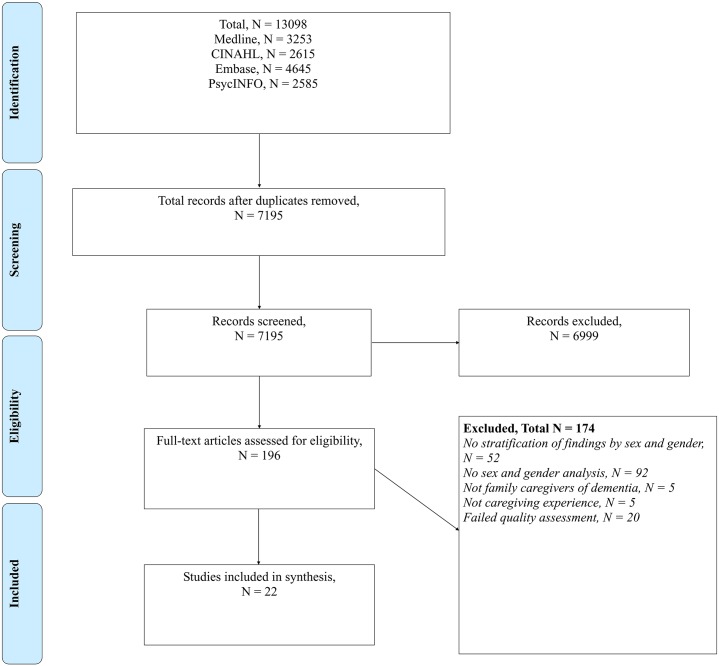
OBJECTIVES: Much is known about the demands of caregiving for persons with dementia (PWD) and its effects on family caregivers, however sex and gender aspects have received less attention. We synthesized the evidence on sex and gender distinctions in: (1) the caregiving burden and (2) the impact of caregiving on the physical and mental health of family caregivers of PWD. DESIGN: Systematic review. DATA SOURCES: Medline, Embase, PsycINFO and Cumulative Index to Nursing and Allied Health Literature between January 2007 and October 2019 were searched. ELIGIBILITY CRITERIA FOR SELECTING STUDIES: Included studies met the following criteria: (1) examine experiences and/or impacts of caregiving among family caregivers of individuals with any form of dementia; (2) report sex and/or gender distribution of study population and/or report results stratified by sex and/or gender, and (3) include both male and female family caregivers. DATA EXTRACTION AND SYNTHESIS: Two independent reviewers extracted the data and assessed risk of bias using the Critical Appraisal Skills Program checklist and National Institutes of Health Quality Assessment Tool for Observational Cohort and Cross-sectional Studies. Data were synthesized using a narrative synthesis approach. RESULTS: A total of 22 studies were included. Caregiving burden was measured using various methods. A majority of studies reported higher burden among females. All studies that did not report a sex and gender difference in caregiving burden accounted for confounders. Findings on sex and gender differences on physical and mental health conditions were inconsistent with most studies failing to account for confounders in their analyses. CONCLUSIONS: Current evidence on sex and gender differences in caregiving burden, mental and physical health is limited. Findings suggest presence of sex and gender differences in caregiving burden. Given the variety of mental and physical health constructs that were examined, further research is required to substantiate the evidence. PROPSERO Registration Number: CRD 42018070032.
Overview
The claims and statistics of this paper haven’t been checked yet.
Free: it reads the open-access text and checks the first 5 claims that cite a source we can check. Create a free account to check every claim.
Integrity signals
Registry
Cites
Statistics
Figures
Verification
Claims the paper makes
The claims and statistics of this paper haven’t been checked yet.
Free: it reads the open-access text and checks the first 5 claims that cite a source we can check. Create a free account to check every claim.
Claims other papers make about this one
Each is checked against this paper’s own text: does it say what the citing paper says it does?
The source backs part of the claim, not all of it — or backs it for a different population, condition or comparison.
In the citing paper
“Similarly, caregivers who are women may experience slightly higher levels of burden, impaired mood, depression and impaired health than caregivers who are men, with evidence suggesting that these differences arise because female caregivers tend to spend more time caregiving, assume more caregiving tasks, and care for someone with more cognitive, functional and/or behavioral problems.”
From 2023 Alzheimer's disease facts and figures (2023) · cites this paper as [417]
Experimental — accuracy not yet measured
Self-check
Percentages, sums and reported differences re-computed from the paper’s own numbers.
The self-check needs the paper’s full text.
Citations
Cites
Preferred Reporting Items for Systematic Reviews and Meta-Analyses: the PRISMA statement
Moher, D., Liberati, A., Tetzlaff, J., Altman, D. G., & for the PRISMA Group (2009) · BMJ · doi:10.1136/bmj.b2535 · Cited by 83,823
Preferred Reporting Items for Systematic Reviews and Meta-Analyses: The PRISMA Statement
Moher, D., Liberati, A., Tetzlaff, J., Altman, D. G., & The PRISMA Group (2009) · PLoS Medicine · doi:10.1371/journal.pmed.1000097 · Cited by 64,042 · cited 1×
“The presentation of the findings was guided by the Preferred Reporting Items for Systematic Reviews and MetaAnalyses (PRISMA) checklist [32].”
Preferred reporting items for systematic reviews and meta-analyses: the PRISMA Statement.
(2009) · PubMed Central · Cited by 44,859
Wang, G., Ma, R., Qiao, G., Wada, K., Aizawa, Y., & Satoh, T. (2015) · Integrative Medicine International · doi:10.1159/000368408 · Cited by 18,657
Critical appraisal skills programme
Singh, J. (2013) · Journal of Pharmacology and Pharmacotherapeutics · doi:10.4103/0976-500x.107697 · Cited by 2,556
Popay, J., Roberts, H., Sowden, A., Petticrew, M., Arai, L., Rodgers, M., Britten, N., Roen, K., & Duffy, S. (2006) · Lancaster University · doi:10.13140/2.1.1018.4643 · Cited by 2,070 · cited 4×
“The presentation of the findings was guided by the Preferred Reporting Items for Systematic Reviews and MetaAnalyses (PRISMA) checklist [32].”
InfluentialWhy is depression more prevalent in women?
Albert, P. R. (2015) · Journal of Psychiatry and Neuroscience · doi:10.1503/jpn.150205 · Cited by 1,785 · cited 1×
“nosed with depression than men [70], they may not necessarily reflect variations in the caregiving experiences between males and females.”
Canadian Institutes of Health Research
(2019) · The Grants Register 2020 · doi:10.1057/978-1-349-95943-3_219 · Cited by 1,466
Guidance on the conduct of narrative synthesis in sytematic reviews
Popay, J., Roberts, H. M., Sowden, A. J., Petticrew, M. P., Arai, L., Rodgers, M., & Britten, N. (2006) · Cited by 1,378
Application of a multidimensional caregiver burden inventory
Novak, M., & Guest, C. (1989) · The Gerontologist · doi:10.1093/geront/29.6.798 · Cited by 1,205 · cited 2×
“Additionally, two studies used the CBI, which like the ZBI, is a scale developed in the late1980s [68, 69].”
Cited by
2023 Alzheimer's disease facts and figures
(2023) · Alzheimer's & Dementia · doi:10.1002/alz.13016 · Cited by 3,212
2024 Alzheimer's disease facts and figures
(2024) · Alzheimer's & Dementia · doi:10.1002/alz.13809 · Cited by 2,536
2022 Alzheimer's disease facts and figures
(2022) · Alzheimer's & Dementia · doi:10.1002/alz.12638 · Cited by 2,341
2021 Alzheimer's disease facts and figures
(2021) · Alzheimer's & Dementia · doi:10.1002/alz.12328 · Cited by 2,201
2025 Alzheimer's disease facts and figures
(2025) · Alzheimer's & Dementia · doi:10.1002/alz.70235 · Cited by 474
Informal Caregiving, Loneliness and Social Isolation: A Systematic Review
Hajek, A., Kretzler, B., & König, H.-H. (2021) · International Journal of Environmental Research and Public Health · doi:10.3390/ijerph182212101 · Cited by 155
Zygouri, I., Cowdell, F., Ploumis, A., Gouva, M., & Mantzoukas, S. (2021) · BMC Health Services Research · doi:10.1186/s12913-021-06736-2 · Cited by 214
Cham, C. Q., Ibrahim, N., Siau, C. S., Kalaman, C. R., Ho, M. C., Yahya, A. N., Visvalingam, U., Roslan, S. B., Rahman, F. N. A., & Lee, K. W. (2022) · Healthcare · doi:10.3390/healthcare10122423 · Cited by 221
Rainero, I., Bruni, A. C., Marra, C., Cagnin, A., Bonanni, L., Cupidi, C., Laganà, V., Rubino, E., Vacca, A., Lorenzo, R. D., et al. (2021) · Frontiers in Aging Neuroscience · doi:10.3389/fnagi.2020.625781 · Cited by 148
Gender Differences in Family Caregiving. Do female caregivers do more or undertake different tasks?
Barzallo, D. P., Schnyder, A., Zanini, C., & Gemperli, A. (2024) · BMC Health Services Research · doi:10.1186/s12913-024-11191-w · Cited by 169
Acknowledging cancer as a family disease: A systematic review of family care in the cancer setting
Coyne, E., Heynsbergh, N., & Dieperink, K. B. (2020) · European Journal of Oncology Nursing · doi:10.1016/j.ejon.2020.101841 · Cited by 111
Caregiving Burden Among Caregivers of People With Dementia Through the Lens of Intersectionality
Liu, R., Chi, I., & Wu, S. (2022) · The Gerontologist · doi:10.1093/geront/gnab146 · Cited by 92
Impact of behavioral and psychological symptoms of Alzheimer’s disease on caregiver outcomes
Pinyopornpanish, K., Soontornpun, A., Wongpakaran, T., Wongpakaran, N., Tanprawate, S., Pinyopornpanish, K., Nadsasarn, A., & Pinyopornpanish, M. (2022) · Scientific Reports · doi:10.1038/s41598-022-18470-8 · Cited by 89
García-Martín, V., de Hoyos-Alonso, M. C., Delgado-Puebla, R., Ariza-Cardiel, G., & del Cura-González, I. (2023) · BMC Geriatrics · doi:10.1186/s12877-023-04234-0 · Cited by 83
Does Caregiving Strain Increase as Patients With and Without Dementia Approach the End of Life?
Vick, J. B., Ornstein, K. A., Szanton, S. L., Dy, S. M., & Wolff, J. L. (2019) · Journal of Pain and Symptom Management · doi:10.1016/j.jpainsymman.2018.11.004 · Cited by 68
Dementia caregiving across Latin America and the Caribbean and brain health diplomacy
Ibáñez, A., Pina-Escudero, S. D., Possin, K. L., Quiroz, Y. T., Peres, F. A., Slachevsky, A., Sosa, A. L., Brucki, S. M. D., & Miller, B. L. (2021) · The Lancet Healthy Longevity · doi:10.1016/s2666-7568(21)00031-3 · Cited by 65
Factors associated with family caregiver burden among frail older persons with multimorbidity
Ding, T. Y. G., De Roza, J. G., Chan, C. Y., Lee, P. S. S., Ong, S. K., Lew, K. J., Koh, H. L., & Lee, E. S. (2022) · BMC Geriatrics · doi:10.1186/s12877-022-02858-2 · Cited by 58
Alshammari, B., Noble, H. R., McAneney, H., Alshammari, F., & O’Halloran, P. D. (2021) · Healthcare · doi:10.3390/healthcare9091212 · Cited by 82
Zwar, L., König, H., & Hajek, A. (2022) · Gerontology · doi:10.1159/000523846 · Cited by 70
Gender Differences in Adverse Psychosocial Outcomes among Family Caregivers: A Systematic Review
Bueno, M., & Chase, J. D. (2022) · Western Journal of Nursing Research · doi:10.1177/01939459221099672 · Cited by 64
Martínez-Cao, C., de la Fuente-Tomás, L., Menéndez-Miranda, I., Velasco, Á., Madera, P. Z., García-Álvarez, L., Sáiz, P. A., García‐Portilla, M. P., & Bobes, J. (2021) · Addictive Behaviors · doi:10.1016/j.addbeh.2021.107003 · Cited by 57
“The literature also reflects that females are more often caregivers and experience a greater burden than their male counterparts (Xiong et al., 2020).”
Scerbe, A., O’Connell, M. E., Astell, A. J., Morgan, D., Kosteniuk, J. G., Panyavin, I. S., DesRoches, A., & Webster, C. (2023) · PLoS ONE · doi:10.1371/journal.pone.0283600 · Cited by 65
Self-citationGoto, Y., Morita, K., Suematsu, M., Imaizumi, T., & Suzuki, Y. (2023) · Internal Medicine · doi:10.2169/internalmedicine.0911-22 · Cited by 74
Rigby, T., Johnson, D. K., Taylor, A., & Galvin, J. E. (2021) · Journal of Alzheimer s Disease · doi:10.3233/jad-201326 · Cited by 52
“Male caregivers may experience these constructs in very different ways [9, 51].”
2026 Alzheimer's disease facts and figures
Alzheimer's, T. S. O. A. D. A. A. W. S. C. I. T. B. I., neurons, T. B. N. A. E. A. A. H. A. B. H. B. O., long, E. W., connections, B. E. T. E. E. I. N. T. F. C. W. O. N. A. S., synapses, C., memories, I. F. I. T. B. O. C. T. A. R. B. O. N. A. T. U. B. A. N. T. B. C. T. O. S. T. A. S. T. T. R. T. T. B. T. S. F. T. C. B. O., thoughts, sensations, emotions, & skills., M. A. (2026) · Alzheimer s & Dementia · doi:10.1002/alz.71345 · Cited by 124
Alzheimer disease seen through the lens of sex and gender
Castro‐Aldrete, L., Einsiedler, M., Martínková, J., Depypere, H. T., Ang, T. F. A., Mielke, M. M., Sindi, S., Eyre, H. A., Au, R., Dimech, A. S., et al. (2025) · Nature Reviews Neurology · doi:10.1038/s41582-025-01071-0 · Cited by 50
“These investigations range from preclinical 3,4 and clinical 5–7 studies to psychosocial perspectives, including caregiver-reported outcomes 8,9 , applications of artificial intelligence 8,9 , and ethical considerations 10 .”
Schaffler‐Schaden, D., Krutter, S., Seymer, A., Eßl‐Maurer, R., Flamm, M., & Osterbrink, J. (2021) · Brain Sciences · doi:10.3390/brainsci11111511 · Cited by 50
The integration of sex and gender considerations in health policymaking: a scoping review
Williams, A., Lyeo, J. S., Geffros, S., & Mouriopoulos, A. (2021) · International Journal for Equity in Health · doi:10.1186/s12939-021-01411-8 · Cited by 43
Rico-Blázquez, M., Quesada-Cubo, V., Polentinos-Castro, E., Sánchez-Ruano, R., Rayo-Gómez, M. Á., del Cura-González, I., CuidaCare Group, Rico-Blázquez, M., Almena-Martín, R., Almodovar-López, Á., et al. (2022) · BMC Nursing · doi:10.1186/s12912-022-00845-x · Cited by 43
Steinsheim, G., Malmedal, W., Follestad, T., Olsen, B., & Saga, S. (2023) · BMC Geriatrics · doi:10.1186/s12877-023-04358-3 · Cited by 51
“Although several previous studies have explored factors associated with caregiver burden, there are still inconsistencies and uncertainties including sex and gender differences [31] and the effect of caregiver age on burden [17].”
BackgroundDuangjina, T., Jeamjitvibool, T., Park, C., Raszewski, R., Gruss, V. A., & Fritschi, C. (2025) · Archives of Gerontology and Geriatrics · doi:10.1016/j.archger.2025.105977 · Cited by 48
Ng, W. I., Che, S. L., Li, X., & Zhu, M. (2024) · BMC Public Health · doi:10.1186/s12889-024-18197-3 · Cited by 33
“Females have undertaken the primary responsibility for providing care to their parents during the terminal stage [45, 46], and it is the concrete embodiment of filial behavior.”
BackgroundTomczyk, S., Altweck, L., & Schmidt, S. (2021) · BMC Public Health · doi:10.1186/s12889-021-11712-w · Cited by 37
Kustanti, C. Y., Chu, H., Kang, X. L., Pien, L., Chen, R., Tsai, H., & Chou, K. (2022) · BMJ Supportive & Palliative Care · doi:10.1136/bmjspcare-2021-003338 · Cited by 44
“Females, who are the main providers of informal caregiving for a relative with a life-threatening illness, have a higher risk of psychological problems due to caregiving respon-sibilities, 48 and their caring roles are strongly emphasised as a spouse in the marital relationship.”
BackgroundLiang, J., Aranda, M., Jang, Y., Wilber, K. H., Chi, I., & Wu, S. (2022) · The Journals of Gerontology Series B · doi:10.1093/geronb/gbac067 · Cited by 31
Negative Impact and Positive Value of Caregiving in Spouse Carers of Persons with Dementia in Sweden
Johansson, M. F., McKee, K., Dahlberg, L., Meranius, M. S., Williams, C. L., & Hammar, L. M. (2022) · International Journal of Environmental Research and Public Health · doi:10.3390/ijerph19031788 · Cited by 34
Tan, K. P., Ang, J. K., Koh, E. B. Y., Pang, N. T. P., & Mat Saher, Z. (2023) · International Journal of Environmental Research and Public Health · doi:10.3390/ijerph20054232 · Cited by 23
Mahomed, A., & Pretorius, C. (2022) · Dementia · doi:10.1177/14713012221118441 · Cited by 36
The impact of sex and gender on burden for caregivers of stroke patients: A narrative review
Comer, A. R., Roeder, H. J., Jones, A., Jawed, A., & Kramer, N. M. (2024) · Journal of Stroke and Cerebrovascular Diseases · doi:10.1016/j.jstrokecerebrovasdis.2024.107854 · Cited by 25
Impact of Aging on Consumer Behavior: A Review and Research Agenda
Zheng, Z., M, H. B. A., Zaki, H. O., & Tan, Q. L. (2024) · International Journal of Consumer Studies · doi:10.1111/ijcs.70000 · Cited by 29
Gender impact of caring on the health of caregivers of persons with dementia
Martinez‐Santos, A., Facal-Mayo, D., Vicho‐de‐la‐Fuente, N., Vilanova‐Trillo, L., Gandoy‐Crego, M., & Rodríguez‐González, R. (2021) · Patient Education and Counseling · doi:10.1016/j.pec.2021.02.017 · Cited by 31
Ndlovu, J. T., & Mokwena, K. E. (2023) · Healthcare · doi:10.3390/healthcare11192686 · Cited by 30
“The finding that most family caregivers were female was previously reported in other studies conducted both in developing and developed countries, where care-giving responsibilities were assumed mostly by females [5,17,18], and the burden of care was higher among females [19,20].”
ResultKim, B., Wister, A., Mitchell, B., Li, L., & Kadowaki, L. (2024) · BMC Health Services Research · doi:10.1186/s12913-024-11549-0 · Cited by 21
Domínguez-Vergara, J., Santa-Cruz-Espinoza, H., & Chávez-Ventura, G. (2023) · European Journal of Investigation in Health Psychology and Education · doi:10.3390/ejihpe13020029 · Cited by 43
Retractedde Graaff, M., van der Heide, I., Rademakers, J. J. D. J. M., van Valkengoed, I. G. M., Francke, A. L., Woonink, A., & Bijnsdorp, F. M. (2025) · BMC Geriatrics · doi:10.1186/s12877-025-05795-y · Cited by 26
Jhang, K.-M., Wang, W., Chang, H.-F., Chang, M., & Wu, H. (2021) · Risk Management and Healthcare Policy · doi:10.2147/rmhp.s297204 · Cited by 22
Carmel, S., Singer, Y., Yosef-Sela, N., & Bachner, Y. G. (2020) · European Journal of Oncology Nursing · doi:10.1016/j.ejon.2020.101828 · Cited by 22
Gorostiaga, A., Etxeberría, I., Salaberría, K., & Kortabitarte, I. (2022) · Healthcare · doi:10.3390/healthcare10061102 · Cited by 32
Vespa, A., Spatuzzi, R., Fabbietti, P., Penna, M., & Giulietti, M. V. (2021) · PLoS ONE · doi:10.1371/journal.pone.0251813 · Cited by 22
Psychometric properties of the Insomnia Severity Index in a sample of family dementia caregivers
Jiménez-Gonzalo, L., Romero-Moreno, R., Pedroso-Chaparro, M. D. S., Gallego-Alberto, L., Barrera-Caballero, S., Olazarán, J., & Losada-Baltar, A. (2021) · Sleep Medicine · doi:10.1016/j.sleep.2021.03.036 · Cited by 16
Li, W., Manuel, D. G., Isenberg, S. R., & Tanuseputro, P. (2022) · BMC Geriatrics · doi:10.1186/s12877-022-03583-6 · Cited by 21
Factors associated with psychological distress in caregivers of patients with malignant gliomas
Forst, D. A., Podgurski, A. F., Quain, K. M., Landay, S. L., Anand, M., Kaslow-Zieve, E., Mesa, M. M., Jacobs, J. M., Dietrich, J., Parsons, M. W., et al. (2022) · Supportive Care in Cancer · doi:10.1007/s00520-022-06989-5 · Cited by 16
Enhancing brain health in the global south through a sex and gender lens
Baez, S., Castro-Aldrete, L., Britton, G. B., Ibañez, A., & Santuccione-Chadha, A. (2024) · Nature Mental Health · doi:10.1038/s44220-024-00339-6 · Cited by 15
“In this region, most informal caregivers are women, who face higher stress, more depressive symptoms and poorer health than men 75 .”
Sex Differences in Mortality and Health Care Utilization After Dementia Diagnosis
Lusk, J. B., Ford, C. B., Soneji, S. S., Blass, B., Rosa, T. D., Kaufman, B. G., Mantri, S., Fan, L., Grory, B. M., Xian, Y., et al. (2025) · JAMA Neurology · doi:10.1001/jamaneurol.2025.2236 · Cited by 17
Tsehay, M., Necho, M., Belete, A., & Srahbzu, M. (2022) · PLoS ONE · doi:10.1371/journal.pone.0271885 · Cited by 17
Ching’oma, C. D., Mkoka, D. A., Ambikile, J. S., & Iseselo, M. K. (2022) · PLoS ONE · doi:10.1371/journal.pone.0267773 · Cited by 29
Fernández-Ruiz, V. E., Paredes-Ibáñez, R., Armero‐Barranco, D., Sánchez-Romera, J. F., & Ferrer, M. (2020) · Life · doi:10.3390/life11010022 · Cited by 18
A Comprehensive Program of activities to develop sustainable core skills in novice scientists
Власенко, К. В., Rovenska, O. G., Чумак, О., Лов'янова, І. В., & Achkan, V. V. (2021) · Journal of Physics Conference Series · doi:10.1088/1742-6596/1946/1/012017 · Cited by 16
Kagwa, A. S., Konradsen, H., & Kabir, Z. N. (2022) · BMC Health Services Research · doi:10.1186/s12913-022-08704-w · Cited by 14
Chan, A. S. W., Leung, L. M., Li, J. S. F., Ho, J. M. C., Tam, H. L., Hsu, W. L., Iu, A. N. O. S., Tang, P. M., & Yan, E. (2022) · Frontiers in Public Health · doi:10.3389/fpubh.2022.912980 · Cited by 17
Ngamasana, E. L., Zarwell, M., & Gunn, L. H. (2023) · BMC Public Health · doi:10.1186/s12889-023-17164-8 · Cited by 19
“…average number of days of poor physical health (on average more than 13 days of poor physical health), however after the COVID-19 NED older (55 + years) Hispanic ICs and middle age [25–44] ICs of non-Hispanic other race origins had the lowest average number of days of poor physical health (Fig.”
Cohen, S. A., Nash, C. C., & Greaney, M. L. (2024) · Frontiers in Public Health · doi:10.3389/fpubh.2024.1423457 · Cited by 20
Robinson, R. R., Notch, J. J., McHuron, A. S., Logston, R., Pham, T., & Ammann, A. J. (2021) · Animal Biotelemetry · doi:10.1186/s40317-021-00246-y · Cited by 15
Patel, K. J., Yang, D., Feldman, H., Hsiung, G. R., Nygaard, H. B., Best, J. R., Dwosh, E., Robillard, J. M., & DeMarco, M. L. (2024) · Alzheimer s & Dementia Translational Research & Clinical Interventions · doi:10.1002/trc2.12463 · Cited by 14
“With female caregivers of people living with dementia experiencing a greater caregiving burden, 34 it was not surprising to find that themes regarding future caregiving and planning were largely voiced by female care partners.”
Hout, E. V., Contreras, M., Mioshi, E., & Kishita, N. (2024) · Dementia · doi:10.1177/14713012241286559 · Cited by 21
“By 2050, it is expected that more than 131 million people will have dementia worldwide (Xiong et al., 2020).”
Chang, C.-C., Wang, W.-F., Li, Y.-Y., Chen, Y.-A., Chen, Y.-J., Liao, Y.-C., Jhang, K.-M., & Wu, H.-H. (2021) · Risk Management and Healthcare Policy · doi:10.2147/rmhp.s316361 · Cited by 12
Social support and healthcare utilization of caregivers of Latinas with breast cancer
Hebdon, M., Badger, T. A., Segrin, C. G., & Pasvogel, A. E. (2021) · Supportive Care in Cancer · doi:10.1007/s00520-020-05983-z · Cited by 20
Caregiving for a Spouse with Cognitive Impairment: Effects on Nutrition and Other Lifestyle Factors
Jeon, S. Y., & Kim, J. L. (2021) · Journal of Alzheimer s Disease · doi:10.3233/jad-210694 · Cited by 16
Zwar, L., König, H., & Hajek, A. (2022) · Gerontology · doi:10.1159/000527745 · Cited by 13
Wasmani, A., Rahnama, M., Abdollahimohammad, A., Badakhsh, M., & Hashemi, Z. (2022) · Asian Pacific Journal of Cancer Prevention · doi:10.31557/apjcp.2022.23.3.1077 · Cited by 21
Development and validation of the caregiver needs and resources assessment
Li, K., Leung, C. L. K., Yeung, D. Y.-L., Chiu, M. Y.-L., Chong, A. M. L., Lam, B. C. Y., Chung, E. K. H., & Lo, T. W. (2023) · Frontiers in Psychology · doi:10.3389/fpsyg.2023.1063440 · Cited by 16
“This evidence again supported the notion of the gendered nature of caregiving (Xiong et al., 2020).”
Unmet needs and depression among spousal caregivers: the mediating role of marital satisfaction
Zhao, X., Zhang, Q., Xu, H., Li, X., LOU, V. W. Q., & Liu, H. (2023) · Aging & Mental Health · doi:10.1080/13607863.2023.2194851 · Cited by 13
“The majority of them indicated that female caregivers reported greater levels of burden and depression than male caregivers (Pinquart & Sörensen, 2006; Sharma et al., 2016; Xiong et al., 2020).”
Dieker, J. L., Yun, S. W., Weber, K., & Qualls, S. H. (2023) · Aging & Mental Health · doi:10.1080/13607863.2023.2282683 · Cited by 15
“A recent meta-analytic review suggested that female caregivers report more burden overall across studies (Xiong et al., 2020).”
BackgroundLessons Learned from Introducing Last Aid Courses at a University Hospital in Germany
Mueller, E., Bollig, G., Becker, G., & Boehlke, C. S. (2021) · Healthcare · doi:10.3390/healthcare9070906 · Cited by 11
Association between caregivers' health‐related quality of life and care recipients' health outcomes
Hoshino, J., Tamakoshi, K., Hori, Y., & Sakakibara, H. (2022) · International Journal of Nursing Practice · doi:10.1111/ijn.13044 · Cited by 14
Montero-Cuadrado, F., Barrero-Santiago, L., Llamas-Ramos, R., & Llamas-Ramos, I. (2022) · International Journal of Environmental Research and Public Health · doi:10.3390/ijerph20010185 · Cited by 10
Brothers and sisters sharing in the care of a parent with dementia
Kokorelias, K. M., Rittenberg, N., Law, A., Wan, N. T. C., Machon, J., Arfeen, Y., & Cameron, J. I. (2022) · Dementia · doi:10.1177/14713012211053970 · Cited by 17
Self-citationMoreno, G., Vicent, L., Rosillo, N., Delgado, J., del Cerro, E. P., & Bueno, H. (2024) · American Journal of Preventive Cardiology · doi:10.1016/j.ajpc.2024.100713 · Cited by 13
Sex and gender differences in genetic and lifestyle risk and protective factors for dementia
Sindi, S., Toopchiani, S. T., Barbera, M., Håkansson, K., Lehtisalo, J., Rosenberg, A., Stephen, R., Udeh‐Momoh, C. T., & Kivipelto, M. (2021) · Elsevier eBooks · doi:10.1016/b978-0-12-819344-0.00013-2 · Cited by 15
Wawrziczny, É., Antoine, P., & Doba, K. (2021) · Journal of Alzheimer s Disease · doi:10.3233/jad-210624 · Cited by 14
Wolverson, E., Moniz-Cook, E. D., Dunn, R., & Dunning, R. (2022) · Age and Ageing · doi:10.1093/ageing/afac047 · Cited by 12
Razafimahatratra, S., Guieysse, T., Lejeune, F., Houot, M., Medani, T., Dreyfus, G., Klarsfeld, A., Villain, N., Pereira, F. R., Corte, V. L., et al. (2023) · Cortex · doi:10.1016/j.cortex.2023.05.014 · Cited by 14
Olson, J. L., Papathomas, A., Kritz, M., Ntoumanis, N., Quested, E., & Thøgersen‐Ntoumani, C. (2021) · Journal of Aging and Physical Activity · doi:10.1123/japa.2021-0009 · Cited by 9
“Similarly, female caregivers to family members with cancer appear to experience greater burden than males (Xiong et al., 2020), and wives caring for a spouse with dementia appear to experience higher levels of strain and lower levels of morale than husband carers (Collins & Jones, 1997).”
Shen, S., & Liu, H. (2023) · The Journal of Sex Research · doi:10.1080/00224499.2023.2238257 · Cited by 10
“Furthermore, more women than men are caregiving for a spouse with dementia (Erol et al., 2015), and women experience a greater caregiver burden than men (Pöysti et al., 2012; Xiong et al., 2020).”
Sex Differences in Late-Life Depression: Where Do We Go from Here?
Barry, L. C., & Zdanys, K. F. (2023) · Public Policy & Aging Report · doi:10.1093/ppar/prad022 · Cited by 9
Grewal, K. S., Gowda-Sookochoff, R., Peacock, S., Cammer, A. L., McWilliams, L. A., Spiteri, R. J., Haase, K. R., Harrison, M., Holtslander, L. F., MacRae, R., et al. (2024) · JMIR Formative Research · doi:10.2196/63041 · Cited by 12
“For example, in a survey of informal care partners, men, on average, held more positive attitudes toward technology (eg, being willing to spend more money), while women tended to have more knowledge of the caregiving capabilities of technology [66].”
InfluentialSchiefer, D., & Nowicka, M. (2024) · Population Space and Place · doi:10.1002/psp.2866 · Cited by 12
WATER DEFICIT ON GROWTH AND PHYSIOLOGICAL INDICATORS OF Bidens pilosa L. AND Bidens subalternans DC.
de Freitas, M. A. M., Lins, H. A., Souza, M. D. F., Carneiro, G. D. O. P., Mendonça, V., & Silva, D. V. (2021) · Revista Caatinga · doi:10.1590/1983-21252021v34n215rc · Cited by 9
Hout, E. V., Contreras, M., Mioshi, E., & Kishita, N. (2022) · Journal of Geriatric Psychiatry and Neurology · doi:10.1177/08919887221093359 · Cited by 11
Richards, K. C., Radhakrishnan, K., Britt, K. C., Vanags-Louredo, A., Park, E. Y., Gooneratne, N. S., & Fry, L. (2022) · Research in Gerontological Nursing · doi:10.3928/19404921-20220829-01 · Cited by 10
İpek, L., & Gencer, G. Y. G. (2024) · Journal of Clinical Neuroscience · doi:10.1016/j.jocn.2024.06.007 · Cited by 9
Cicero, C. E., Angelini, L., Abbadessa, G., Bruno, M., Fiume, G., Nucera, B., Ornello, R., Arabia, G., Giuliano, L., Guarnieri, B., et al. (2026) · Neurological Sciences · doi:10.1007/s10072-025-08623-8 · Cited by 12
Pavarini, S. C. I., Brígola, A. G., Luchesi, B. M., de Oliveira, N. A., & Ottaviani, A. C. (2023) · Dementia & Neuropsychologia · doi:10.1590/1980-5764-dn-2022-0030 · Cited by 16
Kobayashi, M., & 本田, 美. (2021) · BMC Geriatrics · doi:10.1186/s12877-021-02373-w · Cited by 14
Vaismoradi, M., Behboudi‐Gandevani, S., Lorenzl, S., Weck, C. E., & Paal, P. (2021) · Frontiers in Neurology · doi:10.3389/fneur.2021.694572 · Cited by 8
Exploring caregiving stressors and informal resources among Alzheimer's caregivers
Zhao, Y., Hughes, M., & Teaster, P. B. (2022) · Aging and Health Research · doi:10.1016/j.ahr.2022.100091 · Cited by 8
Gender and care: Does gender modify the mental health impact of adolescent care?
Alfonzo, L. F., Singh, A., Disney, G., & King, T. L. (2023) · SSM - Population Health · doi:10.1016/j.ssmph.2023.101479 · Cited by 8
Toleuov, E., Inoue, K., Akkuzinova, K., Moldagaliyev, T., Seksenbayev, N., Jamedinova, U., Takeshita, H., Fujita, Y., Ospanova, N., & Dyussupov, A. (2025) · Healthcare · doi:10.3390/healthcare13202633 · Cited by 8
“A systematic review revealed that caregivers of dementia patients exhibited a significant prevalence of self-reported depression and compromised physical health, including sleep disturbances, weakened immunity, and an early onset of asthenic syndrome [17].”
[The perspective of caregivers from a gender analysis.]
Quiles, Á. S., Alcañiz-Garrán, M. D. M., Montejano‐Lozoya, R., Ramos‐Pichardo, J. D., & García‐Sanjuán, S. (2023) · PubMed Central · Cited by 10
Finding a balance in family caregiving for people with dementia: A correlational longitudinal study
Liu, H., Hsu, W., Shyu, Y. L., Wang, Y., Huang, T., Lin, Y., & Huang, C. (2021) · Journal of Advanced Nursing · doi:10.1111/jan.14747 · Cited by 9
Metadata
- Authors
- Xiong, C., Biscardi, M., Astell, A., Nalder, E., Cameron, J. I., Mihailidis, A., & Colantonio, A.
- Affiliations
- University Health Network (CA)
- University of Toronto (CA)
- Corresponding author
- Xiong, Chen
- ORCID
- Venue
- PLOS ONE
- Publisher
- Public Library of Science (PLoS)
- Published
- 2020-04-20
- Volume
- 15
- Issue
- 4
- Pages
- e0231848
- ISSN
- 1932-6203 (ISSN-L)
- PMC
- PMC7170244
- OpenAlex
- W2886320675
- Cited by
- 290
- References
- 83
- Citations by year
- 2026: 35 · 2025: 54 · 2024: 46 · 2023: 43 · 2022: 45 · 2021: 57 · 2020: 8
- FWCI
- 6.33
- Type
- journal article
- Language
- en
- Open access
- gold
- doi.org
- Licence
- Locations
- PLoS ONE (publishedVersion, cc-by)
- PubMed Central (publishedVersion, cc-by)
- PubMed (publishedVersion)
- CentAUR (University of Reading) (acceptedVersion, other-oa)
- RePEc: Research Papers in Economics (submittedVersion)
- DOAJ (DOAJ: Directory of Open Access Journals) (submittedVersion, cc-by-sa)
- Figshare (submittedVersion, cc-by)
- Funders
- Institute of Gender and Health (CGW-126580, SGB-155385)
- Topics
- Health Sciences › Medicine › Psychiatry and Mental health › Dementia and Cognitive Impairment Research
- Health Sciences › Nursing › Research and Theory › Nursing care and research
- Social Sciences › Sociology and Political Science › Intergenerational Family Dynamics and Caregiving
- Keywords
- dementia, family caregivers, caregiver burden, sex differences, gender differences, caregiver physical health, caregiver mental health, women caregivers
- MeSH terms
- Dementia, Humans, Mental Health, Quality of Life, Self Concept, Sex Factors, Stress, Psychological, Databases, Factual, Caregivers
About these checks
Registry, retraction, Cites and statistics results are computed, not judged, with one exception: a printed reference that no index lists is read once by a model before it counts as a citation error. Claims are extracted by a model and kept only when their quote appears verbatim in the text; each cited source is then checked, with a model’s help, for whether it says what the claim relies on. Those verdicts can be wrong — read the claim’s quote and the cited source before relying on one.
Statistics and arithmetic are recomputed, not judged.
Confidence bands are shown only for fields calibrated on our annotated test set. None is calibrated yet, so no band is shown.
What counts as a claim ›How we measure confidence ›How we check this ›
Are you an author, or do you see a problem with this page? Request a review
Data sources
Bibliographic data: Semantic Scholar, OpenAlex, Crossref.
Contains information from the Semantic Scholar Academic Graph Datasets, made available under the ODC Attribution License (ODC-BY 1.0).
Semantic Scholar’s data is described in: Kinney, R., et al. (2023). The Semantic Scholar Open Data Platform. arXiv:2301.10140.
