

Acceptance and commitment therapy versus mindfulness-based stress reduction for newly diagnosed head and neck cancer patients: A randomized controlled trial assessing efficacy for positive psychology, depression, anxiety, and quality of life
Open accessThe DOI matches its Crossref record; 67 of the 70 references it cites were found in a registry or an index, and 1 are not checked yet; 13 of the 73 sources its claims cite were checked for support.
Abstract
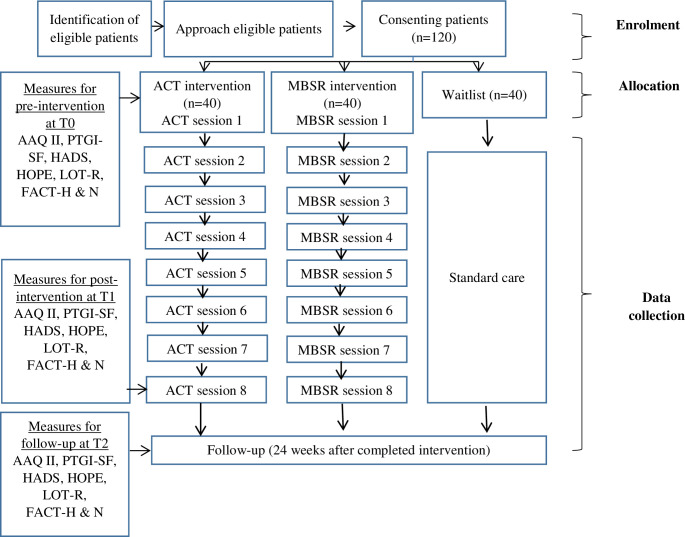
Background and aim Head and neck cancer patients are vulnerable to various psychological complications due to the effects of both cancer itself and cancer treatment on patients’ appearance and physical well-being. Nevertheless, few data have been obtained on effective psychosocial interventions that could protect this group of cancer patients’ psychological well-being. Therefore, this three-armed, parallel-group, double-blind, randomized control trial (RCT) aims to evaluate and compare the effects of acceptance and commitment therapy (ACT) and mindfulness-based stress reduction (MBSR) on positive psychology (such as posttraumatic growth [PTG], hope, and optimism), quality of life (QoL), and psychological complications (depression, anxiety, and experiential avoidance) among newly diagnosed head and neck cancer patients. Methods and analysis This RCT will target newly diagnosed head and neck cancer patients who have been treated only with surgery or who have not yet received any treatment. In total, 120 patients who meet all of the study’s inclusion criteria and none of its exclusion criteria will be randomly assigned into three groups—an ACT group, an MBSR group, and a treatment-as-usual control group—at a 1:1:1 allocation ratio. Participants in the two intervention groups (the ACT and MBSR groups) will undergo an eight-week group intervention program. During this program, each intervention will comprise eight modules based on ACT and MBSR, respectively. Outcome assessments will be performed across a three-point timeline, including before the intervention (t0), immediately after the psychosocial intervention at eight weeks (t1), and six months after the intervention (t2). The primary outcome that will be assessed during this RCT is PTG. Meanwhile, the secondary outcomes that will be evaluated in this study are such as QoL, hope, optimism, depression, anxiety, and experiential avoidance. Copyright: © 2022 Zhang et al. This is an open access article distributed under the terms of the Creative Commons Attribution License, which permits unrestricted use, distribution, and reproduction in any medium, provided the original author and source are credited.
Verified 2026-11-22 · 1 reference not checked yet
Overview
CoChat Summary
## TL;DR
This paper is a three-armed, parallel-group, double-blind randomized controlled trial protocol comparing acceptance and commitment therapy (ACT), mindfulness-based stress reduction (MBSR), and treatment as usual in newly diagnosed head and neck cancer patients. It is designed to test whether ACT or MBSR improves posttraumatic growth, hope, optimism, quality of life, depression, anxiety, and experiential avoidance over 8 weeks and at 24 weeks follow-up.
## Key findings
- Not stated in the paper.
- The planned total sample size is 120 patients, with 40 per group; the power calculation indicated 93 participants were needed for three equal groups to achieve 0.8 power, assuming a 0.15 effect size and 0.05 alpha, and the authors inflated this by 30% for dropout.
- The primary outcome is posttraumatic growth (PTG) measured by the Malay PTGI-SF; secondary outcomes are quality of life, hope, optimism, depression, anxiety, and experiential avoidance.
- The intervention schedule is 8 weekly sessions for ACT and MBSR, with assessments at baseline (t0), 8 weeks (t1), and 24 weeks after intervention (t2).
## Methods
- Design: Multicentre, three-armed, parallel-group, double-blind RCT with 1:1:1 allocation to ACT, MBSR, or treatment-as-usual control.
- Sample/data: Newly diagnosed head and neck cancer patients in Malaysia, treated only with surgery or not yet treated; inclusion required age ≥18, willingness to read/write Malay, and depression/anxiety symptoms with HADS ≥8 on both subscales.
- Analysis: One-way ANOVA with false discovery rate adjustment at each time point, then mixed linear models across time points controlling for age and gender; analyses follow the intention-to-treat principle, with significance set at p < 0.05.
## Limitations
- The paper states that using only a maximum of four therapists may limit generalizability.
- The authors note that if missing data exceed 40% or are not missing at random, only collected data will be analyzed and this will be treated as a research limitation.
- Evident from the text: this is a trial protocol, so the paper reports planned methods and outcomes rather than results.
Model-written summary. Check it against the paper before relying on it.
Integrity signals
Registry
Cites
Statistics
Figures
Verification
Claims the paper makes
10 Valid · 1 Not valid · 34 Not checked · 16 Own results and interpretations
The cited sources support only part of this claim — read each source’s verdict below.
In the paper
“Some studies have found that head and neck cancer is associated with the highest documented rates of depression and anxiety compared with other cancer types [5].”
§ Acceptance and commitment therapy versus mindfulness-based stress reduction for newly diagnosed head and neck cancer patients: A randomized controlled trial assessing efficacy for positive psychology, depression, anxiety, and quality of life > Introduction > Head and neck cancer and its associated psychological issues
What the sources say
- Partly supportedcites [5] Massie MJ. Prevalence of depression in patients with cancer. J Natl Cancer Inst Monogr. 2004; 32: 57– 71. doi: 10.1093/jncimonographs/lgh014 15263042 sourceExperimental — accuracy not yet measured
The section “Cancer Types Highly Associated With Depression” lists oropharyngeal cancer among the types with high depression prevalence (22%–57%). It does not establish that head and neck cancer has the highest depression rate across cancer types, and the passages on head and neck cancer do not make a comparable claim about anxiety. Page numbers were not provided in our copy. (LLM, conf=0.88)
hedgedstates an association- Asserted: passes — The authors put it forward as true.
- Checkable: passes — It can be checked against evidence.
- Load-bearing: unclear — It is unclear whether the paper’s conclusions depend on it.
- Based: passes — The paper gives a reason why it holds.
- Partly supported
The cited sources support only part of this claim — read each source’s verdict below.
In the paper
“PTG is important and should be emphasized as a positive psychological characteristic among cancer patients because it inversely correlates with depression and psychological distress [14, 15].”
§ Acceptance and commitment therapy versus mindfulness-based stress reduction for newly diagnosed head and neck cancer patients: A randomized controlled trial assessing efficacy for positive psychology, depression, anxiety, and quality of life > Introduction > Head and neck cancer and its associated psychological issues
What the sources say
- Not checked — no full text of the sourcecites [14] Shand LK, Cowlishaw S, Brooker JE, Burney S, Ricciardelli LA. Correlates of post‐traumatic stress symptoms and growth in cancer patients: A systematic review and meta‐analysis. Psychooncology. 2015; 24(6); 624– 634. doi: 10.1002/pon.3719 25393527 source
- Partly supportedcites [15] Casellas‐Grau A, Ochoa C, Ruini C. Psychological and clinical correlates of posttraumatic growth in cancer: A systematic and critical review. Psychooncology. 2017; 26(12): 2007– 2018. doi: 10.1002/pon.4426 28317221 sourceExperimental — accuracy not yet measured
The Abstract reports an inverse association between PTG and depressive symptoms, and the distress section reports an inverse relationship in four of six studies. But the Anxiety and depression section says most studies found no relationship with PTG, and one found a direct relationship with depressive symptoms. The claim presents these mixed findings as an unqualified pattern. (LLM, conf=0.87)
plainstates an association- Asserted: passes — The authors put it forward as true.
- Checkable: passes — It can be checked against evidence.
- Load-bearing: unclear — It is unclear whether the paper’s conclusions depend on it.
- Based: passes — The paper gives a reason why it holds.
The sources with a verdict support this claim; the rest weren’t checked yet, have no full text we could read, or their verdicts aren’t rated yet.
In the paper
“Since head and neck cancer is associated with a wide range of illness complications and adverse treatment effects that can reduce QoL [32–34], psychosocial interventions that could enhance head and neck cancer patients’ QoL must be investigated.”
§ Acceptance and commitment therapy versus mindfulness-based stress reduction for newly diagnosed head and neck cancer patients: A randomized controlled trial assessing efficacy for positive psychology, depression, anxiety, and quality of life > Introduction > Head and neck cancer and its associated psychological issues
What the sources say
- Supportedcites [32] Holtmaat K, van der Spek N, Cuijpers P, Leemans CR, Verdonck-de Leeuw IM. Posttraumatic growth among head and neck cancer survivors with psychological distress. Psychooncology. 2017; 26(1): 96– 101. doi: 10.1002/pon.4106 26918531 source
The Background states that head and neck cancer survivors face consequences of the cancer and its treatment, including pain, fatigue, speech and swallowing problems, and changes in facial appearance. It explicitly says these effects negatively affect health-related quality of life. (LLM, conf=0.93)
- Not checked — no full text of the sourcecites [33] Sharp L, Redfearn D, Timmons A, Balfe M, Patterson J. Posttraumatic growth in head and neck cancer survivors: is it possible and what are the correlates? Psychooncology. 2018; 27(6): 1517– 1523. doi: 10.1002/pon.4682 29473248 source
- Could not verifycites [34] Ernst J, Mehnert A, Dietz A, Hornemann B, Esser P. Perceived stigmatization and its impact on quality of life—results from a large register-based study including breast, colon, prostate and lung cancer patients. BMC Cancer. 2017; 17(1): 741. doi: 10.1186/s12885-017-3742-2 29121876 PMC5680772 sourceExperimental — accuracy not yet measured
The Background mentions head and neck cancer only in a comparison of stigmatization levels. The study examines quality of life in patients with breast, colon, prostate and lung cancer; our copy does not address whether illness complications or adverse treatment effects reduce quality of life in head and neck cancer (searched: head and neck cancer, complications, treatment side effects). (LLM, conf=0.76)
plainstates an association- Asserted: passes — The authors put it forward as true.
- Checkable: passes — It can be checked against evidence.
- Load-bearing: passes — The paper’s conclusions depend on it.
- Based: passes — The paper gives a reason why it holds.
- Supported
In the paper
“Additionally, reduced EA also indirectly predicts a higher QoL among cancer patients via its effect on depression symptoms [10].”
§ Acceptance and commitment therapy versus mindfulness-based stress reduction for newly diagnosed head and neck cancer patients: A randomized controlled trial assessing efficacy for positive psychology, depression, anxiety, and quality of life > Introduction > Head and neck cancer and its associated psychological issues
What the sources say
- Not checked — no full text of the sourcecites [10] Aguirre-Camacho A, Pelletier G, González-Márquez A. The relevance of experiential avoidance in breast cancer distress: insights from a psychological group intervention. Psychooncology. 2017; 26(4): 469– 475. doi: 10.1002/pon.4162 27228257 source
plainstates a cause- Asserted: passes — The authors put it forward as true.
- Checkable: passes — It can be checked against evidence.
- Load-bearing: passes — The paper’s conclusions depend on it.
- Based: passes — The paper gives a reason why it holds.
In the paper
“Depression and anxiety could reduce head and neck cancer patients’ QoL [6].”
§ Acceptance and commitment therapy versus mindfulness-based stress reduction for newly diagnosed head and neck cancer patients: A randomized controlled trial assessing efficacy for positive psychology, depression, anxiety, and quality of life > Introduction > Head and neck cancer and its associated psychological issues
What the sources say
- Not checked — no full text of the sourcecites [6] Smith EM, Gomm SA, Dickens CM. Assessing the independent contribution to quality of life from anxiety and depression in patients with advanced cancer. Palliat Med. 2003; 17(6): 509– 513. doi: 10.1191/0269216303pm781oa 14526884 source
hedgedstates a possible cause- Asserted: passes — The authors put it forward as true.
- Checkable: passes — It can be checked against evidence.
- Load-bearing: passes — The paper’s conclusions depend on it.
- Based: passes — The paper gives a reason why it holds.
12 more claims
Create a free account to see all 61 claims and every source verdict.
- It may state two separate claims as one. 28
- Probably not a substantial claim. 27
Claims other papers make about this one
Each is checked against this paper’s own text: does it say what the citing paper says it does?
The source backs part of the claim, not all of it — or backs it for a different population, condition or comparison.
In the citing paper
“the evidence suggests that these approaches hold potential to yield reductions in depression and anxiety and improve overall quality of life across various groups of individuals [28–30], including amongst college students [31–33].”
From An internet-delivered acceptance and commitment therapy program for anxious affect, depression, and wellbeing: A randomized, parallel, two-group, waitlist-controlled trial in a Middle Eastern sample of college students (2024) · cites this paper as [30]
Experimental — accuracy not yet measuredThe check wasn’t confident either way, so it gives no verdict — never disputed.
In the citing paper
“Self-help interventions may be delivered through books, online programs, or mobile applications, and can be either guided or unguided, with therapist-supported formats generally showing stronger efects [16].”
From Internet‐Based Telecare and Bibliotherapy Delivery of Acceptance and Commitment Therapy for Reducing Anxiety and Depression in Breast Cancer Patients: A Randomized Controlled Trial. (2026) · cites this paper as [16]
Experimental — accuracy not yet measuredThe check wasn’t confident either way, so it gives no verdict — never disputed.
In the citing paper
“Comparatively to unguided programs, guided interventions-where patients get therapist support-have shown more success [16].”
From Internet‐Based Telecare and Bibliotherapy Delivery of Acceptance and Commitment Therapy for Reducing Anxiety and Depression in Breast Cancer Patients: A Randomized Controlled Trial. (2026) · cites this paper as [16]
Experimental — accuracy not yet measured
Self-check
Percentages, sums and reported differences re-computed from the paper’s own numbers.
Each contradiction between two passages listed here was confirmed by an independent check.
Rated minor: it would not touch a result — a value no result rests on, a p-value that stays on the same side of the significance level, or a conflict that is clerical, resolved elsewhere in the paper, or outside its own findings.
In the paper
§ Acceptance and commitment therapy versus mindfulness-based stress reduction for newly diagnosed head and neck cancer patients: A randomized controlled trial assessing efficacy for positive psychology, depression, anxiety, and quality of life > Introduction > Objectives
“- Examine ACT’s efficacy in reducing EA among head and neck cancer patients compared to MBSR and a control (no treatment-as-usual) immediately after the eight-week intervention and 24 weeks post-intervention compared to pre-intervention”
§ Acceptance and commitment therapy versus mindfulness-based stress reduction for newly diagnosed head and neck cancer patients: A randomized controlled trial assessing efficacy for positive psychology, depression, anxiety, and quality of life > Methods/Design > Randomization
“Participants will be randomized into three groups: an ACT group, an MBSR group, and a control group of patients on treatment-as-usual for intervention.”
Citations
Cites
The Hospital Anxiety and Depression Scale
Zigmond, A. S., & Snaith, R. P. (1983) · Acta Psychiatrica Scandinavica · doi:10.1111/j.1600-0447.1983.tb09716.x · Cited by 47,139 · cited 1×
“Each item is scored from 0 to 3, and the total score for both the depression and anxiety subscales ranges from 0 to 21 per subscale [65].”
BackgroundDepression and quality of life in older persons: A review
Sivertsen, H., Bjørkløf, G. H., Engedal, K., Selbæk, G., & Helvik, A.-S. (2015) · Dementia and Geriatric Cognitive Disorders · doi:10.1159/000437299 · Cited by 14,152
The validity of the Hospital Anxiety and Depression Scale
Bjelland, I., Dahl, A. A., Haug, T. T., & Neckelmann, D. (2002) · Journal of Psychosomatic Research · doi:10.1016/s0022-3999(01)00296-3 · Cited by 9,779 · cited 1×
“The cut-off for depression cases is 8/21, and the cut-off for anxiety cases is also 8/21 [66].”
Background(2008) · Medical Entomology and Zoology · Cited by 7,477
Scheier, M. F., Carver, C. S., & Bridges, M. W. (1994) · Journal of Personality and Social Psychology · doi:10.1037//0022-3514.67.6.1063 · Cited by 7,456 · cited 2×
“The tool has good internal consistency and has been found to be stable over time [26].”
BackgroundMethodTARGET ARTICLE: "Posttraumatic Growth: Conceptual Foundations and Empirical Evidence"
Tedeschi, R. G., & Calhoun, L. G. (2004) · Psychological Inquiry · doi:10.1207/s15327965pli1501_01 · Cited by 7,154 · cited 2×
“PTG results in positive psychological changes beyond pre-trauma levels [11].”
BackgroundThe functional assessment of cancer therapy scale: development and validation of the general measure
Cella, D. F., Tulsky, D. S., Gray, G., Sarafian, B., Linn, E., Bonomi, A., Silberman, M., Yellen, S. B., Winicour, P., & Brannon, J. (1993) · Journal of Clinical Oncology · doi:10.1200/jco.1993.11.3.570 · Cited by 6,020 · cited 1×
“The tool has also registered excellent psychometric properties [58].”
MethodBond, F. W., Hayes, S. C., Baer, R. A., Carpenter, K. M., Guenole, N., Orcutt, H. K., Waltz, T., & Zettle, R. D. (2011) · Behavior Therapy · doi:10.1016/j.beth.2011.03.007 · Cited by 3,950 · cited 1×
“Higher scores indicate higher levels of psychological inflexibility [63].”
BackgroundThe will and the ways: Development and validation of an individual-differences measure of hope.
Snyder, C. R., Harris, C., Anderson, J. R., Holleran, S. A., Irving, L. M., Sigmon, S. T., Yoshinobu, L., Gibb, J., Langelle, C., & Harney, P. (1991) · Journal of Personality and Social Psychology · doi:10.1037/0022-3514.60.4.570 · Cited by 3,774 · cited 2×
“Hope is a positive, goal-directed motivational state and a dispositional trait that enables a tendency to adopt a positive outlook on life [18].”
BackgroundHayes, S. C., Wilson, K. G., Gifford, E. V., Follette, V. M., & Strosahl, K. (1996) · Journal of Consulting and Clinical Psychology · doi:10.1037//0022-006x.64.6.1152 · Cited by 3,595 · cited 2×
“Currently, negative thoughts, emotions, and sensations are believed not to contribute to psychiatric illnesses; however, a habitual and persistent unwillingness to experience uncomfortable thoughts and feelings (and the associated avoidance and inhibition of these experiences) is thought to be linked to psychiatric il…”
Background
Research works printed but not linked: 4
- The Star. Research on head and neck cancers promising. 2017. [Cited 2021 April 5]. Available from: https://www.thestar.com.my/opinion/letters/2017/06/22/research-on-head-and-neck-cancers-promising/
- Hayes SC, Strosahl KD, Wilson KG. Acceptance and commitment therapy: an experiential approach to behaviour change. New York: The Guilford Press; 1999.
- Páez M, Luciano MC, Gutiérrez O. Psychological treatment for breast cancer. Comparison between acceptance based and cognitive control based strategies. Psicooncología. 2007; 4(1): 75– 95.
- Hayes SC, Smith S. Get out of your mind and into your life: The New Acceptance and Commitment Therapy. Oakland, CA: New Harbinger Publications; 2005.
Cited by
Review of Psychological Interventions in Oncology: Current Trends and Future Directions
Anghel, T., MELANIA, B. L., Costea, I., Albai, O., Marinca, A., Levai, C. M., & Hogea, L. (2025) · Medicina · doi:10.3390/medicina61020279 · Cited by 57
“Additionally, integrating mindfulness with cognitive behavioral strategies has shown promise in enhancing psychological flexibility, which is crucial for coping with the uncertainties associated with cancer [50,51].”
Jaafar, N. R. N., Hamid, N. A., Hamdan, N. A., Rajandram, R. K., Mahadevan, R., Yunus, M. R. M., ZAKARIA, R. H., Shariff, N. M., Hami, R. B., Isa, S., et al. (2022) · Frontiers in Psychology · doi:10.3389/fpsyg.2022.920691 · Cited by 30
Self-citationPâslaru, A. M., Pleșea-Condratovici, A., Moroianu, L.-A., Isailă, O.-M., Rebegea, L. F., Pavel, L. L., & Ciubară, A. (2025) · Medicina · doi:10.3390/medicina61061086 · Cited by 36
Yılmazer, E., & Altinok, A. (2024) · International Journal of Social and Psychological Aspects of Healthcare · doi:10.51847/4u9e1zvfms · Cited by 20
Cancer neuroscience in head and neck: interactions, modulation, and therapeutic strategies
Wang, H., Song, X., Shen, H., Liu, W., Wang, Y., Zhang, M., Yang, T., Mou, Y., Ren, C., & Song, X. (2025) · Molecular Cancer · doi:10.1186/s12943-025-02299-6 · Cited by 22
“Cognitive behavioral therapy and educational interventions may improve the prognosis and quality of life of these patients to a certain extent [257].”
Emerging Concepts Impacting Head and Neck Cancer Surgery Morbidity
Ronen, O., Robbins, K. T., Shaha, A. R., Kowalski, L. P., Mäkitie, A. A., Florek, E., & Ferlito, A. (2022) · Oncology and Therapy · doi:10.1007/s40487-022-00217-0 · Cited by 15
“enables a nondichotomic labeling of the complication [49].”
BackgroundYılmazer, E., & Altınok, A. (2024) · Clinical Cancer Investigation Journal · doi:10.51847/lrpe9pz2wg · Cited by 9
“This level of engagement is essential for experiencing the full benefits of MBSR. [47] Absence of severe psychiatric conditions While MBSR is beneficial for managing stress, anxiety, and mild to moderate depression, it may not be suitable for individuals with severe psychiatric conditions.”
BackgroundSmoking and alcohol habits in head and neck cancers: How many patients stop after diagnosis?
Verro, B., Saraniti, G., Fiumara, S., Ottoveggio, G., & Saraniti, C. (2024) · Journal of Cancer Policy · doi:10.1016/j.jcpo.2024.100498 · Cited by 10
Matamela, N. A., Wyatt, G. E., Oduntan, Y., & Johnson, C. D. (2024) · Journal of Aggression Maltreatment & Trauma · doi:10.1080/10926771.2024.2394086 · Cited by 8
“Research suggests that PTG can lead to positive psychological changes beyond pre-trauma levels, impacting self-perception, interpersonal relationships, and life philosophy (Zhang et al., 2022).”
Zhu, K., Guo, Z., Zhang, Y., Li, S., Wang, X., Xu, R., & Duan, P. (2025) · Asia-Pacific Journal of Oncology Nursing · doi:10.1016/j.apjon.2025.100677 · Cited by 7
Zheng, Y., Wang, X., & Xia, C. (2023) · World Journal of Psychiatry · doi:10.5498/wjp.v13.i10.753 · Cited by 7
The role of prehabilitation in HNSCC patients treated with chemoradiotherapy
Gili, R., Gianluca, S., Paolo, A., Federica, S., Camerino, P. L., Simone, C., Sarocchi, M., Almalina, B., Filippo, M. D., Mastro, L. D., et al. (2024) · Supportive Care in Cancer · doi:10.1007/s00520-024-08834-3 · Cited by 16
Vally, Z., Shah, H., Varga, S.-I., Hassan, W., Kashakesh, M., Albreiki, W., & Helmy, M. (2024) · PLoS ONE · doi:10.1371/journal.pone.0313243 · Cited by 5
Shi, Y., Yu, H., Wang, L., & Zhang, H. (2025) · Frontiers in Surgery · doi:10.3389/fsurg.2025.1693290 · Cited by 7
Wang, Y., Tong, L., Wang, S., et al. (2025) · Asia-Pacific Journal of Oncology Nursing · doi:10.1016/j.apjon.2025.100667 · Cited by 5
Global landscape and hotspot analysis of meditation research in cancer: a bibliometric study
Han, Q., Wang, H., Wang, K., Fu, Y., Li, Z., Guan, X., Guo, H., & Zhang, C. (2025) · Journal of Cancer Survivorship · doi:10.1007/s11764-025-01784-7 · Cited by 3
Wang, S., Lai, L., Deng, Y., Zhang, Y., Cai, Y., Huang, W., Hao, Y., Hou, F., & Li, J. (2025) · BMC Psychology · doi:10.1186/s40359-025-03100-5 · Cited by 4
“Numerous intervention studies attempted to promote PTG to improve patients’ mental health, such as cognitive behavioral therapy (CBT) [36], acceptance and commitment therapy (ACT) [37], and mindfulness-based stress reduction (MBSR) [37].”
Wang, Q., Ren, G., Sun, L., Zhang, X., Hua, H., Gu, Y., & Qu, S. (2025) · Frontiers in Psychiatry · doi:10.3389/fpsyt.2025.1679697 · Cited by 2
Tang, Q., Tao, M., Zhang, J., Zou, M., & Wang, X. (2026) · Frontiers in Psychiatry · doi:10.3389/fpsyt.2025.1739518 · Cited by 3
Li, L. (2024) · American Journal of Translational Research · doi:10.62347/cbkg3767 · Cited by 2
Zhang, Q., Zhang, W., Mao, Y., Wang, X.-S., Zhang, J., & Cao, Y.-J. (2025) · World Journal of Psychiatry · doi:10.5498/wjp.v15.i4.100849 · Cited by 3
Chen, J., Yao, Q., Wang, X., Jiang, J., Zhu, H., & Yu, D. (2024) · Journal of Multidisciplinary Healthcare · doi:10.2147/jmdh.s504720 · Cited by 3
Qin, F., Zhu, Y., Wang, S., Zhang, L., Wang, Z., & Wan, H. (2025) · Supportive Care in Cancer · doi:10.1007/s00520-024-09126-6 · Cited by 6
Bavi, S., Salar, A. R., Talayeri, A., & Bahmaei, H. (2025) · Journal of Contemporary Psychotherapy · doi:10.1007/s10879-025-09676-8 · Cited by 1
“Results showed a significant between-group difference in post-test rumination, indicating MBSR effectively reduced rumination, consistent with prior research (Chen et al., 2022; Dark-Freudeman et al., 2022; Zhang et al., 2022).”
The cognitive processes of cancer patients in advanced stages: Navigating terminal realities
Ahmed, M. M., & John, J. (2025) · Advances in Neuron Sciences · doi:10.70462/ans.2025.1.001 · Cited by 1
Zhang, T., Feng, W., Sun, Y., Li, Y., Hu, J., Du, X., Lai, L., Ke, Y., Hui, B. P. H., & Ren, Z. (2025) · Computers in Human Behavior Reports · doi:10.1016/j.chbr.2025.100859 · Cited by 2
Uner, F. O., & Korukcu, O. (2026) · Seminars in Oncology Nursing · doi:10.1016/j.soncn.2026.152284
Baghelani, N., Miladinia, M., Jahangiri, M., & Zarea, K. (2026) · European Journal of Cancer Care · doi:10.1155/ecc/7802902
The impact of mindfulness on mental health in cancer patients: an integrative review
Martins, G. B., Puziski, A. S., Costa, M., Alves, R. I., & Santiago, T. G. (2023) · Brazilian Journal of Health Review · doi:10.34119/bjhrv6n5-415
Mohanty, D., Bhattacharyya, P., Kar, D., Rout, T., Mishra, S. N., & Agrawala, S. K. (2023) · Al- Anbar Medical Journal · doi:10.33091/amj.2023.141928.1276
Natalia, C., Dahiana, A., Florencia, N., et al. (2023) · Global Journal of Medical Research · doi:10.34257/gjmrfvol23is9pg13
Licu, M., Popescu, D. M., Ionescu, C. G., Voinea, O. C., Stoica, L., & Cotel, A. (2025) · Romanian Journal of Military Medicine · doi:10.55453/rjmm.2025.128.1.4 · Cited by 1
Kumar, R., Amarsi, Y., Badil, & Jabbar, A. A. (2025) · Pakistan BioMedical Journal · doi:10.54393/pbmj.v8i2.1188
Zhao, M., Yao, J., Wang, J., et al. (2025) · PLoS ONE · doi:10.1371/journal.pone.0318577
“The psychological and economic burden of HNC patients should not be underestimated [18,22].”
Zhao, X. F., Li, M., Wang, X., Xi, R., & Xu, Y. (2025) · Psycho-Oncologie · doi:10.18282/po3649 · Cited by 1
Liu, P. (2025) · Psycho-Oncologie · doi:10.18282/po3653
Wang, X., Li, W., Zhao, T., Jin, Q., & Wang, H. (2025) · Frontiers in Psychology · doi:10.3389/fpsyg.2025.1547999 · Cited by 1
Tang, Q., Wang, R., Liu, H., Zhang, J., Xu, X., He, P., & Wang, X. (2026) · BMC Psychology · doi:10.1186/s40359-025-03896-2
“Clinicians should provide clear illness and treatment information, develop economically feasible care plans, and share recovery narratives to bolster confidence [32].”
Integrative approaches to head and neck cancer
McCurdy, M. R. (2026) · Elsevier eBooks · doi:10.1016/b978-0-443-30194-0.00020-5
The Impact of Mindfulness on Cognitive Functioning and Mood in Pre-Service Elementary TeachersPreprint
Ganim, S., Haiadri, S., Cohen, C., & Mualem, R. (2026) · Research Square · doi:10.21203/rs.3.rs-8991328/v1
Lanzetti, J., Ferrati, F., Bartolomeo, M., et al. (2026) · Cancer Treatment and Research Communications · doi:10.1016/j.ctarc.2026.101232
Li, X., Huang, Y., Chen, Y., & Wu, K. (2026) · Journal of Gastrointestinal Cancer · doi:10.1007/s12029-026-01488-w · Cited by 1
Mindfulness training accelerates anxiety and depression relief via enhanced psychological resilience
Zhu, L., Ji, L.-Y., Shi, C., Sun, X.-H., & Wang, J. (2026) · World Journal of Psychiatry · doi:10.5498/wjp.117862
Tong, J., Cheng, J., Gao, S.-M., Chen, Y., Liu, S.-H., Li, M., & Lu, Y. (2026) · World Journal of Psychiatry · doi:10.5498/wjp.118740
Zhindón, M. D. R. R., & Mora, S. R. G. (2026) · Revista Ecuatoriana de Psicología · doi:10.33996/repsi.v9i24.238 · Cited by 1
“…de los mecanismos psicológicos involucrados en la salud mental universitaria ecuatoriana, al integrar en un mismo modelo analítico variables procedentes de tradiciones teóricas diferentes como la Psicología Positiva y la Terapia de Aceptación y Compromiso (Li et al., 2022; Zhang et al., 2022).”
Sun, Y., 郭清华, Chen, Y., Yu, J., Fan, W., Jiang, J., He, H., Qiu, D., & He, G. (2026) · Frontiers in Public Health · doi:10.3389/fpubh.2026.1943852
Kang, Z., Xu, Y., Li, H., Arbing, R., Chen, W.-T., Ke, X., & Huang, F. (2026) · European Journal of Oncology Nursing · doi:10.1016/j.ejon.2026.103141
Metadata
- Authors
- Zhang, Z., Leong Bin Abdullah, M. F. I., Shari, N. I., & Lu, P.
- Affiliations
- Universiti Sains Malaysia (MY)
- University of Technology Malaysia (MY)
- First Affiliated Hospital of Xinxiang Medical University (CN)
- Venue
- PLoS ONE
- Publisher
- Public Library of Science (PLoS)
- Published
- 2022-05-10
- Volume
- 17
- Issue
- 5
- Pages
- e0267887
- ISSN
- 1932-6203 (ISSN-L)
- PMC
- PMC9089868
- OpenAlex
- W4280620181
- Semantic Scholar
- 7a3811522c27ddaa7b509cd962daf4a7ee3754bc
- Cited by
- 46
- References
- 70
- Citations by year
- 2026: 12 · 2025: 19 · 2024: 9 · 2023: 4 · 2022: 2
- FWCI
- 7.76
- Type
- journal article
- Language
- en
- Open access
- gold
- doi.org
- Licence
- Locations
- PLoS ONE (publishedVersion, cc-by)
- PubMed Central (publishedVersion, cc-by)
- PubMed (publishedVersion)
- DOAJ (DOAJ: Directory of Open Access Journals) (submittedVersion)
- DOAJ (DOAJ: Directory of Open Access Journals) (submittedVersion, cc-by-sa)
- Funders
- Short Term Grant of Universiti Sains Malaysia (304.CIPPT.6315236)
- Topics
- Social Sciences › Psychology › Clinical Psychology › Mindfulness and Compassion Interventions
- Health Sciences › Medicine › Oncology › Cancer survivorship and care
- Social Sciences › Health › Religion, Spirituality, and Psychology
- Keywords
- acceptance and commitment therapy, mindfulness-based stress reduction, head and neck cancer, newly diagnosed cancer, posttraumatic growth, hope, optimism, depression, anxiety, experiential avoidance, quality of life, psychosocial interventions, group intervention
- MeSH terms
- Psychology, Positive, Anxiety, Depression, Head and Neck Neoplasms, Humans, Quality of Life, Stress, Psychological, Mindfulness, Acceptance and Commitment Therapy
About these checks
Registry, retraction, Cites and statistics results are computed, not judged, with one exception: a printed reference that no index lists is read once by a model before it counts as a citation error. Claims are extracted by a model and kept only when their quote appears verbatim in the text; each cited source is then checked, with a model’s help, for whether it says what the claim relies on. Those verdicts can be wrong — read the claim’s quote and the cited source before relying on one.
The claim verdicts this report counts are experimental: their accuracy is not yet measured.
A language model drew the claims from the paper on 2026-10-11, under version 3 of the claim definition (model deepseek-v4.1-flash, prompt extract-v3).
A second model labelled each claim on 2026-10-11 (model jev-1.13-20260917, definition revision gold-guideline-v0.2).
Cited sources are checked with a language model’s help (gpt-6-sol).
Statistics and arithmetic are recomputed, not judged.
Confidence bands are shown only for fields calibrated on our annotated test set. None is calibrated yet, so no band is shown.
What counts as a claim ›How we measure confidence ›How we check this ›
Are you an author, or do you see a problem with this page? Request a review
Data sources
Bibliographic data: Semantic Scholar, OpenAlex, Crossref.
Contains information from the Semantic Scholar Academic Graph Datasets, made available under the ODC Attribution License (ODC-BY 1.0).
Semantic Scholar’s data is described in: Kinney, R., et al. (2023). The Semantic Scholar Open Data Platform. arXiv:2301.10140.
