

The DOI matches its Crossref record; 4 of the 4 references it cites were found in a registry or an index.
The impact of working in academia on researchers’ mental health and well-being: A systematic review and qualitative meta-synthesis
Abstract
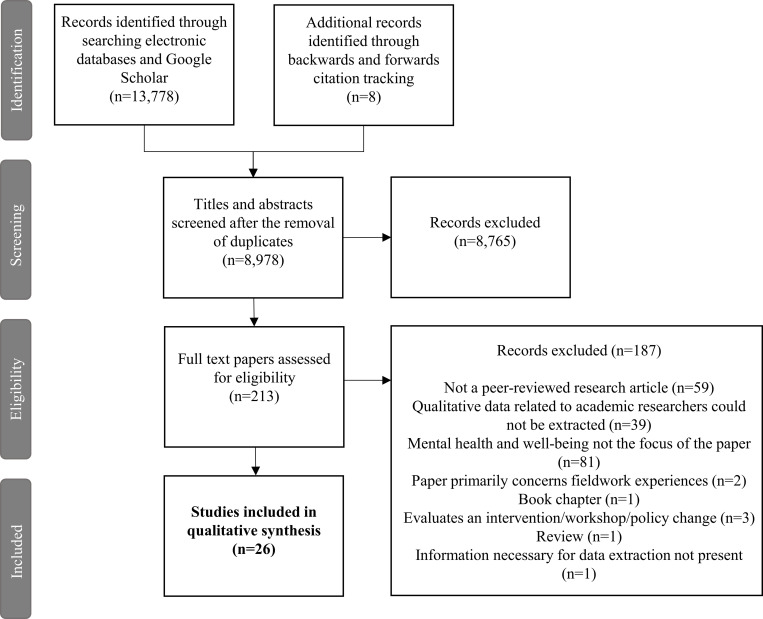
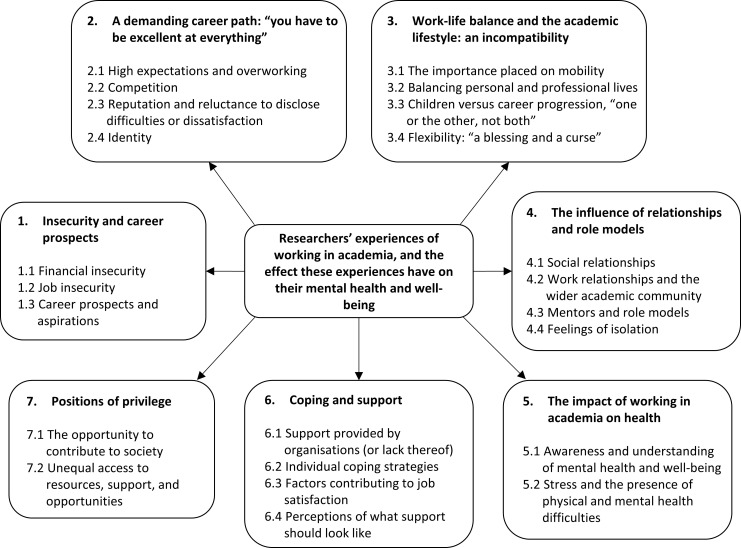
Objective: To understand how researchers experience working in academia and the effects these experiences have on their mental health and well-being, through synthesizing published qualitative data. Method: A systematic review and qualitative meta-synthesis was conducted to gain a comprehensive overview of what is currently known about academic researchers’ mental health and well-being. Relevant papers were identified through searching electronic databases, Google Scholar, and citation tracking. The quality of the included studies was assessed and the data was synthesised using reflexive thematic analysis. Results: 26 papers were identified and included in this review. Academic researchers’ experiences were captured under seven key themes. Job insecurity coupled with the high expectations set by the academic system left researchers at risk of poor mental health and well-being. Access to peer support networks, opportunities for career progression, and mentorship can help mitigate the stress associated with the academic job role, however, under-represented groups in academia are at risk of unequal access to resources, support, and opportunities. Conclusion: To improve researchers’ well-being at work, scientific/academic practice and the system’s concept of what a successful researcher should look like, needs to change. Further high-quality qualitative research is needed to better understand how systemic change, including tackling inequality and introducing better support systems, can be brought about more immediately and effectively. Further research is also needed to better understand the experiences and support needs of post-doctoral and more senior researchers, as there is a paucity of literature in this area. Trial registration: The review protocol was registered on PROSPERO ( CRD42021232480) .
Overview
The claims and statistics of this paper haven’t been checked yet.
Run the check — free, no account needed. It reads the open-access text and checks the sources it cites.
Integrity signals
Registry
Cites
Statistics
Figures
Verification
Claims the paper makes
The claims and statistics of this paper haven’t been checked yet.
Run the check — free, no account needed. It reads the open-access text and checks the sources it cites.
Claims other papers make about this one
Each is checked against this paper’s own text: does it say what the citing paper says it does?
In the citing paper
“A broader systematic evaluation of other relevant mental health issues remains lacking, including clinically defined syndromes such as social phobia, obsessive-compulsive disorder (OCD), post-traumatic stress disorder (PTSD), attention deficit hyperactivity disorder (ADHD), personality disorders, eating disorders, alcohol and drug abuse, and burnout, as well as common symptoms of psychological”
From Prevalence and severity of mental health problems in early-career researchers: a systematic review and meta-analysis (2026) · cites this paper as [40]
In the citing paper
“The most frequently cited systemic factor is the mismatch between the growing number of PhD graduates and the comparatively limited number of permanent positions in academia4,40,66–68.”
From Prevalence and severity of mental health problems in early-career researchers: a systematic review and meta-analysis (2026) · cites this paper as [40]
In the citing paper
“Systematic and narrative reviews highlight additional sample-level moderators, including protective and risk factors35–42. These include financial challenges43, self-doubt44, and social and academic loneliness14,45 as risk factors, and suggest social support, a positive and future-oriented mindset, and self-care14 as potential protective factors.”
From Prevalence and severity of mental health problems in early-career researchers: a systematic review and meta-analysis (2026) · cites this paper as [40]
In the citing paper
“Finally, for ECRs from underrepresented groups, additional barriers may exist, such as discrimination, limited mobility and unequal access to mentorship and resources40,78,79.”
From Prevalence and severity of mental health problems in early-career researchers: a systematic review and meta-analysis (2026) · cites this paper as [40]
Self-check
Percentages, sums and reported differences re-computed from the paper’s own numbers.
The self-check needs the paper’s full text.
Citations
Cites
One size fits all? What counts as quality practice in (reflexive) thematic analysis?
Braun, V., & Clarke, V. (2021) · Qualitative Research in Psychology · doi:10.1080/14780887.2020.1769238 · Cited by 9,727
The challenge of defining wellbeing
Dodge, R., Daly, A., Huyton, J., & Sanders, L. (2012) · International Journal of Wellbeing · doi:10.5502/ijw.v2i3.4 · Cited by 2,166
Evidence for a mental health crisis in graduate education
Evans, T. M., Bira, L., Gastelum, J. B., Weiss, L. T., & Vanderford, N. L. (2018) · Nature Biotechnology · doi:10.1038/nbt.4089 · Cited by 1,441
Having a Lot of a Good Thing: Multiple Important Group Memberships as a Source of Self-Esteem
Jetten, J., Branscombe, N. R., Haslam, S. A., Haslam, C., Cruwys, T., Jones, J. M., Cui, L., Dingle, G., Liu, J., Murphy, S., et al. (2015) · PLOS ONE · doi:10.1371/journal.pone.0124609 · Cited by 308
Research works printed but not linked: 67
- G Kinman, 2019, Special section on well-being in academic employees, International Journal of Stress Management, 26, 159, 10.1037/str0000131 · DOI
- C. Santamaría G del, 2020, Challenges and Drawbacks in the Marketisation of Higher Education Within Neoliberalism., Review of European Studies., 12, p22, 10.5539/res.v12n1p22 · DOI
- S Gibbons, 2015, Student satisfaction, league tables and university applications: Evidence from Britain., Economics of Education Review, 48, 148, 10.1016/j.econedurev.2015.07.002 · DOI
- T Tapper, 2009, The world‐class league tables and the sustaining of international reputations in higher education, Journal of Higher Education Policy and Management, 31, 55, 10.1080/13600800802383091 · DOI
- A Wolf, 2018, What’s in a name? The impact of reputation and rankings on the teaching income of English universities., Higher Education Quarterly., 72, 286, 10.1111/hequ.12162 · DOI
- DL Herbert, 2014, The impact of funding deadlines on personal workloads, stress and family relationships: a qualitative study of Australian researchers, BMJ Open, 4, e004462, 10.1136/bmjopen-2013-004462 · DOI · Paper page
- AP Johnson, 2022, Mental health in academia: Hacks for cultivating and sustaining wellbeing, American Journal of Human Biology, 34, e23664, 10.1002/ajhb.23664 · DOI
- K Sang, 2015, ‘Being an academic is not a 9–5 job’: long working hours and the ‘ideal worker’ in UK academia., Labour & Industry: a journal of the social and economic relations of work, 25, 235, 10.1080/10301763.2015.1081723 · DOI
- N. Rodrigues Lopes, 2021, Act now to support early-career researchers, In: Chemistry World
- S. Keller, 2020, What does mental health have to do with well-being?, Bioethics, 34, 228, 10.1111/bioe.12702 · DOI
- LA Manwell, 2015, What is mental health? Evidence towards a new definition from a mixed methods multidisciplinary international survey, BMJ Open, 5, e007079, 10.1136/bmjopen-2014-007079 · DOI
- S Galderisi, 2015, Toward a new definition of mental health., World Psychiatry., 14, 231, 10.1002/wps.20231 · DOI
- G Simons, 2021, A critical review of the definition of ‘wellbeing’ for doctors and their patients in a post Covid-19 era., Int J Soc Psychiatry, 67, 984, 10.1177/00207640211032259 · DOI
- S Guthrie, 2017, Understanding mental health in the research environment: A Rapid Evidence Assessment, 10.7249/RR2022 · DOI
- DL Belavy, 2020, Do successful PhD outcomes reflect the research environment rather than academic ability?, PLoS One, 15, e0236327, 10.1371/journal.pone.0236327 · DOI
- EJ Andrews, 2020, Supporting early career researchers: insights from interdisciplinary marine scientists, ICES Journal of Marine Science, 77, 476, 10.1093/icesjms/fsz247 · DOI
- C. Woolston, 2020, Postdoc survey reveals disenchantment with working life, Nature, 587, 505, 10.1038/d41586-020-03191-7 · DOI
- EN Satinsky, 2021, Systematic review and meta-analysis of depression, anxiety, and suicidal ideation among Ph.D. students., Sci Rep, 11, 14370, 10.1038/s41598-021-93687-7 · DOI · Paper page
- S Wray, 2021, Supporting Staff Wellbeing in Higher Education
- K Hammarberg, 2016, Qualitative research methods: when to use them and how to judge them, Human Reproduction, 31, 498, 10.1093/humrep/dev334 · DOI
- CM Hazell, 2020, Understanding the mental health of doctoral researchers: a mixed methods systematic review with meta-analysis and meta-synthesis., Systematic Reviews., 9, 197, 10.1186/s13643-020-01443-1 · DOI · Paper page
- A Bosanquet, 2017, Redefining ‘early career’ in academia: a collective narrative approach., Higher Education Research & Development., 36, 890, 10.1080/07294360.2016.1263934 · DOI
- J Lachal, 2017, Metasynthesis: An Original Method to Synthesize Qualitative Literature in Psychiatry., Front Psychiatry., 8, 269, 10.3389/fpsyt.2017.00269 · DOI
- The PRISMA Group, 2009, Preferred Reporting Items for Systematic Reviews and Meta-Analyses: The PRISMA Statement., PLOS Medicine., 6, e1000097, 10.1371/journal.pmed.1000097 · DOI · Paper page
- J Kelly, 2014, Peer Review in Scientific Publications: Benefits, Critiques, & A Survival Guide., EJIFCC, 25, 227
- KM Barry, 2018, Psychological health of doctoral candidates, study-related challenges and perceived performance., Higher Education Research & Development., 37, 468, 10.1080/07294360.2018.1425979 · DOI · Paper page
- C Berry, 2020, Hanging in the balance: Conceptualising doctoral researcher mental health as a dynamic balance across key tensions characterising the PhD experience., Int J Educ Res., 102, 10.1016/j.ijer.2020.101575 · DOI · Paper page
- E. Campbell, 2018, Reconstructing my identity: An autoethnographic exploration of depression and anxiety in academia., J Organ Ethonogr, 7, 235, 10.1108/JOE-10-2017-0045 · DOI
- H Chan, 2021, The battle-hardened academic: an exploration of the resilience of university academics in the face of ongoing criticism and rejection of their research., Higher Education Research & Development., 40, 446, 10.1080/07294360.2020.1765743 · DOI
- J Chubb, 2017, Fear and loathing in the academy? The role of emotion in response to an impact agenda in the UK and Australia., Higher Education Research & Development., 36, 555, 10.1080/07294360.2017.1288709 · DOI
- J Cornwall, 2019, Stressors in early-stage doctoral students., Studies in Continuing Education, 41, 363, 10.1080/0158037X.2018.1534821 · DOI
- S. Cotterall, 2013, More than just a brain: emotions and the doctoral experience., Higher Education Research & Development., 32, 174, 10.1080/07294360.2012.680017 · DOI · Paper page
- M Darabi, 2017, A qualitative study of the UK academic role: positive features, negative aspects and associated stressors in a mainly teaching-focused university, Journal of Further and Higher Education, 41, 566, 10.1080/0309877X.2016.1159287 · DOI
- EO McGee, 2019, “I Know I Have to Work Twice as Hard and Hope that Makes Me Good Enough”: Exploring the Stress and Strain of Black Doctoral Students in Engineering and Computing., Teachers College Record., 121, 1, 10.1177/016146811912100407 · DOI
- DEM Medina, 2016, Síndrome de desgaste emocional en investigadoras. El caso de la Universidad Juárez Autónoma de Tabasco / Emotional burnout syndrome syndrome in women researchers., 52
- IL Muir, 2021, Examining Professional Development among Faculty Members across Varying Career Stages in Kinesiology., International Journal of Kinesiology in Higher Education, 0, 1
- A. Nikischer, 2019, Vicarious trauma inside the academe: understanding the impact of teaching, researching and writing violence., High Educ, 77, 905, 10.1007/s10734-018-0308-4 · DOI
- S Pappa, 2020, Sources of stress and scholarly identity: the case of international doctoral students of education in Finland., High Educ, 80, 173, 10.1007/s10734-019-00473-6 · DOI
- M Schmidt, 2014, Experiences of well-being among female doctoral students in Sweden., Int J Qual Stud Health Well-being., 9, 10.3402/qhw.v9.23059 · DOI
- I Skakni, 2017, Post-PhD researchers’ experiences: an emotionally rocky road., Studies in Graduate and Postdoctoral Education, 8, 205, 10.1108/SGPE-D-17-00026 · DOI
- J Stubb, 2011, Balancing between inspiration and exhaustion: PhD students’ experienced socio-psychological well-being., Studies in Continuing Education, 33, 33, 10.1080/0158037X.2010.515572 · DOI · Paper page
- JD Todd, 2021, Experiencing and embodying anxiety in spaces of academia and social research., Gender, Place & Culture., 28, 475, 10.1080/0966369X.2020.1727862 · DOI
- I van der Weijden, 2016, Career satisfaction of postdoctoral researchers in relation to their expectations for the future., High Educ, 72, 25, 10.1007/s10734-015-9936-0 · DOI
- E Waight, 2018, Doctoral students’ access to non-academic support for mental health, Journal of Higher Education Policy and Management, 40, 390, 10.1080/1360080X.2018.1478613 · DOI · Paper page
- X Wang, 2019, Towards the contributing factors for stress confronting Chinese PhD students., Int J Qual Stud Health Well-being., 14, 10.1080/17482631.2019.1598722 · DOI · Paper page
- C Weise, 2020, Significant events and the role of emotion along doctoral researcher personal trajectories., Educ Res, 62, 304, 10.1080/00131881.2020.1794924 · DOI
- K. White, 2018, Are New Career Models for Science Research Emerging? International Journal of Gender, Science and Technology, 10, 72
- CY Yang, 2020, Psychological adjustment of Chinese phd students: A narrative study., Int J Doctoral Studies, 15, 596
- G Young, 2017, Women Reflect on Being Well in Academia: Challenges and Supports., Learning Landscapes., 10, 335, 10.36510/learnland.v10i2.819 · DOI
- R Ysseldyk, 2019, A Leak in the Academic Pipeline: Identity and Health Among Postdoctoral Women., Front Psychol., 10, 1297, 10.3389/fpsyg.2019.01297 · DOI
- HA Long, 2020, Optimising the value of the critical appraisal skills programme (CASP) tool for quality appraisal in qualitative evidence synthesis., Research Methods in Medicine & Health Sciences., 1, 31, 10.1177/2632084320947559 · DOI · Paper page
- EM Gibson, 2020, How Support of Early Career Researchers Can Reset Science in the Post-COVID19 World., Cell, 181, 1445, 10.1016/j.cell.2020.05.045 · DOI
- M Plotnikof, 2021, The “new normal” of academia in pandemic times: Resisting toxicity through care., Gender Work Organ.
- V. Gewin, 2021, Pandemic burnout is rampant in academia, Nature, 591, 489, 10.1038/d41586-021-00663-2 · DOI · Paper page
- DT O’Brien, 2019, Staff Wellbeing in Higher Education
- S Naumann, 2022, Update on the Mental Health Crisis in Academia: Effects of the COVID-19 Pandemic on Early Career Researchers’ Mental Health and Satisfaction with PhD training., PsyArXiv
- C. Woolston, 2020, Postdocs under pressure: ‘Can I even do this any more?, Nature, 587, 689, 10.1038/d41586-020-03235-y · DOI
- S. Masefield, 2019, Use peer support to improve well-being and research outcomes, Nature, 572, 407, 10.1038/d41586-019-02104-7 · DOI
- TC Moulin, 2020, Mental Health in Academia: The Role of Workplace Relationships., Front Psychol., 11, 562457, 10.3389/fpsyg.2020.562457 · DOI
- PC Jackman, 2021, Mental health and psychological wellbeing in the early stages of doctoral study: a systematic review, European Journal of Higher Education, 0, 1, 10.1080/21568235.2021.1939752 · DOI · Paper page
- K Hutchings, 2022, Sleepless Nights While Our Doctoral Students Are in the Field: Supervisor Reflections on Ethical Challenges, Journal of Management Inquiry, 31, 97, 10.1177/10564926211033910 · DOI
- G Wisker, 2016, Supervisor wellbeing and identity: challenges and strategies, International Journal for Researcher Development, 7, 123, 10.1108/IJRD-03-2016-0006 · DOI
- R English, 2019, Documenting diversity: The experiences of LGBTQ+ doctoral researchers in the UK., Int J Doctoral Studies, 14, 403, 10.28945/4328 · DOI
- E Kalpazidou Schmidt, 2020, Understanding the Athena SWAN award scheme for gender equality as a complex social intervention in a complex system: analysis of Silver award action plans in a comparative European perspective., Health Research Policy and Systems, 18, 19, 10.1186/s12961-020-0527-x · DOI
- PV Ovseiko, 2017, Advancing gender equality through the Athena SWAN Charter for Women in Science: an exploratory study of women’s and men’s perceptions., Health Res Policy Syst, 15, 12, 10.1186/s12961-017-0177-9 · DOI
- SV Rosser, 2019, Athena SWAN and ADVANCE: effectiveness and lessons learned, The Lancet, 393, 604, 10.1016/S0140-6736(18)33213-6 · DOI
- Cactus Foundation, 2020, Joy and Stress Triggers: A global survey on mental health among researchers
Cited by
Sorted by citations
Dreisoerner, A., Goetz, V., Frohnmayer, D., Tran, U. S., Voracek, M., & Nater, U. M. (2026) · Nature Human Behaviour · doi:10.1038/s41562-026-02505-5 · Cited by 2
Metadata
- Authors
- Nicholls, H., Nicholls, M., Tekin, S., Lamb, D., & Billings, J.
- Venue
- PLOS ONE
- Publisher
- Public Library of Science (PLoS)
- Published
- 2022-05-25
- Volume
- 17
- Issue
- 5
- Pages
- e0268890
- ISSN
- 1932-6203
- PMC
- PMC9132292
- Cited by
- 147
- References
- 4
- Language
- en
- Funders
- Bloomsbury Colleges Studentship (ES/P000592/1)
- The McPin Foundation (ES/P000592/1)
About these checks
Registry, retraction, Cites and statistics results are computed, not judged, with one exception: a printed reference that no index lists is read once by a model before it counts as a citation error. Claims are extracted by a model and kept only when their quote appears verbatim in the text; each cited source is then checked, with a model’s help, for whether it says what the claim relies on. Those verdicts can be wrong — read the claim’s quote and the cited source before relying on one.
Statistics and arithmetic are recomputed, not judged.
Confidence bands are shown only for fields calibrated on our annotated test set. None is calibrated yet, so no band is shown.
What counts as a claim ›How we measure confidence ›How we check this ›
Are you an author, or do you see a problem with this page? Request a review
