

The DOI matches its Crossref record; 36 of the 36 references it cites were found in a registry or an index; none of the 15 sources its claims cite is checked for support yet.
Thermal processing and geographical origin as drivers of terpenoids variation in Anethum graveolens L. essential oils: A biplot analysis
Open accessAbstract
Dill (Anethum graveolens L.), a medicinal-vegetable plant renowned for its aromatic and functional properties, exhibits significant variation in essential oil composition due to geographical origin (genotypic diversity) and post-harvest drying temperatures (DTs). This study aimed to (1) quantify the effects of geographical origin (as a proxy for genotype) and DTs on essential oil yield and composition, and (2) evaluate how specific genotypes respond to thermal processing. Six A. graveolens genotypes from distinct Iranian regions (Mashhad, Ardabil, Parsabad, Bushehr, Esfahan, and Kerman) were cultivated under uniform field conditions in Ardabil, Iran, to isolate genotypic variation. Post-harvest treatments included environmental shade drying and oven drying at 40°C and 60°C, creating unique combinations of genotype-treatment (CGT). Using CGT × character biplot analysis, we assessed interactions between genotype, DT, and essential oil compositions. The results revealed significant CGT-driven variation: shade drying enhanced α-Phellandrene levels in Kerman and Esfahan genotypes (57.49% and 55.51%), while oven drying at 40°C maximized Myristicin content (1.72%) in the Ardabil genotype and essential oil yield in Parsabad (1.86% w/v). High-temperature drying (60°C) reduced essential oil content in sensitive genotypes. β-Pinene and γ-Terpinene emerged as discriminative markers for genotype performance. Critically, the Parsabad genotype at 40°C and the Ardabil genotype demonstrated superior essential oil yields, whereas genotype-specific responses to DT highlighted the need for tailored post-harvest protocols. This study establishes CGT interactions as pivotal drivers of A. graveolens essential oil chemotypes, offering actionable strategies for genotype-specific drying protocols to optimize industrial production and breeding programs.
Overview
CoChat Summary
Written by AI from the paper’s full text.
TL;DR
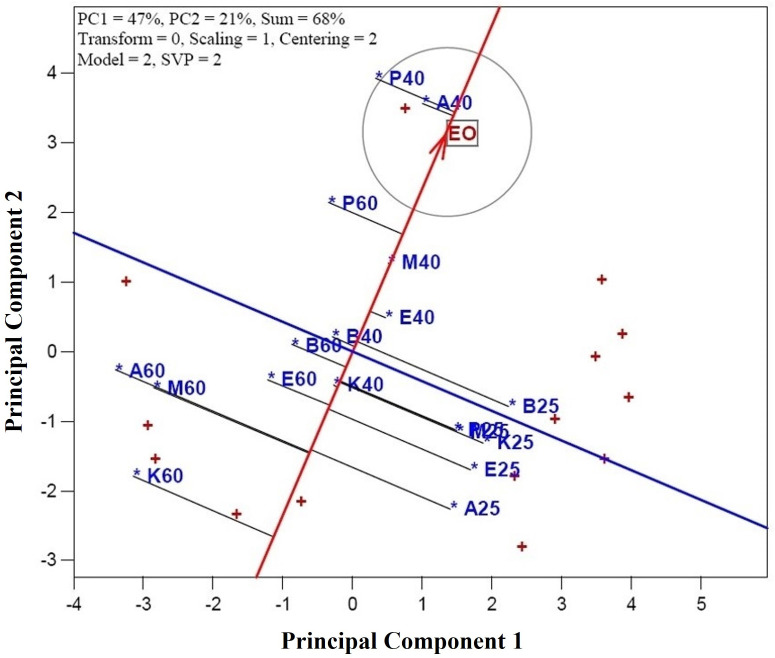
In six Iranian dill genotypes grown under uniform field conditions, genotype-treatment combinations strongly shaped essential oil yield and terpenoid profiles, with shade drying generally preserving quality and 40°C oven drying maximizing some yields/compounds. The CGT × character biplot explained 68% of variation and identified β-pinene and γ-terpinene as key discriminative markers.
Key findings
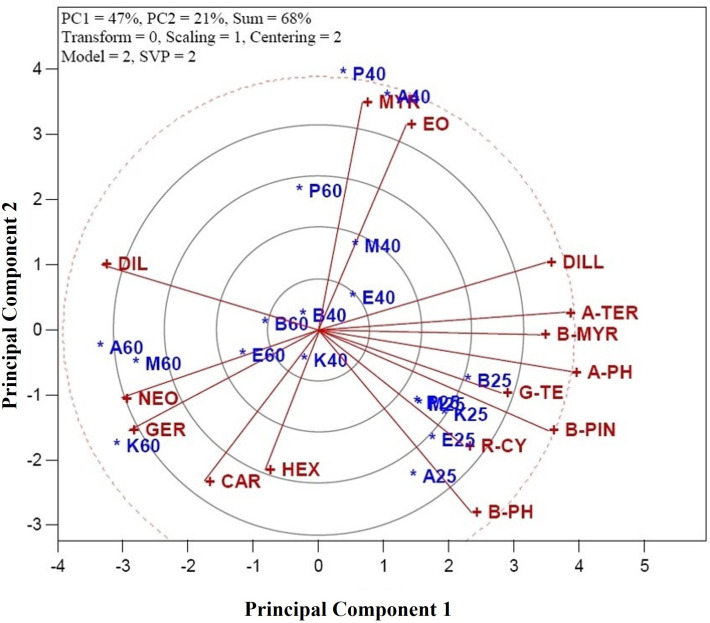
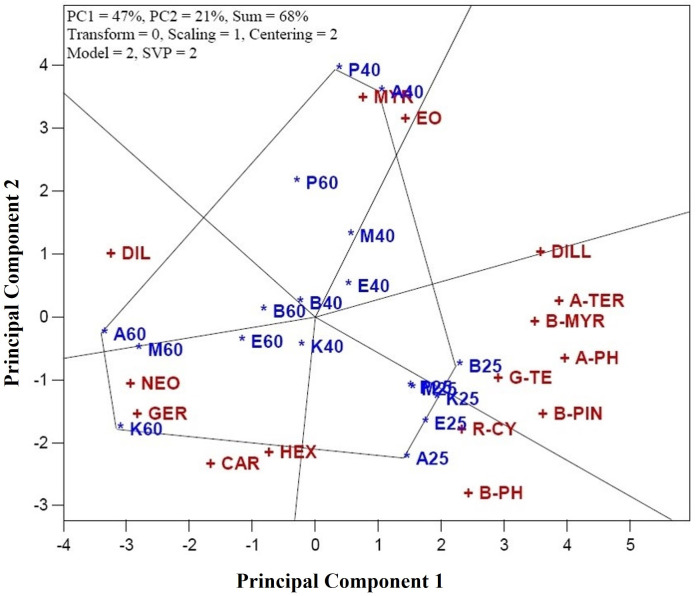
- The genotype-treatment (CGT) × character biplot accounted for 68% of variation. Shade drying enhanced α-Phellandrene in Kerman and Esfahan genotypes (57.49% and 55.51%) according to the abstract; the results section also identifies B25 (Bushehr + shade drying) as exceptionally high in α-Phellandrene.
- Oven drying at 40°C maximized Myristicin content (1.72%) in the Ardabil genotype and essential oil yield in Parsabad (1.86% w/v) per the abstract; the results section identifies P40 (Parsabad + 40°C) as highest for Myristicin and essential oil yield.
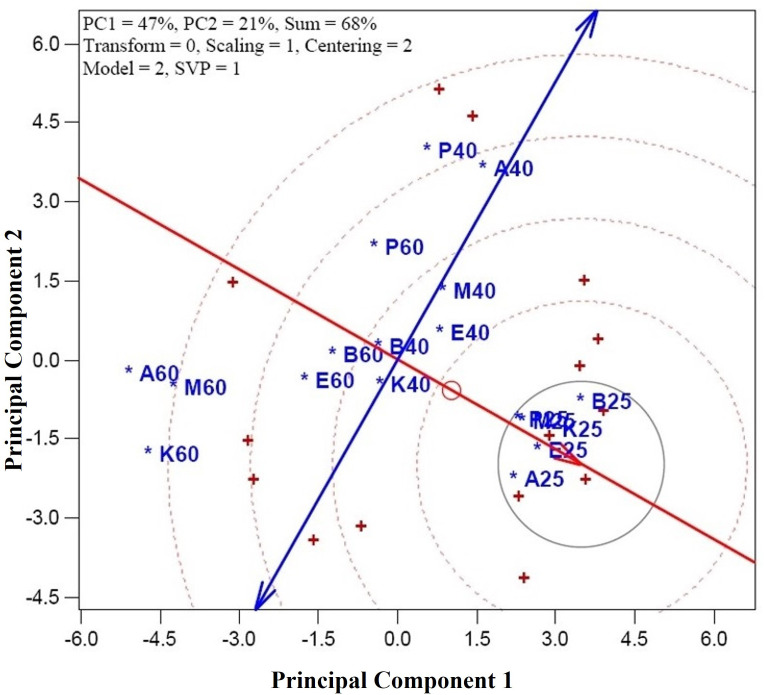
- High-temperature drying (60°C) reduced essential oil content in sensitive genotypes. A40 and P40 were most desirable for high essential oil yield, while K60 was least favorable; A40 also showed low variation.
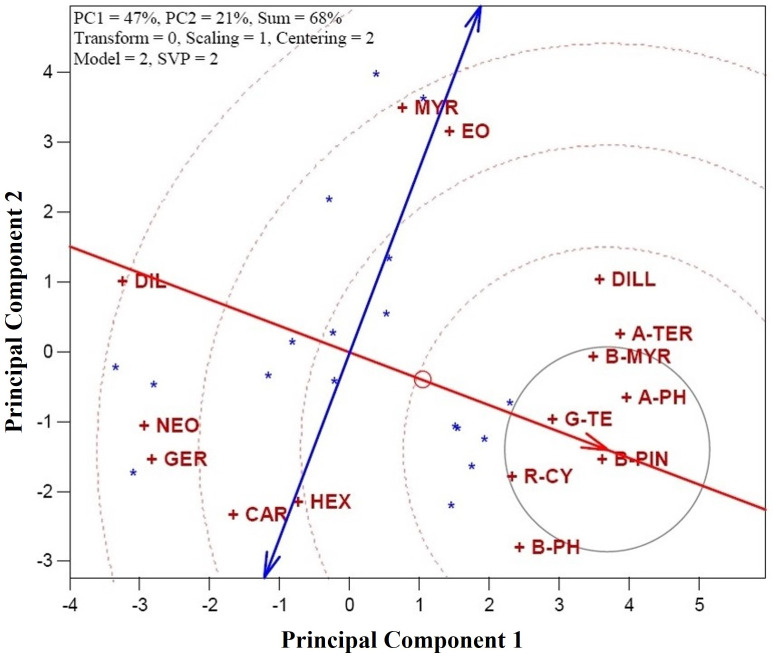
- β-Pinene and γ-Terpinene emerged as discriminative markers; β-Pinene was the most discriminative character, followed by γ-Terpinene, α-Phellandrene, p-Cymene, and β-Myrcene. The conclusion states shade drying was superior across all genotypes.
Methods
- Six *Anethum graveolens* genotypes from Mashhad, Ardabil, Parsabad, Bushehr, Esfahan, and Kerman were cultivated under uniform field conditions in Ardabil, Iran, in three blocks arranged in a completely randomized block design; leaves and flowers were harvested at full bloom.
- Post-harvest treatments were shade drying and oven drying at 40°C and 60°C until 10–12% moisture. Then 50 g dried material per genotype was hydrodistilled for 4 h using a Clevenger apparatus; oil was dehydrated with anhydrous sodium sulfate and stored at 4°C.
- Essential oils were analyzed by GC-MS (Agilent 5977A) and GC-FID (Agilent 7890B) with an HP-5MS column; compounds were identified by retention times/indices and NIST05, Wiley7, and Adams databases. Statistical analysis used Anderson-Darling normality testing and PCA via a CGT × character biplot in GGEbiplot software.
Limitations
- The paper states future research should explore additional environmental and agronomic factors, such as soil type, irrigation practices, and harvest timing; it also notes that direct measurements may not always correspond exactly to biplot results.
- Evident from the text: there is no dedicated limitations section; the biplot model explained 68% of variation, leaving 32% unexplained, and the study is limited to six Iranian genotypes and three drying treatments, so broader generalizability is not established.
Model-written summary. Check it against the paper before relying on it.
Integrity signals
Registry
Cites
Statistics
Figures
Verification
Claims the paper makes
57 Own result · 18 Own interpretation · 9 Check pending · 3 No full text of the sources · 3 Not checked yet · 2 Own method
A result the paper reports from its own data — it cites no other source for it, so there is none to check. The quote shows it is in the paper.
In the paper
“This study revealed a strong positive correlation between Myristicin and essential oil yield, highlighting the Parsabad genotype dried at 40°C as the optimal combination for maximizing these traits.”
§ Thermal processing and geographical origin as drivers of terpenoids variation in Anethum graveolens L. essential oils: A biplot analysis > 5. Conclusion
boostedstates an association- Asserted: passes — The authors put it forward as true.
- Checkable: passes — It can be checked against evidence.
- Load-bearing: passes — The paper’s conclusions depend on it.
- Based: passes — The paper gives a reason why it holds.
A result the paper reports from its own data — it cites no other source for it, so there is none to check. The quote shows it is in the paper.
In the paper
“The six A. graveolens genotypes examined, originating from distinct regions of Iran (Mashhad, Ardabil, Parsabad, Bushehr, Esfahan, and Kerman), showed significant variation in essential oil content and its components.”
§ Thermal processing and geographical origin as drivers of terpenoids variation in Anethum graveolens L. essential oils: A biplot analysis > 4. Discussion
plainstates an association- Asserted: passes — The authors put it forward as true.
- Checkable: passes — It can be checked against evidence.
- Load-bearing: passes — The paper’s conclusions depend on it.
- Based: passes — The paper gives a reason why it holds.
None of the sources cited for this claim have been checked yet.
In the paper
“Conversely, genotypes from Parsabad, subjected to oven drying at 40°C, yielded higher amounts of Myristicin, a phenylpropanoid compound with anti-inflammatory and anti-cancer properties [6].”
§ Thermal processing and geographical origin as drivers of terpenoids variation in Anethum graveolens L. essential oils: A biplot analysis > 4. Discussion
plainstates a cause- Asserted: passes — The authors put it forward as true.
- Checkable: passes — It can be checked against evidence.
- Load-bearing: passes — The paper’s conclusions depend on it.
- Based: passes — The paper gives a reason why it holds.
A result the paper reports from its own data — it cites no other source for it, so there is none to check. The quote shows it is in the paper.
In the paper
“Genotypes A40 (genotype Ardabil + oven drying at 40°C) and P40 (genotype Parsabad + oven drying at 40°C) were identified as the most desirable for achieving high essential oil yields, while K60 (genotype Kerman + oven drying at 60°C) was the least favorable CGT for essential oilproduction (Fig 5).”
§ Thermal processing and geographical origin as drivers of terpenoids variation in Anethum graveolens L. essential oils: A biplot analysis > 3. Results > 3.6. EO yield and genotype stability
plain- Asserted: passes — The authors put it forward as true.
- Checkable: passes — It can be checked against evidence.
- Load-bearing: passes — The paper’s conclusions depend on it.
- Based: passes — The paper gives a reason why it holds.
A result the paper reports from its own data — it cites no other source for it, so there is none to check. The quote shows it is in the paper.
In the paper
“α-Terpinene (A-TER) with β-Myrcene (B-MYR)”
§ Thermal processing and geographical origin as drivers of terpenoids variation in Anethum graveolens L. essential oils: A biplot analysis > 3. Results > 3.2. Character associations and interactions
plainstates an association- Asserted: passes — The authors put it forward as true.
- Checkable: passes — It can be checked against evidence.
- Load-bearing: unclear — It is unclear whether the paper’s conclusions depend on it.
- Based: passes — The paper gives a reason why it holds.
- It may state two separate claims as one. 21
- Probably not a substantial claim. 8
Create a free account to see these claims.
Create a free account to see these assumptions.
61 more claims
Create a free account to see all 92 claims and to verify the 9 references still open.
Self-check
Percentages, sums and reported differences re-computed from the paper’s own numbers.
Each contradiction between two passages listed here was confirmed by an independent check.
Rated major: it would touch a result — a value a result rests on, reported and recomputed p-values on opposite sides of the significance level, two passages that conflict with no sign which is right, or a cited work retracted before this paper was published.
In the paper
§ Thermal processing and geographical origin as drivers of terpenoids variation in Anethum graveolens L. essential oils: A biplot analysis > 5. Conclusion
“Shade drying emerged as the superior post-harvest method across all genotypes, preserving essential oil quality and yield”
§ Thermal processing and geographical origin as drivers of terpenoids variation in Anethum graveolens L. essential oils: A biplot analysis > 3. Results > 3.6. EO yield and genotype stability
“Genotypes A40 (genotype Ardabil + oven drying at 40°C) and P40 (genotype Parsabad + oven drying at 40°C) were identified as the most desirable for achieving high essential oil yields”
Rated minor: it would not touch a result — a value no result rests on, a p-value that stays on the same side of the significance level, or a conflict that is clerical, resolved elsewhere in the paper, or outside its own findings.
In the paper
§ Thermal processing and geographical origin as drivers of terpenoids variation in Anethum graveolens L. essential oils: A biplot analysis > 3. Results > 3.2. Character associations and interactions
“Dill ether (DIL) exhibited negative correlations with γ-Terpinene (G-TE) and β-Pinene (B-PIN)”
§ Thermal processing and geographical origin as drivers of terpenoids variation in Anethum graveolens L. essential oils: A biplot analysis > 2. Materials and methods > 2.4. Statistical analysis
“Dill ether (Dill), Carvacrol (CAR), Germacrene D (GER), Myristicin (MYR), Dillapiole (DIL)”
Rated minor: it would not touch a result — a value no result rests on, a p-value that stays on the same side of the significance level, or a conflict that is clerical, resolved elsewhere in the paper, or outside its own findings.
In the paper
§ Thermal processing and geographical origin as drivers of terpenoids variation in Anethum graveolens L. essential oils: A biplot analysis > 3. Results > 3.1. Biplot analysis of genotype-treatment interactions
“A40 (genotype Ardabil + oven drying at 40°C), A60 (genotype Ardabil + oven drying at 60°C), B25 (genotype Bushehr + shade drying), A40 (genotype Bushehr + oven drying at 40°C), A60 (genotype Bushehr + oven drying at 60°C)”
§ Thermal processing and geographical origin as drivers of terpenoids variation in Anethum graveolens L. essential oils: A biplot analysis > 3. Results > 3.6. EO yield and genotype stability
“B40 (genotype Bushehr + oven drying at 40°C)”
Rated minor: it would not touch a result — a value no result rests on, a p-value that stays on the same side of the significance level, or a conflict that is clerical, resolved elsewhere in the paper, or outside its own findings.
In the paper
§ Thermal processing and geographical origin as drivers of terpenoids variation in Anethum graveolens L. essential oils: A biplot analysis > 3. Results > 3.4. Ideal CGT proximity and implications
“all genotypes under shade drying conditions (A25, B25, E25, K25, and M25)”
§ Thermal processing and geographical origin as drivers of terpenoids variation in Anethum graveolens L. essential oils: A biplot analysis > 3. Results > 3.1. Biplot analysis of genotype-treatment interactions
“P25 (genotype Parsabad + shade drying)”
Rated minor: it would not touch a result — a value no result rests on, a p-value that stays on the same side of the significance level, or a conflict that is clerical, resolved elsewhere in the paper, or outside its own findings.
In the paper
§ Thermal processing and geographical origin as drivers of terpenoids variation in Anethum graveolens L. essential oils: A biplot analysis > 3. Results > 3.3. Genotype-treatment performance and optimization
“K60 showed the highest values for Neophytadiene (NEO), Germacrene D (GER), Carvacrol (CAR), and Hexahydrofarnesyl acetone (HEX).”
§ Thermal processing and geographical origin as drivers of terpenoids variation in Anethum graveolens L. essential oils: A biplot analysis > 4. Discussion
“genotypes from Parsabad subjected to oven drying at 40°C produced the highest essential oil content, particularly in terms of Myristicin and Carvacrol.”
Citations
Cites
Identification of essential oil components by gas chromatography/mass spectroscopy
Waterman, P. G. (1996) · Biochemical Systematics and Ecology · doi:10.1016/0305-1978(96)83708-2 · Cited by 3,093
Therapeutic Potential of α- and β-Pinene: A Miracle Gift of Nature
Salehi, B., Upadhyay, S., Orhan, İ. E., Jugran, A. K., Jayaweera, S. L. D., Dias, D. A., Sharopov, F. S., Taheri, Y., Martins, N. A., Baghalpour, N., et al. (2019) · Biomolecules · doi:10.3390/biom9110738 · Cited by 759
α-Pinene: A never-ending story
Allenspach, M., & Steuer, C. (2021) · Phytochemistry · doi:10.1016/j.phytochem.2021.112857 · Cited by 298
Çiftçi, O., Özdemir, İ., Tanyıldızı, S., Yıldız, S., & Oğuztürk, H. (2011) · Toxicology and Industrial Health · doi:10.1177/0748233710388452 · Cited by 241
Beigi, M., Torki‐Harchegani, M., & Pirbalouti, A. G. (2018) · International Journal of Food Properties · doi:10.1080/10942912.2018.1453839 · Cited by 160
In Vitro and in Vivo Biological Investigations of Camphene and Its Mechanism Insights: A Review
Hachlafi, N. E., Aanniz, T., Menyiy, N. E., Baaboua, A. E., Omari, N. E., Balahbib, A., Shariati, M. A., Zengin, G., Fikri-Benbrahim, K., & Bouyahya, A. (2021) · Food Reviews International · doi:10.1080/87559129.2021.1936007 · Cited by 130
Myristicin-induced neurotoxicity in human neuroblastoma SK-N-SH cells
Lee, B. K., Kim, J. H., Jung, J. W., Choi, J. W., Han, E. S., Lee, S. H., Ko, K. H., & Ryu, J. H. (2005) · Toxicology Letters · doi:10.1016/j.toxlet.2005.01.012 · Cited by 103
Mansinhos, I., Gonçalves, S., & Romano, A. (2024) · Frontiers in Plant Science · doi:10.3389/fpls.2024.1370810 · Cited by 82
Contribution of organic acids to α-terpinene antioxidant activity
Quiroga, P. R., Nepote, V., & Baumgartner, M. T. (2018) · Food Chemistry · doi:10.1016/j.foodchem.2018.10.100 · Cited by 74
Impact of drying methods on the yield and chemistry of Origanum vulgare L. essential oil
Caputo, L., Amato, G., de Bartolomeis, P., De Martino, L., Manna, F., Nazzaro, F., De Feo, V., & Barba, A. A. (2022) · Scientific Reports · doi:10.1038/s41598-022-07841-w · Cited by 64
Qualitative changes of spearmint essential oil as affected by drying methods
Mokhtarikhah, G., Ebadi, M., & Ayyari, M. (2020) · Industrial Crops and Products · doi:10.1016/j.indcrop.2020.112492 · Cited by 60
Çiftçi, O., Öztanır, M. N., & Çetin, A. (2014) · Neurochemical Research · doi:10.1007/s11064-014-1365-4 · Cited by 57
A Narrative Review on the Bioactivity and Health Benefits of Alpha-Phellandrene
Thangaleela, S., Sivamaruthi, B. S., Kesika, P., Tiyajamorn, T., Bharathi, M., & Chaiyasut, C. (2022) · Scientia Pharmaceutica · doi:10.3390/scipharm90040057 · Cited by 56
Abdelmohsen, U. R., & Elmaidomy, A. H. (2025) · Frontiers in Natural Products · doi:10.3389/fntpr.2025.1490511 · Cited by 55
Sharma, S., Gupta, J., Prabhakar, P. K., Gupta, P. K., Solanki, P., & Rajput, A. (2019) · Assay and Drug Development Technologies · doi:10.1089/adt.2019.939 · Cited by 51
Shi, Y., Si, H., Wang, P., Chen, S., Shang, S., Song, Z., Wang, Z., & Liao, S. (2019) · Molecules · doi:10.3390/molecules24173144 · Cited by 43
Milenković, L., Ilić, Z. S., Stanojević, L., Danilović, B., Šunić, L., Kevrešan, Ž., Stanojević, J., & Cvetković, D. (2024) · Plants · doi:10.3390/plants13060886 · Cited by 31
Ozliman, S., Yaldiz, G., Camlica, M., & Ozsoy, N. (2021) · Chemical and Biological Technologies in Agriculture · doi:10.1186/s40538-021-00224-9 · Cited by 28
Gonçalves, R. L. G., Cunha, F. V. M., Sousa-Neto, B. P. S., Oliveira, L. S. A., Lopes, M. E., Rezende, D. C., Sousa, I. J. O., Nogueira, K. M., Souza, L. K. M., Medeiros, J. V. R., et al. (2020) · Naunyn-Schmiedeberg's Archives of Pharmacology · doi:10.1007/s00210-020-01869-3 · Cited by 27
Vimal, A., Pal, D., Tripathi, T., & Kumar, A. (2017) · 3 Biotech · doi:10.1007/s13205-017-0891-6 · Cited by 25
Ramírez‐Alarcón, K., Martorell, M., Gürer, E. S., Laher, I., Lam, H. L., Mohieldin, E. A. M., Muddathir, A. M., Akram, M., Iqbal, M., Shafique, H., et al. (2023) · eFood · doi:10.1002/efd2.90 · Cited by 23
Abdel Rahman, R. T., Kamal, N., Mediani, A., & Farag, M. A. (2022) · ACS Omega · doi:10.1021/acsomega.2c04708 · Cited by 21
Skendi, A., Bouloumpasi, E., Chatzopoulou, P., Biliaderis, C. G., & Irakli, M. (2023) · LWT · doi:10.1016/j.lwt.2023.115463 · Cited by 21
Two types of biplots to integrate multi‐trial and multi‐trait information for genotype selection
Yan, W. (2024) · Crop Science · doi:10.1002/csc2.21231 · Cited by 20
Wei, S., Li, Y.-L., Wang, L., Chu, Z.-Y., Qin, Y.-C., & Zeng, H. (2025) · International Immunopharmacology · doi:10.1016/j.intimp.2025.114287 · Cited by 17
Zhao, Q., Liu, C., Shen, X., Xiao, L., Wang, H., Liu, P., Wang, L., & Xu, H. (2017) · Molecular Medicine Reports · doi:10.3892/mmr.2017.6258 · Cited by 15
Genotype × trait biplot and canonical correlations for spectral and agronomic traits in corn
Santana, D. C., Flores, M. D. S., Cotrim, M. F., Rodrigues, E. V., Santos, A. D., Teodoro, L. P. R., Baio, F. H. R., Silva Junior, C. A. D., & Teodoro, P. E. (2021) · Agronomy Journal · doi:10.1002/agj2.20581 · Cited by 14
Biplot analysis of trait relations of spinach (Spinacia oleracea L.) landraces
Sabaghnia, N., Mohebodini, M., & Janmohammadi, M. (2016) · Genetika · doi:10.2298/gensr1602675s · Cited by 12
Self-citationBiplot analysis of silicon dioxide on early growth of sunflower
Sabaghnia, N., & Janmohammadi, M. (2016) · Plant Breeding and Seed Science · doi:10.1515/plass-2016-0008 · Cited by 12
Self-citationKaur, V., Kaur, R., Bhardwaj, U., & Kaur, H. (2021) · Journal of Essential Oil Bearing Plants · doi:10.1080/0972060x.2022.2026252 · Cited by 11
Farmanpour Kalalagh, K., Mohebodini, M., Fattahi, R., Beyraghdar Kashkooli, A., Davarpanah Dizaj, S., Salehifar, F., & Mokhtari, A. M. (2023) · Frontiers in Plant Science · doi:10.3389/fpls.2023.1137840 · Cited by 9
Self-citationSaha, S., Bhattacharya, R., Dey, P. K., & Mitra, A. (2024) · Journal of Essential Oil Research · doi:10.1080/10412905.2024.2350409 · Cited by 6
Dehghani, N., Haghighi, M., Rahimmalek, M., Sabzalian, M. R., & Szumny, A. (2024) · Molecules · doi:10.3390/molecules29235506 · Cited by 6
Understanding of genetic variables for growth and yield traits of dill (Anethum graveolens L.)
Sinhasane, S. R., Shinde, U. S., Dhumal, S. S., Aher, A. R., Manjunathagowda, D. C., & Benke, A. P. (2022) · Genetic Resources and Crop Evolution · doi:10.1007/s10722-022-01409-3 · Cited by 5
α-Phellandrene: A Promising Natural Remedy for Rotenone-Induced Parkinson's Disease
Kumar, R., Arora, S., Alam, S., Rashid, M., & Kumar, S. (2025) · Recent Advances in Food Nutrition & Agriculture · doi:10.2174/012772574x341801241218051720 · Cited by 4
- Self-citation
Research works printed but not linked: 1
- B Gallegos, 2019, Antibacterial activity of five terpenoid compounds: carvacrol, limonene, Linalool, α-Terpinene and thymol, Trop Subtrop Agroecosystems, 22, 241
Cited by
Environmental Factors Shape Terpenoid Accumulation and Predicted Bioactivity in Houttuynia cordata
Liu, L., Huang, H., Mao, Y., Wang, Q., Liao, Z., Liu, H., Liao, Y., Yang, J., & Hou, K. (2026) · Physiologia Plantarum · doi:10.1111/ppl.70911 · Cited by 1
Kalalagh, K. F., Mohebodini, M., Sabaghnia, N., & Janmohammadi, M. (2026) · Biologija · doi:10.6001/biologija.2025.71.4.2
Self-citationDizaj, S. D., Kalalagh, K. F., Sabaghnia, N., & Mohebodini, M. (2026) · Scientific Reports · doi:10.1038/s41598-026-58098-6
Self-citationLarasati, T. R. D., Mulyana, N., Jumpeno, E. B., Susanto, U., Rosdianti, I., Yusuf, S., Madyaningarum, N., Makmur, M., & Mellawati, J. (2026) · Advances in Agriculture · doi:10.1155/aia/5485116
Metadata
- Authors
- Farmanpour Kalalagh, K., Mohebodini, M., Sabaghnia, N., Beyraghdar Kashkooli, A., & Esmaeili, H.
- Affiliations
- University of Mohaghegh Ardabili (IR)
- University of Maragheh (IR)
- Shahid Beheshti University (IR)
- Corresponding author
- Mohebodini, Mehdi
- Sabaghnia, Naser
- Venue
- PLOS One
- Publisher
- Public Library of Science (PLoS)
- Published
- 2025-08-01
- Volume
- 20
- Issue
- 8
- Pages
- e0327018
- ISSN
- 1932-6203 (ISSN-L)
- PMC
- PMC12316201
- OpenAlex
- W4412830131
- Semantic Scholar
- 49f06551f9f8dcfbd85cf989c2c43a0a9ffa25f5
- Cited by
- 4
- References
- 36
- Citations by year
- 2026: 4
- FWCI
- 1.40
- Type
- journal article
- Language
- en
- Open access
- gold
- doi.org
- Licence
- Locations
- PLoS ONE (publishedVersion, cc-by)
- PubMed (publishedVersion)
- PubMed Central (publishedVersion, cc-by)
- DOAJ (DOAJ: Directory of Open Access Journals) (submittedVersion, cc-by-sa)
- Funders
- Agriculture and Agri-Food Canada
- Topics
- Life Sciences › Agricultural and Biological Sciences › Food Science › Essential Oils and Antimicrobial Activity
- Life Sciences › Agricultural and Biological Sciences › Plant Science › Plant chemical constituents analysis
- Life Sciences › Biochemistry, Genetics and Molecular Biology › Molecular Biology › Plant biochemistry and biosynthesis
- Keywords
- dill, essential oil composition, terpenoids, geographical origin, genotypic variation, oven drying, shade drying, essential oil yield, α-phellandrene, myristicin, β-pinene, γ-terpinene, chemotypes, genotype × treatment interaction
- MeSH terms
- Genotype, Geography, Iran, Oils, Volatile, Plant Oils, Temperature, Terpenes, Anethum graveolens
About these checks
Registry, retraction, Cites and statistics results are computed, not judged, with one exception: a printed reference that no index lists is read once by a model before it counts as a citation error. Claims are extracted by a model and kept only when their quote appears verbatim in the text; each cited source is then checked, with a model’s help, for whether it says what the claim relies on. Those verdicts can be wrong — read the claim’s quote and the cited source before relying on one.
A language model drew the claims from the paper on 2026-11-12, under version 3 of the claim definition (model deepseek-v4.1-flash, prompt extract-v3).
A second model labelled each claim on 2026-11-12 (model jev-1.13-20260917, definition revision gold-guideline-v0.2).
Statistics and arithmetic are recomputed, not judged.
Confidence bands are shown only for fields calibrated on our annotated test set. None is calibrated yet, so no band is shown.
What counts as a claim ›How we measure confidence ›How we check this ›
Are you an author, or do you see a problem with this page? Request a review
