

The DOI matches its Crossref record; 54 of the 54 references it cites were found in a registry or an index.
Modulation of the Arginase Pathway in the Context of Microbial Pathogenesis: A Metabolic Enzyme Moonlighting as an Immune Modulator
Open accessAbstract
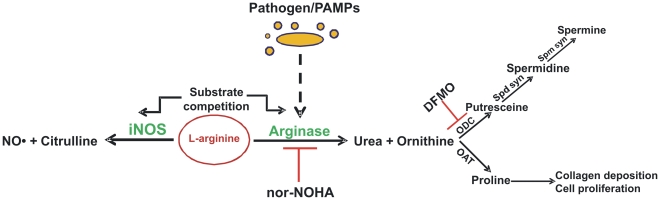
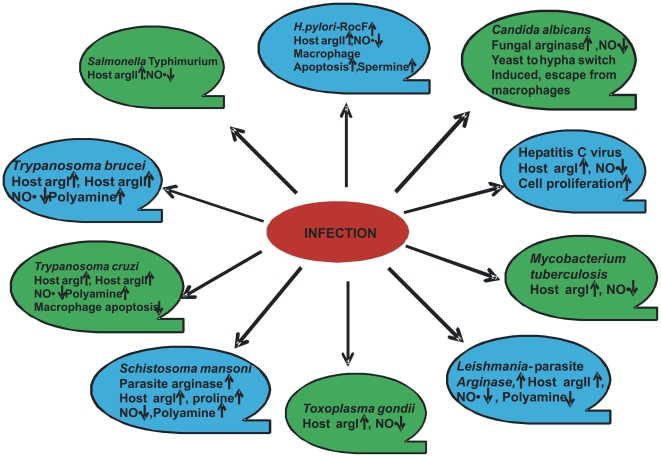
Arginine is a crucial amino acid that serves to modulate the cellular immune response during infection. Arginine is also a common substrate for both inducible nitric oxide synthase (iNOS) and arginase. The generation of nitric oxide from arginine is responsible for efficient immune response and cytotoxicity of host cells to kill the invading pathogens. On the other hand, the conversion of arginine to ornithine and urea via the arginase pathway can support the growth of bacterial and parasitic pathogens. The competition between iNOS and arginase for arginine can thus contribute to the outcome of several parasitic and bacterial infections. There are two isoforms of vertebrate arginase, both of which catalyze the conversion of arginine to ornithine and urea, but they differ with regard to tissue distribution and subcellular localization. In the case of infection with Mycobacterium, Leishmania, Trypanosoma, Helicobacter, Schistosoma, and Salmonella spp., arginase isoforms have been shown to modulate the pathology of infection by various means. Despite the existence of a considerable body of evidence about mammalian arginine metabolism and its role in immunology, the critical choice to divert the host arginine pool by pathogenic organisms as a survival strategy is still a mystery in infection biology.
Overview
The claims and statistics of this paper haven’t been checked yet.
Run the check — free, no account needed. It reads the open-access text and checks the sources it cites.
Integrity signals
Registry
Cites
Statistics
Figures
Verification
Claims the paper makes
The claims and statistics of this paper haven’t been checked yet.
Run the check — free, no account needed. It reads the open-access text and checks the sources it cites.
Claims other papers make about this one
Each is checked against this paper’s own text: does it say what the citing paper says it does?
In the citing paper
“Thereby Arg1 reduces the potential of activated MΦs to produce NO and generally limits tissue nitrogen sources important for T-cell activation and proliferation (57, 107).”
From Macrophage defense mechanisms against intracellular bacteria (2015) · cites this paper as [107]
In the citing paper
“As a hallmark enzyme, alternatively activated MO express arginase 1 (Arg1) depleting the inflamed tissue of arginine by generating L-ornithine and urea, and the downstream products of ornithine decarboxylase (ODC) and ornithine aminotransferase (OAT) activities, polyamines, and proline (important for induction of collagen deposits and fibrosis), respectively.”
From Macrophage defense mechanisms against intracellular bacteria (2015) · cites this paper as [107]
Self-check
Percentages, sums and reported differences re-computed from the paper’s own numbers.
The self-check needs the paper’s full text.
Citations
Cites
Arginine metabolism: nitric oxide and beyond
WU, G., & MORRIS, S. M. (1998) · Biochemical Journal · doi:10.1042/bj3360001 · Cited by 2,811
Hesse, M., Modolell, M., Flamme, A. C. L., Schito, M. L., Fuentes, J. M., Cheever, A. W., Pearce, E. J., & Wynn, T. A. (2001) · The Journal of Immunology · doi:10.4049/jimmunol.167.11.6533 · Cited by 723
El Kasmi, K. C., Qualls, J. E., Pesce, J. T., Smith, A. M., Thompson, R. W., Henao-Tamayo, M., Basaraba, R. J., König, T., Schleicher, U., Koo, M.-S., et al. (2008) · Nature Immunology · doi:10.1038/ni.1671 · Cited by 646 · cited 2×
“Mice lacking arginase I did not lose weight and did not show any sign of toxoplasmosis, unlike the control mice [19].”
BackgroundTh1/Th2-regulated expression of arginase isoforms in murine macrophages and dendritic cells.
Munder, M., Eichmann, K., Morán, J., Centeno, F., Soler, G., & Modolell, M. (1999) · Journal of Immunology · doi:10.4049/jimmunol.163.7.3771 · Cited by 619
Nitric oxide and the regulation of gene expression
Bogdan, C. (2001) · Trends in Cell Biology · doi:10.1016/s0962-8924(00)01900-0 · Cited by 534
Scharton‐Kersten, T., Yap, G. S., Magram, J., & Sher, A. (1997) · The Journal of Experimental Medicine · doi:10.1084/jem.185.7.1261 · Cited by 423
Gobert, A. P., McGee, D. J., Akhtar, M., Mendz, G. L., Newton, J. C., Cheng, Y., Mobley, H. L. T., & Wilson, K. T. (2001) · Proceedings of the National Academy of Sciences · doi:10.1073/pnas.241443798 · Cited by 386
Kropf, P., Fuentes, J. M., Fähnrich, E., Arpa, L., Herath, S., Weber, V., Soler, G., Celada, A., Modolell, M., & Müller, I. (2005) · The FASEB Journal · doi:10.1096/fj.04-3416fje · Cited by 295
Inducible nitric oxide synthase and control of intracellular bacterial pathogens
Chakravortty, D., & Hensel, M. (2003) · Microbes and Infection · doi:10.1016/s1286-4579(03)00096-0 · Cited by 287
Self-citationIniesta, V., Gómez-Nieto, L. C., & Corraliza, I. (2001) · The Journal of Experimental Medicine · doi:10.1084/jem.193.6.777 · Cited by 267
Cited by
Sorted by citations
The metabolic signature of macrophage responses
Viola, A., Munari, F., Sánchez-Rodríguez, R., Scolaro, T., & Castegna, A. (2019) · Frontiers in Immunology · doi:10.3389/fimmu.2019.01462 · Cited by 2,021
Macrophage defense mechanisms against intracellular bacteria
Weiss, G., & Schaible, U. E. (2015) · Immunological Reviews · doi:10.1111/imr.12266 · Cited by 989
Commensal bacteria at the interface of host metabolism and the immune system
Brestoff, J. R., & Artis, D. (2013) · Nature Immunology · doi:10.1038/ni.2640 · Cited by 945
Nitric oxide synthase in innate and adaptive immunity: an update
Bogdan, C. (2015) · Trends in Immunology · doi:10.1016/j.it.2015.01.003 · Cited by 862
Nitric oxide and redox mechanisms in the immune response
Wink, D. A., Hines, H. B., Cheng, R. Y. S., Switzer, C. H., Flores-Santana, W., Vitek, M. P., Ridnour, L. A., & Colton, C. A. (2011) · Journal of Leukocyte Biology · doi:10.1189/jlb.1010550 · Cited by 765
Ha, C. W. Y., Martin, A., Sepich‐Poore, G. D., Shi, B., Wang, Y., Gouin, K. H., Humphrey, G., Sanders, K., Ratnayake, Y., Chan, K. S. L., et al. (2020) · Cell · doi:10.1016/j.cell.2020.09.009 · Cited by 415
Metabolic host responses to infection by intracellular bacterial pathogens
Eisenreich, W., Heesemann, J., Rudel, T., & Goebel, W. (2013) · Frontiers in Cellular and Infection Microbiology · doi:10.3389/fcimb.2013.00024 · Cited by 224
Macrophage activation governs schistosomiasis‐induced inflammation and fibrosis
Barron, L., & Wynn, T. A. (2011) · European Journal of Immunology · doi:10.1002/eji.201141869 · Cited by 185
Multifactorial Etiology of Gastric Cancer
Zabaleta, J. (2012) · Methods in molecular biology · doi:10.1007/978-1-61779-612-8_26 · Cited by 157
Arginine Metabolism in Bacterial Pathogenesis and Cancer Therapy
Xiong, L., Teng, J. L. L., Botelho, M. G., Lo, R. C., Lau, S. K. P., & Woo, P. C. Y. (2016) · International Journal of Molecular Sciences · doi:10.3390/ijms17030363 · Cited by 157
Arginase Inhibitors: A Rational Approach Over One Century
Pudlo, M., Demougeot, C., & Girard, C. (2016) · Medicinal Research Reviews · doi:10.1002/med.21419 · Cited by 151
Dual role of arginine metabolism in establishing pathogenesis
Gogoi, M., Datey, A., Wilson, K. T., & Chakravortty, D. (2015) · Current Opinion in Microbiology · doi:10.1016/j.mib.2015.10.005 · Cited by 142
Self-citationMetabolic Pathways Required for the Intracellular Survival of Leishmania
McConville, M. J., & Naderer, T. (2010) · Annual Review of Microbiology · doi:10.1146/annurev-micro-090110-102913 · Cited by 146
Nitric oxide ( NO ): a key player in the senescence of Medicago truncatula root nodules
Cam, Y., Pierre, O., Boncompagni, É., Hérouart, D., Meilhoc, E., & Bruand, C. (2012) · New Phytologist · doi:10.1111/j.1469-8137.2012.04282.x · Cited by 130
The roles of arginases and arginine in immunity
Canè, S., Geiger, R., & Bronte, V. (2024) · Nature reviews. Immunology · doi:10.1038/s41577-024-01098-2 · Cited by 140
L-arginine metabolism as pivotal interface of mutual host–microbe interactions in the gut
Nüse, B., Holland, T., Rauh, M., Gerlach, R. G., & Mattner, J. (2023) · Gut Microbes · doi:10.1080/19490976.2023.2222961 · Cited by 135
Peroxynitrite, a potent macrophage‐derived oxidizing cytotoxin to combat invading pathogens
Prolo, C., Álvarez, M. N., & Radi, R. (2014) · BioFactors · doi:10.1002/biof.1150 · Cited by 123
Wagener, J., MacCallum, D. M., Brown, G. D., & Gow, N. A. R. (2017) · mBio · doi:10.1128/mbio.01820-16 · Cited by 127
Pamp, S. J., Harrington, E. D., Quake, S. R., Relman, D. A., & Blainey, P. C. (2012) · Genome Research · doi:10.1101/gr.131482.111 · Cited by 129
Amino Acids As Mediators of Metabolic Cross Talk between Host and Pathogen
Ren, W., Rajendran, R., Zhao, Y., Tan, B., Wu, G., Bazer, F. W., Zhu, G., Peng, Y., Huang, X., Deng, J., et al. (2018) · Frontiers in Immunology · doi:10.3389/fimmu.2018.00319 · Cited by 123
Lundström‐Stadelmann, B., Merino, M. C., Persson, L., & Svärd, S. G. (2012) · PLoS ONE · doi:10.1371/journal.pone.0045325 · Cited by 117
Re-thinking the functions of IgA + plasma cells
Gommerman, J. L., Rojas, O. L., & Fritz, J. H. (2014) · Gut Microbes · doi:10.4161/19490976.2014.969977 · Cited by 117
Gupta, K. D., Shakespear, M. R., Iyer, A., Fairlie, D. P., & Sweet, M. J. (2016) · Clinical & Translational Immunology · doi:10.1038/cti.2015.46 · Cited by 116
Szafrańska, A. K., Oxley, A. P. A., Chaves‐Moreno, D., Horst, S. A., Roßlenbroich, S. B., Peters, G., Goldmann, O., Rohde, M., Sinha, B. N. M., Pieper, D. H., et al. (2014) · mBio · doi:10.1128/mbio.01775-14 · Cited by 118
Salmonella entericaserovars Typhimurium and Typhi as model organisms
Garai, P., Gnanadhas, D. P., & Chakravortty, D. (2012) · Virulence · doi:10.4161/viru.21087 · Cited by 112
Self-citationOxidative responses and fungal infection biology
Warris, A., & Ballou, E. R. (2018) · Seminars in Cell and Developmental Biology · doi:10.1016/j.semcdb.2018.03.004 · Cited by 114
ISG15 governs mitochondrial function in macrophages following vaccinia virus infection
Baldanta, S., Fernández‐Escobar, M., Acín‐Pérez, R., Albert, M., Camafeita, E., Jorge, I., Vázquez, J., Enrı́quez, J. A., & Guerra, S. (2017) · PLoS Pathogens · doi:10.1371/journal.ppat.1006651 · Cited by 109
Xu, B., Liu, Y., Li, N., & Geng, Q. (2024) · Frontiers in Immunology · doi:10.3389/fimmu.2024.1395786 · Cited by 123
Modulation of Cancer-Specific Immune Responses by Amino Acid Degrading Enzymes
Timosenko, E., Hadjinicolaou, A. V., & Cerundolo, V. (2016) · Immunotherapy · doi:10.2217/imt-2016-0118 · Cited by 103
Host Cell Signalling andLeishmaniaMechanisms of Evasion
Shio, M. T., Hassani, K., Isnard, A., Ralph, B., Contreras, I., Gómez, M. A., Abu‐Dayyeh, I., & Olivier, M. (2011) · Journal of Tropical Medicine · doi:10.1155/2012/819512 · Cited by 107
Cotton, J. A., Amat, C., & Buret, A. G. (2015) · Pathogens · doi:10.3390/pathogens4040764 · Cited by 103
The Intercellular Metabolic Interplay between Tumor and Immune Cells
Wang, T., Liu, G., & Wang, R. (2014) · Frontiers in Immunology · doi:10.3389/fimmu.2014.00358 · Cited by 96
Arginine: Master and Commander in Innate Immune Responses
Morris, S. M. (2010) · Science Signaling · doi:10.1126/scisignal.3135pe27 · Cited by 96
Lundström‐Stadelmann, B., Hanevik, K., Andersson, M. K., Bruserud, Ø., & Svärd, S. G. (2013) · BMC Microbiology · doi:10.1186/1471-2180-13-256 · Cited by 92
Stress-induced adaptations in Salmonella: A ground for shaping its pathogenesis
Pradhan, D., & Negi, V. D. (2019) · Microbiological Research · doi:10.1016/j.micres.2019.126311 · Cited by 92
Arginase impedes the resolution of colitis by altering the microbiome and metabolome
Baier, J., Gänsbauer, M., Gießler, C., Arnold, H., Muske, M., Schleicher, U., Lukassen, S., Ekici, A. B., Rauh, M., Daniel, C., et al. (2020) · Journal of Clinical Investigation · doi:10.1172/jci126923 · Cited by 87
D'Antonio, E. L., Ullman, B., Roberts, S. C., Dixit, U. G., Wilson, M. E., Hai, Y., & Christianson, D. W. (2013) · Archives of Biochemistry and Biophysics · doi:10.1016/j.abb.2013.03.015 · Cited by 87
Leishmania carbon metabolism in the macrophage phagolysosome- feast or famine?
McConville, M. J., Saunders, E. C., Kloehn, J., & Dagley, M. J. (2015) · F1000Research · doi:10.12688/f1000research.6724.1 · Cited by 76
Burrack, K. S., Burrack, A., Oko, L. M., Montgomery, S. A., Borst, L. B., Gill, R. G., & Morrison, T. E. (2012) · The Journal of Immunology · doi:10.4049/jimmunol.1201240 · Cited by 83
Induction, Propagation, and Activity of Host Nitric Oxide: Lessons from Leishmania Infection
Olekhnovitch, R., & Bousso, P. (2015) · Trends in Parasitology · doi:10.1016/j.pt.2015.08.001 · Cited by 79
Polyamine-Trypanothione Pathway: An Update
Ilari, A., Fiorillo, A., Genovese, I., & Colotti, G. (2016) · Future Medicinal Chemistry · doi:10.4155/fmc-2016-0180 · Cited by 76
Keller‐Costa, T., Lago‐Lestón, A., Saraiva, J., Toscan, R. B., Silva, S. G., Gonçalves, J. M. S., Cox, C. J., Kyrpides, N. C., da Rocha, U. N., & Costa, R. (2021) · Microbiome · doi:10.1186/s40168-021-01031-y · Cited by 74
Cusumano, Z., Watson, M. E., & Caparon, M. G. (2013) · Infection and Immunity · doi:10.1128/iai.00916-13 · Cited by 71
Arginase activity in pathogenic and non-pathogenic species of Leishmania parasites
Badirzadeh, A., Taheri, T., Taslimi, Y., Abdossamadi, Z., Heidari‐Kharaji, M., Gholami, E., Sedaghat, B., Niyyati, M., & Rafati, S. (2017) · PLoS neglected tropical diseases · doi:10.1371/journal.pntd.0005774 · Cited by 70
Reddy, V. P., Chinta, K. C., Saini, V., Glasgow, J. N., Hull, T. D., Traylor, A., Rey-Stolle, F., Soares, M. P., Madansein, R., Rahman, M. A., et al. (2018) · Frontiers in Immunology · doi:10.3389/fimmu.2018.00860 · Cited by 69
Tumor associated macrophages and ‘NO’
Nath, N., & Kashfi, K. (2020) · Biochemical Pharmacology · doi:10.1016/j.bcp.2020.113899 · Cited by 67
Metabolic reprogramming in the immunosuppression of tumor-associated macrophages
Wang, Y., Wang, D., Yang, L., & Zhang, Y. (2022) · Chinese Medical Journal · doi:10.1097/cm9.0000000000002426 · Cited by 71
Development of arginine based nanocarriers for targeting and treatment of intracellular Salmonella
Mudakavi, R. J., Vanamali, S., Chakravortty, D., & Raichur, A. M. (2017) · RSC Advances · doi:10.1039/c6ra27868j · Cited by 65
Self-citationInfection-Associated Thymic Atrophy
Luo, M., Xu, L., Qian, Z.-Y., & Sun, X. (2021) · Frontiers in Immunology · doi:10.3389/fimmu.2021.652538 · Cited by 70
Mon, K. K. Z., Zhu, Y., Chanthavixay, G., Kern, C., & Zhou, H. (2020) · Scientific Reports · doi:10.1038/s41598-020-60892-9 · Cited by 63
Oxidative ornithine metabolism supports non-inflammatory C. difficile colonization
Pruss, K. M., Enam, F., Battaglioli, E. J., DeFeo, M. E., Diaz, O. R., Higginbottom, S. K., Fischer, C. R., Hryckowian, A. J., Treuren, W. V., Dodd, D., et al. (2022) · Nature Metabolism · doi:10.1038/s42255-021-00506-4 · Cited by 62
Arginine depletion increases susceptibility to serious infections in preterm newborns
Badurdeen, S., Mulongo, M. M., & Berkley, J. A. (2014) · Pediatric Research · doi:10.1038/pr.2014.177 · Cited by 63
Banik, S., Viveros, P. R., Seeber, F., Klotz, C., Ignatius, R., & Aebischer, T. (2013) · Infection and Immunity · doi:10.1128/iai.00004-13 · Cited by 62
Natural Products That Target the Arginase in Leishmania Parasites Hold Therapeutic Promise
Carter, N. S., Stamper, B. D., Elbarbry, F., Nguyen, V., Lopez, S., Kawasaki, Y., Poormohamadian, R., & Roberts, S. C. (2021) · Microorganisms · doi:10.3390/microorganisms9020267 · Cited by 63
pknE, a serine/threonine kinase of Mycobacterium tuberculosis modulates multiple apoptotic paradigms
Kumar, D., & Narayanan, S. (2011) · Infection Genetics and Evolution · doi:10.1016/j.meegid.2011.09.008 · Cited by 59
Xie, W., Fu, X., Tang, F., Mo, Y., Cheng, J., Wang, H., & Chen, X. (2019) · Journal of Materials Chemistry B · doi:10.1039/c8tb02938e · Cited by 61
Das, P., Lahiri, A., Lahiri, A., Sen, M., Iyer, N. R., Kapoor, N., Balaji, K. N., & Chakravortty, D. (2010) · PLoS ONE · doi:10.1371/journal.pone.0015466 · Cited by 59
Self-citationWest, E. E., Merle, N. S., Kamiński, M. M., Palacios, G. F., Kumar, D., Wang, L., Bibby, J. A., Overdahl, K. E., Jarmusch, A. K., Freeley, S. J., et al. (2023) · Immunity · doi:10.1016/j.immuni.2023.07.014 · Cited by 57
Li, B., Liao, Y., Su, X., Chen, S., Wang, X., Shen, B., Song, H., & Yue, P. (2023) · Journal of Nanobiotechnology · doi:10.1186/s12951-023-02093-w · Cited by 60
Arginase-1 expression in granulomas of tuberculosis patients: Figure 1
Pessanha, A. P., Martins, R. A. P., Mattos‐Guaraldi, A. L., Vianna, A. R. D. C. B., & Moreira, L. O. (2012) · FEMS Immunology & Medical Microbiology · doi:10.1111/j.1574-695x.2012.01012.x · Cited by 56
Luckett, J., Darch, O., Watters, C., AbuOun, M., Wright, V. J., Paredes-Osses, E., Ward, J., Goto, H., Heeb, S., Pommier, S., et al. (2012) · PLoS Pathogens · doi:10.1371/journal.ppat.1002854 · Cited by 55
Maloney, J. G., Keselman, A. M., Li, E., & Singer, S. M. (2015) · Microbes and Infection · doi:10.1016/j.micinf.2015.03.006 · Cited by 54
Sans-Fons, M. G., Yeramian, A., Pereira‐Lopes, S., Santamaria‐Babí, L. F., Modolell, M., Lloberas, J., & Celada, A. (2013) · The Journal of Infectious Diseases · doi:10.1093/infdis/jit084 · Cited by 54
Miltefosine Effectively Modulates the Cytokine Milieu in Indian Post Kala-Azar Dermal Leishmaniasis
Mukhopadhyay, D., Das, N. K., Roy, S., Kundu, S., Barbhuiya, J. N., & Chatterjee, M. (2011) · The Journal of Infectious Diseases · doi:10.1093/infdis/jir551 · Cited by 54
Diversity, properties and functions of bacterial arginases
Hernández, V. M., Ide, A. A., & Dunn, M. F. (2021) · FEMS Microbiology Reviews · doi:10.1093/femsre/fuab034 · Cited by 56
Arginine Cools the Inflamed Gut
Fritz, J. H. (2013) · Infection and Immunity · doi:10.1128/iai.00789-13 · Cited by 53
Visualizing Macrophage Phenotypes and Polarization in Diseases: From Biomarkers to Molecular Probes
Ni, D., Zhou, H., Wang, P., Xu, F., & Li, C. (2023) · Phenomics · doi:10.1007/s43657-023-00129-7 · Cited by 56
Macrophage-microbe interaction: lessons learned from the pathogen Mycobacterium tuberculosis
Dasgupta, S. B., & Pieters, J. (2018) · Seminars in Immunopathology · doi:10.1007/s00281-018-0710-0 · Cited by 54
Khan, C. M. A. (2014) · International Scholarly Research Notices · doi:10.1155/2014/846049 · Cited by 55
Glycosomal Targets for Anti-Trypanosomatid Drug Discovery
Barros-Álvarez, X., Gualdrón‐López, M., Acosta, H., Cáceres, A. J., Graminha, M. A. S., Michels, P. A. M., Concepción, J. L., & Quiñones, W. A. (2014) · Current Medicinal Chemistry · doi:10.2174/09298673113209990139 · Cited by 50
Small-molecule Arginase Inhibitors
Ivanenkov, Y. A., & Chufarova, N. V. (2013) · Pharmaceutical Patent Analyst · doi:10.4155/ppa.13.75 · Cited by 50
In situ expression of M2 macrophage subpopulation in leprosy skin lesions
de Sousa, J. R., de Sousa, R. P. M., Aarão, T. L. D. S., Dias, L. B., Carneiro, F. R. O., Fuzii, H. T., & Quaresma, J. A. S. (2016) · Acta Tropica · doi:10.1016/j.actatropica.2016.01.008 · Cited by 49
Margarita, V., Rappelli, P., Dessì, D., Pintus, G., Hirt, R. P., & Fiori, P. L. (2016) · Frontiers in Microbiology · doi:10.3389/fmicb.2016.00953 · Cited by 47
Flint, A., Stintzi, A., & Saraiva, L. M. (2016) · FEMS Microbiology Reviews · doi:10.1093/femsre/fuw025 · Cited by 49
The Retrospective on Atypical Brucella Species Leads to Novel Definitions
Occhialini, A., Hofreuter, D., Ufermann, C.-M., Dahouk, S. A., & Köhler, S. (2022) · Microorganisms · doi:10.3390/microorganisms10040813 · Cited by 46
Leishmania Eukaryotic Initiation Factor (LeIF) Inhibits Parasite Growth in Murine Macrophages
Koutsoni, O. S., Barhoumi, M., Guizani, I., & Dotsika, E. (2014) · PLoS ONE · doi:10.1371/journal.pone.0097319 · Cited by 45
Genetic Diversity of Toll-Like Receptors and Immunity toM. lepraeInfection
Hart, B. E., & Tapping, R. I. (2012) · Journal of Tropical Medicine · doi:10.1155/2012/415057 · Cited by 43
Jin, Y., Liu, Y., & Nelin, L. D. (2014) · Journal of Biological Chemistry · doi:10.1074/jbc.m114.599985 · Cited by 41
Malik, A., Dalal, V., Ankri, S., & Tomar, S. (2019) · FEBS Journal · doi:10.1111/febs.14960 · Cited by 42
Nouwen, L. V., & Everts, B. (2020) · Cells · doi:10.3390/cells9010161 · Cited by 43
Paul, J., Karmakar, S., & De, T. (2012) · European Journal of Immunology · doi:10.1002/eji.201242428 · Cited by 41
High-fat diet and estrogen impacts the colon and its transcriptome in a sex-dependent manner
Hases, L., Archer, A., Indukuri, R., Birgersson, M., Savva, C., Korach-André, M., & Williams, C. (2020) · Scientific Reports · doi:10.1038/s41598-020-73166-1 · Cited by 42
Andonova, M., & Urumova, V. (2013) · Comparative Immunology Microbiology and Infectious Diseases · doi:10.1016/j.cimid.2013.03.003 · Cited by 38
Msefula, C. L., Kingsley, R. A., Gordon, M. A., MOLYNEUX, E. M., Molyneux, M. E., MacLennan, C. A., Gordon Dougan, B., & Heyderman, R. S. (2012) · PLoS ONE · doi:10.1371/journal.pone.0042085 · Cited by 35
Modulation of host mitochondrial dynamics during bacterial infection
Khan, S., Raj, D., Jaiswal, K., & Lahiri, A. (2020) · Mitochondrion · doi:10.1016/j.mito.2020.05.005 · Cited by 35
Self-citationXu, F., Jiménez-González, A., Einarsson, E., Ástvaldsson, Á., Peirasmaki, D., Eckmann, L., Andersson, J. O., Svärd, S. G., & Jerlström-Hultqvist, J. (2020) · Microbial Genomics · doi:10.1099/mgen.0.000402 · Cited by 34
The Streptococcus agalactiae Stringent Response Enhances Virulence and Persistence in Human Blood
Hooven, T. A., Catomeris, A. J., Bonakdar, M., Tallon, L. J., Santana-Cruz, I., Ott, S. H., Daugherty, S. C., Tettelin, H., & Ratner, A. J. (2017) · Infection and Immunity · doi:10.1128/iai.00612-17 · Cited by 35
Bhatta, A., Yao, L., Toque, H. A., Shatanawi, A., Xu, Z., Caldwell, R. B., & Caldwell, R. W. (2015) · PLoS ONE · doi:10.1371/journal.pone.0121727 · Cited by 33
Guo, R., Wang, R., Zhang, W., Li, Y., Wang, Y., Wang, H., Li, X., & Song, J. (2025) · Cancer Control · doi:10.1177/10732748251316604 · Cited by 35
Polyamines in the virulence of bacterial pathogens of respiratory tract
Banerji, R., Kanojiya, P., Patil, A. M., & Saroj, S. D. (2020) · Molecular Oral Microbiology · doi:10.1111/omi.12315 · Cited by 33
Hou, R., Han, Y., Fei, Q., Gao, Y., Qi, R., Cai, R., & Qi, Y. (2017) · Molecular Nutrition & Food Research · doi:10.1002/mnfr.201700288 · Cited by 30
Tryptophan as a Central Hub for Host/Microbial Symbiosis
Borghi, M., Puccetti, M., Pariano, M., Renga, G., Stincardini, C., Ricci, M., Giovagnoli, S., Costantini, C., & Romani, L. R. (2020) · International Journal of Tryptophan Research · doi:10.1177/1178646920919755 · Cited by 30
Post-Exposure Therapeutic Efficacy of COX-2 Inhibition against Burkholderia pseudomallei
Asakrah, S. K., Nieves, W., Mahdi, Z. K., Agard, M., Zea, A. H., Roy, C. J., & Morici, L. A. (2013) · PLoS neglected tropical diseases · doi:10.1371/journal.pntd.0002212 · Cited by 29
Fernández, M., Corral‐Lugo, A., & Krell, T. (2018) · Environmental Microbiology · doi:10.1111/1462-2920.14301 · Cited by 29
Dey, R., & Bishayi, B. (2019) · International Immunopharmacology · doi:10.1016/j.intimp.2019.105806 · Cited by 29
Thiol-Based Posttranslational Modifications in Parasites
Jortzik, E., Wang, L.-H., & Becker, K. (2012) · Antioxidants and Redox Signaling · doi:10.1089/ars.2011.4266 · Cited by 28
Yina, S., Cheng-hua, L., Weiwei, Z., Zhenhui, W., & Lv, Z. (2016) · Scientific Reports · doi:10.1038/srep23783 · Cited by 29
Uptake and metabolism of arginine impact Plasmodium development in the liver
Meireles, P., Mendes, A. M., Aroeira, R. I., Mounce, B. C., Vignuzzi, M., Staines, H. M., & Prudêncio, M. (2017) · Scientific Reports · doi:10.1038/s41598-017-04424-y · Cited by 29
Старикова, Э. А., Rubinstein, A., Mammedova, J. T., Isakov, D., & Kudryavtsev, I. V. (2023) · Current Issues in Molecular Biology · doi:10.3390/cimb45040231 · Cited by 30
Lubad, M. A., Meyer, T. F., & Al‐Zeer, M. A. (2014) · The Journal of Immunology · doi:10.4049/jimmunol.1400377 · Cited by 27
Metadata
- Authors
- Das, P., Lahiri, A., Lahiri, A., & Chakravortty, D.
- Affiliations
- Indian Institute of Science Bangalore (IN)
- Corresponding author
- Chakravortty, Dipshikha
- Venue
- PLoS Pathogens
- Publisher
- Public Library of Science (PLoS)
- Published
- 2010-06-17
- Volume
- 6
- Issue
- 6
- Pages
- e1000899
- ISSN
- 1553-7366 (ISSN-L)
- 1553-7374
- PMC
- PMC2887468
- OpenAlex
- W2120562230
- Cited by
- 247
- References
- 54
- Citations by year
- 2026: 4 · 2025: 9 · 2024: 22 · 2023: 17 · 2022: 11 · 2021: 20 · 2020: 24 · 2019: 13 · 2018: 13 · 2017: 14 · 2016: 19 · 2015: 14 · 2014: 15 · 2013: 22 · 2012: 15
- FWCI
- 1.59
- Type
- journal article
- Language
- en
- Open access
- gold
- doi.org
- Locations
- PLoS Pathogens (publishedVersion, cc-by)
- PubMed Central (publishedVersion, cc-by)
- PubMed (publishedVersion)
- DOAJ (DOAJ: Directory of Open Access Journals) (submittedVersion, cc-by-sa)
- Funders
- Indian Institute of Science
- Department of Biotechnology, Ministry of Science and Technology, India (DBT 172, DBT 197)
- Department of Science and Technology, Ministry of Science and Technology, India
- Indian Council of Medical Research
- Center for Advanced Study, University of Illinois at Urbana-Champaign
- Topics
- Life Sciences › Biochemistry, Genetics and Molecular Biology › Biochemistry › Amino Acid Enzymes and Metabolism
- Life Sciences › Biochemistry, Genetics and Molecular Biology › Biotechnology › Bacterial Cancer Therapy
- Life Sciences › Biochemistry, Genetics and Molecular Biology › Molecular Biology › Polyamine Metabolism and Applications
- Keywords
- arginase, arginine metabolism, inducible nitric oxide synthase, nitric oxide, immunomodulation, microbial pathogenesis, ornithine, urea, Mycobacterium, Leishmania, trypanosomes, Helicobacter, Schistosoma, Salmonella, host-pathogen interaction
- MeSH terms
- Animals, Arginase, Bacteria, Bacterial Infections, Humans, Immunologic Factors, Isoenzymes, Signal Transduction
About these checks
Registry, retraction, Cites and statistics results are computed, not judged, with one exception: a printed reference that no index lists is read once by a model before it counts as a citation error. Claims are extracted by a model and kept only when their quote appears verbatim in the text; each cited source is then checked, with a model’s help, for whether it says what the claim relies on. Those verdicts can be wrong — read the claim’s quote and the cited source before relying on one.
Statistics and arithmetic are recomputed, not judged.
Confidence bands are shown only for fields calibrated on our annotated test set. None is calibrated yet, so no band is shown.
What counts as a claim ›How we measure confidence ›How we check this ›
Are you an author, or do you see a problem with this page? Request a review
