

The DOI matches its Crossref record; 54 of the 54 references it cites were found in a registry or an index.
Modulation of the Arginase Pathway in the Context of Microbial Pathogenesis: A Metabolic Enzyme Moonlighting as an Immune Modulator
Open accessAbstract
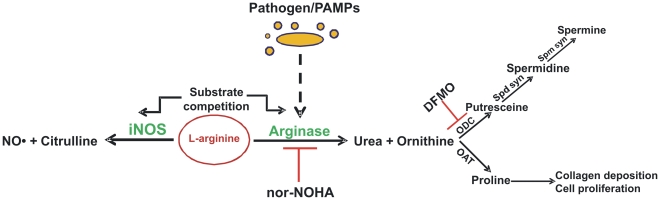
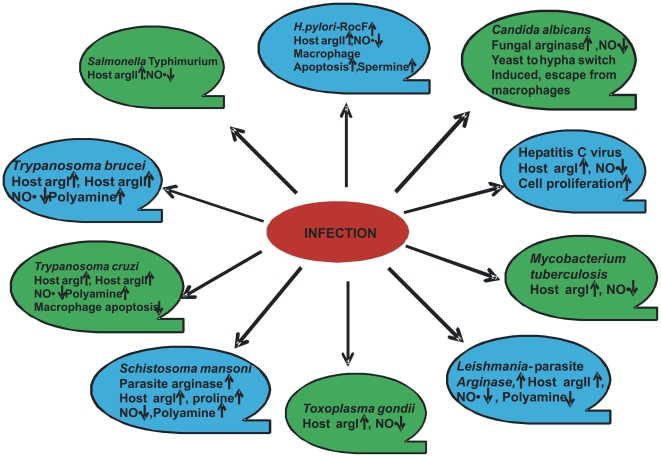
Arginine is a crucial amino acid that serves to modulate the cellular immune response during infection. Arginine is also a common substrate for both inducible nitric oxide synthase (iNOS) and arginase. The generation of nitric oxide from arginine is responsible for efficient immune response and cytotoxicity of host cells to kill the invading pathogens. On the other hand, the conversion of arginine to ornithine and urea via the arginase pathway can support the growth of bacterial and parasitic pathogens. The competition between iNOS and arginase for arginine can thus contribute to the outcome of several parasitic and bacterial infections. There are two isoforms of vertebrate arginase, both of which catalyze the conversion of arginine to ornithine and urea, but they differ with regard to tissue distribution and subcellular localization. In the case of infection with Mycobacterium, Leishmania, Trypanosoma, Helicobacter, Schistosoma, and Salmonella spp., arginase isoforms have been shown to modulate the pathology of infection by various means. Despite the existence of a considerable body of evidence about mammalian arginine metabolism and its role in immunology, the critical choice to divert the host arginine pool by pathogenic organisms as a survival strategy is still a mystery in infection biology.
Overview
The claims and statistics of this paper haven’t been checked yet.
Run the check — free, no account needed. It reads the open-access text and checks the sources it cites.
Integrity signals
Registry
Cites
Statistics
Figures
Verification
Claims the paper makes
The claims and statistics of this paper haven’t been checked yet.
Run the check — free, no account needed. It reads the open-access text and checks the sources it cites.
Claims other papers make about this one
Each is checked against this paper’s own text: does it say what the citing paper says it does?
In the citing paper
“Thereby Arg1 reduces the potential of activated MΦs to produce NO and generally limits tissue nitrogen sources important for T-cell activation and proliferation (57, 107).”
From Macrophage defense mechanisms against intracellular bacteria (2015) · cites this paper as [107]
In the citing paper
“As a hallmark enzyme, alternatively activated MO express arginase 1 (Arg1) depleting the inflamed tissue of arginine by generating L-ornithine and urea, and the downstream products of ornithine decarboxylase (ODC) and ornithine aminotransferase (OAT) activities, polyamines, and proline (important for induction of collagen deposits and fibrosis), respectively.”
From Macrophage defense mechanisms against intracellular bacteria (2015) · cites this paper as [107]
Self-check
Percentages, sums and reported differences re-computed from the paper’s own numbers.
The self-check needs the paper’s full text.
Citations
Cites
Arginine metabolism: nitric oxide and beyond
WU, G., & MORRIS, S. M. (1998) · Biochemical Journal · doi:10.1042/bj3360001 · Cited by 2,811
Hesse, M., Modolell, M., Flamme, A. C. L., Schito, M. L., Fuentes, J. M., Cheever, A. W., Pearce, E. J., & Wynn, T. A. (2001) · The Journal of Immunology · doi:10.4049/jimmunol.167.11.6533 · Cited by 723
El Kasmi, K. C., Qualls, J. E., Pesce, J. T., Smith, A. M., Thompson, R. W., Henao-Tamayo, M., Basaraba, R. J., König, T., Schleicher, U., Koo, M.-S., et al. (2008) · Nature Immunology · doi:10.1038/ni.1671 · Cited by 646 · cited 2×
“Mice lacking arginase I did not lose weight and did not show any sign of toxoplasmosis, unlike the control mice [19].”
BackgroundTh1/Th2-regulated expression of arginase isoforms in murine macrophages and dendritic cells.
Munder, M., Eichmann, K., Morán, J., Centeno, F., Soler, G., & Modolell, M. (1999) · Journal of Immunology · doi:10.4049/jimmunol.163.7.3771 · Cited by 619
Nitric oxide and the regulation of gene expression
Bogdan, C. (2001) · Trends in Cell Biology · doi:10.1016/s0962-8924(00)01900-0 · Cited by 534
Scharton‐Kersten, T., Yap, G. S., Magram, J., & Sher, A. (1997) · The Journal of Experimental Medicine · doi:10.1084/jem.185.7.1261 · Cited by 423
Gobert, A. P., McGee, D. J., Akhtar, M., Mendz, G. L., Newton, J. C., Cheng, Y., Mobley, H. L. T., & Wilson, K. T. (2001) · Proceedings of the National Academy of Sciences · doi:10.1073/pnas.241443798 · Cited by 386
Kropf, P., Fuentes, J. M., Fähnrich, E., Arpa, L., Herath, S., Weber, V., Soler, G., Celada, A., Modolell, M., & Müller, I. (2005) · The FASEB Journal · doi:10.1096/fj.04-3416fje · Cited by 295
Inducible nitric oxide synthase and control of intracellular bacterial pathogens
Chakravortty, D., & Hensel, M. (2003) · Microbes and Infection · doi:10.1016/s1286-4579(03)00096-0 · Cited by 287
Self-citationIniesta, V., Gómez-Nieto, L. C., & Corraliza, I. (2001) · The Journal of Experimental Medicine · doi:10.1084/jem.193.6.777 · Cited by 267
Cited by
Sorted by citations
The metabolic signature of macrophage responses
Viola, A., Munari, F., Sánchez-Rodríguez, R., Scolaro, T., & Castegna, A. (2019) · Frontiers in Immunology · doi:10.3389/fimmu.2019.01462 · Cited by 2,021
Macrophage defense mechanisms against intracellular bacteria
Weiss, G., & Schaible, U. E. (2015) · Immunological Reviews · doi:10.1111/imr.12266 · Cited by 989
Commensal bacteria at the interface of host metabolism and the immune system
Brestoff, J. R., & Artis, D. (2013) · Nature Immunology · doi:10.1038/ni.2640 · Cited by 945
Nitric oxide synthase in innate and adaptive immunity: an update
Bogdan, C. (2015) · Trends in Immunology · doi:10.1016/j.it.2015.01.003 · Cited by 862
Nitric oxide and redox mechanisms in the immune response
Wink, D. A., Hines, H. B., Cheng, R. Y. S., Switzer, C. H., Flores-Santana, W., Vitek, M. P., Ridnour, L. A., & Colton, C. A. (2011) · Journal of Leukocyte Biology · doi:10.1189/jlb.1010550 · Cited by 765
Metadata
- Authors
- Das, P., Lahiri, A., Lahiri, A., & Chakravortty, D.
- Affiliations
- Indian Institute of Science Bangalore (IN)
- Corresponding author
- Chakravortty, Dipshikha
- Venue
- PLoS Pathogens
- Publisher
- Public Library of Science (PLoS)
- Published
- 2010-06-17
- Volume
- 6
- Issue
- 6
- Pages
- e1000899
- ISSN
- 1553-7366 (ISSN-L)
- 1553-7374
- PMC
- PMC2887468
- OpenAlex
- W2120562230
- Cited by
- 247
- References
- 54
- Citations by year
- 2026: 4 · 2025: 9 · 2024: 22 · 2023: 17 · 2022: 11 · 2021: 20 · 2020: 24 · 2019: 13 · 2018: 13 · 2017: 14 · 2016: 19 · 2015: 14 · 2014: 15 · 2013: 22 · 2012: 15
- FWCI
- 1.59
- Type
- journal article
- Language
- en
- Open access
- gold
- doi.org
- Locations
- PLoS Pathogens (publishedVersion, cc-by)
- PubMed Central (publishedVersion, cc-by)
- PubMed (publishedVersion)
- DOAJ (DOAJ: Directory of Open Access Journals) (submittedVersion, cc-by-sa)
- Funders
- Indian Institute of Science
- Department of Biotechnology, Ministry of Science and Technology, India (DBT 172, DBT 197)
- Department of Science and Technology, Ministry of Science and Technology, India
- Indian Council of Medical Research
- Center for Advanced Study, University of Illinois at Urbana-Champaign
- Topics
- Life Sciences › Biochemistry, Genetics and Molecular Biology › Biochemistry › Amino Acid Enzymes and Metabolism
- Life Sciences › Biochemistry, Genetics and Molecular Biology › Biotechnology › Bacterial Cancer Therapy
- Life Sciences › Biochemistry, Genetics and Molecular Biology › Molecular Biology › Polyamine Metabolism and Applications
- Keywords
- arginase, arginine metabolism, inducible nitric oxide synthase, nitric oxide, immunomodulation, microbial pathogenesis, ornithine, urea, Mycobacterium, Leishmania, trypanosomes, Helicobacter, Schistosoma, Salmonella, host-pathogen interaction
- MeSH terms
- Animals, Arginase, Bacteria, Bacterial Infections, Humans, Immunologic Factors, Isoenzymes, Signal Transduction
About these checks
Registry, retraction, Cites and statistics results are computed, not judged, with one exception: a printed reference that no index lists is read once by a model before it counts as a citation error. Claims are extracted by a model and kept only when their quote appears verbatim in the text; each cited source is then checked, with a model’s help, for whether it says what the claim relies on. Those verdicts can be wrong — read the claim’s quote and the cited source before relying on one.
Statistics and arithmetic are recomputed, not judged.
Confidence bands are shown only for fields calibrated on our annotated test set. None is calibrated yet, so no band is shown.
What counts as a claim ›How we measure confidence ›How we check this ›
Are you an author, or do you see a problem with this page? Request a review
