

Type I Interferons Promote Fatal Immunopathology by Regulating Inflammatory Monocytes and Neutrophils during Candida Infections
Open accessThe DOI matches its Crossref record; 70 of the 70 references it cites were found in a registry or an index.
Abstract
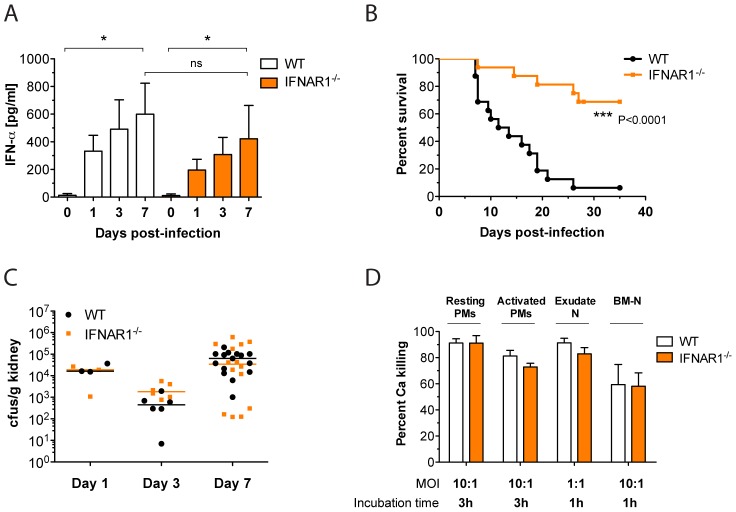
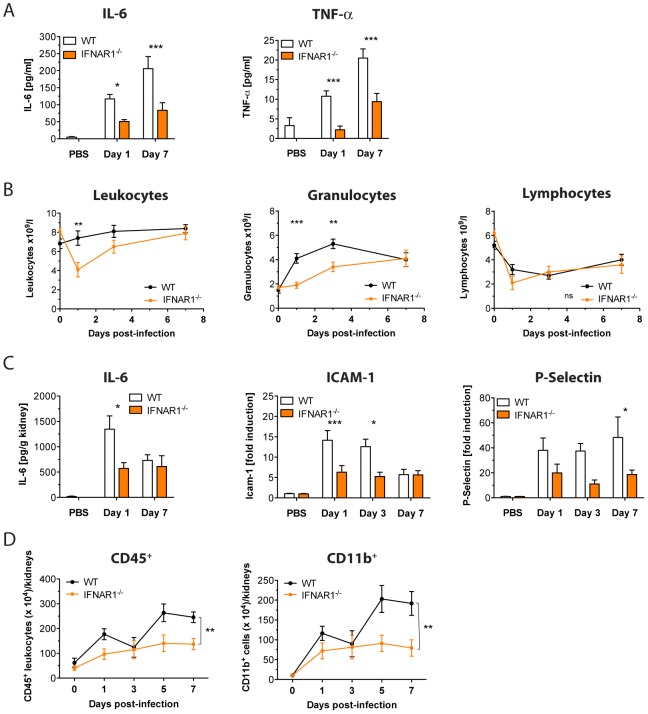
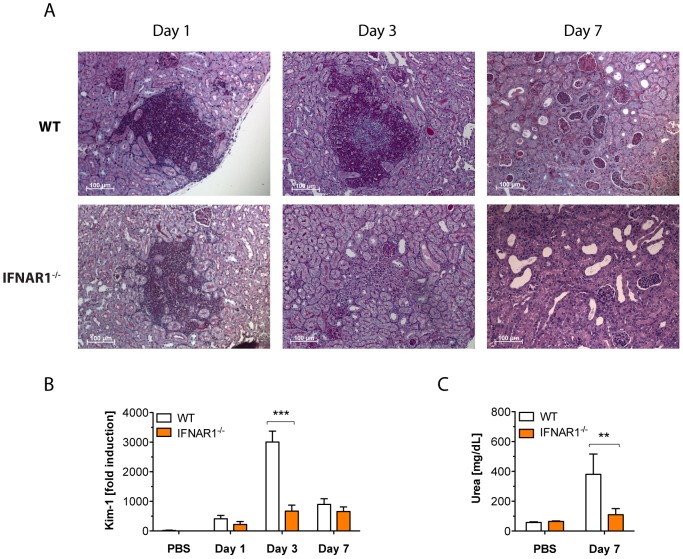
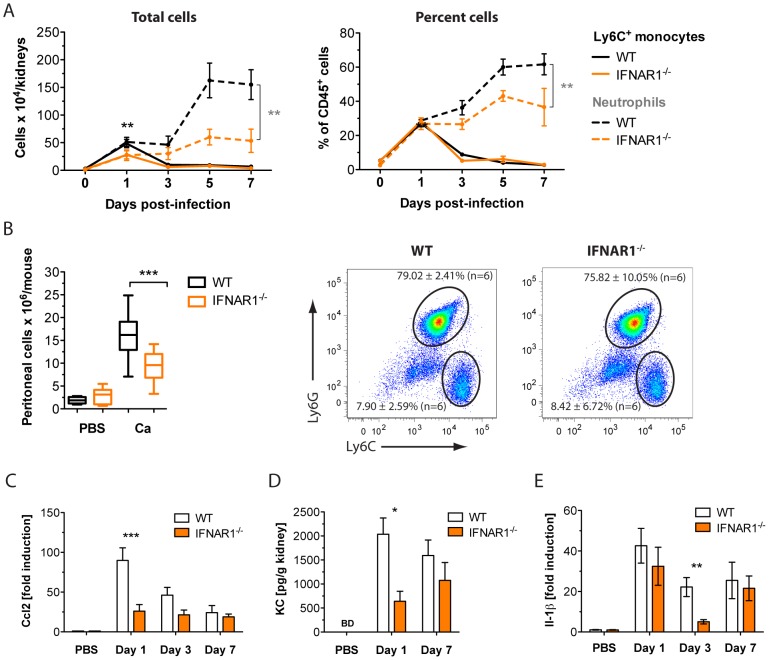
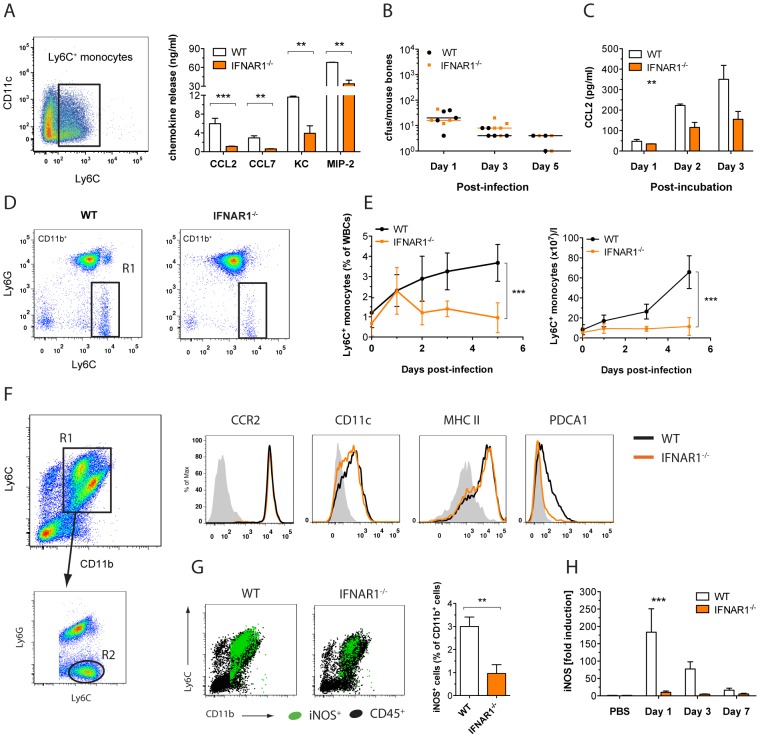
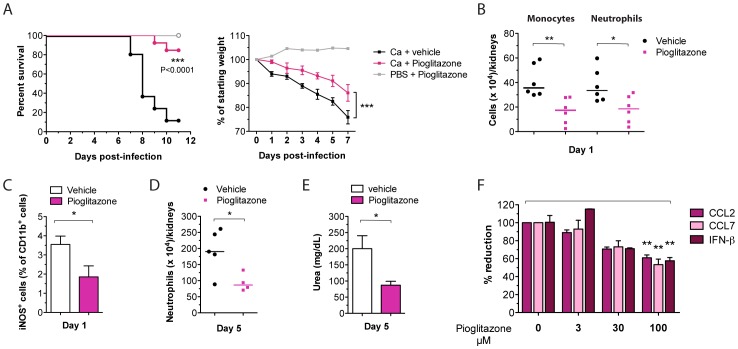
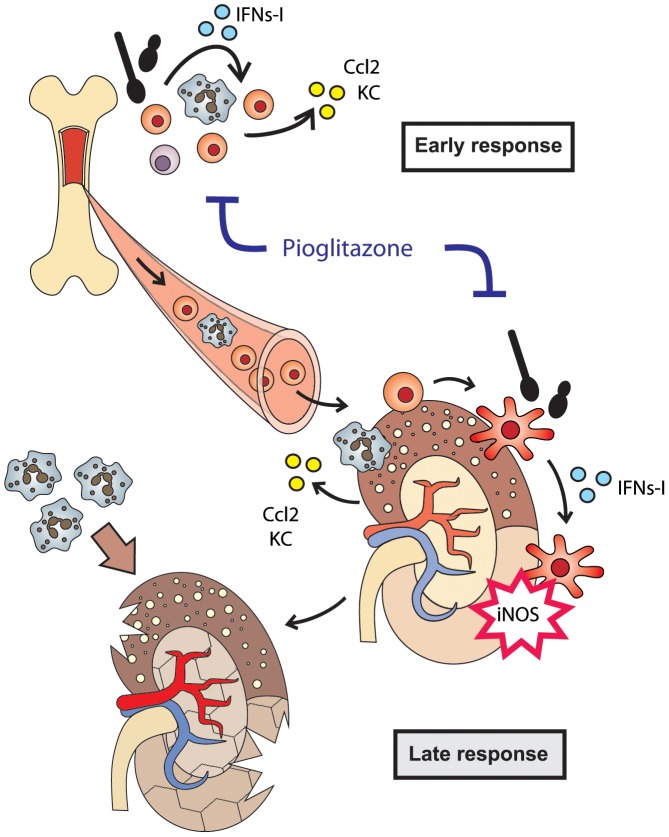
Invasive fungal infections by Candida albicans (Ca) are a frequent cause of lethal sepsis in intensive care unit patients. While a contribution of type I interferons (IFNs-I) in fungal sepsis remains unknown, these immunostimulatory cytokines mediate the lethal effects of endotoxemia and bacterial sepsis. Using a mouse model lacking a functional IFN-I receptor (Ifnar1⁻/⁻), we demonstrate a remarkable protection against invasive Ca infections. We discover a mechanism whereby IFN-I signaling controls the recruitment of inflammatory myeloid cells, including Ly6C(hi) monocytes and neutrophils, to infected kidneys by driving expression of the chemokines CCL2 and KC. Within kidneys, monocytes differentiate into inflammatory DCs but fail to functionally mature in Ifnar1⁻/⁻ mice, as demonstrated by the impaired upregulation of the key activation markers PDCA1 and iNOS. The increased activity of inflammatory monocytes and neutrophils results in hyper-inflammation and lethal kidney pathology. Pharmacological diminution of monocytes and neutrophils by treating mice with pioglitazone, a synthetic agonist of the nuclear receptor peroxisome proliferator-activated receptor-γ (PPAR-γ), strongly reduces renal immunopathology during Ca infection and improves mouse survival. Taken together, our data connect for the first time the sepsis-promoting functions of IFNs-I to the CCL2-mediated recruitment and the activation of inflammatory monocytes/DCs with high host-destructing potency. Moreover, our data demonstrate a therapeutic relevance of PPAR-γ agonists for microbial infectious diseases where inflammatory myeloid cells may contribute to fatal tissue damage.
Overview
The claims and statistics of this paper haven’t been checked yet.
Free: it reads the open-access text and checks the first 5 claims that cite a source we can check. Create a free account to check every claim.
Integrity signals
Registry
Cites
Statistics
Figures
Verification
Claims the paper makes
The claims and statistics of this paper haven’t been checked yet.
Free: it reads the open-access text and checks the first 5 claims that cite a source we can check. Create a free account to check every claim.
Claims other papers make about this one
Each is checked against this paper’s own text: does it say what the citing paper says it does?
The source backs part of the claim, not all of it — or backs it for a different population, condition or comparison.
In the citing paper
“Subsequently, C. albicans that avoid timely killing and elimination by macrophages invade organs and tissues throughout the body through hyphal infiltration into vascular endothelial cells [16,54,55], leading to the induction of systemic inflammatory responses [15,16].”
From The F 1 F o -ATP synthase α subunit of Candida albicans induces inflammatory responses by controlling amino acid catabolism (2023) · cites this paper as [16]
Experimental — accuracy not yet measuredThe cited source says what the claim attributes to it.
In the citing paper
“this response is also induced by bacterial, parasitic (43), and fungal infections (30, 44 – 48).”
From Overlooked Candida glabrata petites are echinocandin tolerant, induce host inflammatory responses, and display poor in vivo fitness (2023) · cites this paper as [44]
Self-check
Percentages, sums and reported differences re-computed from the paper’s own numbers.
The self-check needs the paper’s full text.
Citations
Cites
The peroxisome proliferator-activated receptor-γ is a negative regulator of macrophage activation
Ricote, M., Li, A. C., Willson, T. M., Kelly, C. J., & Glass, C. K. (1998) · Nature · doi:10.1038/34178 · Cited by 3,525 · cited 1×
“In line with previous reports identifying iNOS as one of the main target genes of PPARc mediated repression [41], we detected significantly reduced iNOS inflammatory DCs in kidneys of drug-treated mice (Figure 6C), suggesting that pioglitazone also interferes with the Figure 5.”
ResultFunctional Role of Type I and Type II Interferons in Antiviral Defense
Müller, U., Steinhoff, U., Reis, L. F. L., Hemmi, S., Pavlovic, J., Zinkernagel, R. M., & Aguet, M. (1994) · Science · doi:10.1126/science.8009221 · Cited by 2,453
Serbina, N. V., & Pamer, E. G. (2006) · Nature Immunology · doi:10.1038/ni1309 · Cited by 1,669
IFNα activates dormant haematopoietic stem cells in vivo
Essers, M. A. G., Offner, S., Blanco-Bose, W. E., Waibler, Z., Kalinke, U., Duchosal, M. A., & Trumpp, A. (2009) · Nature · doi:10.1038/nature07815 · Cited by 1,368 · cited 1×
“mice do not show this retention phenotype, most likely because IFN-I signaling might also affect the primary differentiation or proliferation of monocytes within the BM”
BackgroundContribution of Neutrophils to Acute Lung Injury
Grommes, J., & Soehnlein, O. (2011) · Molecular Medicine · doi:10.2119/molmed.2010.00138 · Cited by 1,313
A SUMOylation-dependent pathway mediates transrepression of inflammatory response genes by PPAR-γ
Pascual, G., Fong, A. L., Ogawa, S., Gamliel, A., Li, A. C., Perissi, V., Rose, D. W., Willson, T. M., Rosenfeld, M. G., & Glass, C. K. (2005) · Nature · doi:10.1038/nature03988 · Cited by 1,254
Gillum, A. M., Tsay, E. Y. H., & Kirsch, D. R. (1984) · Molecular and General Genetics MGG · doi:10.1007/bf00328721 · Cited by 1,251
TNF/iNOS-Producing Dendritic Cells Mediate Innate Immune Defense against Bacterial Infection
Serbina, N. V., Salazar-Mather, T. P., Biron, C. A., Kuziel, W. A., & Pamer, E. G. (2003) · Immunity · doi:10.1016/s1074-7613(03)00171-7 · Cited by 1,175
Interferons at age 50: past, current and future impact on biomedicine
Borden, E. C., Sen, G. C., Uze, G., Silverman, R. H., Ransohoff, R. M., Foster, G. R., & Stark, G. R. (2007) · Nature Reviews Drug Discovery · doi:10.1038/nrd2422 · Cited by 1,154 · cited 1×
“cytokines that regulate resistance to viruses, enhance innate and adaptive immunity, and modulate cell survival and apoptosis [2].”
BackgroundTsou, C.-L., Peters, W., Si, Y., Slaymaker, S., Aslanian, A. M., Weisberg, S. P., Mack, M., & Charo, I. F. (2007) · Journal of Clinical Investigation · doi:10.1172/jci29919 · Cited by 1,152 · cited 15×
“Due to a defect of monocyte egression from the BM, mice lacking CCL2 or the cognate receptor CCR2 retain most monocytes in the BM [37,55].”
BackgroundMethodInfluentialSelf-citation
Cited by
Type I interferons in infectious disease
McNab, F., Mayer-Barber, K., Sher, A., Wack, A., & O'Garra, A. (2015) · Nature Reviews Immunology · doi:10.1038/nri3787 · Cited by 2,780
Channappanavar, R., Fehr, A. R., Vijay, R., Mack, M., Zhao, J., Meyerholz, D. K., & Perlman, S. (2016) · Cell Host & Microbe · doi:10.1016/j.chom.2016.01.007 · Cited by 1,419
Self-citationImmune defence against Candida fungal infections
Netea, M. G., Joosten, L. A. B., van der Meer, J. W. M., Kullberg, B.-J., & van de Veerdonk, F. L. (2015) · Nature Reviews Immunology · doi:10.1038/nri3897 · Cited by 642
d'Enfert, C., Kaune, A.-K., Alaban, L.-R., Chakraborty, S., Cole, N., Delavy, M., Kosmala, D., Marsaux, B., Fróis-Martins, R., Morelli, M., et al. (2021) · FEMS Microbiology Reviews · doi:10.1093/femsre/fuaa060 · Cited by 347
The regulation of inflammation by interferons and their STATs
Rauch, I., Müller, M., & Decker, T. (2013) · JAK-STAT · doi:10.4161/jkst.23820 · Cited by 281
Self-citation
Metadata
- Authors
- Majer, O., Bourgeois, C., Zwolanek, F., Lassnig, C., Kerjaschki, D., Mack, M., Müller, M., & Kuchler, K.
- Affiliations
- Max Perutz Labs (AT)
- University of Veterinary Medicine Vienna (AT)
- Vienna General Hospital (AT)
- University Hospital Regensburg (DE)
- Corresponding author
- Kuchler, Karl
- Venue
- PLoS Pathogens
- Publisher
- Public Library of Science (PLoS)
- Published
- 2012-07-26
- Volume
- 8
- Issue
- 7
- Pages
- e1002811
- ISSN
- 1553-7366 (ISSN-L)
- 1553-7374
- PMC
- PMC3406095
- OpenAlex
- W2073067684
- Cited by
- 156
- References
- 70
- Citations by year
- 2026: 7 · 2025: 11 · 2024: 11 · 2023: 8 · 2022: 8 · 2021: 7 · 2020: 15 · 2019: 9 · 2018: 16 · 2017: 10 · 2016: 12 · 2015: 14 · 2014: 19 · 2013: 7 · 2012: 1
- FWCI
- 9.05
- Type
- journal article
- Language
- en
- Open access
- gold
- doi.org
- Locations
- PLoS Pathogens (publishedVersion, cc-by)
- Europe PMC (PubMed Central) (publishedVersion, cc-by)
- PubMed Central (publishedVersion, cc-by)
- PubMed (publishedVersion)
- DOAJ (DOAJ: Directory of Open Access Journals) (submittedVersion, cc-by-sa)
- Figshare (submittedVersion, cc-by)
- MPG.PuRe (Max Planck Society) (submittedVersion, other-oa)
- Funders
- Österreichischen Akademie der Wissenschaften
- Austrian Science Fund (SFB‐F28)
- Bundesministerium für Wissenschaft und Forschung
- Topics
- Health Sciences › Medicine › Infectious Diseases › Antifungal resistance and susceptibility
- Life Sciences › Immunology and Microbiology › Immunology › interferon and immune responses
- Life Sciences › Immunology and Microbiology › Immunology › Inflammation biomarkers and pathways
- Keywords
- type I interferon, Candida albicans, invasive fungal infections, fungal sepsis, immunopathology, inflammatory monocytes, neutrophils, dendritic cell maturation, MCP-1, KC chemokine, IFNAR1, PPARγ agonists, pioglitazone, hyperinflammation, myeloid cell recruitment
- MeSH terms
- Bone Marrow Stromal Antigen 2, Pioglitazone, Animals, Antigens, Ly, Candida albicans, Candidiasis, Dendritic Cells, Inflammation, Interferon Type I, Kidney, Male, Membrane Glycoproteins, Mice, Inbred C57BL, Monocytes, Neutrophils, Signal Transduction, Antigens, CD, Receptors, Interferon, Mice, Knockout, Chemokine CCL2, Thiazolidinediones, PPAR gamma, Mice, Nitric Oxide Synthase Type II, Chemokine CXCL1, Candidemia
About these checks
Registry, retraction, Cites and statistics results are computed, not judged, with one exception: a printed reference that no index lists is read once by a model before it counts as a citation error. Claims are extracted by a model and kept only when their quote appears verbatim in the text; each cited source is then checked, with a model’s help, for whether it says what the claim relies on. Those verdicts can be wrong — read the claim’s quote and the cited source before relying on one.
Statistics and arithmetic are recomputed, not judged.
Confidence bands are shown only for fields calibrated on our annotated test set. None is calibrated yet, so no band is shown.
What counts as a claim ›How we measure confidence ›How we check this ›
Are you an author, or do you see a problem with this page? Request a review
How to cite
Cite CoChat for the checks on this page, and the paper for its own findings.
- This page
- CoChat. (2026). Citation check: Type I Interferons Promote Fatal Immunopathology by Regulating Inflammatory Monocytes and Neutrophils during Candida Infections. https://app.cochat.ai/papers/10.1371/journal.ppat.1002811
- The paper
- Majer, O., Bourgeois, C., Zwolanek, F., Lassnig, C., Kerjaschki, D., Mack, M., Müller, M., & Kuchler, K. (2012). Type I Interferons Promote Fatal Immunopathology by Regulating Inflammatory Monocytes and Neutrophils during Candida Infections. PLoS Pathogens. https://doi.org/10.1371/journal.ppat.1002811
Data sources
Bibliographic data: Semantic Scholar, OpenAlex, Crossref.
Contains information from the Semantic Scholar Academic Graph Datasets, made available under the ODC Attribution License (ODC-BY 1.0).
Semantic Scholar’s data is described in: Kinney, R., et al. (2023). The Semantic Scholar Open Data Platform. arXiv:2301.10140.
