

A Polysaccharide Virulence Factor from Aspergillus fumigatus Elicits Anti-inflammatory Effects through Induction of Interleukin-1 Receptor Antagonist
Open accessThe DOI matches its Crossref record; 35 of the 35 references it cites were found in a registry or an index.
Abstract
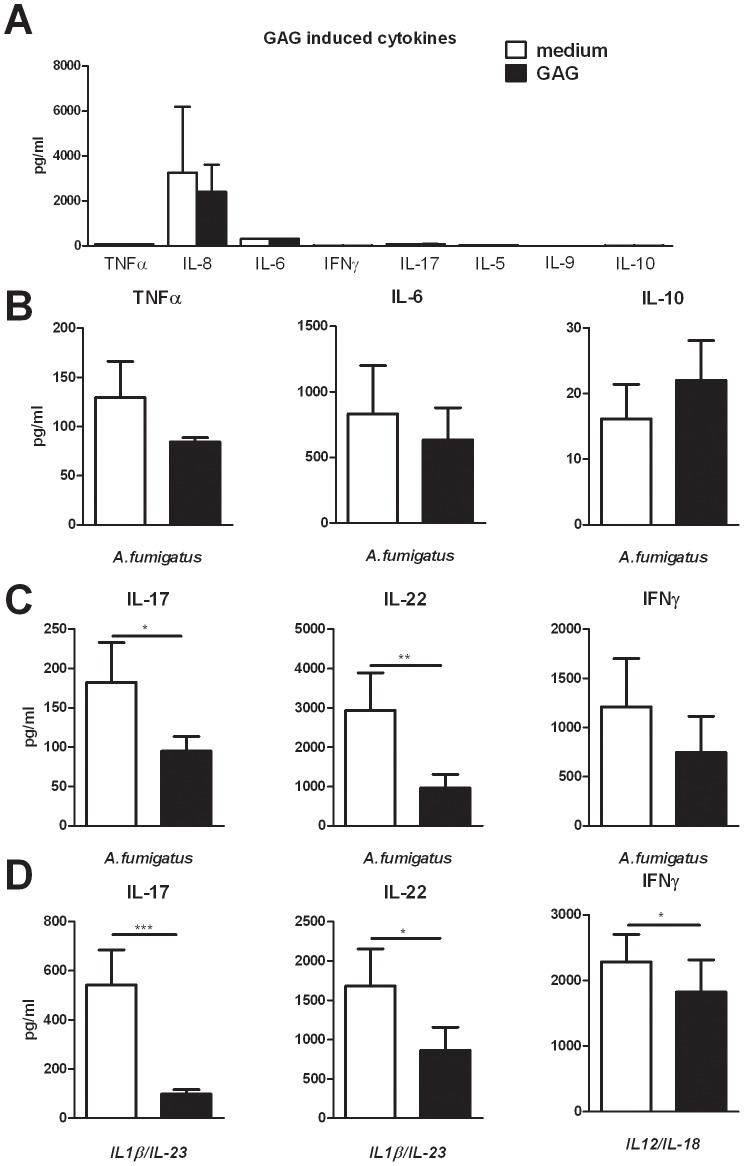
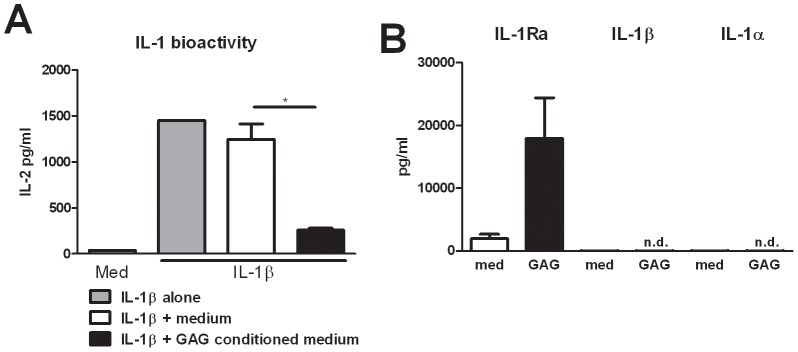
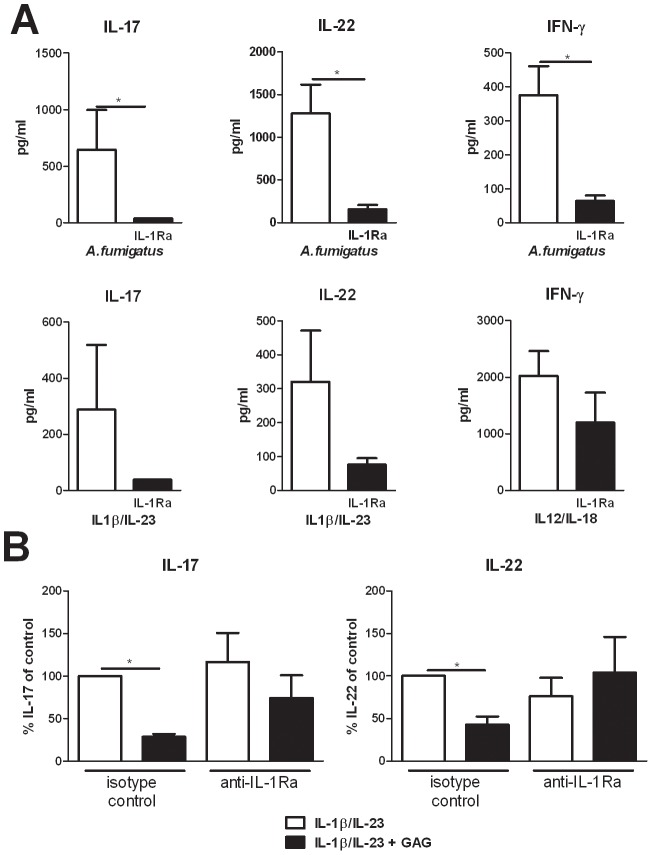
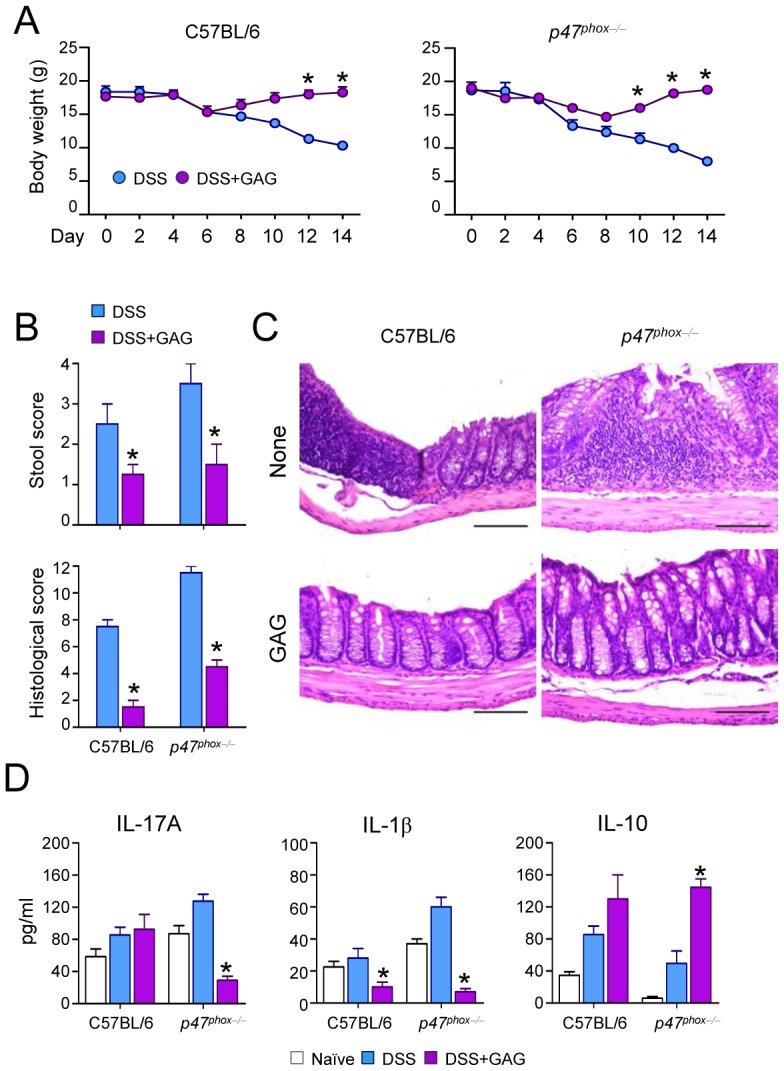
The galactosaminogalactan (GAG) is a cell wall component of Aspergillus fumigatus that has potent anti-inflammatory effects in mice. However, the mechanisms responsible for the anti-inflammatory property of GAG remain to be elucidated. In the present study we used in vitro PBMC stimulation assays to demonstrate, that GAG inhibits proinflammatory T-helper (Th)1 and Th17 cytokine production in human PBMCs by inducing Interleukin-1 receptor antagonist (IL-1Ra), a potent anti-inflammatory cytokine that blocks IL-1 signalling. GAG cannot suppress human T-helper cytokine production in the presence of neutralizing antibodies against IL-1Ra. In a mouse model of invasive aspergillosis, GAG induces IL-1Ra in vivo, and the increased susceptibility to invasive aspergillosis in the presence of GAG in wild type mice is not observed in mice deficient for IL-1Ra. Additionally, we demonstrate that the capacity of GAG to induce IL-1Ra could also be used for treatment of inflammatory diseases, as GAG was able to reduce severity of an experimental model of allergic aspergillosis, and in a murine DSS-induced colitis model. In the setting of invasive aspergillosis, GAG has a significant immunomodulatory function by inducing IL-1Ra and notably IL-1Ra knockout mice are completely protected to invasive pulmonary aspergillosis. This opens new treatment strategies that target IL-1Ra in the setting of acute invasive fungal infection. However, the observation that GAG can also protect mice from allergy and colitis makes GAG or a derivative structure of GAG a potential treatment compound for IL-1 driven inflammatory diseases.
Overview
The claims and statistics of this paper haven’t been checked yet.
Free: it reads the open-access text and checks the first 5 claims that cite a source we can check. Create a free account to check every claim.
Integrity signals
Registry
Cites
Statistics
Figures
![Figure 4 GAG induces IL-1Ra in vivo and IL-1Ra increases susceptibility to aspergillosis. BALB/c and Il1ra−/− mice were intranasally infected with Aspergillus conidia and treated with GAG (250 μg/kg intranasally) the day of infection, and 1, 2 and 3 days post-infection. (A) Il1ra mRNA expression in lung homogenates of mice with invasive aspergillosis, (B) Il1ra mRNA expression in purified cells from lungs of naive mice pre-stimulated with Aspergillus conidia or LPS for 1 hour, and exposed to different GAG concentrations for an additional 18 hours. (C) Survival, (D) fungal growth (CFU/lung, mean +/−SEM), (E) protein levels of IL-1Ra, (F) Mpo expression in lung homogenates, and (G) BAL morphometry [% polymorphonuclear (PMNs) cells and lung histology (PAS stained sections, bars indicate 20× magnification) of Aspergillus-infected mice with or without GAG treatment. Assays were done a day after the last GAG treatment. (H) BAL morphometry [% PMNs or eosinophils (Eo)] and lung histology (PAS stained sections, bars indicate 20× magnification), and (I) expression of Th transcription factors and cytokines in total cells from the draining lymph nodes in mice with ABPA and treated with or without GAG. Naïve means uninfected mice, and none means untreated mice and/or unstimulated cells. (J) IL-5, IL-13 and IL-17 concentrations in culture supernatants of PBMCs pre-incubated 1 h either with medium or GAG (10 μg/ml). After washing, the cells were stimulated for 7 days with heat inactivated 1×10⁷/ml A. fumigatus conidia (n = 4 donors). Data are represented as mean +/− SEM. *, p<0.05; **, p<0.01.](https://figures.cochat.ai/paper-figures/a8002ef6add240c9915f0162170203cd/a-polysaccharide-virulence-factor-from-aspergillus-fumigatus-elicits-anti-figure-4.jpg)
Verification
Claims the paper makes
The claims and statistics of this paper haven’t been checked yet.
Free: it reads the open-access text and checks the first 5 claims that cite a source we can check. Create a free account to check every claim.
Claims other papers make about this one
Each is checked against this paper’s own text: does it say what the citing paper says it does?
The source backs part of the claim, not all of it — or backs it for a different population, condition or comparison.
In the citing paper
“In mouse models of invasive aspergillosis, GAG inhibits Th1 protective antifungal immunity and skews immune responses toward Th2 to facilitate fungal infections (260).”
From Aspergillus fumigatus and Aspergillosis in 2019 (2019) · cites this paper as [260]
Experimental — accuracy not yet measuredThe cited source says what the claim attributes to it.
In the citing paper
“In a model of pulmonary aspergillosis in immunocompetent mice, GAG-induced increases of the fungal burden were largely dependent on the induction of IL-1Ra and subsequent blockade in PMN chemotaxis.”
From Aspergillus fumigatus and Aspergillosis in 2019 (2019) · cites this paper as [260]
The check wasn’t confident either way, so it gives no verdict — never disputed.
In the citing paper
“IL-37, another member of the IL-1 cytokine family, restricted Aspergillus immunopathology by preventing NLRP3-dependent neutrophil recruitment and detrimental immunopathology in murine aspergillosis in cystic fibrosis transgenic mice (260).”
From Aspergillus fumigatus and Aspergillosis in 2019 (2019) · cites this paper as [260]
Experimental — accuracy not yet measuredIn the citing paper
“These results demonstrated that IL-1Ra has an important role during A. fumigatus infections and support the concept that GAG induction of IL-1Ra has important clinical consequences (260).”
From Aspergillus fumigatus and Aspergillosis in 2019 (2019) · cites this paper as [260]
In the citing paper
“In human PBMCs, GAG dampened protective Th1 and Th17 cytokine production by selectively inhibiting IL-1 bioactivity via the induction of IL-1Ra (260).”
From Aspergillus fumigatus and Aspergillosis in 2019 (2019) · cites this paper as [260]
1 more claim about this paper
Create a free account to see every claim other papers make about this one.
Self-check
Percentages, sums and reported differences re-computed from the paper’s own numbers.
The self-check needs the paper’s full text.
Citations
Cites
A CD4+T-cell subset inhibits antigen-specific T-cell responses and prevents colitis
Groux, H., O'Garra, A., Bigler, M., Rouleau, M., Antonenko, S., de Vries, J. E., & Roncarolo, M. G. (1997) · Nature · doi:10.1038/39614 · Cited by 3,588 · cited 1×
“inflammatory cytokine that plays an important role in the protection of colitis [15,16].”
BackgroundInterleukin-1 in the pathogenesis and treatment of inflammatory diseases
Dinarello, C. A. (2011) · Blood · doi:10.1182/blood-2010-07-273417 · Cited by 2,248 · cited 1×
“Bioactivity of the IL-1 signalling pathway is dependent on IL-1 receptor agonists (IL-1a and IL-1b) and IL-1 receptor antagonists [13].”
BackgroundSelf-citationRomani, L. (2011) · Nature Reviews Immunology · doi:10.1038/nri2939 · Cited by 1,793
Self-citationTreating inflammation by blocking interleukin-1 in a broad spectrum of diseases
Dinarello, C. A., Simon, A., & van der Meer, J. W. M. (2012) · Nature Reviews Drug Discovery · doi:10.1038/nrd3800 · Cited by 1,768 · cited 1×
“potential treatment compound for IL-1–mediated diseases, such as joint, bone and muscle diseases and even very common inflammatory diseases such as diabetes and gout [25].”
BackgroundSelf-citationAn Autoinflammatory Disease with Deficiency of the Interleukin-1–Receptor Antagonist
Aksentijevich, I., Masters, S. L., Ferguson, P. J., Dancey, P., Frenkel, J., van Royen-Kerkhoff, A., Laxer, R., Tedgård, U., Cowen, E. W., Pham, T.-H., et al. (2009) · New England Journal of Medicine · doi:10.1056/nejmoa0807865 · Cited by 987
Marr, K. A., Carter, R. A., Boeckh, M., Martin, P., & Corey, L. (2002) · Blood · doi:10.1182/blood-2002-05-1496 · Cited by 957 · cited 1×
“One of the major risk factors that increases susceptibility to invasive aspergillosis is neutropenia [20], and neutrophils are crucial for clearing invasive germinating and hyphal forms of Aspergillus infection [21].”
BackgroundSurface hydrophobin prevents immune recognition of airborne fungal spores
Aimanianda, V., Bayry, J., Bozza, S., Kniemeyer, O., Perruccio, K., Elluru, S. R., Clavaud, C., Paris, S., Brakhage, A. A., Kaveri, S. V., et al. (2009) · Nature · doi:10.1038/nature08264 · Cited by 792 · cited 1×
“Rodlets and melanin, that are present on the conidial surface, shield PAMPs that elicit pro-inflammatory host responses [4,5].”
BackgroundSelf-citationInflammasome activation and IL-1β and IL-18 processing during infection
van de Veerdonk, F. L., Netea, M. G., Dinarello, C. A., & Joosten, L. A. B. (2011) · Trends in Immunology · doi:10.1016/j.it.2011.01.003 · Cited by 691 · cited 1×
“A deficient IL-1 pathway is also detrimental for the host, since it is an important protective pathway required to fight infection [17].”
BackgroundSelf-citationSchaffner, A., Douglas, H., & Braude, A. (1982) · Journal of Clinical Investigation · doi:10.1172/jci110489 · Cited by 615 · cited 1×
“One of the major risk factors that increases susceptibility to invasive aspergillosis is neutropenia [20], and neutrophils are crucial for clearing invasive germinating and hyphal forms of Aspergillus infection [21].”
BackgroundIL-1 acts directly on CD4 T cells to enhance their antigen-driven expansion and differentiation
Ben-Sasson, S. Z., Hu-Li, J., Quiel, J., Cauchetaux, S., Ratner, M., Shapira, I., Dinarello, C. A., & Paul, W. E. (2009) · Proceedings of the National Academy of Sciences · doi:10.1073/pnas.0902745106 · Cited by 568 · cited 1×
“Human Th cytokine responses such as IL-17 and IL-22 production are highly dependent on the IL-1 receptor pathway [11,12].”
BackgroundSelf-citation
Cited by
The Fungal Cell Wall: Structure, Biosynthesis, and Function
Gow, N. A. R., Latge, J.-P., & Munro, C. A. (2017) · Microbiology Spectrum · doi:10.1128/microbiolspec.funk-0035-2016 · Cited by 1,423
Aspergillus fumigatus and Aspergillosis in 2019
Latgé, J.-P., & Chamilos, G. (2019) · Clinical Microbiology Reviews · doi:10.1128/cmr.00140-18 · Cited by 1,400
Self-citationThe Fungal Cell Wall: Candida, Cryptococcus, and Aspergillus Species
Garcia-Rubio, R., de Oliveira, H. C., Rivera, J., & Trevijano-Contador, N. (2020) · Frontiers in Microbiology · doi:10.3389/fmicb.2019.02993 · Cited by 917
Interactions of fungal pathogens with phagocytes
Erwig, L. P., & Gow, N. A. R. (2016) · Nature Reviews Microbiology · doi:10.1038/nrmicro.2015.21 · Cited by 626
Aspergillus fumigatus morphology and dynamic host interactions
van de Veerdonk, F. L., Gresnigt, M. S., Romani, L., Netea, M. G., & Latgé, J.-P. (2017) · Nature Reviews Microbiology · doi:10.1038/nrmicro.2017.90 · Cited by 490
Self-citation
Metadata
- Authors
- Gresnigt, M. S., Bozza, S., Becker, K. L., Joosten, L. A. B., Abdollahi-Roodsaz, S., van der Berg, W. B., Dinarello, C. A., Netea, M. G., Fontaine, T., De Luca, A., Moretti, S., Romani, L., Latge, J.-P., & van de Veerdonk, F. L.
- Affiliations
- Radboud University Medical Center (NL)
- University of Perugia (IT)
- Institut Pasteur (FR)
- Corresponding author
- Romani, Luigina
- ORCID
- Venue
- PLoS Pathogens
- Publisher
- Public Library of Science (PLoS)
- Published
- 2014-03-06
- Volume
- 10
- Issue
- 3
- Pages
- e1003936
- ISSN
- 1553-7366 (ISSN-L)
- 1553-7374
- PMC
- PMC3946377
- OpenAlex
- W2084044646
- Cited by
- 142
- References
- 35
- Citations by year
- 2026: 5 · 2025: 9 · 2024: 7 · 2023: 11 · 2022: 7 · 2021: 16 · 2020: 16 · 2019: 7 · 2018: 9 · 2017: 16 · 2016: 20 · 2015: 9 · 2014: 10
- FWCI
- 12.84
- Type
- journal article
- Language
- en
- Open access
- gold
- doi.org
- Locations
- PLoS Pathogens (publishedVersion, cc-by)
- Europe PMC (PubMed Central) (publishedVersion, cc-by)
- PubMed Central (publishedVersion, cc-by)
- PubMed (publishedVersion)
- Radboud Repository (Radboud University) (submittedVersion)
- HAL (submittedVersion, cc-by)
- DOAJ (DOAJ: Directory of Open Access Journals) (submittedVersion, cc-by-sa)
- Radboud Repository (Radboud University) (submittedVersion, other-oa)
- Funders
- Agence Nationale de la Recherche (ANR-08-PATH-0009, ANR-06-EMPB-0011)
- Radboud Universitair Medisch Centrum
- European Social Fund
- Topics
- Health Sciences › Medicine › Infectious Diseases › Antifungal resistance and susceptibility
- Life Sciences › Biochemistry, Genetics and Molecular Biology › Molecular Biology › Fungal and yeast genetics research
- Life Sciences › Immunology and Microbiology › Immunology › Immune Response and Inflammation
- Keywords
- Aspergillus fumigatus, galactosaminogalactan, interleukin-1 receptor antagonist, anti-inflammatory activity, Th1 cytokines, Th17 cytokines, invasive aspergillosis, allergic bronchopulmonary aspergillosis, colitis, IL-1 signaling, immunomodulation, fungal cell wall
- MeSH terms
- Animals, Aspergillosis, Aspergillus fumigatus, Disease Models, Animal, Enzyme-Linked Immunosorbent Assay, Female, Humans, Leukocytes, Mononuclear, Mice, Inbred BALB C, Polysaccharides, Cytokines, Mice, Knockout, Virulence Factors, Mice, Interleukin 1 Receptor Antagonist Protein, Fungal Polysaccharides
About these checks
Registry, retraction, Cites and statistics results are computed, not judged, with one exception: a printed reference that no index lists is read once by a model before it counts as a citation error. Claims are extracted by a model and kept only when their quote appears verbatim in the text; each cited source is then checked, with a model’s help, for whether it says what the claim relies on. Those verdicts can be wrong — read the claim’s quote and the cited source before relying on one.
Statistics and arithmetic are recomputed, not judged.
Confidence bands are shown only for fields calibrated on our annotated test set. None is calibrated yet, so no band is shown.
What counts as a claim ›How we measure confidence ›How we check this ›
Are you an author, or do you see a problem with this page? Request a review
Data sources
Bibliographic data: Semantic Scholar, OpenAlex, Crossref.
Contains information from the Semantic Scholar Academic Graph Datasets, made available under the ODC Attribution License (ODC-BY 1.0).
Semantic Scholar’s data is described in: Kinney, R., et al. (2023). The Semantic Scholar Open Data Platform. arXiv:2301.10140.
