

The Candida albicans Histone Acetyltransferase Hat1 Regulates Stress Resistance and Virulence via Distinct Chromatin Assembly Pathways
Open accessThe DOI matches its Crossref record; 119 of the 120 references it cites were found in a registry or an index.
Abstract
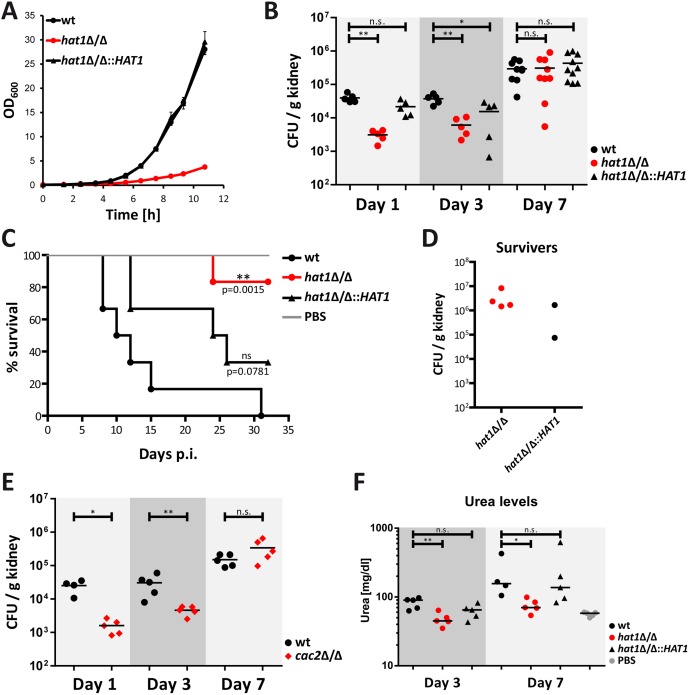
Human fungal pathogens like Candida albicans respond to host immune surveillance by rapidly adapting their transcriptional programs. Chromatin assembly factors are involved in the regulation of stress genes by modulating the histone density at these loci. Here, we report a novel role for the chromatin assembly-associated histone acetyltransferase complex NuB4 in regulating oxidative stress resistance, antifungal drug tolerance and virulence in C. albicans. Strikingly, depletion of the NuB4 catalytic subunit, the histone acetyltransferase Hat1, markedly increases resistance to oxidative stress and tolerance to azole antifungals. Hydrogen peroxide resistance in cells lacking Hat1 results from higher induction rates of oxidative stress gene expression, accompanied by reduced histone density as well as subsequent increased RNA polymerase recruitment. Furthermore, hat1Δ/Δ cells, despite showing growth defects in vitro, display reduced susceptibility to reactive oxygen-mediated killing by innate immune cells. Thus, clearance from infected mice is delayed although cells lacking Hat1 are severely compromised in killing the host. Interestingly, increased oxidative stress resistance and azole tolerance are phenocopied by the loss of histone chaperone complexes CAF-1 and HIR, respectively, suggesting a central role for NuB4 in the delivery of histones destined for chromatin assembly via distinct pathways. Remarkably, the oxidative stress phenotype of hat1Δ/Δ cells is a species-specific trait only found in C. albicans and members of the CTG clade. The reduced azole susceptibility appears to be conserved in a wider range of fungi. Thus, our work demonstrates how highly conserved chromatin assembly pathways can acquire new functions in pathogenic fungi during coevolution with the host.
Overview
The claims and statistics of this paper haven’t been checked yet.
Free: it reads the open-access text and checks the first 5 claims that cite a source we can check. Create a free account to check every claim.
Integrity signals
Registry
Cites
Statistics
Figures
Verification
Claims the paper makes
The claims and statistics of this paper haven’t been checked yet.
Free: it reads the open-access text and checks the first 5 claims that cite a source we can check. Create a free account to check every claim.
Claims other papers make about this one
Each is checked against this paper’s own text: does it say what the citing paper says it does?
The cited source says what the claim attributes to it.
In the citing paper
“The correct genomic integration of the deletion construct and the loss of the target gene were verified by colony PCR (92).”
From Transcriptomics and Phenotyping Define Genetic Signatures Associated with Echinocandin Resistance in Candida auris (2022) · cites this paper as [92]
Self-check
Percentages, sums and reported differences re-computed from the paper’s own numbers.
The self-check needs the paper’s full text.
Citations
Cites
Controlling the False Discovery Rate: A Practical and Powerful Approach to Multiple Testing
Benjamini, Y., & Hochberg, Y. (1995) · Journal of the Royal Statistical Society Series B: Statistical Methodology · doi:10.1111/j.2517-6161.1995.tb02031.x · Cited by 109,482 · cited 1×
“Benjamini-Hochberg adjusted p-values were used to determine differentially regulated genes [115].”
MethodRobinson, M. D., McCarthy, D. J., & Smyth, G. K. (2010) · Bioinformatics · doi:10.1093/bioinformatics/btp616 · Cited by 41,364
HTSeq—a Python framework to work with high-throughput sequencing data
Anders, S., Pyl, P. T., & Huber, W. (2015) · Bioinformatics · doi:10.1093/bioinformatics/btu638 · Cited by 21,464
Crystal structure of the nucleosome core particle at 2.8 Å resolution
Luger, K., Mäder, A. W., Richmond, R. K., Sargent, D. F., & Richmond, T. J. (1997) · Nature · doi:10.1038/38444 · Cited by 9,466 · cited 1×
“Eukaryotic chromatin is densely packed with the nucleosome being its basic repeating unit [1].”
BackgroundSherman, F., Fink, G. R., & Hicks, J. B. (1979) · Cold Spring Harbor Laboratory eBooks · Cited by 7,430
Genomic Expression Programs in the Response of Yeast Cells to Environmental Changes
Gasch, A. P., Spellman, P. T., Kao, C. M., Carmel-Harel, O., Eisen, M. B., Storz, G., Botstein, D., & Brown, P. O. (2000) · Molecular Biology of the Cell · doi:10.1091/mbc.11.12.4241 · Cited by 4,815 · cited 1×
“A possible explanation is that many stress conditions in fungi, including oxidative stress or osmostress, follow a stress-specific and often transient regulation [90], which may result in difficulties choosing the correct timing for collecting data points in hat1Δ/Δ and wild-type cells.”
BackgroundEpidemiology of Invasive Candidiasis: a Persistent Public Health Problem
Pfaller, M. A., & Diekema, D. J. (2007) · Clinical Microbiology Reviews · doi:10.1128/cmr.00029-06 · Cited by 4,174 · cited 2×
“glabrata, the second-most prevalent human fungal pathogen [24], does not result in similar phenotypes.”
BackgroundMethods in Yeast Genetics: A Laboratory Course Manual
Rose, M. D., Winston, F., & Hieter, P. (1990) · Medical Entomology and Zoology · Cited by 1,894
Yeast/E. coli shuttle vectors with multiple unique restriction sites
Hill, J. E., Myers, A. M., Koerner, T. J., & Tzagoloff, A. (1986) · Yeast · doi:10.1002/yea.320020304 · Cited by 1,382
Gillum, A. M., Tsay, E. Y. H., & Kirsch, D. R. (1984) · Molecular and General Genetics MGG · doi:10.1007/bf00328721 · Cited by 1,251 · cited 3×
“All C. albicans strains constructed in this work were derived from the clinical isolate SC5314 [104].”
BackgroundInfluential
Cited by
Fungicide Resistance: Progress in Understanding Mechanism, Monitoring, and Management
Yin, Y., Miao, J., Shao, W., Liu, X., Zhao, Y., & Ma, Z. (2023) · Phytopathology® · doi:10.1094/phyto-10-22-0370-kd · Cited by 279
Rosenberg, A., Ene, I. V., Bibi, M., Zakin, S., Segal, E. S., Ziv, N., Dahan, A. M., Colombo, A. L., Bennett, R. J., & Berman, J. (2018) · Nature Communications · doi:10.1038/s41467-018-04926-x · Cited by 270
Robinett, N. G., Peterson, R. L., & Culotta, V. (2017) · Journal of Biological Chemistry · doi:10.1074/jbc.tm117.000182 · Cited by 135
“albicans from the superoxide burst of macrophages and neutrophils (63,67-69).”
BackgroundYin, Z., Chen, C., Yang, J., Feng, W., Liu, X., Zuo, R., Wang, J., Yang, L., Zhong, K., Gao, C., et al. (2019) · Autophagy · doi:10.1080/15548627.2019.1580104 · Cited by 118
“In Candida albicans, the Hat1 homolog is involved in stress resistance and virulence [70].”
BackgroundZhang, S., Liang, M., Naqvi, N. I., Lin, C., Qian, W., Zhang, L., & Deng, Y. (2017) · Autophagy · doi:10.1080/15548627.2017.1327103 · Cited by 91
“Recently, it has been reported that Hat1 regulates the stress response and virulence in Candida albicans.(44) The GCN5 ortholog is involved in morphological transition and virulence in C.”
Background
Metadata
- Authors
- Tscherner, M., Zwolanek, F., Jenull, S., Sedlazeck, F. J., Petryshyn, A., Frohner, I. E., Mavrianos, J., Chauhan, N., von Haeseler, A., & Kuchler, K.
- Affiliations
- Max Perutz Labs (AT)
- University of Vienna (AT)
- Rutgers, The State University of New Jersey (US)
- Corresponding author
- Kuchler, Karl
- ORCID
- Venue
- PLOS Pathogens
- Publisher
- Public Library of Science (PLoS)
- Published
- 2015-10-16
- Volume
- 11
- Issue
- 10
- Pages
- e1005218
- ISSN
- 1553-7366 (ISSN-L)
- 1553-7374
- PMC
- PMC4608838
- OpenAlex
- W2157150183
- Cited by
- 57
- References
- 120
- Citations by year
- 2026: 4 · 2025: 2 · 2024: 4 · 2023: 7 · 2022: 4 · 2021: 5 · 2020: 8 · 2019: 9 · 2018: 6 · 2017: 5 · 2016: 3
- FWCI
- 2.03
- Type
- journal article
- Language
- en
- Open access
- gold
- doi.org
- Licence
- Locations
- PLoS Pathogens (publishedVersion, cc-by)
- Europe PMC (PubMed Central) (publishedVersion, cc-by)
- PubMed Central (publishedVersion, cc-by)
- PubMed (publishedVersion)
- Cold Spring Harbor Laboratory Institutional Repository (Cold Spring Harbor Laboratory) (acceptedVersion)
- Rutgers University Community Repository (Rutgers University) (submittedVersion)
- DOAJ (DOAJ: Directory of Open Access Journals) (submittedVersion, cc-by-sa)
- Figshare (submittedVersion, cc-by)
- Funders
- Alexander von Humboldt-Stiftung
- Austrian Science Fund (P25333)
- Universität Wien
- Medizinische Universität Wien
- National Institutes of Health
- National Institute of Allergy and Infectious Diseases (R01AI046223, R01AI46223)
- Topics
- Life Sciences › Biochemistry, Genetics and Molecular Biology › Molecular Biology › Fungal and yeast genetics research
- Life Sciences › Biochemistry, Genetics and Molecular Biology › Molecular Biology › Genomics and Chromatin Dynamics
- Health Sciences › Medicine › Infectious Diseases › Antifungal resistance and susceptibility
- Keywords
- Candida albicans, HAT1, histone acetyltransferase, chromatin assembly, histone chaperone complex, CAF-1, oxidative stress resistance, hydrogen peroxide resistance, virulence, RNA polymerase recruitment, host-pathogen coevolution
- MeSH terms
- Adaptation, Physiological, Animals, Candida albicans, Candidiasis, Mice, Inbred C57BL, Mass Spectrometry, Virulence, Immunoblotting, Polymerase Chain Reaction, Oxidative Stress, Chromatin Assembly and Disassembly, Chromatin Immunoprecipitation, Mice, Histone Acetyltransferases
About these checks
Registry, retraction, Cites and statistics results are computed, not judged, with one exception: a printed reference that no index lists is read once by a model before it counts as a citation error. Claims are extracted by a model and kept only when their quote appears verbatim in the text; each cited source is then checked, with a model’s help, for whether it says what the claim relies on. Those verdicts can be wrong — read the claim’s quote and the cited source before relying on one.
Statistics and arithmetic are recomputed, not judged.
Confidence bands are shown only for fields calibrated on our annotated test set. None is calibrated yet, so no band is shown.
What counts as a claim ›How we measure confidence ›How we check this ›
Are you an author, or do you see a problem with this page? Request a review
Data sources
Bibliographic data: Semantic Scholar, OpenAlex, Crossref.
Contains information from the Semantic Scholar Academic Graph Datasets, made available under the ODC Attribution License (ODC-BY 1.0).
Semantic Scholar’s data is described in: Kinney, R., et al. (2023). The Semantic Scholar Open Data Platform. arXiv:2301.10140.
