

FleA Expression in Aspergillus fumigatus Is Recognized by Fucosylated Structures on Mucins and Macrophages to Prevent Lung Infection
Open accessThe DOI matches its Crossref record; 45 of the 45 references it cites were found in a registry or an index.
Abstract
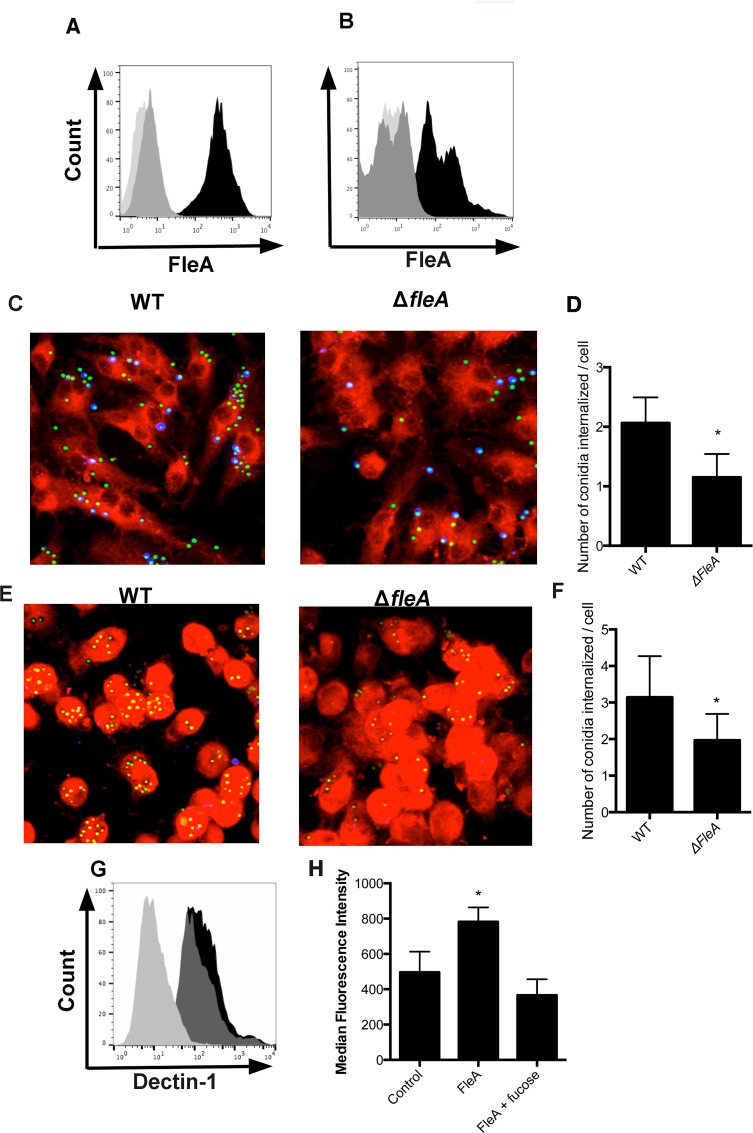
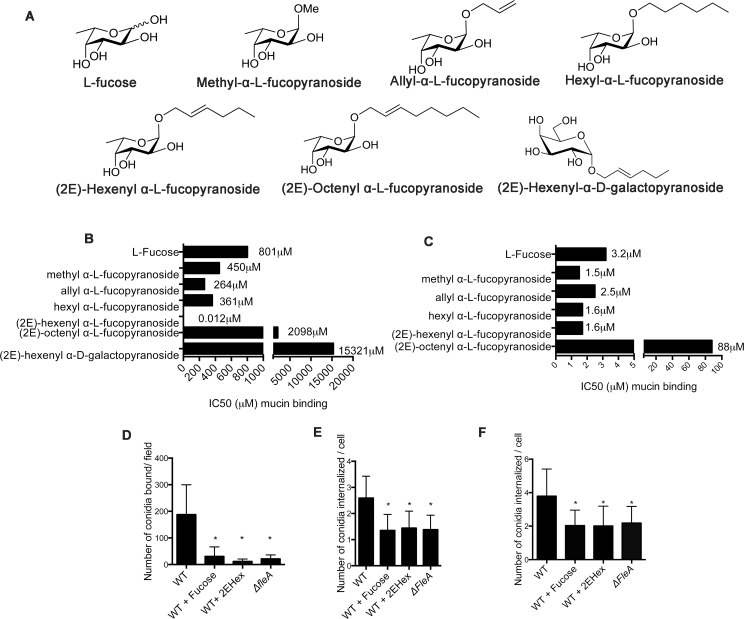
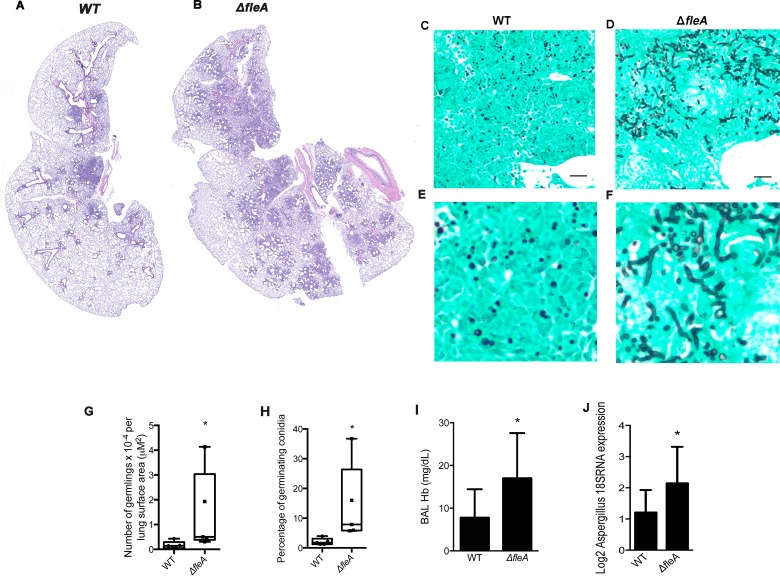
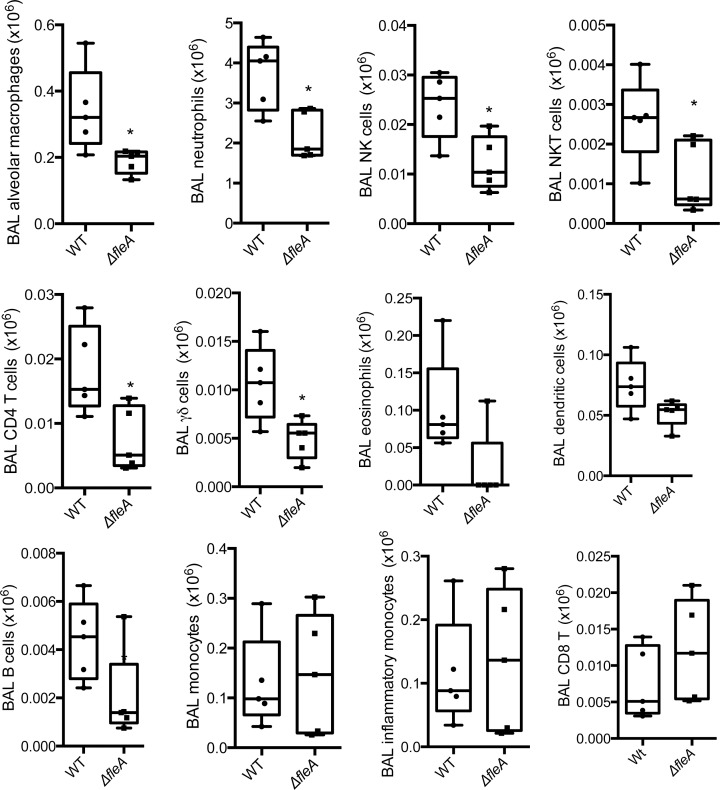
The immune mechanisms that recognize inhaled Aspergillus fumigatus conidia to promote their elimination from the lungs are incompletely understood. FleA is a lectin expressed by Aspergillus fumigatus that has twelve binding sites for fucosylated structures that are abundant in the glycan coats of multiple plant and animal proteins. The role of FleA is unknown: it could bind fucose in decomposed plant matter to allow Aspergillus fumigatus to thrive in soil, or it may be a virulence factor that binds fucose in lung glycoproteins to cause Aspergillus fumigatus pneumonia. Our studies show that FleA protein and Aspergillus fumigatus conidia bind avidly to purified lung mucin glycoproteins in a fucose-dependent manner. In addition, FleA binds strongly to macrophage cell surface proteins, and macrophages bind and phagocytose fleA-deficient (∆fleA) conidia much less efficiently than wild type (WT) conidia. Furthermore, a potent fucopyranoside glycomimetic inhibitor of FleA inhibits binding and phagocytosis of WT conidia by macrophages, confirming the specific role of fucose binding in macrophage recognition of WT conidia. Finally, mice infected with ΔfleA conidia had more severe pneumonia and invasive aspergillosis than mice infected with WT conidia. These findings demonstrate that FleA is not a virulence factor for Aspergillus fumigatus. Instead, host recognition of FleA is a critical step in mechanisms of mucin binding, mucociliary clearance, and macrophage killing that prevent Aspergillus fumigatus pneumonia.
Overview
The claims and statistics of this paper haven’t been checked yet.
Free: it reads the open-access text and checks the first 5 claims that cite a source we can check. Create a free account to check every claim.
Integrity signals
Registry
Cites
Statistics
Figures
Verification
Claims the paper makes
The claims and statistics of this paper haven’t been checked yet.
Free: it reads the open-access text and checks the first 5 claims that cite a source we can check. Create a free account to check every claim.
Claims other papers make about this one
Each is checked against this paper’s own text: does it say what the citing paper says it does?
The source backs part of the claim, not all of it — or backs it for a different population, condition or comparison.
In the citing paper
“Despite the lack of specificity of the phagocytosis process, certain macrophage receptors have been shown to facilitate engulfment of resting and germinating conidia: the C-type lectin II receptor DC-SIGN (CD209) (235), Dectin-1 (236), an unidentified macrophage glycoprotein-scavenger receptor recognizing the Aspergillus FleA fucose-binding lectin (214), and soluble pattern recognition receptors (”
From Aspergillus fumigatus and Aspergillosis in 2019 (2019) · cites this paper as [214]
Experimental — accuracy not yet measuredIn the citing paper
“Due to their small size, some of the inhaled Aspergillus conidia can reach and interact with the lung alveolar epithelial cells (ECs) (214).”
From Aspergillus fumigatus and Aspergillosis in 2019 (2019) · cites this paper as [214]
In the citing paper
“Importantly, most inhaled conidia do not come in contact with the alveolar epithelium, as they are eliminated by mucociliary clearance (214).”
From Aspergillus fumigatus and Aspergillosis in 2019 (2019) · cites this paper as [214]
Self-check
Percentages, sums and reported differences re-computed from the paper’s own numbers.
The self-check needs the paper’s full text.
Citations
Cites
SignalP 4.0: discriminating signal peptides from transmembrane regions
Petersen, T. N., Brunak, S., von Heijne, G., & Nielsen, H. (2011) · Nature Methods · doi:10.1038/nmeth.1701 · Cited by 8,847
Dectin-1 is required for β-glucan recognition and control of fungal infection
Taylor, P. R., Tsoni, S. V., Willment, J. A., Dennehy, K. M., Rosas, M., Findon, H., Haynes, K., Steele, C., Botto, M., Gordon, S., et al. (2007) · Nature Immunology · doi:10.1038/ni1408 · Cited by 1,161 · cited 1×
“fumigatus does not cast any doubt on the validity of the well established role for β-glucan/Dectin-1 interactions [35].”
BackgroundPathogenesis of Aspergillus fumigatus in Invasive Aspergillosis
Dagenais, T. R. T., & Keller, N. P. (2009) · Clinical Microbiology Reviews · doi:10.1128/cmr.00055-08 · Cited by 993 · cited 1×
“fumigatus) is an ubiquitous opportunistic pathogen that causes invasive and often fatal lung infection, particularly in immunocompromised patients [1].”
BackgroundSelf-citationStructure and Function of the Polymeric Mucins in Airways Mucus
Thornton, D. J., Rousseau, K., & McGuckin, M. A. (2008) · Annual Review of Physiology · doi:10.1146/annurev.physiol.70.113006.100702 · Cited by 823 · cited 3×
“1 MUC5B, NM_002458.”
BackgroundMuc5b is required for airway defence
Roy, M. G., Livraghi-Butrico, A., Fletcher, A. A., McElwee, M. M., Evans, S. E., Boerner, R. M., Alexander, S. N., Bellinghausen, L. K., Song, A. S., Petrova, Y. M., et al. (2014) · Nature · doi:10.1038/nature12807 · Cited by 764
Halide ion catalyzed glycosidation reactions. Syntheses of .alpha.-linked disaccharides
Lemieux, R. U., Hendriks, K. B., Stick, R. V., & James, K. (1975) · Journal of the American Chemical Society · doi:10.1021/ja00847a032 · Cited by 716
Luther, K., Torosantucci, A., Brakhage, A. A., Heesemann, J., & Ebel, F. (2007) · Cellular Microbiology · doi:10.1111/j.1462-5822.2006.00796.x · Cited by 582
Bouckaert, J., Berglund, J., Schembri, M., De Genst, E., Cools, L., Wuhrer, M., Hung, C., Pinkner, J., Slättegård, R., Zavialov, A., et al. (2005) · Molecular Microbiology · doi:10.1111/j.1365-2958.2004.04415.x · Cited by 447
Self-citationShimizu, K., & Keller, N. P. (2001) · Genetics · doi:10.1093/genetics/157.2.591 · Cited by 445
Self-citationAspergillus fumigatus Triggers Inflammatory Responses by Stage-Specific β-Glucan Display
Hohl, T. M., Van Epps, H. L., Rivera, A., Morgan, L. A., Chen, P. L., Feldmesser, M., & Pamer, E. G. (2005) · PLoS Pathogens · doi:10.1371/journal.ppat.0010030 · Cited by 428 · cited 1×
“β-glucan is abundant on swollen conidia and hyphae, and Dectin-1 binds βglucan on swollen conidia to trigger a robust host defense response [36].”
Background
Cited by
Aspergillus fumigatus and Aspergillosis in 2019
Latgé, J.-P., & Chamilos, G. (2019) · Clinical Microbiology Reviews · doi:10.1128/cmr.00140-18 · Cited by 1,400
Latgé, J.-P., Beauvais, A., & Chamilos, G. (2017) · Annual Review of Microbiology · doi:10.1146/annurev-micro-030117-020406 · Cited by 207
Pathogenesis of Respiratory Viral and Fungal Coinfections
Salazar, F., Bignell, E., Brown, G. D., Cook, P. C., & Warris, A. (2021) · Clinical Microbiology Reviews · doi:10.1128/cmr.00094-21 · Cited by 178
Lionakis, M. S., Iliev, I. D., & Hohl, T. M. (2017) · JCI Insight · doi:10.1172/jci.insight.93156 · Cited by 153
Histo-blood group antigens as mediators of infections
Heggelund, J. E., Varrot, A., Imberty, A., & Krengel, U. (2017) · Current Opinion in Structural Biology · doi:10.1016/j.sbi.2017.04.001 · Cited by 101
Metadata
- Authors
- Kerr, S. C., Fischer, G. J., Sinha, M., McCabe, O., Palmer, J. M., Choera, T., Yun Lim, F., Wimmerova, M., Carrington, S. D., Yuan, S., Lowell, C. A., Oscarson, S., Keller, N. P., & Fahy, J. V.
- Affiliations
- University of California, San Francisco (US)
- University of Wisconsin–Madison (US)
- University College Dublin (IE)
- Corresponding author
- Fahy, John V.
- ORCID
- Venue
- PLOS Pathogens
- Publisher
- Public Library of Science (PLoS)
- Published
- 2016-04-08
- Volume
- 12
- Issue
- 4
- Pages
- e1005555
- ISSN
- 1553-7366 (ISSN-L)
- 1553-7374
- PMC
- PMC4825926
- OpenAlex
- W2329040846
- Cited by
- 53
- References
- 45
- Citations by year
- 2026: 1 · 2025: 1 · 2024: 2 · 2023: 2 · 2022: 5 · 2021: 9 · 2020: 3 · 2019: 7 · 2018: 9 · 2017: 10 · 2016: 4
- FWCI
- 9.23
- Type
- journal article
- Language
- en
- Open access
- gold
- doi.org
- Licence
- Locations
- PLoS Pathogens (publishedVersion, cc-by)
- Europe PMC (PubMed Central) (publishedVersion, cc-by)
- PubMed Central (publishedVersion, cc-by)
- PubMed (publishedVersion)
- DOAJ (DOAJ: Directory of Open Access Journals) (submittedVersion, cc-by-sa)
- eScholarship (California Digital Library) (submittedVersion)
- Figshare (submittedVersion, cc-by)
- Funders
- U.S. Department of Agriculture (WIS01710)
- American Asthma Foundation
- Grantová Agentura České Republiky (GA13-25401S)
- National Institutes of Health
- U.S. Public Health Service (R01068150)
- National Heart, Lung, and Blood Institute (P01HL128191, HL080414, HL109146, P50HL107191, HL107191, U10HL109146, R01HL080414)
- National Institute of General Medical Sciences (T32GM007133)
- National Institute of Allergy and Infectious Diseases (R01AI113272, R01AI065728, HL080414, R01AI065495)
- Topics
- Health Sciences › Medicine › Infectious Diseases › Antifungal resistance and susceptibility
- Life Sciences › Biochemistry, Genetics and Molecular Biology › Molecular Biology › Glycosylation and Glycoproteins Research
- Life Sciences › Biochemistry, Genetics and Molecular Biology › Molecular Biology › Fungal and yeast genetics research
- Keywords
- Aspergillus fumigatus, fucose binding, macrophage phagocytosis, mucociliary clearance, invasive aspergillosis, host-pathogen interaction, virulence factors
- MeSH terms
- Adult, Animals, Aspergillus fumigatus, Disease Models, Animal, Female, Flow Cytometry, Fluorescent Antibody Technique, Fucose, Fungal Proteins, Humans, Macrophages, Male, Mice, Inbred C57BL, Middle Aged, Mucins, Spores, Fungal, Blotting, Western, Immunity, Mucosal, Lectins, Mice, Pulmonary Aspergillosis
About these checks
Registry, retraction, Cites and statistics results are computed, not judged, with one exception: a printed reference that no index lists is read once by a model before it counts as a citation error. Claims are extracted by a model and kept only when their quote appears verbatim in the text; each cited source is then checked, with a model’s help, for whether it says what the claim relies on. Those verdicts can be wrong — read the claim’s quote and the cited source before relying on one.
Statistics and arithmetic are recomputed, not judged.
Confidence bands are shown only for fields calibrated on our annotated test set. None is calibrated yet, so no band is shown.
What counts as a claim ›How we measure confidence ›How we check this ›
Are you an author, or do you see a problem with this page? Request a review
Data sources
Bibliographic data: Semantic Scholar, OpenAlex, Crossref.
Contains information from the Semantic Scholar Academic Graph Datasets, made available under the ODC Attribution License (ODC-BY 1.0).
Semantic Scholar’s data is described in: Kinney, R., et al. (2023). The Semantic Scholar Open Data Platform. arXiv:2301.10140.
