

Filamentous fungal carbon catabolite repression supports metabolic plasticity and stress responses essential for disease progression
Open accessThe DOI matches its Crossref record; 57 of the 57 references it cites were found in a registry or an index.
Abstract
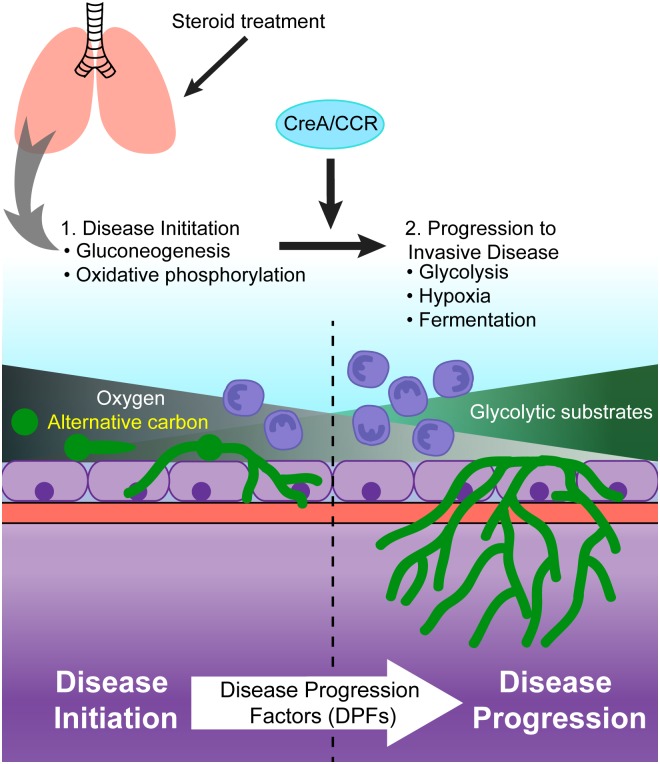
Aspergillus fumigatus is responsible for a disproportionate number of invasive mycosis cases relative to other common filamentous fungi. While many fungal factors critical for infection establishment are known, genes essential for disease persistence and progression are ill defined. We propose that fungal factors that promote navigation of the rapidly changing nutrient and structural landscape characteristic of disease progression represent untapped clinically relevant therapeutic targets. To this end, we find that A. fumigatus requires a carbon catabolite repression (CCR) mediated genetic network to support in vivo fungal fitness and disease progression. While CCR as mediated by the transcriptional repressor CreA is not required for pulmonary infection establishment, loss of CCR inhibits fungal metabolic plasticity and the ability to thrive in the dynamic infection microenvironment. Our results suggest a model whereby CCR in an environmental filamentous fungus is dispensable for initiation of pulmonary infection but essential for infection maintenance and disease progression. Conceptually, we argue these data provide a foundation for additional studies on fungal factors required to support fungal fitness and disease progression and term such genes and factors, DPFs (disease progression factors).
Overview
The claims and statistics of this paper haven’t been checked yet.
Free: it reads the open-access text and checks the first 5 claims that cite a source we can check. Create a free account to check every claim.
Integrity signals
Registry
Cites
Statistics
Figures
Verification
Claims the paper makes
The claims and statistics of this paper haven’t been checked yet.
Free: it reads the open-access text and checks the first 5 claims that cite a source we can check. Create a free account to check every claim.
Claims other papers make about this one
Each is checked against this paper’s own text: does it say what the citing paper says it does?
In the citing paper
“While the transcriptional repressor CreA, controlling carbon catabolite repression, is not required for the initiation of a pulmonary infection, it seems important for infection maintenance and disease progression under an environment that is poor in oxygen and in gluconeogenic carbon sources (340).”
From Aspergillus fumigatus and Aspergillosis in 2019 (2019) · cites this paper as [340]
Self-check
Percentages, sums and reported differences re-computed from the paper’s own numbers.
The self-check needs the paper’s full text.
Citations
Cites
Moderated estimation of fold change and dispersion for RNA-seq data with DESeq2
Love, M. I., Huber, W., & Anders, S. (2014) · Genome Biology · doi:10.1186/s13059-014-0550-8 · Cited by 95,106
Fast, scalable generation of high‐quality protein multiple sequence alignments using Clustal Omega
Sievers, F., Wilm, A., Dineen, D., Gibson, T. J., Karplus, K., Li, W., Lopez, R., McWilliam, H., Remmert, M., Söding, J., et al. (2011) · Molecular Systems Biology · doi:10.1038/msb.2011.75 · Cited by 15,355
Trapnell, C., Roberts, A., Goff, L., Pertea, G., Kim, D., Kelley, D. R., Pimentel, H., Salzberg, S. L., Rinn, J. L., & Pachter, L. (2012) · Nature Protocols · doi:10.1038/nprot.2012.016 · Cited by 12,116
TopHat: discovering splice junctions with RNA-Seq
Trapnell, C., Pachter, L., & Salzberg, S. L. (2009) · Bioinformatics · doi:10.1093/bioinformatics/btp120 · Cited by 11,617
Jalview Version 2—a multiple sequence alignment editor and analysis workbench
Waterhouse, A. M., Procter, J. B., Martin, D. M. A., Clamp, M., & Barton, G. J. (2009) · Bioinformatics · doi:10.1093/bioinformatics/btp033 · Cited by 11,399
Carbon catabolite repression in bacteria: many ways to make the most out of nutrients
Görke, B., & Stülke, J. (2008) · Nature Reviews Microbiology · doi:10.1038/nrmicro1932 · Cited by 1,701
Crucial Step in Cholesterol Homeostasis
Yang, T., Espenshade, P. J., Wright, M. E., Yabe, D., Gong, Y., Aebersold, R., Goldstein, J. L., & Brown, M. S. (2002) · Cell · doi:10.1016/s0092-8674(02)00872-3 · Cited by 987
Fusion PCR and gene targeting in Aspergillus nidulans
Szewczyk, E., Nayak, T., Oakley, C. E., Edgerton, H., Xiong, Y., Taheri-Talesh, N., Osmani, S. A., & Oakley, B. R. (2006) · Nature Protocols · doi:10.1038/nprot.2006.405 · Cited by 766
Love, M. I., Huber, W. K., & Anders, S. (2014) · Cited by 718
The damage-response framework of microbial pathogenesis
Casadevall, A., & Pirofski, L.-A. (2003) · Nature Reviews Microbiology · doi:10.1038/nrmicro732 · Cited by 658
Saville, S. P., Lazzell, A. L., Monteagudo, C., & Lopez-Ribot, J. L. (2003) · Eukaryotic Cell · doi:10.1128/ec.2.5.1053-1060.2003 · Cited by 655
Carbon catabolite repression in bacteria
Stülke, J., & Hillen, W. (1999) · Current Opinion in Microbiology · doi:10.1016/s1369-5274(99)80034-4 · Cited by 464
Aspergillus fumigatus—What Makes the Species a Ubiquitous Human Fungal Pathogen?
Kwon-Chung, K. J., & Sugui, J. A. (2013) · PLoS Pathogens · doi:10.1371/journal.ppat.1003743 · Cited by 432
Analysis of the creA gene, a regulator of carbon catabolite repression in Aspergillus nidulans.
Dowzer, C. E., & Kelly, J. M. (1991) · Molecular and Cellular Biology · doi:10.1128/mcb.11.11.5701 · Cited by 421
Blood glucose concentration and outcome of critical illness: The impact of diabetes*
Egi, M., Bellomo, R., Stachowski, E., French, C. J., Hart, G. K., Hegarty, C., & Bailey, M. (2008) · Critical Care Medicine · doi:10.1097/ccm.0b013e318181039a · Cited by 399
Abad, A., Victoria Fernández-Molina, J., Bikandi, J., Ramírez, A., Margareto, J., Sendino, J., Luis Hernando, F., Pontón, J., Garaizar, J., & Rementeria, A. (2010) · Revista Iberoamericana de Micología · doi:10.1016/j.riam.2010.10.003 · Cited by 394
Aspergillus fumigatus: saprophyte or pathogen?
Tekaia, F., & Latgé, J.-P. (2005) · Current Opinion in Microbiology · doi:10.1016/j.mib.2005.06.017 · Cited by 387
Carbon catabolite repression in yeast
GANCEDO, J. M. (1992) · European Journal of Biochemistry · doi:10.1111/j.1432-1033.1992.tb16928.x · Cited by 349
Willger, S. D., Puttikamonkul, S., Kim, K.-H., Burritt, J. B., Grahl, N., Metzler, L. J., Barbuch, R., Bard, M., Lawrence, C. B., & Cramer, R. A. (2008) · PLoS Pathogens · doi:10.1371/journal.ppat.1000200 · Cited by 345
Self-citationKulmburg, P., Mathieu, M., Dowzer, C., Kelly, J., & Felenbok, B. (1993) · Molecular Microbiology · doi:10.1111/j.1365-2958.1993.tb01175.x · Cited by 321
Major roles of isocitrate lyase and malate synthase in bacterial and fungal pathogenesis
Dunn, M. F., Ramírez-Trujillo, J. A., & Hernández-Lucas, I. (2009) · Microbiology · doi:10.1099/mic.0.030858-0 · Cited by 304
Carbon Catabolite Repression in Aspergillus nidulans
BAILEY, C., & ARST, H. N. (1975) · European Journal of Biochemistry · doi:10.1111/j.1432-1033.1975.tb03958.x · Cited by 263
FungiFun2: a comprehensive online resource for systematic analysis of gene lists from fungal species
Priebe, S., Kreisel, C., Horn, F., Guthke, R., & Linde, J. (2015) · Bioinformatics · doi:10.1093/bioinformatics/btu627 · Cited by 224
Factors determining the appearance of glucose in upper and lower respiratory tract secretions
Philips, B. J., Meguer, J.-X., Redman, J., & Baker, E. H. (2003) · Intensive Care Medicine · doi:10.1007/s00134-003-1961-2 · Cited by 218
Grahl, N., Puttikamonkul, S., Macdonald, J. M., Gamcsik, M. P., Ngo, L. Y., Hohl, T. M., & Cramer, R. A. (2011) · PLoS Pathogens · doi:10.1371/journal.ppat.1002145 · Cited by 217
Self-citationNakari-Setälä, T., Paloheimo, M., Kallio, J., Vehmaanperä, J., Penttilä, M., & Saloheimo, M. (2009) · Applied and Environmental Microbiology · doi:10.1128/aem.00282-09 · Cited by 201
Baker, E. H., Clark, N., Brennan, A. L., Fisher, D. A., Gyi, K. M., Hodson, M. E., Philips, B. J., Baines, D. L., & Wood, D. M. (2007) · Journal of Applied Physiology · doi:10.1152/japplphysiol.01425.2006 · Cited by 200
Shelburne, S. A., Keith, D., Horstmann, N., Sumby, P., Davenport, M. T., Graviss, E. A., Brennan, R. G., & Musser, J. M. (2008) · Proceedings of the National Academy of Sciences · doi:10.1073/pnas.0711767105 · Cited by 197
Identification of the CRE-1 Cellulolytic Regulon in Neurospora crassa
Sun, J., & Glass, N. L. (2011) · PLoS ONE · doi:10.1371/journal.pone.0025654 · Cited by 196
Chung, D., Barker, B. M., Carey, C. C., Merriman, B., Werner, E. R., Lechner, B. E., Dhingra, S., Cheng, C., Xu, W., Blosser, S. J., et al. (2014) · PLoS Pathogens · doi:10.1371/journal.ppat.1004487 · Cited by 193
Self-citationGlucose Promotes Stress Resistance in the Fungal Pathogen Candida albicans
Rodaki, A., Bohovych, I. M., Enjalbert, B., Young, T., Odds, F. C., Gow, N. A. R., & Brown, A. J. P. (2009) · Molecular Biology of the Cell · doi:10.1091/mbc.e09-01-0002 · Cited by 190
Blatzer, M., Barker, B. M., Willger, S. D., Beckmann, N., Blosser, S. J., Cornish, E. J., Mazurie, A., Grahl, N., Haas, H., & Cramer, R. A. (2011) · PLoS Genetics · doi:10.1371/journal.pgen.1002374 · Cited by 175
Self-citationMathieu, M., & Felenbok, B. (1994) · The EMBO Journal · doi:10.1002/j.1460-2075.1994.tb06718.x · Cited by 144
Pleiotropic mutants ofAspergillus nidulans altered in carbon metabolism
Hynes, M. J., & Kelly, J. M. (1977) · Molecular and General Genetics MGG · doi:10.1007/bf00695399 · Cited by 140
Vödisch, M., Scherlach, K., Winkler, R., Hertweck, C., Braun, H.-P., Roth, M., Haas, H., Werner, E. R., Brakhage, A. A., & Kniemeyer, O. (2011) · Journal of Proteome Research · doi:10.1021/pr1012812 · Cited by 128
Barker, B. M., Kroll, K., Vödisch, M., Mazurie, A., Kniemeyer, O., & Cramer, R. A. (2012) · BMC Genomics · doi:10.1186/1471-2164-13-62 · Cited by 127
Self-citationAspergillus fumigatus: Growth and virulence
Rhodes, J. C. (2006) · Medical Mycology · doi:10.1080/13693780600779419 · Cited by 120
Fungal metabolism in host niches
Brock, M. (2009) · Current Opinion in Microbiology · doi:10.1016/j.mib.2009.05.004 · Cited by 115
Sandai, D., Yin, Z., Selway, L., Stead, D., Walker, J., Leach, M. D., Bohovych, I., Ene, I. V., Kastora, S., Budge, S., et al. (2012) · mBio · doi:10.1128/mbio.00495-12 · Cited by 110
Null Alleles ofcreA,the Regulator of Carbon Catabolite Repression inAspergillus nidulans
Shroff, R. A., O'Connor, S. M., Hynes, M. J., Lockington, R. A., & Kelly, J. M. (1997) · Fungal Genetics and Biology · doi:10.1006/fgbi.1997.0989 · Cited by 96
Bi, F., Barad, S., Ment, D., Luria, N., Dubey, A., Casado, V., Glam-Matana, N., Mínguez, J. D., Espeso, E. A., Fluhr, R., et al. (2016) · Molecular Plant Pathology · doi:10.1111/mpp.12355 · Cited by 88
Cepeda-García, C., Domínguez‐Santos, R., García-Rico, R. O., García‐Estrada, C., Cajiao, Á., Fierro, F., & Martín, J. F. (2014) · Applied Microbiology and Biotechnology · doi:10.1007/s00253-014-5760-1 · Cited by 84
Childers, D. S., Raziunaite, I., Mol Avelar, G., Mackie, J., Budge, S., Stead, D., Gow, N. A. R., Lenardon, M. D., Ballou, E. R., MacCallum, D. M., et al. (2016) · PLOS Pathogens · doi:10.1371/journal.ppat.1005566 · Cited by 81
Shepardson, K. M., Jhingran, A., Caffrey, A., Obar, J. J., Suratt, B. T., Berwin, B. L., Hohl, T. M., & Cramer, R. A. (2014) · PLoS Pathogens · doi:10.1371/journal.ppat.1004378 · Cited by 79
Self-citationHypoxia enhances innate immune activation to Aspergillus fumigatus through cell wall modulation
Shepardson, K. M., Ngo, L. Y., Aimanianda, V., Latgé, J.-P., Barker, B. M., Blosser, S. J., Iwakura, Y., Hohl, T. M., & Cramer, R. A. (2013) · Microbes and Infection · doi:10.1016/j.micinf.2012.11.010 · Cited by 75
Self-citationAspergillus fumigatus metabolism: Clues to mechanisms of in vivo fungal growth and virulence
Willger, S. D., Grahl, N., Willger, S. D., Grahl, N., & Cramer, R. A. (2009) · Medical Mycology · doi:10.1080/13693780802455313 · Cited by 69
Self-citationWillger, S. D., Cornish, E. J., Chung, D., Fleming, B. A., Lehmann, M. M., Puttikamonkul, S., & Cramer, R. A. (2012) · Eukaryotic Cell · doi:10.1128/ec.00252-12 · Cited by 67
Self-citationKelly, J. M., & Hynes, M. J. (1977) · Molecular and General Genetics MGG · doi:10.1007/bf00272256 · Cited by 64
Mutation of CRE1 in Fusarium oxysporum reverts the pathogenicity defects of the FRP1 deletion mutant
Jonkers, W., & Rep, M. (2009) · Molecular Microbiology · doi:10.1111/j.1365-2958.2009.06922.x · Cited by 63
Zaragoza, O., Rodríguez, C., & Gancedo, C. (2000) · Journal of Bacteriology · doi:10.1128/jb.182.2.320-326.2000 · Cited by 57
Li, H., Barker, B. M., Grahl, N., Puttikamonkul, S., Bell, J. D., Craven, K. D., & Cramer, R. A. (2011) · Eukaryotic Cell · doi:10.1128/ec.00288-10 · Cited by 55
Self-citationOverexpression of isocitrate lyase—glyoxylate bypass influence on metabolism in Aspergillus niger
Meijer, S. L., Otero, J., Olivares‐Hernández, R., Andersen, M. R., Lisbeth Olsson, A., & Nielsen, J. (2009) · Metabolic Engineering · doi:10.1016/j.ymben.2008.12.002 · Cited by 51
Caza, M., Hu, G., Price, M., Perfect, J. R., & Kronstad, J. W. (2016) · mSphere · doi:10.1128/msphere.00080-15 · Cited by 48
In vivo veritas: pathogenesis of infection as it actually happens
Virgin, H. W. (2007) · Nature Immunology · doi:10.1038/ni1529 · Cited by 41
Sasse, A., Hamer, S. N., Amich, J., Binder, J., & Krappmann, S. (2016) · Virulence · doi:10.1080/21505594.2015.1109766 · Cited by 36
Amich, J., & Krappmann, S. (2012) · Frontiers in Microbiology · doi:10.3389/fmicb.2012.00414 · Cited by 19
In vivo veritas: Aspergillus fumigatusproliferation and pathogenesis – conditionally speaking
Cramer, R. A. (2015) · Virulence · doi:10.1080/21505594.2015.1134074 · Cited by 8
Self-citation
Cited by
Aspergillus fumigatus and Aspergillosis in 2019
Latgé, J.-P., & Chamilos, G. (2019) · Clinical Microbiology Reviews · doi:10.1128/cmr.00140-18 · Cited by 1,400
Carbon Catabolite Repression in Filamentous Fungi
Adnan, M., Zheng, W., Islam, W., Arif, M., Abubakar, Y., Wang, Z., & Lu, G. (2017) · International Journal of Molecular Sciences · doi:10.3390/ijms19010048 · Cited by 244
“[208] proposed a model for the role of CreA and disease progression of invasive aspergillosis, which describes that CCR in an environmental filamentous fungus is dispensable for the initiation of pulmonary infection but essential for infection maintenance and disease progression.”
BackgroundLuciano‐Rosario, D., Keller, N. P., & Jurick, W. M. (2020) · Molecular Plant Pathology · doi:10.1111/mpp.12990 · Cited by 184
“Its role in virulence has been described in several fungal species (Luo et al., 2014; Beattie et al., 2017; Fasoyin et al., 2018) and it is a major virulence factor in P. expansum, where ΔcreA mutants are nearly avirulent (Tannous et al., 2018b).”
BackgroundThe landscape of transcription errors in eukaryotic cells
Gout, J.-F., Li, W., Fritsch, C., Li, A., Haroon, S., Singh, L., Hua, D., Fazelinia, H., Smith, Z., Seeholzer, S., et al. (2017) · Science Advances · doi:10.1126/sciadv.1701484 · Cited by 142
“(41), all four methods used an ACQUITYUPLC instrument (Waters) and aQ-Exactive high-resolution mass spectrometer that was interfaced with a heated ESI source, and an Orbitrap mass analyzer operated at 35,000 mass resolution.”
MethodPetriello, M. C., Hoffman, J. B., Vsevolozhskaya, O. A., Morris, A. J., & Hennig, B. (2018) · Environmental Pollution · doi:10.1016/j.envpol.2018.07.039 · Cited by 154
“At the conclusion of the study, livers were snap frozen and shipped to Metabolon (Durham, NC) for targeted metabolomics analysis as detailed previously (Beattie et al. 2017).”
Method
Metadata
- Authors
- Beattie, S. R., Mark, K. M. K., Thammahong, A., Ries, L. N. A., Dhingra, S., Caffrey-Carr, A. K., Cheng, C., Black, C. C., Bowyer, P., Bromley, M. J., Obar, J. J., Goldman, G. H., & Cramer, R. A.
- Affiliations
- Dartmouth College (US)
- Universidade de São Paulo (BR)
- Dartmouth–Hitchcock Medical Center (US)
- University of Manchester (GB)
- Corresponding author
- Beattie, Sarah R.
- Mark, Kenneth M. K.
- Thammahong, Arsa
- Ries, Laure Nicolas Annick
- Dhingra, Sourabh
- Caffrey-Carr, Alayna K.
- Cheng, Chao
- Black, Candice C.
- Bowyer, Paul
- Bromley, Michael J.
- Obar, Joshua J.
- Goldman, Gustavo H.
- Cramer, Robert A.
- ORCID
- Venue
- PLOS Pathogens
- Publisher
- Public Library of Science (PLoS)
- Published
- 2017-04-19
- Volume
- 13
- Issue
- 4
- Pages
- e1006340
- ISSN
- 1553-7366 (ISSN-L)
- 1553-7374
- PMC
- PMC5411099
- OpenAlex
- W2607468292
- Cited by
- 103
- References
- 57
- Citations by year
- 2026: 12 · 2025: 11 · 2024: 14 · 2023: 10 · 2022: 7 · 2021: 17 · 2020: 10 · 2019: 8 · 2018: 6 · 2017: 7
- FWCI
- 3.46
- Type
- journal article
- Language
- en
- Update notices
- new_version (2017-05-01)
- Open access
- gold
- doi.org
- Licence
- Locations
- PLoS Pathogens (publishedVersion, cc-by)
- PubMed Central (publishedVersion, cc-by)
- PubMed (publishedVersion)
- DOAJ (DOAJ: Directory of Open Access Journals) (submittedVersion, cc-by-sa)
- Figshare (submittedVersion, cc-by)
- Research Explorer (The University of Manchester) (submittedVersion, cc-by)
- Funders
- National Institute of Allergy and Infectious Diseases (2R01AI081838)
- Burroughs Wellcome Fund (1013522)
- National Institute of General Medical Sciences (T32GM008704, P30GM106394)
- Fundação de Amparo à Pesquisa do Estado de São Paulo
- Conselho Nacional de Desenvolvimento Científico e Tecnológico
- European Union Seventh Framework ProgrammeH (HEALTH-F3-2013-601963)
- Topics
- Life Sciences › Biochemistry, Genetics and Molecular Biology › Molecular Biology › Fungal and yeast genetics research
- Health Sciences › Medicine › Infectious Diseases › Antifungal resistance and susceptibility
- Health Sciences › Medicine › Infectious Diseases › Fungal Infections and Studies
- Keywords
- Aspergillus fumigatus, catabolite repression, CREA, metabolic plasticity, invasive aspergillosis, pulmonary infection, fungal fitness, transcriptional regulation, fungal stress response, therapeutic target
- MeSH terms
- Aspergillosis, Aspergillus fumigatus, Carbon, Fungal Proteins, Models, Biological, Repressor Proteins, Stress, Physiological, Gene Expression Regulation, Fungal, Disease Progression, Gene Regulatory Networks, Catabolite Repression
About these checks
Registry, retraction, Cites and statistics results are computed, not judged, with one exception: a printed reference that no index lists is read once by a model before it counts as a citation error. Claims are extracted by a model and kept only when their quote appears verbatim in the text; each cited source is then checked, with a model’s help, for whether it says what the claim relies on. Those verdicts can be wrong — read the claim’s quote and the cited source before relying on one.
Statistics and arithmetic are recomputed, not judged.
Confidence bands are shown only for fields calibrated on our annotated test set. None is calibrated yet, so no band is shown.
What counts as a claim ›How we measure confidence ›How we check this ›
Are you an author, or do you see a problem with this page? Request a review
Data sources
Bibliographic data: Semantic Scholar, OpenAlex, Crossref.
Contains information from the Semantic Scholar Academic Graph Datasets, made available under the ODC Attribution License (ODC-BY 1.0).
Semantic Scholar’s data is described in: Kinney, R., et al. (2023). The Semantic Scholar Open Data Platform. arXiv:2301.10140.
