

Filamentous fungal carbon catabolite repression supports metabolic plasticity and stress responses essential for disease progression
Open accessThe DOI matches its Crossref record; 57 of the 57 references it cites were found in a registry or an index.
Abstract
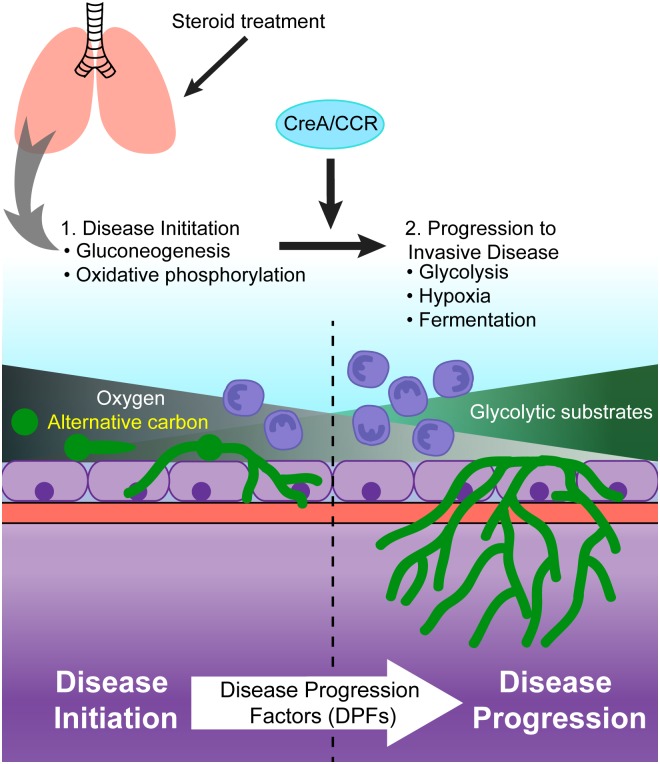
Aspergillus fumigatus is responsible for a disproportionate number of invasive mycosis cases relative to other common filamentous fungi. While many fungal factors critical for infection establishment are known, genes essential for disease persistence and progression are ill defined. We propose that fungal factors that promote navigation of the rapidly changing nutrient and structural landscape characteristic of disease progression represent untapped clinically relevant therapeutic targets. To this end, we find that A. fumigatus requires a carbon catabolite repression (CCR) mediated genetic network to support in vivo fungal fitness and disease progression. While CCR as mediated by the transcriptional repressor CreA is not required for pulmonary infection establishment, loss of CCR inhibits fungal metabolic plasticity and the ability to thrive in the dynamic infection microenvironment. Our results suggest a model whereby CCR in an environmental filamentous fungus is dispensable for initiation of pulmonary infection but essential for infection maintenance and disease progression. Conceptually, we argue these data provide a foundation for additional studies on fungal factors required to support fungal fitness and disease progression and term such genes and factors, DPFs (disease progression factors).
Overview
The claims and statistics of this paper haven’t been checked yet.
Free: it reads the open-access text and checks the first 5 claims that cite a source we can check. Create a free account to check every claim.
Integrity signals
Registry
Cites
Statistics
Figures
Verification
Claims the paper makes
The claims and statistics of this paper haven’t been checked yet.
Free: it reads the open-access text and checks the first 5 claims that cite a source we can check. Create a free account to check every claim.
Claims other papers make about this one
Each is checked against this paper’s own text: does it say what the citing paper says it does?
In the citing paper
“While the transcriptional repressor CreA, controlling carbon catabolite repression, is not required for the initiation of a pulmonary infection, it seems important for infection maintenance and disease progression under an environment that is poor in oxygen and in gluconeogenic carbon sources (340).”
From Aspergillus fumigatus and Aspergillosis in 2019 (2019) · cites this paper as [340]
Self-check
Percentages, sums and reported differences re-computed from the paper’s own numbers.
The self-check needs the paper’s full text.
Citations
Cites
Moderated estimation of fold change and dispersion for RNA-seq data with DESeq2
Love, M. I., Huber, W., & Anders, S. (2014) · Genome Biology · doi:10.1186/s13059-014-0550-8 · Cited by 95,106
Fast, scalable generation of high‐quality protein multiple sequence alignments using Clustal Omega
Sievers, F., Wilm, A., Dineen, D., Gibson, T. J., Karplus, K., Li, W., Lopez, R., McWilliam, H., Remmert, M., Söding, J., et al. (2011) · Molecular Systems Biology · doi:10.1038/msb.2011.75 · Cited by 15,355
Trapnell, C., Roberts, A., Goff, L., Pertea, G., Kim, D., Kelley, D. R., Pimentel, H., Salzberg, S. L., Rinn, J. L., & Pachter, L. (2012) · Nature Protocols · doi:10.1038/nprot.2012.016 · Cited by 12,116
TopHat: discovering splice junctions with RNA-Seq
Trapnell, C., Pachter, L., & Salzberg, S. L. (2009) · Bioinformatics · doi:10.1093/bioinformatics/btp120 · Cited by 11,617
Jalview Version 2—a multiple sequence alignment editor and analysis workbench
Waterhouse, A. M., Procter, J. B., Martin, D. M. A., Clamp, M., & Barton, G. J. (2009) · Bioinformatics · doi:10.1093/bioinformatics/btp033 · Cited by 11,399
Carbon catabolite repression in bacteria: many ways to make the most out of nutrients
Görke, B., & Stülke, J. (2008) · Nature Reviews Microbiology · doi:10.1038/nrmicro1932 · Cited by 1,701
Crucial Step in Cholesterol Homeostasis
Yang, T., Espenshade, P. J., Wright, M. E., Yabe, D., Gong, Y., Aebersold, R., Goldstein, J. L., & Brown, M. S. (2002) · Cell · doi:10.1016/s0092-8674(02)00872-3 · Cited by 987
Fusion PCR and gene targeting in Aspergillus nidulans
Szewczyk, E., Nayak, T., Oakley, C. E., Edgerton, H., Xiong, Y., Taheri-Talesh, N., Osmani, S. A., & Oakley, B. R. (2006) · Nature Protocols · doi:10.1038/nprot.2006.405 · Cited by 766
Love, M. I., Huber, W. K., & Anders, S. (2014) · Cited by 718
The damage-response framework of microbial pathogenesis
Casadevall, A., & Pirofski, L.-A. (2003) · Nature Reviews Microbiology · doi:10.1038/nrmicro732 · Cited by 658
Cited by
Aspergillus fumigatus and Aspergillosis in 2019
Latgé, J.-P., & Chamilos, G. (2019) · Clinical Microbiology Reviews · doi:10.1128/cmr.00140-18 · Cited by 1,400
Carbon Catabolite Repression in Filamentous Fungi
Adnan, M., Zheng, W., Islam, W., Arif, M., Abubakar, Y., Wang, Z., & Lu, G. (2017) · International Journal of Molecular Sciences · doi:10.3390/ijms19010048 · Cited by 244
“[208] proposed a model for the role of CreA and disease progression of invasive aspergillosis, which describes that CCR in an environmental filamentous fungus is dispensable for the initiation of pulmonary infection but essential for infection maintenance and disease progression.”
BackgroundLuciano‐Rosario, D., Keller, N. P., & Jurick, W. M. (2020) · Molecular Plant Pathology · doi:10.1111/mpp.12990 · Cited by 184
“Its role in virulence has been described in several fungal species (Luo et al., 2014; Beattie et al., 2017; Fasoyin et al., 2018) and it is a major virulence factor in P. expansum, where ΔcreA mutants are nearly avirulent (Tannous et al., 2018b).”
BackgroundThe landscape of transcription errors in eukaryotic cells
Gout, J.-F., Li, W., Fritsch, C., Li, A., Haroon, S., Singh, L., Hua, D., Fazelinia, H., Smith, Z., Seeholzer, S., et al. (2017) · Science Advances · doi:10.1126/sciadv.1701484 · Cited by 142
“(41), all four methods used an ACQUITYUPLC instrument (Waters) and aQ-Exactive high-resolution mass spectrometer that was interfaced with a heated ESI source, and an Orbitrap mass analyzer operated at 35,000 mass resolution.”
MethodPetriello, M. C., Hoffman, J. B., Vsevolozhskaya, O. A., Morris, A. J., & Hennig, B. (2018) · Environmental Pollution · doi:10.1016/j.envpol.2018.07.039 · Cited by 154
“At the conclusion of the study, livers were snap frozen and shipped to Metabolon (Durham, NC) for targeted metabolomics analysis as detailed previously (Beattie et al. 2017).”
MethodThe negative cofactor 2 complex is a key regulator of drug resistance in Aspergillus fumigatus
Furukawa, T., van Rhijn, N., Fraczek, M., Gsaller, F., Davies, E., Carr, P., Gago, S., Fortune-Grant, R., Rahman, S., Gilsenan, J. M., et al. (2020) · Nature Communications · doi:10.1038/s41467-019-14191-1 · Cited by 139
Self-citationThe impact of carbon and nitrogen catabolite repression in microorganisms
Nair, A., & Sarma, S. J. (2021) · Microbiological Research · doi:10.1016/j.micres.2021.126831 · Cited by 144
van Rhijn, N., & Bromley, M. (2021) · Journal of Fungi · doi:10.3390/jof7050367 · Cited by 132
Self-citationPathogenicity and virulence of Aspergillus fumigatus
Earle, K., Valero, C., Conn, D. P., Vere, G., Cook, P. C., Bromley, M., Bowyer, P., & Gago, S. (2023) · Virulence · doi:10.1080/21505594.2023.2172264 · Cited by 132
“While carbon is not a limiting factor for A. fumigatus infection, CreA, a transcription factor that controls carbon catabolite repression seems to be important for in vivo fungal fitness and disease progression [118].”
BackgroundSelf-citationOverview of carbon and nitrogen catabolite metabolism in the virulence of human pathogenic fungi
Ries, L. N. A., Beattie, S., Cramer, R. A., & Goldman, G. H. (2018) · Molecular Microbiology · doi:10.1111/mmi.13887 · Cited by 103
“fumigatus (Beattie et al., 2017), generation of a creA-genetic null mutant is viable, underscoring divergence of the role of this transcription factor across fungal species.”
BackgroundInfluentialSelf-citationFungal biofilm morphology impacts hypoxia fitness and disease progression
Kowalski, C. H., Kerkaert, J. D., Liu, K.-W., Bond, M. C., Hartmann, R., Nadell, C. D., Stajich, J., & Cramer, R. A. (2019) · Nature Microbiology · doi:10.1038/s41564-019-0558-7 · Cited by 101
Self-citationFasoyin, O. E., Wang, B., Qiu, M., Han, X., Chung, K.-R., & Wang, S. (2018) · Fungal Genetics and Biology · doi:10.1016/j.fgb.2018.04.008 · Cited by 96
de Assis, L. J., Silva, L. P., Bayram, Ö., Dowling, P., Kniemeyer, O., Krüger, T., Brakhage, A. A., Chen, Y., Dong, L., Tan, K., et al. (2021) · mBio · doi:10.1128/mbio.03146-20 · Cited by 99
Self-citationTannous, J., Kumar, D., Sela, N., Sionov, E., Prusky, D., & Keller, N. P. (2018) · Molecular Plant Pathology · doi:10.1111/mpp.12734 · Cited by 83
Mechanisms of Pulmonary Escape and Dissemination by Cryptococcus neoformans
Denham, S., & Brown, J. (2018) · Journal of Fungi · doi:10.3390/jof4010025 · Cited by 67
“This framework was outlined for infections caused by the filamentous fungus Aspergillus fumigatus [128], and is broadly applicable to additional fungal infections.”
BackgroundHuberman, L. B., Coradetti, S. T., & Glass, N. L. (2017) · Proceedings of the National Academy of Sciences · doi:10.1073/pnas.1707713114 · Cited by 66
“This approach could also lead to the identification of novel targets for battling infection by pathogenic fungi, since accurate nutrient sensing is required for the progression of mammalian disease caused by Aspergillus fumigatus infections (45).”
BackgroundHow Environmental Fungi Cause a Range of Clinical Outcomes in Susceptible Hosts
Denham, S. T., Wambaugh, M. A., & Brown, J. C. S. (2019) · Journal of Molecular Biology · doi:10.1016/j.jmb.2019.05.003 · Cited by 68
“These include heat tolerance [20], cold tolerance [21], drought tolerance [22], other stress tolerance [23–25], and the ability to utilize a variety of carbon and nitrogen sources [26, 27].”
BackgroundBastos, R. W., Valero, C., Silva, L. P., Schoen, T., Drott, M., Brauer, V., Silva-Rocha, R., Lind, A., Steenwyk, J. L., Rokas, A., et al. (2020) · mSphere · doi:10.1128/msphere.00153-20 · Cited by 60
“Fungal metabolic plasticity, which allows growth in unique and diverse ambient and host microenvironments, has long been hypothesized to contribute to Aspergillus virulence, with carbon sources such as glucose (22), ethanol (23), and acetate (24) being predicted to be actively used during in vivo infection.”
Self-citationRies, L. N. A., Steenwyk, J. L., de Castro, P. A., de Lima, P. B. A., Almeida, F. B. D. R., de Assis, L. J., Manfiolli, A. O., Takahashi‐Nakaguchi, A., Kusuya, Y., Hagiwara, D., et al. (2019) · Frontiers in Microbiology · doi:10.3389/fmicb.2019.00854 · Cited by 61
“Total proteins from the fungal conidial surface were extracted as described previously (Beauvais et al., 2013; Leite et al., 2015) and quantified as follows.”
Self-citationDenham, S. T., Verma, S., Reynolds, R. C., Worne, C. L., Daugherty, J. M., Lane, T. E., & Brown, J. C. S. (2018) · Infection and Immunity · doi:10.1128/iai.00662-17 · Cited by 59
“The opposite is also true: genes necessary 491 for later disease might not have a defect in the initial establishment of infection (63).”
Menacing Mold: Recent Advances in Aspergillus Pathogenesis and Host Defense
Tischler, B. Y., & Hohl, T. M. (2019) · Journal of Molecular Biology · doi:10.1016/j.jmb.2019.03.027 · Cited by 60
Mead, M. E., Knowles, S. L., Raja, H. A., Beattie, S. R., Kowalski, C. H., Steenwyk, J. L., Silva, L. P., Chiaratto, J., Ries, L. N. A., Goldman, G. H., et al. (2019) · mSphere · doi:10.1128/msphere.00018-19 · Cited by 57
“fumigatus infection (29), and to assess differences in metabolic plasticity between the two species, we measured the two organisms’ growth on media supplemented with glucose, fatty acids (Tween 80), or Casamino Acids.”
Self-citationAspergillus fumigatus biology, immunopathogenicity and drug resistance
van de Veerdonk, F. L., Carvalho, A., Wauters, J., Chamilos, G., & Verweij, P. E. (2025) · Nature Reviews Microbiology · doi:10.1038/s41579-025-01180-z · Cited by 70
“While this mechanism appears dispensable for initiation of infection, the limited nutrient and oxygen availability at the site of infection favours glucose utilization instead of alternative carbon sources, which contributes to disease progression 10 .”
Ries, L. N. A., Pardeshi, L. A., Dong, Z., Tan, K., Steenwyk, J. L., Colabardini, A. C., Filho, J. A. F., de Castro, P. A., Silva, L. P., Preite, N. W., et al. (2020) · PLoS Pathogens · doi:10.1371/journal.ppat.1008645 · Cited by 54
“To investigate any ADH regulatory or activity defects, enzyme activity was measured in the presence of ethanol and ethanol and glucose, with glucose causing the CCRmediated transcriptional repression of ADH-encoding genes[18].”
Self-citationLai, Y., Cao, X. D., Chen, J., Wang, L., Wei, G., & Wang, S. (2020) · Science Advances · doi:10.1126/sciadv.aaz1659 · Cited by 54
“Although the transcription factor Cre1 has been therefore termed a carbon catabolite repressor, accumulating evidence points to Cre1 function as an activator of certain genes involved in virulence in addition to glucose/ carbon repression (10, 20, 26).”
Regulation of nutrient utilization in filamentous fungi
Kerkaert, J. D., & Huberman, L. B. (2023) · Applied Microbiology and Biotechnology · doi:10.1007/s00253-023-12680-4 · Cited by 51
Wang, L., Wang, D., Yuan, S., Feng, X., & Wang, M. (2020) · Toxins · doi:10.3390/toxins12100665 · Cited by 46
“Carbon catabolite repression (CCR) plays an important role in the regulation of growth, development and secondary metabolism in mold [16,17].”
BackgroundKusch, S., Larrouy, J., Ibrahim, H. M. M., Mounichetty, S., Gasset, N., Navaud, O., Mbengué, M., Zanchetta, C., Lopez‐Roques, C., Donnadieu, C., et al. (2021) · The ISME Journal · doi:10.1038/s41396-021-01058-x · Cited by 44
Peng, M., Khosravi, C., Lubbers, R. J. M., Kun, R. S., Pontes, M. V. A., Battaglia, E., Chen, C., Dalhuijsen, S., Daly, P., Lipzen, A., et al. (2021) · The Cell Surface · doi:10.1016/j.tcsw.2021.100050 · Cited by 39
“…2011; Tamayo et al., 2008), regulation of carbon and nitrogen metabolism (Cubero et al., 2000; Mathieu and Felenbok, 1994; Prathumpai et al., 2004; Ries et al., 2016), secondary metabolism (Cepeda-García et al., 2014) and even disease progression of human fungal pathogens (Beattie et al., 2017).”
Backgroundde Assis, L. J., Manfiolli, A., Mattos, E., Fabri, J. H. T. M., Malavazi, I., Jacobsen, I. D., Brock, M., Cramer, R. A., Thammahong, A., Hagiwara, D., et al. (2018) · mBio · doi:10.1128/mbio.01952-18 · Cited by 38
“4d), which could be the reason for the increased sensitivity of this strain to cell wall-perturbing agents (60).”
Self-citationTashiro, M., Takazono, T., & Izumikawa, K. (2024) · Therapeutic Advances in Infectious Disease · doi:10.1177/20499361241253751 · Cited by 65
Chen, Y., Dong, L., Alam, M. A., Pardeshi, L. A., Miao, Z., Wang, F., Tan, K., Hynes, M. J., Kelly, J. M., & Wong, K. H. (2022) · mBio · doi:10.1128/mbio.03734-21 · Cited by 37
“, glucose-6-phoshate and fructose-6-phosphate) were not significantly changed (47).”
BackgroundResultScott, J., Sueiro-Olivares, M., Thornton, B. P., Owens, R. A., Muhamadali, H., Fortune‐Grant, R., Thomson, D. D., Thomas, R., Hollywood, K. A., Doyle, S., et al. (2020) · mBio · doi:10.1128/mbio.01985-20 · Cited by 34
“growing in the tissue, since the fungal metabolic requirements and the environmental conditions are different (53, 54).”
BackgroundRoss, B. S., Lofgren, L. A., Ashare, A., Stajich, J., & Cramer, R. A. (2021) · mBio · doi:10.1128/mbio.02153-21 · Cited by 31
“For qRT-PCR, 5 μg of RNA was treated with the Ambion Turbo DNAse kit 300 (ThermoFisher Scientific, Waltham MA) according to the manufacturer’s protocol, and 301 DNase-treated RNA was reverse transcribed as previously described (54).”
MethodSelf-citationKale, S. D., Ayubi, T., Chung, D., Tubau‐Juni, N., Leber, A. J., Dang, H. X., Karyala, S. V., Hontecillas, R., Lawrence, C. B., Cramer, R. A., et al. (2017) · Scientific Reports · doi:10.1038/s41598-017-17000-1 · Cited by 33
“An increase in lactate and processes associated with gluconeogenesis likely suggests the fungus is exposed to a hypoxic microenvironment and alternative carbon sources as disease progresses as previously has been suggested 31,103 .”
Self-citationAspergillus fumigatus Acetate Utilization Impacts Virulence Traits and Pathogenicity
Ries, L. N. A., de Castro, P. A., Silva, L. P., Valero, C., dos Reis, T. F., Saborano, R., Duarte, I. F., Persinoti, G. F., Steenwyk, J. L., Rokas, A., et al. (2021) · mBio · doi:10.1128/mbio.01682-21 · Cited by 36
“fumigatus disease progression (9), the utilization of the physiologically relevant”
BackgroundSelf-citationRecent developments in Aspergillus fumigatus research: diversity, drugs, and disease
Kordana, N. E., Johnson, A., Quinn, K., Obar, J. J., & Cramer, R. A. (2025) · Microbiology and Molecular Biology Reviews · doi:10.1128/mmbr.00011-23 · Cited by 29
“In support of this concept, the A. fumigatus carbon catabolite repression (CCR) regulator, creA , is critically important for not only carbon utilization but also cell wall homeostasis and disease progression (Table 2) (92).”
Self-citationThammahong, A., Dhingra, S., Bultman, K. M., Kerkaert, J. D., & Cramer, R. A. (2019) · mSphere · doi:10.1128/msphere.00244-19 · Cited by 32
“For qRT-PCR, DNase-treated RNA was processed as previously described (83).”
MethodSelf-citationQadri, H., Qureshi, M. F., Mir, M. A., & Shah, A. H. (2021) · Microbiological Research · doi:10.1016/j.micres.2021.126725 · Cited by 28
A PAS Protein Directs Metabolic Reprogramming during Cryptococcal Adaptation to Hypoxia
Zhao, Y., & Lin, X. (2021) · mBio · doi:10.1128/mbio.03602-20 · Cited by 26
“fumigatus, the carbon repression regulator CreA promotes fungal fitness in low-oxygen infection microenvironments (23).”
BackgroundChen, Y., Zhang, Z., Li, B., & Tian, S. (2021) · Environmental Microbiology · doi:10.1111/1462-2920.15704 · Cited by 24
Kerkaert, J. D., Mauff, F. L., Wucher, B. R., Beattie, S. R., Vesely, E. M., Sheppard, D. C., Nadell, C. D., & Cramer, R. A. (2022) · mBio · doi:10.1128/mbio.02933-21 · Cited by 22
“A sample of 500 ng of DNase-treated RNA was run on an agarose gel to ensure RNA integrity, and 500 ng of DNasetreated RNA was used for cDNA synthesis as previously described (66).”
MethodSelf-citationTanaka, M., Ichinose, S., Shintani, T., & Gomi, K. (2018) · Molecular Microbiology · doi:10.1111/mmi.14072 · Cited by 29
Weerasinghe, H., Stölting, H., Rose, A. J., & Traven, A. (2024) · Microbiology and Molecular Biology Reviews · doi:10.1128/mmbr.00171-22 · Cited by 31
“CreA-dependent regulation was shown to be required for adapting to lowering oxygen and driving glycolytic metabolism as infection progresses (20).”
Influentialde Assis, L. J., Silva, L. P., Liu, L., Schmitt, K., Valerius, O., Braus, G. H., Ries, L. N. A., & Goldman, G. H. (2020) · PLoS Genetics · doi:10.1371/journal.pgen.1008996 · Cited by 28
Self-citationRecent Advances in Understanding the Human Fungal Pathogen Hypoxia Response in Disease Progression
Puerner, C. T. S., Vellanki, S., Strauch, J. L., & Cramer, R. A. (2023) · Annual Review of Microbiology · doi:10.1146/annurev-micro-032521-021745 · Cited by 23
“Intriguingly, fungi with null mutations of the hypoxia response transcriptional regulators srbA, srbB, and creA fail to form fully mature biofilms, strongly suggesting the A. fumigatus hypoxia response is critical for biofilm maturation, as observed in Candida species (8, 23, 60, 74, 125).”
BackgroundSelf-citationHe, R., Wei, P., Odiba, A. S., Gao, L., Usman, S., Gong, X., Wang, B., Wang, L., Jin, C., Lu, G., et al. (2023) · Carbohydrate Polymers · doi:10.1016/j.carbpol.2023.121511 · Cited by 19
Yang, M., Lu, L., Li, S., Zhang, J., Li, Z., Wu, S., Guo, Q. M., Liu, H., & Wang, C. (2019) · Toxins · doi:10.3390/toxins11020070 · Cited by 19
“Additionally, cell wall homeostasis and conidial differentiation are regulated by creA [54,59].”
BackgroundAspergillus fumigatus dsRNA virus promotes fungal fitness and pathogenicity in the mammalian host
Rocha, M. C., Lerer, V., Adeoye, J. A., Hayby, H., Fabre, M. L., Barber, A. E., & Shlezinger, N. (2025) · Nature Microbiology · doi:10.1038/s41564-025-02096-3 · Cited by 22
“To evaluate fungal burden, total DNA was extracted using phenol–chloroform extraction, and fungal DNA was quantified by qPCR of the 18S rDNA region 83 .”
Pathogenic Fungal Sensing and Responses to Stressful Host Environments
Rapala, J. R., Anderson, F. M., Larkin, A., & O’Meara, T. R. (2025) · Annual Review of Microbiology · doi:10.1146/annurev-micro-051024-033116 · Cited by 19
Luo, Z., Chen, Q., Yufeng, S., Hu, S., Keyhani, N. O., Wang, J., Zhu, C., Zhou, T., Pan, Y., Bidochka, M., et al. (2022) · Journal of Agricultural and Food Chemistry · doi:10.1021/acs.jafc.2c07047 · Cited by 17
Implications of carbon catabolite repression for Aspergillus‐based cell factories: A review
Wang, Z., Wang, B., Jin, L., Ruan, H., & Jin, F. (2024) · Biotechnology Journal · doi:10.1002/biot.202300551 · Cited by 17
“[129,130] In addition to Aspergillus , CCR has also been demonstrated to influence the pathogenicity of other filamentous pathogenic fungi, such as Penicillium expansum and Valsa mali .”
BackgroundWang, C., Li, P., Cong, W., Ma, N., Zhou, M., & Hou, Y. (2024) · International Journal of Biological Macromolecules · doi:10.1016/j.ijbiomac.2024.137903 · Cited by 22
Burr, R., & Espenshade, P. J. (2017) · Seminars in Cell and Developmental Biology · doi:10.1016/j.semcdb.2017.08.043 · Cited by 17
“fumigatus, the recently identified carbon catabolite repression (CCR) zinc-finger transcriptional repressor CreA is required for optimal growth on all carbon sources in vivo and repressing carbon sources (such as glucose) in vivo [92].”
BackgroundInfluentialMeng, Y., Zhang, X., Tang, D., Chen, X., Zhang, D., Chen, J., & Fang, W. (2021) · mSystems · doi:10.1128/msystems.00499-21 · Cited by 15
Tang, D., Tang, X., & Fang, W. (2022) · Frontiers in Fungal Biology · doi:10.3389/ffunb.2022.911366 · Cited by 14
“Dependent on the repressor CreA, CCR ensures glucose is preferentially utilized by preventing the expression of the genes for utilizing less-favored carbon sources (Beattie et al., 2017).”
BackgroundResearch advances and public health strategies in China on WHO priority fungal pathogens
Wang, Y., Han, L., Gong, J., Liu, L., Miao, B., & Xu, J. (2025) · Mycology: An International Journal on Fungal Biology · doi:10.1080/21501203.2025.2561612 · Cited by 15
“…protease gene alp/aspf13 , which is involved in breaking down host tissues (Kolattukudy et al. 1993); creA , which regulates carbon utilisation (Beattie et al. 2017); rhbA and cpcA both linked to nitrogen regulation (Panepinto et al. 2003; Krappmann et al. 2004); HapX , which mediates…”
Cramer, R. A., & Kowalski, C. H. (2021) · mBio · doi:10.1128/mbio.03483-20 · Cited by 6
“In addition to alterations in oxygen availability, a switch in available carbohydrate nutrient sources changes during the course of infection (24, 25) (Fig.”
Self-citationMohamed, R. A., Ren, K., Mou, Y., Ying, S., & Feng, M. (2021) · Journal of Fungi · doi:10.3390/jof7110895 · Cited by 11
“Interestingly, transcriptomic analysis of 852 dysregulated genes (402:450) in Aspergillus fumigatus ∆creA unveil that CreA-mediated CCR is essential for the fungal metabolic plasticity and fitness to dynamic infection microenvironment but not required for pulmonary infection establishment [63].”
BackgroundSensing the threat posed by Aspergillus infection
Obar, J. J. (2020) · Current Opinion in Microbiology · doi:10.1016/j.mib.2020.08.004 · Cited by 10
Self-citationKamath, M. M., Lightfoot, J. D., Adams, E. M., Kiser, R. M., Wells, B. L., & Fuller, K. K. (2023) · PLoS Pathogens · doi:10.1371/journal.ppat.1011435 · Cited by 10
“The Δ prtT Δ xprG1 mutant, therefore, is likely capable of acquiring non-proteinaceous nutrients from the ocular surface (e.g. lipids or carbohydrates in the tear film), or in the lung, in order to initiate growth [50–52].”
BackgroundRahman, S., van Rhijn, N., Papastamoulis, P., Thomson, D. D., Carter, Z., Gregson, L., Fortune‐Grant, R., Rattray, M., Bromley, J. M., & Bignell, M. E. (2022) · Frontiers in Cellular and Infection Microbiology · doi:10.3389/fcimb.2022.907519 · Cited by 9
“…reported to regulate A. fumigatus epithelial invasion (Bertuzzi et al., 2014), CreA (AFUB_027530) the broad domain regulator of carbon catabolism (Beattie et al., 2017), AreA (AFUB_096370) the broad domain regulator of nitrogen metabolism (Hensel et al., 1998; Krappmann and Braus, 2005), a C6…”
Chen, Y.-Y., Gao, F., Chen, X., Tao, S., Chen, P., & Lin, W. (2024) · mSphere · doi:10.1128/msphere.00619-23 · Cited by 8
“Apart from the aforementioned transcription factors SomA and MeaB, a salient case is that of CreA; the carbon catabolite repressor not only regulated cell wall homeostasis (44) but was also closely associated with galactosaminogalactan-mediated biofilm formation (45).”
BackgroundShangguan, J., Qiao, J., Liu, H., Zhu, L., Han, X., Shi, L., Zhu, J. K., Liu, R. W., Ren, A., & Zhao, M. (2024) · Communications Biology · doi:10.1038/s42003-024-06180-y · Cited by 9
“In Aspergillus fumigatus , the Δ creA mutant impacts growth, fi tness, and virulence 56 .”
INTERNACIONALIZACIÓN-COOPERACIÓN NAS PEMES DE VIGO E DA SÚA ÁREA METROPOLITANA
Bouzada, M. I. C., Matés, M. V. V., & Fernández-Jardón, C. M. (2007) · LA Referencia (Red Federada de Repositorios Institucionales de Publicaciones Científicas) · Cited by 8
Research progress on inhibitors and inhibitory mechanisms of mycotoxin biosynthesis
Li, M., & Li, H. (2024) · Mycotoxin Research · doi:10.1007/s12550-024-00553-2 · Cited by 7
“Magnolol down-regulated the expression of CreA , which then inhibited the synthesis of AOH and AME (Adnan et al. 2017; Krysan et al. 2017; Yang et al. 2019; Zhao et al. 2018).”
Martín‐Vicente, A., Souza, A. C. O., Guruceaga, X., Thorn, H. I., Xie, J., Nywening, A. V., Ge, W., & Fortwendel, J. R. (2024) · Nature Communications · doi:10.1038/s41467-024-53358-3 · Cited by 8
“3G, left panels), mimicking what has been previously observed for the A. fumigatus creA deletion mutant 14 .”
InfluentialLiu, S., Lu, X., Dai, M., & Zhang, S. (2023) · Molecular Microbiology · doi:10.1111/mmi.15179 · Cited by 8
“In A . fumigatus , CreA is involved in the regulation of glycogen and trehalose metabolism; additionally, it is required for disease progression in a triamcinolone model of invasive pulmonary aspergillosis (Beattie et al., 2017 ; de Assis, Manfiolli, et al., 2018).”
BackgroundKelty, M. T., Miron-Ocampo, A., & Beattie, S. R. (2024) · Microbiology Spectrum · doi:10.1128/spectrum.01045-24 · Cited by 8
“All A. fumigatus strains were maintained on glucose minimal media (GMM) (46).”
BackgroundInfluentialSelf-citationWang, Y., Xu, D., Yu, B., Lian, Q., & Huang, J. (2024) · International Journal of Molecular Sciences · doi:10.3390/ijms252111575 · Cited by 7
Yu, J., Jiang, W., Guo, M., Dao, Y., & Pang, X. (2022) · Journal of Applied Microbiology · doi:10.1111/jam.15662 · Cited by 6
“Moreover, Beattie et al. (2017) reported that the utilization of glucose provided energy for A. fumigatus during the maintenance and progression of human pulmonary infection. Similarly, Ijadpanahsaravi et al. (2021) observed that glucose was one of the main F I G U R E 3 (a) Distribution of fungal community at the gen…”
BackgroundMethodInfluentialNi, Y., Wang, J., Chen, L., Liu, H., & Wang, G. (2024) · Journal of Agricultural and Food Chemistry · doi:10.1021/acs.jafc.4c05700 · Cited by 5
Song, D., Jin, Y., Shi, Y., Xia, Y., & Peng, G. (2022) · Pest Management Science · doi:10.1002/ps.7010 · Cited by 5
Shuwei, X., Huanbin, S., Hui, W., Liu, Z., Jiehua, Q., Nan, J., & Kou, Y. (2023) · Rice Science · doi:10.1016/j.rsci.2023.11.008 · Cited by 3
Scott, J., & Amich, J. (2021) · Elsevier eBooks · doi:10.1016/b978-0-12-818731-9.00059-8 · Cited by 5
Puerner, C. T. S., Morelli, K. A., Kerkaert, J. D., Jones, J. T., Quinn, K. G., DeMichaelis, N., Vellanki, S., Liao, C., & Cramer, R. A. (2025) · mSphere · doi:10.1128/msphere.00752-25 · Cited by 8
“A sample of 500 ng of DNase-treated RNA was run on an agarose gel to ensure RNA integrity, and 500 ng of DNase-treated RNA was used for cDNA synthesis as previously described (55).”
Self-citationXie, X., Wang, Y., Jin, S., He, L., Jia, Z.-F., & Huang, B. (2023) · Journal of Invertebrate Pathology · doi:10.1016/j.jip.2023.108009 · Cited by 3
Role of carbon and nitrogen assimilation in Candida albicans survival and virulence
Sahoo, S., & Rao, K. H. (2024) · The Microbe · doi:10.1016/j.microb.2024.100127 · Cited by 5
Abera, B. D., Adimas, Z. T., & Alemayehu, A. J. (2026) · Applied Food Research · doi:10.1016/j.afres.2026.101849 · Cited by 2
Development of a murine model to study the cerebral pathogenesis of Aspergillus fumigatus
Kelty, M. T., & Beattie, S. R. (2023) · mSphere · doi:10.1128/msphere.00468-23 · Cited by 2
Self-citationAl-Qiam, R. A., Dumbare, S., Graf, T. N., Vidar, W. S., Raja, H. A., Pearce, C. J., Hematian, S., & Oberlies, N. H. (2025) · Microbial Cell Factories · doi:10.1186/s12934-025-02842-6 · Cited by 2
“As a central carbon source, sugar catabolism via glycolysis generates key precursors and reactants such as acetyl-CoA, NADPH, and ATP that support the perylen-equinone biosynthetic processes [48, 58].”
Lehmann, A., Aguilar-Ramírez, E., Keller, N. P., & Heitman, J. (2025) · bioRxiv (Cold Spring Harbor Laboratory) · doi:10.1101/2025.09.29.679244 · Cited by 2
“Requests for resources and further information should be directed to, and will be fulfilled by, the lead contact, Joseph Heitman (heitm001@duke.edu).”
Bacterial entrapment of a fungal carbon repressor prevents plant colonization
Xu, D., Xia, A., Huang, R., Huang, Y., Zhao, B., Shen, Q., Wang, G., Wang, Q., Liu, H., Huang, L., et al. (2026) · Cell Host & Microbe · doi:10.1016/j.chom.2026.02.001 · Cited by 4
Lehmann, A., Aguilar-Ramírez, E., Keller, N. P., & Heitman, J. (2026) · Current Biology · doi:10.1016/j.cub.2026.05.047 · Cited by 4
Alharthi, R., Sueiro-Olivares, M., Storer, I. S. R., Shuraym, H. B., Scott, J., Al-Shidhani, R., Fortune‐Grant, R., Bignell, E., Tabernero, L., Bromley, M., et al. (2025) · Virulence · doi:10.1080/21505594.2024.2449075 · Cited by 1
“Gene essentiality is a conditional phenomenon, whereby particular growth/environmental conditions may overcome disturbances derived from gene deficiency [15,41–43].”
Self-citationAção imunomoduladora de vesículas extracelulares produzidas por Aspergillus flavus
Brauer, V. S. (2020) · Digital Library of Theses and Dissertations (Universidade de São Paulo) · doi:10.11606/t.17.2020.tde-07092020-102302 · Cited by 1
Aspergillus fumigatus acetate utilisation impacts virulence traits and pathogenicityPreprint
Ries, L. N. A., de Castro, P. A., Silva, L. P., Valero, C., dos Reis, T. F., Saborano, R., Duarte, I. F., Persinoti, G. F., Steenwyk, J. L., Rokas, A., et al. (2021) · bioRxiv (Cold Spring Harbor Laboratory) · doi:10.1101/2021.06.09.447827 · Cited by 1
“fumigatus disease progression (9), the 108 utilisation of the physiologically relevant short chain fatty acids (SCFAs) lactate 109 and acetate remain unexplored in this fungus.”
BackgroundSelf-citationAspergillus dsRNA virus drives fungal fitness and pathogenicity in the mammalian hostPreprint
Rocha, M. C., Lerer, V., Adeoye, J. A., Hayby, H., Fabre, M. L., Barber, A. E., & Shlezinger, N. (2024) · bioRxiv (Cold Spring Harbor Laboratory) · doi:10.1101/2024.02.16.580674 · Cited by 2
Alharthi, R., Sueiro-Olivares, M., Storer, I., Shuraym, H. B., Scott, J., Al-Shidhani, R., Fortune-Grant, R., Bignell, E., Tabernero, L., Bromley, M., et al. (2024) · bioRxiv · doi:10.1101/2024.03.08.582945 · Cited by 1
Self-citationKerkaert, J. D., Mauff, F. L., Wucher, B. R., Beattie, S. R., Vesely, E. M., Sheppard, D. C., Nadell, C. D., & Cramer, R. A. (2021) · bioRxiv (Cold Spring Harbor Laboratory) · doi:10.1101/2021.06.03.446912
Self-citationAspergillus- Human Interactions: From the Environment to Clinical Significance
Thammahong, A. (2022) · IntechOpen eBooks · doi:10.5772/intechopen.98509 · Cited by 2
Self-citationJuglal, S. (2023) · DUT Open Scholar (Durban University of Technology) · doi:10.51415/10321/4829
Walker, B. E., Bignell, E., & Andrianopoulos, A. (2025) · Access Microbiology · doi:10.1099/acmi.0.001057.v3
“The potential utility of co-transformation was assessed while studying CreA, a key regulator of carbon metabolism, which has previously been linked to A. fumigatus virulence [13, 18].”
Molecular basis of the fungal infection and pathogenesis
Patra, S., & Gajbhiye, V. (2025) · Elsevier eBooks · doi:10.1016/b978-0-443-29273-6.00016-3
Puerner, C. T. S., Wilkins, O. M., & Cramer, R. A. (2026) · mBio · doi:10.1128/mbio.03487-25 · Cited by 1
“Paraffin-embedded lung tissue slices were stained with Gömöri methenamine silver (GMS) and hematoxylin and eosin (H&E) histopathology stains for visualization of fungal growth and immune cell recruitment as previously described (6, 75).”
Self-citationCong, L., Lin, Z., Li, Q., Wang, W., & Zhang, S. (2026) · mBio · doi:10.1128/mbio.00896-26
“The growth of A. fumigatus under submerged cultural conditions was assessed as previously described (68).”
Kordana, N. E., Johnson, A., Puerner, C. T. S., Jones, J. T., Kowalski, C. H., Quinn, K. G., Liu, K.-W., Mauff, F. L., & Cramer, R. A. (2026) · bioRxiv (Cold Spring Harbor Laboratory) · doi:10.64898/2026.06.17.732805
Self-citationXu, G., Cao, Y., Xia, Y., Jiang, S., Zhang, W., Meng, X., & Liu, W. (2026) · PLoS Genetics · doi:10.1371/journal.pgen.1012216
“Given that a wide range of genes have been found to be regulated by deletion of creA / cre1 in A. nidulans and T. reesei [66–68], it is tempting to hypothesize that Cre1 ubiquitination is a specific response to Avicel or xylan induction and the modification is confined to the regulation of the…”
Shi, W., Hu, J., Jiang, Q., Xu, Y., Li, R., Xu, H., Zhang, G., Cui, Z., Ouyang, R., Wu, W., et al. (2026) · BMC Microbiology · doi:10.1186/s12866-026-05305-z
“Transport related functions may reflect an enhanced capacity to accommodate extra-cellular stress [21–23], whereas diverse biosynthetic gene clusters may indicate broader ecological and chemical interaction potential [5, 6, 24].”
Thakur, B., Kaur, S., Singh, R., Singh, S., & Tripathi, M. (2026) · Journal of Pure and Applied Microbiology · doi:10.22207/jpam.20.3.24
Metadata
- Authors
- Beattie, S. R., Mark, K. M. K., Thammahong, A., Ries, L. N. A., Dhingra, S., Caffrey-Carr, A. K., Cheng, C., Black, C. C., Bowyer, P., Bromley, M. J., Obar, J. J., Goldman, G. H., & Cramer, R. A.
- Affiliations
- Dartmouth College (US)
- Universidade de São Paulo (BR)
- Dartmouth–Hitchcock Medical Center (US)
- University of Manchester (GB)
- Corresponding author
- Beattie, Sarah R.
- Mark, Kenneth M. K.
- Thammahong, Arsa
- Ries, Laure Nicolas Annick
- Dhingra, Sourabh
- Caffrey-Carr, Alayna K.
- Cheng, Chao
- Black, Candice C.
- Bowyer, Paul
- Bromley, Michael J.
- Obar, Joshua J.
- Goldman, Gustavo H.
- Cramer, Robert A.
- ORCID
- Venue
- PLOS Pathogens
- Publisher
- Public Library of Science (PLoS)
- Published
- 2017-04-19
- Volume
- 13
- Issue
- 4
- Pages
- e1006340
- ISSN
- 1553-7366 (ISSN-L)
- 1553-7374
- PMC
- PMC5411099
- OpenAlex
- W2607468292
- Cited by
- 103
- References
- 57
- Citations by year
- 2026: 12 · 2025: 11 · 2024: 14 · 2023: 10 · 2022: 7 · 2021: 17 · 2020: 10 · 2019: 8 · 2018: 6 · 2017: 7
- FWCI
- 3.46
- Type
- journal article
- Language
- en
- Update notices
- new_version (2017-05-01)
- Open access
- gold
- doi.org
- Licence
- Locations
- PLoS Pathogens (publishedVersion, cc-by)
- PubMed Central (publishedVersion, cc-by)
- PubMed (publishedVersion)
- DOAJ (DOAJ: Directory of Open Access Journals) (submittedVersion, cc-by-sa)
- Figshare (submittedVersion, cc-by)
- Research Explorer (The University of Manchester) (submittedVersion, cc-by)
- Funders
- National Institute of Allergy and Infectious Diseases (2R01AI081838)
- Burroughs Wellcome Fund (1013522)
- National Institute of General Medical Sciences (T32GM008704, P30GM106394)
- Fundação de Amparo à Pesquisa do Estado de São Paulo
- Conselho Nacional de Desenvolvimento Científico e Tecnológico
- European Union Seventh Framework ProgrammeH (HEALTH-F3-2013-601963)
- Topics
- Life Sciences › Biochemistry, Genetics and Molecular Biology › Molecular Biology › Fungal and yeast genetics research
- Health Sciences › Medicine › Infectious Diseases › Antifungal resistance and susceptibility
- Health Sciences › Medicine › Infectious Diseases › Fungal Infections and Studies
- Keywords
- Aspergillus fumigatus, catabolite repression, CREA, metabolic plasticity, invasive aspergillosis, pulmonary infection, fungal fitness, transcriptional regulation, fungal stress response, therapeutic target
- MeSH terms
- Aspergillosis, Aspergillus fumigatus, Carbon, Fungal Proteins, Models, Biological, Repressor Proteins, Stress, Physiological, Gene Expression Regulation, Fungal, Disease Progression, Gene Regulatory Networks, Catabolite Repression
About these checks
Registry, retraction, Cites and statistics results are computed, not judged, with one exception: a printed reference that no index lists is read once by a model before it counts as a citation error. Claims are extracted by a model and kept only when their quote appears verbatim in the text; each cited source is then checked, with a model’s help, for whether it says what the claim relies on. Those verdicts can be wrong — read the claim’s quote and the cited source before relying on one.
Statistics and arithmetic are recomputed, not judged.
Confidence bands are shown only for fields calibrated on our annotated test set. None is calibrated yet, so no band is shown.
What counts as a claim ›How we measure confidence ›How we check this ›
Are you an author, or do you see a problem with this page? Request a review
Data sources
Bibliographic data: Semantic Scholar, OpenAlex, Crossref.
Contains information from the Semantic Scholar Academic Graph Datasets, made available under the ODC Attribution License (ODC-BY 1.0).
Semantic Scholar’s data is described in: Kinney, R., et al. (2023). The Semantic Scholar Open Data Platform. arXiv:2301.10140.
