

"You can't start a fire without a spark". Enjoyment, anxiety, and the emergence of flow in foreign language classrooms
Open accessThe DOI matches its Crossref record, with a small difference in title or year; 50 of the 50 references it cites were found in a registry or an index; none of the 55 sources its claims cite is checked for support yet.
Abstract
The present study adopted a mixed-methods approach using a convergent parallel design to focus on the role that positive and negative emotions have in the Foreign Language (FL) classroom on the ontogenesis of positive flow. Participants were 1,044 FL learners from around the world. They provided quantitative and qualitative data on FL enjoyment (FLE), classroom anxiety (FLCA) and experience of flow via an on-line questionnaire (Dewaele, Jean-Marc & Peter D. MacIntyre. 2014. The two faces of Janus? Anxiety and enjoyment in the foreign language classroom. Studies in Second Language Learning and Teaching 4. 237–274). FLE was a significantly stronger predictor of frequency of flow experience than FLCA. Further statistical analyses revealed that flow experiences are typically self-centred, infrequent and short-lived at the start of the FL learning journey and when the perceived social standing in the group is low. They become an increasingly shared experience, more frequent, stronger and more sustained as learners reach a more advanced level in their FL. What starts as an occasional individual spark can turn into a true fire that extends to other group members. The findings are illustrated by participants’ reports on enjoyable episodes in the FL classroom in which some reported complete involvement in an individual or collective task, merging of action and awareness, joyful bonding with classmates, intense focus and joy, loss of self-consciousness, sense of time and place.
Overview
CoChat Summary
TL;DR
In a mixed-methods study of 1,044 foreign language learners, enjoyment was a stronger predictor of flow frequency than anxiety, and learners reported being in flow for 59.3% of class time on average. Qualitative reports show flow beginning as self-centered, infrequent, short-lived sparks and becoming more shared, frequent, and sustained as learners advance.
Key findings
- Participants reported being in a state of flow for a mean of 59.3% of FL class time (SD = 19.5). FLE correlated positively with flow (r[1044] = .619, p < .0001), FLCA correlated negatively with flow (r[1044] = -.269, p < .0001), and the FLE–flow correlation was significantly stronger than the FLCA–flow correlation (z = 8.5, p < .001).
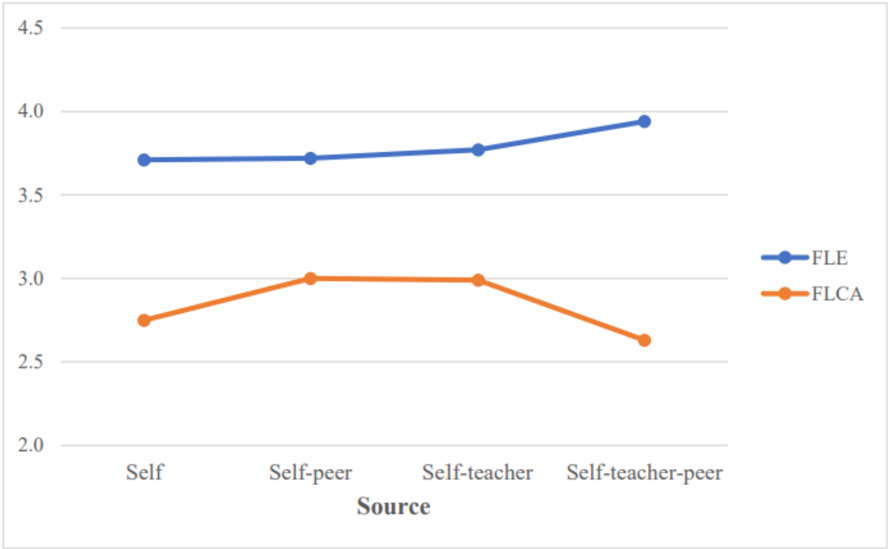
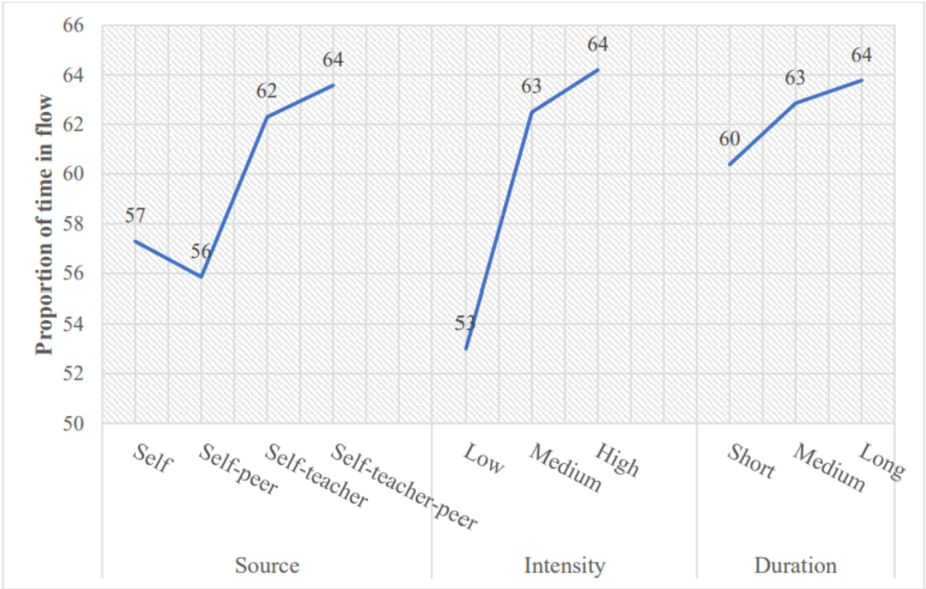
- Source of enjoyable episode had a significant multivariate effect (Pillai’s Trace = .052, F[12, 3117] = 4.54, p < .001, partial-eta² = .017); post-hoc tests showed significant differences for FLE and flow between “self” and “self-teacher-peer” sources (p < .0001 and p < .022, respectively), with no significant FLCA differences.
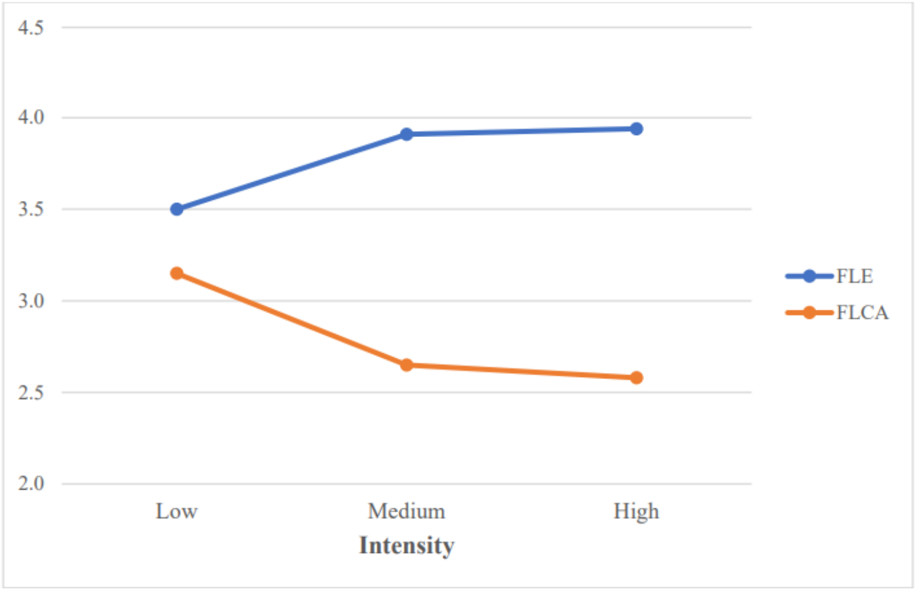
- Intensity of enjoyable episode had a significant multivariate effect (Pillai’s Trace = .101, F[6, 1104] = 9.82, p < .001, partial-eta² = .051); the low-intensity group had significantly higher FLCA, lower FLE, and lower flow than the medium and high groups (p < .001), which did not differ from each other.
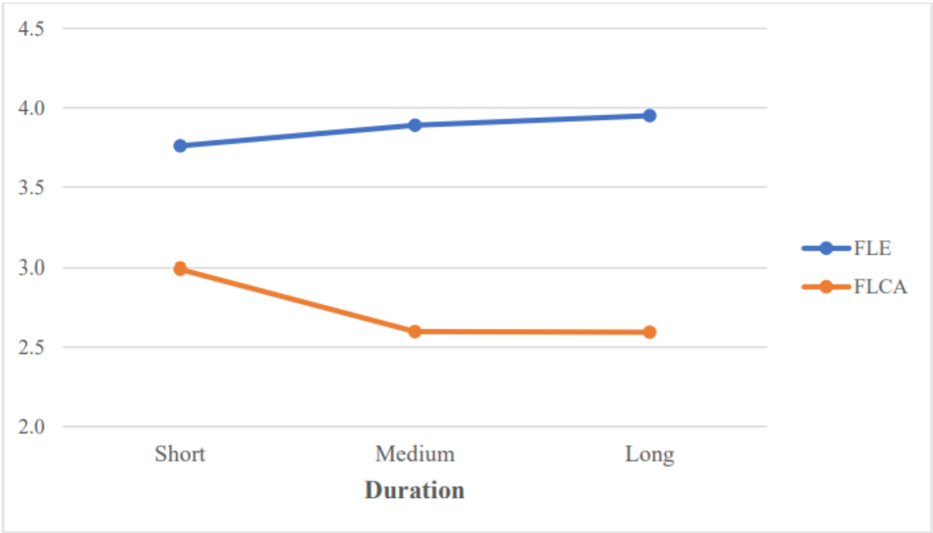
- Duration of enjoyable episode had a significant multivariate effect (Pillai’s Trace = .025, F[9, 3120] = 2.88, p < .002, partial-eta² = .008); only the low versus high duration difference was significant (p < .05), while the medium duration group did not differ significantly from either. Qualitatively, 581 participants answered the open question, producing 31,430 words (average 54 words per response), and the paper reports that flow starts self-centered, infrequent, and short-lived and becomes more social, frequent, stronger, and sustained among advanced learners.
Methods
- Mixed-methods convergent parallel design using a sample of 1,044 multilingual FL learners (745 females, 294 males; age 11–75, Mean = 24 years, SD = 8.0), drawn from the original 1,742-learner database and recruited through snowball sampling via an online questionnaire.
- Measures included FLE (Cronbach α = .87, Mean = 3.83, SD = .47), FLCA (Cronbach α = .86, Mean = 2.70, SD = .83), and flow via four positively worded Experience Sampling Method items asking the percentage of FL class time in flow (Cronbach α = .82), plus an open-ended question asking participants to describe one enjoyable FL class episode.
- Analysis used Pearson correlations and a z-test, one-way MANOVAs with Tukey HSD post-hoc tests for source, intensity, and duration of enjoyable episodes, and qualitative coding of source, duration, and intensity with Cohen’s kappa values of .78, .73, and .79.
Limitations
- The paper states self-selection bias means the sample cannot be considered representative of FL learners and likely attracted motivated, good learners; self-report is inherent because flow cannot be measured directly; qualitative coding inferred flow from keywords in memories of enjoyable episodes without explicit flow questions; and qualitative reliability is lower than quantitative reliability.
- Evident from the text: the cross-sectional, retrospective, correlational design cannot establish causality or track ontogenesis longitudinally; source categories are described as fuzzy and overlapping; the sample is predominantly female and highly educated; and the flow measure relies on four self-report items and a self-estimated percentage of class time.
Model-written summary. Check it against the paper before relying on it.
Integrity signals
Registry
Cites
Statistics
Figures

Verification
Claims the paper makes
0 Valid · 3 Not valid · 43 Not checked · 66 Own results and interpretations
A result the paper reports from its own data — it cites no other source for it, so there is none to check. The quote shows it is in the paper.
In the paper
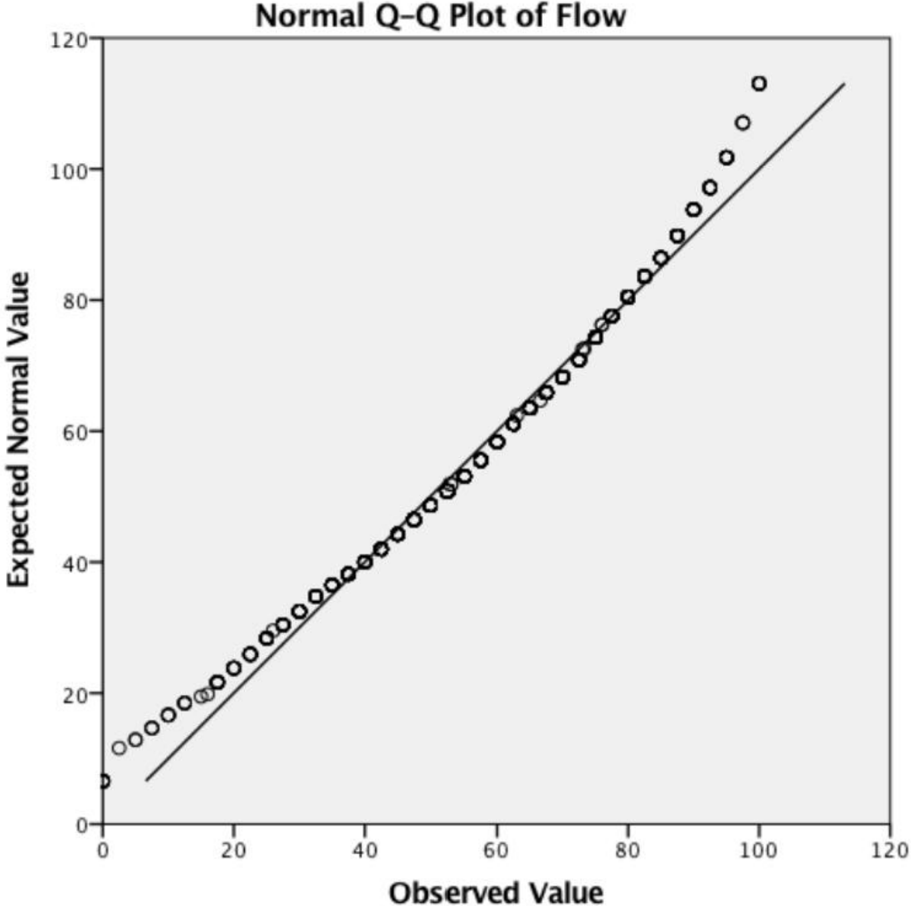
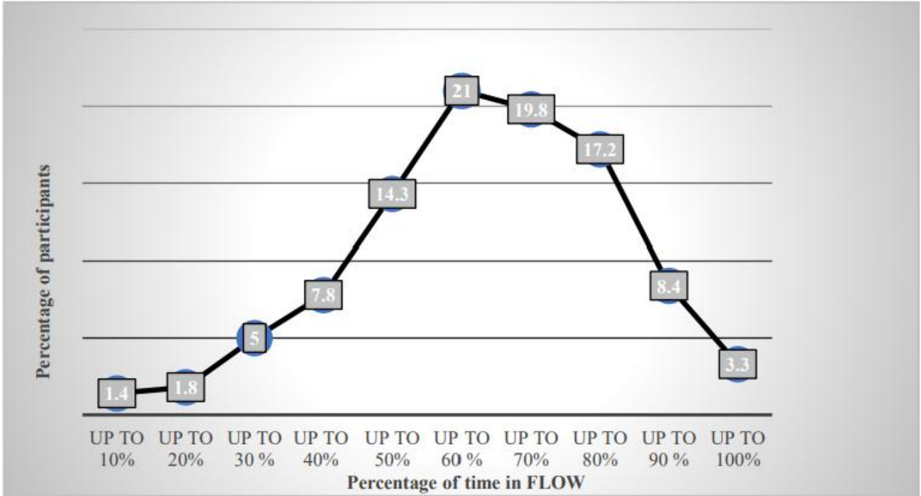
“An analysis of the quantitative flow measure reveals that participants reported, on average, being in a state of flow for more than half the time in their FL classes (Mean = 59.3% of the time, SD = 19.5, range 0-100%, skewness = -.48,kurtosis = -.002)”
§ EMERGENCE OF FLOW IN FOREIGN LANGUAGE CLASSROOMS 1 "You Can't Start a Fire Without a Spark": Enjoyment, Anxiety, and the Emergence of Flow in Foreign Language Classrooms > The Frequency of Flow
plain- Asserted: passes — The authors put it forward as true.
- Checkable: passes — It can be checked against evidence.
- Load-bearing: passes — The paper’s conclusions depend on it.
- Based: passes — The paper gives a reason why it holds.
A result the paper reports from its own data — it cites no other source for it, so there is none to check. The quote shows it is in the paper.
In the paper
“No significant differences emerged for FLCA.”
§ EMERGENCE OF FLOW IN FOREIGN LANGUAGE CLASSROOMS 1 "You Can't Start a Fire Without a Spark": Enjoyment, Anxiety, and the Emergence of Flow in Foreign Language Classrooms > Sources of Enjoyable Episode
plain- Asserted: passes — The authors put it forward as true.
- Checkable: passes — It can be checked against evidence.
- Load-bearing: unclear — It is unclear whether the paper’s conclusions depend on it.
- Based: passes — The paper gives a reason why it holds.
A result the paper reports from its own data — it cites no other source for it, so there is none to check. The quote shows it is in the paper.
In the paper
“and a significant negative relationship between FLCA and proportion of time in a state of flow (r[1044] = -.269,p < .0001)”
§ EMERGENCE OF FLOW IN FOREIGN LANGUAGE CLASSROOMS 1 "You Can't Start a Fire Without a Spark": Enjoyment, Anxiety, and the Emergence of Flow in Foreign Language Classrooms > Distribution of Participants According to Self-Reported Proportion of Time in a State of Flow
plainstates an association- Asserted: passes — The authors put it forward as true.
- Checkable: passes — It can be checked against evidence.
- Load-bearing: passes — The paper’s conclusions depend on it.
- Based: passes — The paper gives a reason why it holds.
A result the paper reports from its own data — it cites no other source for it, so there is none to check. The quote shows it is in the paper.
In the paper
“Using a correlation between FLE and FLCA (r = -.39), a z-test reveals that flow is correlated significantly more strongly with FLE than with FLCA (z = 8.5, p < .001)”
- Also stated in: § Abstract · plain
“FLE was a significantly stronger predictor of frequency of flow experience than FLCA.”
§ EMERGENCE OF FLOW IN FOREIGN LANGUAGE CLASSROOMS 1 "You Can't Start a Fire Without a Spark": Enjoyment, Anxiety, and the Emergence of Flow in Foreign Language Classrooms > Distribution of Participants According to Self-Reported Proportion of Time in a State of Flow
plainstates an association- Asserted: passes — The authors put it forward as true.
- Checkable: passes — It can be checked against evidence.
- Load-bearing: passes — The paper’s conclusions depend on it.
- Based: passes — The paper gives a reason why it holds.
- Also stated in: § Abstract · plain
A result the paper reports from its own data — it cites no other source for it, so there is none to check. The quote shows it is in the paper.
In the paper
“A one-way MANOVA with the source of the enjoyable episode as independent variable (self, self-peer, self-teacher, self-teacher-peer) and FLE, FLCA, and proportion of time in flow as dependent variables revealed a significant main effect at the multivariate level (Pillai's Trace = .052,F[12, 3117] = 4.54, p < .001,partial-eta 2 = .017).”
§ EMERGENCE OF FLOW IN FOREIGN LANGUAGE CLASSROOMS 1 "You Can't Start a Fire Without a Spark": Enjoyment, Anxiety, and the Emergence of Flow in Foreign Language Classrooms > Sources of Enjoyable Episode
plainstates an association- Asserted: passes — The authors put it forward as true.
- Checkable: passes — It can be checked against evidence.
- Load-bearing: passes — The paper’s conclusions depend on it.
- Based: passes — The paper gives a reason why it holds.
42 more claims
Create a free account to see all 112 claims and to verify the 39 references still open.
- It may state two separate claims as one. 39
- Probably not a substantial claim. 45
- The quote only partly states this claim. 1
Statistics recomputed
Every reported test result, recomputed from its test statistic and degrees of freedom. A result shows as not adding up only once an independent check has confirmed it.
- Consistentz = 8.5reported p < .001 · recomputed p < .001
“(z = 8.5, p < .001”
Self-check
Percentages, sums and reported differences re-computed from the paper’s own numbers.
Each contradiction between two passages listed here was confirmed by an independent check.
Rated major: it would touch a result — a value a result rests on, reported and recomputed p-values on opposite sides of the significance level, two passages that conflict with no sign which is right, or a cited work retracted before this paper was published.
In the paper
§ EMERGENCE OF FLOW IN FOREIGN LANGUAGE CLASSROOMS 1 "You Can't Start a Fire Without a Spark": Enjoyment, Anxiety, and the Emergence of Flow in Foreign Language Classrooms > Duration of Enjoyable Episode
“Post-hoc tests of means (Tukey's HSD) showed that the low intensity group had significantly higher FLCA, lower FLE and proportion of time in flow than the other two groups, which did not differ between themselves (see Figure 5).”
§ EMERGENCE OF FLOW IN FOREIGN LANGUAGE CLASSROOMS 1 "You Can't Start a Fire Without a Spark": Enjoyment, Anxiety, and the Emergence of Flow in Foreign Language Classrooms > Duration of Enjoyable Episode
“The tests also showed that only the difference between the low intensity group and the high intensity group was significant (p < .05).However, the medium duration group did not differ significantly from either the low or high duration groups.”
Citations
Cites
The Measurement of Observer Agreement for Categorical Data
Landis, J. R., & Koch, G. G. (1977) · Biometrics · doi:10.2307/2529310 · Cited by 81,148
Fredrickson, B. L. (2001) · American Psychologist · doi:10.1037//0003-066x.56.3.218 · Cited by 18,025
Foreign Language Classroom Anxiety
HORWITZ, E. K., HORWITZ, M. B., & COPE, J. (1986) · The Modern Language Journal · doi:10.1111/j.1540-4781.1986.tb05256.x · Cited by 9,773
Positive Emotions Broaden and Build
Fredrickson, B. L. (2013) · Advances in Experimental Social Psychology · doi:10.1016/b978-0-12-407236-7.00001-2 · Cited by 1,907
The two faces of Janus? Anxiety and enjoyment in the foreign language classroom
Dewaele, J.-M., & MacIntyre, P. D. (2014) · Studies in Second Language Learning and Teaching · doi:10.14746/ssllt.2014.4.2.5 · Cited by 1,757
Self-citationPositive Psychology, Positive Prevention, and Positive Therapy
Seligman, M. E. P. (2001) · Handbook of Positive Psychology · doi:10.1093/oso/9780195135336.003.0001 · Cited by 1,687
The Experience Sampling Method
Larson, R., & Csikszentmihalyi, M. (2014) · Flow and the Foundations of Positive Psychology · doi:10.1007/978-94-017-9088-8_2 · Cited by 1,034
Regulation of Positive Emotions: Emotion Regulation Strategies that Promote Resilience
Tugade, M. M., & Fredrickson, B. L. (2007) · Journal of Happiness Studies · doi:10.1007/s10902-006-9015-4 · Cited by 791
Foreign language enjoyment and anxiety: The effect of teacher and learner variables
Dewaele, J.-M., Witney, J., Saito, K., & Dewaele, L. (2018) · Language Teaching Research · doi:10.1177/1362168817692161 · Cited by 780
Self-citationNakamura, J., & Csikszentmihalyi, M. (2009) · The Oxford Handbook of Positive Psychology · doi:10.1093/oxfordhb/9780195187243.013.0018 · Cited by 702
Research works printed but not linked: 7
- Cohen, Jacob. 1988. Statistical power analysis for the behavioral sciences (2nd ed.). Hillsdale, NJ: Erlbaum.
- Creswell, John W. & Vicky L. Plano Clark. 2011. Designing and Conducting Mixed Methods Research. London: Sage Publications (2nd ed.).
- Csíkszentmihályi, Mihaly. 2009. Flow. In S. Lopez (Ed.), The Encyclopedia of positive psychology (394-400). Chichester, UK: Blackwell.
- Dewaele, Jean-Marc. 2011. Reflections on the emotional and psychological aspects of foreign language learning and use. Anglistik. International Journal of English Studies 22. 23-42.
- Dewaele, Jean-Marc & Chengchen Li. 2020. Emotions in Second Language Acquisition: A critical review and research agenda. Foreign Language World [外语界] 196(1). 34-49.
- Ness Evans, Annabel & Brian J. Rooney. 2013. Methods in psychological research (3rd ed.). New York: SAGE Publications.
- Rubio, Fernando D. 2011. Optimal experiences in the foreign language classroom: Flow states in speaking tasks. Anglistik. International Journal of English Studies 22. 63-80.
Cited by
Li, C., Dewaele, J.-M., Pawlak, M., & Kruk, M. (2025) · Language Teaching Research · doi:10.1177/13621688221111623 · Cited by 163
Self-citationContributions of foreign language writing emotions to writing achievement
Li, C., Wei, L., & Lu, X. (2023) · System · doi:10.1016/j.system.2023.103074 · Cited by 121
Li, Z., & Liu, Y. (2022) · System · doi:10.1016/j.system.2022.102975 · Cited by 61
The significance of humanistic approach and moral development in English language classrooms
Amini, M., Qiufen, W., Amini, D., Ravindran, L., Lin, D. T. A., Ganapathy, M. N. G., & Singh, M. K. M. (2025) · Discover Education · doi:10.1007/s44217-025-00691-4 · Cited by 57
Huang, L., & Liu, M. Z. (2025) · Humanities and Social Sciences Communications · doi:10.1057/s41599-025-05921-6 · Cited by 54
Metadata
- Authors
- Dewaele, J.-M., & MacIntyre, P.
- Affiliations
- Birkbeck, University of London (GB)
- Cape Breton University (CA)
- Corresponding author
- Dewaele, Jean-Marc
- Venue
- Applied Linguistics Review
- Publisher
- Walter de Gruyter GmbH
- Published
- 2022-06-16
- Volume
- 15
- Issue
- 2
- Pages
- 403-426
- ISSN
- 1868-6303 (ISSN-L)
- 1868-6311
- OpenAlex
- W4282932838
- Semantic Scholar
- 3352e67a307bf82d947ac139037406c4dc3e7770
- Cited by
- 144
- References
- 48
- Citations by year
- 2026: 47 · 2025: 51 · 2024: 28 · 2023: 10 · 2022: 7
- FWCI
- 17.92
- Type
- journal article
- Language
- en
- Open access
- green
- hdl.handle.net
- Licence
- cc-by-nc-nd
- Locations
- Applied Linguistics Review (publishedVersion)
- BIROn (Birkbeck, University of London) (acceptedVersion)
- CBU Scholar (submittedVersion, cc-by-nc-nd)
- Funders
- Cape Breton University
- Social Sciences and Humanities Research Council of Canada
- Topics
- Social Sciences › Psychology › Developmental and Educational Psychology › Flow Experience in Various Fields
- Social Sciences › Arts and Humanities › Language and Linguistics › EFL/ESL Teaching and Learning
- Social Sciences › Psychology › Developmental and Educational Psychology › Education, Achievement, and Giftedness
- Keywords
- flow experience, foreign language enjoyment, foreign language classroom anxiety, positive emotions, negative emotions, second language acquisition, student motivation, student engagement
About these checks
Registry, retraction, Cites and statistics results are computed, not judged, with one exception: a printed reference that no index lists is read once by a model before it counts as a citation error. Claims are extracted by a model and kept only when their quote appears verbatim in the text; each cited source is then checked, with a model’s help, for whether it says what the claim relies on. Those verdicts can be wrong — read the claim’s quote and the cited source before relying on one.
A language model drew the claims from the paper on 2026-11-24, under version 3 of the claim definition (model deepseek-v4.1-flash, prompt extract-v3).
A second model labelled each claim on 2026-11-24 (model jev-1.13-20260917, definition revision gold-guideline-v0.2).
Statistics and arithmetic are recomputed, not judged.
Confidence bands are shown only for fields calibrated on our annotated test set. None is calibrated yet, so no band is shown.
What counts as a claim ›How we measure confidence ›How we check this ›
Are you an author, or do you see a problem with this page? Request a review
How to cite
Cite CoChat for the checks on this page, and the paper for its own findings.
- This page
- CoChat. (2026). Citation check: "You can't start a fire without a spark". Enjoyment, anxiety, and the emergence of flow in foreign language classrooms. https://app.cochat.ai/papers/10.1515/applirev-2021-0123
- The paper
- Dewaele, J.-M., & MacIntyre, P. (2024). "You can't start a fire without a spark". Enjoyment, anxiety, and the emergence of flow in foreign language classrooms. Applied Linguistics Review. https://doi.org/10.1515/applirev-2021-0123
Data sources
Bibliographic data: Semantic Scholar, OpenAlex, Crossref.
Contains information from the Semantic Scholar Academic Graph Datasets, made available under the ODC Attribution License (ODC-BY 1.0).
Semantic Scholar’s data is described in: Kinney, R., et al. (2023). The Semantic Scholar Open Data Platform. arXiv:2301.10140.
