

Honey in wound healing: molecular and cellular mechanisms of inflammation control, immune modulation, and antimicrobial defense
Open accessThe DOI matches its Crossref record; 137 of the 137 references it cites were found in a registry or an index; none of the 235 sources its claims cite is checked for support yet.
Abstract
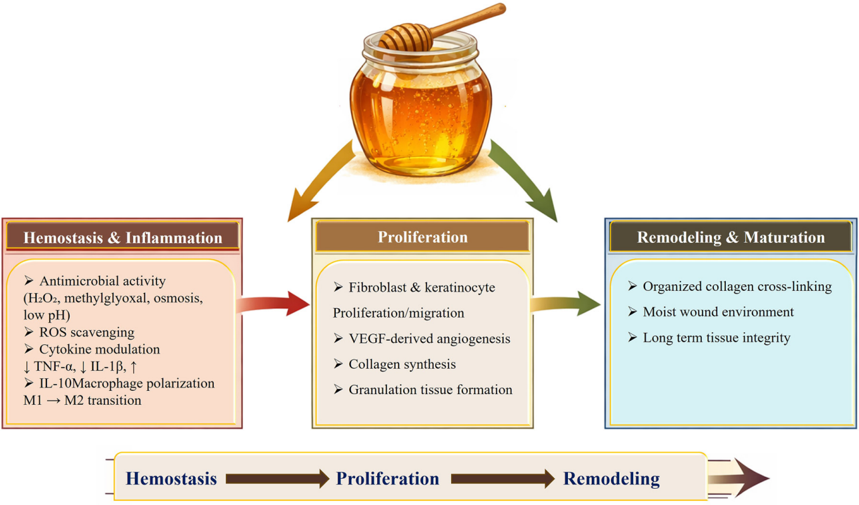
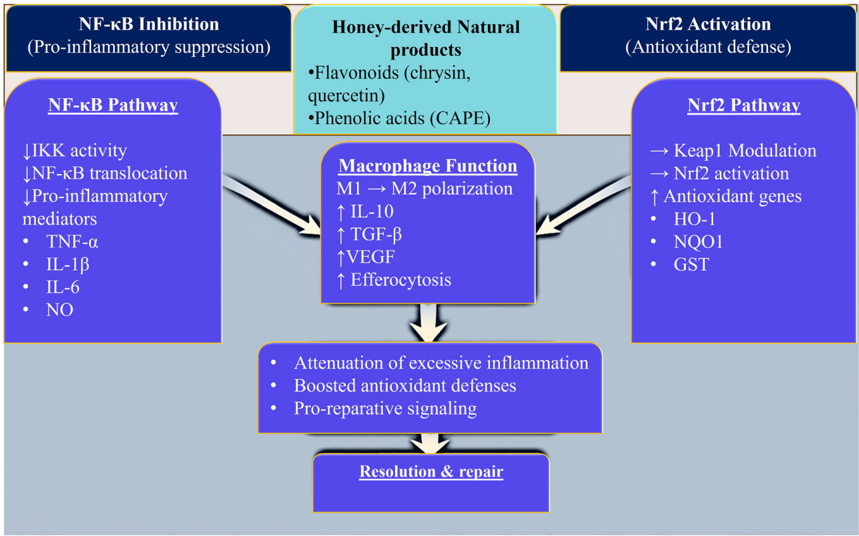
Wound healing is a complex process involving inflammation control, protection against infection, oxidative balance, and tissue regeneration. Honey has attracted considerable attention due to its multifunctional biological activities. In addition to its anti-inflammatory and antioxidant actions, honey exhibits broad antimicrobial activity that helps prevent microbial colonization and biofilm formation, thereby facilitating a favorable environment for healing. It also limits oxidative stress through reactive oxygen species (ROS) scavenging and erythroid 2–related factor 2 (Nrf2) activation, resulting in better control of inflammation and improved tissue repair. However, despite promising experimental and clinical evidence, the clinical translation of honey remains limited by variability in composition, lack of standardization, and methodological weaknesses in existing trials, and robust, well-controlled studies and standardized formulations are therefore essential to confirm efficacy and support its integration into evidence-based wound care. This review summarizes current knowledge on how honey supports wound healing, focusing on its antimicrobial, anti-inflammatory, antioxidant, and immunomodulatory effects. The analysis is based on a literature search of MEDLINE, Google Scholar, Scopus, and Web of Science. Overall, honey reduces pro-inflammatory mediators (e.g., tumor necrosis factor-α (TNF-α), interleukin (IL)-1β, IL-6, nuclear factor kappa B (NF-κB)) and enhances anti-inflammatory responses such as IL-10 and M2 macrophage activity.
Overview
CoChat Summary
TL;DR
This review synthesizes evidence that honey supports wound healing through antimicrobial, antioxidant, anti-inflammatory, and immunomodulatory mechanisms, including suppression of NF-κB and promotion of M2 macrophages. Clinical translation remains limited by compositional variability, lack of standardization, and methodological weaknesses in existing trials.
Key findings
- Honey reduces pro-inflammatory mediators such as TNF-α, IL-1β, IL-6, and NF-κB, while enhancing anti-inflammatory responses including IL-10 and M2 macrophage activity; it also activates Nrf2-dependent antioxidant pathways and inhibits COX, iNOS/NO, NLRP3, and MMP-9.
- Antimicrobial activity arises from high sugar/osmotic effects, acidic pH (typically 3.4–6.1; also reported as about 3.2–6.1), glucose oxidase-generated H₂O₂, and non-peroxide factors such as methylglyoxal in Manuka honey; honey is active against MRSA, *Pseudomonas aeruginosa*, vancomycin-resistant enterococci, and biofilms.
- Honey contains more than 200 constituents; carbohydrates account for approximately 75–85% of composition, with fructose ≈38–41% and glucose ≈31–34%, and biological activity varies by botanical and geographical origin.
- Clinical evidence includes a Cochrane review of 26 RCTs concluding with moderate certainty that honey dressings likely increase healing rates for partial-thickness burns; a 2024 meta-analysis of 8 studies and 906 patients found healing time mean difference = −17.13 days (95% CI −26.37 to −7.89, p = 0.0003) and increased percentage of wound healing MD = 18.31% (95% CI 8.86 to 27.76, p = 0.0001), but no significant difference in complete healing rates (RR = 2.00, 95% CI 0.78 to 5.10, p = 0.15) and very low quality of evidence.
Methods
- Narrative review based on a literature search in PubMed/MEDLINE, Web of Science, and Scopus for studies published between 1990 and 2025, with additional studies identified through Google Scholar and reference-list screening.
- Studies were included if they examined antimicrobial, anti-inflammatory, antioxidant, immunomodulatory, or wound-healing effects of honey in in vitro, in vivo, or clinical settings; editorials and studies without clearly defined interventions were excluded.
- Data were analyzed qualitatively because of variability in study designs and outcomes, focusing on honey composition, mechanisms of action, and relevance to wound healing.
Limitations
- The paper states that honey composition and biological activity vary by botanical origin, geographical location, environmental conditions, bee species, harvesting, storage, and processing; lack of standardization and dose standardization limits reproducibility and clinical translation.
- The paper states that clinical evidence remains limited and heterogeneous, with methodological weaknesses including heterogeneity, risk of bias, publication bias, small sample sizes, inadequate blinding, and variability in honey formulations; most mechanistic evidence is preclinical, and direct confirmation in human wounds is still lacking.
- Evident from the text: as a narrative review using qualitative synthesis, it does not report a systematic review protocol, formal risk-of-bias assessment, or quantitative pooling, and the included studies differ in honey type, concentration, preparation, wound models, microbial strains, formulations, and outcome measures, limiting direct comparability.
Model-written summary. Check it against the paper before relying on it.
Integrity signals
Registry
Cites
Statistics
Figures
Verification
Claims the paper makes
0 Valid · 5 Not valid · 162 Not checked · 78 Own results and interpretations
A result the paper states — it cites no source for it, so there is none to check. The quote shows it is in the paper.
In the paper
“While direct evidence for honey-induced SPM production remains limited, several lines of inquiry suggest potential connections.”
§ Honey in wound healing: molecular and cellular mechanisms of inflammation control, immune modulation, and antimicrobial defense > Honey-mediated immunomodulation and anti-inflammatory effects in wound healing
plain- Asserted: passes — The authors put it forward as true.
- Checkable: passes — It can be checked against evidence.
- Load-bearing: unclear — It is unclear whether the paper’s conclusions depend on it.
- Based: passes — The paper gives a reason why it holds.
A result the paper states — it cites no source for it, so there is none to check. The quote shows it is in the paper.
In the paper
“While these results are promising, heterogeneity in study design, honey type, dosing, and outcome measures limits the generalizability of current clinical recommendations.”
§ Honey in wound healing: molecular and cellular mechanisms of inflammation control, immune modulation, and antimicrobial defense > Clinical evidences supporting the use of honey in wound healing
plainstates a cause- Asserted: passes — The authors put it forward as true.
- Checkable: passes — It can be checked against evidence.
- Load-bearing: passes — The paper’s conclusions depend on it.
- Based: passes — The paper gives a reason why it holds.
A check of a cited source is scheduled, or we don’t hold its full text yet; the claim is checked once it runs.
In the paper
“A 2024 systematic review and meta-analysis evaluating honey dressings for chronic wounds – including DFUs, venous ulcers, and PIs – identified only eight studies meeting rigorous inclusion criteria, encompassing 906 patients [29].”
§ Honey in wound healing: molecular and cellular mechanisms of inflammation control, immune modulation, and antimicrobial defense > Clinical evidences supporting the use of honey in wound healing
What the sources say
- Not checked yetcites [29] Tang Y Chen L Ran X Efficacy and safety of honey dressings in the management of chronic wounds: an updated systematic review and meta-analysis Nutrients 2024 16 2455 10.3390/nu16152455 PMC11314015 39125335 source
A check is scheduled.
plainn = 906- Asserted: passes — The authors put it forward as true.
- Checkable: passes — It can be checked against evidence.
- Load-bearing: passes — The paper’s conclusions depend on it.
- Based: passes — The paper gives a reason why it holds.
- Not checked yet
None of the sources cited for this claim have been checked yet.
In the paper
“The strongest evidence for honey in wound healing comes from clinical trials and systematic reviews.”
§ Honey in wound healing: molecular and cellular mechanisms of inflammation control, immune modulation, and antimicrobial defense > Clinical evidences supporting the use of honey in wound healing
boosted- Asserted: passes — The authors put it forward as true.
- Checkable: passes — It can be checked against evidence.
- Load-bearing: passes — The paper’s conclusions depend on it.
- Based: passes — The paper gives a reason why it holds.
A result the paper states — it cites no source for it, so there is none to check. The quote shows it is in the paper.
In the paper
“Despite these findings, most of the available data are derived from in vitro or preclinical studies.”
§ Honey in wound healing: molecular and cellular mechanisms of inflammation control, immune modulation, and antimicrobial defense > Honey-mediated immunomodulation and anti-inflammatory effects in wound healing > Immunomodulatory mechanisms of honey in coordinating wound healing
plain- Asserted: passes — The authors put it forward as true.
- Checkable: passes — It can be checked against evidence.
- Load-bearing: passes — The paper’s conclusions depend on it.
- Based: passes — The paper gives a reason why it holds.
107 more claims
Create a free account to see all 245 claims and to verify the 166 references still open.
- It may state two separate claims as one. 124
- Probably not a substantial claim. 17
- The quote only partly states this claim. 2
Self-check
Percentages, sums and reported differences re-computed from the paper’s own numbers.
Each contradiction between two passages listed here was confirmed by an independent check.
Rated minor: it would not touch a result — a value no result rests on, a p-value that stays on the same side of the significance level, or a conflict that is clerical, resolved elsewhere in the paper, or outside its own findings.
In the paper
§ Honey in wound healing: molecular and cellular mechanisms of inflammation control, immune modulation, and antimicrobial defense > Clinical evidences supporting the use of honey in wound healing
“Bezerra et al. highlighted honey’s effectiveness in DFUs, while a 2024 review confirmed its benefits in burn wound healing compared with conventional treatments [127].”
§ Honey in wound healing: molecular and cellular mechanisms of inflammation control, immune modulation, and antimicrobial defense > References
“127. Bezerra A Fonseca H Rodrigues F Delerue-Matos C Gouvinhas I Garcia J Honey therapy in diabetic foot ulcers: a promising strategy for effective wound healing Appl Sci 2023 13 12820 10.3390/app132312820”
Rated minor: it would not touch a result — a value no result rests on, a p-value that stays on the same side of the significance level, or a conflict that is clerical, resolved elsewhere in the paper, or outside its own findings.
In the paper
§ Honey in wound healing: molecular and cellular mechanisms of inflammation control, immune modulation, and antimicrobial defense > Clinical evidences supporting the use of honey in wound healing
“Formal cost-effectiveness analyses incorporating direct and indirect costs, as well as quality-adjusted life years, are warranted to determine honey’s value relative to standard care [29], 129] (Table 3).”
§ Honey in wound healing: molecular and cellular mechanisms of inflammation control, immune modulation, and antimicrobial defense > Honey-mediated immunomodulation and anti-inflammatory effects in wound healing
“Table: Table 3: Honey-mediated modulation of immunomediators in wound healing.”
Citations
Cites
Gurtner, G. C., Werner, S., Barrandon, Y., & Longaker, M. T. (2008) · Nature · doi:10.1038/nature07039 · Cited by 6,542
Reactive Oxygen Species in Inflammation and Tissue Injury
Mittal, M., Siddiqui, M. R., Tran, K., Reddy, S. P., & Malik, A. B. (2014) · Antioxidants & Redox Signaling · doi:10.1089/ars.2012.5149 · Cited by 4,897
Macrophages in Tissue Repair, Regeneration, and Fibrosis
Wynn, T. A., & Vannella, K. M. (2016) · Immunity · doi:10.1016/j.immuni.2016.02.015 · Cited by 4,481
Wound healing: cellular mechanisms and pathological outcomes
Wilkinson, H. N., & Hardman, M. J. (2020) · Open Biology · doi:10.1098/rsob.200223 · Cited by 1,796
Cellular and molecular mechanisms of skin wound healing
Peña, O. A., & Martin, P. (2024) · Nature Reviews Molecular Cell Biology · doi:10.1038/s41580-024-00715-1 · Cited by 1,655
Epithelialization in Wound Healing: A Comprehensive Review
Pastar, I., Stojadinovic, O., Yin, N. C., Ramirez, H., Nusbaum, A. G., Sawaya, A., Patel, S. B., Khalid, L., Isseroff, R. R., & Tomic-Canic, M. (2014) · Advances in Wound Care · doi:10.1089/wound.2013.0473 · Cited by 1,531
Honey: Chemical composition, stability and authenticity
da Silva, P. M., Gauche, C., Gonzaga, L. V., Costa, A. C. O., & Fett, R. (2016) · Food Chemistry · doi:10.1016/j.foodchem.2015.09.051 · Cited by 1,415
Inflammation and metabolism in tissue repair and regeneration
Eming, S. A., Wynn, T. A., & Martin, P. (2017) · Science · doi:10.1126/science.aam7928 · Cited by 1,369
Skin Wound Healing Process and New Emerging Technologies for Skin Wound Care and Regeneration
Tottoli, E. M., Dorati, R., Genta, I., Chiesa, E., Pisani, S., & Conti, B. (2020) · Pharmaceutics · doi:10.3390/pharmaceutics12080735 · Cited by 1,340
Honey for Nutrition and Health: A Review
Bogdanov, S., Jurendic, T., Sieber, R., & Gallmann, P. (2008) · Journal of the American College of Nutrition · doi:10.1080/07315724.2008.10719745 · Cited by 1,259
Research works printed but not linked: 1
- Jarrar D Kmail A Masalha M Abu-Farich B Weldali D Touzani S Wound healing mechanisms of Medicago sativa honey: Antioxidant, anti-inflammatory, antibacterial and phytochemical characterisation J Nat Remedies 2025 25 43 · DOI
Cited by
Still being checked.
Metadata
- Authors
- Kmail, A., & Saad, B.
- Affiliations
- Arab American University (PS)
- Corresponding author
- Saad, Bashar
- Venue
- Open Life Sciences
- Publisher
- Walter de Gruyter GmbH
- Published
- 2026-01-01
- Volume
- 21
- Issue
- 1
- Pages
- 20251397-20251397
- ISSN
- 1895-104X (ISSN-L)
- 2391-5412
- PMC
- PMC13718990
- OpenAlex
- W7224524102
- Cited by
- 0
- References
- 137
- FWCI
- 0.00
- Type
- journal article
- Language
- en
- Open access
- gold
- doi.org
- Locations
- Open Life Sciences (publishedVersion, cc-by)
- PubMed Central (publishedVersion, cc-by)
- PubMed (publishedVersion)
- DOAJ (DOAJ: Directory of Open Access Journals) (submittedVersion)
- Topics
- Life Sciences › Agricultural and Biological Sciences › Insect Science › Bee Products Chemical Analysis
- Health Sciences › Medicine › Surgery › Wound Healing and Treatments
- Health Sciences › Medicine › Pharmacology (medical) › Healthcare and Venom Research
- Keywords
- honey, wound healing, anti-inflammatory activity, antioxidant activity, antimicrobial activity, immunomodulation, reactive oxygen species scavenging, Nrf2 activation, oxidative stress, biofilm formation, NF-κB, M2 macrophages, cytokines
About these checks
Registry, retraction, Cites and statistics results are computed, not judged, with one exception: a printed reference that no index lists is read once by a model before it counts as a citation error. Claims are extracted by a model and kept only when their quote appears verbatim in the text; each cited source is then checked, with a model’s help, for whether it says what the claim relies on. Those verdicts can be wrong — read the claim’s quote and the cited source before relying on one.
A language model drew the claims from the paper on 2026-11-22, under version 3 of the claim definition (model deepseek-v4.1-flash, prompt extract-v3).
A second model labelled each claim on 2026-11-22 (model jev-1.13-20260917, definition revision gold-guideline-v0.2).
Statistics and arithmetic are recomputed, not judged.
Confidence bands are shown only for fields calibrated on our annotated test set. None is calibrated yet, so no band is shown.
What counts as a claim ›How we measure confidence ›How we check this ›
Are you an author, or do you see a problem with this page? Request a review
How to cite
Cite CoChat for the checks on this page, and the paper for its own findings.
- This page
- CoChat. (2026). Citation check: Honey in wound healing: molecular and cellular mechanisms of inflammation control, immune modulation, and antimicrobial defense. https://app.cochat.ai/papers/10.1515/biol-2025-1397
- The paper
- Kmail, A., & Saad, B. (2026). Honey in wound healing: molecular and cellular mechanisms of inflammation control, immune modulation, and antimicrobial defense. Open Life Sciences. https://doi.org/10.1515/biol-2025-1397
Data sources
Bibliographic data: Semantic Scholar, OpenAlex, Crossref.
Contains information from the Semantic Scholar Academic Graph Datasets, made available under the ODC Attribution License (ODC-BY 1.0).
Semantic Scholar’s data is described in: Kinney, R., et al. (2023). The Semantic Scholar Open Data Platform. arXiv:2301.10140.
