

Honey in wound healing: molecular and cellular mechanisms of inflammation control, immune modulation, and antimicrobial defense
Open accessThe DOI matches its Crossref record; 137 of the 137 references it cites were found in a registry or an index; none of the 235 sources its claims cite is checked for support yet.
Abstract
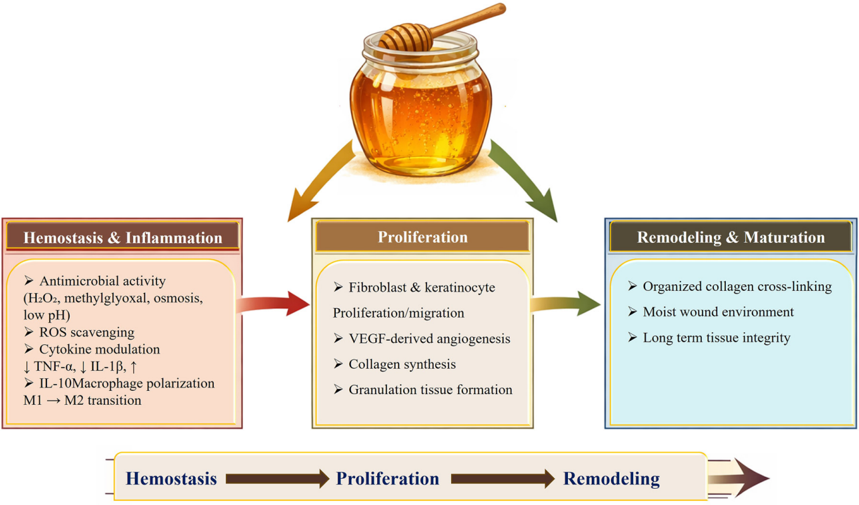
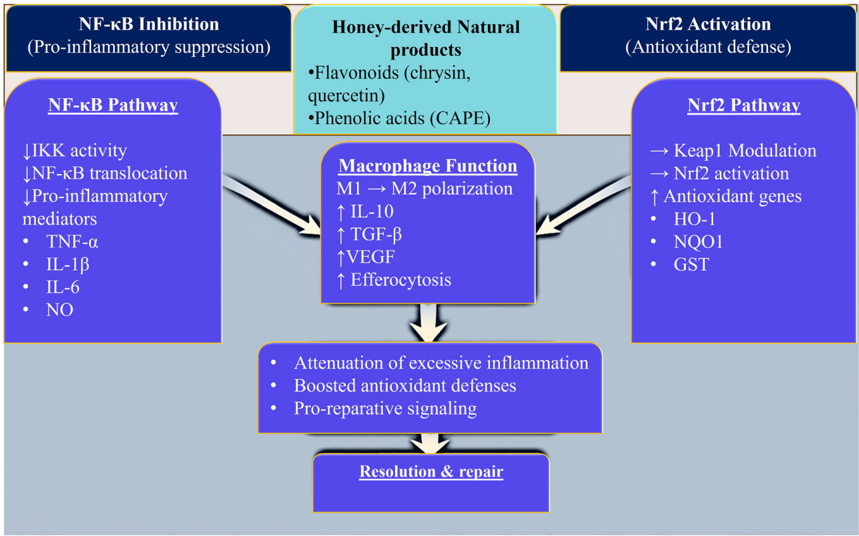
Wound healing is a complex process involving inflammation control, protection against infection, oxidative balance, and tissue regeneration. Honey has attracted considerable attention due to its multifunctional biological activities. In addition to its anti-inflammatory and antioxidant actions, honey exhibits broad antimicrobial activity that helps prevent microbial colonization and biofilm formation, thereby facilitating a favorable environment for healing. It also limits oxidative stress through reactive oxygen species (ROS) scavenging and erythroid 2–related factor 2 (Nrf2) activation, resulting in better control of inflammation and improved tissue repair. However, despite promising experimental and clinical evidence, the clinical translation of honey remains limited by variability in composition, lack of standardization, and methodological weaknesses in existing trials, and robust, well-controlled studies and standardized formulations are therefore essential to confirm efficacy and support its integration into evidence-based wound care. This review summarizes current knowledge on how honey supports wound healing, focusing on its antimicrobial, anti-inflammatory, antioxidant, and immunomodulatory effects. The analysis is based on a literature search of MEDLINE, Google Scholar, Scopus, and Web of Science. Overall, honey reduces pro-inflammatory mediators (e.g., tumor necrosis factor-α (TNF-α), interleukin (IL)-1β, IL-6, nuclear factor kappa B (NF-κB)) and enhances anti-inflammatory responses such as IL-10 and M2 macrophage activity.
Overview
CoChat Summary
TL;DR
This review synthesizes evidence that honey supports wound healing through antimicrobial, antioxidant, anti-inflammatory, and immunomodulatory mechanisms, including suppression of NF-κB and promotion of M2 macrophages. Clinical translation remains limited by compositional variability, lack of standardization, and methodological weaknesses in existing trials.
Key findings
- Honey reduces pro-inflammatory mediators such as TNF-α, IL-1β, IL-6, and NF-κB, while enhancing anti-inflammatory responses including IL-10 and M2 macrophage activity; it also activates Nrf2-dependent antioxidant pathways and inhibits COX, iNOS/NO, NLRP3, and MMP-9.
- Antimicrobial activity arises from high sugar/osmotic effects, acidic pH (typically 3.4–6.1; also reported as about 3.2–6.1), glucose oxidase-generated H₂O₂, and non-peroxide factors such as methylglyoxal in Manuka honey; honey is active against MRSA, *Pseudomonas aeruginosa*, vancomycin-resistant enterococci, and biofilms.
- Honey contains more than 200 constituents; carbohydrates account for approximately 75–85% of composition, with fructose ≈38–41% and glucose ≈31–34%, and biological activity varies by botanical and geographical origin.
- Clinical evidence includes a Cochrane review of 26 RCTs concluding with moderate certainty that honey dressings likely increase healing rates for partial-thickness burns; a 2024 meta-analysis of 8 studies and 906 patients found healing time mean difference = −17.13 days (95% CI −26.37 to −7.89, p = 0.0003) and increased percentage of wound healing MD = 18.31% (95% CI 8.86 to 27.76, p = 0.0001), but no significant difference in complete healing rates (RR = 2.00, 95% CI 0.78 to 5.10, p = 0.15) and very low quality of evidence.
Methods
- Narrative review based on a literature search in PubMed/MEDLINE, Web of Science, and Scopus for studies published between 1990 and 2025, with additional studies identified through Google Scholar and reference-list screening.
- Studies were included if they examined antimicrobial, anti-inflammatory, antioxidant, immunomodulatory, or wound-healing effects of honey in in vitro, in vivo, or clinical settings; editorials and studies without clearly defined interventions were excluded.
- Data were analyzed qualitatively because of variability in study designs and outcomes, focusing on honey composition, mechanisms of action, and relevance to wound healing.
Limitations
- The paper states that honey composition and biological activity vary by botanical origin, geographical location, environmental conditions, bee species, harvesting, storage, and processing; lack of standardization and dose standardization limits reproducibility and clinical translation.
- The paper states that clinical evidence remains limited and heterogeneous, with methodological weaknesses including heterogeneity, risk of bias, publication bias, small sample sizes, inadequate blinding, and variability in honey formulations; most mechanistic evidence is preclinical, and direct confirmation in human wounds is still lacking.
- Evident from the text: as a narrative review using qualitative synthesis, it does not report a systematic review protocol, formal risk-of-bias assessment, or quantitative pooling, and the included studies differ in honey type, concentration, preparation, wound models, microbial strains, formulations, and outcome measures, limiting direct comparability.
Model-written summary. Check it against the paper before relying on it.
Integrity signals
Registry
Cites
Statistics
Figures
Verification
Claims the paper makes
0 Valid · 5 Not valid · 162 Not checked · 78 Own results and interpretations
A result the paper states — it cites no source for it, so there is none to check. The quote shows it is in the paper.
In the paper
“While direct evidence for honey-induced SPM production remains limited, several lines of inquiry suggest potential connections.”
§ Honey in wound healing: molecular and cellular mechanisms of inflammation control, immune modulation, and antimicrobial defense > Honey-mediated immunomodulation and anti-inflammatory effects in wound healing
plain- Asserted: passes — The authors put it forward as true.
- Checkable: passes — It can be checked against evidence.
- Load-bearing: unclear — It is unclear whether the paper’s conclusions depend on it.
- Based: passes — The paper gives a reason why it holds.
A result the paper states — it cites no source for it, so there is none to check. The quote shows it is in the paper.
In the paper
“While these results are promising, heterogeneity in study design, honey type, dosing, and outcome measures limits the generalizability of current clinical recommendations.”
§ Honey in wound healing: molecular and cellular mechanisms of inflammation control, immune modulation, and antimicrobial defense > Clinical evidences supporting the use of honey in wound healing
plainstates a cause- Asserted: passes — The authors put it forward as true.
- Checkable: passes — It can be checked against evidence.
- Load-bearing: passes — The paper’s conclusions depend on it.
- Based: passes — The paper gives a reason why it holds.
A check of a cited source is scheduled, or we don’t hold its full text yet; the claim is checked once it runs.
In the paper
“A 2024 systematic review and meta-analysis evaluating honey dressings for chronic wounds – including DFUs, venous ulcers, and PIs – identified only eight studies meeting rigorous inclusion criteria, encompassing 906 patients [29].”
§ Honey in wound healing: molecular and cellular mechanisms of inflammation control, immune modulation, and antimicrobial defense > Clinical evidences supporting the use of honey in wound healing
What the sources say
- Not checked yetcites [29] Tang Y Chen L Ran X Efficacy and safety of honey dressings in the management of chronic wounds: an updated systematic review and meta-analysis Nutrients 2024 16 2455 10.3390/nu16152455 PMC11314015 39125335 source
A check is scheduled.
plainn = 906- Asserted: passes — The authors put it forward as true.
- Checkable: passes — It can be checked against evidence.
- Load-bearing: passes — The paper’s conclusions depend on it.
- Based: passes — The paper gives a reason why it holds.
- Not checked yet
None of the sources cited for this claim have been checked yet.
In the paper
“The strongest evidence for honey in wound healing comes from clinical trials and systematic reviews.”
§ Honey in wound healing: molecular and cellular mechanisms of inflammation control, immune modulation, and antimicrobial defense > Clinical evidences supporting the use of honey in wound healing
boosted- Asserted: passes — The authors put it forward as true.
- Checkable: passes — It can be checked against evidence.
- Load-bearing: passes — The paper’s conclusions depend on it.
- Based: passes — The paper gives a reason why it holds.
A result the paper states — it cites no source for it, so there is none to check. The quote shows it is in the paper.
In the paper
“Despite these findings, most of the available data are derived from in vitro or preclinical studies.”
§ Honey in wound healing: molecular and cellular mechanisms of inflammation control, immune modulation, and antimicrobial defense > Honey-mediated immunomodulation and anti-inflammatory effects in wound healing > Immunomodulatory mechanisms of honey in coordinating wound healing
plain- Asserted: passes — The authors put it forward as true.
- Checkable: passes — It can be checked against evidence.
- Load-bearing: passes — The paper’s conclusions depend on it.
- Based: passes — The paper gives a reason why it holds.
107 more claims
Create a free account to see all 245 claims and to verify the 166 references still open.
- It may state two separate claims as one. 124
- Probably not a substantial claim. 17
- The quote only partly states this claim. 2
Self-check
Percentages, sums and reported differences re-computed from the paper’s own numbers.
Each contradiction between two passages listed here was confirmed by an independent check.
Rated minor: it would not touch a result — a value no result rests on, a p-value that stays on the same side of the significance level, or a conflict that is clerical, resolved elsewhere in the paper, or outside its own findings.
In the paper
§ Honey in wound healing: molecular and cellular mechanisms of inflammation control, immune modulation, and antimicrobial defense > Clinical evidences supporting the use of honey in wound healing
“Bezerra et al. highlighted honey’s effectiveness in DFUs, while a 2024 review confirmed its benefits in burn wound healing compared with conventional treatments [127].”
§ Honey in wound healing: molecular and cellular mechanisms of inflammation control, immune modulation, and antimicrobial defense > References
“127. Bezerra A Fonseca H Rodrigues F Delerue-Matos C Gouvinhas I Garcia J Honey therapy in diabetic foot ulcers: a promising strategy for effective wound healing Appl Sci 2023 13 12820 10.3390/app132312820”
Rated minor: it would not touch a result — a value no result rests on, a p-value that stays on the same side of the significance level, or a conflict that is clerical, resolved elsewhere in the paper, or outside its own findings.
In the paper
§ Honey in wound healing: molecular and cellular mechanisms of inflammation control, immune modulation, and antimicrobial defense > Clinical evidences supporting the use of honey in wound healing
“Formal cost-effectiveness analyses incorporating direct and indirect costs, as well as quality-adjusted life years, are warranted to determine honey’s value relative to standard care [29], 129] (Table 3).”
§ Honey in wound healing: molecular and cellular mechanisms of inflammation control, immune modulation, and antimicrobial defense > Honey-mediated immunomodulation and anti-inflammatory effects in wound healing
“Table: Table 3: Honey-mediated modulation of immunomediators in wound healing.”
Citations
Cites
Gurtner, G. C., Werner, S., Barrandon, Y., & Longaker, M. T. (2008) · Nature · doi:10.1038/nature07039 · Cited by 6,542
Reactive Oxygen Species in Inflammation and Tissue Injury
Mittal, M., Siddiqui, M. R., Tran, K., Reddy, S. P., & Malik, A. B. (2014) · Antioxidants & Redox Signaling · doi:10.1089/ars.2012.5149 · Cited by 4,897
Macrophages in Tissue Repair, Regeneration, and Fibrosis
Wynn, T. A., & Vannella, K. M. (2016) · Immunity · doi:10.1016/j.immuni.2016.02.015 · Cited by 4,481
Wound healing: cellular mechanisms and pathological outcomes
Wilkinson, H. N., & Hardman, M. J. (2020) · Open Biology · doi:10.1098/rsob.200223 · Cited by 1,796
Cellular and molecular mechanisms of skin wound healing
Peña, O. A., & Martin, P. (2024) · Nature Reviews Molecular Cell Biology · doi:10.1038/s41580-024-00715-1 · Cited by 1,655
Epithelialization in Wound Healing: A Comprehensive Review
Pastar, I., Stojadinovic, O., Yin, N. C., Ramirez, H., Nusbaum, A. G., Sawaya, A., Patel, S. B., Khalid, L., Isseroff, R. R., & Tomic-Canic, M. (2014) · Advances in Wound Care · doi:10.1089/wound.2013.0473 · Cited by 1,531
Honey: Chemical composition, stability and authenticity
da Silva, P. M., Gauche, C., Gonzaga, L. V., Costa, A. C. O., & Fett, R. (2016) · Food Chemistry · doi:10.1016/j.foodchem.2015.09.051 · Cited by 1,415
Inflammation and metabolism in tissue repair and regeneration
Eming, S. A., Wynn, T. A., & Martin, P. (2017) · Science · doi:10.1126/science.aam7928 · Cited by 1,369
Skin Wound Healing Process and New Emerging Technologies for Skin Wound Care and Regeneration
Tottoli, E. M., Dorati, R., Genta, I., Chiesa, E., Pisani, S., & Conti, B. (2020) · Pharmaceutics · doi:10.3390/pharmaceutics12080735 · Cited by 1,340
Honey for Nutrition and Health: A Review
Bogdanov, S., Jurendic, T., Sieber, R., & Gallmann, P. (2008) · Journal of the American College of Nutrition · doi:10.1080/07315724.2008.10719745 · Cited by 1,259
Immunology of Acute and Chronic Wound Healing
Raziyeva, K., Kim, Y., Zharkinbekov, Z., Kassymbek, K., Jimi, S., & Saparov, A. (2021) · Biomolecules · doi:10.3390/biom11050700 · Cited by 1,049
Keloid and Hypertrophic Scars Are the Result of Chronic Inflammation in the Reticular Dermis
Ogawa, R. (2017) · International Journal of Molecular Sciences · doi:10.3390/ijms18030606 · Cited by 978
Honey: its medicinal property and antibacterial activity
Mandal, M. D., & Mandal, S. (2011) · Asian Pacific Journal of Tropical Biomedicine · doi:10.1016/s2221-1691(11)60016-6 · Cited by 893
The neutrophil in vascular inflammation
Phillipson, M., & Kubes, P. (2011) · Nature Medicine · doi:10.1038/nm.2514 · Cited by 768
Phenolic Compounds in Honey and Their Associated Health Benefits: A Review
Cianciosi, D., Forbes-Hernández, T. Y., Afrin, S., Gasparrini, M., Reboredo-Rodriguez, P., Manna, P. P., Zhang, J., Bravo Lamas, L., Martínez Flórez, S., Agudo Toyos, P., et al. (2018) · Molecules · doi:10.3390/molecules23092322 · Cited by 737
Skin Acute Wound Healing: A Comprehensive Review
Cañedo-Dorantes, L., & Cañedo-Ayala, M. (2019) · International Journal of Inflammation · doi:10.1155/2019/3706315 · Cited by 691
Temperature mediates continental-scale diversity of microbes in forest soils
Zhou, J., Deng, Y., Shen, L., Wen, C., Yan, Q., Ning, D., Qin, Y., Xue, K., Wu, L., He, Z., et al. (2016) · Nature Communications · doi:10.1038/ncomms12083 · Cited by 691
Honey as a topical treatment for wounds
Jull, A. B., Cullum, N., Dumville, J. C., Westby, M. J., Deshpande, S., & Walker, N. (2015) · Cochrane Database of Systematic Reviews · doi:10.1002/14651858.cd005083.pub4 · Cited by 653
Immune Regulation of Skin Wound Healing: Mechanisms and Novel Therapeutic Targets
Larouche, J., Sheoran, S., Maruyama, K., & Martino, M. M. (2018) · Advances in Wound Care · doi:10.1089/wound.2017.0761 · Cited by 630
Ellis, S., Lin, E. J., & Tartar, D. (2018) · Current Dermatology Reports · doi:10.1007/s13671-018-0234-9 · Cited by 625
The resolution code of acute inflammation: Novel pro-resolving lipid mediators in resolution
Serhan, C. N., Chiang, N., & Dalli, J. (2015) · Seminars in Immunology · doi:10.1016/j.smim.2015.03.004 · Cited by 583 · cited 2×
“Con fi rmation of such mechanisms would distinguish honey from conventional anti-in fl ammatory agents, positioning it not only as a suppressor of in fl ammation but as a regulator of its timely resolution [105 – 107].”
Contribution of honey in nutrition and human health: a review
Alvarez-Suarez, J. M., Tulipani, S., Romandini, S., Bertoli, E., & Battino, M. (2010) · Mediterranean Journal of Nutrition and Metabolism · doi:10.1007/s12349-009-0051-6 · Cited by 549
Mavric, E., Wittmann, S., Barth, G., & Henle, T. (2008) · Molecular Nutrition & Food Research · doi:10.1002/mnfr.200700282 · Cited by 545
The Immune Functions of Keratinocytes in Skin Wound Healing
Piipponen, M., Li, D., & Landén, N. X. (2020) · International Journal of Molecular Sciences · doi:10.3390/ijms21228790 · Cited by 503
The Evidence Supporting the Use of Honey as a Wound Dressing
Molan, P. C. (2006) · The International Journal of Lower Extremity Wounds · doi:10.1177/1534734605286014 · Cited by 441
Chronic wounds: Treatment consensus
Eriksson, E., Liu, P. Y., Schultz, G. S., Martins‐Green, M. M., Tanaka, R., Weir, D., Gould, L. J., Armstrong, D. G., Gibbons, G. W., Wolcott, R., et al. (2022) · Wound Repair and Regeneration · doi:10.1111/wrr.12994 · Cited by 412
Komi, D. E. A., Khomtchouk, K., & Santa Maria, P. L. (2020) · Clinical Reviews in Allergy & Immunology · doi:10.1007/s12016-019-08729-w · Cited by 384
Platelets in wound healing and regenerative medicine
Etulain, J. (2018) · Platelets · doi:10.1080/09537104.2018.1430357 · Cited by 354
Kwakman, P. H. S., Velde, A. A. T., de Boer, L., Speijer, D., Christina Vandenbroucke‐Grauls, M. J., & Zaat, S. A. J. (2010) · The FASEB Journal · doi:10.1096/fj.09-150789 · Cited by 343
Challenges in the management of chronic wound infections
Falcone, M., De Angelis, B., Pea, F., Scalise, A., Stefani, S., Tasinato, R., Zanetti, O., & Dalla Paola, L. (2021) · Journal of Global Antimicrobial Resistance · doi:10.1016/j.jgar.2021.05.010 · Cited by 339
Subrahmanyam, M. (1998) · Burns · doi:10.1016/s0305-4179(97)00113-7 · Cited by 336
Bang, L. M., Buntting, C., & Molan, P. C. (2003) · The Journal of Alternative and Complementary Medicine · doi:10.1089/10755530360623383 · Cited by 317
Honey for Wound Healing, Ulcers, and Burns; Data Supporting Its Use in Clinical Practice
Al-Waili, N., Salom, K., & Al-Ghamdi, A. A. (2011) · The Scientific World JOURNAL · doi:10.1100/tsw.2011.78 · Cited by 314
Platelet Rich Plasma: New Insights for Cutaneous Wound Healing Management
Chicharro-Alcántara, D., Rubio-Zaragoza, M., Damiá-Giménez, E., Carrillo-Poveda, J., Cuervo-Serrato, B., Peláez-Gorrea, P., & Sopena-Juncosa, J. (2018) · Journal of Functional Biomaterials · doi:10.3390/jfb9010010 · Cited by 301
Recent advances in molecular mechanisms of skin wound healing and its treatments
Mamun, A. A., Shao, C., Geng, P., Wang, S., & Xiao, J. (2024) · Frontiers in Immunology · doi:10.3389/fimmu.2024.1395479 · Cited by 284
Honey and its nutritional and anti-inflammatory value
Ranneh, Y., Akim, A. M., Hamid, H. A., Khazaai, H., Fadel, A., Zakaria, Z. A., Albujja, M., & Bakar, M. F. A. (2021) · BMC Complementary Medicine and Therapies · doi:10.1186/s12906-020-03170-5 · Cited by 284
Acute Inflammation in Tissue Healing
Soliman, A. M., & Barreda, D. R. (2022) · International Journal of Molecular Sciences · doi:10.3390/ijms24010641 · Cited by 254
Potential role of propolis in wound healing: Biological properties and therapeutic activities
Oryan, A., Alemzadeh, E., & Moshiri, A. (2018) · Biomedicine & Pharmacotherapy · doi:10.1016/j.biopha.2017.12.069 · Cited by 238 · cited 1×
“In DFUs, honey dressings signi fi cantly reduce wound size, odor, and exudate, and e ff ectively manage antibiotic-resistant infections, although evidence regarding complete healing rates remains limited and warrants larger studies [127, 128].”
The Immune Nature of Platelets Revisited
Maouia, A., Rebetz, J., Kapur, R., & Semple, J. W. (2020) · Transfusion Medicine Reviews · doi:10.1016/j.tmrv.2020.09.005 · Cited by 238
Honey: An immunomodulator in wound healing
Majtan, J. (2014) · Wound Repair and Regeneration · doi:10.1111/wrr.12117 · Cited by 214
A 5.8-kDa component of manuka honey stimulates immune cells via TLR4
Tonks, A. J., Dudley, E., Porter, N. G., Parton, J., Brazier, J., Smith, E. L., & Tonks, A. (2007) · Journal of Leukocyte Biology · doi:10.1189/jlb.1106683 · Cited by 207
Clinical usage of honey as a wound dressing: an update
Molan, P., & Betts, J. A. (2004) · Journal of Wound Care · doi:10.12968/jowc.2004.13.9.26708 · Cited by 206
Antimicrobial Wound Dressings: A Concise Review for Clinicians
Yousefian, F., Hesari, R., Jensen, T. G., Obagi, S., Rgeai, A., Damiani, G. B., Bunick, C. G., & Grada, A. A. (2023) · Antibiotics · doi:10.3390/antibiotics12091434 · Cited by 204
Contribution of platelets, the coagulation and fibrinolytic systems to cutaneous wound healing
Opneja, A., Kapoor, S., & Stavrou, E. X. (2019) · Thrombosis Research · doi:10.1016/j.thromres.2019.05.001 · Cited by 197
Honey as a Potential Natural Anticancer Agent: A Review of Its Mechanisms
Ahmed, S., & Othman, N. H. (2013) · Evidence-Based Complementary and Alternative Medicine · doi:10.1155/2013/829070 · Cited by 191
Biluca, F. C., da Silva, B., Caon, T., Mohr, E. T. B., Vieira, G. N., Gonzaga, L. V., Vitali, L., Micke, G., Fett, R., Dalmarco, E. M., et al. (2020) · Food Research International · doi:10.1016/j.foodres.2019.108756 · Cited by 188
Natural Honey Lowers Plasma Prostaglandin Concentrations in Normal Individuals
Al-Waili, N. S., & Boni, N. S. (2003) · Journal of Medicinal Food · doi:10.1089/109662003322233530 · Cited by 172
Recent trends in the analysis of honey constituents
Valverde, S., Ares, A. M., Elmore, J. S., & Bernal, J. (2022) · Food Chemistry · doi:10.1016/j.foodchem.2022.132920 · Cited by 164
El-Seedi, H. R., Eid, N., Abd El-Wahed, A. A., Rateb, M. E., Afifi, H. S., Algethami, A. F., Zhao, C., Al Naggar, Y., Alsharif, S. M., Tahir, H. E., et al. (2022) · Frontiers in Nutrition · doi:10.3389/fnut.2021.761267 · Cited by 160
The Antibacterial Activity of Honey Derived from Australian Flora
Irish, J., Blair, S., & Carter, D. A. (2011) · PLoS ONE · doi:10.1371/journal.pone.0018229 · Cited by 155
Chemical composition and uses of Honey: A Review
Tafere, D. A. (2021) · Journal of Food Science and Nutrition Research · doi:10.26502/jfsnr.2642-11000072 · Cited by 154
Honey as a Natural Antimicrobial
Ogwu, M. C., & Izah, S. C. (2025) · Antibiotics · doi:10.3390/antibiotics14030255 · Cited by 151
In vitro anti-inflammatory properties of honey flavonoids: A review
Silva, B., Biluca, F. C., Gonzaga, L. V., Fett, R., Dalmarco, E. M., Caon, T., & Costa, A. C. O. (2020) · Food Research International · doi:10.1016/j.foodres.2020.110086 · Cited by 150
Regulatory T cells in skin regeneration and wound healing
Knoedler, S. A., Knoedler, L., Kauke‐Navarro, M., Rinkevich, Y., Hundeshagen, G., Harhaus, L., Kneser, U., Pomahač, B., Orgill, D. P., & Panayi, A. C. (2023) · Military Medical Research · doi:10.1186/s40779-023-00484-6 · Cited by 149
Epigenetic regulation of macrophage polarization in wound healing
Chen, C., Liu, T., Tang, Y., Luo, G., Liang, G., & He, W. (2023) · Burns & Trauma · doi:10.1093/burnst/tkac057 · Cited by 142
Rani, M., Nicholson, S. E., Zhang, Q., & Schwacha, M. G. (2016) · Burns · doi:10.1016/j.burns.2016.10.001 · Cited by 137
Toll-Like Receptor Function in Acute Wounds
Chen, L., & DiPietro, L. A. (2017) · Advances in Wound Care · doi:10.1089/wound.2017.0734 · Cited by 133
Kavanagh, S., Gunnoo, J., Passos, T. M., Stout, J. C., & White, B. (2018) · Food Chemistry · doi:10.1016/j.foodchem.2018.08.035 · Cited by 128
Gasparrini, M., Afrin, S., Forbes-Hernández, T. Y., Cianciosi, D., Reboredo‐Rodríguez, P., Amici, A., Battino, M. A., & Giampieri, F. (2018) · Food and Chemical Toxicology · doi:10.1016/j.fct.2018.08.001 · Cited by 126
Role of Honey in Advanced Wound Care
Scepankova, H., Combarros-Fuertes, P., Fresno, J. M., Tornadijo, M. E., Dias, M. S., Pinto, C. A., Saraiva, J. A., & Estevinho, L. M. (2021) · Molecules · doi:10.3390/molecules26164784 · Cited by 126
Honey can inhibit and eliminate biofilms produced by Pseudomonas aeruginosa
Lu, J., Cokcetin, N. N., Burke, C. M., Turnbull, L., Liu, M., Carter, D. A., Whitchurch, C. B., & Harry, E. J. (2019) · Scientific Reports · doi:10.1038/s41598-019-54576-2 · Cited by 119
Manuka honey-impregnated dressings in the treatment of neuropathic diabetic foot ulcers
Kamaratos, A. V., Tzirogiannis, K. N., Iraklianou, S. A., Panoutsopoulos, G. I., Kanellos, I. E., & Melidonis, A. I. (2014) · International Wound Journal · doi:10.1111/j.1742-481x.2012.01082.x · Cited by 114
Ji, Y., Li, X., Yao, X., Sun, J., Yi, J., Shen, Y., Chen, B., & Sun, H. (2025) · Frontiers in Immunology · doi:10.3389/fimmu.2025.1732718 · Cited by 113
HONEY DRESSING IN WOUND TREATMENT: A SYSTEMATIC REVIEW
Yilmaz, A. C., & Aygin, D. (2020) · Complementary Therapies in Medicine · doi:10.1016/j.ctim.2020.102388 · Cited by 113
Emerging progress on the mechanism and technology in wound repair
Su, L., Zheng, J., Wang, Y., Zhang, W., & Hu, D. (2019) · Biomedicine & Pharmacotherapy · doi:10.1016/j.biopha.2019.109191 · Cited by 112
Angiogenesis, vascular endothelial growth factor and its receptors in human surgical wounds
Kumar, I., Staton, C. A., Cross, S. S., Reed, M., & Brown, N. J. (2009) · British journal of surgery · doi:10.1002/bjs.6778 · Cited by 102
Honey compared with silver sulphadiazine in the treatment of superficial partial‐thickness burns
Malik, K. I., Malik, M. N., & Aslam, A. (2010) · International Wound Journal · doi:10.1111/j.1742-481x.2010.00717.x · Cited by 98
The Immunomodulatory Effects of Honey and Associated Flavonoids in Cancer
Masad, R. J., Haneefa, S. M., Mohamed, Y. A., Al-Sbiei, A., Bashir, G. H., Fernández-Cabezudo, M. J., & al-Ramadi, B. K. (2021) · Nutrients · doi:10.3390/nu13041269 · Cited by 92
Potential use of antioxidants for the treatment of chronic inflammatory diseases
Blagov, A. V., Summerhill, V. I., Sukhorukov, V. N., Zhigmitova, E. B., Postnov, A. Y., & Orekhov, A. N. (2024) · Frontiers in Pharmacology · doi:10.3389/fphar.2024.1378335 · Cited by 90
Polyphenols as the Main Compounds Influencing the Antioxidant Effect of Honey—A Review
Wilczyńska, A., & Żak, N. (2024) · International Journal of Molecular Sciences · doi:10.3390/ijms251910606 · Cited by 88
Case series of use of Manuka honey in leg ulceration
Gethin, G., & Cowman, S. (2005) · International Wound Journal · doi:10.1111/j.1742-4801.2005.00078.x · Cited by 87
Postmes, T., van den Bogaard, A. E. J. M., & Hazen, M. (1995) · Cellular and Molecular Life Sciences · doi:10.1007/bf01921753 · Cited by 84
Luca, L., Pauliuc, D., & Oroian, M. A. (2024) · Food Chemistry X · doi:10.1016/j.fochx.2024.101524 · Cited by 83
Gajger, I. T., Dar, S. A., Ahmed, M. M. M., Aly, M. M., & Vlainić, J. (2025) · Antioxidants · doi:10.3390/antiox14080959 · Cited by 80
Topical Antibiotic Treatment in Dermatology
Dallo, M., Patel, K., & Hebert, A. A. (2023) · Antibiotics · doi:10.3390/antibiotics12020188 · Cited by 78
Use of DAMPs and SAMPs as Therapeutic Targets or Therapeutics: A Note of Caution
Land, W. G. (2020) · Molecular Diagnosis & Therapy · doi:10.1007/s40291-020-00460-z · Cited by 74
Chemical Composition and Antimicrobial Activity of New Honey Varietals
Kunat-Budzyńska, M., Rysiak, A., Wiater, A., Grąz, M., Andrejko, M., Budzyński, M., Bryś, M. S., Sudziński, M., Tomczyk, M., Gancarz, M., et al. (2023) · International Journal of Environmental Research and Public Health · doi:10.3390/ijerph20032458 · Cited by 70
Cellular therapeutics and immunotherapies in wound healing – on the pulse of time?
Huelsboemer, L. F., Knoedler, L., Kochen, A., Yu, C. T., Hosseini, H. C., Hollmann, K. S., Choi, A. E., Stögner, V. A., Knoedler, S. A., Hsia, H. C., et al. (2024) · Military Medical Research · doi:10.1186/s40779-024-00528-5 · Cited by 69
Bilsel, Y., Bugra, D., Yamaner, S., Bulut, T., Cevikbas, U., & Turkoglu, U. (2002) · Digestive Surgery · doi:10.1159/000064580 · Cited by 65
Evidence for silver in wound care – meta‐analysis of clinical studies from 2000–2015
Dissemond, J., Böttrich, J. G., Braunwarth, H., Hilt, J., Wilken, P., & Münter, K. (2017) · JDDG Journal der Deutschen Dermatologischen Gesellschaft · doi:10.1111/ddg.13233 · Cited by 65
Sugar profile and physicochemical properties of Ethiopian monofloral honey
Belay, A., Haki, G. D., Birringer, M., Borck, H., Lee, Y., Cho, C., Kim, K., Bayissa, B., Baye, K., & Melaku, S. (2016) · International Journal of Food Properties · doi:10.1080/10942912.2016.1255898 · Cited by 63
Wound healing, scarring and management
Sangha, M. S., Deroide, F., & Meys, R. (2023) · Clinical and Experimental Dermatology · doi:10.1093/ced/llad410 · Cited by 60
Vuko, E., Dunkić, V., Ruščić, M., Nazlić, M., Mandić, N., Soldo, B., Šprung, M., & Fredotović, Ž. (2021) · Plants · doi:10.3390/plants10051014 · Cited by 57
The role of complement in the acute phase response after burns
Korkmaz, H. I., Krijnen, P. A. J., Ulrich, M. M. W., de Jong, E., van Zuijlen, P. P. M., & Niessen, H. W. M. (2017) · Burns · doi:10.1016/j.burns.2017.03.007 · Cited by 53
An Overview and Review of Growth Factors in Wound Healing: Emerging Trends and Innovations
Chandra, P., Faizan, M., Porwal, M., Sharma, H., & Sachan, N. (2025) · Current Diabetes Reviews · doi:10.2174/0115733998332692241202072249 · Cited by 52
El-Din, M. G. S., Farrag, A. F. S., Wu, L., Huang, Y., & Wang, K. (2025) · Journal of Traditional Chinese Medical Sciences · doi:10.1016/j.jtcms.2025.03.015 · Cited by 52
Tang, Y., Chen, L., & Ran, X. (2024) · Nutrients · doi:10.3390/nu16152455 · Cited by 51
A Comprehensive Review of Honey-Containing Hydrogel for Wound Healing Applications
Zainuddin, A. N. Z., Mustakim, N. N., Rosemanzailani, F. A., Fadilah, N. I. M., Maarof, M., & Fauzi, M. B. (2025) · Gels · doi:10.3390/gels11030194 · Cited by 47
Protective Roles of Honey in Reproductive Health: A Review
Zaid, S. S. M., Ruslee, S. S., & Mokhtar, M. H. (2021) · Molecules · doi:10.3390/molecules26113322 · Cited by 46
Role of Silver Nanoparticles in Wound Healing: Mechanisms, Efficacy, and Clinical Applications
Balaure, P. C., Niculescu, A.-G., Anghel, D. N., Grumezescu, A. M., & Alberts, A. (2025) · Inorganics · doi:10.3390/inorganics13120401 · Cited by 45
Inhibition of biofilms of Pseudomonas aeruginosa by Medihoney in vitro
Cooper, R., Jenkins, L., & Hooper, S. (2014) · Journal of Wound Care · doi:10.12968/jowc.2014.23.3.93 · Cited by 44
Honey Bioactive Molecules: There Is a World Beyond the Sugars
Bonsignore, G., Martinotti, S., & Ranzato, E. (2024) · BioTech · doi:10.3390/biotech13040047 · Cited by 44
Immunomodulatory and Anti-Inflammatory Properties of Honey and Bee Products
Saad, B. (2025) · Immuno · doi:10.3390/immuno5020019 · Cited by 41
Self-citationAlerting the Body to Tissue Injury: The Role of Alarmins and DAMPs in Cutaneous Wound Healing
Wilgus, T. A. (2018) · Current Pathobiology Reports · doi:10.1007/s40139-018-0162-1 · Cited by 38
Shogan, B. D., Vogel, J. D., Davis, B. R., Keller, D. S., Ayscue, J. M., Goldstein, L. E., Feingold, D. L., Lightner, A. L., & Paquette, I. M. (2024) · Diseases of the Colon & Rectum · doi:10.1097/dcr.0000000000003450 · Cited by 36
Mechanistic Roles of Different Varieties of Honey on Wound Healing: Recent Update
Naskar, A., Chatterjee, K., Roy, K., Majie, A., Nair, A. B., Shinu, P., Morsy, M. A., Jain, N., Pandey, M., & Gorain, B. (2024) · Journal of Pharmacology and Pharmacotherapeutics · doi:10.1177/0976500x241237361 · Cited by 33
Lipid mediators in neutrophil biology: inflammation, resolution and beyond
Ghodsi, A., Hidalgo, A., & Libreros, S. (2024) · Current Opinion in Hematology · doi:10.1097/moh.0000000000000822 · Cited by 32
Wound Dressing Selection Is Critical to Enhance Platelet-Rich Fibrin Activities in Wound Care
Amo, C. D., Perez‐Valle, A., Pérez-Zabala, E., Perez-del-Pecho, K., Larrazabal, A., Basterretxea, A., Bully, P., & Andía, I. (2020) · International Journal of Molecular Sciences · doi:10.3390/ijms21020624 · Cited by 30
Iosăgeanu, A., Ștefan, L. M., Crăciunescu, O., & Cîmpean, A. (2024) · Life · doi:10.3390/life14091187 · Cited by 28
Ahmed, A.-B., Thatcher, S., Khorsandi, J., Ahmed, Z., Lee, M., Jaouhari, A., Bond, B., & Merchant, A. (2025) · Journal of Clinical Medicine · doi:10.3390/jcm14238583 · Cited by 28
Minden‐Birkenmaier, B. A., Meadows, M. B., Cherukuri, K., Smeltzer, M. P., Smith, R. A., Radic, M. Z., & Bowlin, G. L. (2019) · Med One · doi:10.20900/mo.20190005 · Cited by 26
Honey Therapy in Diabetic Foot Ulcers: A Promising Strategy for Effective Wound Healing
Bezerra, A. B. G., Fonseca, H., Rodrigues, F., Delerue-Matos, C. M., Gouvinhas, I., & Garcia, J. (2023) · Applied Sciences · doi:10.3390/app132312820 · Cited by 24
Ren, Q., Chan, K., Huang, H., Wang, Z., Fang, X., Guo, C., Li, F., Zhang, L., Yao, Y., Chen, Z., et al. (2019) · Cytokine · doi:10.1016/j.cyto.2019.154878 · Cited by 21
Osman, S., Umar, H., Hashmi, Y., Jawaid, A., & Ahmed, Z. (2022) · Trauma Care · doi:10.3390/traumacare2040043 · Cited by 20
iPSC-derived megakaryocytes and platelets accelerate wound healing and angiogenesis
Kosaka, K., Takayama, N., Paul, S. K., Kanashiro, M. A., Oshima, M., Fukuyo, M., Rahmutulla, B., Tajiri, I., Mukai, M., Kubota, Y., et al. (2024) · Stem Cell Research & Therapy · doi:10.1186/s13287-024-03966-z · Cited by 20
Holubová, A., Chlupáčová, L., Krocová, J., Cetlová, L., Peters, L. J. F., Cremers, N. A. J., & Pokorná, A. (2023) · Antibiotics · doi:10.3390/antibiotics12091364 · Cited by 19
Medical-grade honey: its definition and refined standards
Peters, L. J. F., Majtán, J., Mossialos, D., Szweda, P., Mateescu, C., Ozturk, F., Wagener, F. A. D. T. G., & Cremers, N. A. J. (2025) · Journal of Wound Care · doi:10.12968/jowc.2024.0206 · Cited by 18
Onyango, L. A., & Liang, J. (2024) · Frontiers in Cellular and Infection Microbiology · doi:10.3389/fcimb.2024.1380289 · Cited by 17
Local Treatment of Wound Infections: A Review of Clinical Trials from 2013 to 2024
Larson, D. A., Neelon, J., Karna, S. L. R., & Nuutila, K. (2025) · Advances in Wound Care · doi:10.1089/wound.2024.0129 · Cited by 14
Gościniak, A., Attard, E., Malesza, I. J., Kamiński, A., & Cielecka‐Piontek, J. (2025) · Applied Sciences · doi:10.3390/app15189997 · Cited by 13
Barazesh, P., Hajihassani, H., Motalebi, F., Neiresi, S. M. H., Hajihassani, R., & Mehrabian, A. R. (2025) · Health Science Reports · doi:10.1002/hsr2.70240 · Cited by 12
Mupirocin for Skin Infection: Clinical Experience from China
Sun, J., Lu, T., Dang, Y., Xu, Z., & Liu, Y. (2024) · Infection and Drug Resistance · doi:10.2147/idr.s475611 · Cited by 12
Natural Nrf2 activators modulate antioxidant gene expression and apoptosis in leukemic K-562 cells
Patergiannakis, I.-S., Georgiou‐Siafis, S. K., Papadopoulou, L. C., & Pappas, I. S. (2025) · Medical Oncology · doi:10.1007/s12032-025-02946-4 · Cited by 11
Vuković, J. S., Perisic, S. D., Nikolić, A., Milošević, I., Mirilović, M., Prokić, B., & Božinovski, T. L. (2025) · Pharmaceutics · doi:10.3390/pharmaceutics17050578 · Cited by 11
Zhang, Y., Huang, B., Wang, T., Dong, H.-F., Huang, X., & Li, X. (2025) · International Journal of Burns and Trauma · doi:10.62347/wvem7973 · Cited by 11
Antibiofilm activity of promethazine, deferiprone, and Manuka honey in an ex vivo wound model
Guedes, G. M. D. M., Freitas, A. S., Pinheiro, R. M., Pereira, V. C., Melgarejo, C. M. A., de Araújo, E. S., Ribeiro, K. V. C., Bandeira, S. P., Cordeiro, R. D. A., Rocha, M. F. G., et al. (2023) · Letters in Applied Microbiology · doi:10.1093/lambio/ovad119 · Cited by 10
Boateng, J., & Khan, S. (2025) · Gels · doi:10.3390/gels11070557 · Cited by 9
Honey and cancer: from traditional medicine to modern adjuvant therapy
Kmail, A. (2026) · Frontiers in Oncology · doi:10.3389/fonc.2026.1745285 · Cited by 9
Self-citationAlshaybawee, M. R., Asgari, S., Ghadersoltani, P., Mehrabian, A., & Saniee, P. (2025) · BMC Complementary Medicine and Therapies · doi:10.1186/s12906-025-04778-1 · Cited by 8
Neo, R., Gaonkar, P. P., Huber, L., & Hlusko, K. C. (2024) · American Journal of Veterinary Research · doi:10.2460/ajvr.24.07.0188 · Cited by 8
Combined effects of honey and silver nanoparticles on wound healing in human dermal fibroblast cells
Taherpour, A., Mirzavi, F., Shafaei, E., Zarban, A., & Shakibaie, M. (2025) · BMC Complementary Medicine and Therapies · doi:10.1186/s12906-025-05171-8 · Cited by 7
Eudermic Properties and Chemical–Physical Characterization of Honeys of Different Botanical Origin
Miraldi, E., Cappellucci, G., Casino, C. D., Giordano, E., Guarnieri, M., Nepi, M., Biagi, M., & Baini, G. (2024) · Nutrients · doi:10.3390/nu16213647 · Cited by 7
Abu‐Farich, B., Masalha, M., Egbaria, E., Kmail, A., Ghouizi, A. E., Ali, D. W., Lyoussi, B., & Saad, B. (2024) · Journal of Pure and Applied Microbiology · doi:10.22207/jpam.18.4.03 · Cited by 6
Self-citationJarar, D., Imtara, H., Kmail, A., Masalha, M., Aouji, M., Weldali, D., Aboulghazi, A., Lyoussi, B., & Saad, B. (2025) · Journal of Ethnopharmacology · doi:10.1016/j.jep.2025.121038 · Cited by 5
Self-citationAati, H. Y., Aati, S. Y., Khanfar, M. A., Bahr, H. S., Ali, A. T., Rateb, M. E., Hassan, H. M., & Darwish, M. A. (2025) · Chemistry & Biodiversity · doi:10.1002/cbdv.202501049 · Cited by 4
Bee Better: The Role of Honey in Modern Wound Care
Tricou, L., Guirguis, N., Djebbar, S., Freedman, B. R., & Matoori, S. (2025) · Advanced Therapeutics · doi:10.1002/adtp.202400502 · Cited by 4
Jarar, D., Kmail, A., Masalha, M., Abu‐Farich, B., Ali, D. W., Tuzani, S., Lyoussi, B., & Saad, B. (2025) · Journal of Natural Remedies · doi:10.18311/jnr/2025/50943 · Cited by 4
Self-citationXie, J., Li, M., Su, Y., & Dong, Q. (2024) · Advances in Dermatology and Allergology · doi:10.5114/ada.2024.145185 · Cited by 4
Induction of Fibroblast-to-Myofibroblast Differentiation by Changing Cytoplasmic Actin Ratio
Levuschkina, Y. G., Dugina, V. B., Shagieva, G. S., Boichuk, S., Eremin, I. I., Хромова, Н. В., & Kopnin, P. (2025) · Biochemistry (Moscow) · doi:10.1134/s000629792460412x · Cited by 3
D’Amico, E., Pierfelice, T. V., D’Ercole, L., Fermo, P. D., Iezzi, G., D’Ercole, S., & Petrini, M. (2025) · Lasers in Medical Science · doi:10.1007/s10103-025-04775-3 · Cited by 3
Network Meta-Analysis of Wound Dressings and Their Effectiveness in Promoting Healing
Burhan, A., Susanti, I., da Silva, V. A., Kumar, V., Chi, D. T. K., Hidayat, R., Sebayang, S. M., & Hamka, H. (2025) · Nurse Media Journal of Nursing · doi:10.14710/nmjn.v15i2.67063 · Cited by 2
Touzani, S., Masalha, M., Kmail, A., Amour, S., Qalalweh, H., Jarrar, D., Weldali, D., Lyoussi, B., & Saad, B. (2026) · Microbes & Immunity · doi:10.36922/mi026060016 · Cited by 1
Self-citationMehravar, F., Sourinejad, H., Dehkordi, Z. R., Arab, S., & Moghaddam, E. A. (2026) · Advances in Integrative Medicine · doi:10.1016/j.aimed.2026.100616 · Cited by 1
Nowak, A., Żwierełło, W., Gutowska, I., Muzykiewicz-Szymańska, A., Kucharska, E., Godočíková, J., Chirkova, V., Kucharski, Ł., Piotrowska, K., Jakubczyk, K., et al. (2026) · Molecules · doi:10.3390/molecules31111863 · Cited by 1
Atresia of the Descending Aorta in a Young Woman Requiring Bypass Graft.
Sadfasdf, A., Mashhood, A., Ali, T. A., & Fatimi, S. H. (2016) · PubMed · Cited by 1
(2013) · PubMed Central
(2015) · PubMed
Research works printed but not linked: 1
- Jarrar D Kmail A Masalha M Abu-Farich B Weldali D Touzani S Wound healing mechanisms of Medicago sativa honey: Antioxidant, anti-inflammatory, antibacterial and phytochemical characterisation J Nat Remedies 2025 25 43 · DOI
Cited by
Still being checked.
Metadata
- Authors
- Kmail, A., & Saad, B.
- Affiliations
- Arab American University (PS)
- Corresponding author
- Saad, Bashar
- Venue
- Open Life Sciences
- Publisher
- Walter de Gruyter GmbH
- Published
- 2026-01-01
- Volume
- 21
- Issue
- 1
- Pages
- 20251397-20251397
- ISSN
- 1895-104X (ISSN-L)
- 2391-5412
- PMC
- PMC13718990
- OpenAlex
- W7224524102
- Cited by
- 0
- References
- 137
- FWCI
- 0.00
- Type
- journal article
- Language
- en
- Open access
- gold
- doi.org
- Locations
- Open Life Sciences (publishedVersion, cc-by)
- PubMed Central (publishedVersion, cc-by)
- PubMed (publishedVersion)
- DOAJ (DOAJ: Directory of Open Access Journals) (submittedVersion)
- Topics
- Life Sciences › Agricultural and Biological Sciences › Insect Science › Bee Products Chemical Analysis
- Health Sciences › Medicine › Surgery › Wound Healing and Treatments
- Health Sciences › Medicine › Pharmacology (medical) › Healthcare and Venom Research
- Keywords
- honey, wound healing, anti-inflammatory activity, antioxidant activity, antimicrobial activity, immunomodulation, reactive oxygen species scavenging, Nrf2 activation, oxidative stress, biofilm formation, NF-κB, M2 macrophages, cytokines
About these checks
Registry, retraction, Cites and statistics results are computed, not judged, with one exception: a printed reference that no index lists is read once by a model before it counts as a citation error. Claims are extracted by a model and kept only when their quote appears verbatim in the text; each cited source is then checked, with a model’s help, for whether it says what the claim relies on. Those verdicts can be wrong — read the claim’s quote and the cited source before relying on one.
A language model drew the claims from the paper on 2026-11-22, under version 3 of the claim definition (model deepseek-v4.1-flash, prompt extract-v3).
A second model labelled each claim on 2026-11-22 (model jev-1.13-20260917, definition revision gold-guideline-v0.2).
Statistics and arithmetic are recomputed, not judged.
Confidence bands are shown only for fields calibrated on our annotated test set. None is calibrated yet, so no band is shown.
What counts as a claim ›How we measure confidence ›How we check this ›
Are you an author, or do you see a problem with this page? Request a review
Data sources
Bibliographic data: Semantic Scholar, OpenAlex, Crossref.
Contains information from the Semantic Scholar Academic Graph Datasets, made available under the ODC Attribution License (ODC-BY 1.0).
Semantic Scholar’s data is described in: Kinney, R., et al. (2023). The Semantic Scholar Open Data Platform. arXiv:2301.10140.
