

ACTH, Cortisol and IL-6 Levels in Athletes Following Magnesium Supplementation
Open accessThe DOI matches its Crossref record; 34 of the 34 references it cites were found in a registry or an index.
Abstract
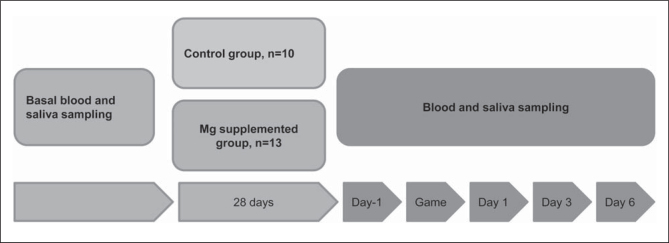
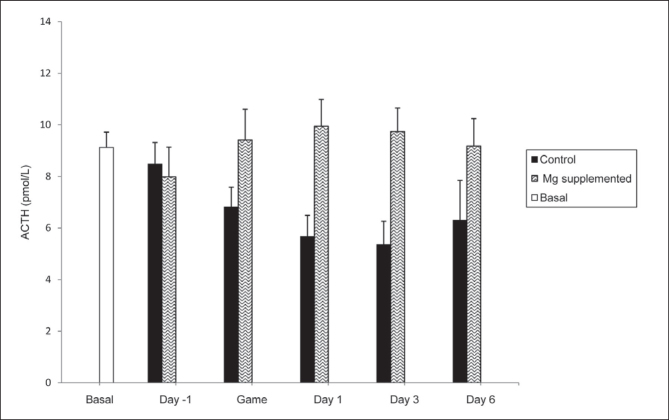
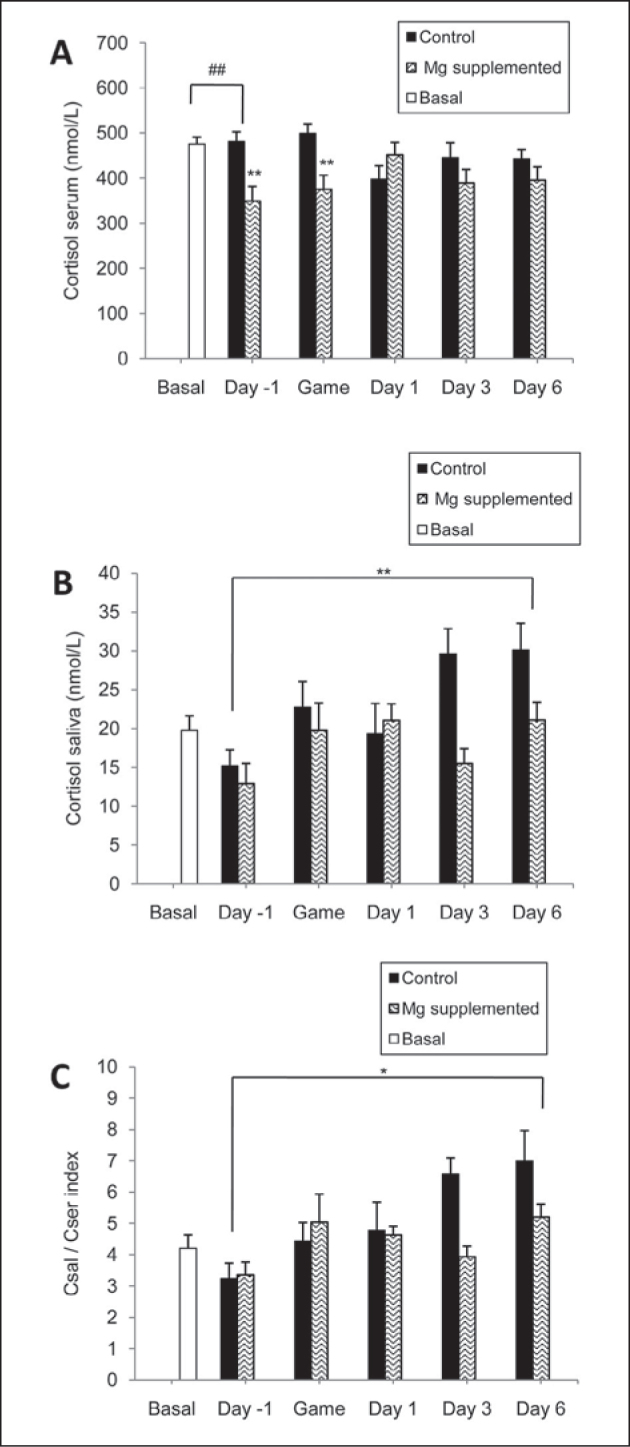
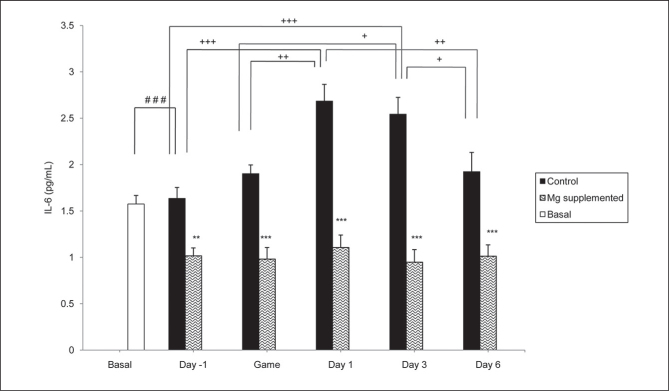
BACKGROUND: Physical exercise activates the hypothalamo-pituitary-adrenal (HPA) axis and induces the body's inflammatory response. Due to contemporary dietary habits and increased energy expenditure, athletes are susceptible to depletion of magnesium ions. The aim of our study was to investigate, through assessment of plasma ACTH, serum IL-6, and salivary/serum cortisol levels, if chronic magnesium supplementation might reduce damaging stress effects in amateur rugby players. METHODS: Rugby players (N=23) were randomly assigned to intervention and control group. Basal samples were collected before intervention group started a 4-week-long supplementation with magnesium (500 mg Mg/d). Blood and saliva sampling were done a day before the match (Day-1), on the morning of competition (Game), and during a six-day-long recovery period (Day1, Day3 and Day6). ACTH, serum/salivary cortisol, IL-6 and total/differential leukocytes counts were determined at each time point. RESULTS: There was a statistically significant increase in ACTH concentration in intervention group compared to control group, while reductions in cortisol concentrations between the two groups were the greatest at Day-1 (p < 0.01) and at the day of competition (Game) (p < 0.01). Our results revealed that magnesium completely abolished the increase in IL-6 level noted in control group on Day1 and Day3 vs. Day-1 (p < 0.01) and also diminished the rise in neutrophil/lymphocyte ratio in intervention group vs. control group (p < 0.01). CONCLUSIONS: These results suggest the possibly important influence magnesium supplementation might have on the change of parameters of HPA axis activity and reduction of immune response activation following strenuous physical exercise such as a rugby game.
Overview
The claims and statistics of this paper haven’t been checked yet.
Free: it reads the open-access text and checks the first 5 claims that cite a source we can check. Create a free account to check every claim.
Integrity signals
Registry
Cites
Statistics
Figures
Verification
Claims the paper makes
The claims and statistics of this paper haven’t been checked yet.
Free: it reads the open-access text and checks the first 5 claims that cite a source we can check. Create a free account to check every claim.
Claims other papers make about this one
Each is checked against this paper’s own text: does it say what the citing paper says it does?
The source backs part of the claim, not all of it — or backs it for a different population, condition or comparison.
In the citing paper
“Four weeks of 500 mg·day−1 of Mg in an amateur rugby union ameliorated the exercise-induced increase in IL-6 (a marker of systemic inflammation), reduced white blood cell count, neutrophils percentage, post-game cortisol, increased adrenocorticotropic hormone and lymphocytes percentage, compared to controls [104].”
From The Role of Mineral and Trace Element Supplementation in Exercise and Athletic Performance: A Systematic Review (2019) · cites this paper as [104]
Experimental — accuracy not yet measuredIn the citing paper
“This is reflected in the general trend for higher doses to have more positive results [103,104] than lower doses [105,106,107,108].”
From The Role of Mineral and Trace Element Supplementation in Exercise and Athletic Performance: A Systematic Review (2019) · cites this paper as [104]
Self-check
Percentages, sums and reported differences re-computed from the paper’s own numbers.
The self-check needs the paper’s full text.
Citations
Cites
The systemic inflammation-based neutrophil–lymphocyte ratio: Experience in patients with cancer
Guthrie, G. J. K., Charles, K. A., Roxburgh, C. S. D., Horgan, P. G., McMillan, D. C., & Clarke, S. J. (2013) · Critical Reviews in Oncology/Hematology · doi:10.1016/j.critrevonc.2013.03.010 · Cited by 1,552 · cited 1×
“One of the earlier studies (7) showed that the neutro phil/ lymphocyte ratio, which has been presumed to be an excellent marker of the systemic inflammatory res ponse (8), increases after prolonged intensive exercise.”
BackgroundImmune function in sport and exercise
Gleeson, M. (2007) · Journal of Applied Physiology · doi:10.1152/japplphysiol.00008.2007 · Cited by 1,016 · cited 1×
“It is well documented that IL-6, whose synthesis is a part of normal physiological response to exercise (4), modulates stress response and has the ability to activate the HPA axis at its various levels: through stimulation of cortisol release from the adrenal glands, and through its influence on the hypothalamus, stim…”
BackgroundRole of Magnesium in Genomic Stability
Hartwig, A. (2001) · Mutation Research - Fundamental and Molecular Mechanisms of Mutagenesis · doi:10.1016/s0027-5107(01)00074-4 · Cited by 625 · cited 1×
“It is proved that Mg diminishes susceptibility to oxidative stress and is important in DNA stabilization (34).”
BackgroundMeasuring cortisol in human psychobiological studies
Levine, A., Zagoory-Sharon, O., Feldman, R., Lewis, J. G., & Weller, A. (2007) · Physiology & Behavior · doi:10.1016/j.physbeh.2006.08.025 · Cited by 472 · cited 1×
“It is well known that only 3–10% of total circulating cortisol is in the free unbound state, whereas the majority of the remaining cortisol binds with high affinity to cortisol binding globulin (CBG), and some 10–15% with low affinity to albumin (22).”
BackgroundMagnesium Decreases Inflammatory Cytokine Production: A Novel Innate Immunomodulatory Mechanism
Sugimoto, J., Romani, A. M., Valentin-Torres, A. M., Luciano, A. A., Ramirez Kitchen, C. M., Funderburg, N., Mesiano, S., & Bernstein, H. B. (2012) · The Journal of Immunology · doi:10.4049/jimmunol.1101765 · Cited by 368 · cited 1×
“(28) showed that MgSO4 supplementation increases IkBa levels, leading to reduced NF-kB activation and decrease in IL-6 and TNF-a cytokine production both in vitro and in vivo.”
Update on the relationship between magnesium and exercise.
Nielsen, F. H., & Lukaski, H. C. (2006) · PubMed · Cited by 250
Magnesium, zinc, and chromium nutriture and physical activity
Lukaski, H. C. (2000) · The American Journal of Clinical Nutrition · doi:10.1093/ajcn/72.2.585s · Cited by 209 · cited 2×
“Magnesium is a physiological regulator of membrane stability and is involved in neuromuscular transmission, immune, hormonal and cardiovascular function (2).”
BackgroundTime course of changes in immuneoendocrine markers following an international rugby game
Cunniffe, B., Hore, A. J., Whitcombe, D. M., Jones, K., Baker, J. S., & Davies, B. (2009) · European Journal of Applied Physiology · doi:10.1007/s00421-009-1200-9 · Cited by 184 · cited 1×
“Studies conducted on different populations showed significant elevation of post-exercise IL-6 levels: both in athletes, especially after 24 hours after the game played (23), as well in physically active volunteers who were not accustomed to high-intensity exercise (24).”
BackgroundMagnesium and Affective Disorders
Murck, H. (2002) · Nutritional Neuroscience · doi:10.1080/1028415021000039194 · Cited by 157 · cited 1×
“It was shown that Mg ion has N-methyl-D-aspartate (NMDA)antagonistic and gamma-aminobutyric acid (GABA)agonistic properties (19) and, thus, its elevation could contribute to reducing the level of anxiety.”
BackgroundVeronese, N., Berton, L., Carraro, S., Bolzetta, F., De Rui, M., Perissinotto, E., Toffanello, E. D., Bano, G., Pizzato, S., Miotto, F., et al. (2014) · The American Journal of Clinical Nutrition · doi:10.3945/ajcn.113.080168 · Cited by 154
Cited by
Heffernan, S. M., Horner, K., De Vito, G., & Conway, G. E. (2019) · Nutrients · doi:10.3390/nu11030696 · Cited by 130
Combating COVID-19 and Building Immune Resilience: A Potential Role for Magnesium Nutrition?
Wallace, T. C. (2020) · Journal of the American College of Nutrition · doi:10.1080/07315724.2020.1785971 · Cited by 111
Lopresti, A. L., Smith, S. J., & Drummond, P. D. (2021) · Nutritional Neuroscience · doi:10.1080/1028415x.2021.1892253 · Cited by 50
“This includes omega-3 fatty acids [92], magnesium [93],”
BackgroundSteward, C. J., Zhou, Y., Keane, G., Cook, M. D., Liu, Y., & Cullen, T. (2019) · European Journal of Applied Physiology · doi:10.1007/s00421-019-04238-y · Cited by 31
The Effect of Exercise on the Hypothalamic-Pituitary-Adrenal Axis
St-Pierre, D. H., & Richard, D. (2020) · Contemporary Endocrinology · doi:10.1007/978-3-030-33376-8_3 · Cited by 28
Training vs. Competition in Sport: State Anxiety and Response of Stress Hormones in Young Swimmers
Páez, L. C., & Martínez-Díaz, I. C. (2021) · Journal of Human Kinetics · doi:10.2478/hukin-2021-0087 · Cited by 26
“These results are consistent with those reported by Dmitrasinovic et al. (2016) who also found no differences in ACTH levels measured in both baseline and precompetitive status in a group of amateur rugby players.”
ResultPetrović, J., Stanić, D., Bulat, Z., Puškaš, N., Labudović‐Borović, M., Batinić, B., Mirković, D., Ignjatović, S., & Pešić, V. (2018) · Hormones and Behavior · doi:10.1016/j.yhbeh.2018.07.003 · Cited by 22
“HPA axis and showed that Mg supplementation can attenuate HPA axis hyperactivity in healthy individuals (Zogović et al., 2014; Dmitrašinović et al., 2016).”
Self-citationKhalil, R. B., Risch, N., Sleilaty, G., Richa, S., Sénèque, M., Lefebvre, P., Sultan, A., Avignon, A., Maïmoun, L., Renard, É., et al. (2022) · Eating and Weight Disorders - Studies on Anorexia Bulimia and Obesity · doi:10.1007/s40519-022-01372-z · Cited by 18
“Some preclinical and clinical studies demonstrated that NLR may increase with HPA axis activation and hypercortisolemia [17, 66, 67].”
BackgroundTalebi, S., Miraghajani, M. S., Hosseini, R., & Mohammadi, H. (2021) · Biological Trace Element Research · doi:10.1007/s12011-021-02783-2 · Cited by 17
Córdova, A., Mielgo-Ayuso, J., Roche, E., Caballero-García, A., & Fernandez-Lázaro, D. (2019) · Nutrients · doi:10.3390/nu11081927 · Cited by 16
Ahmed, M. H., Wilkens, M. R., Ganter, M., & Breves, G. (2020) · Research in Veterinary Science · doi:10.1016/j.rvsc.2020.11.016 · Cited by 15
Salivary cortisol as a biomarker of stress in surgical patients
Vicković, S., Zdravković, R., Maričić-Prijić, S., Nikolić, D., Pap, D., Čolak, E., & Jovičić, S. Ž. (2023) · Journal of Medical Biochemistry · doi:10.5937/jomb0-42011 · Cited by 14
Inflammatory Response 24 h Post-Exercise in Youth with Juvenile Idiopathic Arthritis
Rochette, E., Merlin, É., Hourdé, C., Evrard, B., Peraira, B., Echaubard, S., & Duché, P. (2018) · International Journal of Sports Medicine · doi:10.1055/a-0640-9063 · Cited by 10
Saxena, A., Prabhudesai, K. S., Damle, A., Ramakrishnan, S., Durairaj, P., Kalankariyan, S., Vijayalakshmi, A. B., & Venkatesh, K. V. (2024) · Scientific Reports · doi:10.1038/s41598-024-60112-8 · Cited by 9
“Another study focused on plasma Adrenocorticotropic hormone (ACTH), IL-6, and cortisol levels to determine if magnesium supplementation might reduce damaging stress effects 43 .”
BackgroundLopresti, A. L., Smith, S. J., Metse, A. P., Foster, T. J., & Drummond, P. D. (2020) · Journal of Evidence-Based Integrative Medicine · doi:10.1177/2515690x20937997 · Cited by 9
Pre-exposure and Post-exposure new prophylactic treatments against COVID-19 in healthcare workers
Benarba, B., & Gouri, A. (2020) · The North African Journal of Food and Nutrition Research · doi:10.51745/najfnr.4.7.260-267 · Cited by 7
Suplementação com magnésio sobre a performance de atletas: uma revisão sistemática
Melo, S. R. D. S., dos Santos, L. R., Silva, T. M., Cardoso, B. E. P., de Araújo, D. S. C., de Sousa, T. G. V., Sousa, M. D. P., Severo, J. S., & Marreiro, D. D. N. (2020) · Research Society and Development · doi:10.33448/rsd-v9i1.1754 · Cited by 7
Nechifor, M. (2024) · Journal of Trace Elements and Minerals · doi:10.1016/j.jtemin.2024.100194 · Cited by 5
Sleep, nutrition, and supplements: Implications for athletes
Charest, J., & Grandner, M. A. (2024) · Elsevier eBooks · doi:10.1016/b978-0-12-822969-9.00002-x · Cited by 5
Magnesium and vitamin B2 supplementation is an important nutritional resource of sports medicine
Громова, О. А., Torshin, I. Y., Sorokina, M. A., & Gromov, A. N. (2019) · Meditsinskiy sovet = Medical Council · doi:10.21518/2079-701x-2018-21-216-230 · Cited by 4
Yook, J. S., Kwak, J.-J., Jeong, W.-M., Song, Y. H., Hijioka, Y., Honda, Y., Kim, S. E., & Ha, M. (2020) · Journal of Clinical Biochemistry and Nutrition · doi:10.3164/jcbn.20-96 · Cited by 3
“(34) Similarly, in this study, there was a trend toward lower levels of cortisol and ACTH during exercise after the intake of MCE (Fig.”
COVID-19 Pandemic and Immune Boost Up: The Synergistic Role of Nutrients
Huq, A. K. O., Uddin, I., Islam, M. T., Ahmed, E., Siddique, M. A. B., Rahim, A. N. M. B., Talukder, M. U., Nigar, S., Abedin, N., & Arjoo, M. (2021) · Current Research in Nutrition and Food Science Journal · doi:10.12944/crnfsj.9.3.04 · Cited by 3
IL-6 Does Not Influence the Expression of SLC41A1 and Other Mg-Homeostatic Factors
Brodňanová, M., Cibulka, M., Grendár, M., Gondáš, E., & Kolísek, M. (2024) · International Journal of Molecular Sciences · doi:10.3390/ijms252413274 · Cited by 3
Şahin, K., Yabas, M., Orhan, C., Er, B., Ozmen, R., Tokmak, M., Tuzcu, M., Önderci, M., Küçükgül, A., Özercan, İ. H., et al. (2025) · British Journal Of Nutrition · doi:10.1017/s0007114525105734 · Cited by 1
“In addition, long-term Mg supplementation may lead to changes in pituitary-gonadal and pituitary-adrenocortical hormonal status (52) .”
Estrés biológico y psicológico en deportistas con ingesta de una dieta rica en antioxidantes.
Díaz, E., & Adriana, S. (2019) · El Repositorio Academico Digital de la UANL (Universidad Autónoma de Nuevo León)
Supplements That Affect Cortisol Concentrations during High Intensity Exercise
Pelehach, S. (2020) · OpenCommons - UConn (University of Connecticut)
الحفنی, د. ح. ف. ا. م. (2019) · المجلة العلمیة للتربیة البدنیة وعلوم الریاضة جامعة حلوان · doi:10.21608/jsbsh.2019.223489
Thomson, T., Fikes, K. K., Anderson, M. J., Wagner, A. L., Girard, I. D., & Suagee-Bedore, J. K. (2023) · Journal of Equine Veterinary Science · doi:10.1016/j.jevs.2023.104828
Impact des psychotraumatismes sur l’expression des troubles du comportement alimentaire
Khalil, R. B. (2022) · theses.fr (ABES) · doi:10.70675/566cb9c2z9b27z43f4z835ez485efc4596c8
Coates, A. M., Patel, D. V., Binet, E. R., & Gibala, M. J. (2025) · International Journal of Sport Nutrition and Exercise Metabolism · doi:10.1123/ijsnem.2025-0034 · Cited by 1
Consumo de magnesio y estrés en estudiantes universitarios de Lima Metropolitana, 2023
Espino Baca, A. J. (2023) · Repositorio Institucional USIL (Universidad San Ignacio de Loyola)
Petrović, J. (2021) · FarFar - Pharmacy Repository
Đurić, V. (2023) · FarFar - Pharmacy Repository
Vpliv okoljskega in psihološkega stresa na serumsko koncentracijo magnezija in cinka v telesu
Jugovic, T. (2024) · Repository of the University of Primorsk (University of Primorska)
Emerging Therapeutic Approaches for Tic Alleviation in Tourette Syndrome: The Role of Micronutrients
Madireddy, S., & Madireddy, S. (2025) · Neurology International · doi:10.3390/neurolint18010007
Evaluación del efecto del consumo de suplementos de magnesio en el rendimiento deportivo
Cortés, D. O. P., Quechulpa, A. J. V., Ortega, J. A. A., García, E. A., Polo, A. O., & Delgado‐Olivares, L. (2026) · Educación y Salud Boletín Científico Instituto de Ciencias de la Salud Universidad Autónoma del Estado de Hidalgo · doi:10.29057/icsa.v14i28.16572
Klein, E., Velina, D. A., Mutallibzoda, S., Тефикова, С. Н., Orlovtseva, O., Lebedeva, N. N., & Никитин, И. А. (2026) · Nutrients · doi:10.3390/nu18193134
“In studies where a positive effect of magnesium on stress reactivity was observed, daily doses reached 500 mg of elemental magnesium [70], while the effects of vitamin C on cortisol are registered at dosages of approximately 500–1000 mg [16,73,74].”
InfluentialMekanisme Suplementasi Magnesium Glycinate Sebagai Terapi Adjuvan pada Pasien Depresi
Prihandini, A., & Kurnia, J. A. (2025) · JOURNAL SCIENTIFIC OF MANDALIKA (JSM) · doi:10.36312/jomla.v6i11.5407
Metadata
- Authors
- Dmitrašinović, G., Pešić, V., Stanić, D., Plećaš-Solarović, B., Dajak, M., & Ignjatović, S.
- Affiliations
- University of Belgrade (RS)
- Univerzitetski Klinički Centar Srbije (RS)
- Corresponding author
- Dmitrašinović, Gordana
- Venue
- Journal of Medical Biochemistry
- Published
- 2016-10-01
- Volume
- 35
- Issue
- 4
- Pages
- 375-384
- ISSN
- 1452-8266 (ISSN-L)
- PMC
- PMC5471632
- OpenAlex
- W2437988390
- Cited by
- 27
- References
- 34
- Citations by year
- 2026: 1 · 2025: 2 · 2024: 4 · 2023: 2 · 2022: 1 · 2021: 4 · 2020: 6 · 2019: 5 · 2018: 2
- FWCI
- 2.44
- Type
- journal article
- Language
- en
- Open access
- diamond
- doi.org
- Licence
- Locations
- Journal of Medical Biochemistry (publishedVersion, cc-by-nc-nd)
- PubMed Central (publishedVersion, cc-by-nc-nd)
- PubMed (publishedVersion)
- SCIndeks (publishedVersion, other-oa)
- DOAJ (DOAJ: Directory of Open Access Journals) (submittedVersion, cc-by-sa)
- DOAJ (DOAJ: Directory of Open Access Journals) (submittedVersion)
- FarFar (University of Belgrade, Faculty of Chemistry (Belgrade, Serbia)) (submittedVersion, other-oa)
- Topics
- Health Sciences › Nursing › Nutrition and Dietetics › Magnesium in Health and Disease
- Health Sciences › Medicine › Physiology (medical) › Exercise and Physiological Responses
- Life Sciences › Neuroscience › Behavioral Neuroscience › Stress Responses and Cortisol
- Keywords
- magnesium supplementation, ACTH, cortisol, interleukin-6, hypothalamic-pituitary-adrenal axis, rugby players, athletes, exercise-induced inflammation, neutrophil-to-lymphocyte ratio, salivary cortisol, white blood cell count, acute exercise stress
About these checks
Registry, retraction, Cites and statistics results are computed, not judged, with one exception: a printed reference that no index lists is read once by a model before it counts as a citation error. Claims are extracted by a model and kept only when their quote appears verbatim in the text; each cited source is then checked, with a model’s help, for whether it says what the claim relies on. Those verdicts can be wrong — read the claim’s quote and the cited source before relying on one.
Statistics and arithmetic are recomputed, not judged.
Confidence bands are shown only for fields calibrated on our annotated test set. None is calibrated yet, so no band is shown.
What counts as a claim ›How we measure confidence ›How we check this ›
Are you an author, or do you see a problem with this page? Request a review
Data sources
Bibliographic data: Semantic Scholar, OpenAlex, Crossref.
Contains information from the Semantic Scholar Academic Graph Datasets, made available under the ODC Attribution License (ODC-BY 1.0).
Semantic Scholar’s data is described in: Kinney, R., et al. (2023). The Semantic Scholar Open Data Platform. arXiv:2301.10140.
