

Neural mechanisms underlying state mental fatigue: a systematic review and activation likelihood estimation meta-analysis
Open accessThe DOI matches its Crossref record; 134 of the 134 references it cites were found in a registry or an index; none of the 150 sources its claims cite is checked for support yet.
Abstract
Sustained performance of cognitive tasks could lead to the development of state mental fatigue characterized by subjective sensation of mental weariness and decrease in cognitive performance. In addition to the occupational hazards associated with mental fatigue, it can also affect physical performance reducing endurance, balance, and sport-specific technical skills. Similarly, mental fatigue is a common symptom in certain chronic health conditions such as multiple sclerosis affecting quality of life of the patients. Despite its widely acknowledged negative impact, the neural mechanisms underlining this phenomenon are still not fully understood. We conducted a systematic review and activation likelihood estimation (ALE) meta-analysis of functional neuroimaging studies investigating the effect of mental fatigue due to time-on-task (TOT) on brain activity to elucidate the possible underlying mechanisms. Studies were included if they examined change in brain activity induced by experimental mental fatigue (TOT effect) or investigated the relationship between brain activity and subjective mental fatigue due to TOT. A total of 33 studies met the review’s inclusion criteria, 13 of which were included in meta-analyses. Results of the meta-analyses revealed a decrease in activity with TOT in brain areas that constitute the cognitive control network. Additionally, an increased activity with TOT, as well as negative relationship with subjective mental fatigue was found in parts of the default mode network of the brain. The changes in cognitive control and the default mode networks of the brain due to state mental fatigue observed in this study were discussed in relation to the existing theories of mental fatigue.
Overview
CoChat Summary
TL;DR
This systematic review and activation likelihood estimation (ALE) meta-analysis synthesized functional neuroimaging studies of state mental fatigue induced by time-on-task (TOT). It found decreased activity in cognitive control network regions and increased activity in parts of the default mode network, with subjective mental fatigue negatively related to default mode network activity, interpreted through the “neurotoxic waste disposal” theory.
Key findings
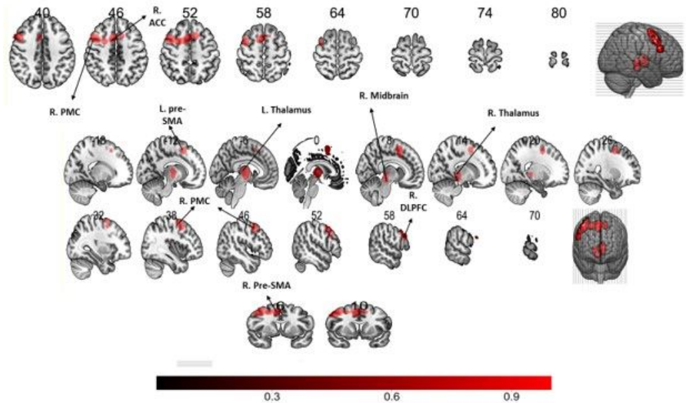
- The review included 33 studies; 13 were included in ALE meta-analyses. The TOT meta-analysis (7 studies; 132 participants) found decreased activity with mental fatigue in cognitive control network areas: right middle/superior frontal gyri (BA6, dorsal/ventral premotor), right middle frontal gyrus (BA9, DLPFC), bilateral medial frontal gyri (BA6, pre-SMA), right medial frontal gyrus (BA32, ACC), and bilateral thalamus/right midbrain red nucleus.
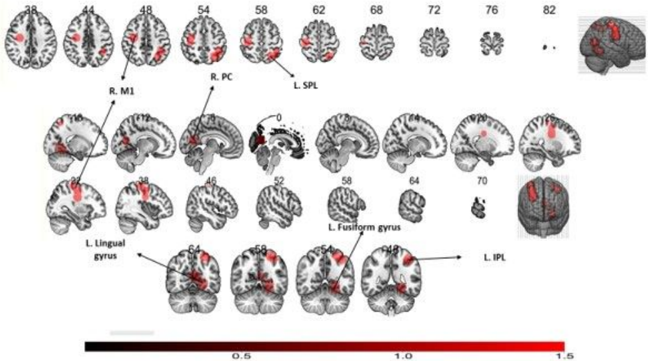
- Increased activity with TOT (3 studies; 34 participants) converged in left lingual gyrus (BA19), left fusiform gyrus (BA37), left posterior cingulate (BA30), left superior parietal lobule (BA7), left inferior parietal lobule (BA40), and right precentral gyrus (BA4, primary motor cortex).
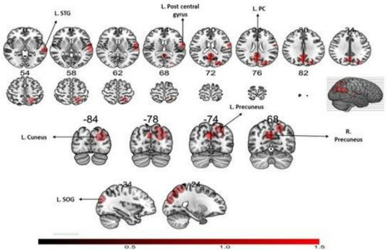
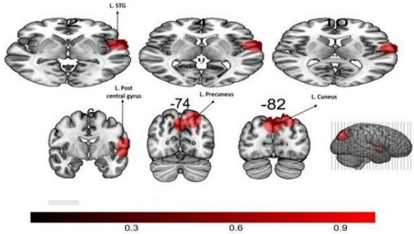
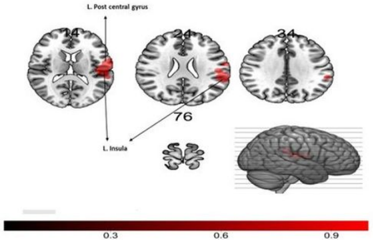
- For subjective mental fatigue, no significant convergence was found for positive relationships with brain activity. Negative relationships in healthy participants (5 studies; 17 foci; 84 participants) converged in left precuneus (BA7/31), left superior occipital gyrus (BA19), left cuneus (BA18), left posterior cingulate (BA30), left postcentral gyrus (BA43), and left superior temporal gyrus (BA22); low-load tasks also showed left postcentral gyrus (BA43) and left insula (BA13/40). Patient-group negative relationships converged in left precuneus (BA7), cuneus (BA19), postcentral gyrus (BA43), and superior temporal gyrus.
- Narrative synthesis of fNIRS and TMS studies showed mixed findings: fNIRS studies reported no significant change, increased, or decreased prefrontal activity with TOT; TMS studies reported increased M1 corticospinal excitability from 15 minutes onward in one study and decreased excitability in the 9th and 10th sets in another.
Methods
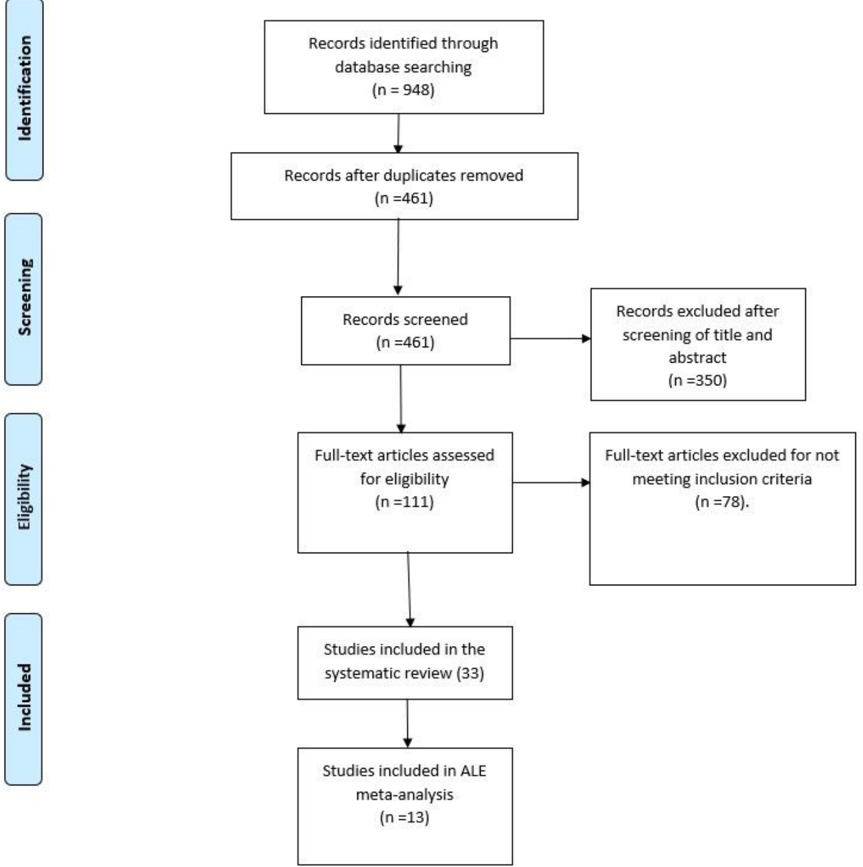
- PRISMA systematic review; databases Medline, EMBASE, Cochrane CENTRAL, Scopus, PubMed, CINAHL Plus, and PsycINFO were searched from inception until July 2021. Studies were included if they experimentally induced mental fatigue with a cognitive task and measured brain activity with fMRI, PET, fNIRS, or TMS, or examined relationships between brain activity and subjective mental fatigue. Exclusions included physical fatigue, questionnaire-only trait mental fatigue, pharmacological/sleep-deprivation interventions, and functional connectivity studies.
- ALE meta-analysis used GingerALE 3.0.2 in MNI space, with separate analyses for decreased and increased activation with TOT and for positive and negative correlations with subjective mental fatigue. Cluster-level family-wise error thresholding was set at p<0.05, voxel-level p<0.05, and 1,000 permutations. fMRI/PET studies were included if they reported whole-brain or small-volume-corrected results, standard coordinates, and TOT-related cognitive performance deterioration; studies showing improvement with TOT, ROI-only analyses, or no coordinates were excluded.
- The 33 included studies comprised 23 fMRI/PET studies (21 fMRI, 2 PET), 8 fNIRS studies, and 2 TMS studies. Cognitive task duration ranged from 10–110 minutes (median 26.5 minutes). The TOT ALE included 7 studies (132 participants; 56 decreased-activation foci and 15 increased-activation foci from 3 studies/34 participants); the correlation ALE included 6 studies.
Limitations
- The paper states that the number of included fNIRS and TMS studies was small and meta-analysis was not possible mainly due to lack of descriptive data; the number of studies in the ALE meta-analysis was also small, which may lower power; and different cognitive tasks and task durations may affect individual study effects.
- The paper states that most data leading to the conclusion came from healthy populations, so findings may not be extrapolated to patient groups, and further studies are needed.
- The text makes evident that fNIRS/TMS findings were mixed and that objective mental fatigue could not be ascertained in many of those studies because cognitive performance change was unreported or nonsignificant; the TOT ALE analysis included only healthy participants.
Model-written summary. Check it against the paper before relying on it.
Integrity signals
Registry
Cites
Statistics
Figures
Verification
Claims the paper makes
0 Valid · 0 Not valid · 75 Not checked · 71 Own results and interpretations
A result the paper reports from its own data — it cites no other source for it, so there is none to check. The quote shows it is in the paper.
In the paper
“Results of the meta-analyses revealed a decrease in activity with TOT in brain areas that constitute the cognitive control network.”
§ Neural mechanisms underlying state mental fatigue: a systematic review and activation likelihood estimation meta-analysis > Abstract
plainstates an association- Asserted: passes — The authors put it forward as true.
- Checkable: passes — It can be checked against evidence.
- Load-bearing: passes — The paper’s conclusions depend on it.
- Based: passes — The paper gives a reason why it holds.
- Rests on an assumption not shown here.
A result the paper reports from its own data — it cites no other source for it, so there is none to check. The quote shows it is in the paper.
In the paper
“In contrast, analysis considering the negative relationship between subjective mental fatigue and brain activity revealed signi cant convergence across studies in mainly the left lateralized parieto-occipital areas including precuneus (BA7), Cuneus (BA19), postcentral gyrus (BA43) and superior temporal gyrus (Fig 3c & Table 5c).”
§ Neural mechanisms underlying state mental fatigue: a systematic review and activation likelihood estimation meta-analysis > Effect of mental fatigue on brain activity (time-on-task effect)
plainstates an associationn = 78- Asserted: passes — The authors put it forward as true.
- Checkable: passes — It can be checked against evidence.
- Load-bearing: passes — The paper’s conclusions depend on it.
- Based: passes — The paper gives a reason why it holds.
None of the sources cited for this claim have been checked yet.
In the paper
“Eight studies used fNIRS to investigate the effect of mental fatigue due to TOT on different markers of brain activity (oxygenated haemoglobin concentration, deoxygenated haemoglobin concentration, cerebral oxygen exchange, oxygen saturation and total haemoglobin concentration) in the prefrontal cortex and other parts of the brain [80-87].”
§ Neural mechanisms underlying state mental fatigue: a systematic review and activation likelihood estimation meta-analysis > Functional near-infrared spectroscopy studies
What the sources say
- Not checked yetcites [80] Mantua J et al (2019) Sleep extension reduces fatigue in healthy, normally-sleeping young adults. Sleep Sci 12(1):21 source
- Not checked yetcites [81] Marcora SM, Staiano W, Manning V (2009) Mental fatigue impairs physical performance in humans. J Appl Physiol 106(3):857- 864 source
- Not checked yetcites [82] Matuz, A., van der Linden, D., Kisander, Z., Hernádi, I., Kázmér, K., and Csathó, Á. (2021). Enhanced cardiac vagal tone in mental fatigue: analysis of heart rate variability in time-on-task, recovery, and reactivity. PLoS One 16: 0238670, https://doi.org/10.1371/journal.pone.0238670. source
- Not checked yetcites [83] Meijman TF (1997) Mental fatigue and the e ciency of information processing in relation to work times. Int J Ind Ergon 20(1):31-38 source
- Not checked yetcites [84] Mishkin, M., Ungerleider, L.G., and Macko, K.A. (1983). Object vision and spatial vision: two cortical pathways. Trends Neurosci. 6: 414–417, https://doi.org/10.1016/0166-2236(83)90190-x. source
- Not checked yetcites [85] Moeller S et al (2012) Dopaminergic involvement during mental fatigue in health and cocaine addiction. Translational psychiatry 2(10):e176-e176 source
- Not checked yetcites [86] Moher D et al (2009) Reprint-preferred reporting items for systematic reviews and meta-analyses: the PRISMA statement. Phys Ther 89(9):873-880 source
- Not checked yetcites [87] Molden DC et al (2012) Motivational versus metabolic effects of carbohydrates on self-control. Psychol Sci 23(10):1137-1144 114. source
plain- Asserted: passes — The authors put it forward as true.
- Checkable: passes — It can be checked against evidence.
- Load-bearing: unclear — It is unclear whether the paper’s conclusions depend on it.
- Based: passes — The paper gives a reason why it holds.
None of the sources cited for this claim have been checked yet.
In the paper
“However, while areas of the cognitive control network including the anterior cingulate cortex, dorsolateral prefrontal cortex, dorsal pre-motor cortex and pre-supplementary motor area [89, 97] were found to show decreased activity with TOT in this review”
§ Neural mechanisms underlying state mental fatigue: a systematic review and activation likelihood estimation meta-analysis > Discussion
What the sources say
- Not checked yetcites [89] Nakagawa S et al (2013) Compensatory effort parallels midbrain deactivation during mental fatigue: an fMRI study. PLoS ONE 8(2):e56606 source
- Not checked yetcites [97] Paus T et al (1997) Time-related changes in neural systems underlying attention and arousal during the performance of an auditory vigilance task. J Cogn Neurosci 9(3):392-408 source
plainstates an association- Asserted: passes — The authors put it forward as true.
- Checkable: passes — It can be checked against evidence.
- Load-bearing: passes — The paper’s conclusions depend on it.
- Based: passes — The paper gives a reason why it holds.
None of the sources cited for this claim have been checked yet.
In the paper
“Among the studies that evaluated effect of mental fatigue due to TOT on brain activity, two studies found no signi cant change in prefrontal cortex, inferior parietal cortex and middle temporal gyrus activity [80, 87] (Table 3a).”
§ Neural mechanisms underlying state mental fatigue: a systematic review and activation likelihood estimation meta-analysis > Functional near-infrared spectroscopy studies
What the sources say
- Not checked yetcites [80] Mantua J et al (2019) Sleep extension reduces fatigue in healthy, normally-sleeping young adults. Sleep Sci 12(1):21 source
- Not checked yetcites [87] Molden DC et al (2012) Motivational versus metabolic effects of carbohydrates on self-control. Psychol Sci 23(10):1137-1144 114. source
plain- Asserted: passes — The authors put it forward as true.
- Checkable: passes — It can be checked against evidence.
- Load-bearing: unclear — It is unclear whether the paper’s conclusions depend on it.
- Based: passes — The paper gives a reason why it holds.
71 more claims
Create a free account to see all 146 claims and to verify the 150 references still open.
- Probably not a substantial claim. 36
- It may state two separate claims as one. 40
- The quote only partly states this claim. 6
Self-check
Percentages, sums and reported differences re-computed from the paper’s own numbers.
Each contradiction between two passages listed here was confirmed by an independent check.
Rated minor: it would not touch a result — a value no result rests on, a p-value that stays on the same side of the significance level, or a conflict that is clerical, resolved elsewhere in the paper, or outside its own findings.
In the paper
“Sixteen studies examined change in brain activity due to mental fatigue by comparing the brain activity at the beginning and the end parts of the task or by monitoring the change in brain activity across task duration.Seven of these studies (all involving healthy participants) were included in the ALE meta-analysis [42, 62-65, 70, 71].”
§ Neural mechanisms underlying state mental fatigue: a systematic review and activation likelihood estimation meta-analysis > Effect of mental fatigue on brain activity (time-on-task effect)
Reported 16 · recomputed 15
Rated minor: it would not touch a result — a value no result rests on, a p-value that stays on the same side of the significance level, or a conflict that is clerical, resolved elsewhere in the paper, or outside its own findings.
In the paper
§ Neural mechanisms underlying state mental fatigue: a systematic review and activation likelihood estimation meta-analysis > Effect of mental fatigue on brain activity (time-on-task effect)
“including precuneus (BA7), Cuneus (BA19), postcentral gyrus (BA43) and superior temporal gyrus”
§ Neural mechanisms underlying state mental fatigue: a systematic review and activation likelihood estimation meta-analysis > Conclusion
“1 Occipital lobe (cuneus) L 7 5.187128 1.07E-07 0.013523 -22 -74 48 1 Parietal lobe (Precuneus) L 19 3.326473 4.40E-04 0.006939 0 -82 38”
Citations
Cites
The Brain's Default Network: Anatomy, Function, and Relevance to Disease
Buckner, R. L., Andrews‐Hanna, J. R., & Schacter, D. L. (2008) · Annals of the New York Academy of Sciences · doi:10.1196/annals.1440.011 · Cited by 9,761
Sleep Drives Metabolite Clearance from the Adult Brain
Xie, L., Kang, H., Xu, Q., Chen, M. J., Liao, Y., Thiyagarajan, M., O’Donnell, J., Christensen, D. J., Nicholson, C., Iliff, J. J., et al. (2013) · Science · doi:10.1126/science.1241224 · Cited by 5,411
Object vision and spatial vision: Two cortical pathways
Mishkin, M., Ungerleider, L. G., & Macko, K. A. (1983) · Trends in Neurosciences · doi:10.1016/0166-2236(83)90190-x · Cited by 2,947
Reprint—Preferred Reporting Items for Systematic Reviews and Meta-Analyses: The PRISMA Statement
Moher, D., Liberati, A., Tetzlaff, J., Altman, D. G., & and the PRISMA Group (2009) · Physical Therapy · doi:10.1093/ptj/89.9.873 · Cited by 2,486
The expected value of control: an integrative theory of anterior cingulate cortex function
Shenhav, A., Botvinick, M. M., & Cohen, J. D. (2013) · Neuron · doi:10.1016/j.neuron.2013.07.007 · Cited by 2,321
Eickhoff, S. B., Laird, A. R., Grefkes, C., Wang, L. E., Zilles, K., & Fox, P. T. (2009) · Human Brain Mapping · doi:10.1002/hbm.20718 · Cited by 1,924
Effect of Reducing Interns' Work Hours on Serious Medical Errors in Intensive Care Units
Landrigan, C. P., Rothschild, J. M., Cronin, J. W., Kaushal, R., Burdick, E., Katz, J. T., Lilly, C. M., Stone, P. H., Lockley, S. W., Bates, D. W., et al. (2004) · New England Journal of Medicine · doi:10.1056/nejmoa041406 · Cited by 1,760
Niendam, T. A., Laird, A. R., Ray, K. L., Dean, Y. M., Glahn, D. C., & Carter, C. S. (2012) · Cognitive, Affective, & Behavioral Neuroscience · doi:10.3758/s13415-011-0083-5 · Cited by 1,700
Default-mode brain dysfunction in mental disorders: A systematic review
Broyd, S. J., Demanuele, C., Debener, S., Helps, S. K., James, C. J., & Sonuga-Barke, E. J. S. (2009) · Neuroscience & Biobehavioral Reviews · doi:10.1016/j.neubiorev.2008.09.002 · Cited by 1,675
Activation likelihood estimation meta-analysis revisited
Eickhoff, S. B., Bzdok, D., Laird, A. R., Kurth, F., & Fox, P. T. (2012) · NeuroImage · doi:10.1016/j.neuroimage.2011.09.017 · Cited by 1,443
Mental fatigue impairs physical performance in humans
Marcora, S. M., Staiano, W., & Manning, V. (2009) · Journal of Applied Physiology · doi:10.1152/japplphysiol.91324.2008 · Cited by 1,442
An opportunity cost model of subjective effort and task performance
Kurzban, R., Duckworth, A., Kable, J. W., & Myers, J. (2013) · Behavioral and Brain Sciences · doi:10.1017/s0140525x12003196 · Cited by 1,381
Vigilance Requires Hard Mental Work and Is Stressful
Warm, J. S., Parasuraman, R., & Matthews, G. (2008) · Human Factors: The Journal of the Human Factors and Ergonomics Society · doi:10.1518/001872008x312152 · Cited by 1,253
Mental fatigue: Costs and benefits
Boksem, M. A. S., & Tops, M. (2008) · Brain Research Reviews · doi:10.1016/j.brainresrev.2008.07.001 · Cited by 1,099
The cognitive control network: Integrated cortical regions with dissociable functions
Cole, M. W., & Schneider, W. (2007) · NeuroImage · doi:10.1016/j.neuroimage.2007.03.071 · Cited by 1,091
The role of default network deactivation in cognition and disease
Anticevic, A., Cole, M. W., Murray, J. D., Corlett, P. R., Wang, X.-J., & Krystal, J. H. (2012) · Trends in Cognitive Sciences · doi:10.1016/j.tics.2012.10.008 · Cited by 978
Precuneus Is a Functional Core of the Default-Mode Network
Utevsky, A. V., Smith, D. V., & Huettel, S. A. (2014) · The Journal of Neuroscience · doi:10.1523/jneurosci.4227-13.2014 · Cited by 897
Dittner, A. J., Wessely, S. C., & Brown, R. G. (2004) · Journal of Psychosomatic Research · doi:10.1016/s0022-3999(03)00371-4 · Cited by 856
The Physiology of Willpower: Linking Blood Glucose to Self-Control
Gailliot, M. T., & Baumeister, R. F. (2007) · Personality and Social Psychology Review · doi:10.1177/1088868307303030 · Cited by 845
Ten simple rules for neuroimaging meta-analysis
Müller, V. I., Cieslik, E. C., Laird, A. R., Fox, P. T., Radua, J., Mataix-Cols, D., Tench, C. R., Yarkoni, T., Nichols, T. E., Turkeltaub, P. E., et al. (2018) · Neuroscience & Biobehavioral Reviews · doi:10.1016/j.neubiorev.2017.11.012 · Cited by 805
Langner, R., & Eickhoff, S. B. (2013) · Psychological Bulletin · doi:10.1037/a0030694 · Cited by 746
Eickhoff, S. B., Nichols, T. E., Laird, A. R., Hoffstaedter, F., Amunts, K., Fox, P. T., Bzdok, D., & Eickhoff, C. R. (2016) · NeuroImage · doi:10.1016/j.neuroimage.2016.04.072 · Cited by 683
Chaudhuri, A., & Behan, P. O. (2000) · Journal of the Neurological Sciences · doi:10.1016/s0022-510x(00)00411-1 · Cited by 651
Penner, I., Raselli, C., Stöcklin, M., Opwis, K., Kappos, L., & Calabrese, P. (2009) · Multiple Sclerosis Journal · doi:10.1177/1352458509348519 · Cited by 593
Conflict-induced behavioural adjustment: a clue to the executive functions of the prefrontal cortex
Mansouri, F. A., Tanaka, K., & Buckley, M. J. (2009) · Nature Reviews Neuroscience · doi:10.1038/nrn2538 · Cited by 559
Jones, B. E. (2003) · Frontiers in Bioscience · doi:10.2741/1074 · Cited by 532
Paus, T., Zatorre, R. J., Hofle, N., Caramanos, Z., Gotman, J., Petrides, M., & Evans, A. C. (1997) · Journal of Cognitive Neuroscience · doi:10.1162/jocn.1997.9.3.392 · Cited by 514
The epidemiology of fatigue: more questions than answers.
Lewis, G., & Wessely, S. (1992) · Journal of Epidemiology and Community Health · doi:10.1136/jech.46.2.92 · Cited by 498
Edlow, B. L., Takahashi, E., Wu, O., Benner, T., Dai, G., Bu, L., Grant, P. E., Greer, D. M., Greenberg, S. M., Kinney, H. C., et al. (2012) · Journal of Neuropathology & Experimental Neurology · doi:10.1097/nen.0b013e3182588293 · Cited by 497
The ironic effect of significant results on the credibility of multiple-study articles.
Schimmack, U. (2012) · Psychological Methods · doi:10.1037/a0029487 · Cited by 455
Fatigue in the U.S. Workforce: Prevalence and Implications for Lost Productive Work Time
Ricci, J. A., Chee, E., Lorandeau, A. L., & Berger, J. (2007) · Journal of Occupational and Environmental Medicine · doi:10.1097/01.jom.0000249782.60321.2a · Cited by 451
Meta-analysis of functional neuroimaging data: current and future directions
Wager, T. D., Lindquist, M., & Kaplan, L. (2007) · Social Cognitive and Affective Neuroscience · doi:10.1093/scan/nsm015 · Cited by 434
Physiological production of the β-amyloid protein and the mechanism of Alzheimer's disease
Selkoe, D. J. (1993) · Trends in Neurosciences · doi:10.1016/0166-2236(93)90008-a · Cited by 424
Psychophysiological investigation of vigilance decrement: boredom or cognitive fatigue?
Pattyn, N., Neyt, X., Henderickx, D., & Soetens, E. (2008) · Physiology & Behavior · doi:10.1016/j.physbeh.2007.09.016 · Cited by 422
Neurobehavioral Performance of Residents After Heavy Night Call vs After Alcohol Ingestion
Arnedt, J. T., Owens, J., Crouch, M., Stahl, J., & Carskadon, M. A. (2005) · JAMA · doi:10.1001/jama.294.9.1025 · Cited by 419
Lim, J., Wu, W.-C., Wang, J., Detre, J. A., Dinges, D. F., & Rao, H. (2010) · NeuroImage · doi:10.1016/j.neuroimage.2009.11.020 · Cited by 418
SWAIN, M. G. (2000) · Clinical Science · doi:10.1042/cs0990001 · Cited by 383
Laird, A. R. (2009) · Frontiers in Neuroinformatics · doi:10.3389/neuro.11.023.2009 · Cited by 372
The Vigilance Decrement Reflects Limitations in Effortful Attention, Not Mindlessness
Grier, R. A., Warm, J. S., Dember, W. N., Matthews, G., Galinsky, T. L., Szalma, J. L., & Parasuraman, R. (2003) · Human Factors: The Journal of the Human Factors and Ergonomics Society · doi:10.1518/hfes.45.3.349.27253 · Cited by 352
Cook, D. B., O’Connor, P. J., Lange, G., & Steffener, J. (2007) · NeuroImage · doi:10.1016/j.neuroimage.2007.02.033 · Cited by 309
Signal salience and the mindlessness theory of vigilance
Helton, W. S., & Warm, J. S. (2008) · Acta Psychologica · doi:10.1016/j.actpsy.2008.04.002 · Cited by 275
Neural correlates of cognitive fatigue in multiple sclerosis using functional MRI
DeLuca, J., Genova, H. M., Hillary, F. G., & Wylie, G. (2008) · Journal of the Neurological Sciences · doi:10.1016/j.jns.2008.01.018 · Cited by 264
Quality of life in adults with multiple sclerosis: A systematic review
Gil-González, I., Martín-Rodríguez, A., Conrad, R., & Pérez-San-Gregorio, M. Á. (2020) · BMJ Open · doi:10.1136/bmjopen-2020-041249 · Cited by 263
Motivational Versus Metabolic Effects of Carbohydrates on Self-Control
Molden, D. C., Hui, C. M., Scholer, A. A., Meier, B. P., Noreen, E. E., D’Agostino, P. R., & Martin, V. (2012) · Psychological Science · doi:10.1177/0956797612439069 · Cited by 261
A motivational control theory of cognitive fatigue.
Hockey, G. R. J. (2011) · Cognitive fatigue: Multidisciplinary perspectives on current research and future applications. · doi:10.1037/12343-008 · Cited by 260
Comparing the Effects of Three Cognitive Tasks on Indicators of Mental Fatigue
Smith, M. R., Chai, R., Nguyen, H. T., Marcora, S. M., & Coutts, A. J. (2019) · The Journal of Psychology · doi:10.1080/00223980.2019.1611530 · Cited by 258
Ahn, S., Nguyen, T., Jang, H., Kim, J. G., & Jun, S. C. (2016) · Frontiers in Human Neuroscience · doi:10.3389/fnhum.2016.00219 · Cited by 254
Does the Brain Consume Additional Glucose during Self-Control Tasks?
Kurzban, R. (2010) · Evolutionary Psychology · doi:10.1177/147470491000800208 · Cited by 252
How Acute Total Sleep Loss Affects the Attending Brain: A Meta-Analysis of Neuroimaging Studies
Ma, N., Dinges, D. F., Basner, M., & Rao, H. (2015) · Sleep · doi:10.5665/sleep.4404 · Cited by 248
The effects of mental fatigue on sport-related performance
Pageaux, B., & Lepers, R. (2018) · Progress in Brain Research · doi:10.1016/bs.pbr.2018.10.004 · Cited by 244
Prolonged Mental Exertion Does Not Alter Neuromuscular Function of the Knee Extensors
Pageaux, B., Marcora, S. M., & Lepers, R. (2013) · Medicine & Science in Sports & Exercise · doi:10.1249/mss.0b013e31829b504a · Cited by 240
Simmons, R. D., Tribe, K. L., & McDonald, E. A. (2010) · Journal of Neurology · doi:10.1007/s00415-009-5441-7 · Cited by 233
Fatigue as a Window to the Brain
(2005) · The MIT Press eBooks · doi:10.7551/mitpress/2967.001.0001 · Cited by 231
Coull, J. T., Frackowiak, R. S. J., & Frith, C. D. (1998) · Neuropsychologia · doi:10.1016/s0028-3932(98)00035-9 · Cited by 227
Neural mechanisms of mental fatigue
Ishii, A., Tanaka, M., & Watanabe, Y. (2014) · Reviews in the Neurosciences · doi:10.1515/revneuro-2014-0028 · Cited by 226
Interactions between dorsal and ventral streams for controlling skilled grasp
van Polanen, V., & Davare, M. (2015) · Neuropsychologia · doi:10.1016/j.neuropsychologia.2015.07.010 · Cited by 225
Beedie, C. J., & Lane, A. M. (2012) · Personality and Social Psychology Review · doi:10.1177/1088868311419817 · Cited by 215
Mental Fatigue: Impairment of Technical Performance in Small-Sided Soccer Games
Badin, O. O., Smith, M. R., Conte, D., & Coutts, A. J. (2016) · International Journal of Sports Physiology and Performance · doi:10.1123/ijspp.2015-0710 · Cited by 204
Neural Correlates of Cognitive Fatigue: Cortico-Striatal Circuitry and Effort–Reward Imbalance
Dobryakova, E., DeLuca, J., Genova, H. M., & Wylie, G. R. (2013) · Journal of the International Neuropsychological Society · doi:10.1017/s1355617713000684 · Cited by 172
Mental effort causes vigilance decrease due to resource depletion
Smit, A. S., Eling, P. A. T. M., & Coenen, A. M. L. (2004) · Acta Psychologica · doi:10.1016/j.actpsy.2003.11.001 · Cited by 166
Cognitive Fatigue Defined in the Context of Attention Networks
Holtzer, R., Shuman, M., Mahoney, J. R., Lipton, R., & Verghese, J. (2010) · Aging, Neuropsychology, and Cognition · doi:10.1080/13825585.2010.517826 · Cited by 162
Genova, H. M., Rajagopalan, V., DeLuca, J., Das, A., Binder, A., Arjunan, A., Chiaravalloti, N., & Wylie, G. (2013) · PLoS ONE · doi:10.1371/journal.pone.0078811 · Cited by 159
Utilization of a combined EEG/NIRS system to predict driver drowsiness
Nguyen, T., Ahn, S., Jang, H., Jun, S. C., & Kim, J. G. (2017) · Scientific Reports · doi:10.1038/srep43933 · Cited by 158
Dissociation between mental fatigue and motivational state during prolonged mental activity
Gergelyfi, M., Jacob, B., Olivier, E., & Zénon, A. (2015) · Frontiers in Behavioral Neuroscience · doi:10.3389/fnbeh.2015.00176 · Cited by 157
The neural correlates of cognitive fatigue in traumatic brain injury using functional MRI
Kohl, A. D., Wylie, G. R., Genova, H. M., Hillary, F. G., & DeLuca, J. (2009) · Brain Injury · doi:10.1080/02699050902788519 · Cited by 152
The temporal dynamics of opportunity costs: A normative account of cognitive fatigue and boredom.
Agrawal, M., Mattar, M. G., Cohen, J. D., & Daw, N. D. (2022) · Psychological Review · doi:10.1037/rev0000309 · Cited by 152
Mental fatigue measurement using eye metrics: A systematic literature review
Bafna, T., & Hansen, J. P. (2021) · Psychophysiology · doi:10.1111/psyp.13828 · Cited by 143
Galland-Decker, C., Marques-Vidal, P. M., & Vollenweider, P. (2019) · BMJ Open · doi:10.1136/bmjopen-2018-027070 · Cited by 142
Fatigue in Aviation: Safety Risks, Preventive Strategies and Pharmacological Interventions
Wingelaar-Jagt, Y. Q., Wingelaar, T. T., Riedel, W. J., & Ramaekers, J. G. (2021) · Frontiers in Physiology · doi:10.3389/fphys.2021.712628 · Cited by 139
Neural Mechanisms of Mental Fatigue Revisited: New Insights from the Brain Connectome
Qi, P., Ru, H., Gao, L., Zhang, X., Zhou, T., Tian, Y., Thakor, N., Bezerianos, A., Li, J., & Sun, Y. (2019) · Engineering · doi:10.1016/j.eng.2018.11.025 · Cited by 135
The effects of intrinsic motivation on mental fatigue
Herlambang, M. B., Cnossen, F., & Taatgen, N. (2021) · PLoS ONE · doi:10.1371/journal.pone.0243754 · Cited by 131
Swain, M. G. (2000) · Clinical Science · doi:10.1042/cs19990372 · Cited by 130
Modality-Specific Cognitive Function of Medial and Lateral Human Brodmann Area 6
Tanaka, S., Honda, M., & Sadato, N. (2005) · The Journal of Neuroscience · doi:10.1523/jneurosci.4324-04.2005 · Cited by 127
Subjective Fatigue, Mental Effort, and Attention Deficits After Severe Traumatic Brain Injury
Belmont, A., Agar, N. Y. R., & Azouvi, P. (2009) · Neurorehabilitation and neural repair · doi:10.1177/1545968309340327 · Cited by 127
Neuberger, G. B. (2003) · Arthritis & Rheumatism · doi:10.1002/art.11405 · Cited by 123
The Role of Motivation as a Factor in Mental Fatigue
Herlambang, M. B., Taatgen, N. A., & Cnossen, F. (2019) · Human Factors: The Journal of the Human Factors and Ergonomics Society · doi:10.1177/0018720819828569 · Cited by 109
Duncan, M. J., Fowler, N., George, O., Joyce, S., & Hankey, J. (2015) · Research in Sports Medicine · doi:10.1080/15438627.2014.975811 · Cited by 107
Physical and Mental Fatigue in Parkinsonʼs Disease: Epidemiology, Pathophysiology and Treatment
Lou, J.-S. (2009) · Drugs & Aging · doi:10.2165/00002512-200926030-00002 · Cited by 101
The Best Laid Plans: Computational Principles of Anterior Cingulate Cortex
Holroyd, C. B., & Verguts, T. (2021) · Trends in Cognitive Sciences · doi:10.1016/j.tics.2021.01.008 · Cited by 95
Functional neuroimaging of fatigue
DeLuca, J., Genova, H. M., Capili, E. J., & Wylie, G. R. (2009) · Physical Medicine and Rehabilitation Clinics of North America · doi:10.1016/j.pmr.2008.12.007 · Cited by 91
Linnhoff, S., Fiene, M., Heinze, H.-J., & Zaehle, T. (2019) · Brain Sciences · doi:10.3390/brainsci9050100 · Cited by 89
Cognitive fatigue in individuals with traumatic brain injury is associated with caudate activation
Wylie, G. R., Dobryakova, E., DeLuca, J., Chiaravalloti, N. D., Essad, K. M., & Genova, H. M. (2017) · Scientific Reports · doi:10.1038/s41598-017-08846-6 · Cited by 88
Persistence of Mental Fatigue on Motor Control
Jacquet, T., Poulin-Charronnat, B., Bard, P., & Lepers, R. (2021) · Frontiers in Psychology · doi:10.3389/fpsyg.2020.588253 · Cited by 86
Mental fatigue and the efficiency of information processing in relation to work times
Meijman, T. F. (1997) · International Journal of Industrial Ergonomics · doi:10.1016/s0169-8141(96)00029-7 · Cited by 85
Matuz, A., van der Linden, D., Kisander, Z., Hernádi, I., Kázmér, K., & Csathó, Á. (2021) · PLOS ONE · doi:10.1371/journal.pone.0238670 · Cited by 83
Dopaminergic involvement during mental fatigue in health and cocaine addiction
Moeller, S. J., Tomasi, D., Honorio, J., Volkow, N. D., & Goldstein, R. Z. (2012) · Translational Psychiatry · doi:10.1038/tp.2012.110 · Cited by 72
Argyle, E. M., Marinescu, A., Wilson, M. L., Lawson, G., & Sharples, S. (2021) · International Journal of Human-Computer Studies · doi:10.1016/j.ijhcs.2020.102522 · Cited by 71
Deep Brain Stimulation in Neurological and Psychiatric Disorders
(2008) · Humana Press eBooks · doi:10.1007/978-1-59745-360-8 · Cited by 71
Role of the Primate Ventral Tegmental Area in Reinforcement and Motivation
Arsenault, J. T., Rima, S., Stemmann, H., & Vanduffel, W. (2014) · Current Biology · doi:10.1016/j.cub.2014.04.044 · Cited by 67
Effects of mental fatigue on biomechanics of slips
Lew, F. L., & Qu, X. (2014) · Ergonomics · doi:10.1080/00140139.2014.937771 · Cited by 67
Adaptations of Motor Neural Structures' Activity to Lapses in Attention
Derosière, G., Billot, M., Ward, T. E., & Perrey, S. (2013) · Cerebral Cortex · doi:10.1093/cercor/bht206 · Cited by 64
Weerakkody, N., Taylor, C. J., Bulmer, C. L., Hamilton, D. B., Gloury, J., O’Brien, N. J., Saunders, J. H., Harvey, S., & Patterson, T. A. (2020) · Journal of science and medicine in sport · doi:10.1016/j.jsams.2020.12.003 · Cited by 63
Feature absence–presence and two theories of lapses of sustained attention
Helton, W. S., & Russell, P. N. (2011) · Psychological Research · doi:10.1007/s00426-010-0316-1 · Cited by 60
Fatigue, Cognition, and Mental Effort
DeLuca, J. (2005) · The MIT Press eBooks · doi:10.7551/mitpress/2967.003.0006 · Cited by 59
Impact of brain networks involved in vigilance on processing irrelevant visual motion
Breckel, T. P. K., Gießing, C., & Thiel, C. M. (2011) · NeuroImage · doi:10.1016/j.neuroimage.2011.01.025 · Cited by 58
Santos, S., Almeida, I., Oliveiros, B., & Castelo-Branco, M. (2016) · PLOS ONE · doi:10.1371/journal.pone.0167276 · Cited by 57
Compensatory Effort Parallels Midbrain Deactivation during Mental Fatigue: An fMRI Study
Nakagawa, S., Sugiura, M., Akitsuki, Y., Hosseini, S. M. H., Kotozaki, Y., Miyauchi, C. M., Yomogida, Y., Yokoyama, R., Takeuchi, H., & Kawashima, R. (2013) · PLoS ONE · doi:10.1371/journal.pone.0056606 · Cited by 54
Neural mechanisms underlying state mental fatigue in multiple sclerosis: a pilot study
Chen, M. H., Wylie, G. R., Sandroff, B. M., Dacosta-Aguayo, R., DeLuca, J., & Genova, H. M. (2020) · Journal of Neurology · doi:10.1007/s00415-020-09853-w · Cited by 54
Attention and Visual Tracking Degradation During Acute Sleep Deprivation in a Military Sample
Heaton, K. J., Maule, A. L., Maruta, J., Kryskow, E. M., & Ghajar, J. (2014) · Aviation, Space, and Environmental Medicine · doi:10.3357/asem.3882.2014 · Cited by 52
Time-on-task and sleep deprivation effects are evidenced in overlapping brain areas
Asplund, C. L., & Chee, M. W. L. (2013) · NeuroImage · doi:10.1016/j.neuroimage.2013.05.119 · Cited by 51
The relationship between outcome prediction and cognitive fatigue: A convergence of paradigms
Wylie, G. R., Genova, H. M., DeLuca, J., & Dobryakova, E. (2017) · Cognitive Affective & Behavioral Neuroscience · doi:10.3758/s13415-017-0515-y · Cited by 50
de Joux, N. R., Russell, P. N., & Helton, W. S. (2013) · Brain and Cognition · doi:10.1016/j.bandc.2012.12.003 · Cited by 49
Effect of Mental Fatigue on Postural Sway in Healthy Older Adults and Stroke Populations
Varas‐Díaz, G., Kannan, L., & Bhatt, T. S. (2020) · Brain Sciences · doi:10.3390/brainsci10060388 · Cited by 47
Using Signal Detection Theory to Better Understand Cognitive Fatigue
Wylie, G. R., Yao, B., Sandry, J. D., & DeLuca, J. (2021) · Frontiers in Psychology · doi:10.3389/fpsyg.2020.579188 · Cited by 47
Johns, P. (2014) · Clinical Neuroscience · doi:10.1016/b978-0-443-10321-6.00003-5 · Cited by 45
Berginström, N., Nordström, P., Ekman, U., Eriksson, J., Andersson, M., Nyberg, L. H., & Nordström, A. (2017) · Journal of Head Trauma Rehabilitation · doi:10.1097/htr.0000000000000340 · Cited by 43
THOMAS, R. J. (2005) · Sleep Medicine · doi:10.1016/j.sleep.2005.04.005 · Cited by 41
Spiteri, S., Hassa, T., Claros-Salinas, D., Dettmers, C., & Schoenfeld, M. A. (2019) · Multiple Sclerosis Journal · doi:10.1177/1352458517743090 · Cited by 40
Crash involvement of large trucks by configuration: a case-control study.
Stein, H. S., & Jones, I. S. (1988) · American Journal of Public Health · doi:10.2105/ajph.78.5.491 · Cited by 39
Kim, D., Chae, Y., Park, H.-J., & Lee, I.-S. (2021) · Frontiers in Neuroscience · doi:10.3389/fnins.2021.684926 · Cited by 35
Borragán, G., Gilson, M., Atas, A., Slama, H., Lysandropoulos, A., De Schepper, M., & Peigneux, P. (2018) · Frontiers in Human Neuroscience · doi:10.3389/fnhum.2018.00378 · Cited by 35
Gergelyfi, M., Sanz-Arigita, E. J., Solopchuk, O., Dricot, L., Jacob, B., & Zénon, A. (2021) · NeuroImage · doi:10.1016/j.neuroimage.2021.118532 · Cited by 35
Tremblay, L., Worbe, Y., & Hollerman, J. R. (2009) · Elsevier eBooks · doi:10.1016/b978-0-12-374620-7.00003-0 · Cited by 34
Poudel, G. R., Innes, C. R. H., & Jones, R. D. (2013) · NeuroImage · doi:10.1016/j.neuroimage.2013.03.054 · Cited by 31
Fenu, G., Fronza, M., Lorefice, L., Arru, M., Coghe, G., Frau, J., Marrosu, M. G., & Cocco, E. E. (2018) · BMC Neurology · doi:10.1186/s12883-018-1224-z · Cited by 31
Effects of Performance and Task Duration on Mental Workload during Working Memory Task
Khaksari, K., Condy, E., Millerhagen, J., Anderson, A., Dashtestani, H., & Gandjbakhche, A. (2019) · Photonics · doi:10.3390/photonics6030094 · Cited by 29
Wylie, G. R., Genova, H. M., Dobryakova, E., DeLuca, J., Chiaravalloti, N. D., Falvo, M. J., & Cook, D. B. (2018) · NeuroImage Clinical · doi:10.1016/j.nicl.2018.101641 · Cited by 29
Qi, P., Gao, L., Meng, J., Thakor, N., Bezerianos, A., & Sun, Y. (2020) · IEEE Transactions on Neural Systems and Rehabilitation Engineering · doi:10.1109/tnsre.2019.2953315 · Cited by 27
Sleep extension reduces fatigue in healthy, normally-sleeping young adults
Mantua, J., Skeiky, L., Prindle, N., Trach, S., Doty, T. J., Balkin, T. J., Brager, A. J., Capaldi, V. F., & Simonelli, G. (2019) · Sleep Science · doi:10.5935/1984-0063.20190056 · Cited by 26
The Waste Disposal Problem of Effortful Control
(2015) · Motivation and Cognitive Control · doi:10.4324/9781315656878-18 · Cited by 25
Mental fatigue after mild traumatic brain injury: a 3D-ASL perfusion study
Liu, K., Li, B., Qian, S., Jiang, Q., Li, L., Wang, W., Zhang, G., Sun, Y., & Sun, G. (2016) · Brain Imaging and Behavior · doi:10.1007/s11682-015-9492-3 · Cited by 24
Fatigue--a rational approach to investigation.
Wilson, J., Morgan, S., Magin, P. J., & van Driel, M. (2014) · PubMed · Cited by 19
Neurocognitive functioning in chronic fatigue syndrome
DiPino, R. K., & Kane, R. L. (1996) · Neuropsychology Review · doi:10.1007/bf01875419 · Cited by 19
Modeling motivation using goal competition in mental fatigue studies
Herlambang, M. B., Taatgen, N., & Cnossen, F. (2021) · Journal of Mathematical Psychology · doi:10.1016/j.jmp.2021.102540 · Cited by 17
Higashi, T., Nakashima, A., Moriuchi, T., Matsuda, D., Hasegawa, T., Nakamura, J., Anan, K., Satoh, K., Suzuki, T., & Sugawara, K. (2021) · Neural Regeneration Research · doi:10.4103/1673-5374.300448 · Cited by 17
Neurobehavioral Performance of Residents After Heavy Night Call vs After Alcohol Ingestion
Arnedt, J. T., Owens, J. A., Crouch, M., Stahl, J. L., & Carskadon, M. A. (2005) · Obstetrical & Gynecological Survey · doi:10.1097/01.ogx.0000193855.81706.10 · Cited by 17
Theories of anterior cingulate cortex function: Opportunity cost
Holroyd, C. B. (2013) · Behavioral and Brain Sciences · doi:10.1017/s0140525x13001052 · Cited by 15
Staud, R., Boissoneault, J., Craggs, J. G., Lai, S., & Robinson, M. E. (2018) · Fatigue: Biomedicine, Health & Behavior · doi:10.1080/21641846.2018.1453919 · Cited by 14
Functional Anatomy and Physiology of the Basal Ganglia: Non-motor Functions
Haber, S. N. (2008) · Deep Brain Stimulation in Neurological and Psychiatric Disorders · doi:10.1007/978-1-59745-360-8_2 · Cited by 12
Bello, U. M., Kranz, G. S., Winser, S. J., & Chan, C. C. H. (2020) · Frontiers in Human Neuroscience · doi:10.3389/fnhum.2020.00276 · Cited by 12
Ung, W. C., Mériaudeau, F., Kiguchi, M., & Tang, T. B. (2020) · IEEE Access · doi:10.1109/access.2020.3024867 · Cited by 6
Fatigue, Hours of Service, and Highway Safety
Board on Human-Systems Integration (2016) · Cited by 3
Pace yourself: Neural activation and connectivity changes over time vary by task type and pacing
Teng, J., Massar, S. A. A., Tandi, J., & Lim, J. (2019) · Brain and Cognition · doi:10.1016/j.bandc.2019.103629 · Cited by 2
POT2 FATIGUE IN THE U.S. WORKFORCE: PREVALENCE AND COST OF LOST PRODUCTIVE WORK TIME
Ricci, J., Chee, E., & Lorandeau, A. (2006) · Value in Health · doi:10.1016/s1098-3015(10)64818-8
Cited by
Wang, J., Li, Y., Yang, G.-Y., & Jin, K. (2025) · Aging and disease · doi:10.14336/ad.2024.0124-1 · Cited by 163
“Various underlying neural mechanisms, involving changes in the brain and nervous system, influence age-Wang related decreases in balance [85, 86].”
Wu, C.-H., Zhao, Y.-D., Yin, F.-Q., Yang, Y., Geng, L., & Xu, X. (2024) · Behavioral Sciences · doi:10.3390/bs14121125 · Cited by 69
“Researchers have argued that blood glucose is a cognitive resource that is likely to be depleted, which has not yet been supported by sufficient experimental data [9].”
InfluentialGoodman, S. P. J., Collins, B. E. G., Shorter, K. A., Moreland, A. T., Papic, C., Hamlin, A. S., Kassman, B., & Marino, F. E. (2025) · Behavior Research Methods · doi:10.3758/s13428-025-02620-7 · Cited by 61
“Despite these limitations, we have identified similar changes in some neural areas highlighted by Salihu et al. (2022), and suggest a potential residual effect of mental fatigue may exist in the brain.”
InfluentialAssessing the Evidential Value of Mental Fatigue and Exercise Research
Holgado, D., Mesquida, C., & Román-Caballero, R. (2023) · Sports Medicine · doi:10.1007/s40279-023-01926-w · Cited by 31
“Furthermore, the emergence and degree of mental fatigue might depend on several factors [12] such as the goal, motivation, expectations and executive capacity of the individual, the (objective and perceived) difficulty of the task, and its duration [13].”
BackgroundBrain endurance training as a strategy for reducing mental fatigue
André, N., Audiffren, M. F., & Englert, C. (2025) · Frontiers in Psychology · doi:10.3389/fpsyg.2025.1616171 · Cited by 23
“…control can be observed with functional brain imaging in the BOLD response of brain structures mediating cognitive control and sustained attention (Salihu et al., 2022) or in the functional connectivity between these structures (Breckel et al., 2013; Esposito et al., 2014; Gui et al., 2015).”
Metadata
- Authors
- Salihu, A. T., Hill, K. D., & Jaberzadeh, S.
- Affiliations
- Monash University (AU)
- Corresponding author
- Salihu, Abubakar Tijjani
- Venue
- Reviews in the Neurosciences
- Publisher
- Walter de Gruyter GmbH
- Published
- 2022-06-14
- Volume
- 33
- Issue
- 8
- Pages
- 889-917
- ISSN
- 0334-1763 (ISSN-L)
- 2191-0200
- OpenAlex
- W4282937189
- Cited by
- 57
- References
- 132
- Citations by year
- 2026: 18 · 2025: 23 · 2024: 10 · 2023: 5 · 2022: 1
- FWCI
- 1.06
- Type
- journal article
- Language
- en
- Open access
- green
- doi.org
- Licence
- cc-by
- Locations
- Reviews in the Neurosciences (publishedVersion)
- Research Square (submittedVersion, cc-by)
- PubMed (publishedVersion)
- Topics
- Social Sciences › Psychology › Experimental and Cognitive Psychology › Sleep and Work-Related Fatigue
- Life Sciences › Neuroscience › Cognitive Neuroscience › Neural and Behavioral Psychology Studies
- Life Sciences › Neuroscience › Cognitive Neuroscience › Mind wandering and attention
- Keywords
- time-on-task effects, cognitive control network, default mode network, brain activity, multiple sclerosis
- MeSH terms
- Brain, Mental Fatigue, Humans, Magnetic Resonance Imaging, Quality of Life, Likelihood Functions
About these checks
Registry, retraction, Cites and statistics results are computed, not judged, with one exception: a printed reference that no index lists is read once by a model before it counts as a citation error. Claims are extracted by a model and kept only when their quote appears verbatim in the text; each cited source is then checked, with a model’s help, for whether it says what the claim relies on. Those verdicts can be wrong — read the claim’s quote and the cited source before relying on one.
A language model drew the claims from the paper on 2026-11-24, under version 3 of the claim definition (model deepseek-v4.1-flash, prompt extract-v3).
A second model labelled each claim on 2026-11-24 (model jev-1.13-20260917, definition revision gold-guideline-v0.2).
Statistics and arithmetic are recomputed, not judged.
Confidence bands are shown only for fields calibrated on our annotated test set. None is calibrated yet, so no band is shown.
What counts as a claim ›How we measure confidence ›How we check this ›
Are you an author, or do you see a problem with this page? Request a review
Data sources
Bibliographic data: Semantic Scholar, OpenAlex, Crossref.
Contains information from the Semantic Scholar Academic Graph Datasets, made available under the ODC Attribution License (ODC-BY 1.0).
Semantic Scholar’s data is described in: Kinney, R., et al. (2023). The Semantic Scholar Open Data Platform. arXiv:2301.10140.
