

Pain acceptance and its impact on function and symptoms in fibromyalgia
Open accessThe DOI matches its Crossref record; 56 of the 56 references it cites were found in a registry or an index.
Abstract
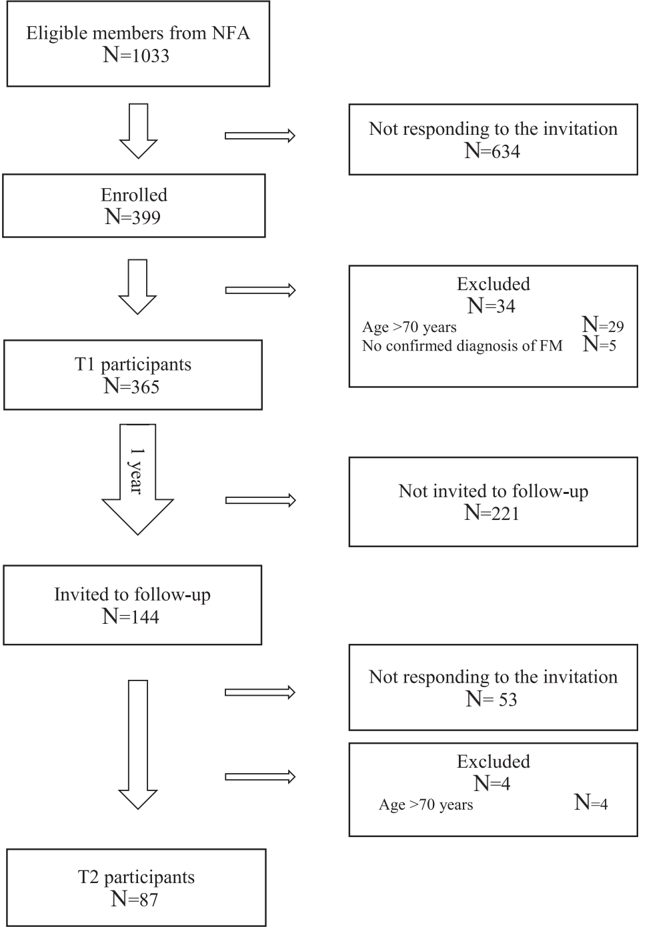
Objectives: Fibromyalgia is a chronic widespread pain (CWP) syndrome of unknown etiology with substantial burden of illness and functional impairment. Pain acceptance has emerged as an interesting target of therapy in chronic pain populations, but few studies have yet been done on the effect of pain acceptance on patients with fibromyalgia. The aim of the present study was to examine the relationship between pain acceptance and its impact on function and symptoms in fibromyalgia with both a cross-sectional and longitudinal design. Methods: Three hundred and sixty five participants aged 22–70 with fibromyalgia were recruited from the Norwegian Fibromyalgia Association (NFA). They filled out a questionnaire containing the Fibromyalgia Impact Questionnaire (FIQ), measurement of function and symptoms, and Chronic Pain Acceptance Questionnaire (CPAQ), measurement of pain acceptance, in addition to sociodemographic and clinical variables such as degree of fibromyalgia, depression and pain duration (T1 measures). One year after, 87 of the participants filled out the FIQ and clinical measures once again (T2 measures). Unadjusted and adjusted linear regression analyses were performed both for cross-sectional measures at T1 and for longitudinal measures from T1 to T2, with FIQ score as the outcome variable and CPAQ score at T1 as one of the main independent variables. Results: Higher CPAQ score was significantly associated with a lower FIQ score at T1, also when adjusting for age, education, work, depression and Fibromyalgianess Score (p<0.01). Lower FIQ score indicate less impact of fibromyalgia on functioning. In addition, two adjusted linear regression models found higher pain acceptance (CPAQ score) at T1 to be associated with lower negative impact of fibromyalgia on function and symptoms (FIQ score) at T2 (p<0.01). Conclusions: Higher pain acceptance is associated with better functional level and less symptoms in fibromyalgia, both cross-sectionally and when measurements are separated in time. Further research should include experimental studies with acceptance-based interventions for this patient group.
Overview
The claims and statistics of this paper haven’t been checked yet.
Free: it reads the open-access text and checks the first 5 claims that cite a source we can check. Create a free account to check every claim.
Integrity signals
Registry
Cites
Statistics
Figures
Verification
Claims the paper makes
The claims and statistics of this paper haven’t been checked yet.
Free: it reads the open-access text and checks the first 5 claims that cite a source we can check. Create a free account to check every claim.
Claims other papers make about this one
Each is checked against this paper’s own text: does it say what the citing paper says it does?
The cited source doesn’t support the claim as written.
In the citing paper
“Despite this, the role of pain acceptance in fibromyalgia patients remains controversial.”
From Does Pain Acceptance Contribute to Improved Functionality through Walking in Women with Fibromyalgia? Looking at Depressive Comorbidity (2023) · cites this paper as [3]
Checked by a reasoning model — may be wrong.
Experimental — accuracy not yet measuredThe source backs part of the claim, not all of it — or backs it for a different population, condition or comparison.
In the citing paper
“Physical exercise together with psychological therapy is considered the most effective treatment for fibromyalgia [3].”
From Does Pain Acceptance Contribute to Improved Functionality through Walking in Women with Fibromyalgia? Looking at Depressive Comorbidity (2023) · cites this paper as [3]
Experimental — accuracy not yet measuredThe source backs part of the claim, not all of it — or backs it for a different population, condition or comparison.
In the citing paper
“رابطه بین پذیرش درد و تأثیر آن بر بیماری در چندین مطالعه با نمونههای مختلف بیماران درد مزمن بررسی شده و گرایش عمومی حاکی از آن است که سطوح بیشتر پذیرش درد با عملکرد روزانه بهتر و ناتوانی و آسیبهای روانشناختی کمتر بهویژه در حوزه اضطراب، افسردگی و خستگی همراه است ] 12 ، 11 [ علاوه .”
From The Effect of Acceptance and Commitment Therapy on the Psychological Consequences of Anxiety, Pain Intensity, and Fatigue in Women with Fibromyalgia: Study with the Effect of Waiting (2022) · cites this paper as [12]
Experimental — accuracy not yet measuredThe cited source says what the claim attributes to it.
In the citing paper
“There are data that confirm that a greater acceptance is related to less intensity of pain, symptoms, and disability and to better physical functionality [3,23,24].”
From Does Pain Acceptance Contribute to Improved Functionality through Walking in Women with Fibromyalgia? Looking at Depressive Comorbidity (2023) · cites this paper as [3]
Self-check
Percentages, sums and reported differences re-computed from the paper’s own numbers.
The self-check needs the paper’s full text.
Citations
Cites
The american college of rheumatology 1990 criteria for the classification of fibromyalgia
Wolfe, F., Smythe, H. A., Yunus, M. B., Bennett, R. M., Bombardier, C., Goldenberg, D. L., Tugwell, P., Campbell, S. M., Abeles, M., Clark, P., et al. (1990) · Arthritis & Rheumatism · doi:10.1002/art.1780330203 · Cited by 9,563
Fear-avoidance and its consequences in chronic musculoskeletal pain: a state of the art.
Vlaeyen, J. W. S., & Linton, S. J. (2000) · Pain · doi:10.1016/s0304-3959(99)00242-0 · Cited by 4,931 · cited 1×
“Avoidance is associated with higher pain intensity, more pain-related anxiety and depression, more functional,mentalandworkdisabilityand is regardeda perpetuatingmechanismforchronicpainaccordingtothefear avoidancemodel of pain [13].”
BackgroundWolfe, F., Clauw, D. J., Fitzcharles, M., Goldenberg, D. L., Katz, R. S., Mease, P., Russell, A. S., Russell, I. J., Winfield, J. B., & Yunus, M. B. (2010) · Arthritis Care & Research · doi:10.1002/acr.20140 · Cited by 3,952 · cited 2×
“Diagnostic criteria were established by the American College of Rheumatology in 1990 [7] with revisions in 2010/2011 [1, 6] and 2016 [8].”
BackgroundMethod2016 revisions to the 2010/2011 fibromyalgia diagnostic criteria
Wolfe, F., Clauw, D. J., Fitzcharles, M.-A., Goldenberg, D. L., Häuser, W., Katz, R. L., Mease, P. J., Russell, A. S., Russell, I. J., & Walitt, B. (2016) · Seminars in Arthritis and Rheumatism · doi:10.1016/j.semarthrit.2016.08.012 · Cited by 2,232
(1991) · PubMed · Cited by 1,837
Fibromyalgia: A Clinical Review
Clauw, D. J. (2014) · JAMA · doi:10.1001/jama.2014.3266 · Cited by 1,674
EULAR revised recommendations for the management of fibromyalgia
Macfarlane, G. J., Kronisch, C., Dean, L. E., Atzeni, F., Häuser, W., Fluß, E., Choy, E., Kosek, E., Amris, K., Branco, J., et al. (2017) · Annals of the Rheumatic Diseases · doi:10.1136/annrheumdis-2016-209724 · Cited by 1,566
WOLFE, F., CLAUW, D. J., FITZCHARLES, M.-A., GOLDENBERG, D. L., HÄUSER, W., KATZ, R. S., MEASE, P., RUSSELL, A. S., RUSSELL, I. J., & WINFIELD, J. B. (2011) · The Journal of Rheumatology · doi:10.3899/jrheum.100594 · Cited by 1,499
Cohort Profile: The HUNT Study, Norway
Krokstad, S., Langhammer, A., Hveem, K., Holmen, T., Midthjell, K., Stene, T., Bratberg, G., Heggland, J., & Holmen, J. (2013) · International Journal of Epidemiology · doi:10.1093/ije/dys095 · Cited by 1,127
Acceptance of chronic pain: component analysis and a revised assessment method
McCracken, L. M., Vowles, K. E., & Eccleston, C. (2004) · Pain · doi:10.1016/j.pain.2003.10.012 · Cited by 1,101
An internet survey of 2,596 people with fibromyalgia
Bennett, R. M., Jones, J., Turk, D. C., Russell, I. J., & Matallana, L. (2007) · BMC Musculoskeletal Disorders · doi:10.1186/1471-2474-8-27 · Cited by 865
The Revised Fibromyalgia Impact Questionnaire (FIQR): validation and psychometric properties
Bennett, R. M., Friend, R., Jones, K. D., Ward, R., Han, B. K., & Ross, R. L. (2009) · Arthritis Research & Therapy · doi:10.1186/ar2783 · Cited by 814 · cited 1×
“the FIQ revised (FIQ-R) has a good correlation with the original FIQ, thus providing the ability to compare the results of studies using the older version with studies using the revised version [47].”
ResultBennett, R. M. (2005) · PubMed · Cited by 726
Learning to live with the pain: acceptance of pain predicts adjustment in persons with chronic pain
McCracken, L. M. (1998) · Pain · doi:10.1016/s0304-3959(97)00146-2 · Cited by 685
Arnold, L. M., Lu, Y., Crofford, L. J., Wohlreich, M., Detke, M. J., Iyengar, S., & Goldstein, D. J. (2004) · Arthritis & Rheumatism · doi:10.1002/art.20485 · Cited by 624 · cited 1×
“It has been shown tohave credible construct validity, reliable testretest characteristics and a good sensitivity to appropriate clinical change [32, 33].”
BackgroundCoping or acceptance? What to do about chronic pain
McCracken, L. M., & Eccleston, C. (2003) · Pain · doi:10.1016/s0304-3959(03)00202-1 · Cited by 591 · cited 1×
“Research has revealed acceptance as giving much more predictive positive outcomes than the amount of pain itself faced by chronic pain patients [12, 21, 23].”
BackgroundThe American College of Rheumatology 1990 criteria for the classification of fibromyalgia
Smith, B., Peterson, K., Fu, R., McDonagh, M. S., & Thakurta, S. (2011) · Cited by 429
White, K. P., Speechley, M. R., Harth, M., & Østbye, T. (1999) · PubMed · Cited by 410
Prevalence of fibromyalgia: literature review update
Marques, A. P., Santo, A. D. S. D. E., Berssaneti, A. A., Matsutani, L. A., & Yuan, S. L. K. (2017) · Revista Brasileira de Reumatologia (English Edition) · doi:10.1016/j.rbre.2017.01.005 · Cited by 408
Minimal Clinically Important Difference in the Fibromyalgia Impact Questionnaire
BENNETT, R. M., BUSHMAKIN, A. G., CAPPELLERI, J. C., ZLATEVA, G., & SADOSKY, A. B. (2009) · The Journal of Rheumatology · doi:10.3899/jrheum.081090 · Cited by 407
Fibromyalgia diagnosis and biased assessment: Sex, prevalence and bias
Wolfe, F., Walitt, B., Perrot, S., Rasker, J. J., & Häuser, W. (2018) · PLOS ONE · doi:10.1371/journal.pone.0203755 · Cited by 346 · cited 1×
“In an unbiased study using the 2016 diagnostic criteria, the female proportion was found to be less than 60% [51].”
MethodA prospective study of acceptance of pain and patient functioning with chronic pain
McCracken, L. M., & Eccleston, C. (2005) · Pain · doi:10.1016/j.pain.2005.08.015 · Cited by 341
Viane, I., Crombez, G., Eccleston, C., Poppe, C., Devulder, J., Van Houdenhove, B., & De Corte, W. (2003) · Pain · doi:10.1016/s0304-3959(03)00291-4 · Cited by 282 · cited 1×
“The crosssectional findings are consistent with results from previous studies [12, 17, 24, 25, 27, 36, 37] and adds to the evidence that pain acceptance plays a part in patients with fibromyalgia as well as in other patients with chronic pain.”
ResultVowles, K. E., McCracken, L. M., & Eccleston, C. (2007) · European Journal of Pain · doi:10.1016/j.ejpain.2006.12.007 · Cited by 253 · cited 1×
“The crosssectional findings are consistent with results from previous studies [12, 17, 24, 25, 27, 36, 37] and adds to the evidence that pain acceptance plays a part in patients with fibromyalgia as well as in other patients with chronic pain.”
ResultMcCracken, L. M., Spertus, I. L., Janeck, A. S., Sinclair, D., & Wetzel, T. F. (1999) · Pain · doi:10.1016/s0304-3959(98)00219-x · Cited by 209
Fibromyalgia and Psychiatric Disorders
&NA; (1996) · The Back Letter · doi:10.1097/00130561-199605000-00018 · Cited by 193
Luciano, J. V., Guallar, J. A., Aguado, J., López-del-Hoyo, Y., Olivan, B., Magallón, R., Alda, M., Serrano-Blanco, A., Gili, M., & Garcia-Campayo, J. (2014) · PAIN · doi:10.1016/j.pain.2013.12.029 · Cited by 183 · cited 1×
“Two of the studies also measured CPAQ [53, 54].”
ResultAndersson, H. I. (2004) · European Journal of Pain · doi:10.1016/s1090-3801(03)00064-8 · Cited by 181 · cited 1×
“Pain is considered to be rather stable over time in chronic pain populations, with day-to-day fluctuations in function and impairment rather than large changes over time [44, 45].”
BackgroundHaugmark, T., Hagen, K. B., Smedslund, G., & Zangi, H. A. (2019) · PLoS ONE · doi:10.1371/journal.pone.0221897 · Cited by 161
Randomized Controlled Trial of Online Acceptance and Commitment Therapy for Fibromyalgia
Simister, H. D., Tkachuk, G. A., Shay, B. L., Vincent, N., Pear, J. J., & Skrabek, R. Q. (2018) · The Journal of Pain · doi:10.1016/j.jpain.2018.02.004 · Cited by 157 · cited 1×
“Two of the studies also measured CPAQ [53, 54].”
ResultFibromyalgia syndrome in the general population of France: A prevalence study
Bannwarth, B., Blotman, F., Lay, K. L., Caubère, J.-P., André, E., & TAIEB, C. (2008) · Joint Bone Spine · doi:10.1016/j.jbspin.2008.06.002 · Cited by 146
Kratz, A. L., Davis, M. C., & Zautra, A. J. (2007) · Annals of Behavioral Medicine · doi:10.1007/bf02879911 · Cited by 143 · cited 1×
“Traditionally, treatment paradigms of chronic pain have assumed that the primary aims should be reduced pain and increased control over responsestopain[10].”
BackgroundWilliams, D. A., & Arnold, L. M. (2011) · Arthritis Care & Research · doi:10.1002/acr.20531 · Cited by 140
Investigating acceptance in adjustment to chronic pain: Is acceptance broader than we thought?
Nicholas, M. K., & Asghari, A. (2006) · Pain · doi:10.1016/j.pain.2006.04.032 · Cited by 100
The Comparative Burden of Chronic Widespread Pain and Fibromyalgia in the United States
Schaefer, C., Mann, R., Masters, E. T., Cappelleri, J. C., Daniel, S. R., Zlateva, G., McElroy, H. J., Chandran, A. B., Adams, E. H., Assaf, A. R., et al. (2016) · Pain Practice · doi:10.1111/papr.12302 · Cited by 97
A prospective investigation of acceptance and control-oriented coping with chronic pain.
McCracken, L. M., Vowles, K. E., & Gauntlett-Gilbert, J. (2007) · Journal of Behavioral Medicine · doi:10.1007/s10865-007-9104-9 · Cited by 96
Acceptance and Commitment Therapy and Traditional Cognitive Behavior Therapy Approaches to Pain
Hayes, S. C., & Duckworth, M. P. (2006) · Cognitive and Behavioral Practice · doi:10.1016/j.cbpra.2006.04.002 · Cited by 93
Acceptance and related processes in adjustment to chronic pain
Thompson, M., & McCracken, L. M. (2011) · Current Pain and Headache Reports · doi:10.1007/s11916-010-0170-2 · Cited by 89
McCracken, L. M. (1999) · Journal of Back and Musculoskeletal Rehabilitation · doi:10.3233/bmr-1999-132-306 · Cited by 87
Lami, M. J., Martínez, M. P., Miró, E., Sánchez, A. I., & Guzmán, M. A. (2018) · Journal of Clinical Psychology in Medical Settings · doi:10.1007/s10880-018-9543-1 · Cited by 82 · cited 2×
“The crosssectional findings are consistent with results from previous studies [12, 17, 24, 25, 27, 36, 37] and adds to the evidence that pain acceptance plays a part in patients with fibromyalgia as well as in other patients with chronic pain.”
BackgroundResultKurtze, N., & Svebak, S. (2001) · British Journal of Medical Psychology · doi:10.1348/000711201161163 · Cited by 76
Castelli, L., Tesio, V., Colonna, F., Molinaro, S., Leombruni, P., Bruzzone, M., Fusaro, E., Sarzi‐Puttini, P., & Torta, R. (2012) · PubMed · Cited by 72
Weather and the pain in fibromyalgia: are they related?
Fors, E. A., & Sexton, H. (2002) · Annals of the Rheumatic Diseases · doi:10.1136/ard.61.3.247 · Cited by 64
Self-citationRodero, B., Casanueva, B., Luciano, J. V., Gili, M., Serrano-Blanco, A., & García-Campayo, J. (2011) · BMC Musculoskeletal Disorders · doi:10.1186/1471-2474-12-143 · Cited by 54 · cited 2×
“[24] found that a greater pain acceptance in fibromyalgia was associated with less pain and better functioning in a crosssectional study with 167 participants.”
ResultAre 2 Questions Enough to Screen for Depression and Anxiety in Patients With Chronic Low Back Pain?
Reme, S. E., Lie, S. A., & Eriksen, H. R. (2014) · Spine · doi:10.1097/brs.0000000000000214 · Cited by 54
Ghiggia, A., Romeo, A., Tesio, V., Tella, M. D., Colonna, F., Geminiani, G. C., Fusaro, E., & Castelli, L. (2017) · Psychiatry Research · doi:10.1016/j.psychres.2017.05.045 · Cited by 44
Vowles, K. E., Witkiewitz, K., Levell, J., Sowden, G., & Ashworth, J. (2017) · Journal of Consulting and Clinical Psychology · doi:10.1037/ccp0000159 · Cited by 41
Fibromyalgia 2016 criteria and assessments: comprehensive validation in a Norwegian population
Fors, E. A., Wensaas, K., Eide, H., Jaatun, E. A. A., Clauw, D. J., Wolfe, F., & Helvik, A. (2020) · Scandinavian Journal of Pain · doi:10.1515/sjpain-2020-0002 · Cited by 40
Self-citationPerrot, S., Winkelmann, A., Dukes, E., Xu, X., Schaefer, C., Ryan, K., Chandran, A., Sadosky, A., & Zlateva, G. (2010) · International Journal of Clinical Practice · doi:10.1111/j.1742-1241.2010.02418.x · Cited by 39
Preliminary investigation of self-as-context in people with fibromyalgia
Yu, L., Norton, S., Almarzooqi, S., & McCracken, L. M. (2017) · British Journal of Pain · doi:10.1177/2049463717708962 · Cited by 35 · cited 2×
“discovered a correlation between pain acceptance and several measures of functioning in their study of self-as-context in fibromyalgia [25].”
BackgroundResultAngarita‐Osorio, N., Pérez‐Aranda, A., Feliu‐Soler, A., Andrés‐Rodríguez, L., Borràs, X., Suso‐Ribera, C., Slim, M., Herrera‐Mercadal, P., Fernández‐Vergel, R., Blanco, M. E., et al. (2020) · Pain Practice · doi:10.1111/papr.12847 · Cited by 34
Long-Term Changes in Musculoskeletal Pain Sites in the General Population: The HUNT Study
Mundal, I. P., Bjørngaard, J. H., Nilsen, T. I. L., Nicholl, B. I., Gråwe, R. W., & Fors, E. A. (2016) · Journal of Pain · doi:10.1016/j.jpain.2016.08.006 · Cited by 30
Self-citationEide, H., Leren, L., & Sørebø, Ø. (2017) · Disability and Rehabilitation · doi:10.1080/09638288.2016.1198427 · Cited by 19 · cited 4×
“The internal consistency of the Norwegian version of CPAQ-20 [29] is previously found adequate (Cronbach’s alpha of 0.”
MethodInfluentialSelf-citationTrainor, H., Baranoff, J., Henke, M., & Winefield, H. (2019) · Australian Psychologist · doi:10.1111/ap.12363 · Cited by 18
Kurtze, N., & Svebak, S. (2005) · Journal of Musculoskeletal Pain · doi:10.1300/j094v13n03_03 · Cited by 10
(2018) · Digital Commons@Becker (Washington University School of Medicine) · doi:10.1371/journal
Cited by
Varallo, G., Scarpina, F., Giusti, E. M., Suso-Ribera, C., Cattivelli, R., Guerrini Usubini, A., Capodaglio, P., & Castelnuovo, G. (2021) · Journal of Personalized Medicine · doi:10.3390/jpm11080810 · Cited by 48
The effectiveness of aerobic exercise for pain management in patients with fibromyalgia
Manojlović, D., & Kopše, E. I. (2023) · European Journal of Translational Myology · doi:10.4081/ejtm.2023.11423 · Cited by 33
dos Santos, J. M., Lacerda, A. C. R., Ribeiro, V. G. C., Figueiredo, P. H. S., da Fonseca, S. F., Lage, V. K. D. S., Costa, H. S., Lima, V. P., Sañudo, B., Bernardo-Filho, M., et al. (2022) · Biology · doi:10.3390/biology11060935 · Cited by 27
Martínez, M. P., Sánchez, A. I., Prados, G., Lami, M. J., Villar, B., & Miró, E. (2021) · The Spanish Journal of Psychology · doi:10.1017/sjp.2021.30 · Cited by 24
Assessment of family physicians' knowledge about fibromyalgia in Egypt
Zeid, W. A., & Ibrahim, M. E. (2020) · The Egyptian Rheumatologist · doi:10.1016/j.ejr.2020.08.009 · Cited by 20
Metadata
- Authors
- Tangen, S. F., Helvik, A.-S., Eide, H., & Fors, E. A.
- Affiliations
- Norwegian University of Science and Technology (NO)
- University of South-Eastern Norway (NO)
- Corresponding author
- Tangen, Synne Flatlandsmo
- Venue
- Scandinavian Journal of Pain
- Publisher
- Walter de Gruyter GmbH
- Published
- 2020-08-07
- Volume
- 20
- Issue
- 4
- Pages
- 727-736
- ISSN
- 1877-8860 (ISSN-L)
- 1877-8879
- OpenAlex
- W3048400901
- Cited by
- 39
- References
- 55
- Citations by year
- 2026: 5 · 2025: 8 · 2024: 6 · 2023: 6 · 2022: 7 · 2021: 6 · 2020: 1
- FWCI
- 3.66
- Type
- journal article
- Language
- en
- Open access
- hybrid
- doi.org
- Locations
- Scandinavian Journal of Pain (publishedVersion, cc-by)
- PubMed (publishedVersion)
- NORA - Norwegian Open Research Archives (submittedVersion, cc-by)
- Funders
- NTNU
- Norwegian Fibromyalgia Association
- Topics
- Health Sciences › Medicine › Psychiatry and Mental health › Fibromyalgia and Chronic Fatigue Syndrome Research
- Health Sciences › Health Professions › Physical Therapy, Sports Therapy and Rehabilitation › Musculoskeletal pain and rehabilitation
- Social Sciences › Psychology › Clinical Psychology › Mindfulness and Compassion Interventions
- Keywords
- fibromyalgia, pain acceptance, chronic widespread pain, functional disability, symptom burden, Chronic Pain Acceptance Questionnaire, Fibromyalgia Impact Questionnaire, depression, pain duration, acceptance-based interventions
- MeSH terms
- Optimism, Adult, Cross-Sectional Studies, Female, Fibromyalgia, Humans, Longitudinal Studies, Male, Middle Aged, Norway, Pain, Pain Measurement, Surveys and Questionnaires
About these checks
Registry, retraction, Cites and statistics results are computed, not judged, with one exception: a printed reference that no index lists is read once by a model before it counts as a citation error. Claims are extracted by a model and kept only when their quote appears verbatim in the text; each cited source is then checked, with a model’s help, for whether it says what the claim relies on. Those verdicts can be wrong — read the claim’s quote and the cited source before relying on one.
Statistics and arithmetic are recomputed, not judged.
Confidence bands are shown only for fields calibrated on our annotated test set. None is calibrated yet, so no band is shown.
What counts as a claim ›How we measure confidence ›How we check this ›
Are you an author, or do you see a problem with this page? Request a review
Data sources
Bibliographic data: Semantic Scholar, OpenAlex, Crossref.
Contains information from the Semantic Scholar Academic Graph Datasets, made available under the ODC Attribution License (ODC-BY 1.0).
Semantic Scholar’s data is described in: Kinney, R., et al. (2023). The Semantic Scholar Open Data Platform. arXiv:2301.10140.
