

The DOI matches its Crossref record; 5 of the 5 references it cites were found in a registry or an index.
Acute Traumatic Brain Injury Does Not Exacerbate Amyotrophic Lateral Sclerosis in the SOD1 G93A Rat Model
Abstract
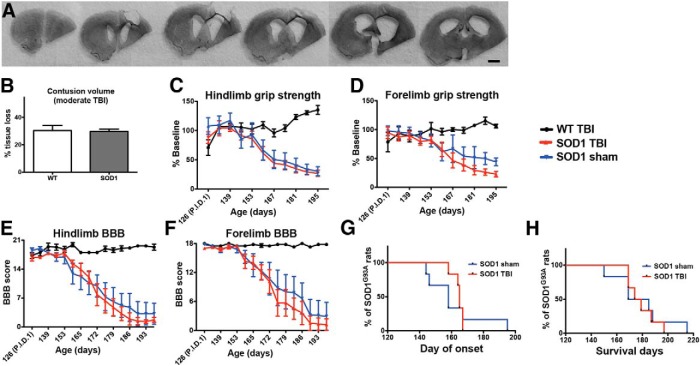
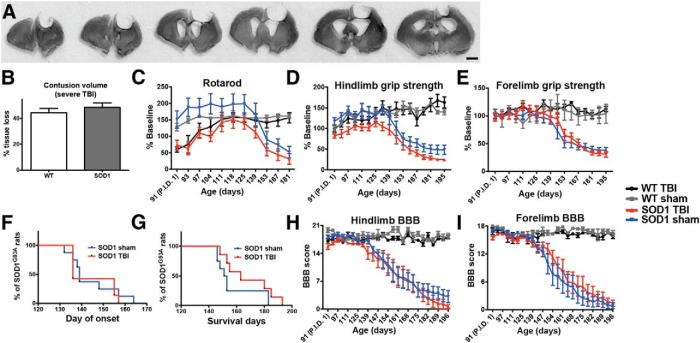
Amyotrophic lateral sclerosis (ALS) is a fatal motor neuron disease in which upper and lower motor neurons degenerate, leading to muscle atrophy, paralysis, and death within 3 to 5 years of onset. While a small percentage of ALS cases are genetically linked, the majority are sporadic with unknown origin. Currently, etiological links are associated with disease onset without mechanistic understanding. Of all the putative risk factors, however, head trauma has emerged as a consistent candidate for initiating the molecular cascades of ALS. Here, we test the hypothesis that traumatic brain injury (TBI) in the SOD1 G93A transgenic rat model of ALS leads to early disease onset and shortened lifespan. We demonstrate, however, that a one-time acute focal injury caused by controlled cortical impact does not affect disease onset or survival. Establishing the negligible involvement of a single acute focal brain injury in an ALS rat model increases the current understanding of the disease. Critically, untangling a single focal TBI from multiple mild injuries provides a rationale for scientists and physicians to increase focus on repeat injuries to hopefully pinpoint a contributing cause of ALS.
Overview
The claims and statistics of this paper haven’t been checked yet.
Run the check — free, no account needed. It reads the open-access text and checks the sources it cites.
Integrity signals
Registry
Cites
Statistics
Figures
Verification
Claims the paper makes
The claims and statistics of this paper haven’t been checked yet.
Run the check — free, no account needed. It reads the open-access text and checks the sources it cites.
Claims other papers make about this one
Each is checked against this paper’s own text: does it say what the citing paper says it does?
In the citing paper
“Supporting the difference between acute and chronic repeated injuries, a single focal brain injury did not induce ALS‐like signs in a transgenic SOD1 rat model 18 ; however, repeated mild bilateral traumatic brain injury accelerated ALS‐like signs onset in this model.”
From Risk factors for amyotrophic lateral sclerosis: A regional United States case‐control study (2021) · cites this paper as [18]
Self-check
Percentages, sums and reported differences re-computed from the paper’s own numbers.
The self-check needs the paper’s full text.
Citations
Cites
A controlled cortical impact model of traumatic brain injury in the rat
Edward Dixon, C., Clifton, G. L., Lighthall, J. W., Yaghmai, A. A., & Hayes, R. L. (1991) · Journal of Neuroscience Methods · doi:10.1016/0165-0270(91)90104-8 · Cited by 1,141
Turner, M. R., Cagnin, A., Turkheimer, F. E., Miller, C. C. J., Shaw, C. E., Brooks, D. J., Leigh, P. N., & Banati, R. B. (2004) · Neurobiology of Disease · doi:10.1016/j.nbd.2003.12.012 · Cited by 737
Neurodegenerative causes of death among retired National Football League players
Lehman, E. J., Hein, M. J., Baron, S. L., & Gersic, C. M. (2012) · Neurology · doi:10.1212/wnl.0b013e31826daf50 · Cited by 638
Loane, D. J., Kumar, A., Stoica, B. A., Cabatbat, R., & Faden, A. I. (2014) · Journal of Neuropathology & Experimental Neurology · doi:10.1097/nen.0000000000000021 · Cited by 498
ALS in Italian professional soccer players: The risk is still present and could be soccer-specific
Chiò, A., Calvo, A., Dossena, M., Ghiglione, P., Mutani, R., & Mora, G. (2009) · Amyotrophic Lateral Sclerosis · doi:10.1080/17482960902721634 · Cited by 180
Research works printed but not linked: 34
- 10.2466/pms.104.4.1251-1254 · DOI
- 2001, Immune reactivity in a mouse model of familial ALS correlates with disease progression., Neurology, 57, 1282, 10.1212/WNL.57.7.1282 · DOI
- 2014, Animal models of sports-related head injury: bridging the gap between pre-clinical research and clinical reality, J Neurochem, 129, 916, 10.1111/jnc.12690 · DOI
- 10.1212/WNL.0000000000000616 · DOI
- 10.1089/neu.1995.12.1 · DOI · Paper page
- 10.3109/17482960903384283 · DOI
- 10.1016/j.jneumeth.2009.04.007 · DOI
- 10.1016/j.neurobiolaging.2014.09.020 · DOI
- 10.1016/j.neuron.2011.09.011 · DOI · Paper page
- 10.1016/j.mcn.2012.10.008 · DOI
- 1994, Lateral cortical impact injury in rats: pathologic effects of varying cortical compression and impact velocity., J Neurotrauma, 11, 587, 10.1089/neu.1994.11.587 · DOI
- 10.3109/21678421.2014.932383 · DOI
- 10.4161/pri.27602 · DOI
- 10.1073/pnas.032539299 · DOI
- 10.1016/j.expneurol.2014.04.016 · DOI
- 10.1523/JNEUROSCI.4690-13.2014 · DOI
- 10.1016/j.neuron.2013.07.033 · DOI · Paper page
- 10.1002/ana.23858 · DOI
- 10.3109/14653249.2011.613929 · DOI
- 10.1212/01.wnl.0000438229.56094.54 · DOI
- 10.1177/1759091414551782 · DOI
- 10.1016/j.cell.2011.10.011 · DOI
- 10.1159/000316800 · DOI
- 10.1002/ana.24150 · DOI · Paper page
- 10.1016/j.neuron.2011.09.010 · DOI · Paper page
- 10.1227/NEU.0000000000000156 · DOI
- 10.1038/362059a0 · DOI · Paper page
- 10.1212/WNL.0000000000000630 · DOI
- 2014, Prior medical conditions and the risk of amyotrophic lateral sclerosis, J Neurol, 261, 1949, 10.1007/s00415-014-7445-1 · DOI · Paper page
- 10.1016/j.expneurol.2009.12.004 · DOI
- 10.1523/JNEUROSCI.2037-14.2014 · DOI
- 10.1212/01.WNL.0000149513.82332.5C · DOI · Paper page
- 10.1038/nrn3407 · DOI
- 2002, Spinal cord contusion models., Prog Brain Res, 137, 231, 10.1016/S0079-6123(02)37019-5 · DOI
Cited by
Sorted by citations
Risk factors for amyotrophic lateral sclerosis: A regional United States case‐control study
Andrew, A. S., Bradley, W. G., Peipert, D., Butt, T., Amoako, K., Pioro, E. P., Tandan, R., Novak, J., Quick, A., Pugar, K. D., et al. (2021) · Muscle & Nerve · doi:10.1002/mus.27085 · Cited by 54
Impact of traumatic brain injury on amyotrophic lateral sclerosis: from bedside to bench
Franz, C. K., Joshi, D., Daley, E. L., Grant, R. A., Dalamagkas, K., Leung, A., Finan, J. D., & Kiskinis, E. (2019) · Journal of Neurophysiology · doi:10.1152/jn.00572.2018 · Cited by 26
Metadata
- Authors
- Thomsen, G. M., Vit, J.-P., Lamb, A., Gowing, G., Shelest, O., Alkaslasi, M., Ley, E. J., & Svendsen, C. N.
- Venue
- eneuro
- Publisher
- Society for Neuroscience
- Published
- 2015-05
- Volume
- 2
- Issue
- 3
- Pages
- ENEURO.0059-14.2015
- ISSN
- 2373-2822
- PMC
- PMC4586929
- Cited by
- 13
- References
- 5
- Language
- en
- Funders
- ALS Association
- Board of Governors Regenerative Medicine Institute
About these checks
Registry, retraction, Cites and statistics results are computed, not judged, with one exception: a printed reference that no index lists is read once by a model before it counts as a citation error. Claims are extracted by a model and kept only when their quote appears verbatim in the text; each cited source is then checked, with a model’s help, for whether it says what the claim relies on. Those verdicts can be wrong — read the claim’s quote and the cited source before relying on one.
Statistics and arithmetic are recomputed, not judged.
Confidence bands are shown only for fields calibrated on our annotated test set. None is calibrated yet, so no band is shown.
What counts as a claim ›How we measure confidence ›How we check this ›
Are you an author, or do you see a problem with this page? Request a review
