

Presenilin/γ-Secretase Activity Is Located in Acidic Compartments of Live Neurons
Open accessThe DOI matches its Crossref record; 68 of the 68 references it cites were found in a registry or an index; 1 of the 29 sources its claims cite were checked for support.
Abstract
Presenilin (PSEN)/γ-secretase is a protease complex responsible for the proteolytic processing of numerous substrates. These substrates include the amyloid precursor protein (APP), the cleavage of which by γ-secretase results in the production of β-amyloid (Aβ) peptides. However, exactly where within the neuron γ-secretase processes APP C99 to generate Aβ and APP intracellular domain (AICD) is still not fully understood. Here, we employ novel Förster resonance energy transfer (FRET)-based multiplexed imaging assays to directly “visualize” the subcellular compartment(s) in which γ-secretase primarily cleaves C99 in mouse cortex primary neurons (from both male and female embryos). Our results demonstrate that γ-secretase processes C99 mainly in LysoTracker-positive low-pH compartments. Using a new immunostaining protocol which distinguishes Aβ from C99, we also show that intracellular Aβ is significantly accumulated in the same subcellular loci. Furthermore, we found functional correlation between the endo-lysosomal pH and cellular γ-secretase activity. Taken together, our findings are consistent with Aβ being produced from C99 by γ-secretase within acidic compartments such as lysosomes and late endosomes in living neurons. SIGNIFICANCE STATEMENT Alzheimer's disease (AD) genetics and histopathology highlight the importance of amyloid precursor protein (APP) processing by γ-secretase in pathogenesis. For the first time, this study has enabled us to directly “visualize” that γ-secretase processes C99 mainly in acidic compartments such as late endosomes and lysosomes in live neurons. Furthermore, we uncovered that intracellular β-amyloid (Aβ) is significantly accumulated in the same subcellular loci. Emerging evidence proposes the great importance of the endo-lysosomal pathway in mechanisms of misfolded proteins propagation (e.g., Tau, α-Syn). Therefore, the predominant processing of C99 and enrichment of Aβ in late endosomes and lysosomes may be critical events in the molecular cascade leading to AD.
Overview
CoChat Summary
TL;DR
Using a near-infrared FRET biosensor for C99 processing in live mouse cortical neurons, this study finds that γ-secretase primarily cleaves C99 in LysoTracker-positive acidic compartments, including late endosomes and lysosomes. Intracellular Aβ accumulates in the same acidic loci, and endo-lysosomal pH is functionally correlated with cellular γ-secretase activity.
Key findings
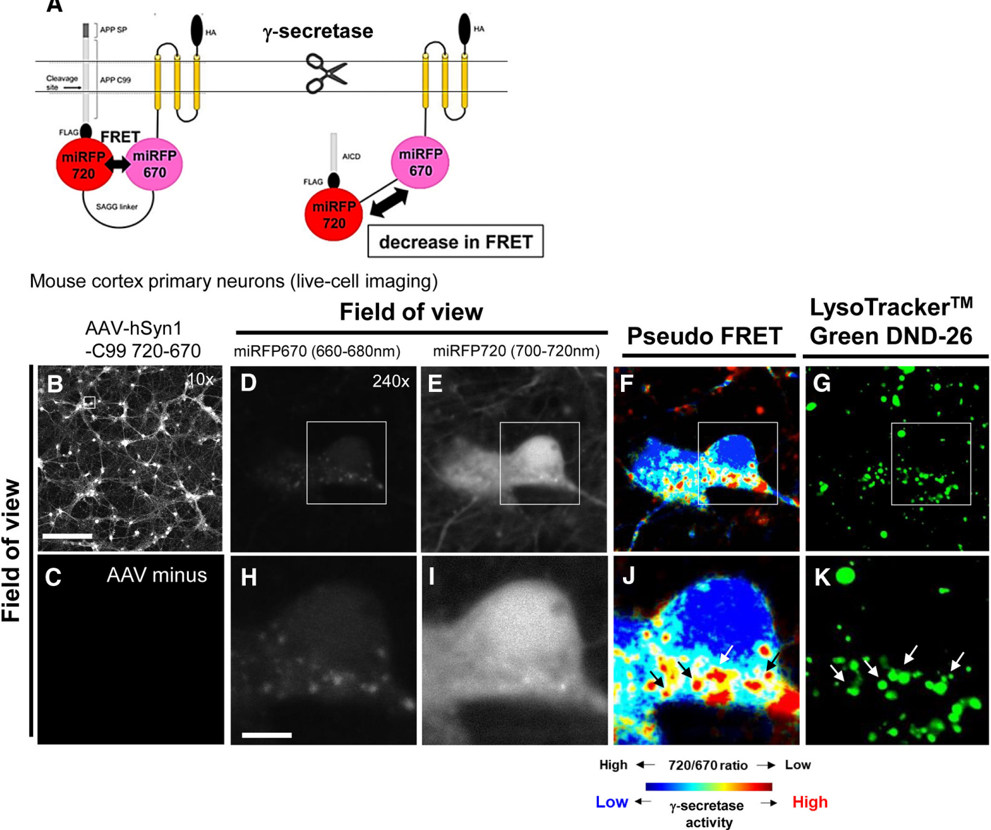
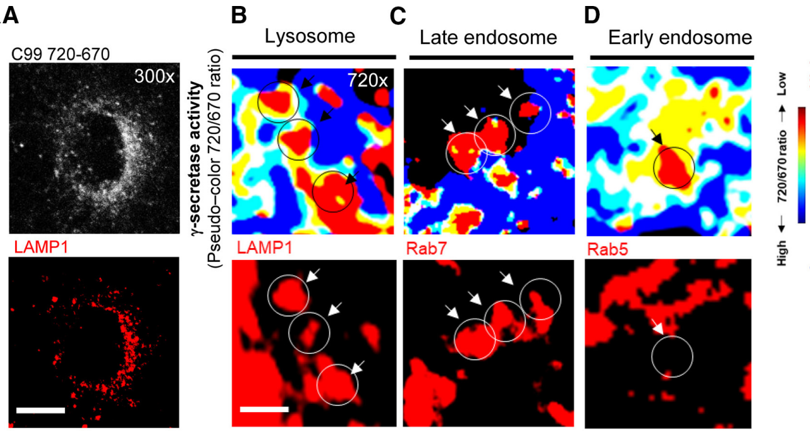
- γ-secretase primarily processes the C99 720-670 biosensor in acidic compartments: lower 720/670 ratios co-localized with LysoTracker Green DND-26 and with LAMP1 (lysosomes) or Rab7 (late endosomes), but rarely with Rab5 (early endosomes).
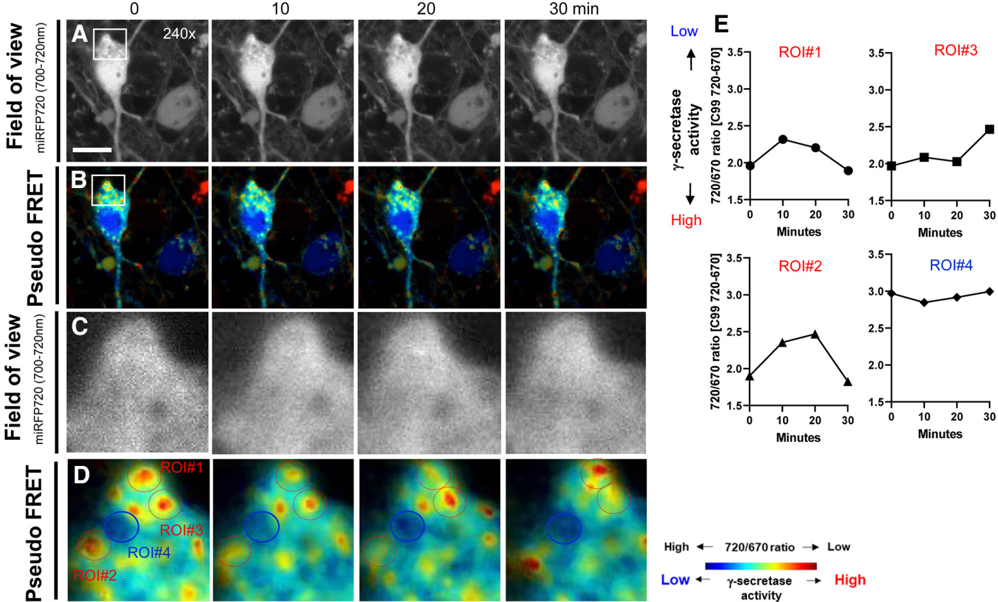
- Processing is spatiotemporally dynamic and heterogeneous: in 30-min time-lapse imaging every 10 min, ROI#1 showed higher 720/670 ratios at 10 and 20 min vs baseline and a significantly lower ratio at 30 min than 20 min; ROI#3 was consistently lower from baseline to 20 min vs 30 min; ROI#4 had high ratios unchanged throughout.
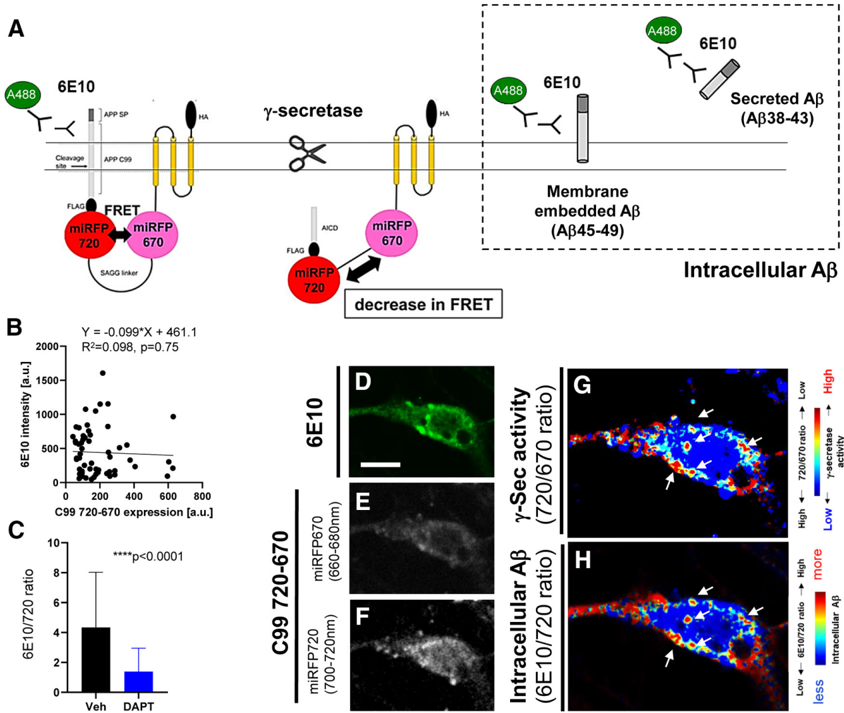
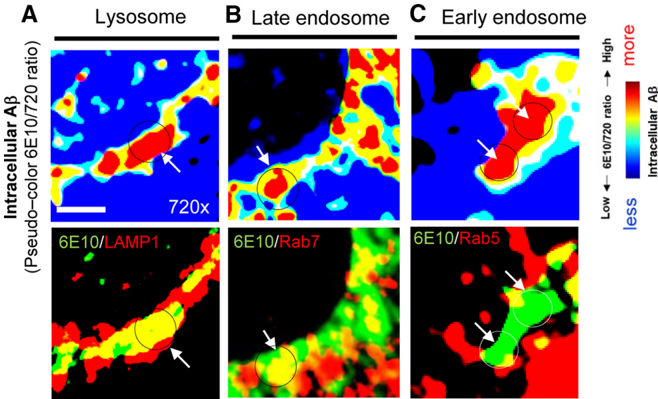
- Intracellular Aβ is enriched where γ-secretase processes C99: 6E10-A488/miRFP720 ratios overlapped with low 720/670 areas and were positive for LAMP1, moderately for Rab7, rarely for Rab5. DAPT (1 mM) significantly decreased 6E10/miRFP720 ratios (n = 50 neurons, Mann-Whitney U test, p < 0.0001), while 6E10 emission did not correlate with biosensor expression (n = 58 neurons, Y = −0.099x + 461.1, R² = 0.098, n.s. p = 0.75).
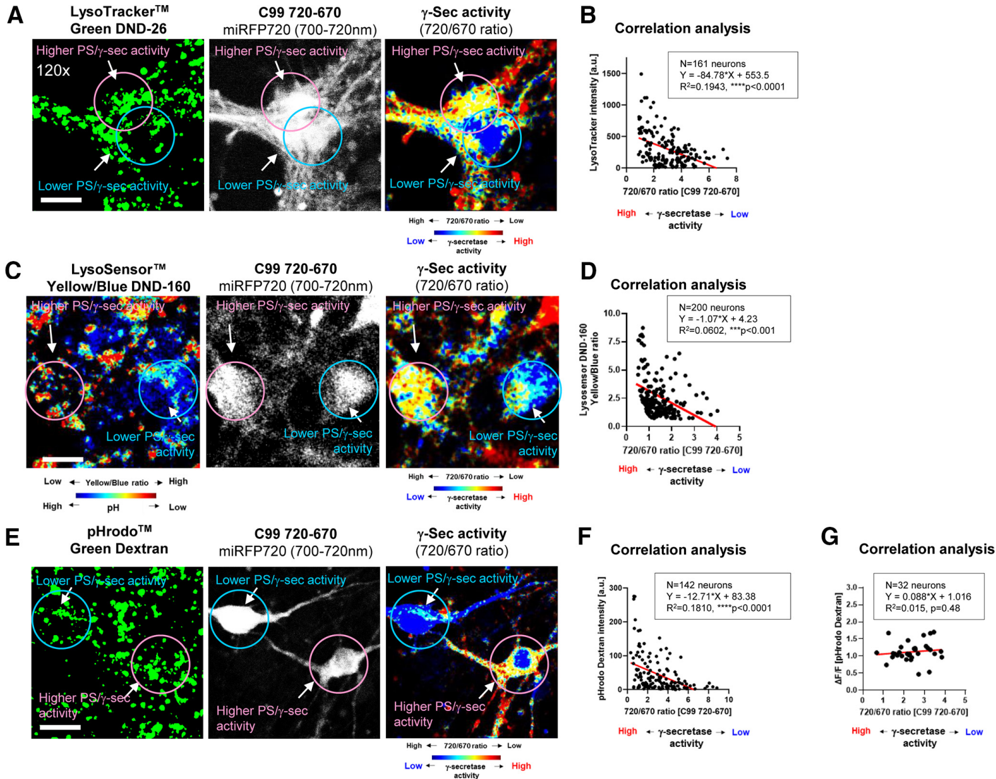
- Endo-lysosomal pH negatively correlated with γ-secretase activity: 720/670 ratios vs LysoTracker Green intensity (n = 161 neurons, Y = −84.78x + 553.5, R² = 0.1943, p < 0.0001), vs LysoSensor Yellow/Blue ratios (n = 200 neurons, Y = −1.07x + 4.23, R² = 0.0602, *p < 0.001), and vs pHrodo Green Dextran intensity (n = 142 neurons, Y = −12.71x + 83.38, R² = 0.1810, p < 0.0001); endocytosis ΔF/F did not correlate with 720/670 ratios (n = 32 neurons, Y = 0.088x + 1.016, R² = 0.015, p = 0.48).
Methods
- Primary cortical neurons from male and female mouse embryos at gestation days 14–16, maintained 13–15 DIV, were transduced with AAV packaging the C99 720-670 FRET biosensor under human Synapsin 1 promoter.
- Live-cell confocal imaging measured miRFP670 donor and miRFP720 acceptor emission; 720/670 ratio reports γ-secretase activity (decreased ratio = increased activity). Assays multiplexed with LysoTracker Green DND-26, LysoSensor Yellow/Blue DND-160, pHrodo Green Dextran, and immunostaining for 6E10, LAMP1, Rab7, Rab5; DAPT vs DMSO; time-lapse every 10 min for 30 min. ELISA measured human Aβ40/Aβ42 in conditioned medium.
- Statistics used GraphPad Prism 9, D’Agostino and Pearson normality test, unpaired Student’s t test or Mann-Whitney U test, Pearson correlation; p < 0.05 significant; values means ± SD.
Limitations
- The paper states remaining key questions: which Aβ species predominantly accumulate, the exact consequence of intracellular Aβ accumulation in acidic compartments, and whether this accumulation is relevant to AD will be investigated in future studies.
- The paper notes that the reported pH optimum for γ-secretase is around 6.3–7.0, different from late endosomal/lysosomal pH, and that γ-secretase has a broad pH range retaining activity at lower pH; it predicts higher functional PSEN1 plus PSEN2/γ-secretase complexes in acidic loci.
- Evident from the text: findings rely on primary mouse cortical neurons and AAV overexpression of a C99 biosensor; pH–activity relationships are correlational; 6E10 recognizes both C99 biosensor and intracellular Aβ, requiring normalization to distinguish them; no in vivo or human neuron validation is reported.
Model-written summary. Check it against the paper before relying on it.
Integrity signals
Registry
Cites
Statistics
Figures
Verification
Claims the paper makes
1 Valid · 0 Not valid · 14 Not checked · 48 Own results and interpretations
The cited sources support only part of this claim — read each source’s verdict below.
In the paper
“Furthermore, recent iPSCs cellular models with FAD mutations illustrate a causal relationship between C99 accumulation and endo-lysosomal dysfunctions (Hung and Livesey, 2018;Kwart et al., 2019).”
§ Neurobiology of Disease Presenilin/c-Secretase Activity Is Located in Acidic Compartments of Live Neurons > Discussion
What the sources say
- Supportedcites Hung and Livesey, 2018 matched to “Altered γ-Secretase Processing of APP Disrupts Lysosome and Autophagosome Function in Monogenic Alzheimer’s Disease.” (2018) source
The Results ("AD Mutations in APP, but Not PSEN1, Result in Early Endosome Abnormalities in Human Cortical Neurons") establish that the neurons are iPSC-derived cortical neurons carrying FAD changes (APP V717I, Ts21, APPdup, three PSEN1 mutations), and the Results section "Dysfunction in the Lysosome-Autophagy System in Familial AD Neurons Is Reversed by β-Secretase Inhibition" plus the Discussion state that APP mutant neurons accumulate APP-β-CTF (C99) and that reducing β-CTF supply rescues the endolysosomal/autophagic defects, while γ-secretase inhibition phenocopies them. The Discussion passage 'These data argue that accumulation and/or altered turnover of APP-CTF by γ-secretase lead to dysfunction in the neuronal lysosomal-autophagy system' directly supports the attributed causal link between C99 accumulation and endo-lysosomal dysfunction in these iPSC FAD models. (LLM, conf=0.90)
- Not matchedcites Kwart et al., 2019
More than one paper fits this citation.
boostedstates a cause- Asserted: passes — The authors put it forward as true.
- Checkable: passes — It can be checked against evidence.
- Load-bearing: passes — The paper’s conclusions depend on it.
- Based: passes — The paper gives a reason why it holds.
- Supported
A result the paper reports from its own data — it cites no other source for it, so there is none to check. The quote shows it is in the paper.
In the paper
“we uncovered that the subcellular loci with increased 6E10/720 ratios (i.e., enrichment of intracellular Ab ) are also positive with the LAMP1 (Fig. 5A), moderately overlaps with Rab7 (Fig. 5B), and rarely with Rab5 (Fig. 5C).”
§ Neurobiology of Disease Presenilin/c-Secretase Activity Is Located in Acidic Compartments of Live Neurons > Ab accumulation in the compartments with predominant C99 processing by c-secretase
plainstates an association- Asserted: passes — The authors put it forward as true.
- Checkable: passes — It can be checked against evidence.
- Load-bearing: passes — The paper’s conclusions depend on it.
- Based: passes — The paper gives a reason why it holds.
A result the paper reports from its own data — it cites no other source for it, so there is none to check. The quote shows it is in the paper.
In the paper
“Our results demonstrate that c-secretase processes C99 mainly in LysoTracker-positive low-pH compartments.”
- Also stated in: § c-Secretase primarily processes APP C99 in acidic compartments of neurons · boosted
“Strikingly, we found that the compartments showing lower 720/670 ratios co-localized with LysoTracker Green fluorescence signals (Fig. 1F,G,J,K), demonstrating that g -secretase mainly cleaves the C99 720-670 biosensor in acidic compartments.”
- Also stated in: § Discussion · boosted
“Here, we demonstrate that g -secretase primarily cleaves the C99 720-670 biosensor in acidic compartments in mouse cortex primary neurons (Figs. 1, 2).”
§ Neurobiology of Disease Presenilin/c-Secretase Activity Is Located in Acidic Compartments of Live Neurons > Abstract
boostedstates a cause- Asserted: passes — The authors put it forward as true.
- Checkable: passes — It can be checked against evidence.
- Load-bearing: passes — The paper’s conclusions depend on it.
- Based: passes — The paper gives a reason why it holds.
- Rests on an assumption not shown here.
- Also stated in: § c-Secretase primarily processes APP C99 in acidic compartments of neurons · boosted
A result the paper reports from its own data — it cites no other source for it, so there is none to check. The quote shows it is in the paper.
In the paper
“Interestingly, we found a statistically significant negative correlation between 720/670 ratios and LysoTracker Green intensity (Fig. 6A,B).”
§ Neurobiology of Disease Presenilin/c-Secretase Activity Is Located in Acidic Compartments of Live Neurons > Ab accumulation in the compartments with predominant C99 processing by c-secretase
plainstates an association- Asserted: passes — The authors put it forward as true.
- Checkable: passes — It can be checked against evidence.
- Load-bearing: passes — The paper’s conclusions depend on it.
- Based: passes — The paper gives a reason why it holds.
- Rests on an assumption not shown here.
A result the paper reports from its own data — it cites no other source for it, so there is none to check. The quote shows it is in the paper.
In the paper
“On the other hand, the area with lower 720/670 ratios rarely overlapped with Rab5 (early endosomes; Fig. 2D).”
§ Neurobiology of Disease Presenilin/c-Secretase Activity Is Located in Acidic Compartments of Live Neurons > c-Secretase primarily processes APP C99 in acidic compartments of neurons
plain- Asserted: passes — The authors put it forward as true.
- Checkable: passes — It can be checked against evidence.
- Load-bearing: passes — The paper’s conclusions depend on it.
- Based: passes — The paper gives a reason why it holds.
39 more claims
Create a free account to see all 63 claims and to verify the 25 references still open.
- The quote only partly states this claim. 1
- Probably not a substantial claim. 13
- It may state two separate claims as one. 5
Self-check
Percentages, sums and reported differences re-computed from the paper’s own numbers.
Each contradiction between two passages listed here was confirmed by an independent check.
Rated minor: it would not touch a result — a value no result rests on, a p-value that stays on the same side of the significance level, or a conflict that is clerical, resolved elsewhere in the paper, or outside its own findings.
In the paper
§ Neurobiology of Disease Presenilin/c-Secretase Activity Is Located in Acidic Compartments of Live Neurons > Discussion
“Higher magnification images corresponding to the squared area in Figure2A,B (C, D).Quantitative analysis of 720/670 ratios in four different ROIs corresponding to Figure2D (E).”
§ Neurobiology of Disease Presenilin/c-Secretase Activity Is Located in Acidic Compartments of Live Neurons > Discussion
“Figure3.Longitudinal monitoring of the C99 720-670 biosensor processing by g -secretase with subcellular resolution.The emission of miRFP670 (donor) and 720 (acceptor) in primary neurons expressing the C99 720-670 biosensor was monitored every 10 min for 30 min.miRFP720 emission (field of view; A) and pseudo-colored miRFP720 over 670 emission ratios (pseudo-colored FRET; B) from every 10-min imaging points.”
Cited works that were retracted
Works this paper cites that were later retracted, from the retraction notices publishers deposit. Major when the notice came out before this paper was published.
A note, not an issue: for example, a cited work that was retracted only after this paper was published, which its authors could not have known.
In the paper
“10.1038/nature04533”
Cited work 10.1038/nature04533 · retracted 2024-06-24 · notice 10.1038/s41586-024-07691-8 · this paper published 2021-11-22
Citations
Cites
1 retracted
RETRACTED ARTICLE: A specific amyloid-β protein assembly in the brain impairs memory
Lesné, S., Koh, M. T., Kotilinek, L., Kayed, R., Glabe, C. G., Yang, A., Gallagher, M., & Ashe, K. H. (2006) · Nature · doi:10.1038/nature04533 · Cited by 2,769
RetractedAmyloid oligomers exacerbate tau pathology in a mouse model of tauopathy
Selenica, M.-L. B., Brownlow, M., Jimenez, J. P., Lee, D. C., Pena, G., Dickey, C. A., Gordon, M. N., & Morgan, D. (2013) · Neurodegenerative Diseases · doi:10.1159/000337230 · Cited by 10,359
The amyloid hypothesis of Alzheimer's disease at 25 years
Selkoe, D. J., & Hardy, J. (2016) · EMBO Molecular Medicine · doi:10.15252/emmm.201606210 · Cited by 6,164
Imaging brain amyloid in Alzheimer's disease with Pittsburgh Compound‐B
Klunk, W. E., Engler, H., Nordberg, A., Wang, Y., Blomqvist, G., Holt, D. P., Bergström, M., Savitcheva, I., Huang, G., Estrada, S., et al. (2004) · Annals of Neurology · doi:10.1002/ana.20009 · Cited by 4,496
Cloning of a gene bearing missense mutations in early-onset familial Alzheimer's disease
Sherrington, R., Rogaev, E. I., Liang, Y., Rogaeva, E. A., Levesque, G., Ikeda, M., Chi, H., Lin, C., Li, G., Holman, K., et al. (1995) · Nature · doi:10.1038/375754a0 · Cited by 4,051
Vassar, R., Bennett, B. D., Babu-Khan, S., Kahn, S., Mendiaz, E. A., Denis, P., Teplow, D. B., Ross, S., Amarante, P., Loeloff, R., et al. (1999) · Science · doi:10.1126/science.286.5440.735 · Cited by 3,876
Shankar, G. M., Li, S., Mehta, T. H., Garcia-Munoz, A., Shepardson, N. E., Smith, I., Brett, F. M., Farrell, M. A., Rowan, M. J., Lemere, C. A., et al. (2008) · Nature Medicine · doi:10.1038/nm1782 · Cited by 3,685
The antibody aducanumab reduces Aβ plaques in Alzheimer’s disease
Sevigny, J., Chiao, P., Bussière, T., Weinreb, P. H., Williams, L., Maier, M., Dunstan, R., Salloway, S., Chen, T., Ling, Y., et al. (2016) · Nature · doi:10.1038/nature19323 · Cited by 3,059
Candidate gene for the chromosome 1 familial Alzheimer’s disease locus
Levy-Lahad, E., Wasco, W., Poorkaj, P., Romano, D. M., Oshima, J., Pettingell, W. H., Yu, C.-E., Jondro, P. D., Schmidt, S. D., Wang, K., et al. (1995) · Science · doi:10.1126/science.7638622 · Cited by 2,577
Wolfe, M. S., Xia, W., Ostaszewski, B. L., Diehl, T. S., Kimberly, W. T., & Selkoe, D. J. (1999) · Nature · doi:10.1038/19077 · Cited by 1,916
Self-citationDeficiency of presenilin-1 inhibits the normal cleavage of amyloid precursor protein
De Strooper, B., Saftig, P., Craessaerts, K., Vanderstichele, H., Guhde, G., Annaert, W., Von Figura, K., & Van Leuven, F. (1998) · Nature · doi:10.1038/34910 · Cited by 1,818
Iwatsubo, T., Odaka, A., Suzuki, N., Mizusawa, H., Nukina, N., & Ihara, Y. (1994) · Neuron · doi:10.1016/0896-6273(94)90458-8 · Cited by 1,774
Rapid appearance and local toxicity of amyloid-β plaques in a mouse model of Alzheimer’s disease
Meyer-Luehmann, M., Spires-Jones, T. L., Prada, C., Garcia-Alloza, M., de Calignon, A., Rozkalne, A., Koenigsknecht-Talboo, J., Holtzman, D. M., Bacskai, B. J., & Hyman, B. T. (2008) · Nature · doi:10.1038/nature06616 · Cited by 987
Haass, C., Koo, E. H., Mellon, A., Hung, A. Y., & Selkoe, D. J. (1992) · Nature · doi:10.1038/357500a0 · Cited by 899
Koffie, R. M., Meyer-Luehmann, M., Hashimoto, T., Adams, K. W., Mielke, M. L., Garcia-Alloza, M., Micheva, K. D., Smith, S. J., Kim, M. L., Lee, V. M., et al. (2009) · Proceedings of the National Academy of Sciences · doi:10.1073/pnas.0811698106 · Cited by 850
Evidence that production and release of amyloid beta-protein involves the endocytic pathway
Koo, E. H., & Squazzo, S. L. (1994) · Journal of Biological Chemistry · doi:10.1016/s0021-9258(17)32449-3 · Cited by 829
Biochemistry of Amyloid -Protein and Amyloid Deposits in Alzheimer Disease
Masters, C. L., & Selkoe, D. J. (2012) · Cold Spring Harbor Perspectives in Medicine · doi:10.1101/cshperspect.a006262 · Cited by 542
LRP1 is a master regulator of tau uptake and spread
Rauch, J. N., Luna, G., Guzman, E., Audouard, M., Challis, C., Sibih, Y. E., Leshuk, C., Hernandez, I., Wegmann, S., Hyman, B. T., et al. (2020) · Nature · doi:10.1038/s41586-020-2156-5 · Cited by 541
Presenilin 1 is linked with γ-secretase activity in the detergent solubilized state
Li, Y.-M., Lai, M.-T., Xu, M., Huang, Q., DiMuzio-Mower, J., Sardana, M. K., Shi, X.-P., Yin, K.-C., Shafer, J. A., & Gardell, S. J. (2000) · Proceedings of the National Academy of Sciences · doi:10.1073/pnas.110126897 · Cited by 525
Takami, M., Nagashima, Y., Sano, Y., Ishihara, S., Morishima-Kawashima, M., Funamoto, S., & Ihara, Y. (2009) · The Journal of Neuroscience · doi:10.1523/jneurosci.2362-09.2009 · Cited by 498
The mechanism of γ‐Secretase dysfunction in familial Alzheimer disease
Chávez‐Gutiérrez, L., Bammens, L., Benilova, I., Vandersteen, A., Benurwar, M., Borgers, M., Lismont, S., Zhou, L., Van Cleynenbreugel, S., Esselmann, H., et al. (2012) · The EMBO Journal · doi:10.1038/emboj.2012.79 · Cited by 495
The Many Substrates of Presenilin/γ-Secretase
Haapasalo, A., & Kovacs, D. M. (2011) · Journal of Alzheimer's Disease · doi:10.3233/jad-2011-101065 · Cited by 458
Klunk, W. E., Bacskai, B. J., Mathis, C. A., Kajdasz, S. T., McLellan, M. E., Frosch, M. P., Debnath, M. L., Holt, D. P., Wang, Y., & Hyman, B. T. (2002) · Journal of Neuropathology & Experimental Neurology · doi:10.1093/jnen/61.9.797 · Cited by 412
Qi-Takahara, Y., Morishima-Kawashima, M., Tanimura, Y., Dolios, G., Hirotani, N., Horikoshi, Y., Kametani, F., Maeda, M., Saido, T. C., Wang, R., et al. (2005) · The Journal of Neuroscience · doi:10.1523/jneurosci.1575-04.2005 · Cited by 391
Sun, L., Zhou, R., Yang, G., & Shi, Y. (2017) · Proceedings of the National Academy of Sciences · doi:10.1073/pnas.1618657114 · Cited by 382
Pasternak, S. H., Bagshaw, R. D., Guiral, M., Zhang, S., Ackerley, C. A., Pak, B. J., Callahan, J. W., & Mahuran, D. J. (2003) · Journal of Biological Chemistry · doi:10.1074/jbc.m304009200 · Cited by 316
Bright monomeric near-infrared fluorescent proteins as tags and biosensors for multiscale imaging
Shcherbakova, D. M., Baloban, M., Emelyanov, A. V., Brenowitz, M., Guo, P., & Verkhusha, V. V. (2016) · Nature Communications · doi:10.1038/ncomms12405 · Cited by 312
Kwart, D., Gregg, A., Scheckel, C., Murphy, E. A., Paquet, D., Duffield, M., Fak, J., Olsen, O., Darnell, R. B., & Tessier-Lavigne, M. (2019) · Neuron · doi:10.1016/j.neuron.2019.07.010 · Cited by 304
Sannerud, R., Esselens, C., Ejsmont, P., Mattera, R., Rochin, L., Tharkeshwar, A. K., De Baets, G., De Wever, V., Habets, R., Baert, V., et al. (2016) · Cell · doi:10.1016/j.cell.2016.05.020 · Cited by 299
Jiang, Y., Mullaney, K. A., Peterhoff, C. M., Che, S., Schmidt, S. D., Boyer-Boiteau, A., Ginsberg, S. D., Cataldo, A. M., Mathews, P. M., & Nixon, R. A. (2010) · Proceedings of the National Academy of Sciences · doi:10.1073/pnas.0908953107 · Cited by 292
Purification and Characterization of the Human γ-Secretase Complex
Fraering, P. C., Ye, W., Strub, J.-M., Dolios, G., LaVoie, M. J., Ostaszewski, B. L., van Dorsselaer, A., Wang, R., Selkoe, D. J., & Wolfe, M. S. (2004) · Biochemistry · doi:10.1021/bi0494976 · Cited by 226
Self-citationHurtado, D. E., Molina-Porcel, L., Iba, M., Aboagye, A. K., Paul, S. M., Trojanowski, J. Q., & Lee, V. M.-Y. (2010) · The American Journal of Pathology · doi:10.2353/ajpath.2010.100346 · Cited by 222
Lauritzen, I., Pardossi-Piquard, R., Bourgeois, A., Pagnotta, S., Biferi, M.-G., Barkats, M., Lacor, P., Klein, W., Bauer, C., & Checler, F. (2016) · Acta Neuropathologica · doi:10.1007/s00401-016-1577-6 · Cited by 219
Koo, E. H., Squazzo, S. L., Selkoe, D. J., & Koo, C. H. (1996) · Journal of Cell Science · doi:10.1242/jcs.109.5.991 · Cited by 201
The substrate repertoire of γ-secretase/presenilin
Güner, G., & Lichtenthaler, S. F. (2020) · Seminars in Cell & Developmental Biology · doi:10.1016/j.semcdb.2020.05.019 · Cited by 195
Presenilin-1 and Presenilin-2 Exhibit Distinct yet Overlapping γ-Secretase Activities
Lai, M.-T., Chen, E., Crouthamel, M.-C., DiMuzio-Mower, J., Xu, M., Huang, Q., Price, E., Register, R. B., Shi, X.-P., Donoviel, D. B., et al. (2003) · Journal of Biological Chemistry · doi:10.1074/jbc.m300974200 · Cited by 167
The physiology of the β‐amyloid precursor protein intracellular domain AICD
Pardossi‐Piquard, R., & Checler, F. (2012) · Journal of Neurochemistry · doi:10.1111/j.1471-4159.2011.07475.x · Cited by 159
Hung, C. O. Y., & Livesey, F. J. (2018) · Cell Reports · doi:10.1016/j.celrep.2018.11.095 · Cited by 159
Cupers, P., Bentahir, M., Craessaerts, K., Orlans, I., Vanderstichele, H., Saftig, P., De Strooper, B., & Annaert, W. (2001) · The Journal of Cell Biology · doi:10.1083/jcb.200104045 · Cited by 158
Qualitative changes in human γ-secretase underlie familial Alzheimer’s disease
Szaruga, M., Veugelen, S., Benurwar, M., Lismont, S., Sepulveda-Falla, D., Lleo, A., Ryan, N. S., Lashley, T., Fox, N. C., Murayama, S., et al. (2015) · Journal of Experimental Medicine · doi:10.1084/jem.20150892 · Cited by 155
Direct multiplex imaging and optogenetics of Rho GTPases enabled by near-infrared FRET
Shcherbakova, D. M., Cox Cammer, N., Huisman, T. M., Verkhusha, V. V., & Hodgson, L. (2018) · Nature Chemical Biology · doi:10.1038/s41589-018-0044-1 · Cited by 154
Fernandez, M. A., Klutkowski, J. A., Freret, T., & Wolfe, M. S. (2014) · Journal of Biological Chemistry · doi:10.1074/jbc.m114.581165 · Cited by 136
Self-citationFunamoto, S., Morishima-Kawashima, M., Tanimura, Y., Hirotani, N., Saido, T. C., & Ihara, Y. (2004) · Biochemistry · doi:10.1021/bi049399k · Cited by 131
Polanco, J. C., Hand, G. R., Briner, A., Li, C., & Götz, J. (2021) · Acta Neuropathologica · doi:10.1007/s00401-020-02254-3 · Cited by 131
Quintero-Monzon, O., Martin, M. M., Fernandez, M. A., Cappello, C. A., Krzysiak, A. J., Osenkowski, P., & Wolfe, M. S. (2011) · Biochemistry · doi:10.1021/bi2007146 · Cited by 118
Self-citationBerezovska, O., Ramdya, P., Skoch, J., Wolfe, M. S., Bacskai, B. J., & Hyman, B. T. (2003) · The Journal of Neuroscience · doi:10.1523/jneurosci.23-11-04560.2003 · Cited by 108
Self-citationPérez, M., Ribé, E. M., Rubio, A., Lim, F., Morán, M. A., Gómez‐Ramos, P., Ferrer, I., Isla, M. T. G., & Ávila, J. (2004) · Neuroscience · doi:10.1016/j.neuroscience.2004.09.029 · Cited by 99
Jiang, Y., Rigoglioso, A., Peterhoff, C. M., Pawlik, M., Sato, Y., Bleiwas, C., Stavrides, P., Smiley, J. F., Ginsberg, S. D., Mathews, P. M., et al. (2016) · Neurobiology of Aging · doi:10.1016/j.neurobiolaging.2015.11.013 · Cited by 97
Effect of alkalizing agents on the processing of the β-amyloid precursor protein
Schrader‐Fischer, G., & Paganetti, P. (1996) · Brain Research · doi:10.1016/0006-8993(96)00002-9 · Cited by 93
Saul, A., Sprenger, F., Bayer, T. A., & Wirths, O. (2013) · Neurobiology of Aging · doi:10.1016/j.neurobiolaging.2013.05.003 · Cited by 88
Addendum: The antibody aducanumab reduces Aβ plaques in Alzheimer’s disease
Sevigny, J., Chiao, P., Bussière, T., Weinreb, P. H., Williams, L., Maier, M., Dunstan, R., Salloway, S., Chen, T., Ling, Y., et al. (2017) · Nature · doi:10.1038/nature22809 · Cited by 83
Presenilin 1 and Presenilin 2 Target γ-Secretase Complexes to Distinct Cellular Compartments
Meckler, X., & Checler, F. (2016) · Journal of Biological Chemistry · doi:10.1074/jbc.m115.708297 · Cited by 76
Devkota, S., Williams, T. D., & Wolfe, M. S. (2021) · Journal of Biological Chemistry · doi:10.1016/j.jbc.2021.100281 · Cited by 74
Self-citationPresenilin-Dependent γ-Secretase on Plasma Membrane and Endosomes Is Functionally Distinct
Fukumori, A., Okochi, M., Tagami, S., Jiang, J., Itoh, N., Nakayama, T., Yanagida, K., Ishizuka-Katsura, Y., Morihara, T., Kamino, K., et al. (2006) · Biochemistry · doi:10.1021/bi052412w · Cited by 73
Kwart, D., Gregg, A., Scheckel, C., Murphy, E. A., Paquet, D., Duffield, M., Fak, J., Olsen, O., Darnell, R. B., & Tessier-Lavigne, M. (2019) · Neuron · doi:10.1016/j.neuron.2019.11.010 · Cited by 70
Lauritzen, I., Pardossi-Piquard, R., Bourgeois, A., Bécot, A., & Checler, F. (2019) · Current Alzheimer Research · doi:10.2174/1567205016666190325092841 · Cited by 67
Placanica, L., Tarassishin, L., Yang, G., Peethumnongsin, E., Kim, S.-H., Zheng, H., Sisodia, S. S., & Li, Y.-M. (2009) · Journal of Biological Chemistry · doi:10.1074/jbc.m807269200 · Cited by 60
Exosomal and vesicle‐free tau seeds—propagation and convergence in endolysosomal permeabilization
Polanco, J. C., & Götz, J. (2022) · The FEBS Journal · doi:10.1111/febs.16055 · Cited by 42
Pathogenic PS1 phosphorylation at Ser367
Maesako, M., Horlacher, J., Zoltowska, K. M., Kastanenka, K. V., Kara, E., Svirsky, S. E., Keller, L. J., Li, X., Hyman, B. T., Bacskai, B. J., et al. (2017) · eLife · doi:10.7554/elife.19720 · Cited by 36
Self-citationCampbell, W. A., Reed, M. L. O., Strahle, J., Wolfe, M. S., & Xia, W. (2003) · Journal of Neurochemistry · doi:10.1046/j.1471-4159.2003.01799.x · Cited by 35
Self-citationEscamilla-Ayala, A. A., Sannerud, R., Mondin, M., Poersch, K., Vermeire, W., Paparelli, L., Berlage, C., Koenig, M., Chavez-Gutierrez, L., Ulbrich, M. H., et al. (2020) · eLife · doi:10.7554/elife.56679 · Cited by 29
Visualization of PS/γ-Secretase Activity in Living Cells
Maesako, M., Sekula, N. M., Aristarkhova, A., Feschenko, P., Anderson, L. C., & Berezovska, O. (2020) · iScience · doi:10.1016/j.isci.2020.101139 · Cited by 20
Self-citationA Novel NIR-FRET Biosensor for Reporting PS/γ-Secretase Activity in Live Cells
Houser, M. C., Hou, S. S., Perrin, F., Turchyna, Y., Bacskai, B. J., Berezovska, O., & Maesako, M. (2020) · Sensors · doi:10.3390/s20215980 · Cited by 20
Self-citationWatanabe, H., Imaizumi, K., Cai, T., Zhou, Z., Tomita, T., & Okano, H. (2021) · eneuro · doi:10.1523/eneuro.0500-20.2021 · Cited by 16
LRP1 is a master regulator of tau uptake and spread
Rauch, J. N. (2021) · The FASEB Journal · doi:10.1096/fasebj.2021.35.s1.05145 · Cited by 6
Shcherbakova, D. M., Cammer, N. C., Huisman, T. M., Verkhusha, V. V., & Hodgson, L. (2018) · Nature Chemical Biology · doi:10.1038/s41589-018-0070-z
Bright Monomeric Near-Infrared Fluorescent Proteins for Multiscale Imaging
Shcherbakova, D. M., Baloban, M., & Verkhusha, V. V. (2017) · Biophysical Journal · doi:10.1016/j.bpj.2016.11.1792
P3–241: Presenilin–dependent γ–secretases on plasma membrane and endosomes are functionally distinct
Fukumori, A., Okochi, M., Jiang, J., Ikuta, A., Yanagida, K., Nakayama, T., Ishizuka-Katsura, Y., Mori, K., Tao, H., Morihara, T., et al. (2006) · Alzheimer's & Dementia · doi:10.1016/j.jalz.2006.05.1510
Cited by
Engineered receptors for soluble cellular communication and disease sensing
Piraner, D. I., Abedi, M. H., Gonzalez, M. J. D., Chazin-Gray, A. M., Lin, A. J., Zhu, I., Ravindran, P. T., Schlichthaerle, T., Huang, B., Bearchild, T. H., et al. (2024) · Nature · doi:10.1038/s41586-024-08366-0 · Cited by 90
Amyloid Precursor Protein: A Regulatory Hub in Alzheimer's Disease
Chen, J., Chen, J.-S., Li, S., Zhang, F., Deng, J., Zeng, L., & Tan, J. (2023) · Aging and Disease · doi:10.14336/ad.2023.0308 · Cited by 62
Mustaly-Kalimi, S., Gallegos, W., Marr, R. A., Gilman-Sachs, A., Peterson, D. A., Sekler, I., & Stutzmann, G. E. (2022) · Proceedings of the National Academy of Sciences · doi:10.1073/pnas.2211999119 · Cited by 55
Rudajev, V., & Novotný, J. (2023) · Cell & Bioscience · doi:10.1186/s13578-023-01127-y · Cited by 54
Cholesterol and Lipid Rafts in the Biogenesis of Amyloid-β Protein and Alzheimer's Disease
Pantelopulos, G. A., Abraham, C. B., & Straub, J. E. (2024) · Annual Review of Biophysics · doi:10.1146/annurev-biophys-062823-023436 · Cited by 44
Metadata
- Authors
- Maesako, M., Houser, M. C. Q., Turchyna, Y., Wolfe, M. S., & Berezovska, O.
- Affiliations
- Harvard University (US)
- University of Kansas (US)
- Corresponding author
- Maesako, Masato
- Venue
- The Journal of Neuroscience
- Publisher
- Society for Neuroscience
- Published
- 2021-11-22
- Volume
- 42
- Issue
- 1
- Pages
- 145-154
- ISSN
- 0270-6474 (ISSN-L)
- 1529-2401
- PMC
- PMC8741161
- OpenAlex
- W3216557857
- Cited by
- 55
- References
- 63
- Citations by year
- 2026: 7 · 2025: 10 · 2024: 23 · 2023: 10 · 2022: 5
- FWCI
- 3.13
- Type
- journal article
- Language
- en
- Open access
- hybrid
- doi.org
- Licence
- Locations
- Journal of Neuroscience (publishedVersion, cc-by-nc-sa)
- PubMed (publishedVersion)
- PubMed Central (publishedVersion)
- Funders
- HHS | NIH | National Institute on Aging (AG 44486, AG 15379)
- BrightFocus Foundation (A2019056F)
- Topics
- Life Sciences › Neuroscience › Cellular and Molecular Neuroscience › Alzheimer's disease research and treatments
- Life Sciences › Biochemistry, Genetics and Molecular Biology › Cell Biology › Cellular transport and secretion
- Life Sciences › Neuroscience › Cellular and Molecular Neuroscience › Neuroscience and Neuropharmacology Research
- Keywords
- presenilin, gamma-secretase, amyloid precursor protein, amyloid-beta, subcellular localization, lysosomes, late endosomes, Alzheimer's disease, primary cortical neurons
- MeSH terms
- Animals, Female, Lysosomes, Male, Neurons, Endosomes, Amyloid beta-Protein Precursor, Mice, Presenilins, Amyloid Precursor Protein Secretases
About these checks
Registry, retraction, Cites and statistics results are computed, not judged, with one exception: a printed reference that no index lists is read once by a model before it counts as a citation error. Claims are extracted by a model and kept only when their quote appears verbatim in the text; each cited source is then checked, with a model’s help, for whether it says what the claim relies on. Those verdicts can be wrong — read the claim’s quote and the cited source before relying on one.
A language model drew the claims from the paper on 2026-11-19, under version 3 of the claim definition (model deepseek-v4.1-flash, prompt extract-v3).
A second model labelled each claim on 2026-11-19 (model jev-1.13-20260917, definition revision gold-guideline-v0.2).
Cited sources are checked with a language model’s help (qwen3.8-omni-flash).
Statistics and arithmetic are recomputed, not judged.
Confidence bands are shown only for fields calibrated on our annotated test set. None is calibrated yet, so no band is shown.
What counts as a claim ›How we measure confidence ›How we check this ›
Are you an author, or do you see a problem with this page? Request a review
Data sources
Bibliographic data: Semantic Scholar, OpenAlex, Crossref.
Contains information from the Semantic Scholar Academic Graph Datasets, made available under the ODC Attribution License (ODC-BY 1.0).
Semantic Scholar’s data is described in: Kinney, R., et al. (2023). The Semantic Scholar Open Data Platform. arXiv:2301.10140.
