

The DOI matches its Crossref record; 86 of the 87 references it cites were found in a registry or an index.
Glucocorticoid Effects on Memory Retrieval Require Concurrent Noradrenergic Activity in the Hippocampus and Basolateral Amygdala
Open accessAbstract
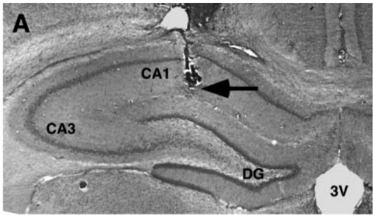
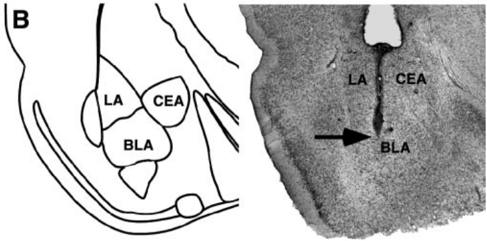
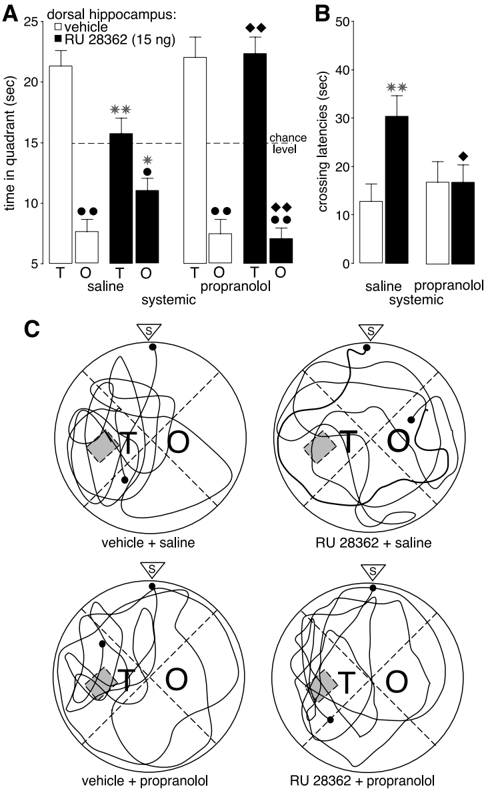
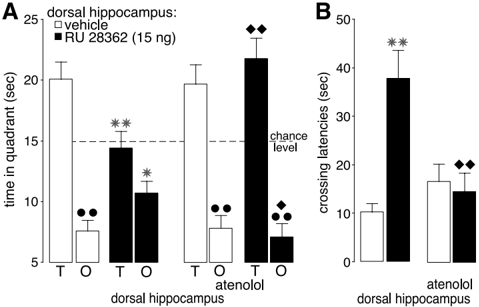
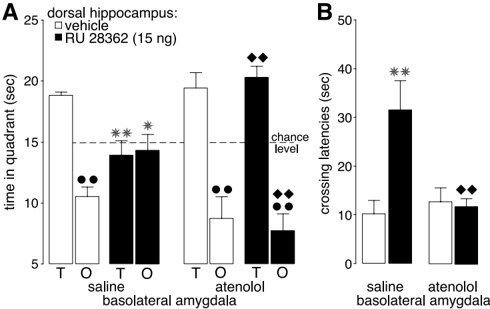
Previous findings indicate that administration of aβ-adrenoceptor antagonist systemically blocks glucocorticoid impairment of memory retrieval. Here, we report that β-adrenoceptor activation in the hippocampus and the basolateral complex of the amygdala (BLA) is implicated in the impairing effects of glucocorticoids on memory retrieval. The specific glucocorticoid receptor (GR) agonist 11β,17β-dihydroxy-6,21-dimethyl-17α-pregna-4,6-trien-20yn-3-one (RU 28362) (15 ng) infused into the hippocampus of male Sprague Dawley rats 60 min before water maze retention testing, 24 hr after training, impaired probe trial retention performance, as assessed by quadrant search time and initial latency to cross the platform location. Because we found previously that RU 28362 infused into the hippocampus does not affect water maze acquisition or immediate recall, the findings suggest that the GR agonist-induced retention impairment was attributable to a selective influence on long-term memory retrieval. Likewise, systemic injections of the β 1-adrenoceptor partial agonist xamoterol (3.0 or 10.0 mg/kg, s.c.) 60 min before the probe trial dose-dependently impaired retention performance. The β-adrenoceptor antagonist propranolol (2.0 mg/kg) administered subcutaneously before retention testing did not affect retention performance alone, but blocked the memory retrieval impairment induced by concurrent intrahippocampal infusions of RU 28362. Pretest infusions of the β 1-adrenoceptor antagonist atenolol into either the hippocampus (1.25 μg in 0.5 μl) or the BLA (0.5 μg in 0.2 μl) also prevented the GR agonist-induced memory retrieval impairment. These findings suggest that glucocorticoids impair retrieval of long-term spatial memory by facilitating noradrenergic mechanisms in the hippocampus, and additionally, that norepinephrine-mediated BLA activity is critical in enabling hippocampal glucocorticoid effects on memory retrieval.
Overview
The claims and statistics of this paper haven’t been checked yet.
Run the check — free, no account needed. It reads the open-access text and checks the sources it cites.
Integrity signals
Registry
Cites
Statistics
Figures
Verification
Claims the paper makes
The claims and statistics of this paper haven’t been checked yet.
Run the check — free, no account needed. It reads the open-access text and checks the sources it cites.
Claims other papers make about this one
Each is checked against this paper’s own text: does it say what the citing paper says it does?
In the citing paper
“and can impair hippocampus-specific memory processing in rats (de Quervain et al. [157]; Conrad et al. [158]; Roozendaal et al. [159]) and people (Kirschbaum et al. [160]; de Quervain et al. [161]; Wolf et al. [162]; Payne et al. [163]; Buss et al. [164]; Wolf et al. [165]; Elzinga et al. [76]; Kuhlmann et al. [166]; Kuhlmann et al. [167]; Payne et al. [168]; Buchanan”
From The Temporal Dynamics Model of Emotional Memory Processing: A Synthesis on the Neurobiological Basis of Stress-Induced Amnesia, Flashbulb and Traumatic Memories, and the Yerkes-Dodson Law (2007) · cites this paper as Roozendaal et al. [159]
Self-check
Percentages, sums and reported differences re-computed from the paper’s own numbers.
The self-check needs the paper’s full text.
Citations
Cites
The Rat Brain in Stereotaxic Coordinates
Paxinos, G., & Watson, C. (1983) · Elsevier eBooks · doi:10.1016/c2009-0-63235-9 · Cited by 28,585
AChE-stained horizontal sections of the rat brain in stereotaxic coordinates
Paxinos, G., WATSON, C. R. R., & Emson, P. C. (1980) · Journal of Neuroscience Methods · doi:10.1016/0165-0270(80)90021-7 · Cited by 4,501
Memory - A century of consolidation
McGaugh, J. L. (2000) · Science · doi:10.1126/science.287.5451.248 · Cited by 4,250
Self-citationImaging Cognition II: An Empirical Review of 275 PET and fMRI Studies
Cabeza, R., & Nyberg, L. (2000) · Journal of Cognitive Neuroscience · doi:10.1162/08989290051137585 · Cited by 3,598
Two receptor systems for corticosterone in rat brain: Microdistribution and differential occupation
REUL, J. M. H. M., & KLOET, E. R. D. (1985) · Endocrinology · doi:10.1210/endo-117-6-2505 · Cited by 2,580
Stress and cognition: are corticosteroids good or bad guys?
de Kloet, E. R., Oitzl, M. S., & Joëls, M. (1999) · Trends in Neurosciences · doi:10.1016/s0166-2236(99)01438-1 · Cited by 1,258
Stress and glucocorticoids impair retrieval of long-term spatial memory
de Quervain, D. J.-F., Roozendaal, B., & McGaugh, J. L. (1998) · Nature · doi:10.1038/29542 · Cited by 1,182
Self-citationThe acute effects of corticosteroids on cognition: integration of animal and human model studies
LUPIEN, S., & MCEWEN, B. (1997) · Brain Research Reviews · doi:10.1016/s0165-0173(97)00004-0 · Cited by 1,024
The hippocampus and contextual retrieval of information from memory: A theory
Hirsh, R. (1974) · Behavioral Biology · doi:10.1016/s0091-6773(74)92231-7 · Cited by 957
Amygdala activity at encoding correlated with long-term, free recall of emotional information.
Cahill, L. F., Haier, R. J., Fallon, J., Alkire, M. T., Tang, C. Y., Keator, D., Wu, J. C., & McGaugh, J. L. (1996) · Proceedings of the National Academy of Sciences · doi:10.1073/pnas.93.15.8016 · Cited by 928
Self-citation
Cited by
Sorted by citations
Stress, memory and the amygdala
Roozendaal, B., McEwen, B. S., & Chattarji, S. (2009) · Nature Reviews Neuroscience · doi:10.1038/nrn2651 · Cited by 1,760
Self-citationLupien, S. J., Maheu, F., Tu, M., Fiocco, A., & Schramek, T. E. (2007) · Brain and Cognition · doi:10.1016/j.bandc.2007.02.007 · Cited by 1,474
Brain on stress: how the social environment gets under the skin
McEwen, B. S. (2012) · Proceedings of the National Academy of Sciences · doi:10.1073/pnas.1121254109 · Cited by 1,200
Diamond, D. M., Campbell, A. M., Park, C. R., Halonen, J., & Zoladz, P. R. (2007) · Neural Plasticity · doi:10.1155/2007/60803 · Cited by 762
“…and can impair hippocampus-specific memory processing in rats (de Quervain et al. [157]; Conrad et al. [158]; Roozendaal et al. [159]) and people (Kirschbaum et al. [160]; de Quervain et al. [161]; Wolf et al. [162]; Payne et al. [163]; Buss et al. [164]; Wolf et al. [165]; Elzinga et al. [76];…”
BackgroundImpaired Memory Retrieval after Psychosocial Stress in Healthy Young Men
Kuhlmann, S., Piel, M., & Wolf, O. T. (2005) · Journal of Neuroscience · doi:10.1523/jneurosci.5139-04.2005 · Cited by 680
Metadata
- Authors
- Roozendaal, B., Hahn, E. L., Nathan, S. V., de Quervain, D. J.-F., & McGaugh, J. L.
- Affiliations
- University of California, Irvine (US)
- University of Zurich (CH)
- Venue
- The Journal of Neuroscience
- Publisher
- Society for Neuroscience
- Published
- 2004-09-15
- Volume
- 24
- Issue
- 37
- Pages
- 8161-8169
- ISSN
- 0270-6474 (ISSN-L)
- 1529-2401
- PMC
- PMC6729799
- OpenAlex
- W2050582843
- Cited by
- 301
- References
- 87
- Citations by year
- 2026: 3 · 2025: 2 · 2024: 6 · 2023: 5 · 2022: 6 · 2021: 2 · 2020: 9 · 2019: 10 · 2018: 16 · 2017: 13 · 2016: 21 · 2015: 19 · 2014: 20 · 2013: 17 · 2012: 20
- FWCI
- 8.58
- Type
- journal article
- Language
- en
- Open access
- hybrid
- doi.org
- Licence
- Locations
- Journal of Neuroscience (publishedVersion, cc-by-nc-sa)
- PubMed Central (publishedVersion)
- PubMed (publishedVersion)
- Zurich Open Repository and Archive (University of Zurich) (acceptedVersion, other-oa)
- Zurich Open Repository and Archive (University of Zurich) (submittedVersion, other-oa)
- Zurich Open Repository and Archive (University of Zurich)
- Funders
- National Science Foundation
- Schweizerischer Nationalfonds zur Förderung der Wissenschaftlichen Forschung (58420)
- U.S. Public Health Service
- National Institute of Mental Health (R01MH012526, MH12526, R56MH012526)
- Topics
- Life Sciences › Neuroscience › Cognitive Neuroscience › Memory and Neural Mechanisms
- Life Sciences › Neuroscience › Behavioral Neuroscience › Stress Responses and Cortisol
- Life Sciences › Neuroscience › Cognitive Neuroscience › Memory Processes and Influences
- Keywords
- glucocorticoids, memory retrieval, noradrenergic activity, hippocampus, basolateral amygdala, beta-adrenergic receptors, glucocorticoid receptor, RU 28362, xamoterol, propranolol, atenolol, spatial memory, water maze, long-term memory, norepinephrine
- MeSH terms
- Adrenergic beta-Antagonists, Amygdala, Androstanols, Animals, Atenolol, Corticosterone, Emotions, Escape Reaction, Hippocampus, Hormone Antagonists, Male, Propranolol, Reaction Time, Mental Recall, Receptors, Glucocorticoid, Stress, Psychological, Rats, Sprague-Dawley, Xamoterol, Receptors, Adrenergic, beta-1, Receptors, Adrenergic, beta-2, Maze Learning, Rats
About these checks
Registry, retraction, Cites and statistics results are computed, not judged, with one exception: a printed reference that no index lists is read once by a model before it counts as a citation error. Claims are extracted by a model and kept only when their quote appears verbatim in the text; each cited source is then checked, with a model’s help, for whether it says what the claim relies on. Those verdicts can be wrong — read the claim’s quote and the cited source before relying on one.
Statistics and arithmetic are recomputed, not judged.
Confidence bands are shown only for fields calibrated on our annotated test set. None is calibrated yet, so no band is shown.
What counts as a claim ›How we measure confidence ›How we check this ›
Are you an author, or do you see a problem with this page? Request a review
