

The DOI matches its Crossref record; 94 of the 94 references it cites were found in a registry or an index; none of the 93 sources its claims cite is checked for support yet.
Molecular crowding and RNA synergize to promote phase separation, microtubule interaction, and seeding of Tau condensates
Open accessAbstract
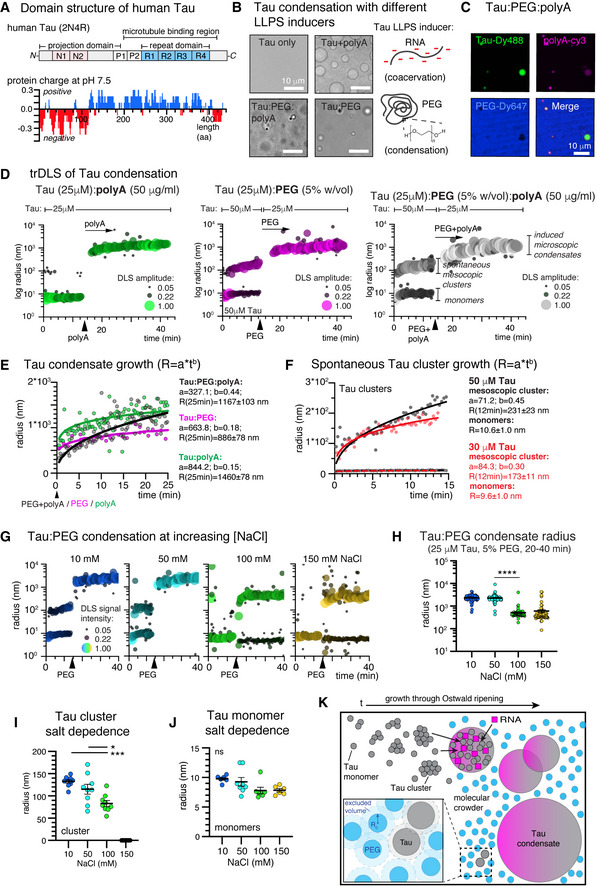
Biomolecular condensation of the neuronal microtubule‐associated protein Tau (MAPT) can be induced by coacervation with polyanions like RNA, or by molecular crowding. Tau condensates have been linked to both functional microtubule binding and pathological aggregation in neurodegenerative diseases. We find that molecular crowding and coacervation with RNA, two conditions likely coexisting in the cytosol, synergize to enable Tau condensation at physiological buffer conditions and to produce condensates with a strong affinity to charged surfaces. During condensate‐mediated microtubule polymerization, their synergy enhances bundling and spatial arrangement of microtubules. We further show that different Tau condensates efficiently induce pathological Tau aggregates in cells, including accumulations at the nuclear envelope that correlate with nucleocytoplasmic transport deficits. Fluorescent lifetime imaging reveals different molecular packing densities of Tau in cellular accumulations and a condensate‐like density for nuclear‐envelope Tau. These findings suggest that a complex interplay between interaction partners, post‐translational modifications, and molecular crowding regulates the formation and function of Tau condensates. Conditions leading to prolonged existence of Tau condensates may induce the formation of seeding‐competent Tau and lead to distinct cellular Tau accumulations. Condensation of the microtubule‐associated protein Tau is induced by the presence of polyanions like RNA or by molecular crowding. Here we show that these conditions have synergistic effects on Tau condensation and Tau‐dependent microtubule bundling in vitro, and on the seeding of Tau aggregates in cells. Conditions that induce liquid‐liquid phase separation have distinct effects on Tau condensation and subcellular localization, including formation of Tau‐positive inclusions along the nuclear envelope that correlate with nucleocytoplasmic transport deficits.
Overview
CoChat Summary
TL;DR
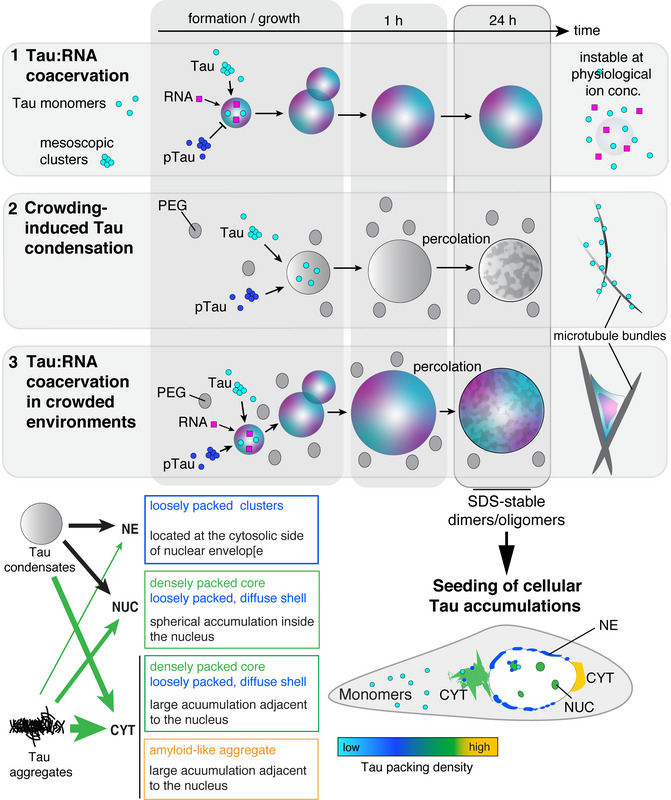
Molecular crowding and RNA synergize to enable Tau condensation at physiological ion conditions and produce condensates with strong affinity to charged surfaces. Aged Tau condensates, including non-percolating Tau:RNA coacervates, seed pathological Tau accumulations in cells, including nuclear-envelope Tau linked to nucleocytoplasmic transport deficits.
Key findings
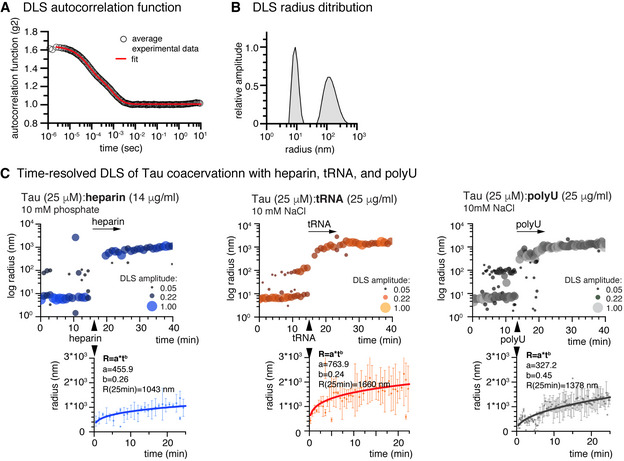
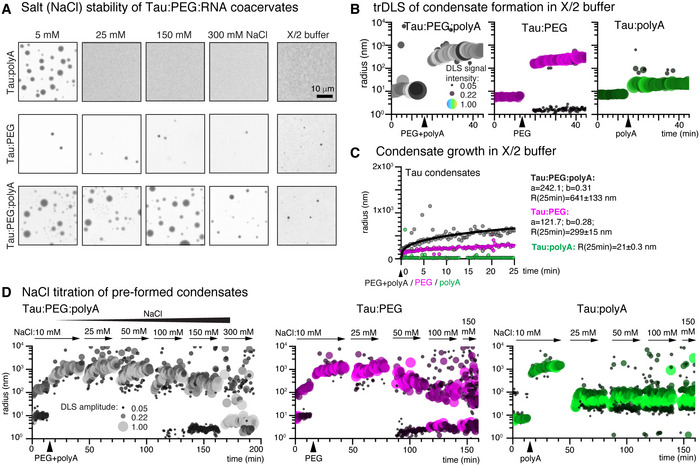
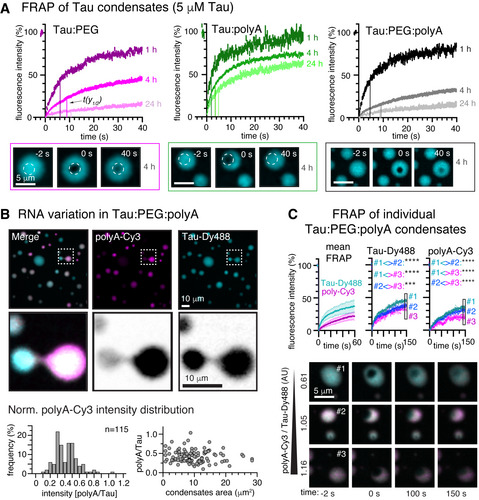
- Crowding plus RNA stabilized Tau condensates against salt: Tau:RNA coacervates disappeared at 25 mM NaCl, Tau:PEG condensates destabilized at 100 mM NaCl, but Tau:PEG:RNA condensates did not change between 5 and 150 mM NaCl and still formed at 300 mM NaCl. In axoplasm-like X/2 buffer, Tau:PEG formed condensates and Tau:PEG:RNA formed more robustly, while Tau:RNA coacervation was inhibited. Growth kinetics gave coarsening exponents b = 0.44 for Tau:PEG:RNA, b = 0.15 for Tau:RNA, and b = 0.18 for Tau:PEG.
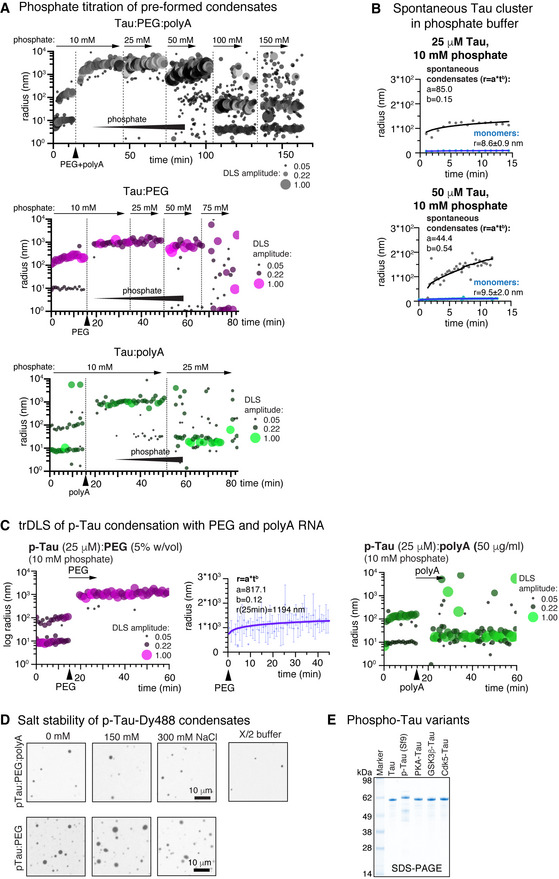
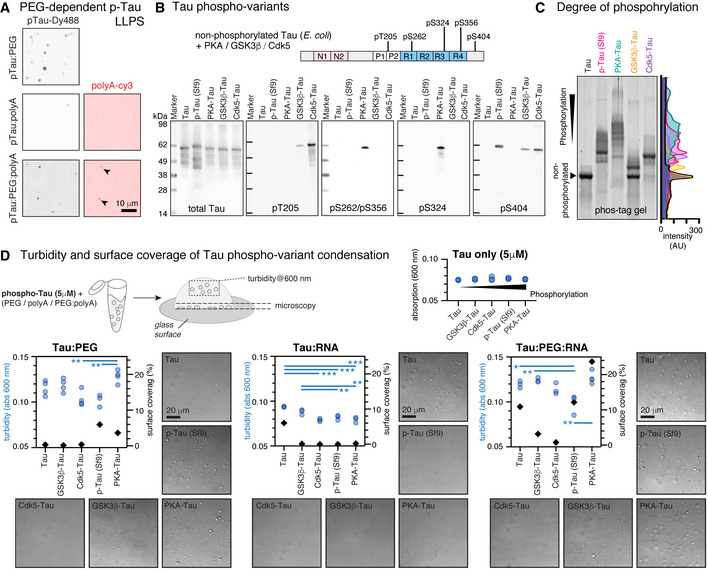
- Phosphorylated Tau failed to coacervate with RNA alone but condensed with PEG; in p-Tau:PEG:RNA systems RNA co-partitioned into condensates and condensates formed at elevated NaCl. PKA-phosphorylated Tau showed the highest in-solution LLPS and surface wetting in Tau:PEG:RNA, while pT205 and pS404 had little effect or inhibited condensation and pS262/pS356/pS324 appeared to favor LLPS.
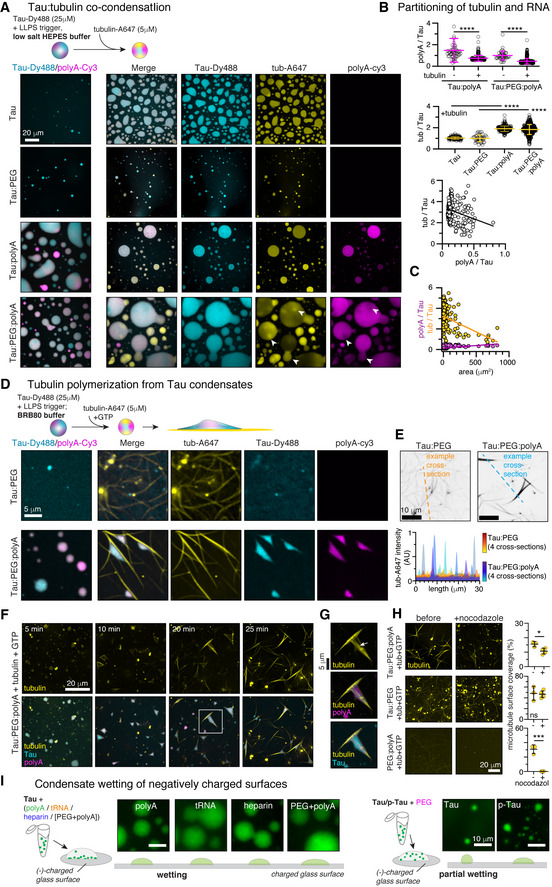
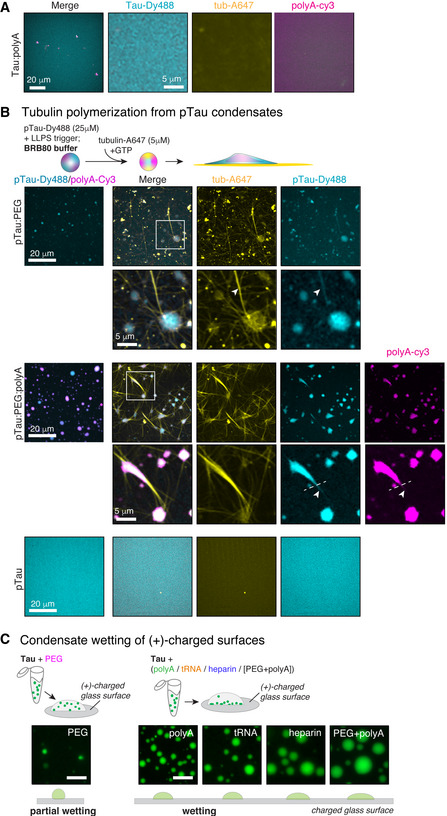
- Tubulin co-partitioned into Tau:PEG, Tau:RNA, and Tau:PEG:RNA condensates, with RNA and tubulin competing for co-condensation. Tau:PEG:RNA produced thick MT bundles arranged around persisting condensates, whereas Tau:PEG produced thin, partly curved bundles; nocodazole stability was higher for Tau:PEG than Tau:PEG:RNA MTs.
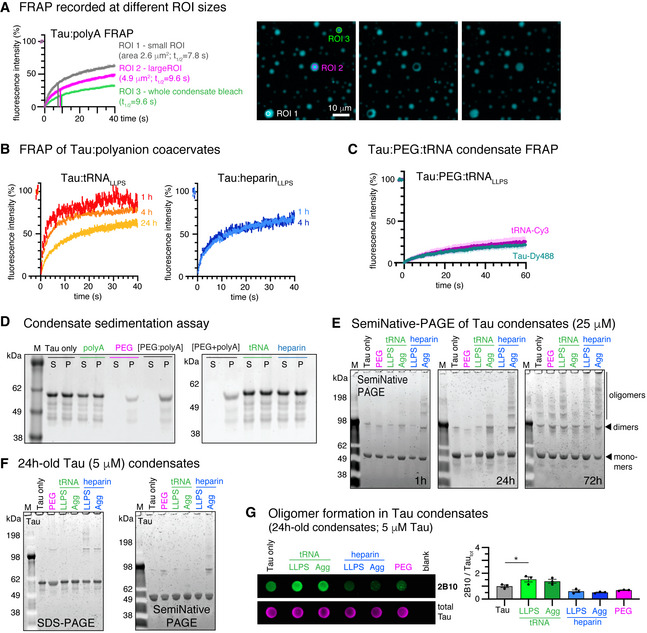
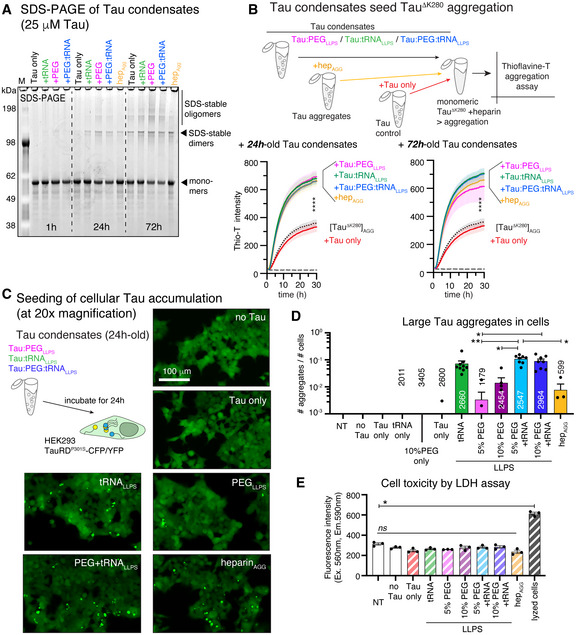
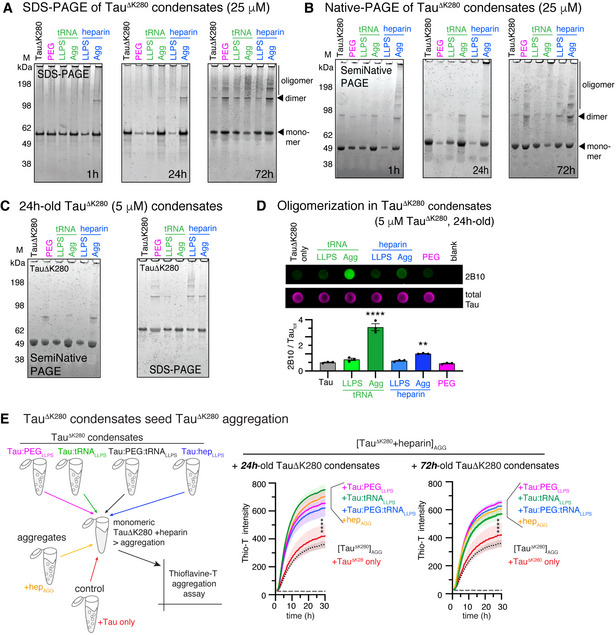
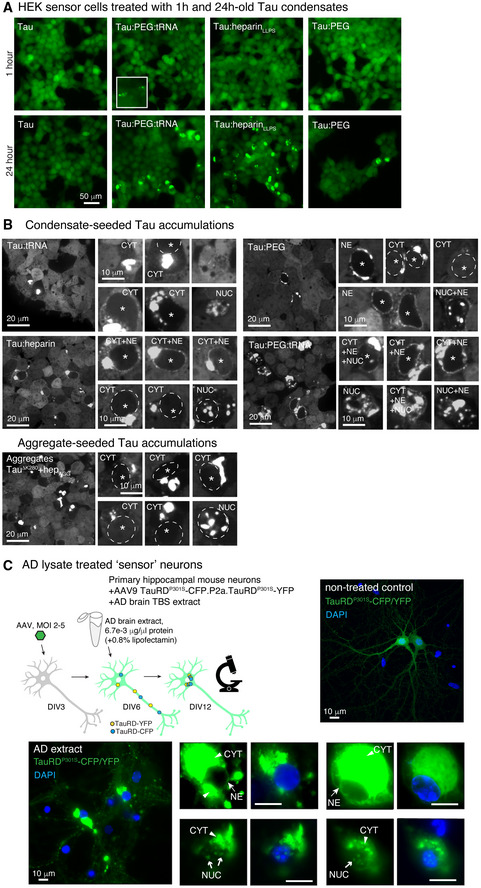
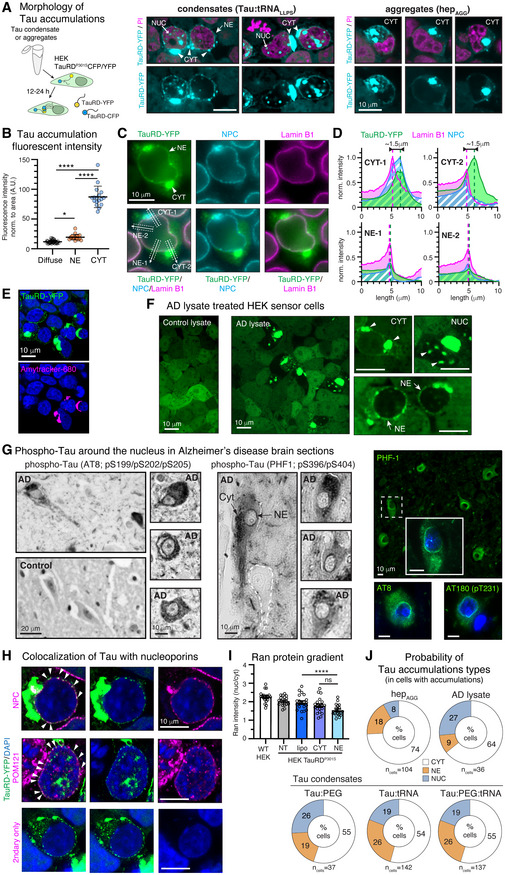
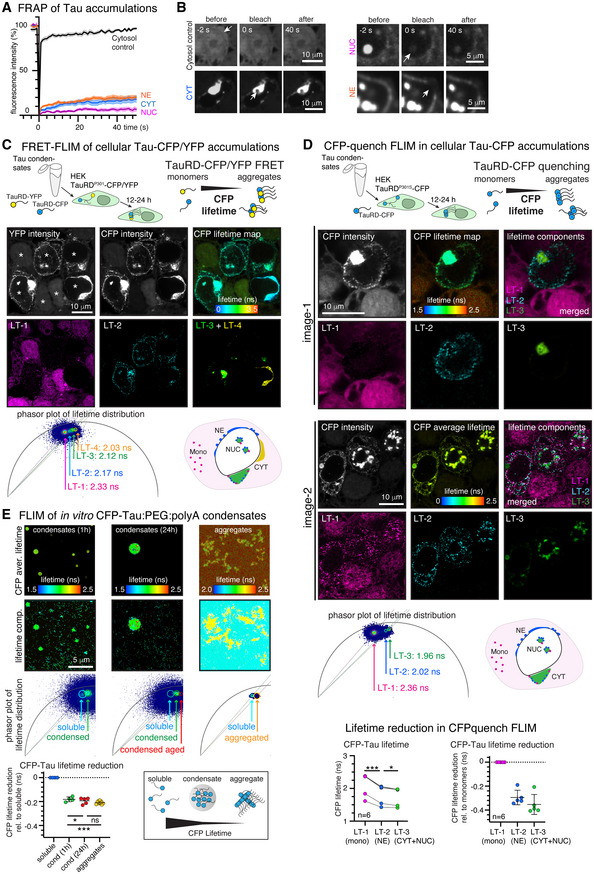
- 24 h-old Tau:PEG, Tau:RNA, and Tau:PEG:RNA condensates formed SDS-stable Tau dimers/oligomers and increased TauΔK280 aggregation in Thioflavin-T assays. Tau:RNA coacervates induced Tau aggregation in HEK sensor cells more efficiently than PEG-induced condensates and similar to Tau:PEG:RNA; RNA-containing condensates induced nuclear-envelope Tau with the highest frequency (26%), while heparin-induced aggregates mostly seeded cytoplasmic accumulations (74% CYT, 18% NE, 8% NUC). NE Tau had faster FRAP (t1/2 ≈ 2.5 s) than CYT Tau (t1/2 ≈ 7 s), and FLIM distinguished soluble Tau (LT-1 ~2.3 ns), NE Tau (LT-2 ~2.2 ns), CYT/NUC Tau (LT-3 ~2.1 ns), and a subset of CYT Tau (LT-4 ~2.0 ns).
Methods
- In vitro LLPS used recombinant human full-length Tau (2N4R, 5 µM), p-Tau from Sf9 cells, TauΔK280, and in vitro phosphorylated Tau variants; condensation was induced with polyA, tRNA, heparin, PEG8000, or combinations. Main techniques included time-resolved dynamic light scattering, light/confocal microscopy, turbidity, FRAP, FLIM, sedimentation assays, SDS–PAGE, semi-native PAGE, dot blots, and Thioflavin-T aggregation assays.
- Cellular and tissue work used HEK293 TauRDP301S-CFP/YFP sensor cells treated with 24 h-old Tau condensates or AD brain lysate, primary mouse hippocampal neurons expressing TauRDP301S-CFP/YFP, and human AD/control brain sections. Analyses included confocal imaging, FRAP, FLIM, immunofluorescence, and statistics by Student’s t-test or one-way ANOVA with Tukey/Holmes–Sidak correction.
Limitations
- The paper states that effects of individual or grouped Tau post-translational modifications need further investigation due to their complexity, and that preferential induction of certain Tau accumulation types by different seeds is not conclusive at this point. It also notes that NE Tau fusion was not observed, possibly due to time/spatial resolution limits or progressed percolation, and that in vitro versus cellular differences (crowding, ion composition, pH, other biomolecules; TauRD versus full-length Tau) may affect FLIM comparisons.
- Evident from the text: many mechanistic conclusions rely on in vitro reconstitution with purified proteins and on HEK sensor cells, with 5% PEG8000 used to induce LLPS at physiological Tau concentrations; the work does not directly demonstrate endogenous Tau condensates in neurons, and cellular seeding assays use lipofectamine and tagged TauRD constructs.
Model-written summary. Check it against the paper before relying on it.
Integrity signals
Registry
Cites
Statistics
Figures
Verification
Claims the paper makes
0 Valid · 0 Not valid · 54 Not checked · 252 Own results and interpretations
A result the paper reports from its own data — it cites no other source for it, so there is none to check. The quote shows it is in the paper.
In the paper
“We find that molecular crowding and coacervation with RNA, two conditions likely coexisting in the cytosol, synergize to enable Tau condensation at physiological buffer conditions and to produce condensates with a strong affinity to charged surfaces.”
§ Molecular crowding and RNA synergize to promote phase separation, microtubule interaction, and seeding of Tau condensates > Abstract
boostedstates an association- Asserted: passes — The authors put it forward as true.
- Checkable: passes — It can be checked against evidence.
- Load-bearing: passes — The paper’s conclusions depend on it.
- Based: passes — The paper gives a reason why it holds.
A result the paper reports from its own data — it cites no other source for it, so there is none to check. The quote shows it is in the paper.
In the paper
“We further show that different Tau condensates efficiently induce pathological Tau aggregates in cells, including accumulations at the nuclear envelope that correlate with nucleocytoplasmic transport deficits.”
§ Molecular crowding and RNA synergize to promote phase separation, microtubule interaction, and seeding of Tau condensates > Abstract
plainstates a cause- Asserted: passes — The authors put it forward as true.
- Checkable: passes — It can be checked against evidence.
- Load-bearing: passes — The paper’s conclusions depend on it.
- Based: passes — The paper gives a reason why it holds.
A result the paper reports from its own data — it cites no other source for it, so there is none to check. The quote shows it is in the paper.
In the paper
“Fluorescent lifetime imaging reveals different molecular packing densities of Tau in cellular accumulations and a condensate‐like density for nuclear‐envelope Tau.”
§ Molecular crowding and RNA synergize to promote phase separation, microtubule interaction, and seeding of Tau condensates > Abstract
plainstates an association- Asserted: passes — The authors put it forward as true.
- Checkable: passes — It can be checked against evidence.
- Load-bearing: passes — The paper’s conclusions depend on it.
- Based: passes — The paper gives a reason why it holds.
A result the paper reports from its own data — it cites no other source for it, so there is none to check. The quote shows it is in the paper.
In the paper
“We find that molecular crowding and coacervation with RNA, two conditions likely coexisting in the cytosol, synergize to enable Tau condensation at physiological buffer conditions and to produce condensates with a strong affinity to charged surfaces.”
- Also stated in: § RNA and crowding synergize during Tau condensation · plain
“In summary, we found that polyanions and crowding synergize during Tau condensation producing Tau condensates that exhibit growth kinetics indicative of Ostwald ripening (= growth through fusion of condensates) as previously reported for other biomolecular condensates (Van Lindt et al, 2021).”
§ Molecular crowding and RNA synergize to promote phase separation, microtubule interaction, and seeding of Tau condensates > Abstract
plainstates a cause- Asserted: passes — The authors put it forward as true.
- Checkable: passes — It can be checked against evidence.
- Load-bearing: passes — The paper’s conclusions depend on it.
- Based: passes — The paper gives a reason why it holds.
- Rests on an assumption not shown here.
- Also stated in: § RNA and crowding synergize during Tau condensation · plain
A result the paper reports from its own data — it cites no other source for it, so there is none to check. The quote shows it is in the paper.
In the paper
“During condensate‐mediated microtubule polymerization, their synergy enhances bundling and spatial arrangement of microtubules.”
§ Molecular crowding and RNA synergize to promote phase separation, microtubule interaction, and seeding of Tau condensates > Abstract
plainstates a cause- Asserted: passes — The authors put it forward as true.
- Checkable: passes — It can be checked against evidence.
- Load-bearing: passes — The paper’s conclusions depend on it.
- Based: passes — The paper gives a reason why it holds.
146 more claims
Create a free account to see all 306 claims and to verify the 68 references still open.
- It may state two separate claims as one. 117
- Probably not a substantial claim. 51
- The quote only partly states this claim. 2
Self-check
Percentages, sums and reported differences re-computed from the paper’s own numbers.
Each contradiction between two passages listed here was confirmed by an independent check.
Rated minor: it would not touch a result — a value no result rests on, a p-value that stays on the same side of the significance level, or a conflict that is clerical, resolved elsewhere in the paper, or outside its own findings.
In the paper
§ Molecular crowding and RNA synergize to promote phase separation, microtubule interaction, and seeding of Tau condensates > Results > Nuclear envelope Tau is loosely packed compared to cytosolic Tau aggregates
“High‐resolution CFP FLIM of HEK sensor cells expressing TauRDP301L‐CFP/YFP and treated with Tau condensates.”
§ Molecular crowding and RNA synergize to promote phase separation, microtubule interaction, and seeding of Tau condensates > Results > Nuclear envelope Tau is loosely packed compared to cytosolic Tau aggregates
“FRET‐FLIM imaging of HEK sensor cells expressing TauRDP301S‐CFP/YFP revealed reduced CFP lifetimes in all Tau accumulations compared to cytosolic soluble TauRD‐CFP (Fig 8C).”
Rated minor: it would not touch a result — a value no result rests on, a p-value that stays on the same side of the significance level, or a conflict that is clerical, resolved elsewhere in the paper, or outside its own findings.
In the paper
§ Molecular crowding and RNA synergize to promote phase separation, microtubule interaction, and seeding of Tau condensates > Results > Decoupling of Tau seeding potential and percolation in Tau coacervates
“tRNALLPS: P = 0.0403 compared to Tau only; Fig EV4G”
§ Molecular crowding and RNA synergize to promote phase separation, microtubule interaction, and seeding of Tau condensates > Results > Crowding, but not polyanions, induce gelation of Tau condensates
“P = 0.043 for tRNALLPS”
Rated minor: it would not touch a result — a value no result rests on, a p-value that stays on the same side of the significance level, or a conflict that is clerical, resolved elsewhere in the paper, or outside its own findings.
In the paper
§ Molecular crowding and RNA synergize to promote phase separation, microtubule interaction, and seeding of Tau condensates > Results > Nuclear envelope Tau is loosely packed compared to cytosolic Tau aggregates
“Similar results were obtained upon full bleach of 4 h‐old Tau:PEG:RNA condensates (Fig EV4A).”
§ Molecular crowding and RNA synergize to promote phase separation, microtubule interaction, and seeding of Tau condensates > Results > Crowding, but not polyanions, induce gelation of Tau condensates
“FRAP of 4 h‐old Tau:polyA condensates comparing different FRAP ROI sizes at similar condensate size (ROI1 versus ROI2) and full condensate bleach (ROI3).”
Rated minor: it would not touch a result — a value no result rests on, a p-value that stays on the same side of the significance level, or a conflict that is clerical, resolved elsewhere in the paper, or outside its own findings.
In the paper
§ Molecular crowding and RNA synergize to promote phase separation, microtubule interaction, and seeding of Tau condensates > Results > Decoupling of Tau seeding potential and percolation in Tau coacervates
“1.2 µM Tau in culture medium including 1% lipofectamine for 2 h”
§ Molecular crowding and RNA synergize to promote phase separation, microtubule interaction, and seeding of Tau condensates > Materials and Methods > Cellular Tau seeding assay
“Tau condensates were mixed with 0.8% lipofectamine 2000 (Invitrogen)”
Rated minor: it would not touch a result — a value no result rests on, a p-value that stays on the same side of the significance level, or a conflict that is clerical, resolved elsewhere in the paper, or outside its own findings.
In the paper
§ Molecular crowding and RNA synergize to promote phase separation, microtubule interaction, and seeding of Tau condensates > Results > Decoupling of Tau seeding potential and percolation in Tau coacervates
“High concentrations of heparin (287 µg/ml; hepAGG) induce β‐structured Tau aggregates”
§ Molecular crowding and RNA synergize to promote phase separation, microtubule interaction, and seeding of Tau condensates > Materials and Methods > Tau LLPS and aggregation sample preparation
“0.287 µg/ml heparin (4:1, Tau:heparin) to 25 µM Tau”
1 more finding
Create a free account to see every finding of this check.
Citations
Cites
Neuropathological stageing of Alzheimer-related changes.
Braak, H., & Braak, E. (1991) · Acta Neuropathologica · doi:10.1007/bf00308809 · Cited by 16,123
The kinetics of precipitation from supersaturated solid solutions
Lifshitz, I. M., & Slyozov, V. V. (1961) · Journal of Physics and Chemistry of Solids · doi:10.1016/0022-3697(61)90054-3 · Cited by 8,558
Liquid phase condensation in cell physiology and disease
Shin, Y., & Brangwynne, C. P. (2017) · Science · doi:10.1126/science.aaf4382 · Cited by 4,212
A Liquid-to-Solid Phase Transition of the ALS Protein FUS Accelerated by Disease Mutation
Patel, A., Lee, H. O., Jawerth, L., Maharana, S., Jahnel, M., Hein, M. Y., Stoynov, S., Mahamid, J., Saha, S., Franzmann, T. M., et al. (2015) · Cell · doi:10.1016/j.cell.2015.07.047 · Cited by 3,282
Liquid-Liquid Phase Separation in Biology
Hyman, A. A., Weber, C. A., & Jülicher, F. (2014) · Annual Review of Cell and Developmental Biology · doi:10.1146/annurev-cellbio-100913-013325 · Cited by 3,155
Molliex, A., Temirov, J., Lee, J., Coughlin, M., Kanagaraj, A. P., Kim, H. J., Mittag, T., & Taylor, J. P. (2015) · Cell · doi:10.1016/j.cell.2015.09.015 · Cited by 2,893
Provencher, S. W. (1982) · Computer Physics Communications · doi:10.1016/0010-4655(82)90174-6 · Cited by 2,763
Molecular Size Distribution in Three Dimensional Polymers. I. Gelation 1
Flory, P. J. (1941) · Journal of the American Chemical Society · doi:10.1021/ja01856a061 · Cited by 1,873
Late stages of spinodal decomposition in binary mixtures
Siggia, E. D. (1979) · Physical Review A · doi:10.1103/physreva.20.595 · Cited by 1,296
Protein misfolding, aggregation, and conformational strains in neurodegenerative diseases
Soto, C., & Pritzkow, S. (2018) · Nature Neuroscience · doi:10.1038/s41593-018-0235-9 · Cited by 1,180
Phosphate-binding Tag, a New Tool to Visualize Phosphorylated Proteins
Kinoshita, E., Kinoshita‐Kikuta, E., Takiyama, K., & Koike, T. (2005) · Molecular & Cellular Proteomics · doi:10.1074/mcp.t500024-mcp200 · Cited by 1,112
Tau protein liquid–liquid phase separation can initiate tau aggregation
Wegmann, S., Eftekharzadeh, B., Tepper, K., Zoltowska, K. M., Bennett, R. E., Dujardin, S., Laskowski, P. R., MacKenzie, D., Kamath, T., Commins, C., et al. (2018) · The EMBO Journal · doi:10.15252/embj.201798049 · Cited by 1,102
Self-citationConsolidation alters motor sequence-specific distributed representations
Pinsard, B., Boutin, A., Gabitov, E., Lungu, O., Benali, H., & Doyon, J. (2019) · eLife · doi:10.7554/elife.39324 · Cited by 1,066
Goedert, M., Jakes, R., Spillantini, M. G., Hasegawa, M., Smith, M. J., & Crowther, R. A. (1996) · Nature · doi:10.1038/383550a0 · Cited by 1,036
ATP as a biological hydrotrope
Patel, A., Malinovska, L., Saha, S., Wang, J., Alberti, S., Krishnan, Y., & Hyman, A. A. (2017) · Science · doi:10.1126/science.aaf6846 · Cited by 1,019
Physical Principles Underlying the Complex Biology of Intracellular Phase Transitions
Choi, J.-M., Holehouse, A. S., & Pappu, R. V. (2020) · Annual Review of Biophysics · doi:10.1146/annurev-biophys-121219-081629 · Cited by 1,015
Stockmayer, W. H. (1944) · The Journal of Chemical Physics · doi:10.1063/1.1723922 · Cited by 946
α‐Synuclein aggregation nucleates through liquid‐liquid phase separation
Ray, S., Singh, N., Kumar, R., Patel, K., Pandey, S., Datta, D., Mahato, J., Panigrahi, R., Navalkar, A., Mehra, S., et al. (2020) · Nature Chemistry · doi:10.1038/s41557-020-0465-9 · Cited by 863
Ambadipudi, S., Biernat, J., Riedel, D., Mandelkow, E., & Zweckstetter, M. (2017) · Nature Communications · doi:10.1038/s41467-017-00480-0 · Cited by 782
Self-citationPrion-like mechanisms in neurodegenerative diseases
Frost, B., & Diamond, M. I. (2010) · Nature Reviews Neuroscience · doi:10.1038/nrn2786 · Cited by 776
Phase separation in biology; functional organization of a higher order
Mitrea, D. M., & Kriwacki, R. W. (2016) · Cell Communication and Signaling · doi:10.1186/s12964-015-0125-7 · Cited by 726
Proteopathic tau seeding predicts tauopathy in vivo
Holmes, B. B., Furman, J. L., Mahan, T. E., Yamasaki, T. R., Mirbaha, H., Eades, W. C., Belaygorod, L., Cairns, N. J., Holtzman, D. M., & Diamond, M. I. (2014) · Proceedings of the National Academy of Sciences · doi:10.1073/pnas.1411649111 · Cited by 696
Evaluating phase separation in live cells: diagnosis, caveats, and functional consequences
McSwiggen, D. T., Mir, M., Darzacq, X., & Tjian, R. (2019) · Genes & Development · doi:10.1101/gad.331520.119 · Cited by 649
Neuronal activity regulates extracellular tau in vivo
Yamada, K., Holth, J. K., Liao, F., Stewart, F. R., Mahan, T. E., Jiang, H., Cirrito, J. R., Patel, T. K., Hochgräfe, K., Mandelkow, E., et al. (2014) · The Journal of Experimental Medicine · doi:10.1084/jem.20131685 · Cited by 614
Self-citationProtein condensates as aging Maxwell fluids
Jawerth, L., Fischer-Friedrich, E., Saha, S., Wang, J., Franzmann, T., Zhang, X., Sachweh, J., Ruer, M., Ijavi, M., Saha, S., et al. (2020) · Science · doi:10.1126/science.aaw4951 · Cited by 572
Kampers, T., Friedhoff, P., Biernat, J., Mandelkow, E.-M., & Mandelkow, E. (1996) · FEBS Letters · doi:10.1016/s0014-5793(96)01386-5 · Cited by 548
Self-citationTau Protein Disrupts Nucleocytoplasmic Transport in Alzheimer’s Disease
Eftekharzadeh, B., Daigle, J. G., Kapinos, L. E., Coyne, A., Schiantarelli, J., Carlomagno, Y., Cook, C., Miller, S. J., Dujardin, S., Amaral, A. S., et al. (2018) · Neuron · doi:10.1016/j.neuron.2018.07.039 · Cited by 460
Self-citationPhysical principles of intracellular organization via active and passive phase transitions
Berry, J., Brangwynne, C. P., & Haataja, M. (2018) · Reports on Progress in Physics · doi:10.1088/1361-6633/aaa61e · Cited by 452
Kaufman, S. K., Sanders, D. W., Thomas, T. L., Ruchinskas, A. J., Vaquer-Alicea, J., Sharma, A. M., Miller, T. M., & Diamond, M. I. (2016) · Neuron · doi:10.1016/j.neuron.2016.09.055 · Cited by 450
Liquid-liquid phase separation induces pathogenic tau conformations in vitro
Kanaan, N. M., Hamel, C., Grabinski, T., & Combs, B. (2020) · Nature Communications · doi:10.1038/s41467-020-16580-3 · Cited by 397
Local Nucleation of Microtubule Bundles through Tubulin Concentration into a Condensed Tau Phase
Hernández-Vega, A., Braun, M., Scharrel, L., Jahnel, M., Wegmann, S., Hyman, B. T., Alberti, S., Diez, S., & Hyman, A. A. (2017) · Cell Reports · doi:10.1016/j.celrep.2017.08.042 · Cited by 395
Self-citationSnead, W. T., & Gladfelter, A. S. (2019) · Molecular Cell · doi:10.1016/j.molcel.2019.09.016 · Cited by 356
Interaction of tau with the RNA-Binding Protein TIA1 Regulates tau Pathophysiology and Toxicity
Vanderweyde, T., Apicco, D. J., Youmans-Kidder, K., Ash, P. E. A., Cook, C., Lummertz da Rocha, E., Jansen-West, K., Frame, A. A., Citro, A., Leszyk, J. D., et al. (2016) · Cell Reports · doi:10.1016/j.celrep.2016.04.045 · Cited by 342
RNA stores tau reversibly in complex coacervates
Zhang, X., Lin, Y., Eschmann, N. A., Zhou, H., Rauch, J. N., Hernandez, I., Guzman, E., Kosik, K. S., & Han, S. (2017) · PLOS Biology · doi:10.1371/journal.pbio.2002183 · Cited by 302
Kar, M., Dar, F., Welsh, T. J., Vogel, L. T., Kühnemuth, R., Majumdar, A., Krainer, G., Franzmann, T. M., Alberti, S., Seidel, C. A. M., et al. (2022) · Proceedings of the National Academy of Sciences · doi:10.1073/pnas.2202222119 · Cited by 282
Liquid–liquid phase separation of tau protein: The crucial role of electrostatic interactions
Boyko, S., Qi, X., Chen, T.-H., Surewicz, K., & Surewicz, W. K. (2019) · Journal of Biological Chemistry · doi:10.1074/jbc.ac119.009198 · Cited by 271
Lost after translation: missorting of Tau protein and consequences for Alzheimer disease
Zempel, H., & Mandelkow, E. (2014) · Trends in Neurosciences · doi:10.1016/j.tins.2014.08.004 · Cited by 265
Self-citationLysine/RNA-interactions drive and regulate biomolecular condensation
Ukmar-Godec, T., Hutten, S., Grieshop, M. P., Rezaei-Ghaleh, N., Cima-Omori, M.-S., Biernat, J., Mandelkow, E., Söding, J., Dormann, D., & Zweckstetter, M. (2019) · Nature Communications · doi:10.1038/s41467-019-10792-y · Cited by 261
Self-citationTau oligomers and tau toxicity in neurodegenerative disease
Ward, S., Himmelstein, D. S., Lancia, J. K., & Binder, L. I. (2012) · Biochemical Society Transactions · doi:10.1042/bst20120134 · Cited by 258
Single-molecule spectroscopy reveals polymer effects of disordered proteins in crowded environments
Soranno, A., König, I., Borgia, M. B., Hofmann, H., Zosel, F., Nettels, D., & Schuler, B. (2014) · Proceedings of the National Academy of Sciences · doi:10.1073/pnas.1322611111 · Cited by 242
Inert and seed-competent tau monomers suggest structural origins of aggregation
Mirbaha, H., Chen, D., Morazova, O. A., Ruff, K. M., Sharma, A. M., Liu, X., Goodarzi, M., Pappu, R. V., Colby, D. W., Mirzaei, H., et al. (2018) · eLife · doi:10.7554/elife.36584 · Cited by 234
Tau aggregates are RNA-protein assemblies that mislocalize multiple nuclear speckle components
Lester, E., Ooi, F. K., Bakkar, N., Ayers, J., Woerman, A. L., Wheeler, J., Bowser, R., Carlson, G. A., Prusiner, S. B., & Parker, R. (2021) · Neuron · doi:10.1016/j.neuron.2021.03.026 · Cited by 232
Microtubules gate tau condensation to spatially regulate microtubule functions
Tan, R., Lam, A. J., Tan, T., Han, J., Nowakowski, D. W., Vershinin, M., Simó, S., Ori-McKenney, K. M., & McKenney, R. J. (2019) · Nature Cell Biology · doi:10.1038/s41556-019-0375-5 · Cited by 231
Lamin Dysfunction Mediates Neurodegeneration in Tauopathies
Frost, B., Bardai, F. H., & Feany, M. B. (2016) · Current Biology · doi:10.1016/j.cub.2015.11.039 · Cited by 226
Domain Conformation of Tau Protein Studied by Solution Small-Angle X-ray Scattering
Mylonas, E., Hascher, A., Bernadó, P., Blackledge, M., Mandelkow, E., & Svergun, D. I. (2008) · Biochemistry · doi:10.1021/bi800900d · Cited by 218
Self-citationFerrer, I., López-González, I., Carmona, M., Arregui, L., Dalfó, E., Torrejón-Escribano, B., Diehl, R., & Kovacs, G. G. (2014) · Journal of Neuropathology & Experimental Neurology · doi:10.1097/nen.0000000000000030 · Cited by 217
Neurofibrillary Tangles and Alzheimer’s Disease
Brion, J. (1998) · European Neurology · doi:10.1159/000007969 · Cited by 209
The “Jaws” of the Tau-Microtubule Interaction
Mukrasch, M. D., von Bergen�, M., Biernat, J., Fischer, D., Griesinger, C., Mandelkow�, E., & Zweckstetter, M. (2007) · Journal of Biological Chemistry · doi:10.1074/jbc.m607159200 · Cited by 205
Self-citationPaonessa, F., Evans, L., Solanki, R., Larrieu, D., Wray, S., Hardy, J., Jackson, S. P., & Livesey, F. J. (2019) · Cell Reports · doi:10.1016/j.celrep.2018.12.085 · Cited by 202
Barghorn, S., Biernat, J., & Mandelkow�, E. (2005) · Humana Press eBooks · doi:10.1385/1-59259-874-9:035 · Cited by 195
Self-citationDeleault, N. R., Geoghegan, J. C., Nishina, K. A., Kascsak, R. J., Williamson, R. A., & Supattapone, S. (2005) · Journal of Biological Chemistry · doi:10.1074/jbc.m503973200 · Cited by 194
Acetylation Disfavors Tau Phase Separation
Ferreon, J. C., Jain, A., Choi, K.-J., Tsoi, P. S., MacKenzie, K. R., Jung, S. Y., & Ferreon, A. C. (2018) · International Journal of Molecular Sciences · doi:10.3390/ijms19051360 · Cited by 183
Janning, D., Igaev, M., Sündermann, F., Brühmann, J., Beutel, O., Heinisch, J. J., Bakota, L., Piehler, J., Junge, W., & Brandt, R. (2014) · Molecular Biology of the Cell · doi:10.1091/mbc.e14-06-1099 · Cited by 176
The Cochaperone BAG2 Sweeps Paired Helical Filament- Insoluble Tau from the Microtubule
Carrettiero, D. C., Hernández, I., Neveu, P. A., Papagiannakopoulos, T. Y., & Kosik, K. S. (2009) · Journal of Neuroscience · doi:10.1523/jneurosci.4660-08.2009 · Cited by 175
Kinetically distinct phases of tau on microtubules regulate kinesin motors and severing enzymes
Siahaan, V., Krattenmacher, J., Hyman, A. A., Diez, S., Hernández-Vega, A., Lansky, Z., & Braun, M. (2019) · Nature Cell Biology · doi:10.1038/s41556-019-0374-6 · Cited by 169
Narrow equilibrium window for complex coacervation of tau and RNA under cellular conditions
Lin, Y., McCarty, J., Rauch, J. N., Delaney, K. T., Kosik, K. S., Fredrickson, G. H., Shea, J.-E., & Han, S. (2019) · eLife · doi:10.7554/elife.42571 · Cited by 165
TIA1 potentiates tau phase separation and promotes generation of toxic oligomeric tau
Ash, P. E. A., Lei, S., Shattuck, J., Boudeau, S., Carlomagno, Y., Medalla, M., Mashimo, B. L., Socorro, G., Al-Mohanna, L. F. A., Jiang, L., et al. (2021) · Proceedings of the National Academy of Sciences · doi:10.1073/pnas.2014188118 · Cited by 159
Self-citationAccumulation of tau induced in neurites by microglial proinflammatory mediators
Gorlovoy, P., Larionov, S., Pham, T. T. H., & Neumann, H. (2009) · The FASEB Journal · doi:10.1096/fj.08-123877 · Cited by 156
Chromatin mechanics dictates subdiffusion and coarsening dynamics of embedded condensates
Lee, D. S. W., Wingreen, N. S., & Brangwynne, C. P. (2021) · Nature Physics · doi:10.1038/s41567-020-01125-8 · Cited by 149
Boyko, S., Surewicz, K., & Surewicz, W. K. (2020) · Proceedings of the National Academy of Sciences · doi:10.1073/pnas.2012460117 · Cited by 144
Formation and Propagation of Tau Oligomeric Seeds
Gerson, J. E., & Kayed, R. (2013) · Frontiers in Neurology · doi:10.3389/fneur.2013.00093 · Cited by 140
PKA modulates GSK‐3β‐ and cdk5‐catalyzed phosphorylation of tau in site‐ and kinase‐specific manners
Liu, F., Liang, Z., Shi, J., Yin, D., El-Akkad, E., Grundke-Iqbal, I., Iqbal, K., & Gong, C.-X. (2006) · FEBS Letters · doi:10.1016/j.febslet.2006.10.033 · Cited by 138
Generalized models for bond percolation transitions of associative polymers
Choi, J.-M., Hyman, A. A., & Pappu, R. V. (2020) · Physical Review E · doi:10.1103/physreve.102.042403 · Cited by 134
Structural basis of lentiviral subversion of a cellular protein degradation pathway
Schwefel, D., Groom, H. C. T., Boucherit, V., Christodoulou, E., Walker, P. A., Stoye, J. P., Bishop, K. N., & Taylor, I. A. (2013) · Nature · doi:10.1038/nature12815 · Cited by 133
The proline-rich domain promotes Tau liquid–liquid phase separation in cells
Zhang, X., Vigers, M., McCarty, J., Rauch, J. N., Fredrickson, G. H., Wilson, M. Z., Shea, J.-E., Han, S., & Kosik, K. S. (2020) · Journal of Cell Biology · doi:10.1083/jcb.202006054 · Cited by 126
Effects of surface wettability and liquid viscosity on the dynamic wetting of individual drops
Chen, L., & Bonaccurso, E. (2014) · Physical Review E · doi:10.1103/physreve.90.022401 · Cited by 116
Nuclear Pore Complex Proteins in Alzheimer Disease
Sheffield, L. G., Miskiewicz, H. B., Tannenbaum, L. B., & Mirra, S. S. (2006) · Journal of Neuropathology & Experimental Neurology · doi:10.1097/01.jnen.0000195939.40410.08 · Cited by 115
Lin, Y., Fichou, Y., Zeng, Z., Hu, N. Y., & Han, S. (2020) · ACS Chemical Neuroscience · doi:10.1021/acschemneuro.9b00627 · Cited by 107
Colloid osmotic parameterization and measurement of subcellular crowding
Mitchison, T. J. (2019) · Molecular Biology of the Cell · doi:10.1091/mbc.e18-09-0549 · Cited by 96
Inhibition of tubulin assembly by RNA and other polyanions: evidence for a required protein.
Bryan, J. B., Nagle, B. W., & Doenges, K. H. (1975) · Proceedings of the National Academy of Sciences · doi:10.1073/pnas.72.9.3570 · Cited by 92
Chen, W., Young, L. J., Lu, M., Zaccone, A., Ströhl, F., Yu, N., Kaminski Schierle, G. S., & Kaminski, C. F. (2017) · Nano Letters · doi:10.1021/acs.nanolett.6b03686 · Cited by 85
Tau prion-like propagation: state of the art and current challenges
Dujardin, S., & Hyman, B. T. (2019) · Advances in Experimental Medicine and Biology · doi:10.1007/978-981-32-9358-8_23 · Cited by 84
Schubert, R., Meyer, A., Baitan, D., Dierks, K., Perbandt, M., & Betzel, C. (2017) · Crystal Growth & Design · doi:10.1021/acs.cgd.6b01826 · Cited by 82
Self-citationSharma, A. M., Thomas, T. L., Woodard, D. R., Kashmer, O. M., & Diamond, M. I. (2018) · eLife · doi:10.7554/elife.37813 · Cited by 79
Lindt, J. V., Bratek‐Skicki, A., Nguyen, P. N., Pakravan, D., Durán-Armenta, L. F., Tantos, Á., Pancsa, R., Bosch, L. V. D., Maes, D., & Tompa, P. (2021) · Communications Biology · doi:10.1038/s42003-020-01596-8 · Cited by 79
Light-Activated ROS Production Induces Synaptic Autophagy
Hoffmann, S., Orlando, M., Andrzejak, E., Bruns, C., Trimbuch, T., Rosenmund, C., Garner, C. C., & Ackermann, F. (2019) · Journal of Neuroscience · doi:10.1523/jneurosci.1317-18.2019 · Cited by 71
Tau‐induced nuclear envelope invagination causes a toxic accumulation of mRNA in Drosophila
Cornelison, G. L., Levy, S. A., Jenson, T., & Frost, B. (2019) · Aging Cell · doi:10.1111/acel.12847 · Cited by 67
Mesoscopic protein-rich clusters host the nucleation of mutant p53 amyloid fibrils
Yang, D. S., Saeedi, A., Davtyan, A., Fathi, M., Sherman, M. B., Safari, M. S., Klindziuk, A., Barton, M. C., Varadarajan, N., Kolomeisky, A. B., et al. (2021) · Proceedings of the National Academy of Sciences · doi:10.1073/pnas.2015618118 · Cited by 64
Stanley, C. B., & Strey, H. H. (2003) · Macromolecules · doi:10.1021/ma034079e · Cited by 62
FRET-based Tau seeding assay does not represent prion-like templated assembly of Tau filaments
Kaniyappan, S., Tepper, K., Biernat, J., Chandupatla, R. R., Hübschmann, S., Irsen, S., Bicher, S., Klatt, C., Mandelkow, E.-M., & Mandelkow, E. (2020) · Molecular Neurodegeneration · doi:10.1186/s13024-020-00389-1 · Cited by 58
Self-citationThe Binding Mode of a Tau Peptide with Tubulin
Kadavath, H., Fontela, Y. C., Jaremko, M., Jaremko, Ł., Overkamp, K., Biernat, J., Mandelkow�, E., & Zweckstetter, M. (2018) · Angewandte Chemie International Edition · doi:10.1002/anie.201712089 · Cited by 56
Self-citationLipid membrane templated misfolding and self-assembly of intrinsically disordered tau protein
Majewski, J. P., Jones, E. M., Zanden, C. M. V., Biernat, J., Mandelkow�, E., & Chi, E. Y. (2020) · Scientific Reports · doi:10.1038/s41598-020-70208-6 · Cited by 56
Self-citationDrepper, F., Biernat, J., Kaniyappan, S., Meyer, H. E., Mandelkow, E. M., Warscheid, B., & Mandelkow, E. (2020) · Journal of Biological Chemistry · doi:10.1074/jbc.ra120.015882 · Cited by 56
Self-citationWatanabe, A., Hong, W., Dohmae, N., Takio, K., Morishima‐Kawashima, M., & Ihara, Y. (2004) · Journal of Neurochemistry · doi:10.1111/j.1471-4159.2004.02611.x · Cited by 52
Wheeler, J. M., McMillan, P., Strovas, T. J., Liachko, N. F., Amlie-Wolf, A., Kow, R. L., Klein, R. L., Szot, P., Robinson, L., Guthrie, C., et al. (2019) · Science Translational Medicine · doi:10.1126/scitranslmed.aao6545 · Cited by 52
Real-time investigation of dynamic protein crystallization in living cells
Schönherr, R., Klinge, M., Rudolph, J. M., Fita, K., Rehders, D., Lübber, F., Schneegans, S., Majoul, I. V., Duszenko, M., Betzel, C., et al. (2015) · Structural Dynamics · doi:10.1063/1.4921591 · Cited by 42
Self-citationMari, S. A., Wegmann, S., Tepper, K., Hyman, B. T., Mandelkow, E., Mandelkow�, E., & Müller, D. J. (2018) · Nano Letters · doi:10.1021/acs.nanolett.8b01085 · Cited by 40
Self-citationDistinct phosphorylation profiles of tau in brains of patients with different tauopathies
Samimi, N., Sharma, G., Kimura, T., Matsubara, T., Huo, A., Chiba, K., Saito, Y., Murayama, S., Akatsu, H., Hashizume, Y., et al. (2021) · Neurobiology of Aging · doi:10.1016/j.neurobiolaging.2021.08.011 · Cited by 28
Beyond Langmuir: surface-bound macromolecule condensates
Mitchison, T. J. (2020) · Molecular Biology of the Cell · doi:10.1091/mbc.e20-06-0393 · Cited by 27
Enhancement of self-association of human spectrin by polyethylene glycol
Cole, N., & Ralston, G. B. (1994) · International Journal of Biochemistry · doi:10.1016/0020-711x(94)90109-0 · Cited by 24
Chandupatla, R., Flatley, A., Feederle, R., Mandelkow, E., & Kaniyappan, S. (2020) · Alzheimer s & Dementia Translational Research & Clinical Interventions · doi:10.1002/trc2.12097 · Cited by 23
Self-citationAnalysis of Microtubules in Isolated Axoplasm from the Squid Giant Axon
Song, Y., & Brady, S. T. (2013) · Methods in Cell Biology · doi:10.1016/b978-0-12-407757-7.00009-8 · Cited by 15
Falke, S., Brognaro, H., Martirosyan, A., Dierks, K., & Betzel, C. (2019) · Heliyon · doi:10.1016/j.heliyon.2019.e03016 · Cited by 8
Self-citationMesoscopic Liquid Clusters Represent a Distinct Condensate of Mutant p53Preprint
Yang, D. S., Saeedi, A., Davtyan, A., Fathi, M., Safari, M. S., Klindziuk, A., Barton, M. C., Varadarajan, N., Kolomeisky, A. B., & Vekilov, P. G. (2020) · bioRxiv (Cold Spring Harbor Laboratory) · doi:10.1101/2020.02.04.931980 · Cited by 5
Cited by
Molecular Crowding: The History and Development of a Scientific Paradigm
Alfano, C., Fichou, Y., Huber, K. P., Weiß, M., Spruijt, E., Ebbinghaus, S., Luca, G. D., Morando, M. A., Vetri, V., Temussi, P. A., et al. (2024) · Chemical Reviews · doi:10.1021/acs.chemrev.3c00615 · Cited by 237
Neurodegenerative Disease Tauopathies
Creekmore, B. C., Watanabe, R., & Lee, E. B. (2023) · Annual Review of Pathology Mechanisms of Disease · doi:10.1146/annurev-pathmechdis-051222-120750 · Cited by 157
Phosphorylation regulates tau’s phase separation behavior and interactions with chromatin
Abasi, L. S., Elathram, N., Movva, M., Deep, A., Corbett, K. D., & Debelouchina, G. T. (2024) · Communications Biology · doi:10.1038/s42003-024-05920-4 · Cited by 58
Ainani, H., Bouchmaa, N., Ben Mrid, R., & El Fatimy, R. (2023) · Neurobiology of Disease · doi:10.1016/j.nbd.2023.106011 · Cited by 54
Copper drives prion protein phase separation and modulates aggregation
do Amaral, M. J., Passos, A. R., Passos, A. R., da Silva, T. S. L., Carvalho, R. S., Almeida, M. S., Pinheiro, A. S., Wegmann, S., & Cordeiro, Y. (2023) · Science Advances · doi:10.1126/sciadv.adi7347 · Cited by 53
Self-citation
Metadata
- Authors
- Hochmair, J., Exner, C., Franck, M., Dominguez‐Baquero, A., Diez, L., Brognaro, H., Kraushar, M. L., Mielke, T., Radbruch, H., Kaniyappan, S., Falke, S., Mandelkow, E., Betzel, C., & Wegmann, S.
- Affiliations
- German Center for Neurodegenerative Diseases (DE)
- Universität Hamburg (DE)
- Max Planck Institute for Molecular Genetics (DE)
- Charité – Universitätsmedizin Berlin (DE)
- University of Bonn (DE)
- Corresponding author
- Wegmann, Susanne
- ORCID
- Venue
- The EMBO Journal
- Published
- 2022-03-17
- Volume
- 41
- Issue
- 11
- Pages
- e108882-e108882
- ISSN
- 0261-4189 (ISSN-L)
- 1460-2075
- PMC
- PMC9156969
- OpenAlex
- W4221061896
- Cited by
- 106
- References
- 94
- Citations by year
- 2026: 38 · 2025: 25 · 2024: 12 · 2023: 22 · 2022: 9
- FWCI
- 5.78
- Type
- journal article
- Language
- en
- Open access
- hybrid
- doi.org
- Licence
- Locations
- The EMBO Journal (publishedVersion, cc-by-nc-nd)
- bioRxiv (Cold Spring Harbor Laboratory) (submittedVersion)
- PubMed (publishedVersion)
- PubMed Central (publishedVersion, cc-by-nc-nd)
- DZNE Pub (submittedVersion, other-oa)
- Funders
- Deutsche Forschungsgemeinschaft (402723784, EXC 2056)
- Deutsches Zentrum für Neurodegenerative Erkrankungen
- Gemeinnützige Hertie‐Stiftung
- BrightFocus Foundation
- Topics
- Life Sciences › Neuroscience › Cellular and Molecular Neuroscience › Alzheimer's disease research and treatments
- Health Sciences › Medicine › Clinical Neurology › Amyotrophic Lateral Sclerosis Research
- Life Sciences › Biochemistry, Genetics and Molecular Biology › Cell Biology › Microtubule and mitosis dynamics
- Keywords
- tau protein, biomolecular condensates, liquid-liquid phase separation, macromolecular crowding, microtubule bundling, microtubule assembly, tau aggregation, nuclear transport, fluorescence lifetime imaging, molecular packing density, neurodegenerative diseases
- MeSH terms
- Humans, Microtubules, Neurons, Protein Binding, RNA, tau Proteins, Neurodegenerative Diseases
About these checks
Registry, retraction, Cites and statistics results are computed, not judged, with one exception: a printed reference that no index lists is read once by a model before it counts as a citation error. Claims are extracted by a model and kept only when their quote appears verbatim in the text; each cited source is then checked, with a model’s help, for whether it says what the claim relies on. Those verdicts can be wrong — read the claim’s quote and the cited source before relying on one.
A language model drew the claims from the paper on 2026-11-13, under version 3 of the claim definition (model deepseek-v4.1-flash, prompt extract-v3).
A second model labelled each claim on 2026-11-13 (model jev-1.13-20260917, definition revision gold-guideline-v0.2).
Statistics and arithmetic are recomputed, not judged.
Confidence bands are shown only for fields calibrated on our annotated test set. None is calibrated yet, so no band is shown.
What counts as a claim ›How we measure confidence ›How we check this ›
Are you an author, or do you see a problem with this page? Request a review
Data sources
Bibliographic data: Semantic Scholar, OpenAlex, Crossref.
Contains information from the Semantic Scholar Academic Graph Datasets, made available under the ODC Attribution License (ODC-BY 1.0).
Semantic Scholar’s data is described in: Kinney, R., et al. (2023). The Semantic Scholar Open Data Platform. arXiv:2301.10140.
