

Comparison of tumor-informed and tumor-naïve sequencing assays for ctDNA detection in breast cancer
Open accessThe DOI matches its Crossref record; 62 of the 62 references it cites were found in a registry or an index.
Abstract
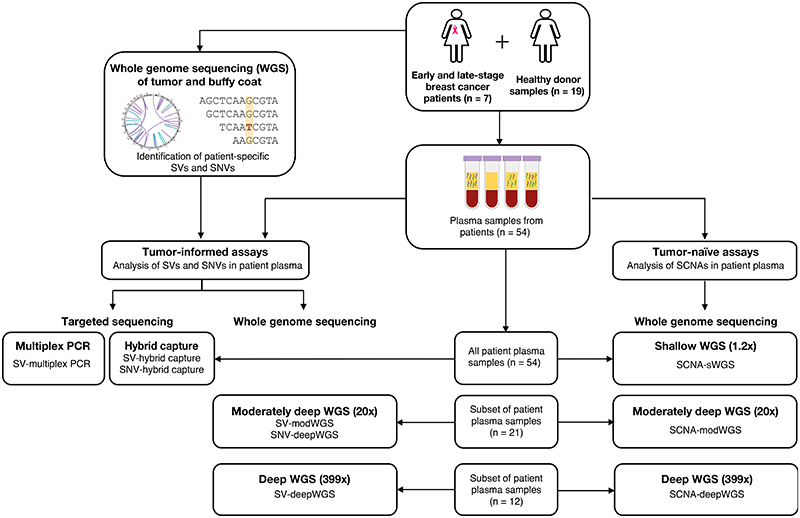
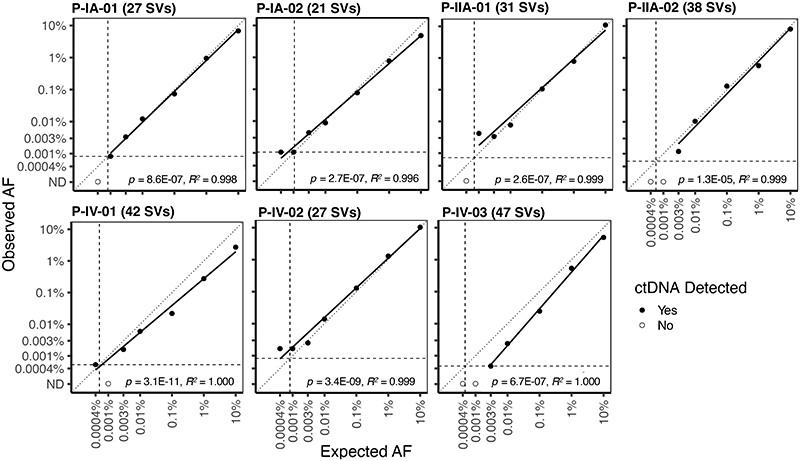
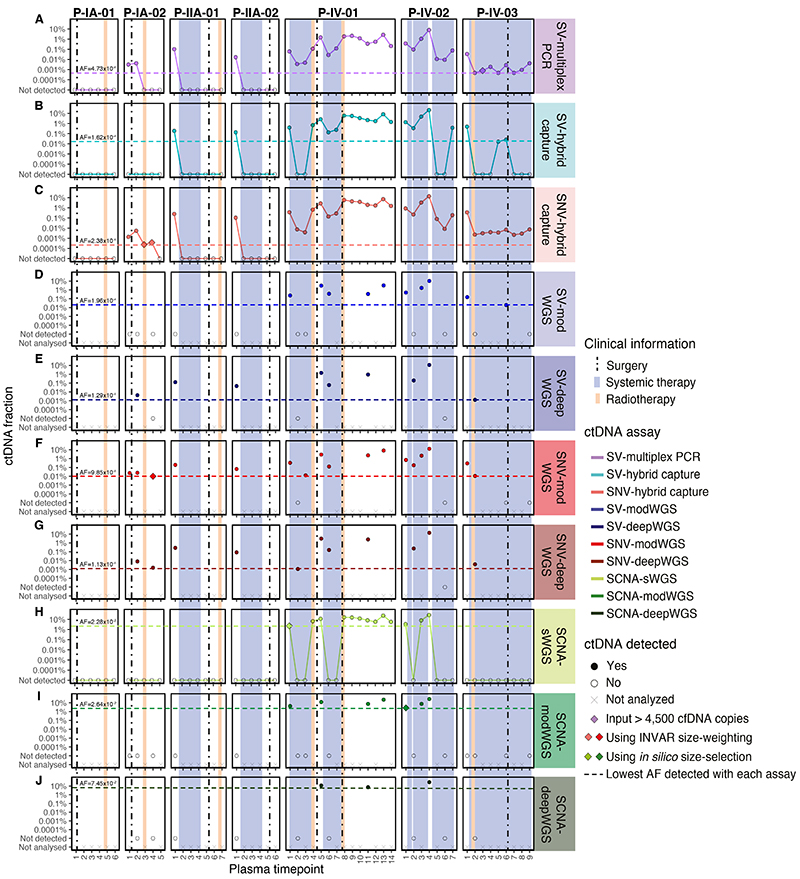
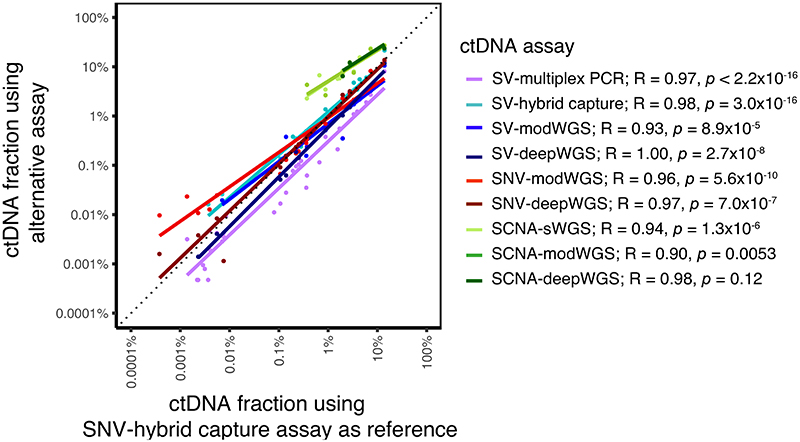
Analysis of circulating tumor DNA (ctDNA) to monitor cancer dynamics and detect minimal residual disease has been an area of increasing interest. Multiple methods have been proposed but few studies have compared the performance of different approaches. Here, we compare detection of ctDNA in serial plasma samples from patients with breast cancer using different tumor-informed and tumor-naïve assays designed to detect structural variants (SVs), single nucleotide variants (SNVs), and/or somatic copy-number aberrations, by multiplex PCR, hybrid capture, and different depths of whole-genome sequencing. Our results demonstrate that the ctDNA dynamics and allele fractions (AFs) were highly concordant when analyzing the same patient samples using different assays. Tumor-informed assays showed the highest sensitivity for detection of ctDNA at low concentrations. Hybrid capture sequencing targeting between 1,347 and 7,491 tumor-identified mutations at high depth was the most sensitive assay, detecting ctDNA down to an AF of 0.00024% (2.4 parts per million, ppm). Multiplex PCR targeting 21-47 tumor-identified SVs per patient detected ctDNA down to 0.00047% AF (4.7 ppm) and has potential as a clinical assay.
Overview
The claims and statistics of this paper haven’t been checked yet.
Free: it reads the open-access text and checks the first 5 claims that cite a source we can check. Create a free account to check every claim.
Integrity signals
Registry
Cites
Statistics
Figures
Verification
Claims the paper makes
The claims and statistics of this paper haven’t been checked yet.
Free: it reads the open-access text and checks the first 5 claims that cite a source we can check. Create a free account to check every claim.
Claims other papers make about this one
Each is checked against this paper’s own text: does it say what the citing paper says it does?
The source backs part of the claim, not all of it — or backs it for a different population, condition or comparison.
In the citing paper
“Tumor-informed assays, based on the mutations existing in the tumor tissue, enable deep sequencing targeting known mutations and MRD detection, which has been validated across multiple solid tumors.19, 20, 21”
From Tumor-informed deep sequencing of ctDNA detects minimal residual disease and predicts relapse in osteosarcoma (2024) · cites this paper as [19]
Experimental — accuracy not yet measured
Self-check
Percentages, sums and reported differences re-computed from the paper’s own numbers.
The self-check needs the paper’s full text.
Citations
Cites
The Sequence Alignment/Map format and SAMtools
Li, H., Handsaker, B., Wysoker, A., Fennell, T., Ruan, J., Homer, N., Marth, G., Abecasis, G., Durbin, R., & 1000 Genome Project Data Processing Subgroup (2009) · Bioinformatics · doi:10.1093/bioinformatics/btp352 · Cited by 62,041 · cited 3×
“For the Illumina pipeline, SNVs were called from the aligned sequences described above; for the in-house pipeline, tumor and matched buffy coat reads were aligned with BWA-MEM to the same reference genome followed by sorting with SAMtools (Li et al, 2009) and marking duplicate reads using Picard tools (Broad Institute…”
InfluentialBEDTools: a flexible suite of utilities for comparing genomic features
Quinlan, A. R., & Hall, I. M. (2010) · Bioinformatics · doi:10.1093/bioinformatics/btq033 · Cited by 27,437
The mutational constraint spectrum quantified from variation in 141,456 humans
Karczewski, K. J., Francioli, L. C., Tiao, G., Cummings, B. B., Alföldi, J., Wang, Q., Collins, R. L., Laricchia, K. M., Ganna, A., Birnbaum, D. P., et al. (2020) · Nature · doi:10.1038/s41586-020-2308-7 · Cited by 9,434 · cited 2×
“Variants present within the gnomAD germline resource (Karczewski et al, 2020) or in a pooled panel of normals (compiled by calling germline variants from WGS data derived from buffy coat of a cohort of 200 breast cancer patients) were removed.”
<tt>BLAT</tt> —The <tt>BLAST</tt> -Like Alignment Tool
Kent, W. J. (2002) · Genome Research · doi:10.1101/gr.229202 · Cited by 8,480 · cited 1×
“Primers were preferentially selected in non-repetitive regions with unique BLAT hits (https://genome.ucsc.edu) (Kent, 2002).”
Detection of Circulating Tumor DNA in Early- and Late-Stage Human Malignancies
Bettegowda, C., Sausen, M., Leary, R. J., Kinde, I., Wang, Y., Agrawal, N., Bartlett, B. R., Wang, H., Luber, B., Alani, R. M., et al. (2014) · Science Translational Medicine · doi:10.1126/scitranslmed.3007094 · Cited by 5,067 · cited 2×
“Chromosomal rearrangements are often clonal, formed in early tumor development and “passenger” mutations, not subject to positive or negative selection pressures (Wang et al, 2014).”
circlize implements and enhances circular visualization in R
Gu, Z., Gu, L., Eils, R., Schlesner, M., & Brors, B. (2014) · Bioinformatics · doi:10.1093/bioinformatics/btu393 · Cited by 4,246 · cited 1×
“The Circos plots (Gu et al, 2014) shown in Figure EV1 detail the patient-specific SVs identified in each of the 7 patients and indicate which were targeted by the different ctDNA assays.”
SeqKit: A Cross-Platform and Ultrafast Toolkit for FASTA/Q File Manipulation
Shen, W., Le, S., Li, Y., & Hu, F. (2016) · PLOS ONE · doi:10.1371/journal.pone.0163962 · Cited by 3,380 · cited 1×
“The UMI was concatenated with read 1 and read 2 using Seqkit v.0.10.1 (Shen et al, 2016).”
InfluentialLiquid biopsies come of age: Towards implementation of circulating tumour DNA
Wan, J. C. M., Massie, C., Garcia-Corbacho, J., Mouliere, F., Brenton, J. D., Caldas, C., Pacey, S., Baird, R., & Rosenfeld, N. (2017) · Nature Reviews Cancer · doi:10.1038/nrc.2017.7 · Cited by 2,809 · cited 2×
“In patients with low burden disease, the detection of ctDNA when only a few tumor-derived molecules may be present in blood can be challenging and is often limited by stochastic sampling (Wan et al, 2017).”
Self-citationDetection and localization of surgically resectable cancers with a multi-analyte blood test
Cohen, J. D., Li, L., Wang, Y., Thoburn, C., Afsari, B., Danilova, L., Douville, C., Javed, A. A., Wong, F., Mattox, A., et al. (2018) · Science · doi:10.1126/science.aar3247 · Cited by 2,783 · cited 1×
“…research is required to improve the sensitivity of tumor-naïve assays to the required levels of sensitivity, through incorporation of additional features or biomarkers (Cohen et al, 2018), as this would have obvious benefits to optimize treatment regimes in patients with earlier stage disease.”
Primer3Plus, an enhanced web interface to Primer3
Untergasser, A., Nijveen, H., Rao, X., Bisseling, T., Geurts, R., & Leunissen, J. A. M. (2007) · Nucleic Acids Research · doi:10.1093/nar/gkm306 · Cited by 2,779
Research works printed but not linked: 3
- Illumina Press Release Illumina Unveils Revolutionary NovaSeq X Series to Rapidly Accelerate Genomic Discoveries and Improve Human Health 2022 https://investor.illumina.com/news/press-release-details/2022/Illumina-Unveils-Revolutionary-NovaSeq-X-Series-to-Rapidly-Accelerate-Genomic-Discoveries-and-Improve-Human-Health/default.aspx
- Kurtz DM Soo J Co Ting Keh L Alig S Chabon JJ Sworder BJ Schultz A Jin MC Scherer F Garofalo A Enhanced detection of minimal residual disease by targeted sequencing of phased variants incirculating tumor DNA Nat Biotechnol 2021 b 39 1537 1547 34294911 PMC8678141 · DOI · Paper page
- Li Heng Aligning sequence reads, clone sequences and assembly contigs with BWA-MEM arXiv:13033997v2 q-bioGN
Cited by
Use of ctDNA in early breast cancer: analytical validity and clinical potential
Panet, F., Papakonstantinou, A., Borrell, M., Vivancos, J., Vivancos, A. P., & Oliveira, M. (2024) · npj Breast Cancer · doi:10.1038/s41523-024-00653-3 · Cited by 132
“For instance, while the latter is generally more sensitive for detecting low tumoral variant allele frequencies (VAF) 18 , it is also more time-consuming because it requires prior sequencing of the tumor and the development of a personalized assay for every patient as a fi rst step 14 .”
Martínez-Castedo, B., Camblor, D. G., Martín-Arana, J., Carbonell‐Asins, J. A., García-Micó, B., Gambardella, V., Huerta, M., Roselló, S., Roda, D., Gimeno-Valiente, F., et al. (2024) · Annals of Oncology · doi:10.1016/j.annonc.2024.12.006 · Cited by 97
Marta, G. N., Monteforte, M., Agostinetto, E., Cinquini, M., Martins-Branco, D. A., Fontsa, M. L., Llombart‐Cussac, A., Cortés, J., Ignatiadis, M., Torri, V., et al. (2024) · ESMO Open · doi:10.1016/j.esmoop.2024.102390 · Cited by 86
“Although head-to-head comparisons be-tween the two strategies are scarce, Santonja et al. 56 compared the detection of ctDNA using different tumor-informed and non tumor-informed assays designed to detect somatic copy-number aberrations, single-nucleotide variants, and/or structural variants, by multiplex PCR, hybrid…”
BackgroundFusco, N., Venetis, K., Pepe, F., Shetty, O. A., Fariñas, S. C., Heeke, S., Burnier, J. V., Patton, S. J., Heitzer, E., Nigita, G., et al. (2025) · The Journal of Liquid Biopsy · doi:10.1016/j.jlb.2025.100301 · Cited by 80
“The choice of cfDNA assay depends on multiple factors, including the intended clinical or research application, detection sensitivity, multiplexing capability, cost, and turnaround time [30].”
Circulating tumour DNA in early stage and locally advanced NSCLC: ready for clinical implementation?
Normanno, N., Morabito, A., Rachiglio, A. M., Sforza, V., Landi, L. M., Bria, E., Delmonte, A., Cappuzzo, F., & Luca, A. D. (2025) · Nature Reviews Clinical Oncology · doi:10.1038/s41571-024-00985-w · Cited by 78
“Both approaches have advantages and disadvantages 47,48 .”
Lindskrog, S. V., Strandgaard, T., Nordentoft, I., Galsky, M. D., Powles, T. B., Agerbæk, M., Jensen, J. B., Alix‐Panabières, C., & Dyrskjøt, L. (2025) · Nature Reviews Urology · doi:10.1038/s41585-025-01023-9 · Cited by 51
“However, the sensitivity of ctDNA analysis is compromised when using tumour-agnostic detection 137–139 , and great sensitivity is especially crucial in settings of low disease burden; for example, when aiming to detect minimal residual disease after radical cystectomy.”
Elliott, M. J., Howarth, K., Main, S. C., Fuentes‐Antrás, J., Echelard, P., Dou, A., Amir, E., Nadler, M. B., Shah, E., Yu, C., et al. (2025) · Clinical Cancer Research · doi:10.1158/1078-0432.ccr-24-3472 · Cited by 46
“While the detection of chromosomal rearrangements in ctDNA has been shown to detect MRD, the use of SVs for ctDNA detection and monitoring in EBC has not been comprehensively evaluated (16–18).”
Negro, S., Pulvirenti, A., Trento, C., Indraccolo, S., Ferrari, S., Scarpa, M., Urso, E. D. L., Bergamo, F., Pucciarelli, S., Deidda, S., et al. (2025) · International Journal of Molecular Sciences · doi:10.3390/ijms26062486 · Cited by 41
“Historically, tumor-agnostic assays were considered less sensitive [35].”
Wyatt, A. W., Litière, S., Bidard, F., Cabel, L., Dyrskjøt, L., Karlovich, C., Pantel, K., Petrie, J., Philip, R., Andrews, H. S., et al. (2024) · Clinical Cancer Research · doi:10.1158/1078-0432.ccr-24-1883 · Cited by 39
“Head-to-head comparisons on real samples will also be critical to understand the optimal assay(s) for each clinical setting, but will require collection of multiple blood tubes from clinical trial patients (56,57).”
Fu, Y., Xu, Y., Liu, W., Zhang, J., Wang, F., Jian, Q., Huang, G., Zou, C., Xie, X., Kim, A. H., et al. (2024) · eClinicalMedicine · doi:10.1016/j.eclinm.2024.102697 · Cited by 37
Advancements in liquid biopsy for breast Cancer: Molecular biomarkers and clinical applications
Qiu, P., Yu, X., Zheng, F., Gu, X., Huang, Q., Qin, K., Hu, Y., Liu, B., Xu, T., Zhang, T., et al. (2025) · Cancer Treatment Reviews · doi:10.1016/j.ctrv.2025.102979 · Cited by 40
Circulating Tumor DNA: A Pan-Cancer Biomarker in Solid Tumors with Prognostic and Predictive Value
Hitchen, N., Shahnam, A., & Tie, J. (2024) · Annual Review of Medicine · doi:10.1146/annurev-med-100223-090016 · Cited by 36
Liu, Z., Wang, G., Yang, Y., Su, Y., Zhang, H., Liu, J., Cui, P., Fan, X., Yang, J., Zhang, Z., et al. (2025) · Cell Reports Medicine · doi:10.1016/j.xcrm.2025.102334 · Cited by 36
“13,33 In our study, we comprehensively compared the sensitivity of three ctDNA assays, including a tumor-informed personalized panel, a tumor-naive fixed panel, and a tumor-informed fixed panel, alongside standard clinical diagnostic methods, in detecting residual disease in ESCC treated with nCRT.”
de Abreu, A. R., Wyninckx, A., Vandamme, T., de Beeck, K. O., Camp, G. V., Peeters, M., Laurent‐Puig, P., Taïeb, J., Taly, V., & Benhaïm, L. (2025) · The Oncologist · doi:10.1093/oncolo/oyaf204 · Cited by 34
Wang, H., Mennea, P. D., Chan, Y. K. E., Cheng, Z., Neofytou, M. C., Surani, A. A., Vijayaraghavan, A., Ditter, E. J., Bowers, R., Eldridge, M., et al. (2025) · Genome biology · doi:10.1186/s13059-025-03607-5 · Cited by 30
“Based on previous experiences [53], SureSelect XT HS (XTHS) [43] could achieve high sensitivity with low input and is more amenable to capture than ThruPLEX kits.”
InfluentialSelf-citationIntegrating ctDNA Analysis and Radiomics for Dynamic Risk Assessment in Localized Lung Cancer
Moding, E. J., Esfahani, M. S., Jin, C., Hui, A. B., Nabet, B. Y., Liu, Y., Chabon, J. J., Binkley, M. S., Kurtz, D. M., Hamilton, E. G., et al. (2025) · Cancer Discovery · doi:10.1158/2159-8290.cd-24-1704 · Cited by 29
Circulating tumor DNA in cholangiocarcinoma: current clinical applications and future perspectives
Wang, J., Li, Y., Liang, Z., Zhang, Y., Li, T., Tian, C., Zhao, J., Jin, B., Cao, J., & Lin, Y. (2025) · Frontiers in Cell and Developmental Biology · doi:10.3389/fcell.2025.1616064 · Cited by 25
Klocker, E. V., Hasenleithner, S. O., Bartsch, R., Gampenrieder, S. P., Egle, D., Singer, C. F., Rinnerthaler, G., Hubalek, M., Schmitz, K., Bagó-Horváth, Z., et al. (2024) · Molecular Oncology · doi:10.1002/1878-0261.13671 · Cited by 25
Circulating tumor DNA: current implementation issues and future challenges for clinical utility
Hu, Q., Chen, L., Li, K., Liu, R. M., Sun, L., & Han, T. (2023) · Clinical Chemistry and Laboratory Medicine (CCLM) · doi:10.1515/cclm-2023-1157 · Cited by 20
“Furthermore, when various assays were evaluated on breast cancer plasma samples, tumor-informed tests demonstrated superior sensitivity in detecting low-concentration ctDNA [34].”
Vojjala, N., Gibatova, V., Shah, R. N., Singal, S., Prabhu, R. R., Krishnamoorthy, G., Riggins, K. S., & Moka, N. (2025) · Cancers · doi:10.3390/cancers17152520 · Cited by 16
“On the other hand, the second method, tumor-informed, uses tumor tissue to create a personalized assay that allows for analysis of patient-specific mutations, enhancing overall sensitivity but with high turnaround time [33,34].”
Mohiuddin, M. (2025) · Health Science Reports · doi:10.1002/hsr2.71409 · Cited by 15
“…employ either multiplexed PCR panels or hybrid ‐ capture probes that are personalized to individual breakpoints and achieve parts ‐ per ‐ million sensitivity, with specificity that is unique to the tumor based on the fact that normal cells do not have combinations of rearrangements in the DNA [14].”
Clinical Management of Circulating Tumor DNA in Breast Cancer: Detection, Prediction, and Monitoring
Lu, Y., Ren, L., Yang, M., & Liu, J. (2025) · Breast Cancer Targets and Therapy · doi:10.2147/bctt.s542704 · Cited by 14
Brogna, M. R., Ferrara, G., Varone, V., Montone, A., Fava, A. S., Schiano, M. R., Sesto, M. D., Pizza, N., Prota, A., Barra, C., et al. (2026) · Frontiers in Oncology · doi:10.3389/fonc.2025.1642521 · Cited by 15
Jongbloed, E. M., Wortelboer, N., de Weerd, V., Beaufort, C. M., Ruigrok-Ritstier, K., Van, M. N., Kraan, J., van Zweeden, A. A., van der Padt‐Pruijsten, A., Hamming, L. C., et al. (2025) · Nature Medicine · doi:10.1038/s41591-025-03935-w · Cited by 14
Xu, J., Fang, K., Li, X., Li, H., Sun, S., & Sun, T. (2025) · Cancer Biology and Medicine · doi:10.20892/j.issn.2095-3941.2025.0431 · Cited by 12
“Two main methods, tumor-informed (patient-specific) and tumor-naive strategies, each with distinct operational frameworks and clinical implications, are used for contemporary MRD testing 43 .”
Wang, M., Xiong, C., Wang, S., Qiu, Y., Hou, Z., & Gao, P. (2025) · Frontiers in Oncology · doi:10.3389/fonc.2025.1608872 · Cited by 11
Pu, W., Chen, F., Tang, Y., Qu, Y., Han, Y., Zha, J., Jin, J., & Kong, F. (2024) · Chinese Journal of Cancer Research · doi:10.21147/j.issn.1000-9604.2024.04.07 · Cited by 10
Rolling Circle Amplification Boosts Ultrasensitive Liquid Biopsy
You, J., Tan, Y., Kong, D., Yang, H. J., Huang, Y., Li, J., Chen, J., Han, Y., He, K., Li, F., et al. (2025) · Small Methods · doi:10.1002/smtd.202501156 · Cited by 10
Is ctDNA ready to outpace imaging in monitoring early and advanced breast cancer?
Foffano, L., Vida, R., Piacentini, A., Molteni, E., Cucciniello, L., Ros, L. D., Buriolla, S., Cereser, L., Roncato, R., Gerratana, L., et al. (2024) · Expert Review of Anticancer Therapy · doi:10.1080/14737140.2024.2362173 · Cited by 8
“…capable of effectively guiding neoadjuvant/adjuvant escalation/de-escalation strategies. ctDNA is characterized by a shorter fragment length (~130 bp), and its levels in the blood may depend on several factor such as tumor type, staging, and tumor evolution including sites of involvement [18].”
Placido, P. D., & Parsons, H. A. (2025) · Current Opinion in Oncology · doi:10.1097/cco.0000000000001180 · Cited by 7
Novel strategies in liquid biopsy
Guo, Q., Shan, L., Luo, J., Huang, Y., Bao, Y., Wang, X., Ma, L., & Wang, G. (2025) · Clinica Chimica Acta · doi:10.1016/j.cca.2025.120385 · Cited by 7
Nguyen, T., Hoang, V. N., Nguyen, T. H., Tran, T. H., Nguyen, N. L., Vo, T. T. B., Nguyen, D. S., Giang, H., Nguyen, H., & Tu, L. N. (2025) · Therapeutic Advances in Medical Oncology · doi:10.1177/17588359251393090 · Cited by 6
Kato, T., Yajima, S., Nakamura, Y., Kobayashi, S., & Miyake, H. (2025) · International Journal of Urology · doi:10.1111/iju.70215 · Cited by 6
“In general, NGS-based approaches with high-throughput ability and high sensitivity can classify MRD testing into two broad categories: tumor-naïve and tumor-informed approaches [23, 32, 33].”
Ahmed, A., Saini, G., Ferguson, S. E., Fazelzad, R., Li, Q., Han, K., Pugh, T., Wong, D., Kim, R. H., Hodgson, A., et al. (2025) · Gynecologic Oncology · doi:10.1016/j.ygyno.2025.12.008 · Cited by 5
Challenges in blood fractionation for cancer liquid biopsy: how can microfluidics assist?
Salomon, R., Bazaz, S. R., Mutafopulos, K., Gallego‐Ortega, D., Warkiani, M. E., Weitz, D. A., & Jin, D. (2025) · Lab on a Chip · doi:10.1039/d4lc00563e · Cited by 5
Circulating tumor DNA for surveillance in high-risk melanoma patients: a study protocol
Obinah, M. P. B., Al-Halafi, S. A., Dreisig, K., Poulsen, T. S., Johansen, C., Litman, T., Bojesen, S. E., Høgdall, E. V. S., Chakera, A. H., & Hölmich, L. R. (2025) · Acta Oncologica · doi:10.2340/1651-226x.2025.42515 · Cited by 5
Applications of ctDNA testing to monitor and detect residual disease in breast cancer
Chen, J. H., Geng, Y., & Lucci, A. (2025) · Expert Review of Molecular Diagnostics · doi:10.1080/14737159.2025.2498545 · Cited by 5
“However, the uninformed approach carries a higher ctDNA detection threshold with notably lower specificity compared to the tumor-informed approach [6].”
Hoang, V.-A. N., Nguyen, N., Nguyen, T., Nguyen, D. S., Nguyen, H.-N., & Tu, L. N. (2025) · JTO Clinical and Research Reports · doi:10.1016/j.jtocrr.2025.100927 · Cited by 4
“Our results suggest that the tumor-informed method tracking personalized mutations by mPCR resulted in better sensitivity and specificity for ctDNA detection, agreeing with Santonja et al., 10 who also directly compared the two methods in breast cancer.”
ctDNA monitoring using tumor-informed copy number analysis
Zhou, Z., Cutts, R., Hrebien, S., Zhang, C., García-Murillas, I., Zhang, W. Z., Frankell, A. M., Cooper, W. N., Roshan, A., Turner, N. C., et al. (2026) · EMBO Molecular Medicine · doi:10.1038/s44321-026-00399-4 · Cited by 4
“Additionally, paired-end sequencing data were obtained from previous studies (Mouliere et al, 2018; Wan et al, 2020; Santonja et al, 2023), including tissue samples of three patients with breast cancer (median coverage: 3.8x; range: 3.7 to 3.9x), and a total of 137 plasma samples.”
InfluentialSelf-citationHao, S., Zhao, S., Shi, L., Zhong, L., Wei, H., Jiao, X., & Xue, C. (2026) · Journal of Thoracic Disease · doi:10.21037/jtd-2025-aw-2202 · Cited by 3
“Current ctDNA technologies fall into two broad categories: tumor-informed assays, which use matched tissue sequencing to track patient-specific mutations, and tumor-agnostic panels, which apply fixed NGS panels to plasma DNA (93,94).”
Rocco, R., Antaramian, A., Krishna, V., Moonsamy, P., Brownlee, A. R., & Soukiasian, H. J. (2026) · Journal of Thoracic Disease · doi:10.21037/jtd-2025-1-2467 · Cited by 3
Marra, A., Kim, S. H., Pareja, F. G., Basili, T., Solit, D. B., Chandarlapaty, S., Plitas, G., Reis-Filho, J. S., Weigelt, B., King, T. A., et al. (2026) · npj Breast Cancer · doi:10.1038/s41523-026-00921-4 · Cited by 3
“To address this issue, several studies have shown that increasing the number of variants tracked per patient can enhance the sensitivity of ctDNA detection 6,32 , particularly during and after NST, when ctDNA levels are dynamic and often low.”
Towards liquid biopsy-based analysis of antitumour immunity
Pantel, K., Masmoudi, D., & Alix‐Panabières, C. (2026) · Nature Reviews Clinical Oncology · doi:10.1038/s41571-026-01181-8 · Cited by 5
“On the one hand, tumour-informed tests can, in principle, reach higher sensitivity than tumour-agnostic tests (with ctDNA detection thresholds as low as 1 part per million compared with ~100–1,000 parts per million) 9–11 .”
Hsieh, R. W., Symonds, L. K., Siu, J. J., & Cohen, S. A. (2024) · International review of cytology · doi:10.1016/bs.ircmb.2024.08.006 · Cited by 3
Faulkner, L. G., Howells, L. M., Lehmann, S., Cowley, C. M., Sidat, Z., Shaw, J., & Thomas, A. (2025) · Cancer Investigation · doi:10.1080/07357907.2025.2464684 · Cited by 3
Zavarykina, T. M., Валерьевна, П. И., Mazina, P. S., Khokhlova, S. V., & Sukhikh, G. T. (2025) · Biochemistry (Moscow) · doi:10.1134/s0006297925602187 · Cited by 2
Circulating Tumor DNA in Urothelial Cancer: Practical Applications in Oncology Clinic
Mittal, K., Mouw, K. W., & Singh, P. (2025) · JCO Oncology Practice · doi:10.1200/op-25-00734 · Cited by 2
Romesser, P. B., Bercz, A., Alvarez, J. A., Kostrzewa, C. E., Adames, A., Liu, E. K., Ho, Y.-J., Mohan, N., Reyngold, M., Yaeger, R. D., et al. (2026) · Nature Communications · doi:10.1038/s41467-026-69984-y · Cited by 2
“Tumor-informed ctDNA assays, customized to each patient ’ s unique mutational pro fi le, may offer a more sensitive and broadly applicable alternative, although their utility in ASCC has not been well established yet 23,24 .”
Pan-Cancer Pre-Treatment ctDNA Detection Using a Highly Sensitive Tumor-Informed Assay
Strum, S. W., Murray, C., Genta, S., Sanz‐García, E., Razak, A. R., Lheureux, S., Pipinikas, C., Wang, B., Chevalier, A., Smith, C. G., et al. (2026) · International Journal of Molecular Sciences · doi:10.3390/ijms27093979 · Cited by 2
“In general, ctDNA detection assays use either a tumor-informed or tumor-agnostic approach [14–17].”
Self-citationZhou, Z., Cooper, W. N., Cheng, Z., Lightowlers, S., Coles, C. E., Roshan, A., Rosenfeld, N., & Zhao, H. (2026) · Nature Communications · doi:10.1038/s41467-026-72925-4 · Cited by 2
“Paired-end whole-genome sequencing data were generated from pre-and post-radiotherapy plasma samples of 11 breast cancer patients in the Neo-RT cohort using SureSelect XT HS2 library preparation kit (Agilent) 35 .”
InfluentialSelf-citationBlood-borne biomarkers: CT-DNA ushers in a new era of cancer detection
Palve, S., Bhardwaj, Y., Dusane, J., & Wankhade, P. P. (2024) · International Journal of Pharmaceutical Sciences and Drug Research · doi:10.25004/ijpsdr.2024.160518 · Cited by 2
Blood-Based Biomarkers for Bladder Cancer Diagnosis and Prognosis
Birkenkamp‐Demtröder, K., Nordentoft, I., Strandgaard, T., Lindskrog, S. V., & Dyrskjøt, L. (2024) · Springer eBooks · doi:10.1007/978-3-031-68505-7_19 · Cited by 1
Huang, X., Leo, P., Clout, M., Fink, J. L., Ellis, J. J., Hughes, B. G. M., Kenny, L., Vasani, S. S., & Punyadeera, C. (2025) · View · doi:10.1002/viw.20250112 · Cited by 1
Fei, K., Zhao, J., Xu, J., Duan, J., Li, C., Xie, W., Zhong, J., Wang, G., Xu, Y., Sun, B., et al. (2025) · Advanced Science · doi:10.1002/advs.202506565 · Cited by 1
Lin, A., Isaeva, O. I., Deger, T., Geurts, V., Vessies, D. C. L., Voorwerk, L., Slagter, M., Moore, K., van der Leest, P., Martens, J. W. M., et al. (2025) · Cell Reports Medicine · doi:10.1016/j.xcrm.2025.102512 · Cited by 1
Sørensen, E. E., Frydendahl, A., Rasmussen, M. H., Nordentoft, I., Knudsen, M., Henriksen, T. V., Lindskrog, S. V., Dyrskjøt, L., Andersen, C. L., & Bramsen, J. B. (2026) · Journal of Translational Medicine · doi:10.1186/s12967-026-07762-6 · Cited by 1
“Although chromosomal rearrangements in ctDNA have been shown to detect molecular residual disease [20–22], the broader application of SVs for ctDNA detection and monitoring in colorectal cancer has not been comprehensively evaluated.”
The clinical utility of molecular residual disease testing in early-stage breast cancer
Micha, J. P., Bohart, R. D., & Goldstein, B. H. (2026) · Expert Review of Anticancer Therapy · doi:10.1080/14737140.2026.2630023 · Cited by 1
“Since a patient’s genetic profile is distinct, tumor-informed testing has a high specificity for detecting cancer progression with a reduced incidence of false positives [17].”
Li, Y., Wang, Y., 王荣荣, Liu, Y., & Pei, J. (2026) · iScience · doi:10.1016/j.isci.2026.116670 · Cited by 1
Wang, H., Mennea, P. D., Andrew, G. M., Sönmezler, Ö., Сергеевич, Щ. Д., Ditter, E.-J., Jensen, S. Ø., Buma, A. I. G., Smith, C. G., Cheng, Z., et al. (2026) · Science Advances · doi:10.1126/sciadv.ady9432 · Cited by 1
Self-citationCirculating tumor DNA in neoadjuvant therapy for solid tumors
Huang, X., Deng, Y., & Shen, Y. (2026) · Frontiers in Oncology · doi:10.3389/fonc.2026.1909934 · Cited by 2
“This is evidenced by studies showing that tumor-informed assays often outperform tumor-agnostic ones in MRD detection sensitivity (14).”
Kleeman, S. O., & Stearns, V. (2026) · Journal of Clinical Oncology · doi:10.1200/jco-26-01423 · Cited by 1
Thusgaard, C. F., Sadegh, S., Jochumsen, K. M., Kruse, T. A., & Thomassen, M. (2024) · International Journal of Molecular Sciences · doi:10.3390/ijms252413349 · Cited by 1
Oliva, M., Llop, S., Arribas, L., & Mesía, R. (2025) · Springer eBooks · doi:10.1007/978-3-031-84539-0_18
Integration of Circulating Tumor DNA into Clinical Practice for Melanoma
Harris, M. S., Steimle, A. K., & Ma, V. T.-L. (2025) · IntechOpen eBooks · doi:10.5772/intechopen.1012473
Guan, Y., Han, L., & Chen, X. (2025) · Talanta Open · doi:10.1016/j.talo.2025.100575
Moloney‐Geany, K., Black, M. A., Day, R. C., Guilford, P., & Dunnet, M. J. (2025) · Scientific Reports · doi:10.1038/s41598-025-24719-9
“Nevertheless, the top ten most mutated genes have all previously implicated with CRC progression previously 18 (Fig.”
Tran, C. W., Zou, W., Assaf, Z. J. F., Mang, A., Ranucci, F., Cheng, J. H., Estay, I. S., Ma, V., Srivastava, M. K., Shames, D. S., et al. (2026) · Journal for ImmunoTherapy of Cancer · doi:10.1136/jitc-2025-014710
“5 6 Moreover, ctDNA assays with the greatest sensitivity and specificity are generally tumor-informed, 7 8 which may increase patient burden by requiring a tumor biopsy for tumor-specific somatic variant identification.”
Stea, E. X., Kydonakis, N., & Roukos, D. H. (2026) · Cancers · doi:10.3390/cancers18111824
Friedl, T. W. P., Fasching, P. A., Hartkopf, A. D., Tesch, H., Lorenz, R., Heinrich, G., Blohmer, J., Fehm, T. N., Mueller, V., Schneeweiß, A., et al. (2026) · JCO Precision Oncology · doi:10.1200/po-26-00095
Promises and Pitfalls of ctDNA testing in the Management of Cholangiocarcinoma
劉銘恩, Doger, B., Pant, A., Lamarca, Á., & Goyal, L. (2026) · JHEP Reports · doi:10.1016/j.jhepr.2026.102023
Verzè, M., Minari, R., Bordi, P., Bocchialini, G., Martines, G., Pluchino, M., D’Agnelli, S., Gnetti, L., Cosenza, A., Balestra, V., et al. (2026) · The Journal of Liquid Biopsy · doi:10.1016/j.jlb.2026.100501
“On the other hand, the tumor-agnostic approach does not require prior tumor sequencing information, either by way of tracking a panel of defined genomic markers or through epigenomic marks [20].”
Madhu, M. J. (1905) · Lu Zone Ul (Laurentian University)
Choksi, A., Varga, M. G., Farmer, T. E., Florou, V., Dill, D., Krabbe, K., Tsao, D., & Chen, A. M. (2026) · The Journal of Liquid Biopsy · doi:10.1016/j.jlb.2026.100669
“It is worth noting that head-to-head studies of tumor-agnostic versus tumor-informed ctDNA assays [29 – 31] have exclusively focused on early-stage cancer patients to evaluate the sensitivity of these assays to detect MRD after surgery, a scenario where results are provided in binary terms (i.e.,…”
Abue, M., Asano, N., Morikawa, T., Masamune, A., Nishizuka, S., & Yasuda, J. (2026) · Cancers · doi:10.3390/cancers18213471
Recent advances in paper-based biomolecule enrichment technologies for point-of-care diagnostics
He, Q., Liu, C., Pal, Y., Baek, J., Shi, Y., Shevkoplyas, S., Kourentzi, K. D., Willson, R. C., & An, R. (2026) · Talanta · doi:10.1016/j.talanta.2026.130908
Tao, S., Xu, M., Sun, H., Yao, X., & Ye, Z. (2026) · Frontiers in Pharmacology · doi:10.3389/fphar.2026.1926454
Metadata
- Authors
- Santonja, A., Cooper, W. N., Eldridge, M. D., Edwards, P. A. W., Morris, J. A., Edwards, A. R., Zhao, H., Heider, K., Couturier, D., Vijayaraghavan, A., Mennea, P., Ditter, E., Smith, C. G., Boursnell, C., Manzano García, R., Rueda, O. M., Beddowes, E., Biggs, H., Sammut, S., Rosenfeld, N., Caldas, C., Abraham, J. E., & Gale, D.
- Affiliations
- University of Cambridge (GB)
- Corresponding author
- Abraham, Jean E
- Gale, Davina
- ORCID
- Cooper, Wendy N
- Eldridge, Matthew D
- Edwards, Paul A W
- Morris, James A
- Edwards, Abigail R
- Zhao, Hui
- Heider, Katrin
- Couturier, Dominique‐Laurent
- Vijayaraghavan, Aadhitthya
- Mennea, Paulius
- Ditter, Emma‐Jane
- Smith, Christopher G
- Boursnell, Chris
- Manzano García, Raquel
- Rueda, Oscar M
- Beddowes, Emma
- Biggs, Heather
- Sammut, Stephen‐John
- Rosenfeld, Nitzan
- Caldas, Carlos
- Abraham, Jean E
- Gale, Davina
- Venue
- EMBO Molecular Medicine
- Published
- 2023-05-10
- Volume
- 15
- Issue
- 6
- Pages
- e16505-e16505
- ISSN
- 1757-4676 (ISSN-L)
- 1757-4684
- PMC
- PMC10245040
- OpenAlex
- W4376121423
- Cited by
- 66
- References
- 61
- Citations by year
- 2026: 16 · 2025: 36 · 2024: 12 · 2023: 2
- FWCI
- 8.36
- Type
- journal article
- Language
- en
- Open access
- gold
- doi.org
- Licence
- cc-by
- creativecommons.org/licenses/by/4.0/ (tdm)
- creativecommons.org/licenses/by/4.0/ (vor)
- Locations
- EMBO Molecular Medicine (publishedVersion, cc-by)
- PubMed Central (publishedVersion, cc-by)
- PubMed (publishedVersion)
- Apollo (University of Cambridge) (submittedVersion, cc-by)
- DOAJ (DOAJ: Directory of Open Access Journals) (submittedVersion, cc-by-sa)
- Funders
- Addenbrooke's Charitable Trust, Cambridge University Hospitals (ACT 9800)
- AstraZeneca (A093777)
- Cancer Research UK (C507/A27657, CRUKE/14/048, C36857/A27548, C1287/A26886, C17918/A28870, EDDCPT\100013)
- EC | FP7 | Ideas | FP7 Ideas: European Research Council (337905)
- Mark Foundation For Cancer Research (C9685/A25177)
- NIHR | NIHR Cambridge Biomedical Research Centre (BRC‐1215‐20014)
- University of Cambridge | Cancer Research UK Cambridge Institute, University of Cambridge (A20240, C9545/A29580)
- Wellcome Trust (106566/Z/14/Z)
- Topics
- Life Sciences › Biochemistry, Genetics and Molecular Biology › Cancer Research › Cancer Genomics and Diagnostics
- Life Sciences › Biochemistry, Genetics and Molecular Biology › Genetics › BRCA gene mutations in cancer
- Health Sciences › Medicine › Pediatrics, Perinatology and Child Health › Prenatal Screening and Diagnostics
- Keywords
- circulating tumor DNA, breast cancer, liquid biopsy, hybrid capture sequencing, multiplex PCR, structural variants, single nucleotide variants, somatic copy number alterations, minimal residual disease, allele fraction, assay sensitivity comparison
- MeSH terms
- Circulating Tumor DNA, Breast Neoplasms, Female, Humans, Mutation, Biomarkers, Tumor, High-Throughput Nucleotide Sequencing
About these checks
Registry, retraction, Cites and statistics results are computed, not judged, with one exception: a printed reference that no index lists is read once by a model before it counts as a citation error. Claims are extracted by a model and kept only when their quote appears verbatim in the text; each cited source is then checked, with a model’s help, for whether it says what the claim relies on. Those verdicts can be wrong — read the claim’s quote and the cited source before relying on one.
Statistics and arithmetic are recomputed, not judged.
Confidence bands are shown only for fields calibrated on our annotated test set. None is calibrated yet, so no band is shown.
What counts as a claim ›How we measure confidence ›How we check this ›
Are you an author, or do you see a problem with this page? Request a review
Data sources
Bibliographic data: Semantic Scholar, OpenAlex, Crossref.
Contains information from the Semantic Scholar Academic Graph Datasets, made available under the ODC Attribution License (ODC-BY 1.0).
Semantic Scholar’s data is described in: Kinney, R., et al. (2023). The Semantic Scholar Open Data Platform. arXiv:2301.10140.
