

Comparison of tumor-informed and tumor-naïve sequencing assays for ctDNA detection in breast cancer
Open accessThe DOI matches its Crossref record; 62 of the 62 references it cites were found in a registry or an index.
Abstract
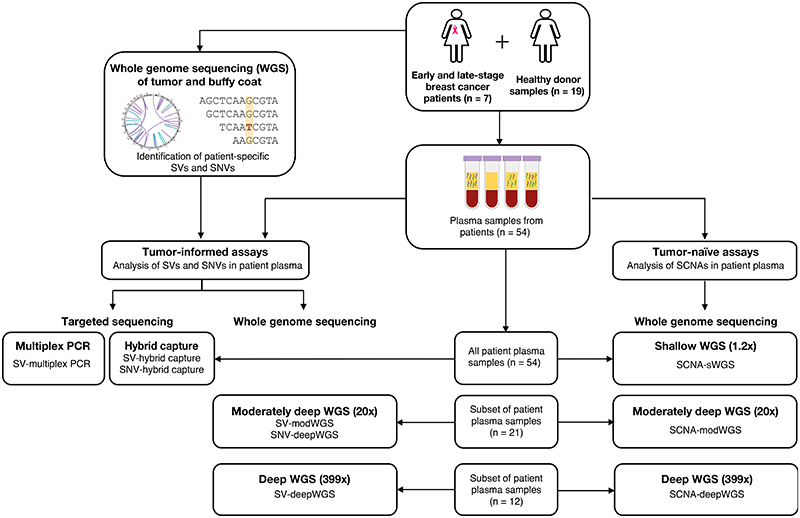
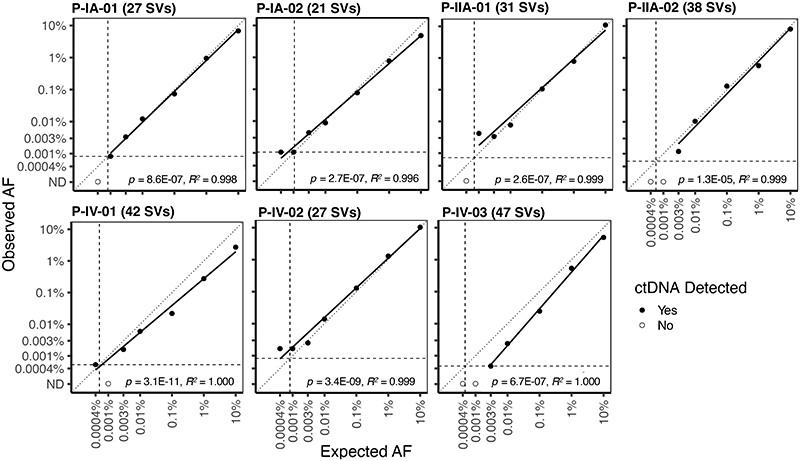
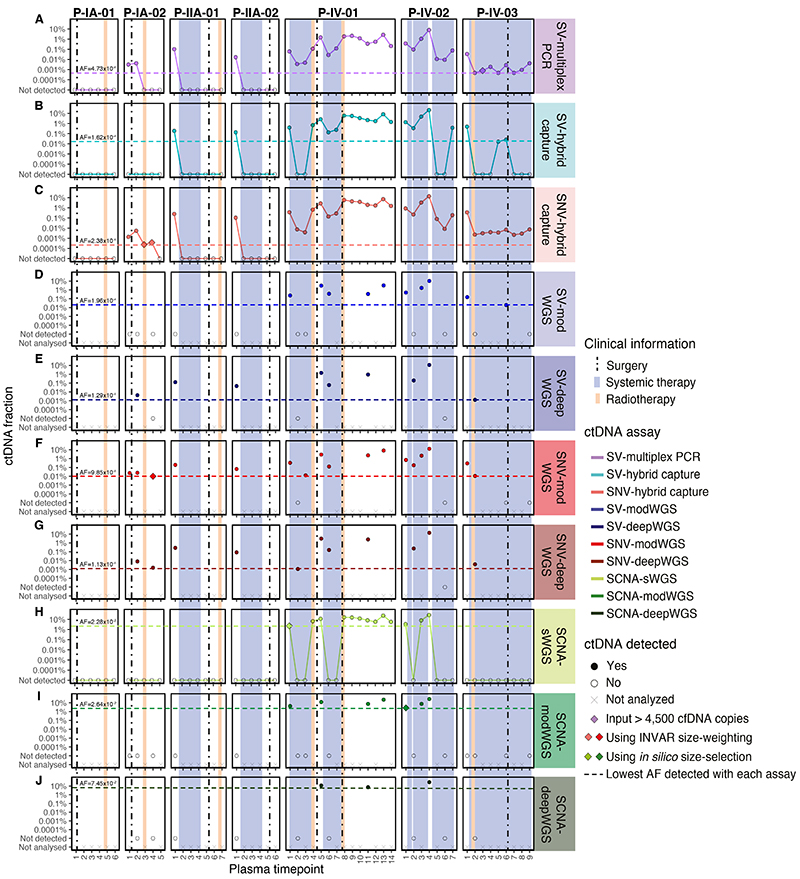
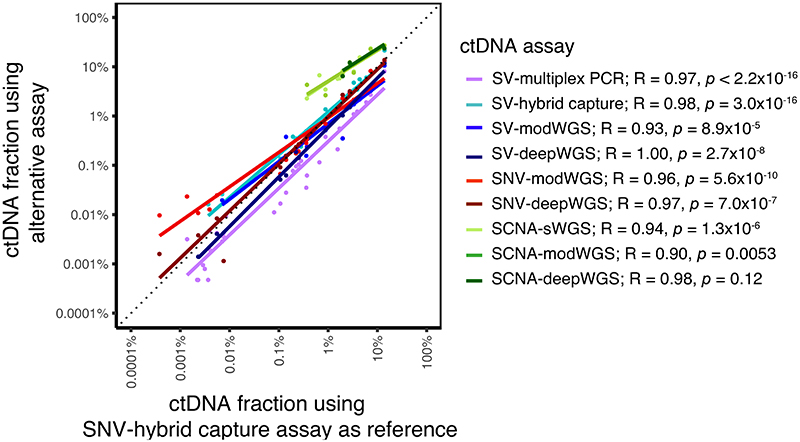
Analysis of circulating tumor DNA (ctDNA) to monitor cancer dynamics and detect minimal residual disease has been an area of increasing interest. Multiple methods have been proposed but few studies have compared the performance of different approaches. Here, we compare detection of ctDNA in serial plasma samples from patients with breast cancer using different tumor-informed and tumor-naïve assays designed to detect structural variants (SVs), single nucleotide variants (SNVs), and/or somatic copy-number aberrations, by multiplex PCR, hybrid capture, and different depths of whole-genome sequencing. Our results demonstrate that the ctDNA dynamics and allele fractions (AFs) were highly concordant when analyzing the same patient samples using different assays. Tumor-informed assays showed the highest sensitivity for detection of ctDNA at low concentrations. Hybrid capture sequencing targeting between 1,347 and 7,491 tumor-identified mutations at high depth was the most sensitive assay, detecting ctDNA down to an AF of 0.00024% (2.4 parts per million, ppm). Multiplex PCR targeting 21-47 tumor-identified SVs per patient detected ctDNA down to 0.00047% AF (4.7 ppm) and has potential as a clinical assay.
Overview
The claims and statistics of this paper haven’t been checked yet.
Free: it reads the open-access text and checks the first 5 claims that cite a source we can check. Create a free account to check every claim.
Integrity signals
Registry
Cites
Statistics
Figures
Verification
Claims the paper makes
The claims and statistics of this paper haven’t been checked yet.
Free: it reads the open-access text and checks the first 5 claims that cite a source we can check. Create a free account to check every claim.
Claims other papers make about this one
Each is checked against this paper’s own text: does it say what the citing paper says it does?
The source backs part of the claim, not all of it — or backs it for a different population, condition or comparison.
In the citing paper
“Tumor-informed assays, based on the mutations existing in the tumor tissue, enable deep sequencing targeting known mutations and MRD detection, which has been validated across multiple solid tumors.19, 20, 21”
From Tumor-informed deep sequencing of ctDNA detects minimal residual disease and predicts relapse in osteosarcoma (2024) · cites this paper as [19]
Experimental — accuracy not yet measured
Self-check
Percentages, sums and reported differences re-computed from the paper’s own numbers.
The self-check needs the paper’s full text.
Citations
Cites
The Sequence Alignment/Map format and SAMtools
Li, H., Handsaker, B., Wysoker, A., Fennell, T., Ruan, J., Homer, N., Marth, G., Abecasis, G., Durbin, R., & 1000 Genome Project Data Processing Subgroup (2009) · Bioinformatics · doi:10.1093/bioinformatics/btp352 · Cited by 62,041 · cited 3×
“For the Illumina pipeline, SNVs were called from the aligned sequences described above; for the in-house pipeline, tumor and matched buffy coat reads were aligned with BWA-MEM to the same reference genome followed by sorting with SAMtools (Li et al, 2009) and marking duplicate reads using Picard tools (Broad Institute…”
InfluentialBEDTools: a flexible suite of utilities for comparing genomic features
Quinlan, A. R., & Hall, I. M. (2010) · Bioinformatics · doi:10.1093/bioinformatics/btq033 · Cited by 27,437
The mutational constraint spectrum quantified from variation in 141,456 humans
Karczewski, K. J., Francioli, L. C., Tiao, G., Cummings, B. B., Alföldi, J., Wang, Q., Collins, R. L., Laricchia, K. M., Ganna, A., Birnbaum, D. P., et al. (2020) · Nature · doi:10.1038/s41586-020-2308-7 · Cited by 9,434 · cited 2×
“Variants present within the gnomAD germline resource (Karczewski et al, 2020) or in a pooled panel of normals (compiled by calling germline variants from WGS data derived from buffy coat of a cohort of 200 breast cancer patients) were removed.”
<tt>BLAT</tt> —The <tt>BLAST</tt> -Like Alignment Tool
Kent, W. J. (2002) · Genome Research · doi:10.1101/gr.229202 · Cited by 8,480 · cited 1×
“Primers were preferentially selected in non-repetitive regions with unique BLAT hits (https://genome.ucsc.edu) (Kent, 2002).”
Detection of Circulating Tumor DNA in Early- and Late-Stage Human Malignancies
Bettegowda, C., Sausen, M., Leary, R. J., Kinde, I., Wang, Y., Agrawal, N., Bartlett, B. R., Wang, H., Luber, B., Alani, R. M., et al. (2014) · Science Translational Medicine · doi:10.1126/scitranslmed.3007094 · Cited by 5,067 · cited 2×
“Chromosomal rearrangements are often clonal, formed in early tumor development and “passenger” mutations, not subject to positive or negative selection pressures (Wang et al, 2014).”
circlize implements and enhances circular visualization in R
Gu, Z., Gu, L., Eils, R., Schlesner, M., & Brors, B. (2014) · Bioinformatics · doi:10.1093/bioinformatics/btu393 · Cited by 4,246 · cited 1×
“The Circos plots (Gu et al, 2014) shown in Figure EV1 detail the patient-specific SVs identified in each of the 7 patients and indicate which were targeted by the different ctDNA assays.”
SeqKit: A Cross-Platform and Ultrafast Toolkit for FASTA/Q File Manipulation
Shen, W., Le, S., Li, Y., & Hu, F. (2016) · PLOS ONE · doi:10.1371/journal.pone.0163962 · Cited by 3,380 · cited 1×
“The UMI was concatenated with read 1 and read 2 using Seqkit v.0.10.1 (Shen et al, 2016).”
InfluentialLiquid biopsies come of age: Towards implementation of circulating tumour DNA
Wan, J. C. M., Massie, C., Garcia-Corbacho, J., Mouliere, F., Brenton, J. D., Caldas, C., Pacey, S., Baird, R., & Rosenfeld, N. (2017) · Nature Reviews Cancer · doi:10.1038/nrc.2017.7 · Cited by 2,809 · cited 2×
“In patients with low burden disease, the detection of ctDNA when only a few tumor-derived molecules may be present in blood can be challenging and is often limited by stochastic sampling (Wan et al, 2017).”
Self-citationDetection and localization of surgically resectable cancers with a multi-analyte blood test
Cohen, J. D., Li, L., Wang, Y., Thoburn, C., Afsari, B., Danilova, L., Douville, C., Javed, A. A., Wong, F., Mattox, A., et al. (2018) · Science · doi:10.1126/science.aar3247 · Cited by 2,783 · cited 1×
“…research is required to improve the sensitivity of tumor-naïve assays to the required levels of sensitivity, through incorporation of additional features or biomarkers (Cohen et al, 2018), as this would have obvious benefits to optimize treatment regimes in patients with earlier stage disease.”
Primer3Plus, an enhanced web interface to Primer3
Untergasser, A., Nijveen, H., Rao, X., Bisseling, T., Geurts, R., & Leunissen, J. A. M. (2007) · Nucleic Acids Research · doi:10.1093/nar/gkm306 · Cited by 2,779
Research works printed but not linked: 3
- Illumina Press Release Illumina Unveils Revolutionary NovaSeq X Series to Rapidly Accelerate Genomic Discoveries and Improve Human Health 2022 https://investor.illumina.com/news/press-release-details/2022/Illumina-Unveils-Revolutionary-NovaSeq-X-Series-to-Rapidly-Accelerate-Genomic-Discoveries-and-Improve-Human-Health/default.aspx
- Kurtz DM Soo J Co Ting Keh L Alig S Chabon JJ Sworder BJ Schultz A Jin MC Scherer F Garofalo A Enhanced detection of minimal residual disease by targeted sequencing of phased variants incirculating tumor DNA Nat Biotechnol 2021 b 39 1537 1547 34294911 PMC8678141 · DOI · Paper page
- Li Heng Aligning sequence reads, clone sequences and assembly contigs with BWA-MEM arXiv:13033997v2 q-bioGN
Cited by
Use of ctDNA in early breast cancer: analytical validity and clinical potential
Panet, F., Papakonstantinou, A., Borrell, M., Vivancos, J., Vivancos, A. P., & Oliveira, M. (2024) · npj Breast Cancer · doi:10.1038/s41523-024-00653-3 · Cited by 132
“For instance, while the latter is generally more sensitive for detecting low tumoral variant allele frequencies (VAF) 18 , it is also more time-consuming because it requires prior sequencing of the tumor and the development of a personalized assay for every patient as a fi rst step 14 .”
Martínez-Castedo, B., Camblor, D. G., Martín-Arana, J., Carbonell‐Asins, J. A., García-Micó, B., Gambardella, V., Huerta, M., Roselló, S., Roda, D., Gimeno-Valiente, F., et al. (2024) · Annals of Oncology · doi:10.1016/j.annonc.2024.12.006 · Cited by 97
Marta, G. N., Monteforte, M., Agostinetto, E., Cinquini, M., Martins-Branco, D. A., Fontsa, M. L., Llombart‐Cussac, A., Cortés, J., Ignatiadis, M., Torri, V., et al. (2024) · ESMO Open · doi:10.1016/j.esmoop.2024.102390 · Cited by 86
“Although head-to-head comparisons be-tween the two strategies are scarce, Santonja et al. 56 compared the detection of ctDNA using different tumor-informed and non tumor-informed assays designed to detect somatic copy-number aberrations, single-nucleotide variants, and/or structural variants, by multiplex PCR, hybrid…”
BackgroundFusco, N., Venetis, K., Pepe, F., Shetty, O. A., Fariñas, S. C., Heeke, S., Burnier, J. V., Patton, S. J., Heitzer, E., Nigita, G., et al. (2025) · The Journal of Liquid Biopsy · doi:10.1016/j.jlb.2025.100301 · Cited by 80
“The choice of cfDNA assay depends on multiple factors, including the intended clinical or research application, detection sensitivity, multiplexing capability, cost, and turnaround time [30].”
Circulating tumour DNA in early stage and locally advanced NSCLC: ready for clinical implementation?
Normanno, N., Morabito, A., Rachiglio, A. M., Sforza, V., Landi, L. M., Bria, E., Delmonte, A., Cappuzzo, F., & Luca, A. D. (2025) · Nature Reviews Clinical Oncology · doi:10.1038/s41571-024-00985-w · Cited by 78
“Both approaches have advantages and disadvantages 47,48 .”
Metadata
- Authors
- Santonja, A., Cooper, W. N., Eldridge, M. D., Edwards, P. A. W., Morris, J. A., Edwards, A. R., Zhao, H., Heider, K., Couturier, D., Vijayaraghavan, A., Mennea, P., Ditter, E., Smith, C. G., Boursnell, C., Manzano García, R., Rueda, O. M., Beddowes, E., Biggs, H., Sammut, S., Rosenfeld, N., Caldas, C., Abraham, J. E., & Gale, D.
- Affiliations
- University of Cambridge (GB)
- Corresponding author
- Abraham, Jean E
- Gale, Davina
- ORCID
- Cooper, Wendy N
- Eldridge, Matthew D
- Edwards, Paul A W
- Morris, James A
- Edwards, Abigail R
- Zhao, Hui
- Heider, Katrin
- Couturier, Dominique‐Laurent
- Vijayaraghavan, Aadhitthya
- Mennea, Paulius
- Ditter, Emma‐Jane
- Smith, Christopher G
- Boursnell, Chris
- Manzano García, Raquel
- Rueda, Oscar M
- Beddowes, Emma
- Biggs, Heather
- Sammut, Stephen‐John
- Rosenfeld, Nitzan
- Caldas, Carlos
- Abraham, Jean E
- Gale, Davina
- Venue
- EMBO Molecular Medicine
- Published
- 2023-05-10
- Volume
- 15
- Issue
- 6
- Pages
- e16505-e16505
- ISSN
- 1757-4676 (ISSN-L)
- 1757-4684
- PMC
- PMC10245040
- OpenAlex
- W4376121423
- Cited by
- 66
- References
- 61
- Citations by year
- 2026: 16 · 2025: 36 · 2024: 12 · 2023: 2
- FWCI
- 8.36
- Type
- journal article
- Language
- en
- Open access
- gold
- doi.org
- Licence
- cc-by
- creativecommons.org/licenses/by/4.0/ (tdm)
- creativecommons.org/licenses/by/4.0/ (vor)
- Locations
- EMBO Molecular Medicine (publishedVersion, cc-by)
- PubMed Central (publishedVersion, cc-by)
- PubMed (publishedVersion)
- Apollo (University of Cambridge) (submittedVersion, cc-by)
- DOAJ (DOAJ: Directory of Open Access Journals) (submittedVersion, cc-by-sa)
- Funders
- Addenbrooke's Charitable Trust, Cambridge University Hospitals (ACT 9800)
- AstraZeneca (A093777)
- Cancer Research UK (C507/A27657, CRUKE/14/048, C36857/A27548, C1287/A26886, C17918/A28870, EDDCPT\100013)
- EC | FP7 | Ideas | FP7 Ideas: European Research Council (337905)
- Mark Foundation For Cancer Research (C9685/A25177)
- NIHR | NIHR Cambridge Biomedical Research Centre (BRC‐1215‐20014)
- University of Cambridge | Cancer Research UK Cambridge Institute, University of Cambridge (A20240, C9545/A29580)
- Wellcome Trust (106566/Z/14/Z)
- Topics
- Life Sciences › Biochemistry, Genetics and Molecular Biology › Cancer Research › Cancer Genomics and Diagnostics
- Life Sciences › Biochemistry, Genetics and Molecular Biology › Genetics › BRCA gene mutations in cancer
- Health Sciences › Medicine › Pediatrics, Perinatology and Child Health › Prenatal Screening and Diagnostics
- Keywords
- circulating tumor DNA, breast cancer, liquid biopsy, hybrid capture sequencing, multiplex PCR, structural variants, single nucleotide variants, somatic copy number alterations, minimal residual disease, allele fraction, assay sensitivity comparison
- MeSH terms
- Circulating Tumor DNA, Breast Neoplasms, Female, Humans, Mutation, Biomarkers, Tumor, High-Throughput Nucleotide Sequencing
About these checks
Registry, retraction, Cites and statistics results are computed, not judged, with one exception: a printed reference that no index lists is read once by a model before it counts as a citation error. Claims are extracted by a model and kept only when their quote appears verbatim in the text; each cited source is then checked, with a model’s help, for whether it says what the claim relies on. Those verdicts can be wrong — read the claim’s quote and the cited source before relying on one.
Statistics and arithmetic are recomputed, not judged.
Confidence bands are shown only for fields calibrated on our annotated test set. None is calibrated yet, so no band is shown.
What counts as a claim ›How we measure confidence ›How we check this ›
Are you an author, or do you see a problem with this page? Request a review
Data sources
Bibliographic data: Semantic Scholar, OpenAlex, Crossref.
Contains information from the Semantic Scholar Academic Graph Datasets, made available under the ODC Attribution License (ODC-BY 1.0).
Semantic Scholar’s data is described in: Kinney, R., et al. (2023). The Semantic Scholar Open Data Platform. arXiv:2301.10140.
