

Thermal proteome profiling for interrogating protein interactions
Open accessThe DOI matches its Crossref record; 81 of the 81 references it cites were found in a registry or an index.
Abstract
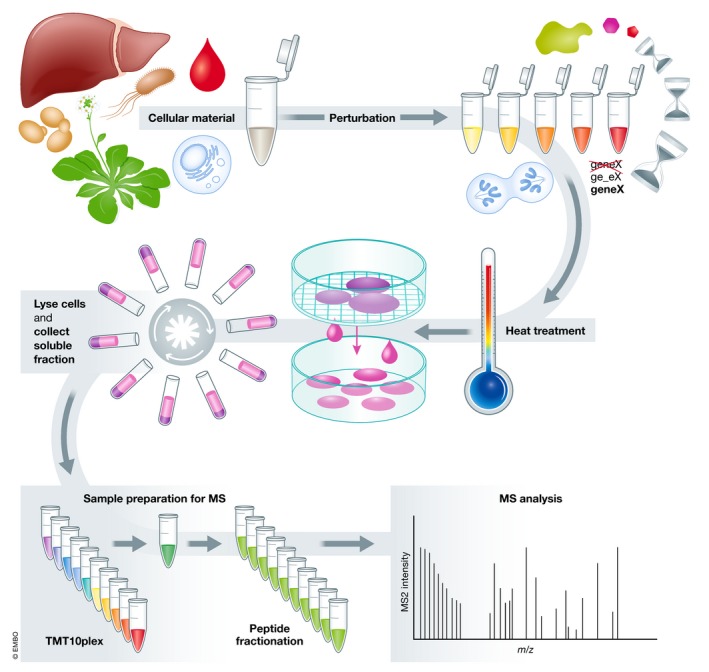
Thermal proteome profiling (TPP) is based on the principle that, when subjected to heat, proteins denature and become insoluble. Proteins can change their thermal stability upon interactions with small molecules (such as drugs or metabolites), nucleic acids or other proteins, or upon post‐translational modifications. TPP uses multiplexed quantitative mass spectrometry‐based proteomics to monitor the melting profile of thousands of expressed proteins. Importantly, this approach can be performed in vitro , in situ , or in vivo . It has been successfully applied to identify targets and off‐targets of drugs, or to study protein–metabolite and protein–protein interactions. Therefore, TPP provides a unique insight into protein state and interactions in their native context and at a proteome‐wide level, allowing to study basic biological processes and their underlying mechanisms.
Overview
The claims and statistics of this paper haven’t been checked yet.
Free: it reads the open-access text and checks the first 5 claims that cite a source we can check. Create a free account to check every claim.
Integrity signals
Registry
Cites
Statistics
Figures

Verification
Claims the paper makes
The claims and statistics of this paper haven’t been checked yet.
Free: it reads the open-access text and checks the first 5 claims that cite a source we can check. Create a free account to check every claim.
Claims other papers make about this one
Each is checked against this paper’s own text: does it say what the citing paper says it does?
The source backs part of the claim, not all of it — or backs it for a different population, condition or comparison.
In the citing paper
“Especially in combination with quantitative changes measured by e.g., phosphoproteomics, TPP can be used to identify functionally relevant alterations and link them to signaling and phenotypic consequences (Savitski et al, 2014; Mateus et al, 2020).”
From Network integration of thermal proteome profiling with multi-omics data decodes PARP inhibition (2024) · cites this paper as Mateus et al, 2020
Experimental — accuracy not yet measuredThe source backs part of the claim, not all of it — or backs it for a different population, condition or comparison.
In the citing paper
“TPP has been used successfully in the past for drug profiling, but it generates complex data that are difficult to interpret and potentially benefit from integration with other data types (Savitski et al, 2014; Perrin et al, 2020; Mateus et al, 2020).”
From Network integration of thermal proteome profiling with multi-omics data decodes PARP inhibition (2024) · cites this paper as Mateus et al, 2020
Experimental — accuracy not yet measuredThe cited source says what the claim attributes to it.
In the citing paper
“Thermal proteome profiling (TPP, Savitski et al, 2014) is a mass-spectrometry (MS) based functional proteomics method that can identify shifts in protein thermal stability across different conditions (Mateus et al, 2020).”
From Network integration of thermal proteome profiling with multi-omics data decodes PARP inhibition (2024) · cites this paper as Mateus et al, 2020
The cited source says what the claim attributes to it.
In the citing paper
“In this case, thermal (de)stabilization can correspond to a variety of effects ranging from drug binding to complex formation among others (Mateus et al, 2020).”
From Network integration of thermal proteome profiling with multi-omics data decodes PARP inhibition (2024) · cites this paper as Mateus et al, 2020
Self-check
Percentages, sums and reported differences re-computed from the paper’s own numbers.
The self-check needs the paper’s full text.
Citations
Cites
limma powers differential expression analyses for RNA-sequencing and microarray studies
Ritchie, M. E., Phipson, B., Wu, D., Hu, Y., Law, C. W., Shi, W., & Smyth, G. K. (2015) · Nucleic Acids Research · doi:10.1093/nar/gkv007 · Cited by 40,458
Cox, J., & Mann, M. (2008) · Nature Biotechnology · doi:10.1038/nbt.1511 · Cited by 14,855
Universal sample preparation method for proteome analysis
Wiśniewski, J. R., Zougman, A., Nagaraj, N., & Mann, M. (2009) · Nature Methods · doi:10.1038/nmeth.1322 · Cited by 8,352 · cited 2×
“…samples are then processed using a general bottom-up proteomics workflow, such as in-gel digestion (Shevchenko et al , 2006), in-solution digestion, filter-aided sample preparation (FASP; Wisniewski et al , 2009), or single-pot solid-phase sample preparation (SP3; Hughes et al , 2014, 2019; Fig 2).”
Global quantification of mammalian gene expression control
Schwanhäusser, B., Busse, D., Li, N., Dittmar, G., Schuchhardt, J., Wolf, J., Chen, W., & Selbach, M. (2011) · Nature · doi:10.1038/nature10098 · Cited by 6,566 · cited 2×
“…upon ligand binding, or changes to protein interactions or conformation, termed limited proteolysis (LiP; Feng et al , 2014; Leuenberger et al , 2017; Schopper et al , 2017; Piazza et al , 2018), or the inferring of stability of proteins from rates of oxidation (SPROX; Strickland et al , 2013).”
Tacconelli, E., Carrara, E., Savoldi, A., Harbarth, S., Mendelson, M., Monnet, D. L., Pulcini, C., Kahlmeter, G., Kluytmans, J., Carmeli, Y., et al. (2018) · The Lancet Infectious Diseases · doi:10.1016/s1473-3099(17)30753-3 · Cited by 6,142 · cited 1×
“Similarly, the redox state of a protein can also alter its melting behavior (Sun et al , 2019), and we anticipate that similar stabilization events are yet to be identified for other types of post-translational modifications.”
Biomolecular condensates: organizers of cellular biochemistry
Banani, S. F., Lee, H. O., Hyman, A. A., & Rosen, M. K. (2017) · Nature Reviews Molecular Cell Biology · doi:10.1038/nrm.2017.7 · Cited by 6,100
In-gel digestion for mass spectrometric characterization of proteins and proteomes
Shevchenko, A., Tomas, H., Havli, J., Olsen, J. V., & Mann, M. (2006) · Nature Protocols · doi:10.1038/nprot.2006.468 · Cited by 4,942
Ross, P. L., Huang, Y. N., Marchese, J. N., Williamson, B., Parker, K., Hattan, S., Khainovski, N., Pillai, S., Dey, S., Daniels, S., et al. (2004) · Molecular & Cellular Proteomics · doi:10.1074/mcp.m400129-mcp200 · Cited by 4,401 · cited 2×
“However, isobaric tags for relative and absolute quantitation (iTRAQ; Ross et al , 2004) have also been used (Huber et al , 2015), but limit the multiplexing capacity (i.e., fewer temperatures or compound concentrations can be multiplexed), which will generally result in longer analysis time.”
Liquid phase condensation in cell physiology and disease
Shin, Y., & Brangwynne, C. P. (2017) · Science · doi:10.1126/science.aaf4382 · Cited by 4,152
Huber, W., von Heydebreck, A., Sültmann, H., Poustka, A., & Vingron, M. (2002) · Bioinformatics · doi:10.1093/bioinformatics/18.suppl_1.s96 · Cited by 2,440
Cited by
Overcoming cancer therapeutic bottleneck by drug repurposing
Zhang, Z., Zhou, L., Xie, N., Nice, E. C., Zhang, T., Cui, Y., & Huang, C. (2020) · Signal Transduction and Targeted Therapy · doi:10.1038/s41392-020-00213-8 · Cited by 516
Impact of phosphorylation on thermal stability of proteins
Potel, C. M., Kurzawa, N., Becher, I., Typas, A., Mateus, A., & Savitski, M. M. (2021) · Nature Methods · doi:10.1038/s41592-021-01177-5 · Cited by 103
“5) and gain experimental depth; and (3) we implemented a robust data analysis approach including two data-normalization steps and multiple-testing correction (Supplementary Discussion, ‘Performing multiple testing correction’, and Supplementary Table 1).”
BackgroundMethodSelf-citationKurzawa, N., Becher, I., Sridharan, S., Franken, H., Mateus, A., Anders, S., Bantscheff, M., Huber, W., & Savitski, M. M. (2020) · Nature Communications · doi:10.1038/s41467-020-19529-8 · Cited by 53
Self-citationAdvancing Targeted Protein Degradation via Multiomics Profiling and Artificial Intelligence
Duran-Frigola, M., Cigler, M., & Winter, G. E. (2023) · Journal of the American Chemical Society · doi:10.1021/jacs.2c11098 · Cited by 50
Molecular profiling of sponge deflation reveals an ancient relaxant-inflammatory response
Ruperti, F., Becher, I., Stokkermans, A., Wang, L., Marschlich, N., Potel, C., Maus, E., Stein, F., Drotleff, B., Schippers, K. J., et al. (2024) · Current Biology · doi:10.1016/j.cub.2023.12.021 · Cited by 23
Self-citation
Metadata
- Authors
- Mateus, A., Kurzawa, N., Becher, I., Sridharan, S., Helm, D., Stein, F., Typas, A., & Savitski, M. M.
- Affiliations
- European Molecular Biology Laboratory (DE)
- Heidelberg University (DE)
- Corresponding author
- Savitski, Mikhail M
- ORCID
- Venue
- Molecular Systems Biology
- Published
- 2020-03-01
- Volume
- 16
- Issue
- 3
- Pages
- e9232-e9232
- ISSN
- 1744-4292 (ISSN-L)
- PMC
- PMC7057112
- OpenAlex
- W3009760307
- Cited by
- 258
- References
- 81
- Citations by year
- 2026: 38 · 2025: 42 · 2024: 52 · 2023: 46 · 2022: 41 · 2021: 29 · 2020: 9
- FWCI
- 3.71
- Type
- journal article
- Language
- en
- Open access
- gold
- doi.org
- Licence
- other-oa
- creativecommons.org/licenses/by/4.0/ (tdm)
- creativecommons.org/licenses/by/4.0/ (vor, 4 d)
- Locations
- Molecular Systems Biology (publishedVersion, other-oa)
- PubMed Central (publishedVersion, cc-by)
- PubMed (publishedVersion)
- DOAJ (DOAJ: Directory of Open Access Journals) (submittedVersion, cc-by-sa)
- Funders
- European Molecular Biology Laboratory (664726)
- Topics
- Physical Sciences › Chemistry › Spectroscopy › Advanced Proteomics Techniques and Applications
- Physical Sciences › Chemistry › Physical and Theoretical Chemistry › thermodynamics and calorimetric analyses
- Life Sciences › Biochemistry, Genetics and Molecular Biology › Molecular Biology › Heat shock proteins research
- Keywords
- thermal proteome profiling, protein-protein interaction, protein-metabolite interactions, protein thermal stability, protein denaturation, drug target identification, off-target effects, post-translational modification
- MeSH terms
- Humans, Protein Binding, Proteins, Mass Spectrometry, Thermodynamics, Proteomics, Protein Stability, Biophysical Phenomena, Protein Interaction Maps
About these checks
Registry, retraction, Cites and statistics results are computed, not judged, with one exception: a printed reference that no index lists is read once by a model before it counts as a citation error. Claims are extracted by a model and kept only when their quote appears verbatim in the text; each cited source is then checked, with a model’s help, for whether it says what the claim relies on. Those verdicts can be wrong — read the claim’s quote and the cited source before relying on one.
Statistics and arithmetic are recomputed, not judged.
Confidence bands are shown only for fields calibrated on our annotated test set. None is calibrated yet, so no band is shown.
What counts as a claim ›How we measure confidence ›How we check this ›
Are you an author, or do you see a problem with this page? Request a review
Data sources
Bibliographic data: Semantic Scholar, OpenAlex, Crossref.
Contains information from the Semantic Scholar Academic Graph Datasets, made available under the ODC Attribution License (ODC-BY 1.0).
Semantic Scholar’s data is described in: Kinney, R., et al. (2023). The Semantic Scholar Open Data Platform. arXiv:2301.10140.
