

Unusual causes of hyperthyrotropinemia and differential diagnosis of primary hypothyroidism: a revised diagnostic flowchart
Open accessThe DOI matches its Crossref record; 94 of the 97 references it cites were found in a registry or an index; 4 of the 134 sources its claims cite were checked for support.
Abstract
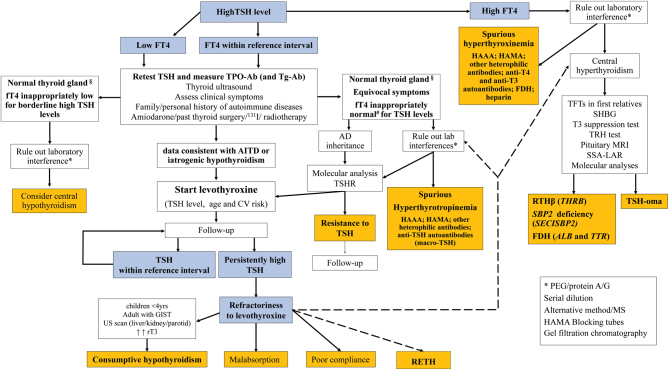
The clinical consequences of primary hypothyroidism include cardiovascular morbidity, increased mortality, and poor quality of life; therefore guidelines endorsed by several Scientific Societies recommend measuring circulating thyroid-stimulating hormone (TSH) in patients at risk. The assessment of serum TSH levels is also deemed to be the most robust and accurate biomarker during the management of replacement therapy in patients with a previous diagnosis of primary hypothyroidism. In line with a reflex TSH laboratory strategy, free thyroxine is measured only if the TSH falls outside specific cutoffs, in order to streamline investigations and save unjustified costs. This serum TSH-based approach to both diagnosis and monitoring has been widely accepted by several national and local health services; nevertheless, false-negative or -positive testing may occur, leading to inappropriate management or treatment. This review aims to describe several infrequent causes of increased circulating TSH, including analytical interferences, resistance to TSH, consumptive hypothyroidism, and refractoriness to levothyroxine replacement treatment. We propose a clinical flowchart to aid correct recognition of these various conditions, which represent important potential pitfalls in the diagnosis and treatment of primary hypothyroidism.
Overview
CoChat Summary
TL;DR
This narrative review describes infrequent causes of elevated TSH—assay interferences, critical illness/nonthyroidal illness, acute amiodarone, TSH resistance, refractoriness to levothyroxine, and consumptive hypothyroidism—and proposes a revised diagnostic flowchart. It emphasizes clinical assessment and targeted testing to avoid misdiagnosis and inappropriate treatment in primary hypothyroidism.
Key findings
- Assay interferences are rare (<1% of samples) but can be harmful: in a review of 150 patients, >50% had mismanagement or adverse events; the probability of falsely raised TSH was estimated at 2.3–16.7% depending on hypothyroidism prevalence. Macro-TSH was found in 0.5–1.6% of samples referred for hypothyroidism and in 0.43% of neonates in one study.
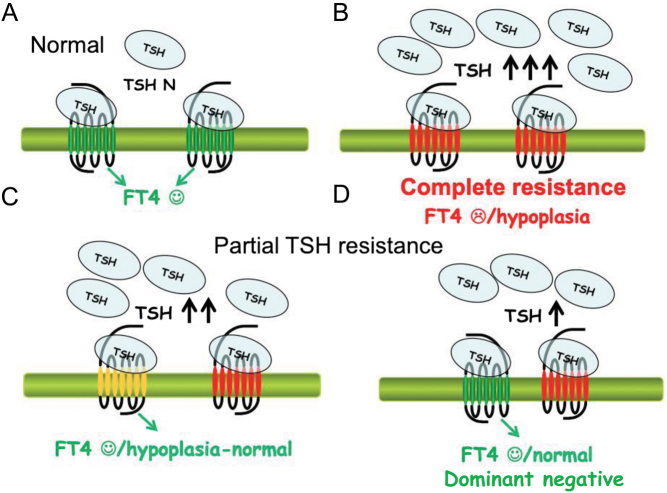
- Partial TSH resistance was estimated at 10–20% among young Italian patients with hyperthyrotropinemia without thyroid autoimmunity; heterozygous TSHR variants were estimated as high as 1:169 in a Hungarian congenital hypothyroidism cohort. Complete biallelic resistance causes severe congenital hypothyroidism with thyroid hypoplasia, moderate biallelic resistance causes high TSH with normal free T4, and mild monoallelic resistance causes slight TSH elevation with normal free T4.
- Refractoriness to levothyroxine can result from poor compliance, malabsorption, nephrotic syndrome, drugs/foods, or resistance to exogenous thyroxine (RETH); in 18 RETH subjects, TSH normalized only with supraphysiological free T4 (>20 pmol/L) and thyrotoxic symptoms. In congenital hypothyroidism, 10–40% of neonates and children fail to normalize TSH despite adequate levothyroxine treatment.
- Consumptive hypothyroidism is a rare paraneoplastic syndrome caused by tumors overexpressing type 3 deiodinase, often hepatic hemangiomas/endotheliomas in children; infantile hemangiomas affect 4–5% of Caucasian children, and treatment requires very high levothyroxine and/or liothyronine doses, with propranolol as first-line therapy for hemangioma control.
Methods
- Narrative review of published literature, with no systematic search, meta-analysis, or primary data collection described; it includes summary tables, figures, and a proposed clinical flowchart.
- Evidence is synthesized from cited studies and the authors’ institutional experience, including a described levothyroxine absorption test protocol: 1 mg levothyroxine with TSH and free T4 measured every 60 min up to 6 h, then at 2 and 7 days.
- Main analysis is qualitative and clinical, aimed at differential diagnosis and management rather than statistical estimation.
Limitations
- The paper states that a detailed discussion of the limitations of the reflex TSH screening approach is beyond its aims; it is a narrative review without systematic review methodology or primary data.
- Some management recommendations rely on retrospective or cross-sectional studies and expert opinion—for example, the suggestion that levothyroxine may be avoided in mild TSH resistance is supported by retrospective cross-sectional studies.
- The text notes there is no standardized protocol for the levothyroxine absorption test and no single method is 100% sensitive for detecting assay interference.
Model-written summary. Check it against the paper before relying on it.
Integrity signals
Registry
Cites
Statistics
Figures
Verification
Claims the paper makes
4 Valid · 3 Not valid · 89 Not checked · 10 Own results and interpretations
The cited sources support only part of this claim — read each source’s verdict below.
In the paper
“Less frequently, consumptive hypothyroidism may also affect adult patients with hemangiomas but also non-vascular tumors such as gastrointestinal stromal tumor (GIST) and malignant fibrous tumors (63, 64).”
§ Unusual causes of hyperthyrotropinemia and differential diagnosis of primary hypothyroidism: a revised diagnostic flowchart > Refractoriness to L-T4 replacement therapy > Consumptive hypothyroidism
What the sources say
- Not matchedcites [63] Fiore R La Rosa S Uccella S Marchiori D & Kopp PA. Consumptive hypothyroidism in a patient with malignant rhabdoid tumor of the kidney: case report on a newly found association. European Thyroid Journal 2022 11 e220006. (10.1530/ETJ-22-0006) PMC9578057 36053775
We searched by its title and found no matching paper.
- Partly supportedcites [64] Maynard MA & Huang SA. Thyroid hormone inactivation in gastrointestinal stromal tumors. New England Journal of Medicine 2014 370 1327– 1334. (10.1056/NEJMc1405198) 24693892 PMC4186889 sourceExperimental — accuracy not yet measured
The Discussion (page not provided) reports only three previous adult cases involving vascular or fibroblastic tumors and presents GIST as another cause of consumptive hypothyroidism. It does not identify the adult vascular tumors as hemangiomas or the fibroblastic tumors as malignant fibrous tumors; it also says the incidence in GIST is unknown. (LLM, conf=0.82)
hedgedstates a possible cause- Asserted: passes — The authors put it forward as true.
- Checkable: passes — It can be checked against evidence.
- Load-bearing: unclear — It is unclear whether the paper’s conclusions depend on it.
- Based: passes — The paper gives a reason why it holds.
- Not matched
The cited sources support only part of this claim — read each source’s verdict below.
In the paper
“In GIST, D3 overexpression can be also induced by the administration of tyrosine kinase inhibitor (TKI) such as sunitinib.”
§ Unusual causes of hyperthyrotropinemia and differential diagnosis of primary hypothyroidism: a revised diagnostic flowchart > Refractoriness to L-T4 replacement therapy > Consumptive hypothyroidism
What the sources say
- Not matchedcites [63] Fiore R La Rosa S Uccella S Marchiori D & Kopp PA. Consumptive hypothyroidism in a patient with malignant rhabdoid tumor of the kidney: case report on a newly found association. European Thyroid Journal 2022 11 e220006. (10.1530/ETJ-22-0006) PMC9578057 36053775
We searched by its title and found no matching paper.
- Partly supportedcites [64] Maynard MA & Huang SA. Thyroid hormone inactivation in gastrointestinal stromal tumors. New England Journal of Medicine 2014 370 1327– 1334. (10.1056/NEJMc1405198) 24693892 PMC4186889 sourceExperimental — accuracy not yet measured
The Results (Endogenous D3 Activity in GIST Cells) report increased D3 activity and messenger RNA after cultured GIST-T1 cells were exposed to sunitinib or imatinib. The Discussion says tumor-biopsy studies before and during treatment are still needed, so the paper does not establish that administering sunitinib induces D3 overexpression in patients’ tumors. (LLM, conf=0.86)
plainstates a cause- Asserted: passes — The authors put it forward as true.
- Checkable: passes — It can be checked against evidence.
- Load-bearing: unclear — It is unclear whether the paper’s conclusions depend on it.
- Based: passes — The paper gives a reason why it holds.
- Not matched
In the paper
“considering a prevalence of hypothyroidism in the population between 2 and 17% (20–170 cases every 1000 assays) and a prevalence of analytical errors of 0.4% (4 cases every 1000 assays), the probability of falsely raised TSH can be estimated as 2.3–16.7%, depending on the quoted prevalence of hypothyroidism (16).”
§ Unusual causes of hyperthyrotropinemia and differential diagnosis of primary hypothyroidism: a revised diagnostic flowchart > Assay interferences
What the sources say
- Not checked yetcites [16] Ismail AA. On the diagnosis of subclinical hypothyroidism. British Journal of General Practice 2007 57 1000– 1001. (10.3399/096016407782604802) PMC2084120 18252087
hedgedstates an association- Asserted: passes — The authors put it forward as true.
- Checkable: passes — It can be checked against evidence.
- Load-bearing: unclear — It is unclear whether the paper’s conclusions depend on it.
- Based: passes — The paper gives a reason why it holds.
A result the paper reports from its own data — it cites no other source for it, so there is none to check. The quote shows it is in the paper.
In the paper
“In our experience, all the patients treated so far adequately absorbed L-T4”
§ Unusual causes of hyperthyrotropinemia and differential diagnosis of primary hypothyroidism: a revised diagnostic flowchart > Refractoriness to L-T4 replacement therapy > Pseudo-malabsorption
plain- Asserted: passes — The authors put it forward as true.
- Checkable: passes — It can be checked against evidence.
- Load-bearing: unclear — It is unclear whether the paper’s conclusions depend on it.
- Based: passes — The paper gives a reason why it holds.
In the paper
“A recent review of 150 patients with interferences in TFTs shows that in more than 50% of cases, the assay artifact had a harmful impact, resulting in mismanagement or adverse events (15).”
§ Unusual causes of hyperthyrotropinemia and differential diagnosis of primary hypothyroidism: a revised diagnostic flowchart > Assay interferences
What the sources say
- Not checked yetcites [15] Favresse J Burlacu MC Maiter D & Gruson D. Interferences with thyroid function immunoassays: clinical implications and detection algorithm. Endocrine Reviews 2018 39 830– 850. (10.1210/er.2018-00119) 29982406
plainstates a causen = 150- Asserted: passes — The authors put it forward as true.
- Checkable: passes — It can be checked against evidence.
- Load-bearing: unclear — It is unclear whether the paper’s conclusions depend on it.
- Based: passes — The paper gives a reason why it holds.
51 more claims
Create a free account to see all 106 claims and to verify the 112 references still open.
- It may state two separate claims as one. 48
- Probably not a substantial claim. 8
Citations
Cites
JOURNAL OF CLINICAL ENDOCRINOLOGY AND METABOLISM
HOSKINS, R. G. (1953) · The Journal of Clinical Endocrinology & Metabolism · doi:10.1210/jcem-13-4-473 · Cited by 3,780
Journal of The American College of Cardiology
(2015) · Wilderness & Environmental Medicine · doi:10.1016/j.wem.2015.03.023 · Cited by 2,584
Clinical and Experimental Immunology
Kay, H. (1966) · PubMed Central · Cited by 2,177
Jonklaas, J., Bianco, A. C., Bauer, A. J., Burman, K. D., Cappola, A. R., Celi, F. S., Cooper, D. S., Kim, B. W., Peeters, R. P., Rosenthal, M. S., et al. (2014) · Thyroid® · doi:10.1089/thy.2014.0028 · Cited by 1,928
Molecular and cellular endocrinology
Gianaroli, L., Ferraretti, A., Canale, D., Foresta, C., & Magli, M. (2000) · Molecular and Cellular Endocrinology · doi:10.1016/s0303-7207(00)00232-x · Cited by 1,741
Garber, J. R., Cobin, R. H., Gharib, H., Hennessey, J. V., Klein, I., Mechanick, J. I., Pessah-Pollack, R., Singer, P. A., & Woeber, K. A. (2012) · Endocrine Practice · doi:10.4158/ep12280.gl · Cited by 1,567
Global epidemiology of hyperthyroidism and hypothyroidism
Taylor, P. N., Albrecht, D., Scholz, A., Gutierrez-Buey, G., Lazarus, J. H., Dayan, C. M., & Okosieme, O. E. (2018) · Nature Reviews Endocrinology · doi:10.1038/nrendo.2018.18 · Cited by 1,552
The journal of clinical investigation
(1994) · Journal of the American Dietetic Association · doi:10.1016/0002-8223(94)92394-9 · Cited by 1,198
Garber, J. R., Cobin, R. H., Gharib, H., Hennessey, J. V., Klein, I., Mechanick, J. I., Pessah-Pollack, R., Singer, P. A., & Woeber for the American Association, K. A. (2012) · Thyroid · doi:10.1089/thy.2012.0205 · Cited by 1,053
The NEW ENGLAND JOURNAL of MEDICINE
Gelijns, A. C., Rosenberg, N., & Moskowitz, A. J. (2009) · Studies on Science and the Innovation Process · doi:10.1142/9789814273596_0013 · Cited by 980
Clinical Chemistry and Laboratory Medicine
(2006) · Clinical Chemistry and Laboratory Medicine (CCLM) · doi:10.1515/cclm · Cited by 662
European Journal of Endocrinology
(2022) · European Journal of Endocrinology · doi:10.1530/eje · Cited by 587
Free radical biology and medicine
(2003) · Free Radical Biology and Medicine · doi:10.1016/s0891-5849(03)00484-2 · Cited by 549
Storch, C. H., & Hoeger, P. H. (2010) · British Journal of Dermatology · doi:10.1111/j.1365-2133.2010.09848.x · Cited by 526
The New England journal of medicine
(1994) · Journal of the American Dietetic Association · doi:10.1016/0002-8223(94)92577-1 · Cited by 465
Demers, L. M., & Spencer, C. A. (2003) · Clinical Endocrinology · doi:10.1046/j.1365-2265.2003.01681.x · Cited by 460
Journal of Pediatric Endocrinology and Metabolism
(2010) · Journal of Pediatric Endocrinology and Metabolism · doi:10.1515/jpem · Cited by 431
Christison-Lagay, E. R., Burrows, P. E., Alomari, A., Dubois, J., Kozakewich, H. P., Lane, T. S., Paltiel, H. J., Klement, G., Mulliken, J. B., & Fishman, S. J. (2007) · Journal of Pediatric Surgery · doi:10.1016/j.jpedsurg.2006.09.041 · Cited by 382
Strachan, T., & Read, A. (2018) · Garland Science eBooks · doi:10.4324/9780203833544 · Cited by 378
Resistance to Thyrotropin Caused by Mutations in the Thyrotropin-Receptor Gene
Sunthornthepvarakul, T., Gottschalk, M. E., Hayashi, Y., & Refetoff, S. (1995) · New England Journal of Medicine · doi:10.1056/nejm199501193320305 · Cited by 345
Mantovani, G., Bastepe, M., Monk, D., de Sanctis, L., Thiele, S., Usardi, A., Ahmed, S. F., Bufo, R., Choplin, T., De Filippo, G., et al. (2018) · Nature Reviews Endocrinology · doi:10.1038/s41574-018-0042-0 · Cited by 345
Chaker, L., Razvi, S., Bensenor, I. M., Azizi, F., Pearce, E. N., & Peeters, R. P. (2022) · Nature Reviews Disease Primers · doi:10.1038/s41572-022-00357-7 · Cited by 330
Minireview: GNAS: Normal and Abnormal Functions
Weinstein, L. S., Liu, J., Sakamoto, A., Xie, T., & Chen, M. (2004) · Endocrinology · doi:10.1210/en.2004-0865 · Cited by 327
Non-Thyroidal Illness in the ICU: A Syndrome with Different Faces
Van den Berghe, G. (2014) · Thyroid® · doi:10.1089/thy.2014.0201 · Cited by 316
(2020) · Journal of Clinical Medicine- Hue Central Hospital · doi:10.38103/jcmhch.2020.64 · Cited by 307
Pitfalls in the measurement and interpretation of thyroid function tests
Koulouri, O., Moran, C., Halsall, D., Chatterjee, K., & Gurnell, M. (2013) · Best Practice & Research Clinical Endocrinology & Metabolism · doi:10.1016/j.beem.2013.10.003 · Cited by 282
Interferences With Thyroid Function Immunoassays: Clinical Implications and Detection Algorithm
Favresse, J., Burlacu, M.-C., Maiter, D., & Gruson, D. (2018) · Endocrine Reviews · doi:10.1210/er.2018-00119 · Cited by 258
Abramowicz, M. J., Duprez, L., Parma, J., Vassart, G., & Heinrichs, C. (1997) · Journal of Clinical Investigation · doi:10.1172/jci119497 · Cited by 257
(2017) · Clinical Chemistry and Laboratory Medicine (CCLM) · doi:10.1515/cclm-2017-7008 · Cited by 249
Nature Reviews Disease Primers
(2019) · Nature Reviews Disease Primers · doi:10.1038/41572.2056-676x · Cited by 244
Heterophilic antibody interference in immunometric assays
Bolstad, N., Warren, D. J., & Nustad, K. (2013) · Best Practice & Research Clinical Endocrinology & Metabolism · doi:10.1016/j.beem.2013.05.011 · Cited by 239
Persani, L., Brabant, G., Dattani, M., Bonomi, M., Feldt-Rasmussen, U., Fliers, E., Gruters, A., Maiter, D., Schoenmakers, N., & van Trotsenburg, A. S. P. (2018) · European Thyroid Journal · doi:10.1159/000491388 · Cited by 222
Self-citationTseng, F.-Y., Lin, W.-Y., Lin, C.-C., Lee, L.-T., Li, T.-C., Sung, P.-K., & Huang, K.-C. (2012) · Journal of the American College of Cardiology · doi:10.1016/j.jacc.2012.03.047 · Cited by 212
Hadlow, N. C., Rothacker, K. M., Wardrop, R., Brown, S. J., Lim, E. M., & Walsh, J. P. (2013) · The Journal of Clinical Endocrinology & Metabolism · doi:10.1210/jc.2012-4223 · Cited by 203
The Relationship between Serum Triiodothyronine and Thyrotropin during Systemic Illness*
BACCI, V., SCHUSSLER, G. C., & KAPLAN, T. B. (1982) · The Journal of Clinical Endocrinology & Metabolism · doi:10.1210/jcem-54-6-1229 · Cited by 202
Association of subclinical hypothyroidism and cardiovascular disease with mortality
Inoue, K., Ritz, B., Brent, G. A., Ebrahimi, R., Rhee, C. M., & Leung, A. M. (2020) · JAMA Network Open · doi:10.1001/jamanetworkopen.2019.20745 · Cited by 191
HAMBLIN, P. S., DYER, S. A., MOHR, V. S., LE GRAND, B. A., LIM, C.-F., TUXEN, D. V., TOPLISS, D. J., & STOCKIGT, J. R. (1986) · The Journal of Clinical Endocrinology & Metabolism · doi:10.1210/jcem-62-4-717 · Cited by 183
Germline Mutations of TSH Receptor Gene as Cause of Nonautoimmune Subclinical Hypothyroidism
Alberti, L. (2002) · Journal of Clinical Endocrinology & Metabolism · doi:10.1210/jc.87.6.2549 · Cited by 154
Self-citationHormone Immunoassay Interference: A 2021 Update
Ghazal, K., Brabant, S., Prié, D., & Piketty, M. (2021) · Annals of Laboratory Medicine · doi:10.3343/alm.2022.42.1.3 · Cited by 153
Ismail, A. A., Walker, P. L., Barth, J. H., Lewandowski, K. C., Jones, R., & Burr, W. A. (2002) · Clinical Chemistry · doi:10.1093/clinchem/48.11.2023 · Cited by 151
Eskes, S. A., & Wiersinga, W. M. (2009) · Best Practice & Research Clinical Endocrinology & Metabolism · doi:10.1016/j.beem.2009.07.001 · Cited by 148
(2026) · European Thyroid Journal · doi:10.1159/issn.2235-0640 · Cited by 139
Deiodinases control local cellular and systemic thyroid hormone availability
Köhrle, J., & Frädrich, C. (2022) · Free Radical Biology and Medicine · doi:10.1016/j.freeradbiomed.2022.09.024 · Cited by 133
Interferences in immunoassays: review and practical algorithm
Wauthier, L., Plebani, M., & Favresse, J. (2022) · Clinical Chemistry and Laboratory Medicine (CCLM) · doi:10.1515/cclm-2021-1288 · Cited by 125
The Journal of Clinical Pathology
(2024) · The journal of clinical pathology. · doi:10.52338/tjocp · Cited by 122
Calebiro, D., de Filippis, T., Lucchi, S., Covino, C., Panigone, S., Beck-Peccoz, P., Dunlap, D., & Persani, L. (2005) · Human Molecular Genetics · doi:10.1093/hmg/ddi329 · Cited by 117
Self-citationGenetics and phenomics of hypothyroidism due to TSH resistance
Persani, L., Calebiro, D., Cordella, D., Weber, G., Gelmini, G., Libri, D., de Filippis, T., & Bonomi, M. (2010) · Molecular and Cellular Endocrinology · doi:10.1016/j.mce.2010.01.008 · Cited by 117
Self-citationFisher, D. A. (2000) · Journal of Clinical Endocrinology & Metabolism · doi:10.1210/jc.85.8.2722 · Cited by 101
(2019) · Nature Reviews Endocrinology · doi:10.1038/41574.1759-5037 · Cited by 100
Syndromes of hormone resistance in the hypothalamic–pituitary–thyroid axis
Beck-Peccoz, P., Persani, L., Calebiro, D., Bonomi, M., Mannavola, D., & Campi, I. (2006) · Best Practice & Research Clinical Endocrinology & Metabolism · doi:10.1016/j.beem.2006.11.001 · Cited by 83
Self-citationInfantile Hemangiomas: An Update on Pathogenesis and Treatment
Kowalska, M., Dębek, W., & Matuszczak, E. (2021) · Journal of Clinical Medicine · doi:10.3390/jcm10204631 · Cited by 80
Interference from endogenous antibodies in automated immunoassays: what laboratorians need to know
Ismail, A. A. A. (2009) · Journal of Clinical Pathology · doi:10.1136/jcp.2008.055848 · Cited by 76
Tonacchera, M., Perri, A., De Marco, G., Agretti, P., Banco, M. E., Di Cosmo, C., Grasso, L., Vitti, P., Chiovato, L., & Pinchera, A. (2004) · The Journal of Clinical Endocrinology & Metabolism · doi:10.1210/jc.2004-1243 · Cited by 72
Thyroid Hormone Inactivation in Gastrointestinal Stromal Tumors
Maynard, M. A., Marino-Enriquez, A., Fletcher, J. A., Dorfman, D. M., Raut, C. P., Yassa, L., Guo, C., Wang, Y., Dorfman, C., Feldman, H. A., et al. (2014) · New England Journal of Medicine · doi:10.1056/nejmoa1308893 · Cited by 70
Walker, J. N., Shillo, P., Ibbotson, V, Vincent, A., Karavitaki, N., Weetman, A. P., Wass, J. A. H., & Allahabadia, A. (2013) · European Journal of Endocrinology · doi:10.1530/eje-12-1035 · Cited by 70
The spectrum of thyroid function tests during hospitalization for SARS COV-2 infection
Campi, I., Bulgarelli, I., Dubini, A., Perego, G. B., Tortorici, E., Torlasco, C., Torresani, E., Rocco, L., Persani, L., & Fugazzola, L. (2021) · European Journal of Endocrinology · doi:10.1530/eje-20-1391 · Cited by 68
Self-citationType 3 deiodinase and consumptive hypothyroidism: a common mechanism for a rare disease
Luongo, C., Trivisano, L., Alfano, F., & Salvatore, D. (2013) · Frontiers in Endocrinology · doi:10.3389/fendo.2013.00115 · Cited by 67
McMillan, M., Rotenberg, K. S., Vora, K., Sterman, A. B., Thevathasan, L., Ryan, M. F., Mehra, M., & Sandulli, W. (2016) · Drugs in R&D · doi:10.1007/s40268-015-0116-6 · Cited by 64
Variability in the detection of macro TSH in different immunoassay systems
Hattori, N., Ishihara, T., & Shimatsu, A. (2016) · European Journal of Endocrinology · doi:10.1530/eje-15-0883 · Cited by 57
Acute Effects of Amiodarone Administration on Thyroid Function in Patients with Cardiac Arrhythmia
Iervasi, G. (1997) · Journal of Clinical Endocrinology & Metabolism · doi:10.1210/jc.82.1.275 · Cited by 55
Kempers, M. J. E., van Trotsenburg, A. S. P., van Tijn, D. A., Bakker, E., Wiedijk, B. M., Endert, E., de Vijlder, J. J. M., & Vulsma, T. (2005) · The Journal of Clinical Endocrinology & Metabolism · doi:10.1210/jc.2005-0197 · Cited by 54
Levothyroxine therapy in gastric malabsorptive disorders
Virili, C., Brusca, N., Capriello, S., & Centanni, M. (2021) · Frontiers in Endocrinology · doi:10.3389/fendo.2020.621616 · Cited by 52
The British Journal of Dermatology
Juliusberg, F. (1913) · Archives of Dermatological Research · doi:10.1007/bf01825469 · Cited by 52
Human anti-mouse antibody response to the injection of murine monoclonal antibodies against IL-6
LEGOUFFE, E., LIAUTARD, J., GAILLARD, J. P., ROSSI, J.-F., WIJDENES, J., BATAILLE, R., KLEIN, B., & BROCHIER, J. (2008) · Clinical and Experimental Immunology · doi:10.1111/j.1365-2249.1994.tb06145.x · Cited by 51
Long-Term Outcome of Loss-of-Function Mutations in Thyrotropin Receptor Gene
Tenenbaum-Rakover, Y., Almashanu, S., Hess, O., Admoni, O., Hag-Dahood Mahameed, A., Schwartz, N., Allon-Shalev, S., Bercovich, D., & Refetoff, S. (2015) · Thyroid · doi:10.1089/thy.2014.0311 · Cited by 50
The levothyroxine absorption test: a four-year experience (2015-2018) at the Mayo Clinic
Gonzales, K. M., Stan, M. N., Morris, J. C., Bernet, V., & Castro, M. R. (2019) · Thyroid · doi:10.1089/thy.2019.0256 · Cited by 46
Thyroid Resistance to TSH Complicated by Autoimmune Thyroiditis
Tonacchera, M. (2001) · Journal of Clinical Endocrinology & Metabolism · doi:10.1210/jc.86.9.4543 · Cited by 45
Campi, I., Covelli, D., Moran, C., Fugazzola, L., Cacciatore, C., Orlandi, F., Gallone, G., Chatterjee, K., Beck-Peccoz, P., & Persani, L. (2020) · Frontiers in Endocrinology · doi:10.3389/fendo.2020.00432 · Cited by 38
Self-citationDillman, R. O., Shawler, D. L., McCallister, T. J., & Halpern, S. E. (1994) · Cancer Biotherapy · doi:10.1089/cbr.1994.9.17 · Cited by 37
Rationalizing Thyroid Function Testing: Which TSH Cutoffs Are Optimal for Testing Free T4?
Henze, M., Brown, S. J., Hadlow, N. C., & Walsh, J. P. (2017) · The Journal of Clinical Endocrinology & Metabolism · doi:10.1210/jc.2017-01322 · Cited by 31
Bagattini, B., Cosmo, C. D., Montanelli, L., Piaggi, P., Ciampi, M., Agretti, P., Marco, G. D., Vitti, P., & Tonacchera, M. (2014) · European Journal of Endocrinology · doi:10.1530/eje-14-0621 · Cited by 28
Mild TSH resistance: Clinical and hormonal features in childhood and adulthood
Vigone, M. C., Di Frenna, M., Guizzardi, F., Gelmini, G., de Filippis, T., Mora, S., Caiulo, S., Sonnino, M., Bonomi, M., Persani, L., et al. (2017) · Clinical Endocrinology · doi:10.1111/cen.13387 · Cited by 28
Self-citationThe Journal of Clinical Endocrinology and Metabolism
(1983) · The Journal of Clinical Endocrinology & Metabolism · doi:10.1210/jcem-56-2-423 · Cited by 25
Thyroid Hormone Inactivation in Gastrointestinal Stromal Tumors
(2014) · New England Journal of Medicine · doi:10.1056/nejmc1405198 · Cited by 24
Lábadi, Á., Grassi, E., Gellén, B., Kleinau, G., Biebermann, H., Ruzsa, B., Gelmini, G., Rideg, O., Miseta, A., Kovács, G. L., et al. (2015) · The Journal of Clinical Endocrinology & Metabolism · doi:10.1210/jc.2014-4511 · Cited by 23
Self-citationPasa, M. W., Scheffel, R. S., Zanella, A. B., Maia, A. L., & Dora, J. M. (2017) · European Thyroid Journal · doi:10.1159/000481253 · Cited by 22
Reflex TSH strategy: the good, the bad and the ugly
Plebani, M., & Giovanella, L. (2019) · Clinical Chemistry and Laboratory Medicine (CCLM) · doi:10.1515/cclm-2019-0625 · Cited by 22
Evaluation of thyroid test utilization through analysis of population-level data
Gill, J., Barakauskas, V., Thomas, D., Rodríguez-Capote, K., Higgins, T., Zhang, D. C., VanSpronsen, A. D., Бабенко, О., Martindale, R., & Estey, M. P. (2017) · Clinical Chemistry and Laboratory Medicine (CCLM) · doi:10.1515/cclm-2016-1049 · Cited by 21
Difficult treatment of consumptive hypothyroidism in a child with massive parotid hemangioma
Vigone, M. C., Cortinovis, F., Rabbiosi, S., Di Frenna, M., Passoni, A., Persani, L., Chiumello, G., Gelmetti, C., & Weber, G. (2012) · Journal of Pediatric Endocrinology and Metabolism · doi:10.1515/jpem.2011.438 · Cited by 20
Self-citationPeters, C., Langham, S., Mullis, P.-E., & Dattani, M. T. (2010) · Hormone Research in Paediatrics · doi:10.1159/000281884 · Cited by 19
Essay – On the diagnosis of subclinical hypothyroidism
Ismail, A. A. (2007) · British Journal of General Practice · doi:10.3399/096016407782604802 · Cited by 17
Identification of Resistance to Exogenous Thyroxine in Humans
Lacámara, N., Beatriz Lecumberri, S., Barquiel, B., Escribano, A., Casado, I. G., Álvarez‐Escolá, C., Blanquer, F. A., Morales, F., Alfayate, R., Bernal-Soriano, M. C., et al. (2020) · Thyroid · doi:10.1089/thy.2019.0825 · Cited by 17
Hormone research in pædiatrics
Pediátrica, S. L.-A. D. E. (2010) · KARGER eBooks · Cited by 16
Bhakri, H. L., Fisher, R., Khadri, A., & MacMahon, D. G. (2009) · Gerontology · doi:10.1159/000213189 · Cited by 15
(1935) · JAMA · doi:10.1001/jama.1935.02760350082016 · Cited by 15
Hattori, N., Aisaka, K., Yamada, A., Matsuda, T., & Shimatsu, A. (2022) · Thyroid · doi:10.1089/thy.2022.0457 · Cited by 15
(2014) · Annals of Laboratory Medicine · doi:10.3343/issn.2234-3806 · Cited by 15
A case of macro-TSH consisting of IgA-bound TSH
Fukushita, M., Watanabe, N., Noh, J. Y., Yoshihara, A., Matsumoto, M., Suzuki, N., Yoshimura, R., Sugino, K., & Ito, K. (2021) · Endocrine Journal · doi:10.1507/endocrj.ej21-0021 · Cited by 14
Taher, J., Brinc, D., Gilmour, J. A., & Beriault, D. R. (2019) · Clinical Chemistry and Laboratory Medicine (CCLM) · doi:10.1515/cclm-2019-0396 · Cited by 10
A rare cause of subclinical hypothyroidism: macro-thyroid-stimulating hormone
Kıraç, C. O., Abuşoğlu, S., Hataysal, E. P., Kebapçılar, A., İpekçi, S. H., Ünlü, A., & Kebapçılar, L. (2019) · Diagnosis · doi:10.1515/dx-2019-0026 · Cited by 8
Tissue sensitivity to thyroid hormones may change over time
Radetti, G., Rigon, F., Salvatoni, A., Campi, I., Filippis, T. D., Cirello, V., Longhi, S., Guizzardi, F., Bonomi, M., & Persani, L. (2022) · European Thyroid Journal · doi:10.1530/etj-21-0054 · Cited by 7
Self-citationCampi, I., Agostini, M., Marelli, F., de Filippis, T., Romartínez-Alonso, B., Rajanayagam, O., Rurale, G., Gentile, I., Spagnolo, F., Andreasi, M., et al. (2021) · European Thyroid Journal · doi:10.1159/000519748 · Cited by 6
Self-citationYeoh, E. C. K., Claude, J. R., & Rajasoorya, C. (2013) · Nephrology · doi:10.1111/nep.12102 · Cited by 5
Fiore, R., La Rosa, S., Uccella, S., Marchiori, D., & Kopp, P. A. (2022) · European Thyroid Journal · doi:10.1530/etj-22-0006 · Cited by 3
Cited by
Van Uytfanghe, K., Ehrenkranz, J., Halsall, D., Hoff, K., Loh, T. P., Spencer, C. A., Köhrle, J., & ATA Thyroid Function Tests Writing Group (2023) · Thyroid® · doi:10.1089/thy.2023.0169 · Cited by 100
Vincenzi, G., Petralia, I. T., Abbate, M. T. A., & Vigone, M. C. (2025) · European Thyroid Journal · doi:10.1530/etj-25-0019 · Cited by 10
“Analytical interference in thyroid function tests (TFTs) can lead to diagnostic delays, unnecessary testing, and inappropriate treatment (40).”
Self-citationVargas‐Uricoechea, H., Barrera, C. A. B., Arenas-Quintero, H. M., Castellanos-Pinedo, A., Restrepo-Erazo, K., Ossman, J. J. D., Melo, L. J. R., Barraza-Gerardino, M., Mejía, G., Hernández-Triana, E., et al. (2023) · Revista Colombiana de Endocrinología Diabetes & Metabolismo · doi:10.53853/encr.10.4.818 · Cited by 7
Musolino, A., Grifoni, G. F. A., Rodolfi, S., Andreasi, M., Bulgarelli, I., Fanelli, F., Morelli, V., Persani, L., & Campi, I. (2025) · Thyroid · doi:10.1177/10507256251364557 · Cited by 3
“1,13 A combination of different methods is often necessary to uncover assay interferences.”
Self-citationSun, F., Wan, J.-P., Zhang, H., Nulali, J., Fang, Y., Zhang, Q.-Y., Wu, C., Wu, F.-Y., Zhang, Q.-Y., Yang, R.-M., et al. (2025) · Thyroid · doi:10.1177/10507256251372195 · Cited by 2
Metadata
- Authors
- Campi, I., Dell’Acqua, M., Stellaria Grassi, E., Cristina Vigone, M., & Persani, L.
- Affiliations
- IRCCS Istituto Auxologico Italiano (IT)
- University of Milan (IT)
- Department of Medical Biotechnology and Translational Medicine, University of Milan, Milan, Italy
- Department of Paediatrics, IRCCS San Raffaele Hospital, Milan, Italy
- Corresponding author
- Campi, Irene
- Venue
- European Thyroid Journal
- Publisher
- Bioscientifica
- Published
- 2023-04-17
- Volume
- 12
- Issue
- 4
- ISSN
- 2235-0640 (ISSN-L)
- 2235-0802
- PMC
- PMC10305563
- OpenAlex
- W4366083112
- Semantic Scholar
- 2d2e59e9403b7a90fa8fc34f0ac7d44cc54b8ab7
- Cited by
- 13
- References
- 97
- Citations by year
- 2026: 3 · 2025: 6 · 2024: 2 · 2023: 2
- FWCI
- 0.47
- Type
- journal article
- Language
- en
- Open access
- diamond
- doi.org
- Locations
- European Thyroid Journal (publishedVersion, cc-by)
- PubMed Central (publishedVersion, cc-by)
- PubMed (publishedVersion)
- Archivio Istituzionale della Ricerca (Universita Degli Studi Di Milano) (submittedVersion, other-oa)
- DOAJ (DOAJ: Directory of Open Access Journals) (submittedVersion, cc-by-sa)
- Funders
- Ministero della Salute
- Topics
- Health Sciences › Medicine › Endocrinology, Diabetes and Metabolism › Thyroid Disorders and Treatments
- Health Sciences › Medicine › Surgery › Thyroid and Parathyroid Surgery
- Health Sciences › Medicine › Endocrinology, Diabetes and Metabolism › Thyroid Cancer Diagnosis and Treatment
- Keywords
- hyperthyrotropinemia, primary hypothyroidism, thyroid-stimulating hormone, TSH resistance, free thyroxine, analytical interference, differential diagnosis, diagnostic flowchart
- MeSH terms
- Diagnosis, Differential, Humans, Hypothyroidism, Quality of Life, Software Design, Thyrotropin
About these checks
Registry, retraction, Cites and statistics results are computed, not judged, with one exception: a printed reference that no index lists is read once by a model before it counts as a citation error. Claims are extracted by a model and kept only when their quote appears verbatim in the text; each cited source is then checked, with a model’s help, for whether it says what the claim relies on. Those verdicts can be wrong — read the claim’s quote and the cited source before relying on one.
The claim verdicts this report counts are experimental: their accuracy is not yet measured.
A language model drew the claims from the paper on 2026-10-10, under version 3 of the claim definition (model deepseek-v4.1-flash, prompt extract-v3).
A second model labelled each claim on 2026-10-10 (model jev-1.13-20260917, definition revision gold-guideline-v0.2).
Cited sources are checked with a language model’s help (gpt-6-sol).
Statistics and arithmetic are recomputed, not judged.
Confidence bands are shown only for fields calibrated on our annotated test set. None is calibrated yet, so no band is shown.
What counts as a claim ›How we measure confidence ›How we check this ›
Are you an author, or do you see a problem with this page? Request a review
Data sources
Bibliographic data: Semantic Scholar, OpenAlex, Crossref.
Contains information from the Semantic Scholar Academic Graph Datasets, made available under the ODC Attribution License (ODC-BY 1.0).
Semantic Scholar’s data is described in: Kinney, R., et al. (2023). The Semantic Scholar Open Data Platform. arXiv:2301.10140.
