

A Case of Evolutionary Hypopituitarism Following Traumatic Brain Injury in Infancy
Open accessThe DOI matches its Crossref record; 28 of the 28 references it cites were found in a registry or an index; none of the 35 sources its claims cite is checked for support yet.
Abstract
The long-term clinical course of hypopituitarism resulting from traumatic brain injury in children is unclear. We here present a case involving a 31-year-old Japanese male with hypopituitarism caused by traumatic brain injury at the age of 5 months. His height velocity began to decrease around 3 years of age. At age 7, growth hormone and thyroid-stimulating hormone deficiencies were diagnosed. At age 10, hydrocortisone therapy was started, and testosterone enanthate therapy was needed at age 14. The secretion of anterior pituitary hormones gradually decreased. We should check endocrinological tests in patients with traumatic brain injury who have retarded growth.
Overview
CoChat Summary
TL;DR
This case report describes a 31-year-old Japanese man who developed progressive hypopituitarism after severe traumatic brain injury at age 5 months, with GH and TSH deficiencies diagnosed at age 7, ACTH deficiency at age 10, and gonadotropin deficiency at age 14. The authors conclude that anterior pituitary hormone deficiencies can evolve over decades after pediatric TBI and recommend periodic endocrine follow-up.
Key findings
- Severe TBI at 5 months (brain contusion, subdural hemorrhage, skull base fracture, cerebral edema) required emergency hematoma removal and ventriculoatrial shunt placement; he was unconscious for 3 days and had seizures on postoperative day 4.
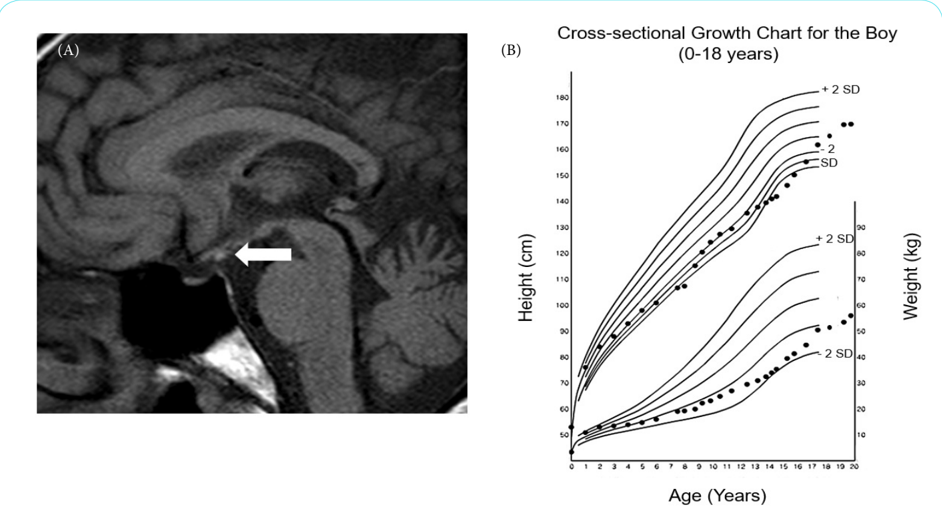
- Growth failure began around age 3. At age 7: height 107.4 cm (-3.4 SD), weight 19.3 kg (-1.4 SD), micropenis 30 mm (-3.0 SD); IGF-1 52 ng/mL (reference 63–247), GH response to arginine/insulin 1.8/2.0 ng/mL, TSH 1.38 μU/mL, thyroxine 3.91 μg/dL; GH and TSH deficiencies were diagnosed.
- Deficiencies progressed: ACTH deficiency at age 10 (peak cortisol to insulin 3.0 μg/dL, vs 12.53 μg/dL at age 7); hypogonadotropic hypogonadism at age 14 (LH, FSH, testosterone below detection limit); TRH test peak TSH 20.53 μIU/mL at 90 min suggested hypothalamic hypothyroidism.
- MRI showed small anterior pituitary, invisible pituitary stalk, and ectopic posterior pituitary bright spot. After GH therapy, final height was 173.0 cm (+0.4 SD) at age 31; at age 31 penile length 9.0 cm, testicular volumes 4 mL bilaterally, pubic hair Tanner stage 4. No mutations were found in previously reported hypopituitarism genes (data not shown).
Methods
- Single-patient case report with clinical and endocrinological follow-up over more than 20 years.
- Data included serial endocrinological tests at ages 7, 10, and 21 years (Table 1), pituitary MRI, and genetic testing for previously reported hypopituitarism genes (Kazusa Laboratory, Japan; data not shown).
- Analysis was descriptive: hormone results and clinical course were compared over time; no formal statistical analysis is reported.
Limitations
- Stated: the long-term clinical course of pediatric TBI-related hypopituitarism remains unclear; prior prospective pediatric studies had follow-up of generally about one year, and cross-sectional studies up to several years, which the authors say is insufficient to analyze the order of hormone deficiencies. Gonadotropin deficiency could not be verified before puberty, and the age-7 cortisol peak was considered fallacious because it was obtained before thyroxine treatment.
- Stated: negative genetic testing does not prove the hypothesis that ectopic posterior pituitary lobe can occur after brain trauma.
- Evident: this is a single case report with no control group, so the inferred progression and order of hormone deficiencies, and the link to the TBI, cannot be generalized or causally established from this report alone.
Model-written summary. Check it against the paper before relying on it.
Integrity signals
Registry
Cites
Statistics
Figures
Verification
Claims the paper makes
0 Valid · 0 Not valid · 14 Not checked · 27 Own results and interpretations
A result the paper reports from its own data — it cites no other source for it, so there is none to check. The quote shows it is in the paper.
In the paper
“The ACTH peak level of insulin tests decreased with age.”
§ & Neonatal Care > Discussion
plainstates an associationSingle case- Asserted: passes — The authors put it forward as true.
- Checkable: passes — It can be checked against evidence.
- Load-bearing: passes — The paper’s conclusions depend on it.
- Based: passes — The paper gives a reason why it holds.
A result the paper reports from its own data — it cites no other source for it, so there is none to check. The quote shows it is in the paper.
In the paper
“Based on these findings, GH and TSH deficiencies were diagnosed and treated with GH and l-thyroxine, respectively.”
§ & Neonatal Care > Case Report
plainSingle case- Asserted: passes — The authors put it forward as true.
- Checkable: passes — It can be checked against evidence.
- Load-bearing: passes — The paper’s conclusions depend on it.
- Based: passes — The paper gives a reason why it holds.
A result the paper reports from its own data — it cites no other source for it, so there is none to check. The quote shows it is in the paper.
In the paper
“After these episodes, he had normal physical and mental development until the age of 3 years, when the ventriculoatrial shunt was removed.”
§ & Neonatal Care > Case Report
plainSingle case- Asserted: passes — The authors put it forward as true.
- Checkable: passes — It can be checked against evidence.
- Load-bearing: unclear — It is unclear whether the paper’s conclusions depend on it.
- Based: passes — The paper gives a reason why it holds.
A result the paper reports from its own data — it cites no other source for it, so there is none to check. The quote shows it is in the paper.
In the paper
“Retrospectively, a decrease in height velocity, the initial symptom, began around the age of 3 years.”
- Also stated in: § Abstract · plain
“His height velocity began to decrease around 3 years of age.”
§ & Neonatal Care > Case Report
plainSingle case- Asserted: passes — The authors put it forward as true.
- Checkable: passes — It can be checked against evidence.
- Load-bearing: unclear — It is unclear whether the paper’s conclusions depend on it.
- Based: passes — The paper gives a reason why it holds.
- Also stated in: § Abstract · plain
A result the paper reports from its own data — it cites no other source for it, so there is none to check. The quote shows it is in the paper.
In the paper
“At age 5 months, he was involved in a motorcycle accident and suffered severe head trauma, including a brain contusion, subdural hemorrhage, fracture of the skull base and cerebral edema, which caused loss of consciousness.”
§ & Neonatal Care > Case Report
plainstates a causeSingle case- Asserted: passes — The authors put it forward as true.
- Checkable: passes — It can be checked against evidence.
- Load-bearing: passes — The paper’s conclusions depend on it.
- Based: passes — The paper gives a reason why it holds.
14 more claims
Create a free account to see all 41 claims and every source verdict.
- Probably not a substantial claim. 9
- It may state two separate claims as one. 16
Self-check
Percentages, sums and reported differences re-computed from the paper’s own numbers.
Each contradiction between two passages listed here was confirmed by an independent check.
Rated minor: it would not touch a result — a value no result rests on, a p-value that stays on the same side of the significance level, or a conflict that is clerical, resolved elsewhere in the paper, or outside its own findings.
In the paper
§ & Neonatal Care > Discussion
“Indeed, mutation of the gene for Ghrhr has been identified in the mouse and results in growth failure and decreased number of somatotrrophs.In this model, the fetal somatotrophs mass is normal, and hypoplasia of the somatotrophs is evident only postnatally [25].”
§ & Neonatal Care > References
“25. Harper CG, Doyle D, Adams JH, Graham DI (1986) Analysis of abnormalities in pituitary gland in non-missile head injury: study of 100 consecutive cases.”
Rated minor: it would not touch a result — a value no result rests on, a p-value that stays on the same side of the significance level, or a conflict that is clerical, resolved elsewhere in the paper, or outside its own findings.
In the paper
§ & Neonatal Care > Discussion
“We previously reported that the serum cortisol levels tended to be high during stressful episodes in an infant with ACTH deficiency and a coexisting hypothyroid state [27].”
§ & Neonatal Care > References
“27. Netchine I, Talon P, Dastot F, Vitaux F, Goossens M, et al. (2009) Extensive Phenotypic Analysis of a Family with Growth Hormone (GH) Deficiency Caused by a Mutation in the GH-Releasing Hormone Receptor Gene.”
Rated minor: it would not touch a result — a value no result rests on, a p-value that stays on the same side of the significance level, or a conflict that is clerical, resolved elsewhere in the paper, or outside its own findings.
In the paper
§ & Neonatal Care > Introduction
“there are at least seven crosssectional studies [14][15][16][17][18][19][20]”
§ & Neonatal Care > References
“14. Personnier C, Crosnier H, Meyer P, Chevignard M, Flechtner I, et al. (2014) Prevalence of pituitary dysfunction after severe trau-matic brain injury in children and adolescents: a large prospective study.”
Citations
Cites
Schneider, H. J., Kreitschmann-Andermahr, I., Ghigo, E., Stalla, G. K., & Agha, A. (2007) · JAMA · doi:10.1001/jama.298.12.1429 · Cited by 549 · cited 1×
“In these reports, TBI-related hypopituitarism was found to manifest as either an isolated growth hormone (GH) deficiency or combined hormone deficiency [1-7].”
BackgroundGodfrey, P., Rahal, J. O., Beamer, W. G., Copeland, N. G., Jenkins, N. A., & Mayo, K. E. (1993) · Nature Genetics · doi:10.1038/ng0793-227 · Cited by 397
Schneider, H. J., Aimaretti, G., Kreitschmann-Andermahr, I., Stalla, G.-K., & Ghigo, E. (2007) · The Lancet · doi:10.1016/s0140-6736(07)60673-4 · Cited by 336
Consensus guidelines on screening for hypopituitarism following traumatic brain injury
Ghigo, E., Masel, B., Aimaretti, G., Léon-Carrión, J., Casanueva, F. F., Dominguez-Morales, M. R., Elovic, E., Perrone, K., Stalla, G., Thompson, C., et al. (2005) · Brain Injury · doi:10.1080/02699050400025315 · Cited by 261
Hypothalamic lesions following closed head injury
CROMPTON, M. R. (1971) · Brain · doi:10.1093/brain/94.1.165 · Cited by 243
Isojima, T., Shimatsu, A., Yokoya, S., Chihara, K., Tanaka, T., Hizuka, N., Teramoto, A., Tatsumi, K.-I., Tachibana, K., Katsumata, N., et al. (2012) · Endocrine Journal · doi:10.1507/endocrj.ej12-0110 · Cited by 208
Traumatic infarction of the anterior lobe of the pituitary gland
Daniel, P. M., Prichard, M. M. L., & Treip, C. S. (1959) · The Lancet · doi:10.1016/s0140-6736(59)91583-1 · Cited by 168 · cited 1×
“In previous reports, TBI-related hypopituitarism resulted from severe TBI complications such as vascular thrombosis, infarction, and hemorrhage of the hypothalamic pituitary gland [22-24].”
BackgroundKIKUCHI, K., FUJISAWA, I., MOMOI, T., YAMANAKA, C., KAJI, M., NAKANO, Y., KONISHI, J., MIKAWA, H., & SUDO, M. (1988) · The Journal of Clinical Endocrinology & Metabolism · doi:10.1210/jcem-67-4-817 · Cited by 130
Netchine, I., Talon, P., Moal, F., Vitaux, F., Goossens, M., & Amselem, S. (1998) · The Journal of Clinical Endocrinology & Metabolism · doi:10.1210/jcem.83.2.4528 · Cited by 120
Einaudi, S., Matarazzo, P., Peretta, P., Grossetti, R., Giordano, F., Aitare, F., Bondone, C., Andreo, M., Ivani, G., Genitori, L., et al. (2006) · Journal of Pediatric Endocrinology and Metabolism · doi:10.1515/jpem.2006.19.5.691 · Cited by 106 · cited 1×
“As mentioned above, the follow-up periods after the TBI episode in the four prospective studies of pediatric TBI-related hypopituitarism of around a year are insufficient to analyze the order of the pituitary hormone deficiencies [10-13].”
BackgroundAbnormalities of pituitary function after traumatic brain injury in children
Niederland, T., Makovi, H., Gál, V., Andréka, B., Ábrahám, C. S., & Kovács, J. (2007) · Journal of Neurotrauma · doi:10.1089/neu.2005.369er · Cited by 104
Endocrine dysfunction following traumatic brain injury in children
Kaulfers, A.-M. D., Backeljauw, P. F., Reifschneider, K., Blum, S., Michaud, L., Weiss, M., & Rose, S. R. (2010) · The Journal of Pediatrics · doi:10.1016/j.jpeds.2010.07.004 · Cited by 84 · cited 1×
“As mentioned above, the follow-up periods after the TBI episode in the four prospective studies of pediatric TBI-related hypopituitarism of around a year are insufficient to analyze the order of the pituitary hormone deficiencies [10-13].”
BackgroundHarper, C. G., Doyle, D., Adams, J. H., & Graham, D. I. (1986) · Journal of Clinical Pathology · doi:10.1136/jcp.39.7.769 · Cited by 72 · cited 1×
“In previous reports, TBI-related hypopituitarism resulted from severe TBI complications such as vascular thrombosis, infarction, and hemorrhage of the hypothalamic pituitary gland [22-24].”
BackgroundUpdate of Endocrine Dysfunction following Pediatric Traumatic Brain Injury
Reifschneider, K., Auble, B., & Rose, S. (2015) · Journal of Clinical Medicine · doi:10.3390/jcm4081536 · Cited by 66 · cited 2×
“In these reports, TBI-related hypopituitarism was found to manifest as either an isolated growth hormone (GH) deficiency or combined hormone deficiency [1-7].”
BackgroundHypopituitarism following traumatic brain injury (TBI)
Agha, A., Phillips, J., & Thompson, C. J. (2007) · British Journal of Neurosurgery · doi:10.1080/02688690701253331 · Cited by 64
Pituitary function in paediatric survivors of severe traumatic brain injury
Poomthavorn, P., Maixner, W., & Zacharin, M. (2008) · Archives of Disease in Childhood · doi:10.1136/adc.2007.121137 · Cited by 63 · cited 1×
“Basal skull fractures may cause direct damage to the hypothalamic-pituitary gland or may indicate a greater contrecoup component of the TBI, consequently resulting in a risk of pituitary stalk disruption [15].”
BackgroundPermanent hypopituitarism is rare after structural traumatic brain injury in early childhood
Heather, N. L., Jefferies, C., Hofman, P. L., Derraik, J. G. B., Brennan, C., Kelly, P., Hamill, J. K. M., Jones, R. G., Rowe, D. L., & Cutfield, W. S. (2012) · The Journal of Clinical Endocrinology & Metabolism · doi:10.1210/jc.2011-2284 · Cited by 62
Berg, C., Oeffner, A., Schumm-Draeger, P.-M., Badorrek, F., Brabant, G., Gerbert, B., Bornstein, S., Zimmermann, A., Weber, M., Broecker-Preuss, M., et al. (2009) · Experimental and Clinical Endocrinology & Diabetes · doi:10.1055/s-0029-1225611 · Cited by 54
Acquired growth hormone deficiency due to pituitary stalk transection after head trauma in childhood
Yamanaka, C., Momoi, T., Fujisawa, I., Kikuchi, K., Kaji, M., Sasaki, H., Yorifuji, T., & Mikawa, H. (1993) · European Journal of Pediatrics · doi:10.1007/bf02072482 · Cited by 50
Traumatic brain injury in children and adolescents: Surveillance for pituitary dysfunction
Norwood, K. W., DeBoer, M. D., Gurka, M. J., Kuperminc, M. N., Rogol, A. D., Blackman, J. A., Wamstad, J. B., Buck, M. L., & Patrick, P. D. (2010) · Clinical Pediatrics · doi:10.1177/0009922810376234 · Cited by 46
Personnier, C., Crosnier, H., Meyer, P., Chevignard, M., Flechtner, I., Boddaert, N., Breton, S., Mignot, C., Dassa, Y., Souberbielle, J.-C., et al. (2014) · The Journal of Clinical Endocrinology & Metabolism · doi:10.1210/jc.2013-4129 · Cited by 44 · cited 1×
“As mentioned above, the follow-up periods after the TBI episode in the four prospective studies of pediatric TBI-related hypopituitarism of around a year are insufficient to analyze the order of the pituitary hormone deficiencies [10-13].”
BackgroundHypopituitarism in pediatric survivors of inflicted traumatic brain injury
Auble, B. A., Bollepalli, S., Makoroff, K., Weis, T., Khoury, J., Colliers, T., & Rose, S. R. (2014) · Journal of Neurotrauma · doi:10.1089/neu.2013.2916 · Cited by 38
Casano‐Sancho, P., Suárez, L., Ibáñez, L., García‐Fructuoso, G., Medina, J., & Febrer, A. (2013) · Clinical Endocrinology · doi:10.1111/cen.12237 · Cited by 36 · cited 1×
“As mentioned above, the follow-up periods after the TBI episode in the four prospective studies of pediatric TBI-related hypopituitarism of around a year are insufficient to analyze the order of the pituitary hormone deficiencies [10-13].”
BackgroundBellone, S., Einaudi, S., Caputo, M., Prodam, F., Busti, A., Belcastro, S., Parlamento, S., Zavattaro, M., Verna, F., Bondone, C., et al. (2013) · Pituitary · doi:10.1007/s11102-012-0446-0 · Cited by 28
Isolated growth hormone deficiency after severe head trauma
Eichler, I., Frisch, H., Eichler, H. G., & Soukop, W. (1988) · Journal of Endocrinological Investigation · doi:10.1007/bf03349069 · Cited by 18
Miyamoto, J., HASEGAWA, Y., Ohnami, N., Onigata, K., KINOSHITA, E., Nishi, Y., Tachibana, K., & Hasegawa, T. (2001) · Endocrine Journal · doi:10.1507/endocrj.48.355 · Cited by 15
Self-citationIs routine endocrine evaluation necessary after paediatric traumatic brain injury?
Salomón-Estébanez, M. A., Grau, G., Vela, A., Rodríguez, A., Morteruel, E., Castaño, L., & Rica, I. (2014) · Journal of Endocrinological Investigation · doi:10.1007/s40618-013-0020-2 · Cited by 15
Nanao, K., Miyamoto, J., Anzo, M., Tsukuda, T., & Hasegawa, Y. (1999) · Endocrine Journal · doi:10.1507/endocrj.46.183 · Cited by 5
Self-citation
Cited by
Neurodevelopmental Disorders and Autism in Valproic Acid Animal Models
Shafique, S. (2018) · International Journal of Pediatrics & Neonatal Care · doi:10.15344/2455-2364/2018/146 · Cited by 2
Metadata
- Authors
- Higuchi, S., & Hasegawa, Y.
- Affiliations
- Tokyo Metropolitan Children's Medical Center (JP)
- Venue
- International Journal of Pediatrics & Neonatal Care
- Publisher
- Graphyonline Publications PVT, Ltd.
- Published
- 2018-12-07
- Volume
- 4
- Issue
- 2
- ISSN
- 2455-2364 (ISSN-L)
- OpenAlex
- W2940293551
- Cited by
- 1
- References
- 24
- Citations by year
- 2018: 1
- FWCI
- 0.18
- Type
- journal article
- Language
- en
- Open access
- diamond
- doi.org
- Licence
- cc-by
- Locations
- International Journal of Pediatrics & Neonatal Care (publishedVersion, cc-by)
- Topics
- Health Sciences › Medicine › Endocrinology, Diabetes and Metabolism › Pituitary Gland Disorders and Treatments
- Health Sciences › Medicine › Endocrinology, Diabetes and Metabolism › Growth Hormone and Insulin-like Growth Factors
- Health Sciences › Medicine › Endocrinology, Diabetes and Metabolism › Adrenal Hormones and Disorders
- Keywords
- hypopituitarism, traumatic brain injury, infancy, growth hormone deficiency, thyroid-stimulating hormone deficiency, hydrocortisone therapy, testosterone enanthate, growth retardation, anterior pituitary hormone secretion, long-term clinical course
About these checks
Registry, retraction, Cites and statistics results are computed, not judged, with one exception: a printed reference that no index lists is read once by a model before it counts as a citation error. Claims are extracted by a model and kept only when their quote appears verbatim in the text; each cited source is then checked, with a model’s help, for whether it says what the claim relies on. Those verdicts can be wrong — read the claim’s quote and the cited source before relying on one.
A language model drew the claims from the paper on 2026-11-14, under version 3 of the claim definition (model deepseek-v4.1-flash, prompt extract-v3).
A second model labelled each claim on 2026-11-14 (model jev-1.13-20260917, definition revision gold-guideline-v0.2).
Statistics and arithmetic are recomputed, not judged.
Confidence bands are shown only for fields calibrated on our annotated test set. None is calibrated yet, so no band is shown.
What counts as a claim ›How we measure confidence ›How we check this ›
Are you an author, or do you see a problem with this page? Request a review
Data sources
Bibliographic data: Semantic Scholar, OpenAlex, Crossref.
Contains information from the Semantic Scholar Academic Graph Datasets, made available under the ODC Attribution License (ODC-BY 1.0).
Semantic Scholar’s data is described in: Kinney, R., et al. (2023). The Semantic Scholar Open Data Platform. arXiv:2301.10140.
