

The DOI matches its Crossref record; 95 of the 96 references it cites were found in a registry or an index, and 1 are not checked yet; none of the 21 sources its claims cite is checked for support yet.
Social media addiction: What is the role of content in YouTube?
Open accessAbstract
Background: YouTube, the online video creation and sharing site, supports both video content viewing and content creation activities. For a minority of people, the time spent engaging with YouTube can be excessive and potentially problematic. Method: This study analyzed the relationship between content viewing, content creation, and YouTube addiction in a survey of 410 Indian-student YouTube users. It also examined the influence of content, social, technology, and process gratifications on user inclination toward YouTube content viewing and content creation. Results: The results demonstrated that content creation in YouTube had a closer relationship with YouTube addiction than content viewing. Furthermore, social gratification was found to have a significant influence on both types of YouTube activities, whereas technology gratification did not significantly influence them. Among all perceived gratifications, content gratification had the highest relationship coefficient value with YouTube content creation inclination. The model fit and variance extracted by the endogenous constructs were good, which further validated the results of the analysis. Conclusion: The study facilitates new ways to explore user gratification in using YouTube and how the channel responds to it.
Checked 2026-10-09 · 1 reference not checked yet
Overview
AI snapshot
Written from the paper’s full text.
TL;DR
This survey of 410 Indian student YouTube users examined how content viewing and content creation relate to YouTube addiction, and how four perceived gratifications (content, social, process, technology) influence those activities. Content creation had a stronger relationship with YouTube addiction than content viewing, and social gratification significantly influenced both viewing and creation.
Key findings
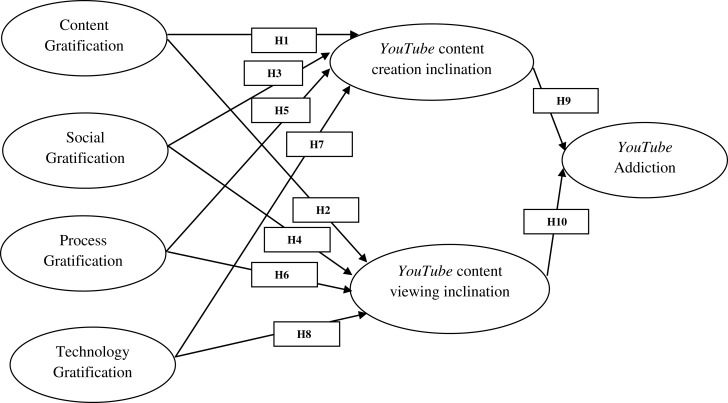
- YouTube content creation inclination had a stronger positive relationship with YouTube addiction (β = 0.512, p < .001) than content viewing inclination (β = 0.319, p < .001).
- Content gratification had the highest relationship with YouTube content creation inclination (β = 0.660, p < .001), while it was not significantly related to content viewing inclination.
- Social gratification significantly influenced both content creation (β = 0.294, p < .001) and content viewing (β = 0.277, p < .001); process gratification significantly influenced content viewing (β = 0.442, p < .001) but not content creation.
- Technology gratification was not significantly related to either content creation or content viewing, and mediation analysis found content, social, and process gratifications had significant indirect effects on YouTube addiction via viewing/creation, whereas technology gratification did not.
Methods
- A survey of 410 Indian student YouTube users: 243 men (59.3%) and 167 women (40.7%); 219 undergraduates, 165 postgraduates, and 26 doctoral students. Respondents averaged 44.66 min/day on YouTube during working hours and 70.55 min/day during non-working hours.
- The questionnaire included 38 statements measuring content, social, process, and technology gratifications; YouTube content viewing and creation affinity; and YouTube addiction. The YouTube Addiction Scale (six items) was adapted from the Bergen Facebook Addiction Scale by replacing “Facebook” with “YouTube.”
- Hierarchical structural equation modeling was used, with first- and second-order measurement models, maximum likelihood estimation, Baron and Kenny mediation analysis, and 2,000 bootstrap iterations; MANOVA and ANOVA examined gender and age differences.
Limitations
- The paper states the study was confined to content viewing and content creation as major YouTube addiction variables, used a non-clinical convenience Indian-student sample aged 16–34, and relied on self-report and self-selected data subject to recall and social desirability biases.
- The paper notes future research should use clinical and non-clinical samples from other countries and age ranges, examine mature age groups, explore more gratifications, and study content creation and viewing separately.
- Evident from the design: the cross-sectional survey cannot establish causal direction between gratifications, YouTube activities, and addiction, and the addiction measure was adapted from a Facebook scale rather than developed specifically for YouTube.
Model-written summary. Check it against the paper before relying on it.
Integrity signals
Registry
Cites
Statistics
Figures
Verification
Claims the paper makes
27 Own result · 17 Not checked yet · 15 Own interpretation · 10 Own method · 4 No basis given
A result the paper reports from its own data — it cites no other source for it, so there is none to check. The quote shows it is in the paper.
In the paper
“Furthermore, social gratification was found to have a significant influence on both types of YouTube activities”
§ Social media addiction: What is the role of content in YouTube? > Abstract > Results
plaindirect- Asserted: passes — The authors put it forward as true.
- Checkable: passes — It can be checked against evidence.
- Load-bearing: passes — The paper’s conclusions depend on it.
- Based: passes — The paper gives a reason why it holds.
A result the paper reports from its own data — it cites no other source for it, so there is none to check. The quote shows it is in the paper.
In the paper
“Among all perceived gratifications, content gratification had the highest relationship coefficient value with YouTube content creation inclination.”
§ Social media addiction: What is the role of content in YouTube? > Abstract > Results
plaincorrelational- Asserted: passes — The authors put it forward as true.
- Checkable: passes — It can be checked against evidence.
- Load-bearing: passes — The paper’s conclusions depend on it.
- Based: passes — The paper gives a reason why it holds.
A result the paper reports from its own data — it cites no other source for it, so there is none to check. The quote shows it is in the paper.
In the paper
“The results demonstrated that content creation in YouTube had a closer relationship with YouTube addiction than content viewing.”
§ Social media addiction: What is the role of content in YouTube? > Abstract > Results
boostedcorrelational- Asserted: passes — The authors put it forward as true.
- Checkable: passes — It can be checked against evidence.
- Load-bearing: passes — The paper’s conclusions depend on it.
- Based: passes — The paper gives a reason why it holds.
A result the paper reports from its own data — it cites no other source for it, so there is none to check. The quote shows it is in the paper.
In the paper
“The univariate analysis of variance also explained that the factors individually were not significantly different within the categories at 95% confidence level, YouTube addiction (gender f = 2.899, p = .089; age f = 0.798; p = .496), YouTube content creation inclination (gender f = 1.754, p = .186; age f = 0.481; p = .695), YouTube content viewing inclination (gender f = 0.150, p = .699; age f = 1”
§ Social media addiction: What is the role of content in YouTube? > Results > Structural model
plain- Asserted: passes — The authors put it forward as true.
- Checkable: passes — It can be checked against evidence.
- Load-bearing: unclear — It is unclear whether the paper’s conclusions depend on it.
- Based: passes — The paper gives a reason why it holds.
A result the paper reports from its own data — it cites no other source for it, so there is none to check. The quote shows it is in the paper.
In the paper
“The relationship between content gratification and YouTube content creation affinity was identified to have highest coefficient (β = 0.569, p < .05).”
§ Social media addiction: What is the role of content in YouTube? > Results > Structural model
plaincorrelational- Asserted: passes — The authors put it forward as true.
- Checkable: passes — It can be checked against evidence.
- Load-bearing: unclear — It is unclear whether the paper’s conclusions depend on it.
- Based: passes — The paper gives a reason why it holds.
A result the paper reports from its own data — it cites no other source for it, so there is none to check. The quote shows it is in the paper.
In the paper
“Of the proposed 10 hypotheses for the main structural model, six hypotheses were significantly supported.”
§ Social media addiction: What is the role of content in YouTube? > Results > Structural model
plain- Asserted: passes — The authors put it forward as true.
- Checkable: passes — It can be checked against evidence.
- Load-bearing: passes — The paper’s conclusions depend on it.
- Based: passes — The paper gives a reason why it holds.
A result the paper reports from its own data — it cites no other source for it, so there is none to check. The quote shows it is in the paper.
In the paper
“The multivariate analysis of variance results explained that there were no significant differences among the exogenous and endogenous factors within the categories at 95% confidence level, gender (Wilk’s λ = .988, f = 0.701, p = .678) and age (Wilk’s λ = .931, f = 1.361, p = .127).”
§ Social media addiction: What is the role of content in YouTube? > Results > Structural model
plain- Asserted: passes — The authors put it forward as true.
- Checkable: passes — It can be checked against evidence.
- Load-bearing: unclear — It is unclear whether the paper’s conclusions depend on it.
- Based: passes — The paper gives a reason why it holds.
A result the paper reports from its own data — it cites no other source for it, so there is none to check. The quote shows it is in the paper.
In the paper
“Social gratification was the only exogenous construct that had a significant relationship with both YouTube content creation affinity (β = 0.256, p < .05) and content viewing affinity (β = 0.281, p < .05).”
§ Social media addiction: What is the role of content in YouTube? > Results > Structural model
plaincorrelational- Asserted: passes — The authors put it forward as true.
- Checkable: passes — It can be checked against evidence.
- Load-bearing: unclear — It is unclear whether the paper’s conclusions depend on it.
- Based: passes — The paper gives a reason why it holds.
A result the paper reports from its own data — it cites no other source for it, so there is none to check. The quote shows it is in the paper.
In the paper
“Surprisingly, technology expectations were found not to have a significant relationship with YouTube content viewing as well as content creation affinity.”
- Also stated in: § Discussion · plain
“Even so, technology failed to establish a linear pattern with YouTube affinity.”
- Also stated in: § Conclusions · plain
“On the other hand, it is surprising to see that technological gratifications did not significantly relate to the content inclination.”
§ Social media addiction: What is the role of content in YouTube? > Discussion
plain- Asserted: passes — The authors put it forward as true.
- Checkable: passes — It can be checked against evidence.
- Load-bearing: passes — The paper’s conclusions depend on it.
- Based: passes — The paper gives a reason why it holds.
- Also stated in: § Discussion · plain
None of the sources cited for this claim have been checked yet.
In the paper
“It is also surprising to see that the addiction construct was highly correlated with content creation affinity compared with content viewing affinity.”
§ Social media addiction: What is the role of content in YouTube? > Discussion
plaincorrelational- Asserted: passes — The authors put it forward as true.
- Checkable: passes — It can be checked against evidence.
- Load-bearing: passes — The paper’s conclusions depend on it.
- Based: passes — The paper gives a reason why it holds.
- It may state two separate claims as one. 28
- Probably not a substantial claim. 20
- The quote only partly states this claim. 2
A result the paper reports from its own data — it cites no other source for it, so there is none to check. The quote shows it is in the paper.
In the paper
“whereas technology gratification did not significantly influence them.”
§ Social media addiction: What is the role of content in YouTube? > Abstract > Results
plain- Asserted: passes — The authors put it forward as true.
- Checkable: passes — It can be checked against evidence.
- Load-bearing: passes — The paper’s conclusions depend on it.
- Based: passes — The paper gives a reason why it holds.
It may state two separate claims as one.
A result the paper reports from its own data — it cites no other source for it, so there is none to check. The quote shows it is in the paper.
In the paper
“The model fit and variance extracted by the endogenous constructs were good”
§ Social media addiction: What is the role of content in YouTube? > Abstract > Results
plain- Asserted: passes — The authors put it forward as true.
- Checkable: passes — It can be checked against evidence.
- Load-bearing: passes — The paper’s conclusions depend on it.
- Based: passes — The paper gives a reason why it holds.
It may state two separate claims as one.
A result the paper reports from its own data — it cites no other source for it, so there is none to check. The quote shows it is in the paper.
In the paper
“A total of 410 Indian students participated in a survey study, of which 243 were men (59.3%) and 167 were women (40.7%).”
§ Social media addiction: What is the role of content in YouTube? > Methods > Participants
plain- Asserted: passes — The authors put it forward as true.
- Checkable: passes — It can be checked against evidence.
- Load-bearing: fails — The paper’s conclusions may not depend on it.
- Based: passes — The paper gives a reason why it holds.
Probably not a substantial claim. The paper’s conclusions may not depend on it. It may state two separate claims as one.
The paper states this without a source or data behind it here, so there is nothing to check it against. The quote shows it is in the paper.
In the paper
“In this research, it was found that content gratifications had a significant positive relationship with YouTube content creation affinity, but there was no significant relationship with YouTube content viewing affinity.”
§ Social media addiction: What is the role of content in YouTube? > Discussion
plaincorrelational- Asserted: passes — The authors put it forward as true.
- Checkable: passes — It can be checked against evidence.
- Load-bearing: passes — The paper’s conclusions depend on it.
- Based: passes — The paper gives a reason why it holds.
It may state two separate claims as one.
A result the paper reports from its own data — it cites no other source for it, so there is none to check. The quote shows it is in the paper.
In the paper
“Technology gratification was found to have an insignificant relationship with both YouTube content creation and content viewing inclination.”
§ Social media addiction: What is the role of content in YouTube? > Results > Structural model
plain- Asserted: passes — The authors put it forward as true.
- Checkable: passes — It can be checked against evidence.
- Load-bearing: passes — The paper’s conclusions depend on it.
- Based: passes — The paper gives a reason why it holds.
It may state two separate claims as one.
A result the paper reports from its own data — it cites no other source for it, so there is none to check. The quote shows it is in the paper.
In the paper
“Both content creation and viewing were found to have considerable effect on addiction, with content creation having a slightly higher coefficient of influence.”
§ Social media addiction: What is the role of content in YouTube? > Discussion
plaindirect- Asserted: passes — The authors put it forward as true.
- Checkable: passes — It can be checked against evidence.
- Load-bearing: passes — The paper’s conclusions depend on it.
- Based: passes — The paper gives a reason why it holds.
It may state two separate claims as one.
A result the paper reports from its own data — it cites no other source for it, so there is none to check. The quote shows it is in the paper.
In the paper
“The study respondents spent an average of 44.66 min daily on YouTube during working hours and 70.55 min daily on YouTube during non-working hours.”
§ Social media addiction: What is the role of content in YouTube? > Methods > Participants
plain- Asserted: passes — The authors put it forward as true.
- Checkable: passes — It can be checked against evidence.
- Load-bearing: unclear — It is unclear whether the paper’s conclusions depend on it.
- Based: passes — The paper gives a reason why it holds.
It may state two separate claims as one.
A result the paper reports from its own data — it cites no other source for it, so there is none to check. The quote shows it is in the paper.
In the paper
“Consequently, analysis also demonstrated that technology gratifications had no mediation or strong total effect toward YouTube addiction.”
§ Social media addiction: What is the role of content in YouTube? > Discussion
boosted- Asserted: passes — The authors put it forward as true.
- Checkable: passes — It can be checked against evidence.
- Load-bearing: passes — The paper’s conclusions depend on it.
- Based: passes — The paper gives a reason why it holds.
It may state two separate claims as one.
The paper states this without a source or data behind it here, so there is nothing to check it against. The quote shows it is in the paper.
In the paper
“Process gratification was found to have a significant relationship with YouTube content viewing affinity but not with YouTube content creation affinity.”
§ Social media addiction: What is the role of content in YouTube? > Discussion
plaincorrelational- Asserted: passes — The authors put it forward as true.
- Checkable: passes — It can be checked against evidence.
- Load-bearing: passes — The paper’s conclusions depend on it.
- Based: passes — The paper gives a reason why it holds.
It may state two separate claims as one.
In the paper
“Social media is increasingly being used for communicating, learning, and collaborating, and for a small minority has become a potential problematic, compulsive, and/or addictive habit (Kuss & Griffiths, 2017).”
§ Social media addiction: What is the role of content in YouTube? > Introduction
What the sources say
- Not checked yetcites Kuss & Griffiths, 2017
plain- Asserted: passes — The authors put it forward as true.
- Checkable: passes — It can be checked against evidence.
- Load-bearing: fails — The paper’s conclusions may not depend on it.
- Based: passes — The paper gives a reason why it holds.
Probably not a substantial claim. The paper’s conclusions may not depend on it.
In the paper
“Griffiths (1999) noted many years ago that online addictions are primarily about addictions on the Internet rather than addiction to the Internet, and that most of those with online problematic behavior are addicted to the online content rather than the Internet itself”
§ Social media addiction: What is the role of content in YouTube? > Introduction
What the sources say
- Not checked yetcites Griffiths (1999)
plain- Asserted: passes — The authors put it forward as true.
- Checkable: passes — It can be checked against evidence.
- Load-bearing: fails — The paper’s conclusions may not depend on it.
- Based: passes — The paper gives a reason why it holds.
Probably not a substantial claim. The paper’s conclusions may not depend on it. It may state two separate claims as one.
A conclusion the paper draws from its own results — it cites no other source for it, so there is none to check. The quote shows it is in the paper.
In the paper
“which further validated the results of the analysis.”
§ Social media addiction: What is the role of content in YouTube? > Abstract > Results
plain- Asserted: passes — The authors put it forward as true.
- Checkable: passes — It can be checked against evidence.
- Load-bearing: fails — The paper’s conclusions may not depend on it.
- Based: passes — The paper gives a reason why it holds.
Probably not a substantial claim. The paper’s conclusions may not depend on it. It may state two separate claims as one. The quote only partly states this claim.
A conclusion the paper draws from its own results — it cites no other source for it, so there is none to check. The quote shows it is in the paper.
In the paper
“All these four gratifications are important in both content viewing and content creation and may lead to YouTube addiction.”
§ Social media addiction: What is the role of content in YouTube? > YouTube Uses and Gratifications
hedgedconditional- Asserted: passes — The authors put it forward as true.
- Checkable: passes — It can be checked against evidence.
- Load-bearing: passes — The paper’s conclusions depend on it.
- Based: fails — The paper may give no reason why it holds.
Probably not a substantial claim. The paper may give no reason why it holds. It may state two separate claims as one.
In the paper
“A structural equation modeling program is effective when the latent variables and paths are well defined, since the total and direct effects are calculated separately in the model, and the indirect effect and mediation can be calculated effectively (Preacher & Hayes, 2004).”
§ Social media addiction: What is the role of content in YouTube? > Methods > Analysis
What the sources say
- Not checked yetcites Preacher & Hayes, 2004
plain- Asserted: passes — The authors put it forward as true.
- Checkable: passes — It can be checked against evidence.
- Load-bearing: passes — The paper’s conclusions depend on it.
- Based: passes — The paper gives a reason why it holds.
Probably not a substantial claim.
In the paper
“The factor loadings of all constructs were more than 0.6, thus satisfying the necessary condition of the content validity (Nunnally, 1978).”
§ Social media addiction: What is the role of content in YouTube? > Results > Measurement model
What the sources say
- Not checked yetcites Nunnally, 1978
plain- Asserted: passes — The authors put it forward as true.
- Checkable: passes — It can be checked against evidence.
- Load-bearing: passes — The paper’s conclusions depend on it.
- Based: passes — The paper gives a reason why it holds.
It may state two separate claims as one.
In the paper
“The values in the diagonal demonstrate that most cases are seen to be larger than the respective construct correlation with other factors and therefore satisfy the condition of discriminant validity to a greater extent (Sánchez-Franco & Roldán, 2005).”
§ Social media addiction: What is the role of content in YouTube? > Results > Measurement model
What the sources say
- Not checked yetcites Sánchez-Franco & Roldán, 2005
boostedcorrelational- Asserted: passes — The authors put it forward as true.
- Checkable: passes — It can be checked against evidence.
- Load-bearing: passes — The paper’s conclusions depend on it.
- Based: passes — The paper gives a reason why it holds.
It may state two separate claims as one.
None of the sources cited for this claim have been checked yet.
In the paper
“Items for YouTube content creation, content sharing, and addiction scales were derived from previous research (Andreassen et al., 2012; Haridakis & Hanson, 2009; Rubin, 1983).”
§ Social media addiction: What is the role of content in YouTube? > Methods > Measures
What the sources say
- Not checked yetcites Andreassen et al., 2012
- Not checked yetcites Haridakis & Hanson, 2009
- Not checked yetcites Rubin, 1983
plain- Asserted: passes — The authors put it forward as true.
- Checkable: passes — It can be checked against evidence.
- Load-bearing: passes — The paper’s conclusions depend on it.
- Based: passes — The paper gives a reason why it holds.
Probably not a substantial claim.
In the paper
“Real-life difficulties, such as introversion and difficulty in social expression, are overcome in the virtual medium of social networking, which can potentially lead to addiction (Ferris, 2001).”
§ Social media addiction: What is the role of content in YouTube? > Discussion
What the sources say
- Not checked yetcites Ferris, 2001
hedgedconditional- Asserted: passes — The authors put it forward as true.
- Checkable: passes — It can be checked against evidence.
- Load-bearing: unclear — It is unclear whether the paper’s conclusions depend on it.
- Based: passes — The paper gives a reason why it holds.
It may state two separate claims as one.
In the paper
“Previous literature has examined information sharing as a dependent behavior to flow and satisfaction experienced by users (Lu, Lin, Hsiao, & Cheng, 2010).”
§ Social media addiction: What is the role of content in YouTube? > Discussion
What the sources say
- Not checked yetcites Lu, Lin, Hsiao, & Cheng, 2010
plaindirect- Asserted: passes — The authors put it forward as true.
- Checkable: passes — It can be checked against evidence.
- Load-bearing: passes — The paper’s conclusions depend on it.
- Based: passes — The paper gives a reason why it holds.
Probably not a substantial claim.
What the paper did — it cites no source for this, so there is none to check. The quote shows it is in the paper.
In the paper
“The results of the first-order measurement model satisfied the requirements of convergent and discriminant validity.”
§ Social media addiction: What is the role of content in YouTube? > Results > Measurement model
plain- Asserted: passes — The authors put it forward as true.
- Checkable: passes — It can be checked against evidence.
- Load-bearing: passes — The paper’s conclusions depend on it.
- Based: passes — The paper gives a reason why it holds.
It may state two separate claims as one.
A conclusion the paper draws from its own results — it cites no other source for it, so there is none to check. The quote shows it is in the paper.
In the paper
“The results of technology gratification are a unique observation with reference to YouTube, which warrants further investigation.”
§ Social media addiction: What is the role of content in YouTube? > Discussion
plain- Asserted: passes — The authors put it forward as true.
- Checkable: passes — It can be checked against evidence.
- Load-bearing: passes — The paper’s conclusions depend on it.
- Based: passes — The paper gives a reason why it holds.
Probably not a substantial claim. It may state two separate claims as one. The quote only partly states this claim.
- Rests on an assumption: Technology is an important factor that encourages users to engage in any social media domain.
A conclusion the paper draws from its own results — it cites no other source for it, so there is none to check. The quote shows it is in the paper.
In the paper
“In either case, there is a potential risk of a minority of users becoming addicted to YouTube.”
§ Social media addiction: What is the role of content in YouTube? > YouTube Content Viewing and Content Creation Inclination
hedged- Asserted: passes — The authors put it forward as true.
- Checkable: passes — It can be checked against evidence.
- Load-bearing: fails — The paper’s conclusions may not depend on it.
- Based: fails — The paper may give no reason why it holds.
Probably not a substantial claim. The paper’s conclusions may not depend on it. The paper may give no reason why it holds.
None of the sources cited for this claim have been checked yet.
In the paper
“Stafford et al. (2004) proposed three gratifications (i.e., content, process, and social gratification); Liu et al. (2010) later added technology gratification to their research.”
§ Social media addiction: What is the role of content in YouTube? > Methods > Measures
What the sources say
- Not checked yetcites Stafford et al. (2004)
- Not checked yetcites Liu et al. (2010)
plain- Asserted: passes — The authors put it forward as true.
- Checkable: passes — It can be checked against evidence.
- Load-bearing: fails — The paper’s conclusions may not depend on it.
- Based: passes — The paper gives a reason why it holds.
Probably not a substantial claim. The paper’s conclusions may not depend on it. It may state two separate claims as one.
In the paper
“Haridakis and Hanson (2009) consider YouTube content creation as a “co-viewing” activity, but the assessment of “co-viewing” is more concerned with engagement and participation with family and friends.”
§ Social media addiction: What is the role of content in YouTube? > Discussion
What the sources say
- Not checked yetcites Haridakis and Hanson (2009)
plain- Asserted: passes — The authors put it forward as true.
- Checkable: passes — It can be checked against evidence.
- Load-bearing: fails — The paper’s conclusions may not depend on it.
- Based: passes — The paper gives a reason why it holds.
Probably not a substantial claim. The paper’s conclusions may not depend on it. It may state two separate claims as one.
In the paper
“Caplan and High (2010) postulate that online users compensate for their real-life disappointments through online messages and networking.”
§ Social media addiction: What is the role of content in YouTube? > Discussion
What the sources say
- Not checked yetcites Caplan and High (2010)
plaindirect- Asserted: passes — The authors put it forward as true.
- Checkable: passes — It can be checked against evidence.
- Load-bearing: fails — The paper’s conclusions may not depend on it.
- Based: passes — The paper gives a reason why it holds.
Probably not a substantial claim. The paper’s conclusions may not depend on it.
What the paper did — it cites no source for this, so there is none to check. The quote shows it is in the paper.
In the paper
“However, YouTube content creation inclination (r2 = .410) and YouTube content viewing inclination (r2 = .300) had adequate values to validate the model.”
§ Social media addiction: What is the role of content in YouTube? > Results > Structural model
plain- Asserted: passes — The authors put it forward as true.
- Checkable: passes — It can be checked against evidence.
- Load-bearing: passes — The paper’s conclusions depend on it.
- Based: passes — The paper gives a reason why it holds.
It may state two separate claims as one.
What the paper did — it cites no source for this, so there is none to check. The quote shows it is in the paper.
In the paper
“The fit indices of first-order and second-order measurement models met the ideal satisfactory values.”
§ Social media addiction: What is the role of content in YouTube? > Results > Measurement model
plain- Asserted: passes — The authors put it forward as true.
- Checkable: passes — It can be checked against evidence.
- Load-bearing: passes — The paper’s conclusions depend on it.
- Based: passes — The paper gives a reason why it holds.
It may state two separate claims as one.
None of the sources cited for this claim have been checked yet.
In the paper
“Technology acceptance is subjective to the experience of users, user beliefs, usage pattern, usefulness, system design, trust, risk, etc. (Davis, 1993; Pavlou, 2003; Venkatesh, 2000; Venkatesh & Davis, 2000).”
§ Social media addiction: What is the role of content in YouTube? > Discussion
What the sources say
- Not checked yetcites Davis, 1993
- Not checked yetcites Pavlou, 2003
- Not checked yetcites Venkatesh, 2000
plaincorrelational- Asserted: passes — The authors put it forward as true.
- Checkable: fails — It may be too vague to check against evidence.
- Load-bearing: fails — The paper’s conclusions may not depend on it.
- Based: passes — The paper gives a reason why it holds.
Probably not a substantial claim. It may be too vague to check against evidence. The paper’s conclusions may not depend on it.
What the paper did — it cites no source for this, so there is none to check. The quote shows it is in the paper.
In the paper
“The study was approved by the first author’s university ethics committee.”
§ Social media addiction: What is the role of content in YouTube? > Methods > Ethics
plain- Asserted: passes — The authors put it forward as true.
- Checkable: passes — It can be checked against evidence.
- Load-bearing: fails — The paper’s conclusions may not depend on it.
- Based: passes — The paper gives a reason why it holds.
Probably not a substantial claim. The paper’s conclusions may not depend on it.
In the paper
“In all cases, average variance extracted was more than 0.50, maximum shared squared variance and average shared squared variance, which further validates the convergent validity requirements (Fornell & Larcker, 1981).”
§ Social media addiction: What is the role of content in YouTube? > Results > Measurement model
What the sources say
- Not checked yetcites Fornell & Larcker, 1981
plain- Asserted: passes — The authors put it forward as true.
- Checkable: passes — It can be checked against evidence.
- Load-bearing: passes — The paper’s conclusions depend on it.
- Based: passes — The paper gives a reason why it holds.
It may state two separate claims as one.
A conclusion the paper draws from its own results — it cites no other source for it, so there is none to check. The quote shows it is in the paper.
In the paper
“Thus, the possibility of getting addicted is equal to, if not more, in YouTube than in the traditional television medium.”
§ Social media addiction: What is the role of content in YouTube? > Discussion
hedged- Asserted: passes — The authors put it forward as true.
- Checkable: passes — It can be checked against evidence.
- Load-bearing: fails — The paper’s conclusions may not depend on it.
- Based: fails — The paper may give no reason why it holds.
Probably not a substantial claim. The paper’s conclusions may not depend on it. The paper may give no reason why it holds.
- Rests on an assumption: The multiple functions offered by YouTube have attracted many users to it.
- Rests on an assumption: The uniqueness of YouTube as an entertainment medium is that it facilitates both content viewing and creation activities.
In the paper
“Content viewing is like hedonic activity (Olney, Holbrook, & Batra, 1991), but content creation is an informing and self-explaining activity.”
§ Social media addiction: What is the role of content in YouTube? > Discussion
What the sources say
- Not checked yetcites Olney, Holbrook, & Batra, 1991
plain- Asserted: passes — The authors put it forward as true.
- Checkable: passes — It can be checked against evidence.
- Load-bearing: passes — The paper’s conclusions depend on it.
- Based: passes — The paper gives a reason why it holds.
It may state two separate claims as one.
What the paper did — it cites no source for this, so there is none to check. The quote shows it is in the paper.
In the paper
“The study procedures were carried out in accordance with the Declaration of Helsinki.”
§ Social media addiction: What is the role of content in YouTube? > Methods > Ethics
plain- Asserted: passes — The authors put it forward as true.
- Checkable: passes — It can be checked against evidence.
- Load-bearing: fails — The paper’s conclusions may not depend on it.
- Based: passes — The paper gives a reason why it holds.
Probably not a substantial claim. The paper’s conclusions may not depend on it.
A conclusion the paper draws from its own results — it cites no other source for it, so there is none to check. The quote shows it is in the paper.
In the paper
“Although users tend to spend more time on viewing YouTube content, their involvement and passion in content creation in YouTube can lead users to addiction in a minority of cases.”
§ Social media addiction: What is the role of content in YouTube? > Discussion
plaindirect- Asserted: passes — The authors put it forward as true.
- Checkable: passes — It can be checked against evidence.
- Load-bearing: passes — The paper’s conclusions depend on it.
- Based: passes — The paper gives a reason why it holds.
It may state two separate claims as one.
- Rests on an assumption: Content creation is a passionate activity, unlike content viewing, which is largely passive.
What the paper did — it cites no source for this, so there is none to check. The quote shows it is in the paper.
In the paper
“First, the study was confined only to content viewing and content creation as major variables of YouTube addiction.”
§ Social media addiction: What is the role of content in YouTube? > Conclusions > Limitations and future research
plain- Asserted: passes — The authors put it forward as true.
- Checkable: passes — It can be checked against evidence.
- Load-bearing: fails — The paper’s conclusions may not depend on it.
- Based: passes — The paper gives a reason why it holds.
Probably not a substantial claim. The paper’s conclusions may not depend on it.
What the paper did — it cites no source for this, so there is none to check. The quote shows it is in the paper.
In the paper
“This study utilized a non-clinical convenience Indian-student sample with age group from 16 to 34 years, which may affect the generalizability of the study results from an age, cultural, and clinical perspective.”
§ Social media addiction: What is the role of content in YouTube? > Conclusions > Limitations and future research
hedged- Asserted: passes — The authors put it forward as true.
- Checkable: passes — It can be checked against evidence.
- Load-bearing: unclear — It is unclear whether the paper’s conclusions depend on it.
- Based: passes — The paper gives a reason why it holds.
It may state two separate claims as one.
What the paper did — it cites no source for this, so there is none to check. The quote shows it is in the paper.
In the paper
“In addition, the data were self-report and self-selected, and subject to biases (such as recall biases and social desirability biases).”
§ Social media addiction: What is the role of content in YouTube? > Conclusions > Limitations and future research
plain- Asserted: passes — The authors put it forward as true.
- Checkable: passes — It can be checked against evidence.
- Load-bearing: unclear — It is unclear whether the paper’s conclusions depend on it.
- Based: passes — The paper gives a reason why it holds.
It may state two separate claims as one.
A conclusion the paper draws from its own results — it cites no other source for it, so there is none to check. The quote shows it is in the paper.
In the paper
“YouTube content viewing affinity is more of an entertainment and passing time activity, whereas content creation may be more than merely entertaining”
§ Social media addiction: What is the role of content in YouTube? > Discussion
hedged- Asserted: passes — The authors put it forward as true.
- Checkable: passes — It can be checked against evidence.
- Load-bearing: passes — The paper’s conclusions depend on it.
- Based: passes — The paper gives a reason why it holds.
It may state two separate claims as one.
The paper states this without a source or data behind it here, so there is nothing to check it against. The quote shows it is in the paper.
In the paper
“As discussed earlier, content creation is a passionate activity rather than mere entertaining activity.”
§ Social media addiction: What is the role of content in YouTube? > Discussion
plain- Asserted: passes — The authors put it forward as true.
- Checkable: fails — It may be too vague to check against evidence.
- Load-bearing: passes — The paper’s conclusions depend on it.
- Based: fails — The paper may give no reason why it holds.
Probably not a substantial claim. It may be too vague to check against evidence. The paper may give no reason why it holds.
A conclusion the paper draws from its own results — it cites no other source for it, so there is none to check. The quote shows it is in the paper.
In the paper
“The results are consistent with past research, and there is no major deviation from past literature.”
§ Social media addiction: What is the role of content in YouTube? > Conclusions
plain- Asserted: passes — The authors put it forward as true.
- Checkable: fails — It may be too vague to check against evidence.
- Load-bearing: fails — The paper’s conclusions may not depend on it.
- Based: fails — The paper may give no reason why it holds.
Probably not a substantial claim. It may be too vague to check against evidence. The paper’s conclusions may not depend on it. The paper may give no reason why it holds. It may state two separate claims as one.
The paper relies on this without support.
YouTube allows two major user functions: content creation and content seeking.
“YouTube allows two major user functions (i.e., content creation and content seeking).”
The paper relies on this without support.
There have been few studies that have analyzed user gratification and addiction to YouTube use.
“There have been few studies that have analyzed user gratification and addiction to YouTube use.”
The paper relies on this without support.
The multiple functions offered by YouTube have attracted many users to it.
“The multiple functions offered by YouTube have attracted many users to it.”
The paper relies on this without support.
The uniqueness of YouTube as an entertainment medium is that it facilitates both content viewing and creation activities.
“The uniqueness of YouTube as an entertainment medium is that it facilitates both content viewing and creation activities.”
The paper relies on this without support.
Content creation is a dynamic activity that incorporates both personal satisfaction and social approval.
“Content creation is a dynamic activity that incorporates both personal satisfaction and social approval.”
The paper relies on this without support.
Content creation is an enhanced function of user engagement.
“Content creation is an enhanced function of user engagement.”
The paper relies on this without support.
Content creation is a passionate activity, unlike content viewing, which is largely passive.
“Content creation is a passionate activity, unlike content viewing, which is largely passive.”
The paper relies on this without support.
Communication and content are the basics for building a social interpersonal relationship.
“Communication and content are the basics for building a social interpersonal relationship.”
The paper relies on this without support.
Self-documentation is dependent upon content.
“Similarly, self-documentation is dependent upon content.”
The paper relies on this without support.
Although there is no monetary reward associated with content creation, users create video content on YouTube to create and share videos exhibiting their interest and passion and comment on those that pique their interest.
“Although there is no monetary reward associated with content creation, users create video content on YouTube to create and share videos exhibiting their interest and passion and comment on those that pique their interest.”
The paper relies on this without support.
Technology is an important factor that encourages users to engage in any social media domain.
“Technology is an important factor that encourages users to engage in any social media domain.”
The paper relies on this without support.
Students are the relevant sample for the study objectives.
“Although students are considered to be the relevant sample for the study objectives”
Claims other papers make about this one
Each is checked against this paper’s own text: does it say what the citing paper says it does?
The cited source says what the claim attributes to it.
In the citing paper
“Previous studies investigating YouTube use from the U> perspective have reported different motivations such as content creation and viewing, social gratification, relaxing entertainment, social interaction, and information seeking (Balakrishnan and Griffiths 2017;Haridakis and Hanson 2009;Khan 2017).”
From Uses and Gratifications of Problematic Social Media Use Among University Students: a Simultaneous Examination of the Big Five of Personality Traits, Social Media Platforms, and Social Media Use Motives (2020) · cites this paper as Balakrishnan and Griffiths 2017
Self-check
Percentages, sums and reported differences re-computed from the paper’s own numbers.
Each contradiction between two passages listed here was confirmed by an independent check.
Rated major: it would touch a result — a value a result rests on, reported and recomputed p-values on opposite sides of the significance level, two passages that conflict with no sign which is right, or a cited work retracted before this paper was published.
In the paper
§ Social media addiction: What is the role of content in YouTube? > Results > Structural model
“The relationship between content gratification and YouTube content creation affinity was identified to have highest coefficient (β = 0.569, p < .05).”
§ Social media addiction: What is the role of content in YouTube? > Results > Structural model
“| | Content gratification | 0.660*** | | H1 – supported |”
Rated major: it would touch a result — a value a result rests on, reported and recomputed p-values on opposite sides of the significance level, two passages that conflict with no sign which is right, or a cited work retracted before this paper was published.
In the paper
§ Social media addiction: What is the role of content in YouTube? > Results > Structural model
“Social gratification was the only exogenous construct that had a significant relationship with both YouTube content creation affinity (β = 0.256, p < .05) and content viewing affinity (β = 0.281, p < .05).”
§ Social media addiction: What is the role of content in YouTube? > Results > Structural model
“| YouTube content creation inclination | Social gratification | 0.294*** | .410 | H3 – supported |”
Rated major: it would touch a result — a value a result rests on, reported and recomputed p-values on opposite sides of the significance level, two passages that conflict with no sign which is right, or a cited work retracted before this paper was published.
In the paper
§ Social media addiction: What is the role of content in YouTube? > Results > Structural model
“YouTube content creation inclination (r2 = .410) and YouTube content viewing inclination (r2 = .300) had adequate values to validate the model.”
§ Social media addiction: What is the role of content in YouTube? > Results > Structural model
“| YouTube content viewing inclination | Social gratification | 0.277*** | .207 | H4 – supported |”
Rated minor: it would not touch a result — a value no result rests on, a p-value that stays on the same side of the significance level, or a conflict that is clerical, resolved elsewhere in the paper, or outside its own findings.
In the paper
§ Social media addiction: What is the role of content in YouTube? > Methods > Measures
“| Self-expression | Show my personality | 3.14 (1.18) | 0.86*** | 0.817 | 0.623 (0.399, 0.234) |”
§ Social media addiction: What is the role of content in YouTube? > Results > Measurement model
“| Self-expression (V8) | 0.569 | −0.113 | −0.020 | −0.057 | 0.368 | 0.283 | 0.500 | 0.831 |”
Rated minor: it would not touch a result — a value no result rests on, a p-value that stays on the same side of the significance level, or a conflict that is clerical, resolved elsewhere in the paper, or outside its own findings.
In the paper
§ Social media addiction: What is the role of content in YouTube? > Discussion
“the indirect effects are relatively higher with the aforementioned three gratifications, which imply strong partial mediation.”
§ Social media addiction: What is the role of content in YouTube? > Results > Structural model
“| Effect b | −0.413*** | −0.068ns | −0.487*** | 0.096** | 0.936*** | 0.528*** |”
Rated minor: it would not touch a result — a value no result rests on, a p-value that stays on the same side of the significance level, or a conflict that is clerical, resolved elsewhere in the paper, or outside its own findings.
In the paper
§ Social media addiction: What is the role of content in YouTube? > Results > Structural model
“YouTube addiction (r2 = .404), the end endogenous construct accounted for 30% of the total variance extracted via its two immediate exogenous constructs.”
§ Social media addiction: What is the role of content in YouTube? > Results > Structural model
“| YouTube addiction | YouTube content creation inclination | 0.512*** | .404 | H9 – supported |”
Rated minor: it would not touch a result — a value no result rests on, a p-value that stays on the same side of the significance level, or a conflict that is clerical, resolved elsewhere in the paper, or outside its own findings.
In the paper
§ Social media addiction: What is the role of content in YouTube? > Results > Structural model
“content viewing affinity (β = 0.281, p < .05)”
§ Social media addiction: What is the role of content in YouTube? > Results > Structural model
“| YouTube content viewing inclination | Social gratification | 0.277*** | .207 | H4 – supported |”
Citations
Cites
Evaluating Structural Equation Models with Unobservable Variables and Measurement Error
Fornell, C., & Larcker, D. F. (1981) · Journal of Marketing Research · doi:10.2307/3151312 · Cited by 109,314
Evaluating structural equation models with unobservable variables and measurement error
Fornell, C., & Larcker, D. F. (1981) · Journal of Marketing Research · doi:10.1177/002224378101800104 · Cited by 109,190
Baron, R. M., & Kenny, D. A. (1986) · Journal of Personality and Social Psychology · doi:10.1037/0022-3514.51.6.1173 · Cited by 91,532
User Acceptance of Information Technology: Toward A Unified View1
Venkatesh, V., Morris, M. G., Davis, G. B., & Davis, F. D. (2003) · MIS Quarterly · doi:10.2307/30036540 · Cited by 45,035
A Theoretical Extension of the Technology Acceptance Model: Four Longitudinal Field Studies
Venkatesh, V., & Davis, F. D. (2000) · Management Science · doi:10.1287/mnsc.46.2.186.11926 · Cited by 23,066
SPSS and SAS procedures for estimating indirect effects in simple mediation models
Preacher, K. J., & Hayes, A. F. (2004) · Behavior Research Methods, Instruments, & Computers · doi:10.3758/bf03206553 · Cited by 17,383
Social network sites: definition, history, and scholarship
boyd, D. M., & Ellison, N. B. (2007) · Journal of Computer-Mediated Communication · doi:10.1111/j.1083-6101.2007.00393.x · Cited by 16,251
Digital Natives, Digital Immigrants Part 1
Prensky, M. (2001) · On the Horizon · doi:10.1108/10748120110424816 · Cited by 11,104
Venkatesh, V. (2000) · Information Systems Research · doi:10.1287/isre.11.4.342.11872 · Cited by 6,664
(2003) · International Journal of Electronic Commerce · doi:10.1080/10864415.2003.11044275 · Cited by 5,715
Research works printed but not linked: 100
- Edwards, 1993, Development of a new scale for measuring compulsive buying behavior, Financial Counseling and Planning,, 4, 67
- Lange, 2007, a Commenting on comments : Investigating responses to antagonism on YouTube Proceedings of the Society for Conference, Applied Anthropology
- Weiyan, 2015, A historical overview of uses and gratifications theory, Cross-Cultural Communication,, 11, 71
- Hong, 2014, Analysis of the psychological traits, Facebook usage, and Facebook addiction model of Taiwanese university students, Telematics and Informatics,, 31, 597, 10.1016/j.tele.2014.01.001 · DOI · Paper page
- Nunnally, 1978, Psychometric theory
- Pavlou, 2003, Consumer acceptance of electronic commerce: Integrating trust and risk with the technology acceptance model, International Journal of Electronic Commerce,, 7, 101, 10.1080/10864415.2003.11044275 · DOI · Paper page
- Khan, 2017, Social media engagement: What motivates user participation and consumption on YouTube?, Computers in Human Behavior,, 66,, 236, 10.1016/j.chb.2016.09.024 · DOI · Paper page
- Young, 1998, The relationship between depression and Internet addiction, CyberPsychology & Behavior,, 1, 25, 10.1089/cpb.1998.1.25 · DOI
- Sánchez-Franco, 2005, Web acceptance and usage model: A comparison between goal-directed and experiential web users, Internet Research,, 15, 21, 10.1108/10662240510577059 · DOI
- Balakrishnan, 2017, Validation of the YouTube Addiction Scale
- Cutler, 1980, Process gratification in aging cohorts, Journalism Quarterly,, 57, 269, 10.1177/107769908005700210 · DOI
- Caplan, 2010, Internet addiction: A handbook for evaluation and treatment, 35
- Balakrishnan, 2017, Validation of the YouTube Addiction Scale
- Park, 2016, The health-related uses and gratifications of YouTube: Motive, cognitive involvement, online activity, and sense of empowerment, Journal of Consumer Health on the Internet,, 20, 52, 10.1080/15398285.2016.1167580 · DOI
- Nunnally, 1978, Psychometric theory
- Lange, 2007c, Searching for the ‘You’ in ‘YouTube’: An analysis of online response ability, 36
- Lin, 1996, Looking back: The contribution of Blumler and Katz’s uses of mass communication to communication research, Journal of Broadcasting & Electronic Media,, 40, 574, 10.1080/08838159609364379 · DOI · Paper page
- Ryan, 2014, The uses and abuses of Facebook: A review of Facebook addiction, Journal of Behavioral Addictions,, 3, 133, 10.1556/jba.3.2014.016 · DOI · Paper page
- Lange, 2007, a Commenting on comments : Investigating responses to antagonism on YouTube Proceedings of the Society for Conference, Applied Anthropology
- Griffiths, 1999, Internet addiction: Fact or fiction?, The Psychologist: Bulletin of the British Psychological Society,, 12,, 246
- Kuss, 2017, Social networking sites and addiction: Ten lessons learned, International Journal of Environmental Research and Public Health,, 14, 311, 10.3390/ijerph14030311 · DOI · Paper page
- Rosen, 2013, Is Facebook creating “iDisorders”? The link between clinical symptoms of psychiatric disorders and technology use, attitudes and anxiety, Computers in Human Behavior,, 29, 1243, 10.1016/j.chb.2012.11.012 · DOI · Paper page
- Edwards, 1993, Development of a new scale for measuring compulsive buying behavior, Financial Counseling and Planning,, 4, 67
- Charney, 2002, Communication technology and society: Audience adoption and uses, 379
- Joo, 2013, Exploring Koreans’ smartphone usage: An integrated model of the technology acceptance model and uses and gratifications theory, Computers in Human Behavior,, 29, 2512, 10.1016/j.chb.2013.06.002 · DOI
- Chou, 2000, Internet addiction, usage, gratification, and pleasure experience: The Taiwan college students’ case, Computers & Education,, 35, 65, 10.1016/s0360-1315(00)00019-1 · DOI
- Olney, 1991, Consumer responses to advertising: The effects of ad content, emotions, and attitude toward the ad on viewing time, Journal of Consumer Research,, 17, 440, 10.1086/208569 · DOI
- Cranwell, 2015, Adolescents’ exposure to tobacco and alcohol content in YouTube music videos, Addiction,, 110, 703, 10.1111/add.12835 · DOI
- Korgaonkar, 2002, Web usage, advertising, and shopping: Relationship patterns, Internet Research,, 12, 191, 10.1108/10662240210422549 · DOI
- McCormack, 2013, An examination of participation in online gambling activities and the relationship with problem gambling, Journal of Behavioral Addictions,, 2, 31, 10.1556/jba.2.2013.1.5 · DOI
- Caplan, 2010, Internet addiction: A handbook for evaluation and treatment, 35
- Davis, 1993, User acceptance of information technology: System characteristics, user perceptions and behavioral impacts, International Journal of Man-Machine Studies,, 38, 475, 10.1006/imms.1993.1022 · DOI
- Andreassen, 2013, The relationships between behavioral addictions and the five-factor model of personality, Journal of Behavioral Addictions,, 2, 90, 10.1556/jba.2.2013.003 · DOI · Paper page
- Berger, 2012, What makes online content viral?, Journal of Marketing Research,, 49, 192, 10.1509/jmr.10.0353 · DOI · Paper page
- Blumler, 1974, The uses of mass communications: Current perspectives on gratifications research
- Leménager, 2013, Self-concept deficits in massively multiplayer online role-playing games addiction, European Addiction Research,, 19, 227, 10.1159/000345458 · DOI
- Mo, 2015, Exploring the roles of narcissism, uses of, and gratifications from microblogs on affinity-seeking and social capital, Asian Journal of Social Psychology,, 18, 152, 10.1111/ajsp.12087 · DOI
- De Vries, 2012, Popularity of brand posts on brand fan pages: An investigation of the effects of social media marketing, Journal of Interactive Marketing,, 26, 83, 10.1016/j.intmar.2012.01.003 · DOI · Paper page
- Chiang, 2015, YouTube stickiness: The needs, personal, and environmental perspective, Internet Research,, 25, 85, 10.1108/intr-11-2013-0236 · DOI · Paper page
- Prensky, 2001, Digital natives, digital immigrants (Part 1), On the Horizon,, 9, 1
- Sumiala, 2015, News rituals of participation: Negotiating temporalities, categories, and hierarchies of news-making on YouTube, Anthropological Notebooks,, 21, 5
- Flanagin, 2001, Internet use in the contemporary media environment, Human Communication Research,, 27, 153, 10.1093/hcr/27.1.153 · DOI
- Acar, 2016, Are Heimlich maneuver videos on YouTube accurate and reliable?, Signa Vitae,, 11, 132, 10.22514/sv111.052016.9 · DOI
- Burke, 2009, Work motivations, work outcomes, and health: Passion versus addiction, Journal of Business Ethics,, 84, 257, 10.1007/s10551-008-9697-0 · DOI
- Taylor, 2015, On the new era of zipping and zapping: The need for research on how advertisers deal with an era of time-shifted television program viewing on a variety of devices, International Journal of Advertising,, 34, 403, 10.1080/02650487.2015.1048602 · DOI
- Finamore, 2011, YouTube everywhere: Impact of device and infrastructure synergies on user experience, 345
- Baron, 1986, The moderator–mediator variable distinction in social psychological research: Conceptual, strategic, and statistical considerations, Journal of Personality and Social Psychology,, 51, 1173, 10.1037/0022-3514.51.6.1173 · DOI · Paper page
- Caplan, 2003, Preference for online social interaction: A theory of problematic Internet use and psychosocial well-being, Communication Research,, 30, 625, 10.1177/0093650203257842 · DOI · Paper page
- Haridakis, 2009, Social interaction and co-viewing with YouTube: Blending mass communication reception and social connection, Journal of Broadcasting & Electronic Media,, 53, 317, 10.1080/08838150902908270 · DOI · Paper page
- Gainsbury, 2013, Consumer attitudes towards Internet gambling: Perceptions of responsible gambling policies, consumer protection, and regulation of online gambling sites, Computers in Human Behavior,, 29, 235, 10.1016/j.chb.2012.08.010 · DOI
- Siersdorfer, 2010, How useful are your comments? Analyzing and predicting YouTube comments and comment ratings, 891
- Liu, 2010, Understanding Twitter usage: What drive people continue to tweet
- Cha, 2014, Usage of video sharing websites: Drivers and barriers, Telematics and Informatics,, 31, 16, 10.1016/j.tele.2012.01.003 · DOI
- Duncan, 2013, YouTube as a source of clinical skills education, Nurse Education Today,, 33, 1576, 10.1016/j.nedt.2012.12.013 · DOI
- Kuss, 2012, Online gaming addiction? Motives predict addictive play behavior in massively multiplayer online role-playing games, Cyberpsychology, Behavior, and Social Networking,, 15, 480, 10.1089/cyber.2012.0034 · DOI
- Rubin, 1983, Television uses and gratifications: The interactions of viewing patterns and motivations, Journal of Broadcasting & Electronic Media,, 27, 37, 10.1080/08838158309386471 · DOI · Paper page
- Weiyan, 2015, A historical overview of uses and gratifications theory, Cross-Cultural Communication,, 11, 71
- Preacher, 2004, SPSS and SAS procedures for estimating indirect effects in simple mediation models, Behavior Research Methods,, 36, 717, 10.3758/bf03206553 · DOI · Paper page
- Song, 2004, Internet gratifications and Internet addiction: On the uses and abuses of new media, CyberPsychology & Behavior,, 7, 384, 10.1089/cpb.2004.7.384 · DOI
- Chak, 2004, Shyness and locus of control as predictors of Internet addiction and Internet use, CyberPsychology & Behavior,, 7, 559, 10.1089/cpb.2004.7.559 · DOI
- Bhattacherjee, 2009, The intention–behaviour gap in technology usage: The moderating role of attitude strength, Behaviour & Information Technology,, 28, 389, 10.1080/01449290802121230 · DOI
- Shao, 2009, Understanding the appeal of user-generated media: A uses and gratification perspective, Internet Research,, 19, 7, 10.1108/10662240910927795 · DOI · Paper page
- Boyd, 2007, Social network sites: Definition, history, and scholarship, Journal of Computer-Mediated Communication,, 13, 210, 10.1111/j.1083-6101.2007.00393.x · DOI · Paper page
- McCormack, 2012, Motivating and inhibiting factors in online gambling behaviour: A grounded theory study, International Journal of Mental Health and Addiction,, 10, 39, 10.1007/s11469-010-9300-7 · DOI
- O’Keeffe, 2011, The impact of social media on children, adolescents, and families, Pediatrics,, 127, 800, 10.1542/peds.2011-0054 · DOI · Paper page
- Papacharissi, 2000, Predictors of Internet use, Journal of Broadcasting & Electronic Media,, 44, 175, 10.1207/s15506878jobem4402_2 · DOI · Paper page
- Subramani, 2003, Knowledge-sharing and influence in online social networks via viral marketing, Communications of the ACM,, 46, 300, 10.1145/953460.953514 · DOI
- Cranwell, 2016, Adult and adolescent exposure to tobacco and alcohol content in contemporary YouTube music videos in Great Britain: A population estimate, Journal of Epidemiology and Community Health,, 70, 488, 10.1136/jech-2015-206402 · DOI
- Palmgreen, 1979, Uses and gratifications and exposure to public television: A discrepancy approach, Communication Research,, 6, 155, 10.1177/009365027900600203 · DOI · Paper page
- Venkatesh, 2000, Determinants of perceived ease of use: Integrating control, intrinsic motivation, and emotion into the technology acceptance model, Information Systems Research,, 11, 342, 10.1287/isre.11.4.342.11872 · DOI · Paper page
- Gill, 2007, Youtube traffic characterization: A view from the edge, 15
- Shaw, 2002, In defense of the Internet: The relationship between Internet communication and depression, loneliness, self-esteem, and perceived social support, CyberPsychology & Behavior,, 5, 157, 10.1089/109493102753770552 · DOI · Paper page
- Lee, 2013, User acceptance of YouTube for procedural learning: An extension of the technology acceptance model, Computers & Education,, 61, 193, 10.1016/j.compedu.2012.10.001 · DOI · Paper page
- Moor, 2010, Flaming on YouTube, Computers in Human Behavior,, 26, 1536, 10.1016/j.chb.2010.05.023 · DOI
- Yee, 2006, Motivations for play in online games, CyberPsychology & Behavior,, 9, 772, 10.1089/cpb.2006.9.772 · DOI
- Andreassen, 2012, Development of a Facebook Addiction Scale, Psychological Reports,, 110, 501, 10.2466/02.09.18.pr0.110.2.501-517 · DOI · Paper page
- Lin, 1999, Online service adoption likelihood, Journal of Advertising Research,, 39,, 79
- Kim, 2013, The influence of an educational course on language expression and treatment of gaming addiction for massive multiplayer online role-playing game (MMORPG) players, Computers & Education,, 63,, 208, 10.1016/j.compedu.2012.12.008 · DOI
- Lange, 2007b, Publicly private and privately public: Social networking on YouTube, Journal of Computer-Mediated Communication,, 13, 361, 10.1111/j.1083-6101.2007.00400.x · DOI
- Venkatesh, 2000, A theoretical extension of the technology acceptance model: Four longitudinal field studies, Management Science,, 46, 186, 10.1287/mnsc.46.2.186.11926 · DOI · Paper page
- Huang, 2016, 100 million views of electronic cigarette YouTube videos and counting: Quantification, content evaluation, and engagement levels of videos, Journal of Medical Internet Research,, 18, e67, 10.2196/jmir.4265 · DOI
- Uysal, 2013, Mediating effect of Facebook® addiction on the relationship between subjective vitality and subjective happiness, Psychological Reports,, 113, 948, 10.2466/02.09.18.pr0.113x32z3 · DOI
- Ji, 2013, Love Internet, love online content: Predicting Internet affinity with information gratification and social gratifications, Internet Research,, 23, 396, 10.1108/intr-08-2012-0155 · DOI
- Venkatesh, 2003, User acceptance of information technology: Toward a unified view, MIS Quarterly,, 27, 425, 10.2307/30036540 · DOI · Paper page
- Ferris, 2001, Social ramifications of excessive Internet use among college-age males, Journal of Technology and Culture,, 20, 44
- Beranuy, 2013, A qualitative analysis of online gaming addicts in treatment, International Journal of Mental Health and Addiction,, 11, 149, 10.1007/s11469-012-9405-2 · DOI
- Ruggiero, 2000, Uses and gratifications theory in the 21st century, Mass Communication and Society,, 3, 3, 10.1207/s15327825mcs0301_02 · DOI · Paper page
- Ferris, 2001, Social ramifications of excessive Internet use among college-age males, Journal of Technology and Culture,, 20, 44
- Stafford, 2004, Determining uses and gratifications for the Internet, Decision Sciences,, 35, 259, 10.1111/j.00117315.2004.02524.x · DOI · Paper page
- Lu, 2010, Information sharing behaviour on blogs in Taiwan: Effects of interactivities and gender differences, Journal of Information Science,, 36, 401, 10.1177/0165551510363631 · DOI
- Griffiths, 2005, A ‘components’ model of addiction within a biopsychosocial framework, Journal of Substance Use,, 10, 191, 10.1080/14659890500114359 · DOI · Paper page
- Raacke, 2008, MySpace and Facebook: Applying the uses and gratifications theory to exploring friend-networking sites, CyberPsychology & Behavior,, 11, 169, 10.1089/cpb.2007.0056 · DOI · Paper page
- Bennett, 2008, The ‘digital natives’ debate: A critical review of the evidence, British Journal of Educational Technology,, 39, 775, 10.1111/j.1467-8535.2007.00793.x · DOI · Paper page
- Kuo, 2013, Relationships among community interaction characteristics, perceived benefits, community commitment, and oppositional brand loyalty in online brand communities, International Journal of Information Management,, 33, 948, 10.1016/j.ijinfomgt.2013.08.005 · DOI
- Elliott, 1987, The 1985 Philadelphia newspaper strike: A uses and gratifications study, Journalism Quarterly,, 64, 679, 10.1177/107769908706400401 · DOI
- Peters, 2007, An exploratory investigation of consumers’ perceptions of wireless advertising, Journal of Advertising,, 36, 129, 10.2753/joa0091-3367360410 · DOI
- Williams, 1988, Research methods and the new media
- Wesner, 2008, Boomers and millennials have much in common, Organization Development Journal,, 26, 89
- Lortie, 2013, Internet addiction assessment tools: Dimensional structure and methodological status, Addiction,, 108, 1207, 10.1111/add.12202 · DOI
- Bakar, 2014, Factors of gratification contributing in continuance intention to watch movies on YouTube, Procedia – Social and Behavioral Sciences,, 155,, 9, 10.1016/j.sbspro.2014.10.248 · DOI
Cited by
Sorted by citations
Kircaburun, K., Alhabash, S., Tosuntaş, Ş. B., & Griffiths, M. D. (2020) · International Journal of Mental Health and Addiction · doi:10.1007/s11469-018-9940-6 · Cited by 594
“In the literature, PSMU has been investigated in relation to specific SMSs such as Facebook (Andreassen et al. 2012; Hong et al. 2014), Twitter (Davenport et al. 2014; Kircaburun 2016a; Kim et al. 2008), Instagram (Kircaburun and Griffiths 2018a, b), Snapchat (Punyanunt-Carter et al. 2017), WeChat (Hou et al. 2017), Y…”
BackgroundInfluentialSelf-citationSoroya, S. H., Farooq, A., Mahmood, K., Isoaho, J., & Zara, S.-E. (2020) · Information Processing & Management · doi:10.1016/j.ipm.2020.102440 · Cited by 639
Sun, Y., & Zhang, Y. (2021) · Addictive Behaviors · doi:10.1016/j.addbeh.2020.106699 · Cited by 509
Cheng, Y., & Jiang, H. (2020) · Journal of Broadcasting & Electronic Media · doi:10.1080/08838151.2020.1834296 · Cited by 469
Instagram addiction and the Big Five of personality: The mediating role of self-liking
Kircaburun, K., & Griffiths, M. D. (2018) · Journal of Behavioral Addictions · doi:10.1556/2006.7.2018.15 · Cited by 342
Self-citationMatthes, J., Karsay, K., Schmuck, D., & Stević, A. (2019) · Computers in Human Behavior · doi:10.1016/j.chb.2019.106217 · Cited by 305
de Bérail, P., Guillon, M., & Bungener, C. (2019) · Computers in Human Behavior · doi:10.1016/j.chb.2019.05.007 · Cited by 191
Compulsive YouTube usage: A comparison of use motivation and personality effects
Klobas, J. E., McGill, T. J., Moghavvemi, S., & Paramanathan, T. (2018) · Computers in Human Behavior · doi:10.1016/j.chb.2018.05.038 · Cited by 183
Siste, K., Hanafi, E., Sen, L. T., Christian, H., Adrian, A., Siswidiani, L. P., Limawan, A. P., Murtani, B. J., & Suwartono, C. (2020) · Frontiers in Psychiatry · doi:10.3389/fpsyt.2020.580977 · Cited by 223
Problematic Instagram Use: The Role of Perceived Feeling of Presence and Escapism
Kırcaburun, K., & Griffiths, M. D. (2018) · International Journal of Mental Health and Addiction · doi:10.1007/s11469-018-9895-7 · Cited by 184
Self-citationResearch trends in social media addiction and problematic social media use: A bibliometric analysis
Pellegrino, A., Stasi, A., & Bhatiasevi, V. (2022) · Frontiers in Psychiatry · doi:10.3389/fpsyt.2022.1017506 · Cited by 212
Boursier, V., Gioia, F., & Griffiths, M. D. (2020) · Computers in Human Behavior · doi:10.1016/j.chb.2020.106395 · Cited by 189
Self-citationForoughi, B., Griffiths, M. D., Iranmanesh, M., & Salamzadeh, Y. (2022) · International Journal of Mental Health and Addiction · doi:10.1007/s11469-021-00510-5 · Cited by 133
Self-citationSaura, J. R., Palacios‐Marqués, D., & Fernández, A. I. (2021) · Journal of Business Research · doi:10.1016/j.jbusres.2021.03.001 · Cited by 139
Xie, C., Wang, Y., & Cheng, Y. (2022) · International Journal of Human-Computer Interaction · doi:10.1080/10447318.2022.2121458 · Cited by 141
Followers' problematic engagement with influencers on social media: An attachment theory perspective
Farivar, S., Wang, F., & Turel, O. (2022) · Computers in Human Behavior · doi:10.1016/j.chb.2022.107288 · Cited by 113
The Psychology of Mukbang Watching: A Scoping Review of the Academic and Non-academic Literature
Kırcaburun, K., Harris, A., Calado, F., & Griffiths, M. D. (2020) · International Journal of Mental Health and Addiction · doi:10.1007/s11469-019-00211-0 · Cited by 131
Self-citationThe Overlap Between Problematic Smartphone Use and Problematic Social Media Use: a Systematic Review
Marino, C., Canale, N., Melodia, F., Spada, M. M., & Vieno, A. (2021) · Current Addiction Reports · doi:10.1007/s40429-021-00398-0 · Cited by 128
Boursier, V., Gioia, F., & Griffiths, M. D. (2020) · Frontiers in Psychology · doi:10.3389/fpsyg.2020.00147 · Cited by 112
Self-citationBoursier, V., Gioia, F., & Griffiths, M. D. (2020) · Addictive Behaviors Reports · doi:10.1016/j.abrep.2020.100263 · Cited by 121
Self-citationYouTube as a Source of Information About Premature Ejaculation Treatment
Gül, M., & Diri, M. A. (2019) · The Journal of Sexual Medicine · doi:10.1016/j.jsxm.2019.08.008 · Cited by 91
Silaban, P. H., Chen, W.-K., Nababan, T. S., Eunike, I. J., & Silalahi, A. D. K. (2022) · Human Behavior and Emerging Technologies · doi:10.1155/2022/4432977 · Cited by 86
Gioia, F., Griffiths, M. D., & Boursier, V. (2020) · Sex Roles · doi:10.1007/s11199-020-01142-0 · Cited by 81
Self-citationThe personality, motivational, and need-based background of problematic Tinder use
Orosz, G., Benyó, M., Berkes, B., Nikoletti, E., Gál, É., Tóth-Király, I., & Bőthe, B. (2018) · Journal of Behavioral Addictions · doi:10.1556/2006.7.2018.21 · Cited by 82
Kırcaburun, K., Jonason, P. K., & Griffiths, M. D. (2018) · Personality and Individual Differences · doi:10.1016/j.paid.2018.07.038 · Cited by 84
Self-citationGriffiths, M. D. (2020) · Dusunen Adam: The Journal of Psychiatry and Neurological Sciences · doi:10.14744/dajpns.2019.00027 · Cited by 73
“Over the past decade, the ‘components model of addiction’ (1) has become highly cited in the field of behavioral addiction and has been used in the development of many psychometric instruments assessing the risk of developing various behavioral addictions including exercise addiction (2), gaming addiction (3), work ad…”
BackgroundSelf-citationKırcaburun, K., Griffiths, M. D., & Billieux, J. (2019) · International Journal of Mental Health and Addiction · doi:10.1007/s11469-019-0054-6 · Cited by 83
Self-citationYang, Z., Griffiths, M. D., Yan, Z., & Xu, W. (2021) · International Journal of Environmental Research and Public Health · doi:10.3390/ijerph18147247 · Cited by 80
Self-citationPreventing the digital scars of COVID-19
Marabelli, M., Vaast, E., & Li, J. L. (2021) · European Journal of Information Systems · doi:10.1080/0960085x.2020.1863752 · Cited by 68
Wei, D., Chan, L. S., Du, N., Hu, X., & Huang, Y. (2024) · Addictive Behaviors · doi:10.1016/j.addbeh.2024.108044 · Cited by 80
Adolescent user behaviors on short video application, cognitive functioning and academic performance
Xu, Z., Gao, X., Wei, J., Liu, H., & Zhang, Y. (2023) · Computers & Education · doi:10.1016/j.compedu.2023.104865 · Cited by 78
Why Do People Return to Video Platforms? Millennials and Centennials on TikTok
Cuesta-Valiño, P., Gutiérrez-Rodríguez, P., & Durán-Álamo, P. (2022) · Media and Communication · doi:10.17645/mac.v10i1.4737 · Cited by 63
Amon, M. J., Kartvelishvili, N., Bertenthal, B. I., Hugenberg, K., & Kapadia, A. C. (2022) · Proceedings of the ACM on Human-Computer Interaction · doi:10.1145/3512963 · Cited by 64
Zhu, C., Jiang, Y., Lei, H., Wang, H., & Zhang, C. (2024) · Heliyon · doi:10.1016/j.heliyon.2024.e30346 · Cited by 60
Pekpazar, A., Kaya Aydın, G., Aydın, U., Beyhan, H., & Arı, E. (2021) · Computers and Education Open · doi:10.1016/j.caeo.2021.100049 · Cited by 58
Huang, Y., & Huang, H. (2025) · International Journal of Human–Computer Interaction · doi:10.1080/10447318.2024.2426029 · Cited by 58
YouTube as Digital Learning Resources for Teaching Bilingual Young Learners
Listiani, N. K. M., Suwastini, N. K. A., Dantes, G. R., Adnyani, N. L. P. S., & Jayantini, I. G. A. S. R. (2021) · Advances in Social Science, Education and Humanities Research/Advances in social science, education and humanities research · doi:10.2991/assehr.k.210407.230 · Cited by 51
Xu, X.-P., Liu, Q., Li, Z.-H., & Yang, W. (2022) · International Journal of Environmental Research and Public Health · doi:10.3390/ijerph191610176 · Cited by 51
Mogaji, E., Balakrishnan, J., & Kieu, T. A. (2020) · Journal of Consumer Behaviour · doi:10.1002/cb.1820 · Cited by 46
Self-citationLukoff, K., Lyngs, U., Shirokova, K., Rao, R., Tian, L., Zade, H., Munson, S. A., & Hiniker, A. (2023) · CHI Conference on Human Factors in Computing Systems · doi:10.1145/3544548.3580703 · Cited by 47
The effects of cognitive dissonance and self-efficacy on short video discontinuous usage intention
Chen, T., Li, X., & Duan, Y. (2023) · Information Technology and People · doi:10.1108/itp-08-2022-0634 · Cited by 51
Compensatory Usage of the Internet: The Case of Mukbang Watching on YouTube
Kırcaburun, K., Balta, S., Emirtekin, E., Tosuntaş, Ş. B., Demetrovics, Z., & Griffiths, M. D. (2021) · Psychiatry Investigation · doi:10.30773/pi.2019.0340 · Cited by 49
Self-citationUses and Gratifications of YouTube: A Comparative Analysis of Users and Content Creators
Buf, D.-M., & Ștefăniță, O. (2020) · Romanian Journal of Communication and Public Relations · doi:10.21018/rjcpr.2020.2.301 · Cited by 52
YouTube as a source of medical information about epidural analgesia for labor pain
D'Souza, R. S., D’Souza, S., & Sharpe, E. (2020) · International Journal of Obstetric Anesthesia · doi:10.1016/j.ijoa.2020.11.005 · Cited by 43
Zhu, X., & Xiong, Z. (2022) · Frontiers in Psychiatry · doi:10.3389/fpsyt.2022.896762 · Cited by 60
Naeem, M., & Ozuem, W. (2021) · Journal of Brand Management · doi:10.1057/s41262-021-00239-5 · Cited by 42
Monacis, L., Griffiths, M. D., Limone, P., & Sinatra, M. (2021) · Telematics and Informatics · doi:10.1016/j.tele.2021.101709 · Cited by 38
Self-citationAnalysis of the impact of online social networks addiction on the propagation of rumors
Hosni, A. I. E., Li, K., & Ahmad, S. (2019) · Physica A Statistical Mechanics and its Applications · doi:10.1016/j.physa.2019.123456 · Cited by 39
The Pitfalls of Recycling Substance-Use Disorder Criteria to Diagnose Behavioral Addictions
Flayelle, M., Schimmenti, A., Starčević, V., & Billieux, J. (2022) · Routledge eBooks · doi:10.4324/9781003032762-34 · Cited by 37
Griffiths, M. D. (2022) · Journal of Behavioral Addictions · doi:10.1556/2006.2022.00025 · Cited by 31
Self-citationPakpour, A. H., Jafari, E., Zanjanchi, F., Potenza, M. N., & Lin, C. (2023) · International Journal of Mental Health and Addiction · doi:10.1007/s11469-023-01216-6 · Cited by 34
Problematic and extensive YouTube use: first hand reports
Klobas, J. E., McGill, T. J., Moghavvemi, S., & Paramanathan, T. (2018) · Online Information Review · doi:10.1108/oir-01-2018-0032 · Cited by 30
Kim, J.-H., Kim, K.-J., Park, B.-T., & Choi, H.-J. (2022) · Sustainability · doi:10.3390/su14063200 · Cited by 30
Balakrishnan, J., & Foroudi, P. (2019) · Corporate Reputation Review · doi:10.1057/s41299-019-00078-w · Cited by 33
Self-citationTechnology-Enabled Learning (TEL): YouTube as a Ubiquitous Learning Aid
Mady, M. A., & Baadel, S. (2020) · Journal of Information & Knowledge Management · doi:10.1142/s0219649220400079 · Cited by 29
Haryanto, H., Kusuma, W. M., Mutohhari, F., Nurtanto, M., & Suyitno, S. (2021) · Journal of Physics Conference Series · doi:10.1088/1742-6596/2111/1/012020 · Cited by 35
Internet use disorders: What's new and what's not?. •
Griffiths, M. D. (2020) · Journal of Behavioral Addictions · doi:10.1556/2006.2020.00072 · Cited by 31
Self-citationAslan, H. R., & TOLAN, Ö. Ç. (2022) · International Education Studies · doi:10.5539/ies.v15n1p47 · Cited by 28
DIGITAL MEDIA USE OF GENERATION Z DURING COVID-19 PANDEMIC
Suwana, F., Pramiyanti, A., Mayangsari, I. D., Nuraeni, R., & Firdaus, Y. D. (2020) · Jurnal Sosioteknologi · doi:10.5614/sostek.itbj.2020.19.3.2 · Cited by 26
Emotional, cognitive and conative response to influencer marketing
Weinlich, P., & Semerádová, T. (2022) · New Techno Humanities · doi:10.1016/j.techum.2022.07.004 · Cited by 26
Tetteh, M. O., Boateng, E. B., Darko, A., & Chan, A. P. C. (2023) · Energy and Buildings · doi:10.1016/j.enbuild.2023.113721 · Cited by 25
Hussain, Z., Kırcaburun, K., Savcı, M., & Griffiths, M. D. (2023) · Journal of Concurrent Disorders · doi:10.54127/aojw5819 · Cited by 23
Self-citationSanskriti, S., Guglani, I., Joshi, S. H., & Anjankar, A. P. (2023) · Cureus · doi:10.7759/cureus.44392 · Cited by 24
Tran, G. T. C., Nguyen, L. V., Jung, J. J., & Han, J. (2022) · SAGE Open · doi:10.1177/21582440221094587 · Cited by 25
Paschke, K., Napp, A.-K., & Thomasius, R. (2022) · Journal of Behavioral Addictions · doi:10.1556/2006.2022.00041 · Cited by 24
Wong, N., Yanagida, T., Spiel, C., & Graf, D. (2022) · International Journal of Environmental Research and Public Health · doi:10.3390/ijerph19169956 · Cited by 26
Common and specific risk factors for comorbidity types of problematic smartphone use in adolescents
Chang, W.-C., & Ko, H. (2023) · Computers in Human Behavior · doi:10.1016/j.chb.2023.107656 · Cited by 25
Kalam, A., Goi, C. L., & Tiong, Y. Y. (2023) · Interactive Technology and Smart Education · doi:10.1108/itse-09-2022-0115 · Cited by 26
Differentiating Problematic from Habitual Instagram Use: A Uses and Grats 2.0 Perspective
Chen, C., Cohen, O., & Sundar, S. S. (2022) · Social Media + Society · doi:10.1177/20563051221116339 · Cited by 29
Problematic video-streaming: a short review
Rahat, M., Mojgani, J. S., Lethbridge, G., Al-Bya, H., Patterson, B. A., Bergmann, C. G., & Ameringen, M. V. (2022) · Current Opinion in Behavioral Sciences · doi:10.1016/j.cobeha.2022.101232 · Cited by 21
Olumlu ve Olumsuz Dini Başa Çıkma, Sosyal Medya Bağımlılığı ve Yalnızlık İlişkisi
Korkmaz, S. (2021) · Tasavvur / Tekirdağ İlahiyat Dergisi · doi:10.47424/tasavvur.883693 · Cited by 20
Rachmawati, Y. L., Putri, D. W., Hariyani, N., Bahar, A., & Maharani, D. A. (2022) · Journal of International Society of Preventive and Community Dentistry · doi:10.4103/jispcd.jispcd_246_21 · Cited by 20
Domoff, S. E., Borgen, A. L., Kim, S. J., & Emond, J. A. (2021) · Human Behavior and Emerging Technologies · doi:10.1002/hbe2.322 · Cited by 21
de Bérail, P., & Bungener, C. (2022) · Psychology of Language and Communication · doi:10.2478/plc-2022-0009 · Cited by 25
Masrom, M. B., Busalim, A. H., Griffiths, M. D., Asadi, S., & Ali, R. M. (2023) · Interactive Learning Environments · doi:10.1080/10494820.2023.2184393 · Cited by 25
Self-citationKemppainen, T., & Paananen, T. (2024) · Journal of Service Theory and Practice · doi:10.1108/jstp-03-2023-0075 · Cited by 21
Social Media Addiction: A Systematic Review through Cognitive-Behavior Model of Pathological Use
Ahmed, E. S., & Vaghefi, I. (2021) · Hawaii International Conference on System Sciences (HICSS) · doi:10.24251/hicss.2021.802 · Cited by 21
Singh, A., Ali, A., Choudhury, M., & Gujar, N. M. (2020) · Archives of Mental Health · doi:10.4103/amh.amh_20_20 · Cited by 16
Wang, C., Zhou, R., & Lee, M. (2021) · Journal of the Association for Information Science and Technology · doi:10.1002/asi.24448 · Cited by 16
Sathya, A., & Nakagaki, K. (2024) · CHI Conference on Human Factors in Computing Systems · doi:10.1145/3613904.3642505 · Cited by 15
Paschke, K., Napp, A.-K., & Thomasius, R. (2023) · Journal of Clinical Medicine · doi:10.3390/jcm12031010 · Cited by 15
Linking Dark Triad traits to Instagram addiction: The mediating role of motives
Nikbin, D., Taghizadeh, S. K., & Rahman, S. A. (2022) · Technology in Society · doi:10.1016/j.techsoc.2022.101892 · Cited by 18
Cheng, Y., Wang, Y., Zhao, W., Zhang, K., Cai, X., & Jiang, H. (2022) · Social Science Computer Review · doi:10.1177/08944393221111482 · Cited by 14
The quality and content analysis of YouTube videos about chemotherapy for children
Semerci, R., Şimşek, E., Savaş, E. H., Orhan, E., & Erbey, F. (2024) · Pediatric Blood & Cancer · doi:10.1002/pbc.30865 · Cited by 13
Online video impact of world class universities
Meseguer-Martínez, Á., Ros-Galvez, A., Rosa-García, A., & Catalan-Alarcon, J. A. (2018) · Electronic Markets · doi:10.1007/s12525-018-0315-4 · Cited by 12
Marmolejo, A., Rivas, J. F., Molina, A. P. R. F., de la Cruz, S. A., Zárate, A. C., Bandin, A., & Osorio, V. J. C. (2021) · Surgical Endoscopy · doi:10.1007/s00464-021-08286-4 · Cited by 13
Roffarello, A. M., & Russis, L. D. (2023) · International Conference on Information Technology for Social Good (GoodIT) · doi:10.1145/3582515.3609523 · Cited by 12
Influencing factors of social media addiction: a systematic review
Liang, M., Duan, Q., Liu, J., Wang, X., & Zheng, H. (2023) · Aslib Journal of Information Management · doi:10.1108/ajim-10-2022-0476 · Cited by 18
Explicit and implicit effects of gaming content on social media on the behavior of young adults
Jitoku, D., Kobayashi, N., Fujimoto, Y., Qian, C., Okuzumi, S., Tei, S., Matsuyoshi, D., Tamura, T., Takahashi, H., Ueno, T., et al. (2024) · Frontiers in Psychology · doi:10.3389/fpsyg.2024.1332462 · Cited by 14
Relationships among childhood experiences, happiness and social media addictions in adolescents
Demir, Y. (2021) · Educational Process International Journal · doi:10.22521/edupij.2021.101.2 · Cited by 12
Valera, P. A., Acuna, N., Alzate-Duque, L., Liang, L. E., Cupertino, P., & Merulla, J. (2021) · Cancer Control · doi:10.1177/10732748211006055 · Cited by 12
Columb, D., Keegan, E., Griffiths, M. D., & OʼGara, C. (2021) · Irish Journal of Psychological Medicine · doi:10.1017/ipm.2021.40 · Cited by 13
Self-citationRachmawati, Y. L., Putri, D. W., Hariyani, N., Bahar, A., & Maharani, D. A. (2022) · Universitas Airlangga Repository (Universitas Airlangga) · Cited by 12
A Latent Transition Analysis of Internet Addiction in Early Adolescents and Its Contributing Factors
Hu, X., Chen, Y., Wang, Z., Huebner, E. S., & Ling, Y. (2022) · The Journal of Early Adolescence · doi:10.1177/02724316221116045 · Cited by 12
Yan, Z., Yang, Z., & Griffiths, M. D. (2023) · BMC Psychiatry · doi:10.1186/s12888-023-05018-x · Cited by 12
Self-citationEstudio de la competencia mediática frente al impacto de los youtubers en los menores españoles
Conde, M. A., & Delgado-Ponce, Á. (2021) · Pixel-Bit Revista de Medios y Educación · doi:10.12795/pixelbit.74234 · Cited by 14
Soraci, P., Destro, C. L., Pisanti, R., Melchiori, F. M., Scali, L., Ferrari, A., Cimaglia, R., Spagna, S., Guaitoli, E., Bernardo, C. D., et al. (2022) · Journal of Concurrent Disorders · doi:10.54127/wzvo6947 · Cited by 12
Self-citationYan, Z., Yang, Z., Xu, X., Zhou, C., & Sang, Q. (2025) · Psychology Research and Behavior Management · doi:10.2147/prbm.s498142 · Cited by 10
YouTube addiction scale (YAS): Adaptation to Turkish culture, validity and reliability study
Dinç, E., Ruckwongpatr, K., Karaduman, A., Chen, I., Karaduman, A., & Wang, X. L. (2025) · Journal of Social Media Research · doi:10.29329/jsomer.20 · Cited by 10
Problematic Internet Usage by Adolescents with Disabilities
Volkova, I. P., Koroleva, N. N., Bogdanovskaya, I. M., Ikonnikova, G. Y., & Владимировна, М. А. (2019) · The Education and science journal · doi:10.17853/1994-5639-2019-9-98-121 · Cited by 10
Metadata
- Authors
- Balakrishnan, J., & Griffiths, M. D.
- Affiliations
- 1 Thiagarajar School of Management, Madurai, India
- Nottingham Trent University (GB)
- Corresponding author
- Griffiths, Mark D.
- Venue
- Journal of Behavioral Addictions
- Publisher
- Akademiai Kiado Zrt.
- Published
- 2017-09
- Volume
- 6
- Issue
- 3
- Pages
- 364-377
- ISSN
- 2062-5871 (ISSN-L)
- 2063-5303
- PMC
- PMC5700732
- OpenAlex
- W2756435224
- Semantic Scholar
- 629959749148f00bf1de3dc53f7a04d8f50912ba
- Cited by
- 266
- References
- 96
- Citations by year
- 2026: 12 · 2025: 24 · 2024: 37 · 2023: 45 · 2022: 58 · 2021: 46 · 2020: 24 · 2019: 10 · 2018: 10
- FWCI
- 30.82
- Type
- journal article
- Language
- en
- Open access
- gold
- doi.org
- Locations
- Journal of Behavioral Addictions (publishedVersion)
- PubMed Central (publishedVersion, cc-by-nc)
- PubMed (publishedVersion)
- Nottingham Trent University's Institutional Repository (Nottingham Trent Repository) (acceptedVersion)
- Repository of the Academy's Library (Library of the Hungarian Academy of Sciences) (acceptedVersion)
- Topics
- Social Sciences › Sociology and Political Science › Impact of Technology on Adolescents
- Social Sciences › Communication › Media and Digital Communication
- Social Sciences › Decision Sciences › Information Systems and Management › Technology Adoption and User Behaviour
- Keywords
- social media addiction, content creation, user gratification, social gratification, online video platforms
- MeSH terms
- Adolescent, Adult, Communication, Female, Humans, Male, Models, Psychological, Surveys and Questionnaires, Reward, Social Behavior, Students, Video Recording, Multivariate Analysis, Likelihood Functions, Behavior, Addictive, Young Adult, Social Media
About these checks
Registry, retraction, Cites and statistics results are computed, not judged, with one exception: a printed reference that no index lists is read once by a model before it counts as a citation error. Claims are extracted by a model and kept only when their quote appears verbatim in the text; each cited source is then checked, with a model’s help, for whether it says what the claim relies on. Those verdicts can be wrong — read the claim’s quote and the cited source before relying on one.
A language model drew the claims from the paper on 2026-10-09, under version 3 of the claim definition (model deepseek-v4.1-flash, prompt extract-v3).
A second model labelled each claim on 2026-10-09 (model jev-1.13-20260917, definition revision gold-guideline-v0.2).
Statistics and arithmetic are recomputed, not judged.
Confidence bands are shown only for fields calibrated on our annotated test set. None is calibrated yet, so no band is shown.
What counts as a claim ›How we measure confidence ›How we check this ›
Are you an author, or do you see a problem with this page? Request a review
