

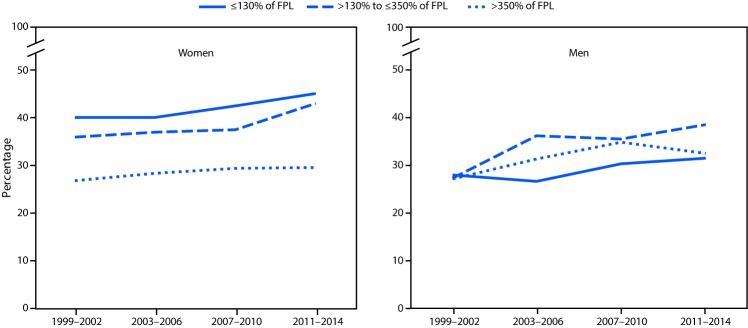
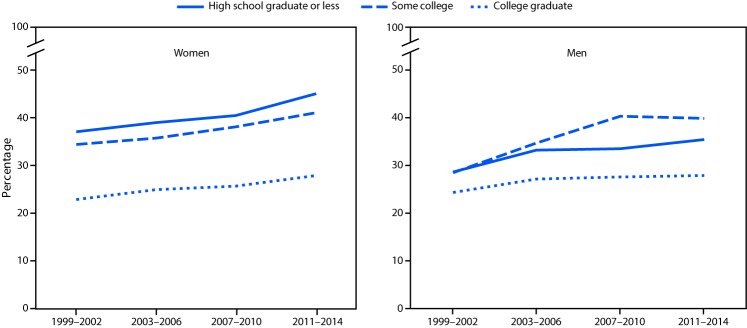
Prevalence of obesity among adults, by household income and education—United States, 2011-2014.
Open accessThe DOI matches its Crossref record; 6 of the 9 references it cites were found in a registry or an index.
Abstract
Studies have suggested that obesity prevalence varies by income and educational level, although patterns might differ between high-income and low-income countries (1-3). Previous analyses of U.S. data have shown that the prevalence of obesity varied by income and education, but results were not consistent by sex and race/Hispanic origin (4). Using data from the National Health and Nutrition Examination Survey (NHANES), CDC analyzed obesity prevalence among adults (aged ≥20 years) by three levels of household income, based on percentage (≤130%, >130% to ≤350%, and >350%) of the federal poverty level (FPL) and individual education level (high school graduate or less, some college, and college graduate). During 2011-2014, the age-adjusted prevalence of obesity among adults was lower in the highest income group (31.2%) than the other groups (40.8% [>130% to ≤350%] and 39.0% [≤130%]). The age-adjusted prevalence of obesity among college graduates was lower (27.8%) than among those with some college (40.6%) and those who were high school graduates or less (40.0%). The patterns were not consistent across all sex and racial/Hispanic origin subgroups. Continued progress is needed to achieve the Healthy People 2020 targets of reducing age-adjusted obesity prevalence to <30.5% and reducing disparities (5).
Overview
The claims and statistics of this paper haven’t been checked yet.
Free: it reads the open-access text and checks the first 5 claims that cite a source we can check. Create a free account to check every claim.
Integrity signals
Registry
Cites
Statistics
Figures
Verification
Claims the paper makes
The claims and statistics of this paper haven’t been checked yet.
Free: it reads the open-access text and checks the first 5 claims that cite a source we can check. Create a free account to check every claim.
Claims other papers make about this one
Each is checked against this paper’s own text: does it say what the citing paper says it does?
The cited source says what the claim attributes to it.
In the citing paper
“Because obesity is more prevalent among individuals with low income, access and affordability to GLP-1 RAs may represent a major barrier to initiation and continued use.14,15”
From Discontinuation and Reinitiation of Dual-Labeled GLP-1 Receptor Agonists Among US Adults With Overweight or Obesity (2025) · cites this paper as [14]
The check wasn’t confident either way, so it gives no verdict — never disputed.
In the citing paper
“Obesity is a known independent risk factor for multiple cardiovascular diseases [16,21,22]”
From PPG-Based Heart Rate Accuracy in Hispanic Adults with Fitzpatrick III–V Skin Tones: An Evaluation of Body Composition and Skin-Tone Effects (2026) · cites this paper as [22]
Experimental — accuracy not yet measured
Self-check
Percentages, sums and reported differences re-computed from the paper’s own numbers.
The self-check needs the paper’s full text.
Citations
Cites
Association between body-mass index and risk of death in more than 1 million Asians
Zheng, W., McLerran, D. F., Rolland, B., Zhang, X., Inoue, M., Matsuo, K., He, J., Gupta, P. C., Ramadas, K., Tsugane, S., et al. (2011) · New England Journal of Medicine · doi:10.1056/nejmoa1010679 · Cited by 885 · cited 1×
“For example, it has been suggested that the BMI cut point (≥30 kg/m2) that typically defines obesity might be too high for Asians and underestimate associated health risks (8,9).”
BackgroundObesity and socioeconomic status in developing countries: a systematic review
Dinsa, G. D., Goryakin, Y., Fumagalli, E., & Suhrcke, M. (2012) · Obesity Reviews · doi:10.1111/j.1467-789x.2012.01017.x · Cited by 805
Obesity and socioeconomic status in adults: United States, 2005-2008.
Ogden, C. L., Lamb, M. M., Carroll, M. D., & Flegal, K. M. (2010) · PubMed · Cited by 530
Self-citationLamerz, A., Kuepper-Nybelen, J., Wehle, C., Bruning, N., Trost-Brinkhues, G., Brenner, H., Hebebrand, J., & Herpertz-Dahlmann, B. (2005) · International Journal of Obesity · doi:10.1038/sj.ijo.0802914 · Cited by 304 · cited 1×
“50 1373 US Department of Health and Human Services/Centers for Disease Control and Prevention income and obesity and education has been reported in at least one other study (7) in children.”
BackgroundObesity - United States, 1988-2008.
Freedman, D. S. (2011) · PubMed · Cited by 109
Self-citationObesity - United States, 1999-2010.
May, A. L., Freedman, D. S., Sherry, B., & Blanck, H. M. (2013) · PubMed · Cited by 95
Self-citation
Cited by
Items 101–200 of 486
Screening for social determinants of health among populations at risk for MASLD: a scoping review
Kim, R. G., Ballantyne, A., Conroy, M. B., Price, J. C., & Inadomi, J. M. (2024) · Frontiers in Public Health · doi:10.3389/fpubh.2024.1332870 · Cited by 26
Gustafson, C. R., & Prate, M. R. (2019) · Nutrients · doi:10.3390/nu11102272 · Cited by 28
“The prevalence of obesity in the United States has increased markedly over the past few decades and currently affects close to 40 percent of the adult population [1].”
BackgroundThe Rise of Obesity among Total Knee Arthroplasty Patients
Mohamed, N. S., Wilkie, W. A., Remily, E. A., Castrodad, I. M. D., Jean-Pierre, M., Jean-Pierre, N., Gbadamosi, W. A., Halik, A. K., & Delanois, R. E. (2020) · The Journal of Knee Surgery · doi:10.1055/s-0040-1710566 · Cited by 24
Alderete, T. L., Wild, L. E., Mierau, S., Bailey, M. J., Patterson, W. B., Berger, P. K., Jones, R. B., Plows, J. F., & Goran, M. I. (2020) · American Journal of Clinical Nutrition · doi:10.1093/ajcn/nqaa156 · Cited by 26
“These results provide the first evidence that dietary added sugars and soluble fiber may affect postpartum weight trajectories among Hispanic women, a group with high rates of overweight and obesity (1, 2).”
BackgroundLavenburg, L.-M. U., Kim, Y., Weinhandl, E. D., Johansen, K. L., & Harhay, M. N. (2022) · Transplantation · doi:10.1097/tp.0000000000004243 · Cited by 23
“We observed associations between proxies for low income and class 3 obesity among incident dialysis patients, consistent with research in the general population.(31) For example, we found that incident dialysis patients with class 3 obesity were more likely to be Medicaid beneficiaries than those with normal BMI.”
ResultBenusic, M., & Cheskin, L. J. (2019) · Journal of Public Health · doi:10.1093/pubmed/fdz077 · Cited by 25
Antiobesity drug therapy: An individualized and comprehensive approach
Mauer, Y., Parker, M., & Kashyap, S. R. (2021) · Cleveland Clinic Journal of Medicine · doi:10.3949/ccjm.88a.20080 · Cited by 27
“6,7 11 ■ CHOOSING THE RIGHT DRUG Pharmacotherapy is indicated in patients with a BMI of 30 kg/m 2 or higher, or 27 kg/m 2 or higher with obesity-associated complications in whom a healthy low-calorie diet and regular physical activity have failed to achieve a healthy weight.”
BackgroundHlavin, C. A., Sebastiani, R. S., Scherer, R., Kenkre, T. S., Bernardi, K., Reed, D. A., Ahmed, B. H., & Courcoulas, A. P. (2023) · Obesity Surgery · doi:10.1007/s11695-023-06761-6 · Cited by 24
Shen, T., Wu, C., Lee, Y., & Chang, C. (2024) · European Journal of Gastroenterology & Hepatology · doi:10.1097/meg.0000000000002741 · Cited by 23
“Studies have shown that children from well-educated families are less likely to have asthma and obesity [53–55], which may decrease the risk of MASLD.”
BackgroundKim, D. D., Hwang, J. H., & Fendrick, A. M. (2024) · Health Affairs Scholar · doi:10.1093/haschl/qxae055 · Cited by 21
“11 As obesity and related clinical sequelae disproportionately affect people from racial and ethnic minority populations and those with low socioeconomic status, 12,13 the limited access and coverage to highly effective obesity-treatment options would further exacerbate health disparities.”
BackgroundAllen, B. (2023) · PLoS ONE · doi:10.1371/journal.pone.0292341 · Cited by 24
Kwok, R. K., Jackson, W. B., Curry, M. D., Stewart, P. A., McGrath, J. A., Stenzel, M., Huynh, T., Groth, C. P., Ramachandran, G., Banerjee, S., et al. (2022) · JAMA Network Open · doi:10.1001/jamanetworkopen.2022.0108 · Cited by 22
Fowler, S. P., Gimeno, D., Swartz, M. D., Granados, P. S., Heilbrun, L. P., & Palmer, R. F. (2023) · Nutrients · doi:10.3390/nu15173772 · Cited by 21
General and Postbariatric Nutritional Knowledge among Patients Undergoing Bariatric Surgery
Alkhaldy, A. A., Alshehri, B., Albalawi, N., Alsaady, F., Alfarshooti, R., Jamal, W. H., Altaf, A., & Maghrabi, A. A. (2019) · Journal of Nutrition and Metabolism · doi:10.1155/2019/6549476 · Cited by 23
“Moreover, there were no differences found in the prevalence of obesity according to the level of education among non-Hispanic Asian women and men [24].”
BackgroundEmotional Eating Predicts Weight Regain Among Black Women in the SisterTalk Intervention
Risica, P. M., Nelson, T., Kumanyika, S., Orona, K. C., Bové, G., Odoms‐Young, A. M., & Gans, K. M. (2020) · Obesity · doi:10.1002/oby.23045 · Cited by 21
“Based on the distribution of frequencies, stress categories of low (responses 1-4), medium (5-7), and high (8-10) were created.”
BackgroundFerris, E., Wyka, K., Evenson, K. R., Dorn, J. M., Thorpe, L. E., Catellier, D., & Huang, T. T. ‐. (2021) · JMIR Formative Research · doi:10.2196/18591 · Cited by 19
“Among women, increased income and educational attainment are associated with decreased obesity prevalence [11].”
BackgroundTucker, C. M., Wippold, G. M., Roncoroni, J., Henry, M. A., Klein, K. G., Garrepy, M., Ateyah, W. A., Burwell, A., Walker, H., Clements, L., et al. (2022) · Journal of Prevention and Health Promotion · doi:10.1177/26320770221099586 · Cited by 21
“…resilience, Black older adults have been disproportionately impacted by adverse health conditions (Assari, 2018; Millett et al., 2020; Phillips et al., 2021), such as obesity (Ogden et al., 2017), low health-related quality of life (Hayes-Larsonet al., 2021), and loneliness (Chatters et al., 2020).”
BackgroundMolarius, A., Lindén‐Boström, M., & Karlsson, J. (2020) · Obesity Science & Practice · doi:10.1002/osp4.412 · Cited by 20
Jang, H., & Oh, H. (2021) · International Journal of Environmental Research and Public Health · doi:10.3390/ijerph18084162 · Cited by 20
“The access to resources and knowledge may influence individual’s ability to maintain healthy weight [33,34].”
BackgroundMehta, N. K. (2023) · Milbank Quarterly · doi:10.1111/1468-0009.12635 · Cited by 20
Shao, B., Chen, J., Kozel, O. A., Tang, O. Y., Amaral-Nieves, N., Sastry, R. A., Watson-Smith, D., Monteagudo, J., Luks, F. I., Carr, S. R., et al. (2023) · Neurosurgery · doi:10.1227/neu.0000000000002604 · Cited by 19
“35 Low-income mothers affected by obesity may be doubly disadvantaged regarding fetal repair because they are at once both at a higher risk for fetal neural tube defects and in-eligible for fetal MMCr given substantive surgical limitations.”
BackgroundEpidemiology and Discrimination in Obesity
Forse, R. A., Betancourt-Garcia, M. M., & Kissee, M. C. (2019) · Springer eBooks · doi:10.1007/978-3-030-27021-6_1 · Cited by 25
Zheng, Z., Xu, W., Wang, F., Qiu, Y., & Xue, Q. (2022) · Frontiers in Nutrition · doi:10.3389/fnut.2022.980908 · Cited by 18
“As a developed economy, the United States has a high obesity rate (58), and there is also a certain interaction between BMI and household income level (59).”
BackgroundWei, X. (2023) · Frontiers in Nutrition · doi:10.3389/fnut.2023.1101764 · Cited by 18
“PIR was categorized as ≤130, >130 to 350%, and ≥ 350% by the federal poverty level (FPL) (25).”
BackgroundVuong, V. T., Fiorella, K. J., Jones, A. D., Trinh, H. T., Khoury, C. K., Huynh, T. T. T., Hoang, K. T., & Nguyen, K. T. (2023) · Journal of Human Nutrition and Dietetics · doi:10.1111/jhn.13242 · Cited by 22
Usability evaluation for the Amulet Wearable Device in rural older adults with obesity
Batsis, J. A., Zagaria, A. B., Kotz, D. F., Bartels, S. J., Boateng, G., Proctor, P., Halter, R. J., & Carpenter-Song, E. A. (2018) · Gerontechnology · doi:10.4017/gt.2018.17.3.003.00 · Cited by 19
Maternal anxiety and diet quality among mothers and toddlers from low‐income households
Trude, A. C. B., Black, M. M., Surkan, P. J., Hurley, K. M., & Wang, Y. (2020) · Maternal and Child Nutrition · doi:10.1111/mcn.12992 · Cited by 19
“Individuals in low-income households are also at greater risk for low diet quality and obesity (Ogden et al., 2017).”
BackgroundTu, R., Hou, J., Liu, X., Li, R., Dong, X., Pan, M., Yin, S., Hu, K., Mao, Z., Huo, W., et al. (2020) · Environmental Research · doi:10.1016/j.envres.2020.110632 · Cited by 18
Association between sleep quality and central obesity among southern Chinese reproductive-aged women
Li, B., Liu, N., Guo, D., Li, B., Liang, Y., Huang, L., Wang, X., Su, Z., Zhang, G., & Wang, P. (2021) · BMC Women s Health · doi:10.1186/s12905-021-01407-0 · Cited by 22
The new kids on the block: Emerging obesogens
Chamorro-García, R., & Veiga‐Lopez, A. (2021) · Advances in pharmacology · doi:10.1016/bs.apha.2021.05.003 · Cited by 19
Larsen, B. A., Klinedinst, B. S., Le, S. T., Pappas, C. A., Wolf, T., Meier, N. F., Lim, Y., & Willette, A. A. (2022) · Obesity Science & Practice · doi:10.1002/osp4.598 · Cited by 18
“Spirit drinkers in this cohort had less educational attainment and earned less income, which have been linked to greater adiposity.(62) In the model, the spirit‐adiposity relationships were fully influenced by urate and cystatin C levels; however, these relationships cannot imply causality.”
BackgroundKim, R. G., Medina, S. P., Magee, C., & Khalili, M. (2021) · Hepatology Communications · doi:10.1002/hep4.1873 · Cited by 17
Food Acquisition Practices, Body Mass Index, and Dietary Outcomes by Level of Rurality
Kegler, M. C., Prakash, R., Hermstad, A. K., Anderson, K., Haardörfer, R., & Raskind, I. G. (2020) · The Journal of Rural Health · doi:10.1111/jrh.12536 · Cited by 17
The Impact of ACEs on BMI: An Investigation of the Genotype-Environment Effects of BMI
Schlauch, K. A., Read, R. W., Neveux, I., Lipp, B., Slonim, A. D., & Grzymski, J. J. (2022) · Frontiers in Genetics · doi:10.3389/fgene.2022.816660 · Cited by 22
“It has been previously determined that lower educational level and lower income are both linked to higher BMI and a greater number of ACEs (Hajian-Tilaki and Heidari, 2010; Hermann et al., 2011; Cohen et al., 2013; Ogden et al., 2017; Hardcastle et al., 2018; Blair et al., 2019; Giano et al., 2021; Hansen et al., 2021…”
BackgroundKritchevsky, S. B., Lovato, L., Handing, E. P., Blair, S., Botoseneanu, A., Guralnik, J. M., Liu, C., King, A., Marsh, A. P., Pahor, M., et al. (2017) · Obesity · doi:10.1002/oby.21860 · Cited by 16
Sámano, R., Esparza-Juárez, F., Chico‐Barba, G., González-Medina, E., Sánchez-Jiménez, B., & Hernández‐Trejo, M. (2022) · International Journal of Environmental Research and Public Health · doi:10.3390/ijerph191710569 · Cited by 20
“Several socioeconomic sectors have a high prevalence of obesity [19,57] and this condition has been consistently associated with intestinal disorders [64,65], as can be observed in our sample.”
BackgroundRacial and Ethnic Health Disparities in Dermatology
Brown, S. G., Cobb, C. B. C., & Harvey, V. M. (2023) · Dermatologic Clinics · doi:10.1016/j.det.2022.10.003 · Cited by 18
Podrekar, N., Kozinc, Ž., & Šarabon, N. (2019) · International Journal of Occupational Safety and Ergonomics · doi:10.1080/10803548.2018.1562688 · Cited by 16
“EE data derived from the SenseWear (BodyMedia, Inc., USA) accelerometers were shown to be reliable during light-intensity stepping [59].”
BackgroundInfluentialDevelopment of a mobile phone app to maintain physical activity in African American men: MobileMen
Newton, R. L., Carter, L., Romain, J. S., Jerrod, T., Griffith, D. M., & Myers, V. H. (2019) · mHealth · doi:10.21037/mhealth.2019.05.03 · Cited by 18
“Relative to White men, African American men have a higher rate of morbidity and mortality from chronic disease, including obesity, cardiovascular disease, hypertension, stroke, diabetes, and prostate cancer (1-3).”
BackgroundPalaiodimos, L., Ali, R., Teo, H. O., Parthasarathy, S., Karamanis, D., Chamorro-Pareja, N., Kokkinidis, D. G., Kaur, S., Kladas, M., Sperling, J. D., et al. (2022) · Journal of Clinical Medicine · doi:10.3390/jcm11030622 · Cited by 16
Poblacion, A. P., de Cuba, S. E., & Cook, J. T. (2022) · Journal of the Academy of Nutrition and Dietetics · doi:10.1016/j.jand.2022.04.009 · Cited by 17
Cost Effectiveness of Calorie Labeling at Large Fast-Food Chains Across the U.S.
Dupuis, R., Block, J. P., Barrett, J. L., Long, M. W., Petimar, J., Ward, Z. J., Kenney, E. L., Musicus, A. A., Cannuscio, C. C., Williams, D. R., et al. (2023) · American Journal of Preventive Medicine · doi:10.1016/j.amepre.2023.08.012 · Cited by 16
Hammond, J. B., Webb, C., Pulivarthi, V., Pearson, D. G., Harold, K. L., & Madura, J. A. (2020) · Obesity Surgery · doi:10.1007/s11695-020-04532-1 · Cited by 15
Geographic clustering and region-specific determinants of obesity in the Netherlands
Qiu, G., Liu, X., Amiranti, A. Y., Yasini, M., Wu, T., Amer, S., & Jia, P. (2020) · Geospatial health · doi:10.4081/gh.2020.839 · Cited by 15
Full characterisation of knee extensors’ function in ageing: effect of sex and obesity
Muollo, V., Rossi, A. P., Zignoli, A., Teso, M., Milanese, C., Cavedon, V., Zamboni, M. M., Schena, F. F., Capelli, C., & Pogliaghi, S. (2021) · International Journal of Obesity · doi:10.1038/s41366-021-00755-z · Cited by 15
“Only 1/3 of the women and 1/6 of the men showed a class of OB > I, in line with the prevalence of this condition in Italian population as compared with North American one [34, 35].”
ResultThe Potential for Healthy Checkout Policies to Advance Nutrition Equity
Falbe, J., White, J. S., Sigala, D. M., Grummon, A. H., Solar, S. E., & Powell, L. M. (2021) · Nutrients · doi:10.3390/nu13114181 · Cited by 15
“[10-13] The food environment in checkout lanes also might contribute to prevailing inequities in dietary and health outcomes, such as higher consumption of unhealthy foods and beverages and higher prevalence of obesity in low-income, Black, and Hispanic populations.[14-19] One national study, for example, found that s…”
BackgroundBreast Cancer in Black Women: Racial/Ethnic Disparities Affecting Survival
Nnorom, S. O., & Wilson, L. (2022) · Journal of Women s Health · doi:10.1089/jwh.2021.0113 · Cited by 16
“34 Metastasis is a major determinant for cancer relapse and mortality.”
Essel, K. D., Fotang, J. P., Deyton, L., & Cotter, E. W. (2022) · Teaching and Learning in Medicine · doi:10.1080/10401334.2022.2041421 · Cited by 16
Chew, H. S. J., Loong, S. S. E., Lim, S. L., Tam, W., Chew, N., Chin, Y. H., Chao, A. M., Dimitriadis, G. K., Gao, Y., So, J. B. Y., et al. (2023) · Nutrients · doi:10.3390/nu15081826 · Cited by 17
“However, this observation could be highly subjective to the population in question, as the study also reported that there were no differences in obesity prevalence among non-Hispanic Asians, regardless of their education level and household income [58].”
BackgroundResultYusuf, F. M., Sebastiån, M. S., & Vaezghasemi, M. (2023) · International Journal for Equity in Health · doi:10.1186/s12939-023-01973-9 · Cited by 15
“Other studies also reinforce the finding that women frequently show a higher rate of obesity [12–14].”
ResultBlankinship, L. A., Rouse, W. A., Bernstein, J., Kruk, J., & Aboul-Enein, B. H. (2021) · Journal of Religion and Health · doi:10.1007/s10943-020-01150-0 · Cited by 15
Abdalla, S. M., Yu, S., & Galea, S. (2021) · SSM - Population Health · doi:10.1016/j.ssmph.2021.100745 · Cited by 15
“Conversely, 41% of the poorest 80% are married and only 28% have a college degree or more (Perry, 2019).”
BackgroundLinking obesity-induced leptin-signaling pathways to common endocrine-related cancers in women
Nyasani, E., Munir, I., Perez, M. N., Payne, K. J., & Khan, S. (2018) · Endocrine · doi:10.1007/s12020-018-1748-4 · Cited by 17
Leider, J., & Powell, L. M. (2019) · Preventive Medicine Reports · doi:10.1016/j.pmedr.2019.100883 · Cited by 16
Daubenmier, J., Chao, M. T., Hartogensis, W., Liu, R., Moran, P. J., Acree, M. C., Kristeller, J., Epel, E. S., & Hecht, F. M. (2021) · Psychosomatic Medicine · doi:10.1097/psy.0000000000000859 · Cited by 14
Idiopathic Intracranial Hypertension and Socioeconomic Status in the Greater Toronto Area, Canada
Eshtiaghi, A., Margolin, E., & Micieli, J. A. (2022) · Journal of Neuro-Ophthalmology · doi:10.1097/wno.0000000000001680 · Cited by 14
Han, H., Ni, P., Zhang, S., Ji, X., Zhu, M., Ma, W., Ge, H., & Chu, H. (2023) · European journal of medical research · doi:10.1186/s40001-023-01343-9 · Cited by 18
“However, in the US population, Black people have a higher prevalence of obesity [52].”
BackgroundEisenberg, M. D., Avery, R. J., Mathios, A., Ernst, P., & Cawley, J. (2021) · Preventive Medicine · doi:10.1016/j.ypmed.2021.106628 · Cited by 15
Socioeconomic Vulnerability Index and Obesity among Korean Adults
Park, E., & Ko, Y. (2021) · International Journal of Environmental Research and Public Health · doi:10.3390/ijerph182413370 · Cited by 14
“A higher education level reduced obesity [12], and the obesity rate of the low-educated group was higher [13].”
BackgroundHarris, C. L., Goldman, B. M., Gurkas, P., Butler, C., & Bookman, P. (2022) · Journal of Health Psychology · doi:10.1177/13591053211068974 · Cited by 15
“Over half of Black women in the United States are obese, and have exceeded all other racial and ethnic groups in the prevalence of obesity for several decades (Chu et al., 2009; Hales et al., 2018, 2020; Ogden et al., 2014, 2017; Rummo et al., 2018).”
BackgroundSpinner, J. R. (2022) · Journal of Primary Care & Community Health · doi:10.1177/21501319221098519 · Cited by 15
Corallo, B., Proser, M., & Nocon, R. S. (2020) · Journal of Ambulatory Care Management · doi:10.1097/jac.0000000000000324 · Cited by 14
Obesity in Total Hip Arthroplasty: Demographic Disparities and Outcome Incongruities
Wilkie, W. A., Remily, E. A., Mohamed, N. S., McDermott, S., Shalit, B., Baird, A., Brand, K., Nace, J., & Delanois, R. E. (2020) · Cureus · doi:10.7759/cureus.7955 · Cited by 14
Ishida, M., D’Souza, M., Zhao, Y. W., Pan, T., Carman, W., Haregu, T., & Lee, J. T. (2023) · Scientific Reports · doi:10.1038/s41598-023-33389-4 · Cited by 15
Edwards, N. C., Ferro, C. J., & Townend, J. (2023) · Nephrology Dialysis Transplantation · doi:10.1093/ndt/gfad194 · Cited by 14
Adekunle, O. A., Le, P. N. B., Gupta, D. Y., Rothberg, M. B., Tran, H. T., Yue, Y., & Gasoyan, H. (2025) · Diabetes Obesity and Metabolism · doi:10.1111/dom.16544 · Cited by 13
Association between Income and Obesity in Black Men: The Role of Work-Life Interference
Bell, C. N., & Thorpe, R. J. (2020) · Ethnicity & Disease · doi:10.18865/ed.30.4.629 · Cited by 13
Intersectionality of Net Worth and Race Relative to Utilization of Total Hip and Knee Arthroplasty
Dlott, C. C., Pei, X., Ittner, J. L., Lefar, S. L., & O’Connor, M. I. (2021) · The Journal of Arthroplasty · doi:10.1016/j.arth.2021.04.037 · Cited by 13
Morden, F. T. C., Tan, C. H., Carrazana, E. J., Viereck, J. C., Liow, K. K., & Ghaffari‐Rafi, A. (2021) · Clinical Neurology and Neurosurgery · doi:10.1016/j.clineuro.2021.106894 · Cited by 13
“When stratifying age of IIH diagnosis by race/ethnicity, Hispanic patients were found to have the youngest median age of diagnosis at 20.50 years (IQR: 20.25, 21.75), followed by NHPI at 29.00 years (IQR: 22.00, 37.25), Asians at 35.00 years (IQR: 31.25, 41.00), Whites at 35.00 years (IQR: 28.00, 41.50), NAAN at 47 ye…”
BackgroundInfluentialHöchsmann, C., Dorling, J. L., Martin, C. K., Earnest, C. P., & Church, T. S. (2022) · BMC Public Health · doi:10.1186/s12889-022-12835-4 · Cited by 15
“Background Obesity continues to be a highly prevalent disease that directly affects health, health care costs to the individual and employers, overall psychological health, and quality of life (QoL) [1].”
BackgroundAssociation between serum vitamin C and HPV infection in American women: a cross-sectional study
Zheng, C., Zheng, Z., & Chen, W. (2022) · BMC Women s Health · doi:10.1186/s12905-022-01993-7 · Cited by 13
“Education was categorized as high school graduate or lower, some college, and college graduate or above [23].”
BackgroundKim, C. Y., Fryar, C. D., & Ogden, C. L. (2023) · Springer eBooks · doi:10.1007/978-1-4614-6625-3_55-1 · Cited by 20
Self-citationAssari, S., Cobb, S., Najand, B., Zare, H., & Sonnega, A. J. (2023) · Journal of Racial and Ethnic Health Disparities · doi:10.1007/s40615-023-01589-3 · Cited by 13
“In addition, while Fryar et al. and Ogden et al. have shown social inequalities in BMI by race and education [38–42], most previous studies on this topic have examined the separate or additive effects of race and educational attainment on BMI.”
BackgroundHuttunen‐Lenz, M., Raben, A., Adam, T. C., Macdonald, I. A., Taylor, M. A., Stratton, G., Mackintosh, K. A., Martínez, J. A., Handjieva‐Darlenska, T., Bogdanov, G., et al. (2023) · BMC Public Health · doi:10.1186/s12889-023-16569-9 · Cited by 14
“For women, higher SES has been associated with lower likelihood of obesity but similar association has not been observed between men in lower and higher SES [50].”
BackgroundResultFeasibility and acceptability of a faith-based mind-body intervention among African American adults
Mama, S. K., Bhuiyan, N., Chaoul, A., Cohen, L. G., Fagundes, C. P., Hoover, D. S., Strong, L. L., Li, Y., Nguyen, N. T., & McNeill, L. H. (2018) · Translational Behavioral Medicine · doi:10.1093/tbm/iby114 · Cited by 13
Healthy Behaviors: Prevalence of Uptake Among Cancer Survivors
Hirschey, R., Nyrop, K. A., & Mayer, D. K. (2020) · Clinical journal of oncology nursing · doi:10.1188/20.cjon.s2.19-29 · Cited by 15
LaRose, J. G., Lanoye, A. M., Ferrell, D., Lü, J., & Mosavel, M. (2021) · Translational Behavioral Medicine · doi:10.1093/tbm/ibaa140 · Cited by 14
“Furthermore, data demonstrate stark disparities for racial/ethnic minority populations and those from economically disadvantaged backgrounds [3, 4].”
BackgroundAddressing Weight Stigma and Opening Doors for a Patient‐Centered Approach to Childhood Obesity
Kyle, T. K., Stanford, F. C., & Nadglowski, J. F. (2017) · Obesity · doi:10.1002/oby.22084 · Cited by 13
Johnson, C., Sharkey, J. R., & Gómez, L. A. (2021) · Journal of Nutrition Education and Behavior · doi:10.1016/j.jneb.2021.01.014 · Cited by 13
Höchsmann, C., Martin, C. K., Apolzan, J. W., Dorling, J. L., Newton, R. L., Denstel, K. D., Mire, E. F., Johnson, W. D., Zhang, D., Arnold, C. L., et al. (2023) · Obesity · doi:10.1002/oby.23854 · Cited by 12
“Certain demographic groups, such as Black and Hispanic populations as well as those with a low household income, exhibit higher rates of obesity [3, 4].”
BackgroundDiscordance Between Self-Reported and Lab-Measured A1C Among Adults With Diabetes
Kamath, A., & Imes, C. C. (2023) · The Journal for Nurse Practitioners · doi:10.1016/j.nurpra.2023.104769 · Cited by 12
Self-Compassion, Healthy Lifestyle Behaviors, and Psychological Well-Being in Women
Koch, J. M., Ross, J. B., Karaffa, K. M., & Rosencrans, A. C. R. (2021) · Journal of Prevention and Health Promotion · doi:10.1177/26320770211039214 · Cited by 12
“For example, individuals who identify as Black or Hispanic, as well as those with less than a college degree, are at particular risk for health problems (Ogden et al., 2017).”
BackgroundBuszkiewicz, J., Hajat, A., Hill, H. D., Otten, J. J., & Drewnowski, A. (2023) · Social Science & Medicine · doi:10.1016/j.socscimed.2023.115817 · Cited by 12
Li, J., Sun, M., Wang, X., Wang, F., Dong, Y., Fang, J., Xie, Z., Li, X., Guo, R., Wang, Y., et al. (2024) · Nutrients · doi:10.3390/nu16050575 · Cited by 13
“Household income was categorized based on the federal poverty level (FPL), adjusting for inflation and family size [35], into ≤ 130% (low income), >130% to ≤ 350% (middle income), and >350% (high income) of FPL. Sleep disorder presence was determined by a binary question regarding a…”
MethodSelf-citationHagedorn, R. L., White, J. A., Franzen-Castle, L. D., Colby, S. E., Kattelmann, K. K., White, A. A., & Olfert, M. D. (2018) · International Journal of Environmental Research and Public Health · doi:10.3390/ijerph15050934 · Cited by 12
“Although childhood obesity is present nationally, researchers have reported that certain regions are more affected by the obesity epidemic than others [4,12].”
BackgroundVolz, K., Wyckoff, E. P., Huedo-Medina, T. B., Denmat, Z., Field, C. M., LaRose, J. G., Gorin, A. A., & Leahey, T. M. (2021) · Journal of Behavioral Medicine · doi:10.1007/s10865-021-00238-6 · Cited by 12
Jaceldo‐Siegl, K., Estevez, D., Fraser, G. E., Hayes‐Bautista, D. E., Flores, H., Jordan, M., & Singh, P. N. (2019) · American Journal of Health Promotion · doi:10.1177/0890117119828285 · Cited by 13
Depressive symptom severity as a predictor of attendance in the HOME behavioral weight loss trial
Shell, A. L., Hsueh, L., Vrany, E. A., Clark, D. O., Keith, N. R., Xu, H., & Stewart, J. C. (2020) · Journal of Psychosomatic Research · doi:10.1016/j.jpsychores.2020.109970 · Cited by 13
“A key strength of our study is sampling from an understudied population that experiences disproportionately high depression and obesity rates (27, 28).”
BackgroundFernández, A., Lozano, A., Lee, T. K., Messiah, S. E., & Prado, G. J. (2021) · Journal of Nutrition Education and Behavior · doi:10.1016/j.jneb.2021.05.001 · Cited by 12
Li, H., & Adair, T. (2024) · BMC Medicine · doi:10.1186/s12916-024-03752-x · Cited by 12
“Education status is important in the context of obesity-related mortality; in the US, obesity prevalence is higher for people with lower education, including within specific ethnic groups [20].”
Trends in Store-Level Sales of Sugary Beverages and Water in the U.S., 2006–2015
Rummo, P. E., Pho, N., Bragg, M. A., Roberto, C. A., & Elbel, B. D. (2020) · American Journal of Preventive Medicine · doi:10.1016/j.amepre.2020.04.022 · Cited by 11
Garfield, C. F., Simon, C. D., Stephens, F., Roman, P. C., Bryan, M., Smith, R. A., Kortsmit, K., von Essen, B. S., Williams, L., Kapaya, M., et al. (2022) · PLoS ONE · doi:10.1371/journal.pone.0262366 · Cited by 11
“, National Health Interview Survey [NHIS] [15], Behavioral Risk Factor Surveillance System [BRFSS] [16], National Survey of Family Growth [NSFG] [17], and National Health and Nutrition Examination Survey [NHANES] [18]), they are not specific to fatherhood or men’s experiences and behaviors before, during, and after th…”
BackgroundPoor Education Predicts Poor Health - A Challenge Unmet by American Medicine
Johnston, R. B. (2019) · NAM Perspectives · doi:10.31478/201904a · Cited by 18
“Page 2 Published April 8, 2019 inversely with educational attainment and in step-wise fashion [15,16]—for example, smoking varies from 5% in those with a graduate degree to 41% in those without a high-school diploma [16].”
BackgroundRingling, K. M., & Marquart, L. F. (2020) · Frontiers in Sustainable Food Systems · doi:10.3389/fsufs.2020.00070 · Cited by 12
Prevalence of overweight and obesity among school children and parents: a cross-sectional study
Arslan, A., Dündar, & Terzi, Ö. (2021) · Rural and Remote Health · doi:10.22605/rrh6773 · Cited by 11
Training Needs of Nutrition Educators Engaged in Policy, Systems, and Environmental Approaches
Hill, T. F., Stark, C. M., Sellers, D. E., & Dollahite, J. (2020) · Journal of Nutrition Education and Behavior · doi:10.1016/j.jneb.2020.07.007 · Cited by 11
Fan, S., Xu, J., Wu, J., Yan, L., & Ren, M. (2024) · The journal of nutrition health & aging · doi:10.1016/j.jnha.2024.100402 · Cited by 10
Baumer, Y., Singh, K., Saurabh, A., Baez, A. S., Gutierrez‐Huerta, C. A., Chen, L., Igboko, M., Turner, B. S., Yeboah, J. A., Reger, R. N., et al. (2024) · JCI Insight · doi:10.1172/jci.insight.180606 · Cited by 12
Gudzune, K. A., Perreault, L., Apovian, C. M., Aroda, V. R., Aronne, L. J., Fitch, A., Fitzpatrick, S. L., Garvey, W. T., Kahan, S. I., Khunti, K., et al. (2026) · Diabetes Obesity and Cardiometabolic CARE · doi:10.2337/doci26-0003 · Cited by 13
“For example, obesity is more prevalent among racial and ethnic minori-tized groups as well as groups with low socioeconomic status (150,151).”
Miller, S., de la Haye, K., Bell, B. M., Gálvez, A., Rupp, S., & Flórez, K. R. (2023) · Journal of Hunger & Environmental Nutrition · doi:10.1080/19320248.2023.2199681 · Cited by 11
Metadata
- Authors
- Ogden, C. L., Fakhouri, T. H., Carroll, M. D., Hales, C. M., Fryar, C. D., Li, X., & Freedman, D. S.
- Affiliations
- Centers for Disease Control and Prevention (US)
- Corresponding author
- Ogden, Cynthia L.
- ORCID
- Venue
- MMWR. Morbidity and Mortality Weekly Report
- Published
- 2017-12-22
- Volume
- 66
- Issue
- 50
- Pages
- 1369-1373
- ISSN
- 0149-2195 (ISSN-L)
- 1545-861X
- PMC
- PMC5751581
- OpenAlex
- W2778311948
- Cited by
- 456
- References
- 9
- Citations by year
- 2026: 19 · 2025: 40 · 2024: 58 · 2023: 76 · 2022: 68 · 2021: 69 · 2020: 60 · 2019: 40 · 2018: 23 · 2017: 3
- FWCI
- 32.36
- Type
- journal article
- Language
- en
- Open access
- bronze
- doi.org
- Locations
- MMWR Morbidity and Mortality Weekly Report (publishedVersion)
- PubMed Central (publishedVersion, cc-by)
- PubMed (publishedVersion)
- Topics
- Health Sciences › Medicine › Public Health, Environmental and Occupational Health › Obesity, Physical Activity, Diet
- Health Sciences › Medicine › Public Health, Environmental and Occupational Health › Obesity and Health Practices
- Social Sciences › Health › Health disparities and outcomes
- Keywords
- obesity prevalence, household income, educational attainment, socioeconomic disparities, federal poverty level, adults, sex differences, Healthy People 2020, NHANES
- MeSH terms
- Adult, Cross-Sectional Studies, Educational Status, Female, Hispanic or Latino, Humans, Income, Male, Middle Aged, Nutrition Surveys, Obesity, Poverty, Risk Factors, United States, Prevalence, Racial Groups, Health Status Disparities, Young Adult
About these checks
Registry, retraction, Cites and statistics results are computed, not judged, with one exception: a printed reference that no index lists is read once by a model before it counts as a citation error. Claims are extracted by a model and kept only when their quote appears verbatim in the text; each cited source is then checked, with a model’s help, for whether it says what the claim relies on. Those verdicts can be wrong — read the claim’s quote and the cited source before relying on one.
Statistics and arithmetic are recomputed, not judged.
Confidence bands are shown only for fields calibrated on our annotated test set. None is calibrated yet, so no band is shown.
What counts as a claim ›How we measure confidence ›How we check this ›
Are you an author, or do you see a problem with this page? Request a review
Data sources
Bibliographic data: Semantic Scholar, OpenAlex, Crossref.
Contains information from the Semantic Scholar Academic Graph Datasets, made available under the ODC Attribution License (ODC-BY 1.0).
Semantic Scholar’s data is described in: Kinney, R., et al. (2023). The Semantic Scholar Open Data Platform. arXiv:2301.10140.
