

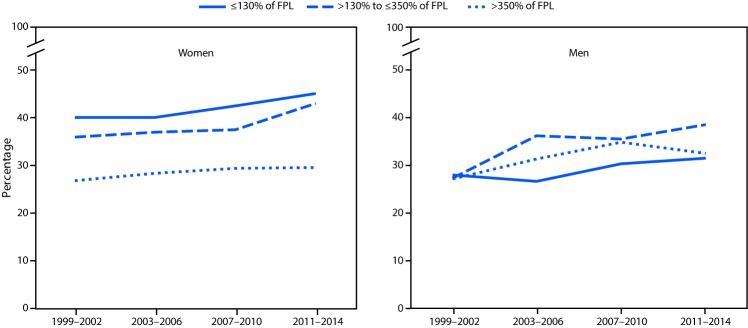
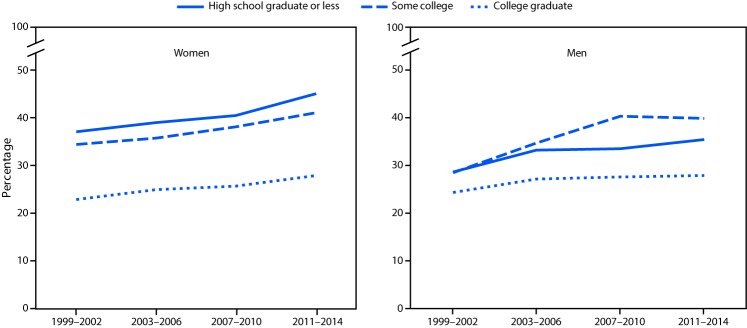
Prevalence of obesity among adults, by household income and education—United States, 2011-2014.
Open accessThe DOI matches its Crossref record; 6 of the 9 references it cites were found in a registry or an index.
Abstract
Studies have suggested that obesity prevalence varies by income and educational level, although patterns might differ between high-income and low-income countries (1-3). Previous analyses of U.S. data have shown that the prevalence of obesity varied by income and education, but results were not consistent by sex and race/Hispanic origin (4). Using data from the National Health and Nutrition Examination Survey (NHANES), CDC analyzed obesity prevalence among adults (aged ≥20 years) by three levels of household income, based on percentage (≤130%, >130% to ≤350%, and >350%) of the federal poverty level (FPL) and individual education level (high school graduate or less, some college, and college graduate). During 2011-2014, the age-adjusted prevalence of obesity among adults was lower in the highest income group (31.2%) than the other groups (40.8% [>130% to ≤350%] and 39.0% [≤130%]). The age-adjusted prevalence of obesity among college graduates was lower (27.8%) than among those with some college (40.6%) and those who were high school graduates or less (40.0%). The patterns were not consistent across all sex and racial/Hispanic origin subgroups. Continued progress is needed to achieve the Healthy People 2020 targets of reducing age-adjusted obesity prevalence to <30.5% and reducing disparities (5).
Overview
The claims and statistics of this paper haven’t been checked yet.
Free: it reads the open-access text and checks the first 5 claims that cite a source we can check. Create a free account to check every claim.
Integrity signals
Registry
Cites
Statistics
Figures
Verification
Claims the paper makes
The claims and statistics of this paper haven’t been checked yet.
Free: it reads the open-access text and checks the first 5 claims that cite a source we can check. Create a free account to check every claim.
Claims other papers make about this one
Each is checked against this paper’s own text: does it say what the citing paper says it does?
The cited source says what the claim attributes to it.
In the citing paper
“Because obesity is more prevalent among individuals with low income, access and affordability to GLP-1 RAs may represent a major barrier to initiation and continued use.14,15”
From Discontinuation and Reinitiation of Dual-Labeled GLP-1 Receptor Agonists Among US Adults With Overweight or Obesity (2025) · cites this paper as [14]
The check wasn’t confident either way, so it gives no verdict — never disputed.
In the citing paper
“Obesity is a known independent risk factor for multiple cardiovascular diseases [16,21,22]”
From PPG-Based Heart Rate Accuracy in Hispanic Adults with Fitzpatrick III–V Skin Tones: An Evaluation of Body Composition and Skin-Tone Effects (2026) · cites this paper as [22]
Experimental — accuracy not yet measured
Self-check
Percentages, sums and reported differences re-computed from the paper’s own numbers.
The self-check needs the paper’s full text.
Citations
Cites
Association between body-mass index and risk of death in more than 1 million Asians
Zheng, W., McLerran, D. F., Rolland, B., Zhang, X., Inoue, M., Matsuo, K., He, J., Gupta, P. C., Ramadas, K., Tsugane, S., et al. (2011) · New England Journal of Medicine · doi:10.1056/nejmoa1010679 · Cited by 885 · cited 1×
“For example, it has been suggested that the BMI cut point (≥30 kg/m2) that typically defines obesity might be too high for Asians and underestimate associated health risks (8,9).”
BackgroundObesity and socioeconomic status in developing countries: a systematic review
Dinsa, G. D., Goryakin, Y., Fumagalli, E., & Suhrcke, M. (2012) · Obesity Reviews · doi:10.1111/j.1467-789x.2012.01017.x · Cited by 805
Obesity and socioeconomic status in adults: United States, 2005-2008.
Ogden, C. L., Lamb, M. M., Carroll, M. D., & Flegal, K. M. (2010) · PubMed · Cited by 530
Self-citationLamerz, A., Kuepper-Nybelen, J., Wehle, C., Bruning, N., Trost-Brinkhues, G., Brenner, H., Hebebrand, J., & Herpertz-Dahlmann, B. (2005) · International Journal of Obesity · doi:10.1038/sj.ijo.0802914 · Cited by 304 · cited 1×
“50 1373 US Department of Health and Human Services/Centers for Disease Control and Prevention income and obesity and education has been reported in at least one other study (7) in children.”
BackgroundObesity - United States, 1988-2008.
Freedman, D. S. (2011) · PubMed · Cited by 109
Self-citationObesity - United States, 1999-2010.
May, A. L., Freedman, D. S., Sherry, B., & Blanck, H. M. (2013) · PubMed · Cited by 95
Self-citation
Cited by
Items 401–486 of 486
Lee, J. H. (2018) · eScholarship (California Digital Library)
Daundasekara, S. S., Kamdar, N. P., Dao, A., Greer, A. E., McKyer, E. L. J., & Hernandez, D. C. (2019) · Health Behavior Research · doi:10.4148/2572-1836.1056
“Among men, these differences are minimal (32.6% versus 31.5%, respectively) (Ogden et al., 2017).”
BackgroundInfluentialAdult Food Insecurity is Associated with Heavier Weight Preferences among Black Women
Reesor-Oyer, L. M., Marroquin, N. G., & Hernandez, D. C. (2019) · Health Behavior Research · doi:10.4148/2572-1836.1066
“Participants self-reported their age (years), race/ethnicity (Hispanic, black, white), nativity status [foreign-born vs. native born (reference)], marital status [single vs. married/cohabitating (reference)], education [less than a high school degree vs. high school degree or greater (reference)], employment [unemploy…”
Nutritional and Metabolic Wellness
Noland, D. (2020) · Springer eBooks · doi:10.1007/978-3-030-30730-1_3
Grosso, J. L. (1997) · Anuário Antropológico · Cited by 1
Health Research in JFEI Over a Decade: 2009–2019
Chaudhuri, A. (2020) · Journal of Family and Economic Issues · doi:10.1007/s10834-020-09707-7
“Rising rates of obesity, especially in childhood, is a cause of concern in the United States as it is associated with a multitude of chronic diseases and poses a heavy economic burden (Ogden 2017).”
Area-Level Factors Linked to Obesity in African American and Caucasian Women in Michigan
Arrey, M. (2020) · ScholarWorks (Walden University) · Cited by 1
Synthetic Endocrine Disrupting Chemicals are not a Significant Cause of Obesity
Smith Carr, J., Perfetti Thomas, A., Hayes, A. W., & Colin, B. S. (2020) · doi:10.36959/736/637
Bernhart, J. A., Turner‐McGrievy, G. M., Eustis, S. J., Wilson, M. J., Hutto, B., Wilcox, S., Frongillo, E. A., & Murphy, E. A. (2020) · Lifestyle Medicine · doi:10.1002/lim2.16
The influence of state minimum wage increases on health and behavior
Buszkiewicz, J. (2020) · ResearchWorks at the University of Washington (University of Washington)
Holmes, H. (2020) · ScholarSpace (University of Hawaii at Manoa)
Drug Release Studies of SC‐514 PLGA Nanoparticles
Famuyiwa, T. O., Bowers, Z., Caraballo, D., Diaka, K., & Asghar, W. (2021) · The FASEB Journal · doi:10.1096/fasebj.2021.35.s1.02367
Rashed, S. A., & Ali, R. M. (2021) · Indian Journal of Forensic Medicine & Toxicology · doi:10.37506/ijfmt.v15i4.17217
Elkind, J. A. (2020) · ScholarlyCommons (University of Pennsylvania) · Cited by 1
Avancées scientifiques de 2020 en médecine interne générale ambulatoire
Gouveia, A., Wenger-Bonny, C., Ho, L. K. S., Fogarasi, N., Kokkinakis, I., Gray, R., Alencastro, L. D., Favrat, B., & Bodenmann, P. (2021) · JMIG · doi:10.53738/revmed.2021.17.722.0119
Drug Release Studies of SC-514 PLGA Nanoparticles
Famuyiwa, T. O., Bowers, Z., Bentley, A., Caraballo, D., Subtil, P., James, K. K. D., & Asghar, W. (2021) · Pharmacovigilance and Pharmacoepidemiology · doi:10.33805/2638-8235.118
BMI Perception: A potential cheap alternative to objectively measured BMI?Preprint
Shiely, F., & Millar, S. (2019) · Research Square · doi:10.21203/rs.2.15448/v1
Quality & Safety in the Literature: March 2020
Houchens, N., Meddings, J. A., & Gupta, A. B. (2020) · BMJ Quality & Safety · doi:10.1136/bmjqs-2020-010832
Minor, L. B., & Rees, M. J. (2020) · Wiley eBooks · doi:10.1002/9781119672715.notes
Machine learning to predict intubation in COVID-19 patients
Hamdar, H. (2022) · Journal of Clinical Case Reports and Studies · doi:10.31579/2690-8808/124
Tang, H., Cao, Y., Wu, J., Li, Y., Li, S., Shen, M., & Zhu, L. (2022) · Research Square · doi:10.21203/rs.3.rs-2215383/v1
Retracted- Retracted
Work Can Be Good—or Bad—for Your Health
Braveman, P. (2023) · Oxford University Press eBooks · doi:10.1093/oso/9780190624118.003.0009
Kamath, A., & Imes, C. C. (2023) · medRxiv · doi:10.1101/2023.05.10.23289782
Watts, S. O., Wang, C.-H., Tsai, P., Ware, K., Sagong, H., & Feeley, C. A. (2023) · Journal of Racial and Ethnic Health Disparities · doi:10.1007/s40615-023-01651-0
“Also, income and education levels are noted to impact obesity level across racial/ethnic groups in different ways [26, 27].”
Peinado, J. (2022) · Digital Commons - Andrews University (Andrews University) · doi:10.32597/dmin/760/
The Impacts of Inequality and Effects of External Factors in Economics
Guarnieri, L., & Lee‐Davies, L. (2023) · Palgrave studies in sustainability, environment and macroeconomics · doi:10.1007/978-3-031-31879-5_3
Anthropometric Predictors of Hemoglobin A1c among Adults: NHANES 2003 to 2004 and 2013 to 2014
Nicolò, M., Compher, C. W., Shewokis, P. A., Boullata, J. I., Sukumar, D., Smith, S. A., & Volpe, S. L. (2019) · Translational Journal of the American College of Sports Medicine · doi:10.1249/tjx.0000000000000107 · Cited by 1
Assessment of the Prevalence of Body Mass Index in Some Rural Agro-Settlements, South-East Nigeria
Anumudu, E. N., Nnamonu, E. I., & Onyeke, P. C. (2023) · Journal of Biology Agriculture and Healthcare · doi:10.7176/jbah/13-14-01
Diana, A. F., Abidemi, O. M., Eniola, A. I., Dorcas, F. O., Toyin, A. A., & Chioma, D. S. (2023) · Path of Science · doi:10.22178/pos.94-20
“Obesity represents a persistent health condition, and the link between obesity and factors such as income and educational attainment is intricate, varying according to gender and racial/non-Hispanic background [4].”
BackgroundObesity and Metabolic Syndrome in the United States
Osei, A. D., Ohene-Kyei, E. T., & Echouffo-Tcheugui, J. B. (2023) · Springer eBooks · doi:10.1007/978-3-319-12125-3_55-1
Community-Based Interventions to Address Obesity in the Context of Health Equity
Drake, B. F., Chavez, S., Davis, K. L., Brownson, R. C., & Colditz, G. A. (2023) · Springer eBooks · doi:10.1007/978-3-031-37638-2_9
Obesity as an important risk factor for dementia
Fus-Mazurkiewicz, L., Sak, J., Nowiński, M., & Mazurkiewicz, W. (2023) · Environmental Medicine · doi:10.26444/ms/175316
“[35].”
Christensen, J. T., Taylor, Z., & Jones, B. L. (2023) · The Journal of Early Adolescence · doi:10.1177/02724316231223529
“There are several biological, demographic, and behavioral risk factors that contribute to the development of obesity including genetics, socioeconomic status (SES), ethnicity, exercise, sleep, and diet (e.g., Dev et al., 2013; Farooqi & O ’ Rahilly, 2006; Hales, 2020; Min et al., 2018; Ogden, 2017).”
Dimitrios, K. H. (2024) · INOSR APPLIED SCIENCES · doi:10.59298/inosras/2024/1.1.41103
Othman, A. A., Yusoff, Y. S., & Rahim, N. A. (2024) · AIP conference proceedings · doi:10.1063/5.0194229
Obesity in Low-Income Communities
Shrestha, A., & Shrestha, P. S. (2024) · IntechOpen eBooks · doi:10.5772/intechopen.1005371
Exploring the Interaction between Health-promoting and Health Risk Behaviours in Health
Zhou, H., Jiang, F., & Tang, Y.-L. (2024) · Frontiers research topics · doi:10.3389/978-2-8325-4968-1
deLateur, B. J. (2024) · Oxford University Press eBooks · doi:10.1093/med/9780197649176.003.0028
Predictors of the Attempt and Failure to Lose Weight among the South African Population
Manafe, M. (2024) · Obesities · doi:10.3390/obesities4030018
“Another study that noted a higher prevalence of obesity among men was conducted in the United States (USA) by Ogden et al. [28].”
BackgroundHow Children Influence Weight-Related Behaviors of Women With Low Incomes: A Qualitative Study
Adams, M. M., & Anderson, G. (2024) · Families in Society The Journal of Contemporary Social Services · doi:10.1177/10443894241265522
“%) have a higher prevalence of obesity than their higher-income counterparts (29.7%; Ogden et al., 2017).”
InfluentialSeoane, M. C., & McVay, M. A. (2024) · Hispanic Health Care International · doi:10.1177/15404153241286768
“Forexample,37%ofHispanicswhoarecollegegraduates have obesity (Ogden, 2017).”
Evaluation of Body Weight Perception Using Body Size Guides
Kaya, S., & Ateş, E. A. (2024) · Konuralp Tıp Dergisi · doi:10.18521/ktd.1500023
Waraich, H. A., Wirth, M. D., Wandji, S. R., Graves, J. M., & Abshire, D. A. (2024) · The Journal of Rural Health · doi:10.1111/jrh.12892
“Education is an important social determinant of health linked to obesity with research suggesting that higher education is inversely related to obesity rates among White and Hispanic adults 37 and more accurate weight perceptions among African American adults.”
Assari, S., & Zare, H. (2024) · Global Journal of Epidemiology and Infectious Disease · doi:10.31586/gjeid.2024.1096
Okui, T. (2024) · European Journal of Obstetrics & Gynecology and Reproductive Biology · doi:10.1016/j.ejogrb.2024.11.050
The Impact of Overweight on Wages of Russians
Deeva, A. S. (2025) · Вопросы статистики · doi:10.34023/2313-6383-2025-32-1-51-63
Understanding Obesity: History, Epidemiology, Causes, Consequences and Comprehensive Solutions
Shebini, S. M. E., Moaty, M. I. A., & Ahmed, N. H. (2025) · Liaquat National Journal of Primary Care · doi:10.37184/lnjpc.2707-3521.7.54 · Cited by 2
Epidemiology and Pathophysiology of Diabetes and Obesity
Lennon, A. (2025) · Springer eBooks · doi:10.1007/978-3-031-88835-9_1
Fransisco, C., Kinabo, J., & Pacific, R. (2025) · Journal of Food and Nutrition Sciences · doi:10.11648/j.jfns.20251304.11
Epidemiology of osteoarthritis in female patients
Wallace, S., Emenari, C. C., & Benson, D. (2025) · Elsevier eBooks · doi:10.1016/b978-0-443-10559-3.00010-x
Połtyn–Zaradna, K., Basiak-Rasała, A., Kujawa, K., Matera-Witkiewicz, A., Kiliś‐Pstrusińska, K., Gaweł-Dąbrowska, D., Zatoński, T., & Zatońska, K. (2025) · Critical Public Health · doi:10.1080/09581596.2025.2562706
“…al., 2025). it may be partially explained by larger share of participants with higher level of education in our study in comparison to the general Polish population. level of education has been previously found to be inversely correlated with over-weight and obesity prevalence (Ogden et al., 2017).”
Maqsood, U., & Zheng, S. (2025) · Cureus · doi:10.7759/cureus.93297
“The impact of overweight/obesity is not spread equally across the population, as it tends to affect those with lower education levels and income more significantly, along with certain racial and ethnic groups [8,9].”
Li, X., & Zhang, M. (2025) · Respiratory Medicine · doi:10.1016/j.rmed.2025.108397
Self-citationHill, N. E., & Fendrick, A. M. (2025) · American Journal of Preventive Medicine · doi:10.1016/j.amepre.2025.108153
Li, X., Wang, Q., Wang, Y., & Zhang, M. (2025) · Nutrition Research · doi:10.1016/j.nutres.2025.09.012
Self-citationMartins, H. X., Siqueira, J. H., de Oliveira, A. M. A., de Jesus, H. C., Alvim, R. D. O., Mill, J. G., Pereira, T. S. S., & Molina, M. D. C. B. (2025) · Cadernos Saúde Coletiva · doi:10.1590/1414-462x202533040243
Han, H., Ni, P., Zhang, S., Ji, X., Zhu, M., Ma, W., Ge, H., & Chu, H. (2024) · Figshare · doi:10.6084/m9.figshare.26619751
Han, H., Ni, P., Zhang, S., Ji, X., Zhu, M., Ma, W., Ge, H., & Chu, H. (2024) · Figshare · doi:10.6084/m9.figshare.26619754
Ma, L., Yuan, J., Yang, X., Yan, M., Li, Y., & Niu, M. (2024) · Figshare · doi:10.6084/m9.figshare.26195756
Han, H., Ni, P., Zhang, S., Ji, X., Zhu, M., Ma, W., Ge, H., & Chu, H. (2024) · Figshare · doi:10.6084/m9.figshare.26619757
Yang, Y., Pentland, A., & Moro, E. (2023) · Figshare · doi:10.6084/m9.figshare.22949295
Robina-Galatas, A. (2018) · NORA - Norwegian Open Research Archives
Hernandez, M., & NC DOCKS at The University of North Carolina at Greensboro (2023) · NC Digital Online Collection of Knowledge and Scholarship (The University of North Carolina at Greensboro)
Taliman, J. (2023) · ScholarWorks (Walden University)
Comportamento alimentar dos consumidores de Cabo Verde durante a Pandemia do Covid-19
Djau, M. A. B. (2021) · Portuguese National Funding Agency for Science, Research and Technology (RCAAP Project by FCT)
Phan, M. M. (2021) · Illinois Digital Environment for Access to Learning and Scholarship (University of Illinois at Urbana-Champaign)
Why is Obesity Today More Prevalent than Ever?
Baretić, M. (2025) · University of Zagreb University Computing Centre (SRCE)
Castanheiro, M., Teixeira, A., Monteiro, H., & Páscoa, R. (2026) · Lecture notes in networks and systems · doi:10.1007/978-3-032-10731-2_30
Gürgil, S. O. (2026) · Environmental Research and Technology · doi:10.35208/ert.1571175
Enhance cardiovascular health through exercise
Alhajar, Y. T., Saleh, M. Y., Fathy, K. A., & Saleh, A. Y. (2026) · AIP conference proceedings · doi:10.1063/5.0321838 · Cited by 1
Rummo, P. E., Echenique, J. A., Wu, E., Mijanovich, T., Desai, S. M., Bragg, M. A., Weitzman, B. C., & Elbel, B. D. (2026) · PLoS Medicine · doi:10.1371/journal.pmed.1004642
“Consuming sugary drinks contributes to higher total energy intake and an increased risk of obesity and heart disease [1,2], with variation by age, income, educational attainment, and race/ethnicity [3,4].”
Siddiqui, A. (2021) · theses.fr (ABES) · doi:10.70675/fe902f84zb034z4a27z99ddz0d91b3c0ef78
Kaufman, R. C. (2026) · Research Square · doi:10.21203/rs.3.rs-9657897/v1
Zhang, B., Lang, L., Li, Y., Wang, P., Zhao, Z., Du, W., Ye, W., & Zhong, J. (2026) · Journal of Orofacial Orthopedics / Fortschritte der Kieferorthopädie · doi:10.1007/s00056-026-00644-y
Carlson, J., Materia, F. T., Moon, M., Ryu, S., Yeager, C., Steel, C., Shields, K., Gill, H. S., Berkley‐Patton, J., & Catley, D. (2026) · JMIR mhealth and uhealth · doi:10.2196/76991
“Physical activity interventions are especially important for low-income population groups, which can be underresourced and have been shown to engage in less leisure-time physical activity and experience higher rates of related chronic diseases than other groups [2-5].”
Forse, R. A., Betancourt-Garcia, M. M., & Kissee, M. C. (2026) · Springer eBooks · doi:10.1007/978-3-032-24278-5_1
Mupfudze, T. G., Handarova, D. K., Noreen, S. M., Schold, J. D., Paramesh, A. S., & Mohandas, R. (2026) · World Journal of Transplantation · doi:10.5500/wjt.120639
“Adverse SDOH may be more prevalent among obese individuals[8-10], raising concerns that obesity may compound the effects of socioeconomic disadvantage in limiting access to transplantation.”
Yun, H., Park, J., Unruh, M. A., & Jung, H. (2026) · Journal of the American Geriatrics Society · doi:10.1111/jgs.70568
“Several analyses using national data for noninstitutionalized adults in the US have consistently documented an association between higher prevalence of obesity and rurality [28–30] and lower income [31, 32].”
Effects of Positive Childhood Experiences in Adolescence on Obesity in Women
Katzow, M. W., Duh‐Leong, C., Leschly, J., & Jan, S. (2026) · Journal of Adolescent Health · doi:10.1016/j.jadohealth.2026.05.004
Holm, M. E., Reinikainen, J., Sainio, P., Sääksjärvi, K., Lundqvist, A., Lahti, J., Koskinen, S. V. P., & Parikka, S. (2026) · BMC Public Health · doi:10.1186/s12889-026-28941-6
Ambient Temperature and Adult Obesity: Evidence from U.S. County-Level Panel Data
Qi, X., Tao, T., Cheng, K., Liu, X., & Lai, L. (2026) · Advances in economics, business and management research/Advances in Economics, Business and Management Research · doi:10.2991/978-94-6239-774-3_7
Oliveira, A. L. (2025) · Illinois Digital Environment for Access to Learning and Scholarship (University of Illinois at Urbana-Champaign)
Horning, M. L., Gorman, K. S., Wagner, S., Fulkerson, J. A., Laska, M. N., Wolfson, J. A., Hu, J., Wang, Y., & Harnack, L. (2026) · JAMA Network Open · doi:10.1001/jamanetworkopen.2026.46816
Järvensivu, E., Järvensivu, L., Viitanen, M., Rahkonen, O., & Lallukka, T. M. (2026) · medRxiv · doi:10.64898/2026.11.10.26367699
Metadata
- Authors
- Ogden, C. L., Fakhouri, T. H., Carroll, M. D., Hales, C. M., Fryar, C. D., Li, X., & Freedman, D. S.
- Affiliations
- Centers for Disease Control and Prevention (US)
- Corresponding author
- Ogden, Cynthia L.
- ORCID
- Venue
- MMWR. Morbidity and Mortality Weekly Report
- Published
- 2017-12-22
- Volume
- 66
- Issue
- 50
- Pages
- 1369-1373
- ISSN
- 0149-2195 (ISSN-L)
- 1545-861X
- PMC
- PMC5751581
- OpenAlex
- W2778311948
- Cited by
- 456
- References
- 9
- Citations by year
- 2026: 19 · 2025: 40 · 2024: 58 · 2023: 76 · 2022: 68 · 2021: 69 · 2020: 60 · 2019: 40 · 2018: 23 · 2017: 3
- FWCI
- 32.36
- Type
- journal article
- Language
- en
- Open access
- bronze
- doi.org
- Locations
- MMWR Morbidity and Mortality Weekly Report (publishedVersion)
- PubMed Central (publishedVersion, cc-by)
- PubMed (publishedVersion)
- Topics
- Health Sciences › Medicine › Public Health, Environmental and Occupational Health › Obesity, Physical Activity, Diet
- Health Sciences › Medicine › Public Health, Environmental and Occupational Health › Obesity and Health Practices
- Social Sciences › Health › Health disparities and outcomes
- Keywords
- obesity prevalence, household income, educational attainment, socioeconomic disparities, federal poverty level, adults, sex differences, Healthy People 2020, NHANES
- MeSH terms
- Adult, Cross-Sectional Studies, Educational Status, Female, Hispanic or Latino, Humans, Income, Male, Middle Aged, Nutrition Surveys, Obesity, Poverty, Risk Factors, United States, Prevalence, Racial Groups, Health Status Disparities, Young Adult
About these checks
Registry, retraction, Cites and statistics results are computed, not judged, with one exception: a printed reference that no index lists is read once by a model before it counts as a citation error. Claims are extracted by a model and kept only when their quote appears verbatim in the text; each cited source is then checked, with a model’s help, for whether it says what the claim relies on. Those verdicts can be wrong — read the claim’s quote and the cited source before relying on one.
Statistics and arithmetic are recomputed, not judged.
Confidence bands are shown only for fields calibrated on our annotated test set. None is calibrated yet, so no band is shown.
What counts as a claim ›How we measure confidence ›How we check this ›
Are you an author, or do you see a problem with this page? Request a review
Data sources
Bibliographic data: Semantic Scholar, OpenAlex, Crossref.
Contains information from the Semantic Scholar Academic Graph Datasets, made available under the ODC Attribution License (ODC-BY 1.0).
Semantic Scholar’s data is described in: Kinney, R., et al. (2023). The Semantic Scholar Open Data Platform. arXiv:2301.10140.
