

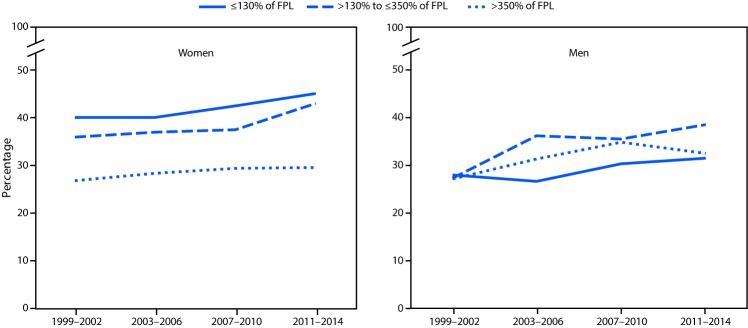
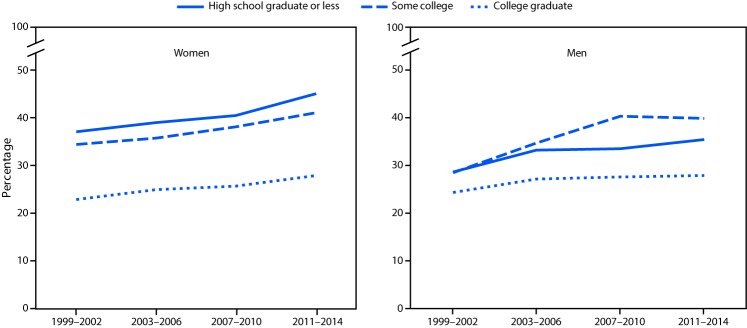
Prevalence of obesity among adults, by household income and education—United States, 2011-2014.
Open accessThe DOI matches its Crossref record; 6 of the 9 references it cites were found in a registry or an index.
Abstract
Studies have suggested that obesity prevalence varies by income and educational level, although patterns might differ between high-income and low-income countries (1-3). Previous analyses of U.S. data have shown that the prevalence of obesity varied by income and education, but results were not consistent by sex and race/Hispanic origin (4). Using data from the National Health and Nutrition Examination Survey (NHANES), CDC analyzed obesity prevalence among adults (aged ≥20 years) by three levels of household income, based on percentage (≤130%, >130% to ≤350%, and >350%) of the federal poverty level (FPL) and individual education level (high school graduate or less, some college, and college graduate). During 2011-2014, the age-adjusted prevalence of obesity among adults was lower in the highest income group (31.2%) than the other groups (40.8% [>130% to ≤350%] and 39.0% [≤130%]). The age-adjusted prevalence of obesity among college graduates was lower (27.8%) than among those with some college (40.6%) and those who were high school graduates or less (40.0%). The patterns were not consistent across all sex and racial/Hispanic origin subgroups. Continued progress is needed to achieve the Healthy People 2020 targets of reducing age-adjusted obesity prevalence to <30.5% and reducing disparities (5).
Overview
The claims and statistics of this paper haven’t been checked yet.
Free: it reads the open-access text and checks the first 5 claims that cite a source we can check. Create a free account to check every claim.
Integrity signals
Registry
Cites
Statistics
Figures
Verification
Claims the paper makes
The claims and statistics of this paper haven’t been checked yet.
Free: it reads the open-access text and checks the first 5 claims that cite a source we can check. Create a free account to check every claim.
Claims other papers make about this one
Each is checked against this paper’s own text: does it say what the citing paper says it does?
The cited source says what the claim attributes to it.
In the citing paper
“Because obesity is more prevalent among individuals with low income, access and affordability to GLP-1 RAs may represent a major barrier to initiation and continued use.14,15”
From Discontinuation and Reinitiation of Dual-Labeled GLP-1 Receptor Agonists Among US Adults With Overweight or Obesity (2025) · cites this paper as [14]
The check wasn’t confident either way, so it gives no verdict — never disputed.
In the citing paper
“Obesity is a known independent risk factor for multiple cardiovascular diseases [16,21,22]”
From PPG-Based Heart Rate Accuracy in Hispanic Adults with Fitzpatrick III–V Skin Tones: An Evaluation of Body Composition and Skin-Tone Effects (2026) · cites this paper as [22]
Experimental — accuracy not yet measured
Self-check
Percentages, sums and reported differences re-computed from the paper’s own numbers.
The self-check needs the paper’s full text.
Citations
Cites
Association between body-mass index and risk of death in more than 1 million Asians
Zheng, W., McLerran, D. F., Rolland, B., Zhang, X., Inoue, M., Matsuo, K., He, J., Gupta, P. C., Ramadas, K., Tsugane, S., et al. (2011) · New England Journal of Medicine · doi:10.1056/nejmoa1010679 · Cited by 885 · cited 1×
“For example, it has been suggested that the BMI cut point (≥30 kg/m2) that typically defines obesity might be too high for Asians and underestimate associated health risks (8,9).”
BackgroundObesity and socioeconomic status in developing countries: a systematic review
Dinsa, G. D., Goryakin, Y., Fumagalli, E., & Suhrcke, M. (2012) · Obesity Reviews · doi:10.1111/j.1467-789x.2012.01017.x · Cited by 805
Obesity and socioeconomic status in adults: United States, 2005-2008.
Ogden, C. L., Lamb, M. M., Carroll, M. D., & Flegal, K. M. (2010) · PubMed · Cited by 530
Self-citationLamerz, A., Kuepper-Nybelen, J., Wehle, C., Bruning, N., Trost-Brinkhues, G., Brenner, H., Hebebrand, J., & Herpertz-Dahlmann, B. (2005) · International Journal of Obesity · doi:10.1038/sj.ijo.0802914 · Cited by 304 · cited 1×
“50 1373 US Department of Health and Human Services/Centers for Disease Control and Prevention income and obesity and education has been reported in at least one other study (7) in children.”
BackgroundObesity - United States, 1988-2008.
Freedman, D. S. (2011) · PubMed · Cited by 109
Self-citationObesity - United States, 1999-2010.
May, A. L., Freedman, D. S., Sherry, B., & Blanck, H. M. (2013) · PubMed · Cited by 95
Self-citation
Cited by
Items 201–300 of 486
Association between internal migration experience and depressive symptoms: analysis of PSID data
Liao, Z.-X., Tan, X.-M., Zhao, Y., Sun, X.-C., & Yi, F. (2023) · BMC Public Health · doi:10.1186/s12889-023-16073-0 · Cited by 10
“Family size (number of family members) and household income levels [33] (≤ 130% of the federal poverty level (FPL) = 1, > 130% to ≤ 350% of FPL = 2 and > 350% of FPL = 3) was the household characteristic, and difficulty in activities of daily living (ADLs) (yes = 1) was the personal life history characteristic.”
BackgroundGolightly, Y. M., Álvarez, C., Arbeeva, L. S., Cleveland, R. J., Schwartz, T. A., Renner, J. B., Murphy, L. B., Callahan, L. F., Jordan, J. M., & Nelson, A. E. (2021) · ACR Open Rheumatology · doi:10.1002/acr2.11287 · Cited by 10
Loneliness in Primary Care Patients: Relationships With Body Mass Index and Health Care Utilization
Oser, T. K., Roy, S., Parascando, J. A., Mullen, R. A., Radico, J. A., Reedy-Cooper, A., & Moss, J. L. (2021) · Journal of patient-centered research and reviews · doi:10.17294/2330-0698.1808 · Cited by 11
White as milk: Biocentric bias in the framing of lactose intolerance and lactase persistence
Kaufman, E. J., & Tan, C. (2022) · Sociology of Health & Illness · doi:10.1111/1467-9566.13528 · Cited by 10
“The construction of these conditions also implicates race and class—with anorexia more commonly associated with White middle class women/girls and obesity with non-White and lower class populations (even though the relationship between obesity and race, class and education is more complicated than this (Ogden et al.,…”
BackgroundBMI and related risk factors among U.S. Marshallese with diabetes and their families
Wang, M. L., McElfish, P. A., Long, C. R., Lee, M., Bursac, Z., Kozak, A. T., Ko, L. K., Kulik, N. L., & Yeary, K. H. K. (2019) · Ethnicity and Health · doi:10.1080/13557858.2019.1640351 · Cited by 10
“lished among children and adults (Bann et al. 2017; Krueger and Reither 2015; Morgenstern, Sargent, and Hanewinkel 2009; Ogden et al. 2017) but can vary depending on gender, race/ethnicity, and the measure of SES used.”
Weiss, L., Quint, E., Leto, C., Vaughn, I. A., Redrovan, A., Fernandes, M. G., Lamourt, K., Edgar, C., & Reso, A. (2020) · Public Health Nursing · doi:10.1111/phn.12839 · Cited by 10
“…low-income adults are more likely to be in fair or poor health, to have activity limitations, and to die younger—in part due to high rates of chronic disease, including obesity, type 2 diabetes mellitus (diabetes), and hypertension (Khullar & Choksi, 2018; Ogden et al., 2017; Toprani et al., 2016).”
BackgroundKetogenic diet, African American women, and cardiovascular health: A systematic review
Hanners, A., Melnyk, B. M., Volek, J. S., & Kelley, M. M. (2022) · Worldviews on Evidence-Based Nursing · doi:10.1111/wvn.12561 · Cited by 11
Noblesse, A. P., Meeds, A. W., & Weidner, L. M. (2022) · Journal of Medical Entomology · doi:10.1093/jme/tjac040 · Cited by 10
(2025) · BMJ Open Diabetes Research & Care · doi:10.1136/bmjdrc-2026-006247 · Cited by 13
Built environment correlates of overweight and obesity among adults in Chennai, India
Adlakha, D., Brownson, R. C., & Hipp, J. A. (2020) · Cities & Health · doi:10.1080/23748834.2020.1791397 · Cited by 11
“*Adjusted for age, gender, household socioeconomic status and household car ownership countries, in contrast to the situation in developed countries where obesity was more common among the poor than among the rich (Ogden et al. 2017).”
BackgroundHaemer, M. A., Tong, S., Bracamontes, P., Gritz, M., Osborn, B., Jolles, M. P., Shomaker, L. B., Steen, E., Studts, C. R., & Boles, R. E. (2023) · Contemporary Clinical Trials · doi:10.1016/j.cct.2023.107359 · Cited by 9
Social Determinants of Health in Idiopathic Intracranial Hypertension
Markowitz, D. M., Aamodt, W. W., & Hamedani, A. G. (2024) · Journal of Neuro-Ophthalmology · doi:10.1097/wno.0000000000002073 · Cited by 9
Fuller, T., Newberry, Z., Nasir, M., & Tondt, J. (2024) · Primary Care Clinics in Office Practice · doi:10.1016/j.pop.2024.04.007 · Cited by 9
The decorin and myostatin response to acute whole body vibration: impact of adiposity, sex, and race
Broniec, M. N., Norland, K., Thomas, J., Wang, X., & Harris, R. A. (2024) · International Journal of Obesity · doi:10.1038/s41366-024-01630-3 · Cited by 9
Dastgheib, S. A., Rezaianzadeh, A., Maharlouei, N., Rahimikazerooni, S., & Lankarani, K. B. (2021) · BMC Public Health · doi:10.1186/s12889-021-10802-z · Cited by 9
“Clearly, the association between obesity and level of education is complex [27], and the following genderbased findings provide a clearer picture of the relationship.”
BackgroundTipping the scales: Provider perspectives on a multi-disciplinary approach to obesity
Bright, D., O’Hare, K., Beesley, R., & Tapp, H. (2019) · Experimental Biology and Medicine · doi:10.1177/1535370219825639 · Cited by 10
Racial/ethnic and educational differences in perceptions and use of a new urban trail
Kraft, A. N., Nunez, J., Tarlov, E., Slater, S. J., & Zenk, S. N. (2018) · Ethnicity and Health · doi:10.1080/13557858.2018.1539218 · Cited by 9
“Obesity represents a growing health risk worldwide (Ljungvall and Zimmerman 2012) and within the US in particular where it disproportionately impacts racial/ethnic minority and low-SES populations (Ogden et al. 2017; Hales et al. 2018).”
BackgroundChung, S., & Xu, L. (2025) · Health Economics Review · doi:10.1186/s13561-025-00664-1 · Cited by 8
“…composition (Black and Hispanic population shares), which are important given well-documented disparities in obesity prevalence and health outcomes [44]; 3) Baseline health indicators, including pre-intervention prevalence of obesity (BMI ≥ 30 and BMI ≥ 35), diabetes, high blood pressure, high…”
Evans, M. G., Fleckman, J. M., Williams, T. T., Tokarz, S., & Theall, K. P. (2021) · Maternal and Child Health Journal · doi:10.1007/s10995-021-03233-0 · Cited by 8
Socioeconomic Position, Pre-Obesity and Obesity in Latin American Cities: A Systematic Review
de Menezes, M. C., Duran, A. C., Langellier, B. A., Ferrer, C. P., Barnoya, J., & Mayén, A. (2024) · International Journal of Social Determinants of Health and Health Services · doi:10.1177/27551938241238677 · Cited by 8
“53 Our results fi nding a clear negative association between SEP and obesity in women differ from a previous review conducted of low-to middle-income countries, 43 where a positive association was most likely reported between income and obesity.”
ResultLu, S.-Y., & Gao, G.-N. (2024) · International Dental Journal · doi:10.1016/j.identj.2024.03.011 · Cited by 9
Cho, B., Pan, Y., Chapman, M., Spaulding, A., & Stallings‐Smith, S. (2024) · American Journal of Health Promotion · doi:10.1177/08901171241233399 · Cited by 9
“31 More recently, a study using data from an online survey showed that U.S. adults with lower educational levels were more likely to gain weight in the fi rst year of the pandemic.”
Association between life’s essential 8 and periodontitis: a study based on NHANES 2009–2014
Hou, K., Zhang, H., Song, W., Li, S., Liu, J., & Ma, Z. (2024) · Frontiers in Medicine · doi:10.3389/fmed.2024.1342792 · Cited by 11
“3, moderate-income 1.3–3.5, high income ≥ 3.5) (26), and educational attainment (less than high school, high school, some college or above).”
BackgroundInfluentialRajbhandari‐Thapa, J., Zhang, D. “., MacLeod, K. E., & Thapa, K. (2020) · Obesity · doi:10.1002/oby.22793 · Cited by 10
“It is as high as 45% among subgroups with low income and it differs by sex, race, and socioeconomic status (2).”
BackgroundIngol, T. T., Li, R., Ronau, R., Klebanoff, M. A., Oza‐Frank, R. B., Rausch, J. R., Boone, K. M., & Keim, S. A. (2021) · International Journal of Obesity · doi:10.1038/s41366-021-00834-1 · Cited by 8
Does the socio-demographic profile of patients limit access to bariatric surgery?
Richard, V., Stähli, C., Giudicelli, G., Worreth, M. D., Krähenbühl, N., Greiner, E., Papastathi, C., Diana, M., & Saadi, A. (2021) · Eating and Weight Disorders - Studies on Anorexia Bulimia and Obesity · doi:10.1007/s40519-021-01285-3 · Cited by 8
Basu, T., Sehar, U., Selman, A., Reddy, A. P., & Reddy, P. H. (2023) · Healthcare · doi:10.3390/healthcare11101442 · Cited by 8
“, behavior), medication and disease, environment and socio-demographics [1,3,6].”
BackgroundInfluentialBiopsychosocial and Environmental Factors That Impact Brain-Gut-Microbiome Interactions in Obesity
Sood, R., Kilpatrick, L. A., Keefer, L., & Church, A. (2025) · Clinical Gastroenterology and Hepatology · doi:10.1016/j.cgh.2025.07.045 · Cited by 7
Raman, S., Ong, S. C., & Ooi, G. S. (2023) · Journal of Pharmaceutical Health Services Research · doi:10.1093/jphsr/rmad018 · Cited by 7
Ma, L., Yuan, J., Yang, X., Yan, M., Li, Y., & Niu, M. (2024) · Journal of Health Population and Nutrition · doi:10.1186/s41043-024-00572-w · Cited by 10
“PIR was categorized as 1.0 (insufficient income), ≥ 1.0 (sufficient income) and unknown [21].”
InfluentialHealth Disparities in Calorie Knowledge and Confidence Among the U.S. Adult Population
Lando, A. M., Ferguson, M. S., Verrill, L. A., Wu, F., Jones-Dominic, O. E., Punzalan, C., & Wolpert, B. J. (2021) · Journal of Primary Care & Community Health · doi:10.1177/21501327211002416 · Cited by 7
“6-10 The Nutrition Facts label changes to calorie information include (1) enlarging the text size of calories and serving size to increase distinction; (2) providing an updated and more accurate estimate of calories in a “serving” based on current food consumption; (3) providing calculations of calorie amounts of the…”
BackgroundDorling, J. L., Martin, C. K., Yu, Q., Cao, W., Höchsmann, C., Apolzan, J. W., Newton, R. L., Denstel, K. D., Mire, E. F., & Katzmarzyk, P. T. (2022) · American Journal of Clinical Nutrition · doi:10.1093/ajcn/nqac179 · Cited by 7
Barboza‐Guadagnini, L., Podlipnik, S., Fuertes, I., Morgado‐Carrasco, D., & Bassas‐Vila, J. (2022) · Actas Dermo-Sifiliográficas · doi:10.1016/j.ad.2022.08.016 · Cited by 7
“The association between adult obesity and lower income and lower educational level has been identified in the literature.(30) In the same way, lower socioeconomic status in HS patients has also been associated with higher BMI.”
BackgroundHorning, M. L., Friend, S. E., FREESE, R. L., Barr‐Anderson, D. J., Linde, J. A., Sidebottom, A. C., Sommerness, S. A., & Fulkerson, J. A. (2022) · Journal of the Academy of Nutrition and Dietetics · doi:10.1016/j.jand.2022.10.009 · Cited by 7
Phipps, D., & Helton, M. R. (2023) · Springer eBooks · doi:10.1007/978-3-031-29171-5_2 · Cited by 12
Neuropsychological Functioning in Older Adults with Obesity: Implications for Bariatric Surgery
Roth, R. M., Rotenberg, S., Carmasin, J. S., Billmeier, S. E., & Batsis, J. A. (2019) · Journal of Nutrition in Gerontology and Geriatrics · doi:10.1080/21551197.2018.1564722 · Cited by 7
“The number of adults aged 65 years of age and older in the United States is increasing, and the prevalence rate of obesity in this population is approaching 40% (1).”
BackgroundOberbach, A., Schlichting, N. S., Kullnick, Y., Heinrich, M., Lehmann, S., Retschlag, U., Friedrich, M., Fayad, L., Dietrich, A., Khashab, M. A., et al. (2019) · Endoscopy International Open · doi:10.1055/a-0990-9683 · Cited by 10
“Despite increased public awareness of the epidemic of obesity, the percentage of the population afflicted with obesity and its associated comorbidities, particularly cardiovascular disease (CVD), continues to rise [1].”
Buchthal, O. V., Nelson-Hurwitz, D. C., Hsu, L., Byers, M., & Banna, J. C. (2019) · Journal of Immigrant and Minority Health · doi:10.1007/s10903-019-00952-z · Cited by 9
“In the United States (US), almost one-third of adults and 17% of youth are considered obese [1], with notable disparities among ethnic minorities and low-resource urban populations [2].”
BackgroundKim, J., & Yoon, K. (2020) · International Journal of Environmental Research and Public Health · doi:10.3390/ijerph17196981 · Cited by 7
“As one of the environmental factors related to obesity, particulate matters (PM) were investigated for various chronic conditions and acute episodes [4–6], age groups [7–10], gender [4], regions [11], and socioeconomic statuses such as education level [12,13], household income [13–18], or occupational characteristics…”
BackgroundWild, L. E., Alderete, T. L., Naik, N. C., Patterson, W. B., Berger, P. K., Jones, R. B., Plows, J. F., & Goran, M. I. (2021) · Food Science & Nutrition · doi:10.1002/fsn3.2085 · Cited by 7
Menu Labeling Utilization and Socioeconomic Status in West Virginia and Mississippi
Warner, L. N., Ruderman, S. A., Zinsli, K. A., Jones‐Smith, J. C., & Littman, A. J. (2022) · Journal of Nutrition Education and Behavior · doi:10.1016/j.jneb.2021.11.005 · Cited by 7
Attentional processing of body images in women with overweight and obesity
Baur, J., Krohmer, K., Naumann, E., & Svaldi, J. (2022) · Eating and Weight Disorders - Studies on Anorexia Bulimia and Obesity · doi:10.1007/s40519-022-01419-1 · Cited by 8
Ambient struggling: food, chronic disease, and spatial isolation among the urban poor
Pine, A. M. (2022) · Agriculture and Human Values · doi:10.1007/s10460-022-10408-0 · Cited by 7
Engaging in healthy eating behaviors when access to affordable nutritious foods is limited
Adams, M. M. (2023) · Journal of Human Behavior in the Social Environment · doi:10.1080/10911359.2023.2195904 · Cited by 8
“For example, in the United States, 55-percent of WLI do not have an obese weight status (Ogden et al., 2017).”
BackgroundSocioeconomic status differences in food consumption following a laboratory-induced stressor
Langer, S. L., Soltero, E. G., Beresford, S. A. A., McGregor, B. A., Albano, D. L., Patrick, D. L., & Bowen, D. J. (2018) · Health Psychology Open · doi:10.1177/2055102918804664 · Cited by 7
“The two variables are either unassociated or less consistently associated among non-Hispanic Black and Mexican American women (Kimm et al., 1996; Ogden et al., 2017; Zhang and Wang, 2004).”
BackgroundEarnest, C. P., & Church, T. S. (2020) · Journal of Occupational and Environmental Medicine · doi:10.1097/jom.0000000000001990 · Cited by 7
Dou, J., Du, L., Wang, K., Sun, H., & Zhang, C. (2020) · International Journal of Environmental Research and Public Health · doi:10.3390/ijerph17197004 · Cited by 7
Munir, F., Chopra, H., Nasir, M. H., Simhachalam, L. V., Anis, Z. B., Bano, S., Islam, N., Baig, A. A., Heyat, M. B. B., Parveen, S., et al. (2025) · International Journal of Systems Assurance Engineering and Management · doi:10.1007/s13198-025-02801-9 · Cited by 6
“Many different electronic devices, like surgical navigation systems for computer-assisted surgery (Tepper et al. 2017), virtual-reality continuum tools for surgery, pain management, mental diseases, and AI-based technologies, enable augmented medicine (Sheikh et al. 2021; Mishkind et al. 2017).”
The transition from preclinical to clinical obesity: the importance of a borderline stage
Maldonado-Arvizu, J. E., Rios-Verdugo, P. V., Díaz‐Villanueva, J. F., Chimal‐Vega, B., Vique‐Sánchez, J. L., & García‐González, V. (2026) · Clinical Science · doi:10.1042/cs20256728 · Cited by 6
“%) compared with those with a high school diploma or less (45.3%; P < 0.001) [36].”
InfluentialPrevalence of Obesity among Polish Primary Care Population Considered Healthy
Babicki, M., Kłoda, K., Ledwoch, J., Malchrzak, W., Janiak, S., Krzyżanowski, F., Zieliński, T., Grabska, P., Gajowiak, D., Pokorna-Kałwak, D., et al. (2024) · Nutrients · doi:10.3390/nu16172973 · Cited by 6
“Some studies show a lower prevalence of obesity among people (especially women) with a higher educational status [31–35], whereas some show no straightforward and significant connections [36,37].”
BackgroundObstructed Labor, Evolution, and Health Disparities
Light, L., Virdee, S. K., Dickens, C., & Diogo, R. (2024) · Biology · doi:10.3390/biology13121001 · Cited by 8
Zhu, J., Xu, W., Wu, S., & Song, D. (2025) · BMC Oral Health · doi:10.1186/s12903-025-05597-z · Cited by 6
“PIR was divided into ≤ 1.3 (poor or near poor), 1.3–3.5 (medium income) and > 3.5 (high income) according to the federal poverty level (FPL) [23].”
InfluentialAlmutairi, M., Almutairi, A. A., & Alodhialah, A. M. (2025) · Cancer Management and Research · doi:10.2147/cmar.s515781 · Cited by 6
Middle School Students’ Perceptions of the Lunchroom: Implications for Future Interventions
Askelson, N. M., Ryan, G. W., Brady, P., Meier, C. L., Delger, P. J., & Scheidel, C. A. (2020) · The Journal of School Nursing · doi:10.1177/1059840520928504 · Cited by 6
Eating speed and height loss in relation to overweight: A retrospective study
Shimizu, Y., Hayakawa, H., Honda, E., Sasaki, N., Takada, M., Okada, T., Ohira, T., & Kiyama, M. (2023) · PLoS ONE · doi:10.1371/journal.pone.0284998 · Cited by 6
“In addition, the prevalence of obesity is also reported to be influenced by education level and economic status [34].”
BackgroundGabison, J. G., Palazzolo, B., Saleh, C., Ritchie, O., Sheehan, K., Othman, A., Harper, D. M., & Oshman, L. D. (2024) · Clinical Obesity · doi:10.1111/cob.12654 · Cited by 7
Long-term trends in lifestyle factors among respondents with dyslipidemia in the United States
Bai, B., Liu, Q., Liu, Y., Liu, F., Wang, Y., Chen, Y., Liang, Y., Wang, H., Wu, C., Guo, L.-Y., et al. (2024) · The American Journal of the Medical Sciences · doi:10.1016/j.amjms.2024.06.025 · Cited by 9
Shilts, M. K., Rios, L. K. D., Panarella, K., Styne, D. M., Lanoue, L., Drake, C., Ontai, L., & Townsend, M. S. (2021) · Journal of Primary Care & Community Health · doi:10.1177/21501327211009695 · Cited by 7
“These included (1) partnering with trusted community clinics for referral, recruitment, and delivery, and (2) allowing family members to come to the classes.”
BackgroundNaschold, F., & Porter, C. (2022) · Current Developments in Nutrition · doi:10.1093/cdn/nzac100 · Cited by 6
“Trends of lower BMI among higher-income women in this study mirror a general US pattern of wealthier individuals tending to be less overweight or obese, particularly among females (16).”
BackgroundMedicaid expansion and health care access for individuals with obesity in the United States
Kendrick, K. N., Marcondes, F. O., Stanford, F. C., & Mukamal, K. J. (2022) · Obesity · doi:10.1002/oby.23531 · Cited by 7
McCormick, N., Yokose, C., & Choi, H. K. (2023) · Gout Urate and Crystal Deposition Disease · doi:10.3390/gucdd1020010 · Cited by 6
“Poverty likely impacts gout directly through its downstream effects on diet quality and BMI [42], with obese women experiencing greater risk of food insecurity than non-obese [43], and may also reflect the more limited healthcare and other health-promoting resources available in many low-income neighbourhoods.”
BackgroundChattaraman, V., Lee, Y. M., Robinson, E. M., Book, A. J., & AL-AMIN, F. (2023) · Nutrients · doi:10.3390/nu15153427 · Cited by 6
“Sample Given the relevance of SES to health outcomes [5,43,44], this study targeted low-mid SES consumers who make food purchasing decisions for their households.”
BackgroundPaone, E., Trani, M. D., Visani, E., Monte, C. D., Campedelli, V., Silecchia, G., & Lai, C. (2024) · Eating and Weight Disorders - Studies on Anorexia Bulimia and Obesity · doi:10.1007/s40519-024-01638-8 · Cited by 6
“The two groups differ only for their educational level; in fact, according to the literature [33], the con-trol group had a higher education level.”
BackgroundRazak, F. A., Subramanian, S. V., Sarma, S., Kawachi, I. I., Berkman, L. F., Smith, G. D., & Corsi, D. J. (2018) · BMJ · doi:10.1136/bmj.k3147 · Cited by 9
Dohmen, A. E., & Raman, D. R. (2018) · Frontiers in Nutrition · doi:10.3389/fnut.2018.00109 · Cited by 6
Rajbhandari‐Thapa, J., Ingels, J. B., Chung, S. R., Thapa, K., Chen, Z., & Zhang, D. “. (2020) · Clinical Obesity · doi:10.1111/cob.12385 · Cited by 6
Association of Chain Restaurant Advertising Spending With Obesity in US Adults
Bleich, S. N., Soto, M. J., Jones‐Smith, J. C., Wolfson, J. A., Jarlenski, M., Dunn, C. G., Frelier, J. M., & Herring, B. J. (2020) · JAMA Network Open · doi:10.1001/jamanetworkopen.2020.19519 · Cited by 7
The Risks and Consequences of Skipping Meals for Low-Income Mothers
Martin, M. A., Gough, M., & Lippert, A. M. (2022) · Population Research and Policy Review · doi:10.1007/s11113-022-09743-1 · Cited by 6
The Complex Contributors to Obesity-Related Health Disparities: Introduction to the Special Issue
Fouad, M. N., Waugaman, K. J., & Dutton, G. R. (2022) · American Journal of Preventive Medicine · doi:10.1016/j.amepre.2022.03.022 · Cited by 6
Kostrna, J., Oparina, E., Palacios, C., Rodriguez, A. J., Pei, J., Ajmal, A., & Ramella-Roman, J. C. (2026) · Sensors · doi:10.3390/s26102922 · Cited by 5
“Obesity is a known independent risk factor for multiple cardiovascular diseases [16,21,22], while underserved populations, who are more likely to present with darker skin tones or elevated BMI, are also at greater risk of cardiovascular morbidity.”
Gu, L., Jia, S. H., & Chen, J. (2025) · Science Progress · doi:10.1177/00368504251392701 · Cited by 5
The Impact of a Clinical Pharmacist in an Interdisciplinary Weight Loss Service: A Follow-Up Study
Francis, B. R., & Challen, L. (2021) · INNOVATIONS in pharmacy · doi:10.24926/iip.v12i4.4356 · Cited by 5
Factors Associated with Beverage Intake in Low-Income, Overweight, or Obese Pregnant Women
Chang, M., Lin, C. J., Lee, R. E., Wegener, D. T., Hu, J., & Williams, K. P. (2022) · Nutrients · doi:10.3390/nu14040840 · Cited by 5
“Black women suffer a disproportionally high prevalence of obesity [30], which increases their risk for excessive gestational weight gain and its associated adverse maternal and birth outcomes [5,6].”
BackgroundHigher intuitive eating is associated with lower adiposity in midlife women
Owens, B. A., Sabik, N. J., Tovar, A., Ward‐Ritacco, C. L., & Oaks, B. M. (2023) · Eating Behaviors · doi:10.1016/j.eatbeh.2023.101796 · Cited by 5
Ahmed, S., Wedekind, M. F., Rivero, J. D., Raygada, M. J., Lockridge, R., Glod, J. W., Flowers, C., Thomas, B., Bernstein, D. B., Kapustina, O. B., et al. (2023) · Cancer Research Communications · doi:10.1158/2767-9764.crc-23-0247 · Cited by 5
“Our cohort had a bias toward White college-educated women, who typically have lower rates of obesity (48).”
Epigenetic implications of socioeconomic status and education on sperm DNA methylation patterns
Stalker, K., Pollard, C. A., Perkins, N. J., DeVilbiss, E. A., & Jenkins, T. G. (2024) · Fertility and Sterility · doi:10.1016/j.fertnstert.2024.10.010 · Cited by 5
Gaston, S. A., Kendrick, K. N., Ogbenna, B. T., Sandler, D. P., Stanford, F. C., & Jackson, C. L. (2025) · International Journal of Obesity · doi:10.1038/s41366-025-01784-8 · Cited by 6
JOINTLY REPRESENTING GEOGRAPHIC EXPOSURE AND OUTCOME DATA USING CARTOGRAMS
Tran, N. K., & Goldstein, N. D. (2019) · American Journal of Epidemiology · doi:10.1093/aje/kwz141 · Cited by 5
Renal Disease and Kidney Transplantation in Hispanic American Persons
Mour, G. K., Kukla, A., Jaramillo, A., Ramón, D. S., Wadei, H. M., & Stegall, M. D. (2024) · Kidney360 · doi:10.34067/kid.0000000579 · Cited by 6
“35,36 As stated above, dietary patterns may predispose to obesity, but dietary intervention alone may not produce long-term solutions.”
Precision Measurements to Assess Baseline Status and Efficacy of Healthy Living Medicine
Hwang, C., Bishop, J., Ching, J., Elokda, A. S., da Silva, A. L. G., Laddu, D., & Phillips, S. A. (2019) · Progress in Cardiovascular Diseases · doi:10.1016/j.pcad.2018.12.011 · Cited by 5
Rhodewalt, R., Largent, K., Saur, B., Astorino, T. A., Zenko, Z., & Schubert, M. M. (2019) · International journal of exercise science · doi:10.70252/ryir6699 · Cited by 5
“It is evident that obesity rates have increased worldwide, and that obesity is a risk factor for several chronic diseases (9, 32, 33).”
BackgroundPerceived Severity of Interrelated Cardiometabolic Risk Factors among U.S. College Students
Merianos, A. L., Jacobs, W., Oloruntoba, O., Gittens, O. E., & Smith, M. L. (2020) · American Journal of Health Education · doi:10.1080/19325037.2020.1765907 · Cited by 5
“However, these relationships may be complicated by sex and race/ ethnicity.(4,8,9) For example, females overall and those in”
BackgroundSangroula, R. K., Subedi, H. P., & Tiwari, K. (2020) · Journal of Nutrition and Metabolism · doi:10.1155/2020/7432716 · Cited by 5
“Income was not significant with the nutritional status and is in agreement with other studies [33, 35].”
ResultPromoting Healthier Home Food Environments Through 2-1-1: A Pilot and Feasibility Study
Kegler, M. C., Bundy, Ł., Hartman, T. J., Owolabi, S., & Haardörfer, R. (2020) · Family & Community Health · doi:10.1097/fch.0000000000000275 · Cited by 7
“48-51 Related healthy actions include: (1) Identify one unhealthy food or drink and do not allow it in the home, (2) always have a low-calorie beverage available instead of sugar soda and/or sweet tea, and (3) purchase fresh fruits and vegetables at least once a week, and make them easy to see and grab.”
BackgroundWeight Management Treatment Representations: A Novel Use of the Common Sense Model
Dawson, D. B., Mohankumar, R., Puran, D., Nevedal, A., Maguen, S., Timko, C., Kunik, M. E., & Breland, J. Y. (2023) · Journal of Clinical Psychology in Medical Settings · doi:10.1007/s10880-023-09946-4 · Cited by 5
“Comparatively, researchers concluded that low-income individuals are limited in the amount of internal and external resources needed to commit to weight management treat-ment when trying to understand challenges that families with low-income face (Bhushan et al., 2017; Ogden et al., 2017).”
BackgroundWoo, J. M. P., Bookwalter, D. B., Green, G. Y., & Sandler, D. P. (2023) · SSM - Population Health · doi:10.1016/j.ssmph.2023.101556 · Cited by 7
“%) women (Ogden et al., 2017).”
Socioeconomic Factors: Poverty and Obesity
Hojjat, T. A., & Hojjat, R. (2017) · SpringerBriefs in public health · doi:10.1007/978-981-10-2911-0_4 · Cited by 7
First-Time Prescribing of GLP-1 Receptor Agonists from 2018-2023: A Descriptive AnalysisPreprint
Rodriguez, P. J., Gratzl, S., Cartwright, B. M. G., Brar, R., Gluckman, T. J., & Stucky, N. L. (2023) · medRxiv · doi:10.1101/2023.08.22.23294277 · Cited by 5
Burns, S. D., Baker, E. H., Sheehan, C. M., & Markides, K. S. (2025) · Journal of Aging and Health · doi:10.1177/08982643251359389 · Cited by 4
“We also included socioeconomic indicators that are commonly associated with health: education (Dupre, 2007), marital status (Goldman et al., 1995), household income (Ogden et al., 2017), and home ownership (Pollack et al., 2007).”
Crane, M. M., Walton, S. M., Suzuki, S., & Appelhans, B. M. (2022) · Obesity Science & Practice · doi:10.1002/osp4.642 · Cited by 5
Walts, Z. L., Parlato, L., Brent, R., Cai, Q., Steinwandel, M. D., Zheng, W., & Andersen, S. W. (2023) · Journal of Racial and Ethnic Health Disparities · doi:10.1007/s40615-023-01797-x · Cited by 6
Are area-level socioeconomic inequalities in obesity moderated by neighbourhood greenery?
Selvakumaran, S., Hadgraft, N. T., Chandrabose, M., Mavoa, S., Owen, N. G., & Sugiyama, T. (2024) · BMC Public Health · doi:10.1186/s12889-024-20711-6 · Cited by 4
“However, such disparities in obesity also occur between individuals with different levels of SES [53].”
Cho, Y., Kim, H., Jeong, J., Oh, J., Park, J., Kim, J.-W., Hwang, J.-Y., & Yon, D. K. (2025) · Medicine · doi:10.1097/md.0000000000045296 · Cited by 4
“[5] 8] Consequently, examining the prevalence of MASLD by income level is essential for understanding its socioeconomic determinants.”
Robinovich, J., Bosma, H., van den Borne, B. H. P., Ximena Ossa, G., Muñoz, S., & Krumeich, A. J. S. M. (2021) · Social Science & Medicine · doi:10.1016/j.socscimed.2021.114019 · Cited by 4
Bell, C. N., Robles, B., Singleton, C. R., Tobin, C. S. T., Spears, E. C., & Thorpe, R. J. (2022) · American Journal of Health Behavior · doi:10.5993/ajhb.46.5.3 · Cited by 4
Obesity as A Risk Factor For Severe COVID-19 Disease
Sajjad, M. M., Nasir, A., Yousaf, S., & Rahim, M. W. A. (2022) · Pakistan Armed Forces Medical Journal · doi:10.51253/pafmj.v72i1.4477 · Cited by 5
Lee, J., Austin, R. R., Mathiason, M. A., & Monsen, K. A. (2023) · Journal of the American Medical Informatics Association · doi:10.1093/jamia/ocad079 · Cited by 4
Xu, X., Han, Q., Lin, X., Lin, J., & Wang, S. (2024) · Heliyon · doi:10.1016/j.heliyon.2024.e33482 · Cited by 4
“Based on a US government report, the poverty income ratio (PIR) was utilized to categorize family income into three groups: low (PIR ≤ 1.3), medium (PIR > 1 .3 – 3.5), and high (PIR > 3.5) [40].”
MethodInfluentialRelationship between race, income-level, and Cardiovascular Disease
Talha, K. M., Waqar, E., Johnson, H. M., Shapiro, M. D., Nambi, V., Virani, S. S., Mehta, A., Nasir, K., Hall, M. E., Abramov, D., et al. (2024) · Journal of the National Medical Association · doi:10.1016/j.jnma.2024.07.115 · Cited by 4
Adherence to Mediterranean diet and female urinary incontinence: Evidence from the NHANES database
Xie, S., Li, Z., Yao, Q., Zhang, Y., & Ou, Y. (2024) · PLoS ONE · doi:10.1371/journal.pone.0311771 · Cited by 6
Metadata
- Authors
- Ogden, C. L., Fakhouri, T. H., Carroll, M. D., Hales, C. M., Fryar, C. D., Li, X., & Freedman, D. S.
- Affiliations
- Centers for Disease Control and Prevention (US)
- Corresponding author
- Ogden, Cynthia L.
- ORCID
- Venue
- MMWR. Morbidity and Mortality Weekly Report
- Published
- 2017-12-22
- Volume
- 66
- Issue
- 50
- Pages
- 1369-1373
- ISSN
- 0149-2195 (ISSN-L)
- 1545-861X
- PMC
- PMC5751581
- OpenAlex
- W2778311948
- Cited by
- 456
- References
- 9
- Citations by year
- 2026: 19 · 2025: 40 · 2024: 58 · 2023: 76 · 2022: 68 · 2021: 69 · 2020: 60 · 2019: 40 · 2018: 23 · 2017: 3
- FWCI
- 32.36
- Type
- journal article
- Language
- en
- Open access
- bronze
- doi.org
- Locations
- MMWR Morbidity and Mortality Weekly Report (publishedVersion)
- PubMed Central (publishedVersion, cc-by)
- PubMed (publishedVersion)
- Topics
- Health Sciences › Medicine › Public Health, Environmental and Occupational Health › Obesity, Physical Activity, Diet
- Health Sciences › Medicine › Public Health, Environmental and Occupational Health › Obesity and Health Practices
- Social Sciences › Health › Health disparities and outcomes
- Keywords
- obesity prevalence, household income, educational attainment, socioeconomic disparities, federal poverty level, adults, sex differences, Healthy People 2020, NHANES
- MeSH terms
- Adult, Cross-Sectional Studies, Educational Status, Female, Hispanic or Latino, Humans, Income, Male, Middle Aged, Nutrition Surveys, Obesity, Poverty, Risk Factors, United States, Prevalence, Racial Groups, Health Status Disparities, Young Adult
About these checks
Registry, retraction, Cites and statistics results are computed, not judged, with one exception: a printed reference that no index lists is read once by a model before it counts as a citation error. Claims are extracted by a model and kept only when their quote appears verbatim in the text; each cited source is then checked, with a model’s help, for whether it says what the claim relies on. Those verdicts can be wrong — read the claim’s quote and the cited source before relying on one.
Statistics and arithmetic are recomputed, not judged.
Confidence bands are shown only for fields calibrated on our annotated test set. None is calibrated yet, so no band is shown.
What counts as a claim ›How we measure confidence ›How we check this ›
Are you an author, or do you see a problem with this page? Request a review
Data sources
Bibliographic data: Semantic Scholar, OpenAlex, Crossref.
Contains information from the Semantic Scholar Academic Graph Datasets, made available under the ODC Attribution License (ODC-BY 1.0).
Semantic Scholar’s data is described in: Kinney, R., et al. (2023). The Semantic Scholar Open Data Platform. arXiv:2301.10140.
