

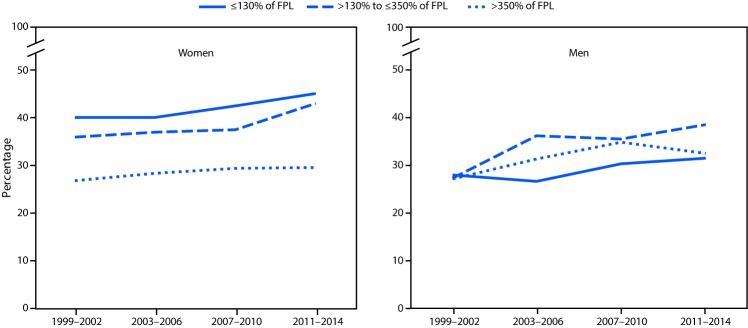
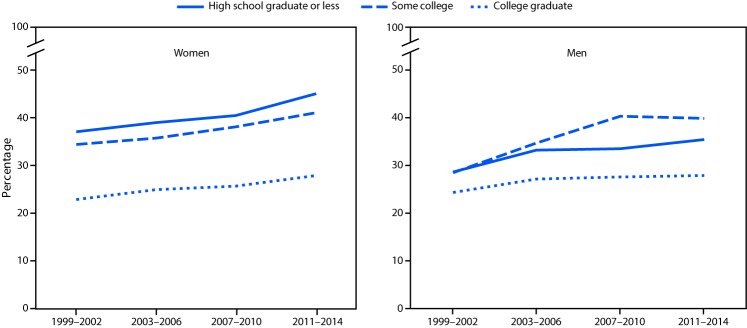
Prevalence of obesity among adults, by household income and education—United States, 2011-2014.
Open accessThe DOI matches its Crossref record; 6 of the 9 references it cites were found in a registry or an index.
Abstract
Studies have suggested that obesity prevalence varies by income and educational level, although patterns might differ between high-income and low-income countries (1-3). Previous analyses of U.S. data have shown that the prevalence of obesity varied by income and education, but results were not consistent by sex and race/Hispanic origin (4). Using data from the National Health and Nutrition Examination Survey (NHANES), CDC analyzed obesity prevalence among adults (aged ≥20 years) by three levels of household income, based on percentage (≤130%, >130% to ≤350%, and >350%) of the federal poverty level (FPL) and individual education level (high school graduate or less, some college, and college graduate). During 2011-2014, the age-adjusted prevalence of obesity among adults was lower in the highest income group (31.2%) than the other groups (40.8% [>130% to ≤350%] and 39.0% [≤130%]). The age-adjusted prevalence of obesity among college graduates was lower (27.8%) than among those with some college (40.6%) and those who were high school graduates or less (40.0%). The patterns were not consistent across all sex and racial/Hispanic origin subgroups. Continued progress is needed to achieve the Healthy People 2020 targets of reducing age-adjusted obesity prevalence to <30.5% and reducing disparities (5).
Overview
The claims and statistics of this paper haven’t been checked yet.
Free: it reads the open-access text and checks the first 5 claims that cite a source we can check. Create a free account to check every claim.
Integrity signals
Registry
Cites
Statistics
Figures
Verification
Claims the paper makes
The claims and statistics of this paper haven’t been checked yet.
Free: it reads the open-access text and checks the first 5 claims that cite a source we can check. Create a free account to check every claim.
Claims other papers make about this one
Each is checked against this paper’s own text: does it say what the citing paper says it does?
The cited source says what the claim attributes to it.
In the citing paper
“Because obesity is more prevalent among individuals with low income, access and affordability to GLP-1 RAs may represent a major barrier to initiation and continued use.14,15”
From Discontinuation and Reinitiation of Dual-Labeled GLP-1 Receptor Agonists Among US Adults With Overweight or Obesity (2025) · cites this paper as [14]
The check wasn’t confident either way, so it gives no verdict — never disputed.
In the citing paper
“Obesity is a known independent risk factor for multiple cardiovascular diseases [16,21,22]”
From PPG-Based Heart Rate Accuracy in Hispanic Adults with Fitzpatrick III–V Skin Tones: An Evaluation of Body Composition and Skin-Tone Effects (2026) · cites this paper as [22]
Experimental — accuracy not yet measured
Self-check
Percentages, sums and reported differences re-computed from the paper’s own numbers.
The self-check needs the paper’s full text.
Citations
Cites
Association between body-mass index and risk of death in more than 1 million Asians
Zheng, W., McLerran, D. F., Rolland, B., Zhang, X., Inoue, M., Matsuo, K., He, J., Gupta, P. C., Ramadas, K., Tsugane, S., et al. (2011) · New England Journal of Medicine · doi:10.1056/nejmoa1010679 · Cited by 885 · cited 1×
“For example, it has been suggested that the BMI cut point (≥30 kg/m2) that typically defines obesity might be too high for Asians and underestimate associated health risks (8,9).”
BackgroundObesity and socioeconomic status in developing countries: a systematic review
Dinsa, G. D., Goryakin, Y., Fumagalli, E., & Suhrcke, M. (2012) · Obesity Reviews · doi:10.1111/j.1467-789x.2012.01017.x · Cited by 805
Obesity and socioeconomic status in adults: United States, 2005-2008.
Ogden, C. L., Lamb, M. M., Carroll, M. D., & Flegal, K. M. (2010) · PubMed · Cited by 530
Self-citationLamerz, A., Kuepper-Nybelen, J., Wehle, C., Bruning, N., Trost-Brinkhues, G., Brenner, H., Hebebrand, J., & Herpertz-Dahlmann, B. (2005) · International Journal of Obesity · doi:10.1038/sj.ijo.0802914 · Cited by 304 · cited 1×
“50 1373 US Department of Health and Human Services/Centers for Disease Control and Prevention income and obesity and education has been reported in at least one other study (7) in children.”
BackgroundObesity - United States, 1988-2008.
Freedman, D. S. (2011) · PubMed · Cited by 109
Self-citationObesity - United States, 1999-2010.
May, A. L., Freedman, D. S., Sherry, B., & Blanck, H. M. (2013) · PubMed · Cited by 95
Self-citation
Cited by
Items 301–400 of 486
Liang, M., Ren, X., Zhang, Q., Ruan, Z., Jin, M., Xu, Y., Chen, X., & Qiu, Z. (2024) · International Journal of COPD · doi:10.2147/copd.s485017 · Cited by 4
Relationship between community characteristics and impact of calorie labeling on fast‐food purchases
Dupuis, R., Bragg, M. A., Heng, L., Hafeez, E., Wu, E., Mijanovich, T., Weitzman, B. C., Rummo, P. E., & Elbel, B. D. (2025) · Obesity · doi:10.1002/oby.24198 · Cited by 4
“…or mitigated by differences in baseline weight; evidence has suggested that individuals with lower income have a higher prevalence of obesity [38] and that dietary changes have a larger impact on individuals with higher weight [39], which is something that we could not explore in the current…”
Protásio, P. S. P. D. G. V., de Almeida, M. D. C. C., Maestri, M. K., da Silva, G. B., Matos, S. M. A., Brunoni, A. R., Vidal, K. S. M., Aquino, E. M. L., Lotufo, P. A., Barreto, S. M., et al. (2025) · Ethnicity & Disease · doi:10.18865/ethndis-2024-6 · Cited by 4
The Obesity Epidemic and Women’s Health
Mackey, R. H., McTigue, K. M., & Kuller, L. H. (2012) · Elsevier eBooks · doi:10.1016/b978-0-12-384978-6.00056-x · Cited by 4
Inequities in Cities and in Urban Health
Brisbois, B., O'Campo, P. J., & Kamalanathan, J. (2019) · Oxford University Press eBooks · doi:10.1093/oso/9780190915858.003.0009 · Cited by 5
Fuster, M., & González, E. (2019) · Food and Foodways · doi:10.1080/07409710.2019.1673016 · Cited by 4
“These concerns are associated with diet-related conditions, which are particularly high in these communities (Heiss et al. 2014; Schneiderman et al. 2014; Isasi et al. 2015), especially within lower socioeconomic strata (Rogers et al. 2015; Ogden et al. 2017).”
BackgroundEvans, E. W., Lyerly, R., Gans, K. M., Scott, N. A., Cohen, E. D., Lawson, E., & Nunn, A. S. (2021) · Public Health Reports · doi:10.1177/00333549211012409 · Cited by 4
Intergenerational cardiovascular disease risks among Hispanics living in the United States
Kobayashi, M. A., Lee, T. K., George, S. M. S., Lebron, C. N., Dorcius, D., Prado, G. J., & Messiah, S. E. (2021) · Pediatric Obesity · doi:10.1111/ijpo.12870 · Cited by 4
Is obesity in the brain? Parent perceptions of brain influences on obesity
Sadler, J. R., Persky, S., Gu, C., Aghababian, A. H., & Carnell, S. (2021) · Pediatric Obesity · doi:10.1111/ijpo.12881 · Cited by 4
Adams, M. M., & Sterrett-Hong, E. (2021) · International Journal of Social Work Values and Ethics · doi:10.55521/10-018-209 · Cited by 4
Ahmed, N. H., Greaney, M. L., & Cohen, S. A. (2022) · International Journal of Environmental Research and Public Health · doi:10.3390/ijerph19137750 · Cited by 4
“Results of the study confirm past research in highlighting the well-established association between income and having obesity and diabetes, considering multiple intersecting socioeconomic factors [28,30,45].”
ResultRecovery from weight regain among long‐term weight loss maintainers in WW
Hayes, J. F., Wing, R. R., Phelan, S., Alarcon, N., Cardel, M. I., & Foster, G. D. (2022) · Obesity · doi:10.1002/oby.23573 · Cited by 4
“Rates of obesity and related comorbidities are higher among Black and Hispanic populations [27], as well as in individuals, particularly women, of lower socioeconomic classes [28].”
BackgroundReed, B. L., & Abunnaja, S. (2022) · Wiley eBooks · doi:10.1002/9781119521686.ch3 · Cited by 4
Jones, A., Ishizawa, H., & Samant, P. (2023) · International Journal of Behavioral Medicine · doi:10.1007/s12529-023-10161-6 · Cited by 4
Hodge, R. A., Um, C. Y., McCullough, M. L., Fan, Q., Chantaprasopsuk, S., Deubler, E. L., Rees‐Punia, E., & Patel, A. V. (2022) · American Journal of Clinical Nutrition · doi:10.1016/j.ajcnut.2022.12.006 · Cited by 3
Grimes, A. R., Berkley‐Patton, J., Allsworth, J. E., Lightner, J. S., Feldman, K., Never, B., Drees, B. M., Saelens, B. E., Powell‐Wiley, T. M., Fitzpatrick, L., et al. (2024) · Frontiers in Public Health · doi:10.3389/fpubh.2024.1458137 · Cited by 3
Hebert, J. L., Irish, A. M., Khadka, A., Arons, A., Riley, A. R., Huang, E. S., & Vable, A. M. (2025) · BMC Public Health · doi:10.1186/s12889-025-23063-x · Cited by 3
“…12 or more years of education is consistent with prior literature showing that lower educational attainment is associated with increased risk of diabetes and more broadly that detrimental social factors strongly affect risk of diabetes [1, 2, 3, 4, 5, 6, 7, 8, 9, 10, 11, 12, 13, 14, 15, 16, 17].”
Ghirardi, G. (2025) · Social Science & Medicine · doi:10.1016/j.socscimed.2025.118539 · Cited by 3
Folorunsho, S. A., Ajayi, V., & Sanmori, M. (2025) · BMC Public Health · doi:10.1186/s12889-025-22910-1 · Cited by 5
“However, this relationship can be complex and may differ by race and gender [9].”
Caldwell, J. I., Palimaru, A. I., Cohen, D. A., Rizik‐Baer, D., Shah, D., & Kuo, T. (2022) · American Journal of Health Promotion · doi:10.1177/08901171211069128 · Cited by 3
Yassin, S., Sori, N., Gilad, O., Shnell, M., Richer, R., Bar, N., Ron, Y., Cohen, N. A., Abu‐Abeid, S., Dayan, D., et al. (2024) · International Journal of Gastrointestinal Intervention · doi:10.18528/ijgii230045 · Cited by 4
Interplay of Social Determinants of Health and Traditional Risk Factors in Predicting Cardiac Aging
Rajai, N., Medina‐Inojosa, B. J., Hamidabad, N. M., Medina‐Inojosa, J. R., Lewis, B. R., Sara, J. D. S., Nyman, M., Attia, Z. I., Lerman, L. O., Friedman, P. A., et al. (2025) · Mayo Clinic Proceedings · doi:10.1016/j.mayocp.2025.01.024 · Cited by 3
Bruxvoort, C. (2021) · Nursing for Women s Health · doi:10.1016/j.nwh.2021.10.001 · Cited by 3
Promoting Healthy Eating: A Whole-of-System Approach Leveraging Social Network Brokers
de la Haye, K., Miller, S., & Valente, T. W. (2021) · Springer eBooks · doi:10.1007/978-3-030-78755-4_10 · Cited by 4
The Epidemiology and Social Determinants of Obesity
Jaacks, L. M., & Cesare, M. D. (2022) · Wiley eBooks · doi:10.1002/9781119695257.ch2 · Cited by 5
Distributional effects of perceptional financial scarcity and abundance on food choices
Huseynov, S., Palma, M. A., & Segovia, M. S. (2023) · Journal of the Agricultural and Applied Economics Association · doi:10.1002/jaa2.50 · Cited by 4
Jacobson, L. T., Wolfe, M., Zackula, R., Okut, H., Hampton, F., Grainger, D. A., Griebel-Thompson, A. K., Kong, K. L., & Befort, C. A. (2023) · Preventive Medicine Reports · doi:10.1016/j.pmedr.2023.102254 · Cited by 3
Patient-Related Predictors for Seeking and Receiving Obesity Surgery
Sauerbrey, S. E., Schmidt, R., Schlögl, H., Bluher, M., Dietrich, A., & Hilbert, A. (2023) · Obesity Facts · doi:10.1159/000531353 · Cited by 2
“…without a preference for OS had a higher education than patients with a constant preference for OS, possibly because patients with lower education may not be as con fi dent in managing their weight through their own behavior, in addition to associations of lower education with higher BMI [31 – 33].”
BackgroundQiu, M., Chen, Y., Ke, B., Fang, X., Xu, C., & Hua, J. (2024) · International Urology and Nephrology · doi:10.1007/s11255-024-04272-6 · Cited by 3
Cheng, C., Blay, C., Tsai, P.-Y., Li, M., Williams, M., Acor, N., Edwards, K., Qu, Y., Liu, Y., D’Silva, L., et al. (2025) · American Journal of Physiology-Endocrinology and Metabolism · doi:10.1152/ajpendo.00380.2024 · Cited by 3
Salinas, J. J., Sheen, J., Carlyle, M., Shokar, N. K., Vazquez, G., Murphy, D. E., & Alozie, O. K. (2020) · International Journal of Environmental Research and Public Health · doi:10.3390/ijerph17124591 · Cited by 3
Walch, A. K., & Holland, K. (2021) · Ecology of Food and Nutrition · doi:10.1080/03670244.2021.1881895 · Cited by 3
“Examples of these associations include higher rates food insecurity and overweight or obesity among Hispanic and Black or African Americans (Hernandez, Reesor, and Murillo 2017; Leung, Williams, and Villamor 2012), women (Wilde and Peterman 2006), and low-income individuals (Ogden et al. 2017).”
BackgroundBMI self-selection: Exploring alternatives to self-reported BMI
Shiely, F., & Millar, S. (2021) · Research Methods in Medicine & Health Sciences · doi:10.1177/26320843211010061 · Cited by 5
Factors contributes to overweight and obesity among young adults
Elfaki, B. A. A. M. (2023) · International Journal of Health Sciences · doi:10.53730/ijhs.v7ns1.14260 · Cited by 3
The System Will Not Be Labeled: gm Food Marketing and American Secularism
Seales, C. E. (2022) · Journal of Religion Media and Digital Culture · doi:10.1163/21659214-bja10065 · Cited by 2
Setiono, F., Heller, S. P., & Leak, T. M. (2024) · Public Health Nutrition · doi:10.1017/s1368980024001368 · Cited by 2
“In the USA, disparities in the food environment are said to contribute to disparities in diet quality and health (12) .”
BackgroundZare, H., Balsara, K., Meyerson, N. S., Delgado, P., Delarmente, B. A., McCleary, R. R., Thorpe, R. J., & Gaskin, D. J. (2024) · Journal of Racial and Ethnic Health Disparities · doi:10.1007/s40615-024-02210-x · Cited by 3
“Generally, lower socioeconomic status is associated with higher rates of obesity among adults [9]; this relationship can vary across gender or race/ethnicity [9].”
InfluentialPeng, X., Shan, W., 周志坚, Wang, G., & Liu, T. (2024) · Public Health Nutrition · doi:10.1017/s1368980024001988 · Cited by 2
“Previous studies have confirmed that people with low education are more likely to be obese and overweight (50) .”
Acosta, D. R., Aguilar-Hernandez, L., Perez, G., Guzman-Ruiz, I. Y., Castellon, J. M., Cruz, J., Gutierrez, L., Monteon-Garcia, P., Torres, V. N., Duru, O. K., et al. (2025) · JMIR Research Protocols · doi:10.2196/80534 · Cited by 2
“Furthermore, the prevalence of obesity is higher among American adults with lower educational attainment and lower household income—with the lowest prevalence observed among those with a bachelor’s degree or higher [2, 5,6].”
Cho, Y. K., & Jung, C. H. (2025) · Clinical and Molecular Hepatology · doi:10.3350/cmh.2025.0744 · Cited by 5
“Such inequities disproportionately affect individuals from lower socioeconomic groups, who already carry a higher burden of obesity and diabetes 120,122-124 .”
Huang, Q., Qiu, W., Wu, S., Zhu, Y., Yi, S., Wang, J., & Feng, Y. (2026) · Diabetes Obesity and Metabolism · doi:10.1111/dom.70425 · Cited by 2
Nicholson, L. M., Jett, M. G., Reyes, A. J., Grabowsky, A. B., & Sandage, M. J. (2026) · Journal of Voice · doi:10.1016/j.jvoice.2026.01.009 · Cited by 2
Henderson, G. V., Liu, C., Zhang, L., Levitsky, D. A., Forman, D. E., & Brose, S. W. (2026) · Journal of Spinal Cord Medicine · doi:10.1080/10790268.2026.2671474 · Cited by 2
Boonya-ananta, T., Rodriguez, A. J., Hansen, A. K., Hutcheson, J. D., & Ramella‐Roman, J. C. (2020) · Optical Interactions with Tissue and Cells · doi:10.1117/12.2546589 · Cited by 2
Shaka, H., El‐amir, Z., Wani, F., Dahiya, D. S., Velazquez, G., & Kichloo, A. (2021) · Obesity Medicine · doi:10.1016/j.obmed.2021.100339 · Cited by 2
Keramat, S. A., Sathi, N. J., Haque, R., Ahammed, B., Chowdhury, R., Hashmi, R., & Ahmad, K. (2021) · Obesities · doi:10.3390/obesities1030016 · Cited by 3
Downey, J. C., & Gudmunson, C. G. (2022) · OBM Integrative and Complementary Medicine · doi:10.21926/obm.icm.2201006 · Cited by 3
“2% had incomes at or above 350% of poverty level [46].”
Socioeconomic Factors: Poverty and Obesity
Hojjat, T. A. (2021) · Springer eBooks · doi:10.1007/978-3-030-78487-4_5 · Cited by 3
Ulfah, N. H., & Wongsasuluk, P. (2022) · International Journal of Public Health Science (IJPHS) · doi:10.11591/ijphs.v11i3.21618 · Cited by 2
Şıklaroğlu, M., & Tuzcu, A. (2023) · Journal of Basic and Clinical Health Sciences · doi:10.30621/jbachs.1117789 · Cited by 2
M-W, C., Wegener, D. T., Pek, J., & Lee, R. E. (2022) · Austin Journal of Public Health and Epidemiology · doi:10.26420/austinjpublichealthepidemiol.2022.1118 · Cited by 2
Characterizing alterations in the gut microbiota following postpartum weight change
Chalifour, B., Trifonova, D. I., Holzhausen, E. A., Bailey, M. J., Schmidt, K. A., Babaei, M., Mokhtari, P., Goran, M. I., & Alderete, T. L. (2023) · mSystems · doi:10.1128/msystems.00808-23 · Cited by 2
Applying an Equity Lens to Pediatric Obesity
Orr, C. J., Gorecki, M. C., & Baidal, J. W. (2024) · Pediatric Clinics of North America · doi:10.1016/j.pcl.2024.07.001 · Cited by 2
Trude, A. C. B., Covington, L. B., Armstrong, B., Vedovato, G. M., & Black, M. M. (2024) · Pediatric Obesity · doi:10.1111/ijpo.13189 · Cited by 2
“10 Black women are also less likely to lose weight in weight loss interventions, compared to other marginalized subpopulations.”
Trends in Obesity Among Adults in Mississippi, 2017–2023
Shoman, A. M., Malone, S., Barnes, T., Hynes, A., Jones, W. A., & Jones, E. A. (2025) · Obesities · doi:10.3390/obesities5020021 · Cited by 2
O’Leary, D., Gross, J. J., & Rehkopf, D. H. (2020) · Affective Science · doi:10.1007/s42761-020-00010-0 · Cited by 2
Cultural factors related to the obesity epidemic
Salehi, Z. (2020) · Elsevier eBooks · doi:10.1016/b978-0-12-818839-2.00011-9 · Cited by 3
Examining the Organizational Capacity of Public Libraries That Offer Obesity Prevention Programs
Whitt, O. R. (2020) · Scholar Commons (University of South Carolina) · Cited by 3
In the Eye of the Beholder: Body Weight Misperceptions among African Americans Living in Kentucky
Della, L. J., Sohn, S. H., Smith, S. E., D’Silva, M. U., Hartson, K. R., & Seton, M. J. (2021) · Journal of Intercultural Communication Research · doi:10.1080/17475759.2021.1877175 · Cited by 2
“Evidence from national epidemiological data suggests that higher educational attainment, specifically obtaining a college degree, and higher household income are associated with lower rates of adult obesity (Ogden et al., 2017).”
BackgroundHousehold Composition, Income, and Body Mass Index Among Adults by Race/Ethnicity and Sex
Bell, C. N., Carr, L. T. B., Chaparro, M. P., Tobin, C. S. T., & Theall, K. P. (2021) · Journal of Racial and Ethnic Health Disparities · doi:10.1007/s40615-021-01087-4 · Cited by 2
Quality of Dietary Intake in Children With Developmental Disabilities: A Pilot Study.
Moosreiner, A., Polfuss, M. L., & Forseth, B. M. (2021) · PubMed · Cited by 2
Liu, Y., Shier, V., King, S., & Datar, A. (2022) · American Journal of Health Promotion · doi:10.1177/08901171211069992 · Cited by 2
Explaining obesity disparities by urbanicity, 2006 to 2016: A decomposition analysis
Zang, E. X., Morales, J. F., Luo, L., & Baid, D. (2023) · Obesity · doi:10.1002/oby.23608 · Cited by 3
Rahmani, A., Najand, B., Maharlouei, N., Zare, H., & Assari, S. (2023) · Journal of Racial and Ethnic Health Disparities · doi:10.1007/s40615-023-01601-w · Cited by 2
Mapping reading attitudes of high school students: Information mastery strategy
Mustika, T. P., Zulhafizh, Z., Rasdana, O., & Pernantah, P. S. (2023) · Journal of Research in Instructional · doi:10.30862/jri.v3i2.268 · Cited by 2
“…to those at the elementary and middle school levels, requiring a positive attitude towards learning, such as being diligent in reading or completing assignments (Changwong et al., 2018; Ogden et al., 2017) Reading is an action to acquire information, thus expanding one's knowledge and abilities.”
BackgroundDave, P. (2024) · Journal of Drug Delivery and Therapeutics · doi:10.22270/jddt.v14i6.6667 · Cited by 3
“26 When it comes to other socioeconomic factors such as education, lower education levels have been linked to an increase in obesity prevalence.”
BackgroundInfluentialRossi, A. P., Gottin, L., Donadello, K., Schweiger, V., Nocini, R., Taiana, M., Zamboni, M. M., & Polati, E. (2020) · doi:10.21203/rs.3.rs-40844/v1 · Cited by 2
Evaluation of the nutrition education for limited resource audiences in Iowa
Skalka, A. J. (2020) · Iowa State University Digital Repository (Iowa State University) · doi:10.31274/etd-20210114-139 · Cited by 2
Chue, K. M., Foo, M. Y., Chua, C. M. E., Toh, B. C., Ong, L. W. L., Lim, C. H., Tan, J. T. H., Chua, M. W. J., Lee, W. C. D., Wong, W. K., et al. (2022) · Research Square · doi:10.21203/rs.3.rs-1543853/v1 · Cited by 2
Disparity Indices and Overweight: Frame of Reference
Taylor, W. C., Durand, C. P., & Knell, G. (2019) · Health Equity · doi:10.1089/heq.2019.0064 · Cited by 1
“erty guidelines) based on the eligibility of state and federal assistance programs, and 75th percentile as the high-income category in our study is justified.(21) In addition, our income categories provide similar sample sizes for analyses, which align with Ogden’s approach.”
MethodOjukwu, D. I., Barbosa, D. A. N., Caplan, A. L., & Halpern, C. H. (2023) · Springer eBooks · doi:10.1007/978-3-031-14339-7_7 · Cited by 1
Reading, J. M., Crane, M. M., Guan, J., Jackman, R., Thomson, M. D., & LaRose, J. G. (2024) · JMIR Formative Research · doi:10.2196/53841 · Cited by 1
“Given the racial and education disparities in both obesity prevalence and enrollment in behavioral weight loss interventions [48,49], more research is warranted to investigate the weight management needs and preferences of young men from marginalized racial and ethnic identities or men without a…”
BackgroundShi, Y., Lu, M., He, F., Chen, J., Zheng, C., & Lu, L. (2024) · Hormone and Metabolic Research · doi:10.1055/a-2460-7718 · Cited by 1
“PIR was categorized into > 1 and ≤ 1 by the federal pov - erty level (FPL) [20].”
Social Networks, Health Support, and Dietary Intake in Mothers Receiving Home Visiting Services
Miller, S., Salvy, S., Cáceres, N. A., Pickering, T. A., de Bruin, W. B., Valente, T. W., Wilson, J. P., & de la Haye, K. (2025) · Journal of Racial and Ethnic Health Disparities · doi:10.1007/s40615-025-02286-z · Cited by 1
“As obesity is linked with a myriad of barriers over the life course such as low income or food insecurity [49, 50], these network members with obesity may be constrained by their own socio-ecological barriers that inhibit their capacity to provide support.”
Chattaraman, V., Lee, Y. M., Robinson, E. M., Book, A. J., & AL-AMIN, F. (2025) · Journal of Social Marketing · doi:10.1108/jsocm-06-2024-0137 · Cited by 1
Educational Attainment Better Protects Non-Latino than Latino People Against Diabetes Mellitus
Assari, S., & Zare, H. (2025) · Global Journal of Cardiovascular Diseases · doi:10.31586/gjcd.2025.1099 · Cited by 1
McVay, M. A., Moore, W. S., Deceus, D., Townsend, S. B., Rosenberg, E. I., Muenyi, S., Lou, X., Webb, F. J., Diaz, L. D., Shankar, M. N., et al. (2024) · Contemporary Clinical Trials · doi:10.1016/j.cct.2025.107948 · Cited by 1
Campbell, J. M. (2025) · Social Science & Medicine · doi:10.1016/j.socscimed.2025.118413 · Cited by 1
Social Determinants of Health and Effects on Cardiovascular Disease
Amireh, K., & Makaryus, A. N. (2025) · International Journal of Angiology · doi:10.1055/a-2645-8778 · Cited by 1
“Mitigating SDOH is essential for establishing a”
Deyo, A. G., Milligan, M. A., McBride, H., Antshel, K. M., & Kidwell, K. M. (2025) · Journal of American College Health · doi:10.1080/07448481.2025.2547804 · Cited by 1
“The ACHA-NCHA III does not assess annual income, but because research has demonstrated negative associations between BMI and income, 33 parent education was included as a proxy for socioeconomic status.”
Goldman, J. C., Watt, M. J., Trulove, S. G., Tindal, R. R., Shukla, V. V., Carlo, W. A., & Travers, C. P. (2025) · American Journal of Perinatology · doi:10.1055/a-2717-3838 · Cited by 1
The organic health halo: Influence of mood, restrained eating and healthiness perceptions
Codjo, O. S., Kassas, B., Khachatryan, H., & Nayga, R. M. (2025) · European Review of Agricultural Economics · doi:10.1093/erae/jbaf058 · Cited by 2
Sharif, A. B., Chowdhury, S. S. A., Hossain, M. Z., Hossain, M. A., Hossain, A., & Reza, H. M. (2025) · PLoS ONE · doi:10.1371/journal.pone.0337526 · Cited by 2
“The probable explanation behind this finding could be the choice of a sedentary lifestyle and a high-calorie diet among the high-income family members, which contributes to their high BMI [32].”
Yuan, X., Cai, L., Huang, H., Chen, Z., Zhang, Y., Zhan, Y. J., & Zhou, T. (2026) · BMC Public Health · doi:10.1186/s12889-026-26531-0 · Cited by 1
Kim, U., Koroukian, S. M., & Rose, J. (2026) · JCO Clinical Cancer Informatics · doi:10.1200/cci-25-00171 · Cited by 1
Haidar, L., & Delaney, J. A. (2026) · Current Opinion in HIV and AIDS · doi:10.1097/coh.0000000000001059 · Cited by 1
Hart, P. D. (2018) · American journal of public health research · doi:10.12691/ajphr-6-5-3 · Cited by 1
“Obesity is a growing concern both in the US and world-wide and is receiving much attention from national public health organizations [1,2,3,4].”
BackgroundQuality & safety in the literature: May 2020
Gupta, A. B., Meddings, J. A., & Houchens, N. (2020) · BMJ Quality & Safety · doi:10.1136/bmjqs-2020-011059 · Cited by 1
Hill, T. F., Stark, C. M., Wakoff, Z., Scott‐Pierce, M., & Dollahite, J. (2020) · Journal of Nutrition Education and Behavior · doi:10.1016/j.jneb.2020.07.008 · Cited by 1
Association between type of cooking fuel and body mass index among women in Cambodia
Rowles, H. L. (2021) · Advances in Obesity Weight Management & Control · doi:10.15406/aowmc.2021.11.00346 · Cited by 1
Barboza‐Guadagnini, L., Podlipnik, S., Fuertes, I., Morgado‐Carrasco, D., & Bassas‐Vila, J. (2022) · Actas Dermo-Sifiliográficas · doi:10.1016/j.ad.2022.11.007 · Cited by 1
Mahmoudieh, M., Kalidari, B., Shahraki, M. S., Melali, H., Mirzaie, H., & Salamati, M. (2023) · Advanced Biomedical Research · doi:10.4103/abr.abr_26_22 · Cited by 1
“[1,2] The prevalence of obesity has increased dramatically over the past three decades, one of the most important reasons being lifestyle changes.[3,4] Obesity and overweight are significant in populations because most cases of obesity and overweight lead to other diseases such as cardiovascular disease.”
BackgroundOyan, B., & Ndu-Akinla, C. (2023) · Nigerian Journal of Medicine · doi:10.4103/njm.njm_44_23 · Cited by 1
Harfmann, R. F., Heil, S. H., Bunn, J. Y., Snell, L. M., Tidey, J. W., Sigmon, S. C., Gaalema, D. E., Lee, D. C., Streck, J. M., Bergeria, C. L., et al. (2024) · Experimental and Clinical Psychopharmacology · doi:10.1037/pha0000700 · Cited by 1
Obesity and Metabolic Syndrome in the United States
Osei, A. D., Ohene-Kyei, E. T., & Echouffo-Tcheugui, J. B. (2023) · Springer eBooks · doi:10.1007/978-3-031-40116-9_55 · Cited by 2
Obesity-Induced Leptin-Signaling Pathways to Gynecologic Cancers
Tabassum, T., & Khan, S. (2024) · Springer eBooks · doi:10.1007/978-3-031-62491-9_4 · Cited by 1
Adams, M. (2020) · ThinkIR: The University of Louisville's Institutional Repository (University of Louisville) · doi:10.18297/etd/3392 · Cited by 1
Decreasing Food Insecurity Among Young Women in Robeson County, NC
Adeshina, B., Drakeley, S. C., Middleton, K., & Ndiaye, A. (2020) · Carolina Digital Repository (University of North Carolina at Chapel Hill) · doi:10.17615/v3fc-2j87 · Cited by 1
Short-Term Fasting and Autonomic Control
Gonzalez, J. E. (2021) · Digital Commons - Michigan Tech (Michigan Technological University) · doi:10.37099/mtu.dc.etdr/1257 · Cited by 4
SOCIAL AND BEHAVIORAL DETERMINANTS OF NON-COMMUNICABLE DISEASE RISK IN KENYA
Mkuu, R. S. (2018) · OakTrust (Texas A&M University Libraries) · Cited by 1
Metadata
- Authors
- Ogden, C. L., Fakhouri, T. H., Carroll, M. D., Hales, C. M., Fryar, C. D., Li, X., & Freedman, D. S.
- Affiliations
- Centers for Disease Control and Prevention (US)
- Corresponding author
- Ogden, Cynthia L.
- ORCID
- Venue
- MMWR. Morbidity and Mortality Weekly Report
- Published
- 2017-12-22
- Volume
- 66
- Issue
- 50
- Pages
- 1369-1373
- ISSN
- 0149-2195 (ISSN-L)
- 1545-861X
- PMC
- PMC5751581
- OpenAlex
- W2778311948
- Cited by
- 456
- References
- 9
- Citations by year
- 2026: 19 · 2025: 40 · 2024: 58 · 2023: 76 · 2022: 68 · 2021: 69 · 2020: 60 · 2019: 40 · 2018: 23 · 2017: 3
- FWCI
- 32.36
- Type
- journal article
- Language
- en
- Open access
- bronze
- doi.org
- Locations
- MMWR Morbidity and Mortality Weekly Report (publishedVersion)
- PubMed Central (publishedVersion, cc-by)
- PubMed (publishedVersion)
- Topics
- Health Sciences › Medicine › Public Health, Environmental and Occupational Health › Obesity, Physical Activity, Diet
- Health Sciences › Medicine › Public Health, Environmental and Occupational Health › Obesity and Health Practices
- Social Sciences › Health › Health disparities and outcomes
- Keywords
- obesity prevalence, household income, educational attainment, socioeconomic disparities, federal poverty level, adults, sex differences, Healthy People 2020, NHANES
- MeSH terms
- Adult, Cross-Sectional Studies, Educational Status, Female, Hispanic or Latino, Humans, Income, Male, Middle Aged, Nutrition Surveys, Obesity, Poverty, Risk Factors, United States, Prevalence, Racial Groups, Health Status Disparities, Young Adult
About these checks
Registry, retraction, Cites and statistics results are computed, not judged, with one exception: a printed reference that no index lists is read once by a model before it counts as a citation error. Claims are extracted by a model and kept only when their quote appears verbatim in the text; each cited source is then checked, with a model’s help, for whether it says what the claim relies on. Those verdicts can be wrong — read the claim’s quote and the cited source before relying on one.
Statistics and arithmetic are recomputed, not judged.
Confidence bands are shown only for fields calibrated on our annotated test set. None is calibrated yet, so no band is shown.
What counts as a claim ›How we measure confidence ›How we check this ›
Are you an author, or do you see a problem with this page? Request a review
Data sources
Bibliographic data: Semantic Scholar, OpenAlex, Crossref.
Contains information from the Semantic Scholar Academic Graph Datasets, made available under the ODC Attribution License (ODC-BY 1.0).
Semantic Scholar’s data is described in: Kinney, R., et al. (2023). The Semantic Scholar Open Data Platform. arXiv:2301.10140.
