

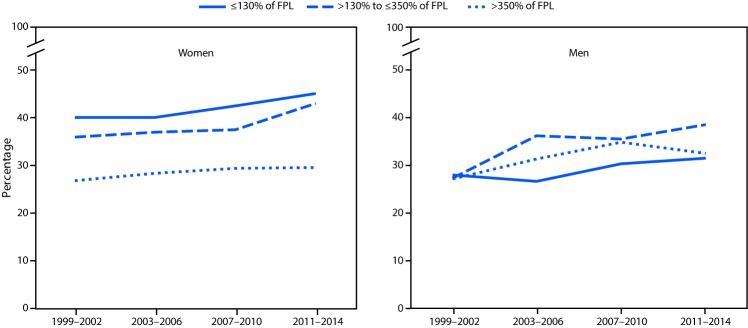
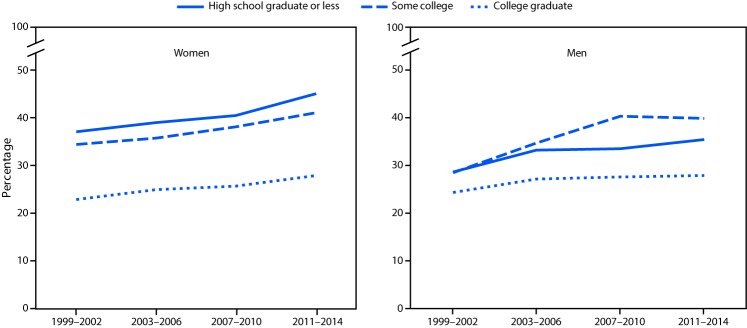
Prevalence of obesity among adults, by household income and education—United States, 2011-2014.
Open accessThe DOI matches its Crossref record; 6 of the 9 references it cites were found in a registry or an index.
Abstract
Studies have suggested that obesity prevalence varies by income and educational level, although patterns might differ between high-income and low-income countries (1-3). Previous analyses of U.S. data have shown that the prevalence of obesity varied by income and education, but results were not consistent by sex and race/Hispanic origin (4). Using data from the National Health and Nutrition Examination Survey (NHANES), CDC analyzed obesity prevalence among adults (aged ≥20 years) by three levels of household income, based on percentage (≤130%, >130% to ≤350%, and >350%) of the federal poverty level (FPL) and individual education level (high school graduate or less, some college, and college graduate). During 2011-2014, the age-adjusted prevalence of obesity among adults was lower in the highest income group (31.2%) than the other groups (40.8% [>130% to ≤350%] and 39.0% [≤130%]). The age-adjusted prevalence of obesity among college graduates was lower (27.8%) than among those with some college (40.6%) and those who were high school graduates or less (40.0%). The patterns were not consistent across all sex and racial/Hispanic origin subgroups. Continued progress is needed to achieve the Healthy People 2020 targets of reducing age-adjusted obesity prevalence to <30.5% and reducing disparities (5).
Overview
The claims and statistics of this paper haven’t been checked yet.
Free: it reads the open-access text and checks the first 5 claims that cite a source we can check. Create a free account to check every claim.
Integrity signals
Registry
Cites
Statistics
Figures
Verification
Claims the paper makes
The claims and statistics of this paper haven’t been checked yet.
Free: it reads the open-access text and checks the first 5 claims that cite a source we can check. Create a free account to check every claim.
Claims other papers make about this one
Each is checked against this paper’s own text: does it say what the citing paper says it does?
The cited source says what the claim attributes to it.
In the citing paper
“Because obesity is more prevalent among individuals with low income, access and affordability to GLP-1 RAs may represent a major barrier to initiation and continued use.14,15”
From Discontinuation and Reinitiation of Dual-Labeled GLP-1 Receptor Agonists Among US Adults With Overweight or Obesity (2025) · cites this paper as [14]
The check wasn’t confident either way, so it gives no verdict — never disputed.
In the citing paper
“Obesity is a known independent risk factor for multiple cardiovascular diseases [16,21,22]”
From PPG-Based Heart Rate Accuracy in Hispanic Adults with Fitzpatrick III–V Skin Tones: An Evaluation of Body Composition and Skin-Tone Effects (2026) · cites this paper as [22]
Experimental — accuracy not yet measured
Self-check
Percentages, sums and reported differences re-computed from the paper’s own numbers.
The self-check needs the paper’s full text.
Citations
Cites
Association between body-mass index and risk of death in more than 1 million Asians
Zheng, W., McLerran, D. F., Rolland, B., Zhang, X., Inoue, M., Matsuo, K., He, J., Gupta, P. C., Ramadas, K., Tsugane, S., et al. (2011) · New England Journal of Medicine · doi:10.1056/nejmoa1010679 · Cited by 885 · cited 1×
“For example, it has been suggested that the BMI cut point (≥30 kg/m2) that typically defines obesity might be too high for Asians and underestimate associated health risks (8,9).”
BackgroundObesity and socioeconomic status in developing countries: a systematic review
Dinsa, G. D., Goryakin, Y., Fumagalli, E., & Suhrcke, M. (2012) · Obesity Reviews · doi:10.1111/j.1467-789x.2012.01017.x · Cited by 805
Obesity and socioeconomic status in adults: United States, 2005-2008.
Ogden, C. L., Lamb, M. M., Carroll, M. D., & Flegal, K. M. (2010) · PubMed · Cited by 530
Self-citationLamerz, A., Kuepper-Nybelen, J., Wehle, C., Bruning, N., Trost-Brinkhues, G., Brenner, H., Hebebrand, J., & Herpertz-Dahlmann, B. (2005) · International Journal of Obesity · doi:10.1038/sj.ijo.0802914 · Cited by 304 · cited 1×
“50 1373 US Department of Health and Human Services/Centers for Disease Control and Prevention income and obesity and education has been reported in at least one other study (7) in children.”
BackgroundObesity - United States, 1988-2008.
Freedman, D. S. (2011) · PubMed · Cited by 109
Self-citationObesity - United States, 1999-2010.
May, A. L., Freedman, D. S., Sherry, B., & Blanck, H. M. (2013) · PubMed · Cited by 95
Self-citation
Cited by
Heart Disease and Stroke Statistics—2023 Update: A Report From the American Heart Association
Tsao, C. W., Aday, A. W., Almarzooq, Z. I., Anderson, C. A. M., Arora, P., Avery, C. L., Baker-Smith, C. M., Beaton, A. Z., Boehme, A. K., Buxton, A. E., et al. (2023) · Circulation · doi:10.1161/cir.0000000000001123 · Cited by 8,300
Heart Disease and Stroke Statistics—2022 Update: A Report From the American Heart Association
Tsao, C. W., Aday, A. W., Almarzooq, Z. I., Alonso, A., Beaton, A. Z., Bittencourt, M. S., Boehme, A. K., Buxton, A. E., Carson, A. P., Commodore-Mensah, Y., et al. (2022) · Circulation · doi:10.1161/cir.0000000000001052 · Cited by 5,987
Obesity in Patients Younger Than 60 Years Is a Risk Factor for COVID-19 Hospital Admission
Lighter, J., Phillips, M., Hochman, S., Sterling, S., Johnson, D., Francois, F., & Stachel, A. (2020) · Clinical Infectious Diseases · doi:10.1093/cid/ciaa415 · Cited by 1,225
“This has important and practical implications, where nearly 40% of adults in the US are obese with a BMI >30 [4].”
BackgroundOgden, C. L., Carroll, M. D., Fakhouri, T. H., Hales, C. M., Fryar, C. D., Li, X., & Freedman, D. S. (2018) · MMWR. Morbidity and Mortality Weekly Report · doi:10.15585/mmwr.mm6706a3 · Cited by 475
Self-citationHales, C. M., Fryar, C. D., Carroll, M. D., Freedman, D. S., Aoki, Y., & Ogden, C. L. (2018) · JAMA · doi:10.1001/jama.2018.7270 · Cited by 430
“Demographic variables included sex, age group, race and Hispanic origin, and education level because previous analyses have shown differences in the prevalence of obesity by these factors.(2,9,10) Participant age was categorized in the following age groups: 20 to 39years, 40 to 59years, and60years or older.”
Self-citationRodriguez, P. J., Zhang, V., Gratzl, S., Do, D., Goodwin Cartwright, B., Baker, C., Gluckman, T. J., Stucky, N., & Emanuel, E. J. (2025) · JAMA Network Open · doi:10.1001/jamanetworkopen.2024.57349 · Cited by 374
Semaglutide vs Tirzepatide for Weight Loss in Adults With Overweight or Obesity
Rodriguez, P. J., Goodwin Cartwright, B. M., Gratzl, S., Brar, R., Baker, C., Gluckman, T. J., & Stucky, N. L. (2024) · JAMA Internal Medicine · doi:10.1001/jamainternmed.2024.2525 · Cited by 334
Rodriguez, P. J., Goodwin Cartwright, B. M., Gratzl, S., Brar, R., Baker, C., Gluckman, T. J., & Stucky, N. L. (2023) · doi:10.1101/2023.11.21.23298775 · Cited by 334
“Overweight and obesity are highly prevalent conditions associated with increased morbidity and mortality [1–3].”
BackgroundHealth equity among black women in the United States
Chinn, J. J., Martin, I. K., & Redmond, N. (2021) · Journal of Women's Health · doi:10.1089/jwh.2020.8868 · Cited by 320
“Unlike other demographic groups, higher levels of income are not protective against obesity among non-Hispanic Black women.(39) This difference in the prevalence of obesity as reflected in national adiposity data on Black women is the result of the complex multilevel interplay of the measurable and difficult-to-measur…”
BackgroundEpidemiology of Obesity in Adults: Latest Trends
Inoue, Y., Qin, B., Poti, J., Sokol, R., & Gordon-Larsen, P. (2018) · Current Obesity Reports · doi:10.1007/s13679-018-0317-8 · Cited by 308
“Ogden et al. (2017) [37] • To analyze trends in obesity prevalence by household income levels and individual education level during 1999–2002 to 2011–2014, • No information on models provided.”
BackgroundA Framework for Increasing Equity Impact in Obesity Prevention
Kumanyika, S. K. (2019) · American Journal of Public Health · doi:10.2105/ajph.2019.305221 · Cited by 230
A review of current guidelines for the treatment of obesity
(2022) · The American Journal of Managed Care · doi:10.37765/ajmc.2022.89292 · Cited by 207
Gafoor, R., Booth, H. P., & Gulliford, M. C. (2018) · BMJ · doi:10.1136/bmj.k1951 · Cited by 205
How Lifestyle Factors Affect Cognitive and Executive Function and the Ability to Learn in Children
Jirout, J. J., LoCasale‐Crouch, J., Turnbull, K. L. P., Gu, Y., Mateus, M. C., Garzione, S., Evans, T. M., WELTMAN, A. L., & Kranz, S. (2019) · Nutrients · doi:10.3390/nu11081953 · Cited by 212
“9% of preschool-aged children to be obese in 2015 to 2016 [163].”
BackgroundFactors Associated With Intubation and Prolonged Intubation in Hospitalized Patients With COVID‐19
Hur, K., Price, C. P. E., Gray, E. L., Gulati, R. K., Maksimoski, M., Racette, S. D., Schneider, A. L., & Khanwalkar, A. R. (2020) · Otolaryngology–Head and Neck Surgery · doi:10.1177/0194599820929640 · Cited by 187
“2% having a BMI 40.(19,20) Initial reports from New York City have suggested that obese patients may have a higher likelihood of being admitted and placed on mechanical ventilation.”
BackgroundDiscrimination and systemic inflammation: A critical review and synthesis
Cuevas, A. G., Ong, A. D., Carvalho, K., Ho, T., Chan, S. W. (., Allen, J. D., Chen, R., Rodgers, J., Biba, U., & Williams, D. R. (2020) · Brain, Behavior, and Immunity · doi:10.1016/j.bbi.2020.07.017 · Cited by 185
“BMI rates and dietary patterns also varies by race/ethnicity and socioeconomic status—disproportionately affecting Blacks and Hispanics/ Latinos and low-socioeconomic groups (Flegal et al., 2016; Ogden, 2017).”
BackgroundIn the United States, Obesity Is So Prevalent Could It Be Described as a Pandemic?
Tzenios, N., Tazanios, M., & Chahine, M. (2022) · Preprints.org · doi:10.20944/preprints202212.0303.v1 · Cited by 164
Weight Loss in Underserved Patients — A Cluster-Randomized Trial
Katzmarzyk, P. T., Martin, C. K., Newton, R. L., Apolzan, J. W., Arnold, C. L., Davis, T. C., Price-Haywood, E. G., Denstel, K. D., Mire, E. F., Thethi, T. K., et al. (2020) · New England Journal of Medicine · doi:10.1056/nejmoa2007448 · Cited by 147
Proportion of Cancer Cases Attributable to Excess Body Weight by US State, 2011-2015
Islami, F., Goding Sauer, A., Gapstur, S. M., & Jemal, A. (2019) · JAMA Oncology · doi:10.1001/jamaoncol.2018.5639 · Cited by 153
Social determinants of health and obesity: Findings from a national study of US adults
Javed, Z., Valero‐Elizondo, J., Maqsood, M. H., Mahajan, S., Taha, M. B., Patel, K. V., Sharma, G., Hagan, K., Blaha, M. J., Blankstein, R., et al. (2022) · Obesity · doi:10.1002/oby.23336 · Cited by 134
Social and Environmental Factors Influencing Obesity
Lee, A. M., Cardel, M. I., & Donahoo, W. T. (2019) · Europe PMC (PubMed Central) · Cited by 185
Obesity among African American people in the United States : A review
Lofton, H. F., Ard, J. D., Hunt, R. R., & Knight, M. G. (2023) · Obesity · doi:10.1002/oby.23640 · Cited by 133
“However, among African American men, the prevalence of obesity is higher among the highest income group compared with the lowest income group [10].”
BackgroundTrends in the Prevalence of Metabolically Healthy Obesity Among US Adults, 1999-2018
Wang, J., Xia, P., Ma, M., Li, Y., Geng, T., Zhang, Y., Tu, Z., Jiang, L., Zhou, L., Zhang, B.-F., et al. (2023) · JAMA Network Open · doi:10.1001/jamanetworkopen.2023.2145 · Cited by 126
Bell, C. N., Kerr, J., & Young, J. L. (2019) · International Journal of Environmental Research and Public Health · doi:10.3390/ijerph16050861 · Cited by 115
Bailey, J. E., Gurgol, C., Pan, E., Njie, S., Emmett, S. D., Gatwood, J. D., Gauthier, L. V., Rosas, L. G., Kearney, S. M., Robler, S. K., et al. (2021) · Journal of Medical Internet Research · doi:10.2196/28503 · Cited by 132
The Many Faces of Obesity and Its Influence on Breast Cancer Risk
Agurs‐Collins, T., Ross, S. A., & Dunn, B. K. (2019) · Frontiers in Oncology · doi:10.3389/fonc.2019.00765 · Cited by 108
“In women, the overall obesity prevalence was shown to decrease with increased income and educational attainment (33).”
BackgroundTime trends and projected obesity epidemic in Brazilian adults between 2006 and 2030
Estivaleti, J. M., Guzman-Habinger, J. M., Lobos, J., Azeredo, C. M., Claro, R. M., Ferrari, G., Adami, F., & Rezende, L. F. M. (2022) · Scientific Reports · doi:10.1038/s41598-022-16934-5 · Cited by 94
Wang, Q., Zheng, D., Liu, J., Li, F., & Li, Q. (2018) · Lipids in Health and Disease · doi:10.1186/s12944-018-0932-0 · Cited by 94
Barbi, J. J., Patnaik, S. K., Pabla, S., Zollo, R. A., Smith, R. J., Sass, S. N., Srinivasan, A., Petrucci, C. M., Seager, R. J., Conroy, J. M., et al. (2021) · Journal of Thoracic Oncology · doi:10.1016/j.jtho.2021.04.020 · Cited by 84
Lamy, E., Viegas, C., da Rocha, A. M. C. N., Lucas, M. R., Tavares, S., Silva, F. C. E., Guedes, D., Laureati, M., Zian, Z., Machado, A. S., et al. (2022) · Food Quality and Preference · doi:10.1016/j.foodqual.2022.104559 · Cited by 89
Liu, X., Tu, R., Qiao, D., Niu, M., Li, R., Mao, Z., Huo, W., Chen, G., Xiang, H., Guo, Y., et al. (2020) · Environmental Pollution · doi:10.1016/j.envpol.2020.114077 · Cited by 86
Obesity associated disease risk: the role of inherent differences and location of adipose depots
Hill, J. H., Solt, C., & Foster, M. T. (2018) · Hormone Molecular Biology and Clinical Investigation · doi:10.1515/hmbci-2018-0012 · Cited by 79
New research directions on disparities in obesity and type 2 diabetes
Thornton, P. L., Kumanyika, S. K., Gregg, E. W., Araneta, M. R., Baskin, M. L., Chin, M. H., Crespo, C. J., de Groot, M., Garcia, D. O., Haire‐Joshu, D., et al. (2020) · Annals of the New York Academy of Sciences · doi:10.1111/nyas.14270 · Cited by 73
The COVID-19, Obesity, and Food Insecurity Syndemic
Pryor, S. P., & Dietz, W. H. (2022) · Current Obesity Reports · doi:10.1007/s13679-021-00462-w · Cited by 86
The American Cancer Society 2035 challenge goal on cancer mortality reduction
Ma, J., Jemal, A., Fedewa, S. A., Islami, F., Lichtenfeld, J. L., Wender, R. C., Cullen, K. J., & Brawley, O. W. (2019) · CA A Cancer Journal for Clinicians · doi:10.3322/caac.21564 · Cited by 79
Racial/Ethnic and Socioeconomic Disparities in Osteoarthritis Management
Reyes, A. M., & Katz, J. N. (2020) · Rheumatic Disease Clinics of North America · doi:10.1016/j.rdc.2020.09.006 · Cited by 71
Cuevas, A. G., Chen, R., Slopen, N. B., Thurber, K. A., Wilson, N. L. W., Economos, C. D., & Williams, D. R. (2019) · Obesity · doi:10.1002/oby.22648 · Cited by 72
“Studies have found that racial differences in obesity vary significantly across gradients of socioeconomic indicators, with the greatest disparities at higher levels of SEP (14,15).”
BackgroundRacial and Sex Disparities in Gout Prevalence Among US Adults
McCormick, N., Lu, N., Yokose, C., Joshi, A. D., Li, S., Rosenberg, L. A., Warner, E. T., Dalbeth, N., Merriman, T. R., Saag, K. G., et al. (2022) · JAMA Network Open · doi:10.1001/jamanetworkopen.2022.26804 · Cited by 66
Hsieh, T.-H., Lee, J. J., Yu, E. W.-R., Hu, H., Lin, S.-Y., & Ho, C.-Y. (2020) · Scientific Reports · doi:10.1038/s41598-020-77306-5 · Cited by 66
Grummon, A. H., Smith, N., Golden, S. D., Frerichs, L., Taillie, L. S., & Brewer, N. T. (2019) · American Journal of Preventive Medicine · doi:10.1016/j.amepre.2019.06.022 · Cited by 63
Höchsmann, C., Dorling, J. L., Martin, C. K., Newton, R. L., Apolzan, J. W., Myers, C. A., Denstel, K. D., Mire, E. F., Johnson, W. D., Zhang, D., et al. (2021) · Circulation · doi:10.1161/circulationaha.120.051328 · Cited by 54
Social determinants of health, health disparities, and adiposity
Baez, A. S., Ortiz-Whittingham, L. R., Tarfa, H. A., Baah, F. O., Thompson, K., Baumer, Y., & Powell‐Wiley, T. M. (2023) · Progress in Cardiovascular Diseases · doi:10.1016/j.pcad.2023.04.011 · Cited by 65
Petimar, J., Zhang, F., Rimm, E. B., Simon, D., Cleveland, L. P., Gortmaker, S. L., Bleich, S. N., Polacsek, M., Roberto, C. A., & Block, J. P. (2021) · PLoS Medicine · doi:10.1371/journal.pmed.1003714 · Cited by 76
Czernichow, S., Renuy, A., Rives‐Lange, C., Carette, C., Airagnes, G., Wiernik, E., Ozguler, A., Kab, S., Goldberg, M., Zins, M., et al. (2021) · Scientific Reports · doi:10.1038/s41598-021-93432-0 · Cited by 66
Factors Associated with Increased Morbidity and Mortality of Obese and Overweight COVID-19 Patients
Beshbishy, A. M., Hetta, H. F., Hussein, D. E. E., Saati, A. A., Uba, C. C., Rivero-Pérez, N., Zaragoza-Bastida, A., Shah, M. A., Behl, T., & Batiha, G. E. (2020) · Biology · doi:10.3390/biology9090280 · Cited by 59
“This risk is particularly significant in the United States as the incidence of obese adults (with a BMI of approximately 30) is about 40% compared to 6.2% in China, 20% in Italy, and 24% in Spain [42].”
BackgroundInfluentialBeyond fatalism: Information overload as a mechanism to understand health disparities
Ramírez, A. S., & Carmona, K. A. (2018) · Social Science & Medicine · doi:10.1016/j.socscimed.2018.10.006 · Cited by 56
“Sci. Med 213, 37–44. https://doi.org/10.1016/j.socscimed.2018.07.034 [PubMed: 30056325] Schneiderman N, Llabre M, Cowie CC, Barnhart J, Carnethon M, Gallo LC, Giachello AL, Heiss G, Kaplan RC, LaVange LM, Teng Y, Villa-Caballero L, Avilés-Santa ML, 2014 Prevalence of diabetes among Hispanics/Latinos from diverse backg…”
BackgroundInfluentialNonalcoholic Fatty Pancreas Disease
Shah, N., Rocha, J. P., Bhutiani, N., & Omer, E. M. (2019) · Nutrition in Clinical Practice · doi:10.1002/ncp.10397 · Cited by 63
Larson, N., Chen, Y., Wall, M. M., Winkler, M. R., Goldschmidt, A. B., & Neumark‐Sztainer, D. (2018) · Preventive Medicine · doi:10.1016/j.ypmed.2018.04.027 · Cited by 58
Advancing Health Equity Efforts to Reduce Obesity: Changing the Course
Kumanyika, S. (2022) · Annual Review of Nutrition · doi:10.1146/annurev-nutr-092021-050805 · Cited by 59
“As an obesity-specific example, the Black–White gap in obesity prevalence among women is highest in the highest categories of income and education (117): The prevalence of obesity in White women decreases with increasing income and education from ~40% to ~27%, but this decline is not observed for Black women, among wh…”
BackgroundExplaining adult obesity, severe obesity, and BMI: Five decades of change
Kranjac, A. W., & Kranjac, D. (2023) · Heliyon · doi:10.1016/j.heliyon.2023.e16210 · Cited by 53
Obesity as a risk factor for unfavourable outcomes in critically ill patients affected by Covid 19
Rossi, A. P., Gottin, L., Donadello, K., Schweiger, V., Nocini, R., Taiana, M., Zamboni, M. M., & Polati, E. (2020) · Nutrition Metabolism and Cardiovascular Diseases · doi:10.1016/j.numecd.2020.11.012 · Cited by 60
“Obesity in people <60 years of age is a newly identi ed epidemiologic risk factor which may contribute to the increased morbidity rates that are experienced in the US [6].”
Peer Support Groups for Weight Loss
Ufholz, K. E. (2020) · Current Cardiovascular Risk Reports · doi:10.1007/s12170-020-00654-4 · Cited by 52
Exploring the Impact of the Obesity Paradox on Lung Cancer and Other Malignancies
Nitsche, L., Mukherjee, S., Cheruvu, K., Krabak, C., Rachala, R., Ratnakaram, K., Sharma, P., Singh, M., & Yendamuri, S. (2022) · Cancers · doi:10.3390/cancers14061440 · Cited by 53
“This is particularly concerning considering that the proportion of the population that is obese continues to climb [2].”
BackgroundMethodAdegoke, O., Ozoh, O. B., Odeniyi, I. A., Bello, B. T., Akinkugbe, A., Ojo, O. O., Agabi, O. P., & Okubadejo, N. U. (2021) · Scientific Reports · doi:10.1038/s41598-021-83055-w · Cited by 59
Shi, S., Huang, H., Huang, Y., Zhong, V. W., & Feng, N. (2023) · Journal of the American Heart Association · doi:10.1161/jaha.122.028926 · Cited by 54
Diet-Related Health Inequalities in High-Income Countries: A Scoping Review of Observational Studies
Álvarez, E. C., Rifà‐Ros, R., Salinas‐Roca, B., Costa‐Tutusaus, L., Lamas, M., & Rodríguez‐Monforte, M. (2025) · Advances in Nutrition · doi:10.1016/j.advnut.2025.100439 · Cited by 51
Derose, K. P., Williams, M. V., Flórez, K. R., Griffin, B. A., Payán, D. D., Seelam, R., Branch, C. A., Hawes-dawson, J. A., Mata, M. A., Whitley, M. D., et al. (2018) · American Journal of Health Promotion · doi:10.1177/0890117118813333 · Cited by 50
Social and population health science approaches to understand the human microbiome
Herd, P., Palloni, A., Rey, F., & Dowd, J. B. (2018) · Nature Human Behaviour · doi:10.1038/s41562-018-0452-y · Cited by 44
Prevalence and factors associated with overweight and obesity in Kenya
Mkuu, R. S., Barry, A. E., Yonga, G., Nafukho, F. M., Wernz, C., Gilreath, T. D., Chowdhury, M. A. B., & Harvey, I. S. (2021) · Preventive Medicine Reports · doi:10.1016/j.pmedr.2021.101340 · Cited by 47
“Unlike middle and highincome countries where individuals from low SES are more likely to have overweight or obesity (Ogden et al., 2017; Neupane et al., 2015), studies in Kenya and similar LMICs support findings of higher prevalence of obesity and obesogenic diets with increasing SES (Mbochi et…”
ResultIdiopathic Intracranial Hypertension in the United States: Demographic and Socioeconomic Disparities
Ghaffari‐Rafi, A., Mehdizadeh, R., Ko, A. W. K., Ghaffari-Rafi, S., & León-Rojas, J. E. (2020) · Frontiers in Neurology · doi:10.3389/fneur.2020.00869 · Cited by 46
Newton, R. L., Carter, L., Johnson, W. D., Zhang, D., Larrivée, S., Kennedy, B. M., Harris, M. N., & Hsia, D. S. (2018) · Journal of Medical Internet Research · doi:10.2196/jmir.9816 · Cited by 48
“Obesity represents a health inequity for African American adults [1,2].”
BackgroundA Prescription for Achieving Equitable Access to Antiobesity Medications
Wright, D. R., Guo, J., & Hernandez, I. (2023) · JAMA Health Forum · doi:10.1001/jamahealthforum.2023.0493 · Cited by 42
Djalalinia, S., Yoosefi, M., Shahin, S., Ghasemi, E., Rezaei, N., Ahmadi, N., Rezaei, N., Azmin, M., Rezaei, S., Nasserinejad, M., et al. (2022) · Frontiers in Endocrinology · doi:10.3389/fendo.2022.1043894 · Cited by 42
“Results from other relevant investigations reveal different patterns in increasing the BMI associated with wealth index and income populations (2, 24).”
BackgroundMossadeghi, B., Caixeta, R. D. B., Ondarsuhu, D., Luciani, S., Hambleton, I. R., & Hennis, A. J. M. (2023) · BMC Public Health · doi:10.1186/s12889-023-15768-8 · Cited by 45
“One MMWR report based on NHANES 2011–2014 did find an association for obesity with ageadjusted education and income levels, but not consistently for different racial groups [29].”
BackgroundIdentifying latent activity behaviors and lifestyles using mobility data to describe urban dynamics
Yang, Y., Pentland, A., & Moro, E. (2023) · EPJ Data Science · doi:10.1140/epjds/s13688-023-00390-w · Cited by 50
Unraveling common threads in obesity risk among racial/ethnic minority and migrant populations
Kumanyika, S. (2019) · Public Health · doi:10.1016/j.puhe.2019.04.010 · Cited by 42
Park, S. H., Nicolaou, M., Dickens, B. S. L., Yang, Q., Tan, K. W., & van Dam, R. M. (2020) · Obesity · doi:10.1002/oby.22995 · Cited by 41
“In our study, the association between all measures of SES and obesity was modified by gender, in agreement with previous findings (29,41,42).”
ResultSkin optical properties in the obese and their relation to body mass index: a review
Rodriguez, A. J., Boonya-Ananta, M. T., Gonzalez, M., Le, V. N. D., Fine, J. N., Palacios, C. S., McShane, M. J., Coté, G. L., & Ramella‐Roman, J. C. (2022) · Journal of Biomedical Optics · doi:10.1117/1.jbo.27.3.030902 · Cited by 39
“Obesity trends vary across regions, ethnicities, and socioeconomic status.(3) In particular, individuals of darker skin (Blacks and many Hispanics) have a higher prevalence of obesity compared with whites, which has been increasing steadily over the years.”
BackgroundObesity and Postmenopausal Hormone Receptor-positive Breast Cancer: Epidemiology and Mechanisms
Zuo, Q., Band, S., Kesavadas, M. P., & Madak‐Erdogan, Z. (2021) · Endocrinology · doi:10.1210/endocr/bqab195 · Cited by 40
The Current State of Care for Black and Hispanic Inflammatory Bowel Disease Patients
Liu, J. J., Abraham, B. P., Adamson, P., Barnes, E. L., Brister, K. A., Damas, O. M., Glover, S. C., Hooks, K., Ingram, A., Kaplan, G. G., et al. (2022) · Inflammatory Bowel Diseases · doi:10.1093/ibd/izac124 · Cited by 38
Zhang, X., Zhang, F., Yang, J., Yang, W., Liu, W., Gao, L., Peng, Z., & Wang, Y. (2018) · PLoS ONE · doi:10.1371/journal.pone.0202681 · Cited by 37
Ahmed, K. Y., Abrha, S., Page, A., Arora, A., Shiferaw, S., Tadese, F., Seifu, C. N., Yeneabat, T., Alemu, E., Yilma, D., et al. (2020) · BMC Public Health · doi:10.1186/s12889-020-09345-6 · Cited by 35
Cao, S., Guo, Q., Xue, T., Wang, B., Wang, L., Duan, X., & Zhang, J. J. (2021) · The Science of The Total Environment · doi:10.1016/j.scitotenv.2021.145812 · Cited by 35
Socioeconomically Distressed Communities Associated With Long-term Mortality After Bariatric Surgery
Mehaffey, J. H., Hawkins, R. B., Charles, E. J., Sahli, Z. T., Schirmer, B. D., & Hallowell, P. T. (2019) · Journal of Surgical Research · doi:10.1016/j.jss.2019.04.081 · Cited by 33
Cheng, X., Hu, Y., Ruan, Z., Zang, G., Chen, X., & Qiu, Z. (2023) · Aging Clinical and Experimental Research · doi:10.1007/s40520-023-02353-7 · Cited by 33
“Family income was categorized into two groups using 130% of the federal poverty level (FPL) as the cutoff, which was the cutpoint for participation in the Supplemental Nutrition Assistance Program [31].”
MethodGrant, W. B., van Amerongen, B. M., & Boucher, B. J. (2023) · Nutrients · doi:10.3390/nu15122787 · Cited by 37
“For example, obesity is strongly linked to lower education achievement [250], ethnicity/race [250,251], and lower income level [250], notably in the southern US [44], and management of obesity is challenging [252].”
BackgroundEffect of mobile food environments on fast food visits
Bueno, B. G. B., Horn, A. L., Bell, B. M., Bahrami, M., Bozkaya, B., Pentland, A., de la Haye, K., & Moro, E. (2024) · Nature Communications · doi:10.1038/s41467-024-46425-2 · Cited by 39
“Our results align well with the contradicting evidence of little variability in fastfoodintake across income levels despite consistent differences based on educational levels and race and ethnicity 42 – 44 .”
Progress and recognition of idiopathic intracranial hypertension: A narrative review
Zhou, C., Zhou, Y., Liu, L., Jiang, H., Wei, H., Zhou, C., & Ji, X. (2024) · CNS Neuroscience & Therapeutics · doi:10.1111/cns.14895 · Cited by 33
COVID-19 infection and body weight: A deleterious liaison in a J-curve relationship
Manolis, A. S., Manolis, T. A., Manolis, T. A., Apostolaki, N. E., & Melita, H. (2021) · Obesity Research & Clinical Practice · doi:10.1016/j.orcp.2021.10.006 · Cited by 36
“This has practical implications for countries with high prevalence of obesity, like the US where ~40% or the UK where ~30% of adults are obese (BMI ≥ 30) [27, 28].”
Trends in Obesity-Related Mortality and Racial Disparities
Okobi, O. E., Beeko, P. K. A., Nikravesh, E., Beeko, M. A. E., Ofiaeli, C., Ojinna, B. T., Okunromade, O., Dick, A. I., Sulaiman, A. R., & Sowemimo, A. F. (2023) · Cureus · doi:10.7759/cureus.41432 · Cited by 32
“Although further research is recommended, the trend of Black women being disproportionately affected by obesity is well documented in previous studies [5,7,8].”
BackgroundResultInfluentialSick Individuals and Sick (Microbial) Populations: Challenges in Epidemiology and the Microbiome
Renson, A., Herd, P., & Dowd, J. B. (2019) · Annual Review of Public Health · doi:10.1146/annurev-publhealth-040119-094423 · Cited by 34
Adverse childhood experiences, economic hardship, and obesity: Differences by gender
Kim, Y., Lee, H., & Park, A. (2020) · Children and Youth Services Review · doi:10.1016/j.childyouth.2020.105214 · Cited by 32
Segmented assimilation as a mechanism to explain the dietary acculturation paradox
Ramírez, A. S., Wilson, M., & Miller, L. M. S. (2021) · Appetite · doi:10.1016/j.appet.2021.105820 · Cited by 29
Delay discounting and obesity in food insecure and food secure women.
Rodriguez, L. R., Rasmussen, E. B., Kyne-Rucker, D., Wong, M. Y.-Y., & Martin, K. S. (2021) · Health Psychology · doi:10.1037/hea0001042 · Cited by 31
“Lower socioeconomic status is linked to obesity in women and in individuals who identify as non-Hispanic Black and Latino ethnicities (Ogden et al., 2017).”
BackgroundRodrigues, L. C., Canella, D. S., & Claro, R. M. (2021) · European Journal of Ageing · doi:10.1007/s10433-021-00659-x · Cited by 27
Parks, C. A., Han, P., Fricke, H. E., Parker, H., Hesterman, O. B., & Yaroch, A. L. (2021) · SSM - Population Health · doi:10.1016/j.ssmph.2021.100898 · Cited by 30
“…et al., 2014; Oberholtzer et al., 2012; Lindsay, 2013), which benefits local economies and farmers, as well as demonstrates increased consumer FVI (Bowling et al., 2016; Cohen et al., 2017; Dimitri et al., 2015; Olsho et al., 2016; Pellegrino et al., 2018; Savoie-Roskos et al., 2016; Young, 2013).”
BackgroundZhu, L., Huang, Y., Edirisinghe, I., Park, E., & Burton‐Freeman, B. M. (2019) · Nutrients · doi:10.3390/nu11050952 · Cited by 30
ESG and Sovereign Risk: What is Priced in by the Bond Market and Credit Rating Agencies?Preprint
Semet, R., Roncalli, T., & Stagnol, L. (2021) · SSRN Electronic Journal · doi:10.2139/ssrn.3940945 · Cited by 41
Socioeconomic and Geographic Disparities in Idiopathic Intracranial Hypertension
Brahma, V. L., Snow, J., Tam, V. W., Ross, A. G., Tamhankar, M. A., Shindler, K. S., Avery, R. A., Liu, G. T., & Hamedani, A. G. (2021) · Neurology · doi:10.1212/wnl.0000000000012037 · Cited by 26
“Food deserts and food swamps are both found more frequently in low-income communities, and a recent Centers for Disease Control and Prevention (CDC) review found that among women, higher incomes were associated with lower obesity prevalence.(6) Both income and food access limitations disproportionately affect minority…”
BackgroundBustami, M., Matalka, K. Z., Mallah, E., Abu-Qatouseh, L., Dayyih, W. A., Hussein, N., Safieh, N. A., Elyyan, Y., Hussein, N., & Arafat, T. (2021) · Journal of Multidisciplinary Healthcare · doi:10.2147/jmdh.s313172 · Cited by 28
Dunn, C. G., Gao, K. J., Soto, M. J., & Bleich, S. N. (2021) · American Journal of Preventive Medicine · doi:10.1016/j.amepre.2021.01.043 · Cited by 26
Trends in Metabolic Phenotypes According to Body Mass Index Among US Adults, 1999-2018
Liu, J., Zhang, Y., Lavie, C. J., & Moran, A. E. (2022) · Mayo Clinic Proceedings · doi:10.1016/j.mayocp.2022.02.013 · Cited by 26
Measuring Socioeconomic Inequalities in Obesity among Korean Adults, 1998–2015
Hwang, J., Lee, E., & Lee, C. G. (2019) · International Journal of Environmental Research and Public Health · doi:10.3390/ijerph16091617 · Cited by 26
“For instance, an inverse relationship between SES and obesity is commonly observed, demonstrating that income and educational attainment are negatively associated with obesity [25,26].”
BackgroundBanas, J., Cook, A. M., Raygoza-Cortez, K., Davila, D., Irwin, M. L., Ferrucci, L. M., & Humphries, D. L. (2024) · International Journal of Environmental Research and Public Health · doi:10.3390/ijerph21010073 · Cited by 26
Income and Marital Status Interact on Obesity Among Black and White Men
Bell, C. N., & Thorpe, R. J. (2019) · American Journal of Men s Health · doi:10.1177/1557988319829952 · Cited by 29
“…that race moderates the effects of income on obesity among men such that higher income is associated with higher obesity rates among Black men (Chang & Lauderdale, 2005; Griffith, Johnson-Lawrence, et al., 2011; Ogden et al., 2007, 2010, 2017; Sanchez-Vaznaugh et al., 2009; Zhang & Wang, 2004).”
BackgroundResultLiu, Q., Wang, H., Liu, A., Jiang, C. S., Li, W., Ma, H., & Geng, Q. (2022) · BMC Psychiatry · doi:10.1186/s12888-022-04424-x · Cited by 25
“Sociodemographic characteristics Sociodemographic characteristics included sex (grouped as male or female), age (< 30, 30–54, 55–74, or ≥ 75 years old), body mass index ([BMI] < 25, 25–30, or ≥ 30 m/kg2), race/ethnicity (Mexican American, other Hispanic, Non-Hispanic White, Non-Hispanic Black, or other), marital statu…”
BackgroundCuevas, A. G., Ortiz, K. S., & Ransome, Y. (2019) · BMC Public Health · doi:10.1186/s12889-019-7811-0 · Cited by 26
Radwan, R. M., Lee, Y. A., Kotecha, P., Wright, D. R., Hernandez, I., Ramon, R., Donahoo, W. T., Chen, Y., Allen, J. M., Bian, J., et al. (2025) · Diabetes Obesity and Metabolism · doi:10.1111/dom.16318 · Cited by 24
Duan, S., Ren, Z.-Y., Zheng, T., Peng, H., Niu, Z., Xia, H., Chen, J.-L., Zhou, Y.-C., Wang, R.-R., & Yao, S. (2022) · World Journal of Gastroenterology · doi:10.3748/wjg.v28.i36.5364 · Cited by 27
Owobi, O. U., Okonji, O. C., Nzoputam, C. I., & Ekholuenetale, M. (2022) · Women · doi:10.3390/women2040029 · Cited by 27
“Funding: The Inner City Fund (ICF) provided technical assistance throughout the survey program with funds from the United States Agency for International Development (USAID).”
BackgroundResult
Metadata
- Authors
- Ogden, C. L., Fakhouri, T. H., Carroll, M. D., Hales, C. M., Fryar, C. D., Li, X., & Freedman, D. S.
- Affiliations
- Centers for Disease Control and Prevention (US)
- Corresponding author
- Ogden, Cynthia L.
- ORCID
- Venue
- MMWR. Morbidity and Mortality Weekly Report
- Published
- 2017-12-22
- Volume
- 66
- Issue
- 50
- Pages
- 1369-1373
- ISSN
- 0149-2195 (ISSN-L)
- 1545-861X
- PMC
- PMC5751581
- OpenAlex
- W2778311948
- Cited by
- 456
- References
- 9
- Citations by year
- 2026: 19 · 2025: 40 · 2024: 58 · 2023: 76 · 2022: 68 · 2021: 69 · 2020: 60 · 2019: 40 · 2018: 23 · 2017: 3
- FWCI
- 32.36
- Type
- journal article
- Language
- en
- Open access
- bronze
- doi.org
- Locations
- MMWR Morbidity and Mortality Weekly Report (publishedVersion)
- PubMed Central (publishedVersion, cc-by)
- PubMed (publishedVersion)
- Topics
- Health Sciences › Medicine › Public Health, Environmental and Occupational Health › Obesity, Physical Activity, Diet
- Health Sciences › Medicine › Public Health, Environmental and Occupational Health › Obesity and Health Practices
- Social Sciences › Health › Health disparities and outcomes
- Keywords
- obesity prevalence, household income, educational attainment, socioeconomic disparities, federal poverty level, adults, sex differences, Healthy People 2020, NHANES
- MeSH terms
- Adult, Cross-Sectional Studies, Educational Status, Female, Hispanic or Latino, Humans, Income, Male, Middle Aged, Nutrition Surveys, Obesity, Poverty, Risk Factors, United States, Prevalence, Racial Groups, Health Status Disparities, Young Adult
About these checks
Registry, retraction, Cites and statistics results are computed, not judged, with one exception: a printed reference that no index lists is read once by a model before it counts as a citation error. Claims are extracted by a model and kept only when their quote appears verbatim in the text; each cited source is then checked, with a model’s help, for whether it says what the claim relies on. Those verdicts can be wrong — read the claim’s quote and the cited source before relying on one.
Statistics and arithmetic are recomputed, not judged.
Confidence bands are shown only for fields calibrated on our annotated test set. None is calibrated yet, so no band is shown.
What counts as a claim ›How we measure confidence ›How we check this ›
Are you an author, or do you see a problem with this page? Request a review
Data sources
Bibliographic data: Semantic Scholar, OpenAlex, Crossref.
Contains information from the Semantic Scholar Academic Graph Datasets, made available under the ODC Attribution License (ODC-BY 1.0).
Semantic Scholar’s data is described in: Kinney, R., et al. (2023). The Semantic Scholar Open Data Platform. arXiv:2301.10140.
