

Cyberbullying and adolescent mental health: systematic review.
Open accessThe DOI matches its Crossref record; 42 of the 43 references it cites were found in a registry or an index.
Abstract
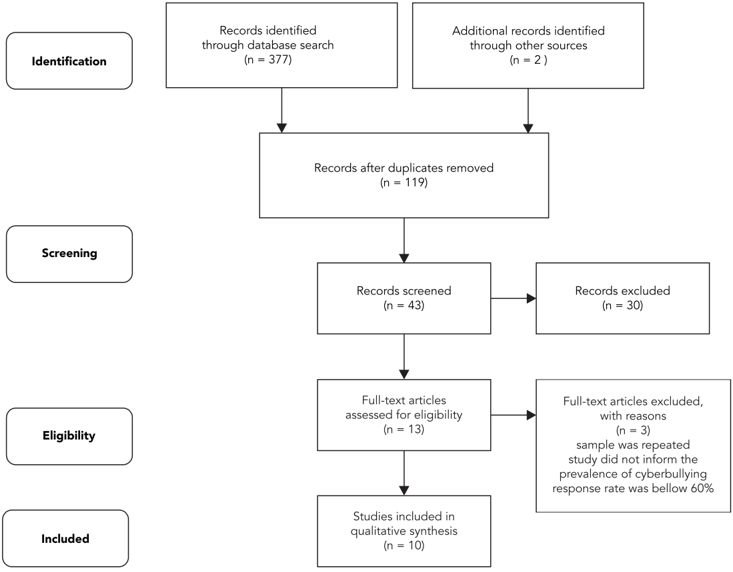
Cyberbullying is a new form of violence that is expressed through electronic media and has given rise to concern for parents, educators and researchers. In this paper, an association between cyberbullying and adolescent mental health will be assessed through a systematic review of two databases: PubMed and Virtual Health Library (BVS). The prevalence of cyberbullying ranged from 6.5% to 35.4%. Previous or current experiences of traditional bullying were associated with victims and perpetrators of cyberbullying. Daily use of three or more hours of Internet, web camera, text messages, posting personal information and harassing others online were associated with cyberbullying. Cybervictims and cyberbullies had more emotional and psychosomatic problems, social difficulties and did not feel safe and cared for in school. Cyberbullying was associated with moderate to severe depressive symptoms, substance use, ideation and suicide attempts. Health professionals should be aware of the violent nature of interactions occurring in the virtual environment and its harm to the mental health of adolescents.
Overview
The claims and statistics of this paper haven’t been checked yet.
Free: it reads the open-access text and checks the first 5 claims that cite a source we can check. Create a free account to check every claim.
Integrity signals
Registry
Cites
Statistics
Figures
Verification
Claims the paper makes
The claims and statistics of this paper haven’t been checked yet.
Free: it reads the open-access text and checks the first 5 claims that cite a source we can check. Create a free account to check every claim.
Claims other papers make about this one
Each is checked against this paper’s own text: does it say what the citing paper says it does?
The source backs part of the claim, not all of it — or backs it for a different population, condition or comparison.
In the citing paper
“It is associated with anxiety, depressive symptoms and suicidal ideation, and reportedly has a stronger association with depressive symptoms and suicidal ideation than traditional bullying (Bottino, Bottino, Regina, Correia, & Ribeiro, 2015;Fahy et al., 2016;Hamm et al., 2015;John et al., 2018;Katsaras et al., 2018;Nixon, 2014;van Geel, Vedder, & Tanilon, 2014).”
From Young people’s conceptualizations of the nature of cyberbullying: A systematic review and synthesis of qualitative research (2020) · cites this paper as Bottino et al., 2015
Experimental — accuracy not yet measuredIn the citing paper
“It is associated with anxiety, depressive symptoms and suicidal ideation, and reportedly has a stronger association with depressive symptoms and suicidal ideation than traditional bullying (Bottino, Bottino, Regina, Correia, & Ribeiro, 2015;Fahy et al., 2016;Hamm et al., 2015;John et al., 2018;Katsaras et al., 2018;Nixon, 2014;van Geel, Vedder, & Tanilon, 2014).”
From Young people’s conceptualizations of the nature of cyberbullying: A systematic review and synthesis of qualitative research (2020) · cites this paper as Bottino et al., 2015
Self-check
Percentages, sums and reported differences re-computed from the paper’s own numbers.
The self-check needs the paper’s full text.
Citations
Cites
Preferred Reporting Items for Systematic Reviews and Meta-Analyses: the PRISMA statement
Moher, D., Liberati, A., Tetzlaff, J., Altman, D. G., & for the PRISMA Group (2009) · BMJ · doi:10.1136/bmj.b2535 · Cited by 83,823
The CES-D Scale: A Self-Report Depression Scale for Research in the General Population
Radloff, L. S. (1977) · Applied Psychological Measurement · doi:10.1177/014662167700100306 · Cited by 53,267
Society and the Adolescent Self-Image
Rosenberg, M. (1965) · doi:10.1515/9781400876136 · Cited by 30,126
Diagnostic and Statistical Manual of Mental Disorders.
Widiger, T. A. (2000) · Encyclopedia of Psychology, Vol. 3. · doi:10.1037/10518-009 · Cited by 19,744
The Strengths and Difficulties Questionnaire: A research note
Goodman, R. (1997) · Journal of Child Psychology and Psychiatry · doi:10.1111/j.1469-7610.1997.tb01545.x · Cited by 14,908
Johnston, L. D., O'Malley, P. M., Bachman, J. G., & Schulenberg, J. E. (2009) · PsycEXTRA Dataset · doi:10.1037/e560352009-001 · Cited by 6,921
(1991) · Cited by 3,844
Cyberbullying: Its nature and impact in secondary school pupils
Smith, P. K., Mahdavi, J., Carvalho, M., Fisher, S., Russell, S., & Tippett, N. (2008) · Journal of Child Psychology and Psychiatry · doi:10.1111/j.1469-7610.2007.01846.x · Cited by 3,639
Hawker, D. S. J., & Boulton, M. J. (2000) · Journal of Child Psychology and Psychiatry · doi:10.1111/1469-7610.00629 · Cited by 2,694
Tokunaga, R. S. (2010) · Computers in Human Behavior · doi:10.1016/j.chb.2009.11.014 · Cited by 2,566
Research works printed but not linked: 1
- 32. Cad. Saúde Pública, Rio de Janeiro, 31(3):463-475, mar, 2015
Cited by
Items 101–200 of 439
Factores asociados al ciberacoso en adolescentes: Una perspectiva ecológico-social
López, E. J. M., Valdés‐Cuervo, A. A., Murrieta, M. U., Acuña, G. M. T., & Parra-Pérez, L. G. (2019) · Perfiles Educativos · doi:10.22201/iisue.24486167e.2019.167.59128 · Cited by 33
Ünal‐Aydın, P., Özkan, Y., Öztürk, M., Aydın, O., & Spada, M. M. (2023) · Clinical Psychology & Psychotherapy · doi:10.1002/cpp.2826 · Cited by 18
Safer Cyberspace Through Legal Intervention: A Comparative Review of Cyberbullying Legislation
Yang, Y. T., & Grinshteyn, E. G. (2016) · World Medical & Health Policy · doi:10.1002/wmh3.206 · Cited by 27
Player versus Player: A systematic review of cyberbullying in multiplayer online games
Hu, Y., Evelyn, S., Clancy, E. M., & Klettke, B. (2025) · Computers in Human Behavior Reports · doi:10.1016/j.chbr.2025.100675 · Cited by 23
Ciberacoso y comportamiento suicida. ¿Cuál es la conexión? A propósito de un caso
Escobar-Echavarría, J., González, L. E. M., Restrepo, D., & Mejía-Rodríguez, D. (2016) · Revista Colombiana de Psiquiatría · doi:10.1016/j.rcp.2016.08.004 · Cited by 44
“Para que se califique como bullying , estos comportamientos deben ocurrir repetida y sistemáticamente contra alguien que es incapaz de defenderse 16 . victimario en el cyberbullying evita el contacto cara a cara y logra mayor intimidación porque ocurre a cualquier hora y en cualquier sitio, a…”
Iverson, G. L., Merz, Z. C., & Terry, D. P. (2021) · Clinical Journal of Sport Medicine · doi:10.1097/jsm.0000000000000890 · Cited by 21
Cyberbullying and Gambling Disorder: Associations with Emotion Regulation and Coping Strategies
Estévez, A., Macía, L., López-González, H., Momeñe, J., Jáuregui, P., Etxaburu, N., Granero, R., Fernández‐Aranda, F., Mestre‐Bach, G., Vintró‐Alcaraz, C., et al. (2022) · Journal of Gambling Studies · doi:10.1007/s10899-022-10160-4 · Cited by 20
“, 2017), in addition to other psychopathological disorders, such as depression (Bottino et al., 2015).”
BackgroundDefinition and Characteristics of “Cyberbullying” among Vietnamese Students
Công, T. V., Ngoc, N. P. H., Weiss, B., Luot, N. V., & Dat, N. B. (2018) · VNU Journal of Science Education Research · doi:10.25073/2588-1159/vnuer.4212 · Cited by 21
“According to a systematic review published by Bottino et al. (2015), the prevalence of cyberbullying in the world ranges from 6.5% to 35.4% [6].”
BackgroundInfluentialNavigating the Digital Maze: A Review of AI Bias, Social Media, and Mental Health in Generation Z
Chang, J. P., Cheng, S., Chang, S. M.-J., & Su, K. (2025) · AI · doi:10.3390/ai6060118 · Cited by 28
“Cyberbullying risk factors include spending more than three hours online, using webcams, sharing personal information, and engaging in online harassment [39].”
InfluentialZamora, A. A., Regencia, Z. J. G., Crisostomo, M. E., Hal, G. F. V., & Baja, E. S. (2021) · International Maritime Health · doi:10.5603/imh.2021.0008 · Cited by 21
“Time spent on social media may also increase the risk of experiencing cyberbullying, which may lead to an increased risk for depression, particularly in teenagers and young adults [25].”
BackgroundUddin, H., & Hasan, M. K. (2023) · European Journal of Pediatrics · doi:10.1007/s00431-023-04898-1 · Cited by 22
“In addition, adolescents who spend more time on screen may risk being self-isolated [49] and may expose to more harmful content like cyberbullying [50], leading to a higher likelihood of anxiety and depression [4].”
BackgroundCyberbullying: A Narrative Review
Grover, S., & Raju, V. V. (2023) · Journal of Mental Health and Human Behaviour · doi:10.4103/jmhhb.jmhhb_47_22 · Cited by 22
Eweida, R. S., Hamad, N. I., Abdou, R. A. E. H., & Rashwan, Z. I. (2021) · Journal of Pediatric Nursing · doi:10.1016/j.pedn.2021.05.008 · Cited by 25
Lau-Zhu, A., Anderson, C., & Lister, M. (2023) · Clinical Child Psychology and Psychiatry · doi:10.1177/13591045221098896 · Cited by 16
“…emerging evidence (Dickson et al., 2018), particularly in areas associated with high levels of clinical risks, including self-harm (Biernesser et al., 2020), cyberbullying (Bottino, Bottino, Regina, Correia, & Ribeiro, 2015), and problematic sexual attitudes and behaviours (Horvath et al., 2013).”
BackgroundZeroing in on Heroes: Adolescents’ Perceptions of Hero Features and Functions
Kinsella, E. L., English, A., & McMahon, J. (2020) · Heroism Science An Interdisciplinary Journal · doi:10.26736/hs.2020.02.02 · Cited by 26
Factors Associated with Cyberbullying Victimisation among Colombian High-School Adolescents
Cassiani-Miranda, C. A., Campo‐Arias, A., & Caballero‐Domínguez, C. C. (2021) · Journal of Child & Adolescent Trauma · doi:10.1007/s40653-021-00355-z · Cited by 20
Türk, B., Yayak, A., & Hamzaoğlu, N. (2021) · doi:10.35365/ctjpp.21.4.25 · Cited by 19
Zhou, H., Wei, X., Jiang, H., Tuo, A., Lu, G., Liang, H., & Xiao, N. (2022) · Aggressive Behavior · doi:10.1002/ab.22057 · Cited by 18
Cyberbullying among Brazilian schoolchildren: data from the National Student Health Survey, 2019
Malta, D. C., de Souza, J. B., de Vasconcelos, N. M., de Mello, F. C. M., Buback, J. B., Gomes, C. S., & Pereira, C. A. (2024) · Ciência & Saúde Coletiva · doi:10.1590/1413-81232024299.19572023 · Cited by 21
Cyberbullying and internet safety: a survey of child and adolescent mental health practitioners
Lonergan, A., Moriarty, A., McNicholas, F., & Byrne, T. (2021) · Irish Journal of Psychological Medicine · doi:10.1017/ipm.2021.63 · Cited by 20
“This is in line with previous research identifying negative effects ofCBvictimisation onmood, anxiety and suicidal ideation (Bottino et al. 2015; John et al. 2018; Biddle et al. 2018; Patchin & Hunduja, 2010).”
BackgroundResultExploring the Negative Consequences of Online Body Shaming: A Study of Czech Adolescents
Novotný, J., Kvintová, J., Váchová, L., Szotkowski, R., Kopecký, K., & Rodríguez, J. M. R. (2025) · Journal of Child and Family Studies · doi:10.1007/s10826-025-03032-z · Cited by 26
“It can disrupt identity formation, potentially leading to depression, anxiety, and disordered eating (Bottino et al., 2015; Brewer & Kerslake, 2015).”
Zhang, J., Xu, Y., Zhang, R., Wang, Y., Li, X., Xu, Y., Guo, Z., Lv, Y., & Jiang, S. (2022) · Cyberpsychology Journal of Psychosocial Research on Cyberspace · doi:10.5817/cp2022-3-5 · Cited by 17
“A large number of research studies have focused on the risk and protective factors involved in cyberbullying perpetration (Bottino et al., 2015; Kowalski et al., 2019; Park et al., 2021; Yudes et al., 2020), including individual factors (i.e., gender, self-esteem, self-control, and dark…”
BackgroundAn explorative qualitative study of cyberbullying and cyberstalking in a higher education community
Bussu, A., Ashton, S., Pulina, M., & Mangiarulo, M. (2023) · Crime Prevention and Community Safety · doi:10.1057/s41300-023-00186-0 · Cited by 21
“Besides, rates of CB prevalence were high in HE student populations even before the COVID-19 pandemic, ranging between 6 and 35% in the studied samples (Bottino et al. 2015; Kamali 2015).”
BackgroundImpact of screen and social media use on mental health
Eddy, L. S., Patón, A. H., Buratti, M. A. F., Pitti, J. Á., Salmerón-Ruiz, M. A., Hernández, P. J. R., & Real‐López, M. (2025) · Anales de Pediatría (English Edition) · doi:10.1016/j.anpede.2025.503909 · Cited by 20
Park, M. S., Billieux, J., Raj, S., Lee, M. C., Geoffrey, D. S., & Nuyens, F. (2024) · Criminal Behaviour and Mental Health · doi:10.1002/cbm.2321 · Cited by 19
“Existing evidence suggests that the experience of cyberbullying is associated with elevated levels of depression (Bottino et al., 2015), suicidal ideation and suicide attempts (Klomek et al., 2010; Suzuki et al., 2012) and social anxiety (Coelho & Romão, 2018).”
BackgroundFitzgerald, A., Mahon, C., Shevlin, M. E., Dooley, B. A., & O’Reilly, A. (2024) · Early Intervention in Psychiatry · doi:10.1111/eip.13562 · Cited by 23
“Other factors include: increased screen time, internet, and social media use (Carli et al., 2014; O'Keeffe et al., 2011); cyber bullying (Bottino et al., 2015); greater school-based pressures (Sweeting et al., 2010); changes in health (e.g., poorer sleep; Keyes et al., 2015); more sedentary…”
Khadka, S., Limbu, A., Chalise, A., Pandey, S., & Paudel, S. (2024) · BMJ Open · doi:10.1136/bmjopen-2023-081797 · Cited by 18
Impacto de las pantallas y las redes sociales en la salud mental
Eddy, L. S., Patón, A. H., Buratti, M. A. F., Pitti, J. Á., Salmerón-Ruiz, M. A., Hernández, P. J. R., & Real‐López, M. (2025) · Anales de Pediatría · doi:10.1016/j.anpedi.2025.503909 · Cited by 18
Zhang, J., Lin, G., Cai, Q., Hu, Q., Xu, Y., Guo, Z., Hong, D., Huang, Y., Lv, Y., Chen, J., et al. (2022) · Frontiers in Psychiatry · doi:10.3389/fpsyt.2022.914055 · Cited by 18
“Previous studies have found that traditional bullying perpetration/victimization (61) and cyberbullying perpetration/victimization (62) were”
BackgroundLahti, H., Kulmala, M., Lyyra, N., Mietola, V., & Paakkari, L. T. (2024) · Scientific Reports · doi:10.1038/s41598-024-55578-5 · Cited by 20
Tadpatrikar, A., Sharma, M. K., & Murthy, P. (2024) · Asian Journal of Psychiatry · doi:10.1016/j.ajp.2024.104154 · Cited by 16
Кибербуллинг и суицидальное поведение подростков
Karaush, I. S., Куприянова, И. Е., & Кузнецова, А. А. (2020) · Суицидология · doi:10.32878/suiciderus.20-11-01(38)-117-129 · Cited by 17
“Анонимность усиливает чувство страха и незащищённости, провоцирует возникновение чувства бессилия, поскольку зачастую жертва не способна при-нять достаточные меры для прекращения агрессивных действий [6, 26].”
InfluentialTran, C. V., Weiss, B., & Nguyen, N. P. H. (2020) · International Journal of School & Educational Psychology · doi:10.1080/21683603.2020.1837700 · Cited by 21
Malinowska-Cieślik, M., Kleszczewska, D. W., Dzielska, A., Ścibor, M., & Mazur, J. (2023) · International Journal of Environmental Research and Public Health · doi:10.3390/ijerph20021358 · Cited by 21
“Studies showed that bullies and cyberbullies did not like school, did not feel safe and cared for by teachers, and a felt weak sense of belonging to their school [31,64,65].”
BackgroundDo Our Adolescents Know They Are Cyberbullying Victims?
Shakir, T., Bhandari, N., Andrews, A., Zmitrovich, A. G., McCracken, C. M., Gadomski, J., Morris, C. R., & Jain, S. (2019) · Journal of Infant Child and Adolescent Psychotherapy · doi:10.1080/15289168.2018.1565004 · Cited by 17
“The problem of cyberbullying is further exacerbated because victims and perpetuators of cyberbullying are more likely to also experience traditional bullying at school (Bottino et al., 2015; Sourander et al., 2010; What is Cyberbullying.”
BackgroundMoro, G. L., Scaioli, G., Martella, M., Pagani, A., Colli, G., Bert, F., & Siliquini, R. (2023) · International Journal of Environmental Research and Public Health · doi:10.3390/ijerph20043224 · Cited by 13
“Furthermore, since episodes of cyberbullying often overlap with traditional bullying, considering both cyberbullies and cybervictims [11], experiences of in-person aggressions were explored.”
BackgroundResultInfluentialGupta, S., Soohinda, G. S., Sampath, H., & Dutta, S. (2023) · Industrial Psychiatry Journal · doi:10.4103/ipj.ipj_40_23 · Cited by 18
Characteristics and Dynamics of Cyberstalking Victimization Among Juveniles and Young Adults
Walsh, W. A., Finkelhor, D., & Turner, H. A. (2024) · Violence Against Women · doi:10.1177/10778012231225238 · Cited by 15
“Two reviews exploring cyberbullying and youths ’ mental health found that depression and anxiety were the most experienced emotions by victims (Bottino et al., 2015; Kwan et al., 2020).”
Adolescent-Centric Design of an Online Safety Chatbot
Roehrer, E., Pokawinkoon, P., Watters, P., Sauer, J. D., & Scanlan, J. D. (2024) · Journal of Computer Information Systems · doi:10.1080/08874417.2024.2401991 · Cited by 14
“13 Addressing these challenges necessitates a multi-faceted approach, combining traditional intervention strategies with innovative technological solutions.”
Zhang, D., Gong, J., Liu, J., Bullock, A., & Sang, B. (2025) · Aggression and Violent Behavior · doi:10.1016/j.avb.2025.102052 · Cited by 12
Corke, L., Maksyutynska, K., Jones, J. M., & George, T. P. (2025) · Annals of Clinical Psychiatry · doi:10.1177/10401237251344098 · Cited by 19
“47 The negative impact of cyberbullying on AYA mental health outcomes was demonstrated by Garthe et al., and Bonasaken et al. 22,27 This may be another factor contributing to the association between increased social media use and poorer mental health outcomes.”
Modeling of variables related to parents’ awareness in Cyberbullying Prevention
Vezne, R., Uslu, N. A., & Durak, H. Y. (2022) · Current Psychology · doi:10.1007/s12144-022-03837-x · Cited by 14
“Similarly, it is reported that cyberbullied adoles - cents mostly live in single-parent households (Bevilacqua et al., 2017 ; Bottino et al., 2015 ) or have a negative family environment (Guo, 2016).”
BackgroundAlrasheed, N., Nishat, S., Shihah, A. B., Alalwan, A. I., & Jradi, H. (2022) · Cureus · doi:10.7759/cureus.32806 · Cited by 17
“attack could be, written - via text messages, posting derogatory comments, visual - circulation of private or humiliating images, verbal - voice messages or calls, exclusion - deliberately excluding a participant from a conversation [4].”
BackgroundSarhangi, N., Rostami, M., Abbasirad, R., Fasihi, M., & Ahmadboukani, S. (2023) · Psychology in the Schools · doi:10.1002/pits.22868 · Cited by 17
Maji, S., & Abhiram, A. H. (2023) · Telematics and Informatics Reports · doi:10.1016/j.teler.2023.100064 · Cited by 16
Dhara, S., Thakur, J., Pandey, N., Mozumdar, A., & Roy, S. (2024) · PLoS ONE · doi:10.1371/journal.pone.0306071 · Cited by 17
“Our study confirms similar findings where cyberbullying or telephonic harassment has an intimidating effect to disrupt the personal mental space and causing MDD [114–116], irrespective of the marital status of the studied participants.”
ResultAN OVERVIEW OF THE LEGAL FRAMEWORK GOVERNING CYBERBULLYING AMONG CHILDREN IN MALAYSIA
Razali, N. A., & Nawang, N. I. (2022) · IIUM Law Journal · doi:10.31436/iiumlj.v30is1.704 · Cited by 15
Magalhães, J., Matijasevich, A., Ziebold, C., Malvasi, P. A., Evans-Lacko, S. E., & Paula, C. S. (2021) · Cadernos de Pós-Graduação em Distúrbios do Desenvolvimento · doi:10.5935/cadernosdisturbios.v21n2p9-38 · Cited by 6
Peker, A., Cengiz, S., & Eroğlu, Y. (2024) · Current Psychology · doi:10.1007/s12144-024-05864-2 · Cited by 14
“Bottino et al. (2015) reported in their systematic study that cyber-victims experienced more physical, emotional, and social problems at school.”
Luo, M., Duan, Z., Luo, W., & Niu, Z. (2025) · Child and Adolescent Psychiatry and Mental Health · doi:10.1186/s13034-025-00895-4 · Cited by 14
Cemiloglu, D., Alshakhsi, S. A. A., Babiker, A., Naiseh, M., Al‐Thani, D., & Ali, R. (2025) · International Journal of Human-Computer Interaction · doi:10.1080/10447318.2025.2480909 · Cited by 11
“…identified requirements align with concerns high-lighted in existing literature, particularly in relation to mental health issues, including usage time (Huang, 2022), harmful content such as bullying (Bottino et al., 2015) and misinformation (Verma et al., 2022), and privacy (Park et al., 2014).”
Social threat and adolescent mental health
Sequeira, S. L., Rodman, A. M., Nesi, J. L., & Silk, J. S. (2025) · Nature Reviews Psychology · doi:10.1038/s44159-025-00484-4 · Cited by 13
“Reviews typically find robust associations between cyberbullying victimization and youths’ depression, anxiety, and suicidal thoughts and behaviours 110,115,119,120 .”
Cyberbullying prevention and treatment interventions targeting young people: an umbrella review
Heyeres, M., Carter, M. A., Lui, S. M., Low‐Lim, A., Teo, S., & Tsey, K. (2020) · Pastoral Care in Education · doi:10.1080/02643944.2020.1827281 · Cited by 14
Concepts and issues related to adolescent health in nursing education
Cassiani, S. H. D. B., Dias, B. M., Beltrán, M. P. B., Gualdrón, L. M. V., Pérez, T. R., Aguilar, G. M. V., Ponce, R. A. L., & Valdivia, A. R. C. (2022) · Revista Latino-Americana de Enfermagem · doi:10.1590/1518-8345.6166.3651 · Cited by 13
“4%, and victims present more emotional and psychosomatic problems, social difficulties, moderate to severe depressive symptoms, substance use and suicide ideation and attempts(27).”
BackgroundUnveiling the silent crisis: global burden of suicide-related deaths among children aged 10–14 years
Michałek, I. M., Koczkodaj, P., Michalek, M., & dos Santos, F. L. C. (2024) · World Journal of Pediatrics · doi:10.1007/s12519-023-00781-z · Cited by 12
Cyberbullying and Its Impact on Mental Health of Adolescents
Mahanta, D., & Khatoniyar, S. (2019) · IRA-International Journal of Management & Social Sciences · doi:10.21013/jmss.v14.n2sp.p1 · Cited by 17
Parents' perception of cyberbullying of their children in Saudi Arabia
Alghamdi, A., Alfakeh, S. A., Kouzaba, K. A., Altaifi, M., Abu-Alamah, S., & Salamah, M. (2021) · Journal of Family and Community Medicine · doi:10.4103/jfcm.jfcm_516_20 · Cited by 19
“[8‐10] In some extreme circumstances, unmonitored behaviors may lead victims to severe mental illness, and even worse with the taking of their life.[11,12] Consequently, cyberbullying has become a significant concern of parents, educators, and policy‐makers.”
BackgroundNew Media Use and Mental Health of Married Women: Mediating Effects of Marital Quality
Zhou, D., Xu, Y., & He, Q. (2023) · Healthcare · doi:10.3390/healthcare11212909 · Cited by 16
“Empirically, certain behaviors, such as cyberbullying and engaging in social comparisons, on social media are found to be associated with the development of depressive symptoms, particularly in young adults [36–39].”
BackgroundYang, W., Ning, L., Miao, Q., Xu, F. H., Li, K., Chen, X., & Lu, H. (2025) · BMC Psychiatry · doi:10.1186/s12888-025-06943-9 · Cited by 10
“Previous research has consistently shown that cyber-bullying has adverse effects on mental health, manifesting in various forms such as anxiety, depression, loneliness, and non-suicidal self-injury (NSSI) [11, 14–17].”
Psychological impact of cyber-crime on victims
Gautam, R., & Yadav, S. (2026) · Current Psychology · doi:10.1007/s12144-025-08873-x · Cited by 11
“The circumstances may make victims feel hopeless and overwhelmed (Bottino et al., 2015, Hawdon, 2021 ).”
Levine, R. S., Bintliff, A. V., & Raj, A. (2022) · Adolescents · doi:10.3390/adolescents2020019 · Cited by 11
How many cyberbullying(s)? A non-unitary perspective for offensive online behaviours
Guidi, S., Palmitesta, P., Bracci, M., Marchigiani, E., Pomponio, I. D., & Parlangeli, O. (2022) · PLoS ONE · doi:10.1371/journal.pone.0268838 · Cited by 12
“In this regard, several reviews have already been produced [3, 4, 16–18] that showed how research has essentially focused on some fundamental aspects related to cyberbullying, and that there are still many open issues.”
Sciacca, B., Mazzone, A., & Norman, J. O. (2022) · Aggression and Violent Behavior · doi:10.1016/j.avb.2022.101812 · Cited by 12
Risk factors of cyberbullying and its association with perceived health among Finnish adolescents
Hamal, M., Neupane, S., & Rimpelä, A. (2019) · Vulnerable Children and Youth Studies · doi:10.1080/17450128.2019.1653505 · Cited by 12
“Some adolescents also found to have low educational performances, feelings of having low self-esteem and low confidence (Bottino et al., 2015; Daine et al., 2013; Pham & Adesman, 2015; Sourander et al., 2010; Wang, Nansel, & Iannotti, 2011; Wolke et al., 2013).”
BackgroundPaez, G. R., & Hart, T. C. (2021) · International Journal of Bullying Prevention · doi:10.1007/s42380-021-00104-8 · Cited by 10
“One of the most distinguishing characteristics of cyberbullying is the role technologies play in harming victims (Bottino et al., 2015; Hinduja & Patchin, 2015).”
BackgroundInfluentialInternet y comportamiento suicida en adolescentes: ¿cuál es la conexión?
Molina, M. J., & Restrepo, D. (2018) · Pediatría · doi:10.14295/pediatr.v51i2.109 · Cited by 19
Lu, W.-H., Chang, Y., Lin, C., & Yen, C. (2019) · Neuropsychiatric Disease and Treatment · doi:10.2147/ndt.s190878 · Cited by 10
“For instance, cyberbullying was related to previous or current traditional bullying experiences.(16) A study of students of one high school revealed that nearly two-thirds of the cyberbullying victims experienced concurrent traditional bullying, and more than one-third of victims of traditional bullying experiences cy…”
BackgroundA Stakeholders’ Analysis of the Sociotechnical Approaches for Protecting Youth Online
Caddle, X., Park, J., & Wiśniewski, P. (2024) · Lecture notes in networks and systems · doi:10.1007/978-3-031-54053-0_40 · Cited by 9
“Cyberbullying, one of the most prevalent online risks, is associated with emotional stress and negative emotions such as anger, fear, and depression [39].”
BackgroundDinamika Cyberbullying di Media Sosial dan Dampaknya Terhadap Kehidupan Sosial Remaja
Arifin, I., Nirwana, Nurmagfira, & Aksayanti (2025) · Discourse · doi:10.69875/djosse.v2i2.133 · Cited by 8
Kim, D., Magane, R., Poitier, M., Kuang, J., Wang, A., Adderley, R., & Deveaux, L. (2025) · BMC Public Health · doi:10.1186/s12889-025-23646-8 · Cited by 10
Estilos de crianza que inciden en la presencia de ciberbullying en un colegio público de Bucaramanga
Blanco-Suarez, M. F., Gordillo-Rondón, M. A., Pacheco, J. R., & Briceño, M. L. (2017) · Psicoespacios · doi:10.25057/21452776.886 · Cited by 36
Jordan, M. D., & Schmidhauser, V. (2023) · doi:10.58758/rech154 · Cited by 9
Web Radio: educational nursing care technology addressing cyberbullying students’ statements
de Abreu, L. D. P., Torres, R. A. M., Veras, K. D. C. B. B., de Araújo, A. F., Costa, I. G., & Oliveira, G. R. (2020) · Revista Brasileira de Enfermagem · doi:10.1590/0034-7167-2018-0872 · Cited by 7
Ranney, M. L., Pittman, S. K., Moseley, I. H., Morgan, K. E., Riese, A., Ybarra, M. L., Cunningham, R. M., & Rosen, R. K. (2021) · JMIR Formative Research · doi:10.2196/25900 · Cited by 13
“Cybervictimization is strongly associated with negative consequences, including depressive symptoms and suicidality, posttraumatic stress, alcohol and other drug use, physical violence, and dating violence [4,5].”
BackgroundMéndez, C. G. (2022) · ReiDoCrea Revista electrónica de investigación Docencia Creativa · doi:10.30827/digibug.76395 · Cited by 8
Shao, I. Y., Al-Shoaibi, A. A. A., Trompeter, N., Testa, A. M., Ganson, K. T., Baker, F. C., & Nagata, J. M. (2023) · Drug and Alcohol Dependence · doi:10.1016/j.drugalcdep.2023.110920 · Cited by 9
Centofanti, S. A., Lushington, K., Wicking, A., Wicking, P., & Dorrian, J. (2024) · Adolescents · doi:10.3390/adolescents4030025 · Cited by 11
“…such as persistent harassment, flaming (online fighting), exclusion, outing and trickery, masquerading, cyberstalking, fraping (posting content without permission), doxing (publishing private or identifying information without consent), and catfishing (creating fake profiles or identities) [3].”
BackgroundStevens, J., & Egger, G. J. (2017) · American Journal of Lifestyle Medicine · doi:10.1177/1559827617749171 · Cited by 8
Una revisión sobre emociones asociadas al ciberacoso en jóvenes adultos
Marín-Cortés, A., & Linne, J. (2020) · Psicoperspectivas Individuo y Sociedad · doi:10.5027/psicoperspectivas-vol19-issue3-fulltext-1824 · Cited by 17
“…programas de prevención escolar (Tanrikulu, 2017), prevalencia y evaluación (Brochado et al., 2017; Selkie at al., 2015; Zych et al. 2016), estrategias de afrontamiento (Raskauskas & Huynh, 2015), salud mental (Borges et al., 2015), autolesiones y comportamientos suicidas (John et al., 2018).”
BackgroundFamily, Bullying and Cyberbullying
Olivas, R. N. (2019) · MDPI eBooks · doi:10.3390/books978-3-03921-081-7 · Cited by 11
Marinos, G., Lamprinos, D., Georgakopoulos, P., Oikonomou, E., Zoumpoulis, G., Garmpis, N., Garmpi, A., Tzalavara, E., Siasos, G., Rachiotis, G., et al. (2022) · International Journal of Environmental Research and Public Health · doi:10.3390/ijerph19084559 · Cited by 6
“The definition of electronic bullying or Cyberbullying is derived from the traditional concept of bulling and refers to the use of information and communication technologies to support deliberate, repeated, and hostile behavior by an individual or group, that is intended to harm others, with major impacts on adolescen…”
BackgroundImpactos da violência na escola: um diálogo com professores
de Assis, S. G., Constantino, P., Avanci, J. Q., & Njaine, K. (2023) · Editora FIOCRUZ eBooks · doi:10.7476/9786557082126 · Cited by 26
Comparative Analysis of GPT Models for Detecting Cyberbullying in Social Media Platforms Threads
Islam, M. S., & Rafiq, R. I. (2024) · Communications in computer and information science · doi:10.1007/978-3-031-63616-5_25 · Cited by 7
Social Media: Opportunity or threat to public health in context of Nepal
Thakur, D. N. (2017) · Health Prospect · doi:10.3126/hprospect.v16i1.17099 · Cited by 12
“Cyberbullying is often associated with severe depressive symptoms, ideation and substance use and even suicide attempts (17).”
BackgroundRanney, M. L., Pittman, S. K., Riese, A., Ybarra, M. L., Huang, J. J. S., Spirito, A., & Rosen, R. K. (2018) · Hawaii International Conference on System Sciences (HICSS) · doi:10.24251/hicss.2018.422 · Cited by 7
“associated with multiple negative outcomes, ranging from depression to suicidal ideation to substance use [36-43].”
BackgroundThe Association of Bullying and Suicidality: Does it Affect the Pediatric Population?
Limbaña, T. A., Khan, F., Eskander, N., Emamy, M., & Jahan, N. (2020) · Cureus · doi:10.7759/cureus.9691 · Cited by 9
Espino, E., Monks, C. P., Casas, J. A., & Rey, R. D. (2025) · Journal of Child and Family Studies · doi:10.1007/s10826-024-02982-0 · Cited by 7
“Emotions therefore vary considerably among cybervictims (Bottino et al., 2015; Kim et al., 2017).”
Prestera, G., Amadori, A., Intra, F. S., Taverna, L., Basso, D., & Brighi, A. (2025) · Frontiers in Psychology · doi:10.3389/fpsyg.2025.1492295 · Cited by 10
Cyberbullying, psychosocial problems and affecting factors among adolescents
Öztürk, F. Ö., Tamaddon, M., & Tezel, A. (2024) · Archives of Psychiatric Nursing · doi:10.1016/j.apnu.2024.12.001 · Cited by 8
Eichenberg, C., Piening, K., & van Loh, J. (2022) · Zeitschrift für psychosomatische Medizin und Psychotherapie · doi:10.13109/zptm.2022.68.1.24 · Cited by 6
Barranco, R., Gatti, U., Verde, A., & Rocca, G. (2022) · Psychiatry Psychology and Law · doi:10.1080/13218719.2022.2040395 · Cited by 8
“…how victims can become perpetrators: cybervictims are reported to be more likely to live in single-parent families (Bevilacqua et al., 2017; Bottino et al., 2015; Fanti et al., 2012) than their nonvictimized peers, and to have a more negative family environment (Guo, 2016) characterized by…”
BackgroundVarela, J. J., González, C., Sánchez, P. A., Guzmán, P., & Torres, A. J. O. (2022) · International handbooks of quality-of-life · doi:10.1007/978-3-031-01783-4_13 · Cited by 8
Perwitasari, D. R., & Wuryaningsih, E. W. (2022) · NurseLine Journal · doi:10.19184/nlj.v7i1.27311 · Cited by 12
The Metaverse and Mental Well-Being: Potential Benefits and Challenges intheCurrent Era
Govindankutty, S., & Gopalan, S. P. (2024) · Springer eBooks · doi:10.1007/978-3-031-60073-9_7 · Cited by 8
Nurlaily, T. H., Maslihah, S., & Wulandari, A. (2020) · INQUIRY Jurnal Ilmiah Psikologi · doi:10.51353/inquiry.v11i1.388 · Cited by 6
Attention-based networks for analyzing inappropriate speech in Arabic text
Berrimi, M., Moussaouı, A., Oussalah, M., & Saidi, M. (2020) · International Symposium Informatics and its Applications · doi:10.1109/isia51297.2020.9416539 · Cited by 8
“5% of adolescents reported experiencing negative emotions such as anger, upset, and depression [21].”
BackgroundNavarro-Rodríguez, C. D., Noriega, J. Á. V., & Bauman, S. A. (2021) · The Journal of Early Adolescence · doi:10.1177/02724316211058064 · Cited by 13
“…bias-based aggression, as both victim and perpetrator, has been associated with poor mental health, moderate or severe depression, substance use, ideation, and suicide attempt, among other social, emotional, and psychosomatic problems (Baier et al., 2019; Borges et al., 2015; Rice et al., 2015).”
BackgroundCyberincivility among Adolescents: A Systematic Review of Qualitative Evidence
Kim, J., Scroggins, J. K., Ledbetter, L., & De Gagne, J. C. (2024) · Journal of School Health · doi:10.1111/josh.13484 · Cited by 5
Liu, C., You, L., Li, J., Zhang, M., Li, H., Qian, B., Xie, J., & Li, J. (2025) · Journal of Affective Disorders · doi:10.1016/j.jad.2025.119654 · Cited by 6
Atsariyasing, W., Foongsathaporn, C., Ayudhya, Q. D. N., Vasupanrajit, A., Chanpen, S., & Pornnoppadol, C. (2024) · Journal of Health Science and Medical Research · doi:10.31584/jhsmr.20241065 · Cited by 8
“A systematic review published in 2015, found that 6.5% to 35.4% of adolescents were associated with cyberbullying 2 .”
BackgroundInfluential
Metadata
- Authors
- Bottino, S. M. B., Bottino, C. M. C., Regina, C. G., Correia, A. V. L., & Ribeiro, W. S.
- Affiliations
- Universidade Federal de São Paulo (BR)
- Universidade de São Paulo (BR)
- Universidade Federal de São Paulo, Brasil
- Venue
- Cadernos de Saúde Pública
- Publisher
- FapUNIFESP (SciELO)
- Published
- 2015-03
- Volume
- 31
- Issue
- 3
- Pages
- 463-475
- ISSN
- 0102-311X (ISSN-L)
- OpenAlex
- W2126006743
- Semantic Scholar
- c1e65861719844ee35d6fa172d06cc0f08e3a555
- Cited by
- 418
- References
- 43
- Citations by year
- 2026: 37 · 2025: 46 · 2024: 52 · 2023: 56 · 2022: 62 · 2021: 40 · 2020: 41 · 2019: 23 · 2018: 35 · 2017: 13 · 2016: 8 · 2015: 4
- FWCI
- 3.12
- Type
- journal article
- Language
- en
- Open access
- diamond
- doi.org
- Licence
- cc-by-nc
- Locations
- Cadernos de Saúde Pública (publishedVersion, cc-by-nc)
- LA Referencia (Red Federada de Repositorios Institucionales de Publicaciones Científicas) (publishedVersion, other-oa)
- PubMed (publishedVersion)
- Americanae (AECID Library) (submittedVersion, cc-by-nc)
- DOAJ (DOAJ: Directory of Open Access Journals) (submittedVersion, cc-by-sa)
- LA Referencia (Red Federada de Repositorios Institucionales de Publicaciones Científicas) (submittedVersion, other-oa)
- Funders
- Universidade de São Paulo
- Topics
- Social Sciences › Psychology › Social Psychology › Bullying, Victimization, and Aggression
- Social Sciences › Sociology and Political Science › Impact of Technology on Adolescents
- Social Sciences › Sociology and Political Science › Stalking, Cyberstalking, and Harassment
- Keywords
- cyberbullying, adolescent mental health, prevalence of cyberbullying, traditional bullying, depressive symptoms, suicide attempts, substance use, psychosomatic disorders, social difficulties, online harassment, internet use
- MeSH terms
- Adolescent, Adolescent Behavior, Brazil, Child, Depression, Humans, Mental Health, Risk Factors, Suicide, Crime Victims, Substance-Related Disorders, Internet, Bullying
About these checks
Registry, retraction, Cites and statistics results are computed, not judged, with one exception: a printed reference that no index lists is read once by a model before it counts as a citation error. Claims are extracted by a model and kept only when their quote appears verbatim in the text; each cited source is then checked, with a model’s help, for whether it says what the claim relies on. Those verdicts can be wrong — read the claim’s quote and the cited source before relying on one.
Statistics and arithmetic are recomputed, not judged.
Confidence bands are shown only for fields calibrated on our annotated test set. None is calibrated yet, so no band is shown.
What counts as a claim ›How we measure confidence ›How we check this ›
Are you an author, or do you see a problem with this page? Request a review
Data sources
Bibliographic data: Semantic Scholar, OpenAlex, Crossref.
Contains information from the Semantic Scholar Academic Graph Datasets, made available under the ODC Attribution License (ODC-BY 1.0).
Semantic Scholar’s data is described in: Kinney, R., et al. (2023). The Semantic Scholar Open Data Platform. arXiv:2301.10140.
