

Cyberbullying and adolescent mental health: systematic review.
Open accessThe DOI matches its Crossref record; 42 of the 43 references it cites were found in a registry or an index.
Abstract
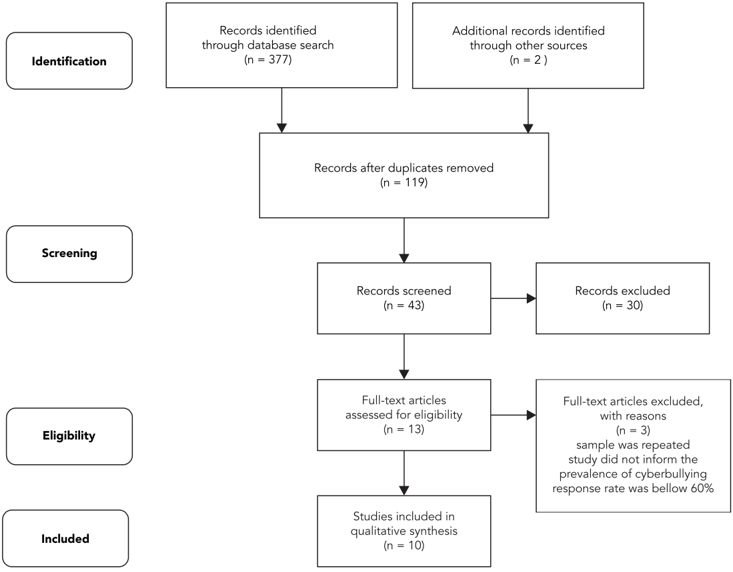
Cyberbullying is a new form of violence that is expressed through electronic media and has given rise to concern for parents, educators and researchers. In this paper, an association between cyberbullying and adolescent mental health will be assessed through a systematic review of two databases: PubMed and Virtual Health Library (BVS). The prevalence of cyberbullying ranged from 6.5% to 35.4%. Previous or current experiences of traditional bullying were associated with victims and perpetrators of cyberbullying. Daily use of three or more hours of Internet, web camera, text messages, posting personal information and harassing others online were associated with cyberbullying. Cybervictims and cyberbullies had more emotional and psychosomatic problems, social difficulties and did not feel safe and cared for in school. Cyberbullying was associated with moderate to severe depressive symptoms, substance use, ideation and suicide attempts. Health professionals should be aware of the violent nature of interactions occurring in the virtual environment and its harm to the mental health of adolescents.
Overview
The claims and statistics of this paper haven’t been checked yet.
Free: it reads the open-access text and checks the first 5 claims that cite a source we can check. Create a free account to check every claim.
Integrity signals
Registry
Cites
Statistics
Figures
Verification
Claims the paper makes
The claims and statistics of this paper haven’t been checked yet.
Free: it reads the open-access text and checks the first 5 claims that cite a source we can check. Create a free account to check every claim.
Claims other papers make about this one
Each is checked against this paper’s own text: does it say what the citing paper says it does?
The source backs part of the claim, not all of it — or backs it for a different population, condition or comparison.
In the citing paper
“It is associated with anxiety, depressive symptoms and suicidal ideation, and reportedly has a stronger association with depressive symptoms and suicidal ideation than traditional bullying (Bottino, Bottino, Regina, Correia, & Ribeiro, 2015;Fahy et al., 2016;Hamm et al., 2015;John et al., 2018;Katsaras et al., 2018;Nixon, 2014;van Geel, Vedder, & Tanilon, 2014).”
From Young people’s conceptualizations of the nature of cyberbullying: A systematic review and synthesis of qualitative research (2020) · cites this paper as Bottino et al., 2015
Experimental — accuracy not yet measuredIn the citing paper
“It is associated with anxiety, depressive symptoms and suicidal ideation, and reportedly has a stronger association with depressive symptoms and suicidal ideation than traditional bullying (Bottino, Bottino, Regina, Correia, & Ribeiro, 2015;Fahy et al., 2016;Hamm et al., 2015;John et al., 2018;Katsaras et al., 2018;Nixon, 2014;van Geel, Vedder, & Tanilon, 2014).”
From Young people’s conceptualizations of the nature of cyberbullying: A systematic review and synthesis of qualitative research (2020) · cites this paper as Bottino et al., 2015
Self-check
Percentages, sums and reported differences re-computed from the paper’s own numbers.
The self-check needs the paper’s full text.
Citations
Cites
Preferred Reporting Items for Systematic Reviews and Meta-Analyses: the PRISMA statement
Moher, D., Liberati, A., Tetzlaff, J., Altman, D. G., & for the PRISMA Group (2009) · BMJ · doi:10.1136/bmj.b2535 · Cited by 83,823
The CES-D Scale: A Self-Report Depression Scale for Research in the General Population
Radloff, L. S. (1977) · Applied Psychological Measurement · doi:10.1177/014662167700100306 · Cited by 53,267
Society and the Adolescent Self-Image
Rosenberg, M. (1965) · doi:10.1515/9781400876136 · Cited by 30,126
Diagnostic and Statistical Manual of Mental Disorders.
Widiger, T. A. (2000) · Encyclopedia of Psychology, Vol. 3. · doi:10.1037/10518-009 · Cited by 19,744
The Strengths and Difficulties Questionnaire: A research note
Goodman, R. (1997) · Journal of Child Psychology and Psychiatry · doi:10.1111/j.1469-7610.1997.tb01545.x · Cited by 14,908
Johnston, L. D., O'Malley, P. M., Bachman, J. G., & Schulenberg, J. E. (2009) · PsycEXTRA Dataset · doi:10.1037/e560352009-001 · Cited by 6,921
(1991) · Cited by 3,844
Cyberbullying: Its nature and impact in secondary school pupils
Smith, P. K., Mahdavi, J., Carvalho, M., Fisher, S., Russell, S., & Tippett, N. (2008) · Journal of Child Psychology and Psychiatry · doi:10.1111/j.1469-7610.2007.01846.x · Cited by 3,639
Hawker, D. S. J., & Boulton, M. J. (2000) · Journal of Child Psychology and Psychiatry · doi:10.1111/1469-7610.00629 · Cited by 2,694
Tokunaga, R. S. (2010) · Computers in Human Behavior · doi:10.1016/j.chb.2009.11.014 · Cited by 2,566
Research works printed but not linked: 1
- 32. Cad. Saúde Pública, Rio de Janeiro, 31(3):463-475, mar, 2015
Cited by
Items 201–300 of 439
A Qualitative Study on Problems of Young People and Ways of Religious Coping in Türkiye
Çinici, M. (2024) · İlahiyat Tetkikleri Dergisi · doi:10.29288/ilted.1457901 · Cited by 8
Hasan, M., & Amin, M. A. (2024) · PLoS ONE · doi:10.1371/journal.pone.0314283 · Cited by 11
“The higher rate of cyberbullying and internet-based violence among married adolescents could be attributed to their mental health status, through decreasing self-esteem and problematic behavior, which is often associated with a higher rate of depressive symptoms [65, 66].”
Cyberbullying victimization among university students- a national study of Pakistan
Saleem, S., Khan, N. F., Zafar, S. N., & Ahmed, M. (2025) · Security Journal · doi:10.1057/s41284-025-00470-8 · Cited by 8
“The rates of CB victimization prevalence range from 14% for primary school children (Foody et al. 2017) to 25–35% for middle/high school students (Hamm et al. 2015; Bottino et al. 2015).”
DEPRESSÃO NA ADOLESCÊNCIA E COMPORTAMENTO SUICIDA: UMA REVISÃO INTEGRATIVA
Ramos, A. S. M. B., Mesquita, S., Pessoa, D., Fontenele, R. M., & Sousa, I. (2018) · Enciclopédia Biosfera · doi:10.18677/encibio_2018a123 · Cited by 5
Psychiatric Symptomatology is Associated with Polydrug Use and School Violence in Early Adolescence
García-Cerde, R., de Oliveira, C. W. L., Ferreira‐Junior, V., Caetano, S. C., & Sanchez, Z. M. (2021) · Child Psychiatry & Human Development · doi:10.1007/s10578-021-01228-0 · Cited by 7
Cyberbullying and suicidal behaviour: What is the connection? About a case
Escobar-Echavarría, J., González, L. E. M., Restrepo, D., & Mejía-Rodríguez, D. (2017) · Revista Colombiana de Psiquiatría (English ed ) · doi:10.1016/j.rcpeng.2017.09.004 · Cited by 8
Kasimova, L. N., Svyatogor, M. V., & Sychugov, E. M. (2022) · Суицидология · doi:10.32878/suiciderus.22-13-02(47)-74-91 · Cited by 9
CYBERBULLYING AMONG ADOLESCENTS AND ONLINE INFORMATION SEEKING ABOUT MENTAL HEALTH
Gazibara, T. M., Cakić, M., Cakic, J., Grgurević, A., & Pekmezovic, T. D. (2023) · Psychiatria Danubina · doi:10.24869/psyd.2023.369 · Cited by 5
“A systematic review of the influence of cyberbullying on mental health in ado - lescents suggested that students who experienced cyber - bullying are at risk of poorer mental health worldwide (Bottino et al. 2015).”
Pérez-Sastre, M. A., García‐Peña, C., Lira, L. R., & Ortiz-Hernández, L. (2024) · Gaceta Sanitaria · doi:10.1016/j.gaceta.2024.102408 · Cited by 6
Research on cyberbullying and suicide: a bibliometric analysis
Denche-Zamorano, Á. M., Mendoza-Muñoz, M., Barrios‐Fernández, S., Galán-Arroyo, C., Adsuar, J. C., & Rojo-Ramos, J. (2024) · Psychology in the Schools · doi:10.1002/pits.23327 · Cited by 6
Bachmeier, O. A., & Cardozo, G. (2024) · Revista de Psicología · doi:10.46553/rpsi.20.40.2024.p108-132 · Cited by 9
Children’s (Non-)Participation in Cyberbullying and Emotional, Behavioural Problems
Raižienė, S., & Pakalniškienė, V. (2019) · Psichologija · doi:10.15388/psichol.2019.10 · Cited by 8
Birgisson, O., Hysing, M., Eriksen, H. R., Jóhannsson, E., & Gestsdóttir, S. (2023) · Scandinavian Journal of Public Health · doi:10.1177/14034948231161382 · Cited by 12
Huong, X. V. (2023) · International Journal of Current Science Research and Review · doi:10.47191/ijcsrr/v6-i10-05 · Cited by 8
Castro-Granados, M. M. A., Medina-Almeida, M. C., & Glasserman‐Morales, L. D. (2017) · CPU-e Revista de Investigación Educativa · doi:10.25009/cpue.v0i24.2409 · Cited by 5
“Por su parte, Borges et al. (2015), afirman que los padres de familia y los maestros deben conocer las implicaciones y riesgos de las comunicaciones electrónicas y, por ende, facilitar el diálogo sobre el tema, con el fin de brindar al estudiante una comunicación efectiva de los diferentes sucesos…”
BackgroundCyberbullying and Emotional-Behavioral Functioning Among Northern Thai Adolescents
Louthrenoo, O. (2019) · Biomedical Journal of Scientific & Technical Research · doi:10.26717/bjstr.2019.17.003011 · Cited by 6
“A meta-analysis found that victims of cyberbullying were at higher risk of both suicidal ideation and suicide attempts [14] whereas another study has found that cyberbullying was associated with moderate to severe depressive symptoms, substance use, and suicide attempts [5].”
BackgroundCyberbullying and Its Contributing Factors Among Iranian Adolescents
Shariatpanahi, G., Tahouri, K., Asadabadi, M., Moienafshar, A., Nazari, M., & Sayarifard, A. (2021) · international journal high risk behaviors & addiction · doi:10.5812/ijhrba.112178 · Cited by 6
Kim, S., Ahn, S.-K., Yang, E. S., Kim, S., & Chung, I.-J. (2026) · Journal of Technology in Human Services · doi:10.1080/15228835.2026.2647023 · Cited by 4
Behind the Screen: How Gaming Habits, Motives, and Content Shape Cyberbullying Behaviour
Hu, Y., Clancy, E. M., & Klettke, B. (2025) · International Journal of Bullying Prevention · doi:10.1007/s42380-025-00320-6 · Cited by 4
“…consequences, such as decreased self-esteem and increased stress, anxiety, and depression (Cole et al., 2020; Fryling et al., 2015; Zsila et al., 2022), with symptoms potentially culminating in suicidal ideation and attempts (Achuthan et al., 2023; Bottino et al., 2015; John et al., 2018).”
Virtual Violence as a Contributing Factor to the Mental Health of Young People: A Scoping Review
Silva, R. V. D. S., Moura, H. S. D., de Araujo, P. N., dos Santos, F. L., & Fortuna, C. M. (2025) · Canadian Journal of Nursing Research · doi:10.1177/08445621251364528 · Cited by 6
“(Bottino et al., 2015) [S3] Brazil n = 10 To review and evaluate the associations between cyberbullying and mental health problems in adolescents.”
InfluentialDavies, J., Cadwallader, S., Black, L., Dunne, J. H., & Panayiotou, M. (2025) · BMC Public Health · doi:10.1186/s12889-025-23897-5 · Cited by 10
Liang, Q., Tao, S., Pan, Q., Lan, M., Guo, Z., Li, W., Li, Y., Tan, C. Y., & Law, N. W. Y. (2025) · Humanities and Social Sciences Communications · doi:10.1057/s41599-025-06395-2 · Cited by 6
“…substance use (Carvalho et al., 2021), both individuals engaging in cyberbullying and those experiencing cyber victimization exhibited increased emotional dif fi cul-ties, physical complaints, social challenges, and a reduced sense of security (Bottino et al., 2015), diminishing overall well-being.”
Developmental Issues in the Prevention of Aggression and Violence in School
Goldstein, S. E., Terranova, A. M., Savoy, S. C., Bradley, S., Park, J., & Boxer, P. (2023) · Springer eBooks · doi:10.1007/978-3-031-13134-9_3 · Cited by 7
Lessons from Cyberpsychology that Educators Should be Reminded of
Jusić, M. (2023) · Društvene i humanističke studije · doi:10.51558/2490-3647.2023.8.1.567 · Cited by 4
Bonsaksen, T., Kleppang, A. L., & Steigen, A. M. (2024) · Behavioral Sciences · doi:10.3390/bs14111043 · Cited by 5
The Changing Face of Bullying and What We Can Do to Stop It
Khan, L. (2021) · Pediatric Annals · doi:10.3928/19382359-20210912-02 · Cited by 4
Digital space and its influence on the lifestyle and health of students: A literature review
Shubochkina, E. I. (2021) · Sociology of Medicine · doi:10.17816/1728-2810-20-1-91 · Cited by 6
Adolescents’ Methods for Coping with Cyberbullying
Gavcar, E. G., Büber, A., & Şenol, H. (2024) · Çocuk ve Gençlik Ruh Sağlığı Dergisi / Turkish Journal of Child and Adolescent Mental Health · doi:10.4274/tjcamh.galenos.2022.32932 · Cited by 9
Cardozo, G. (2020) · Revista Iberoamericana de Psicología · doi:10.33881/2027-1786.rip.13105 · Cited by 13
Zulfa, H. A., Rizki Fitryasari, P. K., & Dewi, L. C. (2020) · Psychiatry Nursing Journal (Jurnal Keperawatan Jiwa) · doi:10.20473/pnj.v2i2.22237 · Cited by 6
THE RELATIONSHIP BETWEEN SOCIAL MEDIA USE AND DEPRESSION IN COLLEGE STUDENTS: A SCOPING REVIEW
Wu, S. Y. (2019) · Digital Commons-TMC (Texas Medical Center) · Cited by 6
The Psychological Factors and Treatment of Cyberbullying
刘, 言. (2019) · Advances in Psychology · doi:10.12677/ap.2019.95097 · Cited by 5
Ahmmad, M., Iqbal, N., & Naz, W. (2024) · Media and Communication Review · doi:10.32350/mcr.42.02 · Cited by 6
Honor, fear, and coercion: cyberbullying and blackmailing in Palestinian society
Hamamra, B. T., Mahamid, F., & Bdier, D. (2025) · Security Journal · doi:10.1057/s41284-025-00509-w · Cited by 3
Gender Differences in Image-Based Sexual Abuse and Cyberbullying Victimization
Hu, Y., Clancy, E. M., & Klettke, B. (2025) · International Journal of Bullying Prevention · doi:10.1007/s42380-025-00329-x · Cited by 3
Cyberbullying and emotional vulnerabilities: role of coping styles
Manzoor, Z., Sadiq, U., & Baig, K. B. (2026) · BMC Psychology · doi:10.1186/s40359-026-04021-7 · Cited by 4
Abikoye, O. C., Gboyega, O., Ogundokun, R. O., Babatunde, A. O., & Lee, C. (2024) · Security and Privacy · doi:10.1002/spy2.480 · Cited by 3
“…of CB are profoundly damaging, including emotional distress (such as rage, anxiety, and self-blame), psychological harm (including diminished self-esteem, despair, and even suicidal tendencies), and physical ailments (such as sleep disturbances, headaches, and eating disorders) ([5-7]; and [8]).”
Peprah, P., Oduro, M. S., & Addo, I. Y. (2024) · Child Abuse & Neglect · doi:10.1016/j.chiabu.2024.107213 · Cited by 5
Bullying e saúde mental de estudantes do ensino fundamental e médio
Mansur, T. S., & Portugal, F. B. (2025) · Revista Brasileira de Pesquisa em Saúde/Brazilian Journal of Health Research · doi:10.47456/rbps.v27isupl_1.48255 · Cited by 3
Özkan, Y., Sadıç, Ç. Ç., Özmutlu, A. G., Kara, A., & Gerçek, H. G. (2025) · OSMANGAZİ JOURNAL OF MEDICINE · doi:10.20515/otd.1619413 · Cited by 3
عوامل التنبؤ بالتنمر الإلكتروني لدى الأطفال والمراهقين: مراجعة للدراسات السابقة
البراشدية, ح. س. أ. (2020) · Journal of Information Studies & Technology (JIS&T) · doi:10.5339/jist.2020.6 · Cited by 3
Ciberacoso y su relación con la intencionalidad suicida en adolescentes de 12 a 17 años
Santo, R. S. Q., & Fernández, A. L. (2021) · Pro Sciences Revista de Producción Ciencias e Investigación · doi:10.29018/issn.2588-1000vol5iss38.2021pp103-112 · Cited by 9
Warning Signs of Threats to Student Safety: Recommendations for Virtual School Counseling
Ellington, B. (2022) · Professional School Counseling · doi:10.1177/2156759x211067964 · Cited by 3
“Evidence of perpetuating internal emotional distress may appear through physical indicators (Bottino et al., 2015), including deterioration in personal hygiene, excessive fatigue or exhaustion, drastic changes in physical appearance (e.”
BackgroundWongchinsri, T., Chaiudomsom, K., Piyavhatkul, N., Piyawattanametha, S., & Bunpromma, W. (2022) · Journal of Population and Social Studies · doi:10.25133/jpssv302022.036 · Cited by 3
Associação entre possível bruxismo e violência em adolescentes escolares: estudo exploratório
Carvalho, M. B. D. R., Barbosa, A. T. L., dos Santos, J. C., de Sales, A. D. N., da Franca›, C., de Menezes, V. A., Colares, V., & de Godoy, F. (2023) · Revista Eletrônica Acervo Saúde · doi:10.25248/reas.e11824.2023 · Cited by 3
Bullying escolar e cyberbullying
Ristum, M., & Ferreira, T. R. D. S. C. (2023) · Editora FIOCRUZ eBooks · doi:10.7476/9786557082126.0006 · Cited by 59
Alshehry, A. A., Sulaiman, W. S. W., Khairudin, R., & Abdullah, N.-A. (2023) · F1000Research · doi:10.12688/f1000research.141431.1 · Cited by 3
Dias, D. T., Claumann, G. S., Ribovski, M., Folle, A., Farias, G. O., Silva, D. A. S., & Pelegrini, A. (2018) · Revista Paulista de Pediatria · doi:10.1590/1984-0462/;2018;36;3;00005 · Cited by 4
Online safety: The impact of the coronavirus pandemic on children in the UK
Allkins, S. (2021) · British Journal of Child Health · doi:10.12968/chhe.2021.2.2.69 · Cited by 3
Ciberbullying en estudiantes del nivel secundario de la sierra central de Perú
Orosco-Fabian, J. R., Huaytalla, R. P., Puchoc, A. M. R., & Atoc, N. R. A. (2022) · REVISTA CIENCIAS PEDAGÓGICAS E INNOVACIÓN · doi:10.26423/rcpi.v10i1.439 · Cited by 3
Conceitos e temas relacionados à saúde do adolescente na formação em enfermagem
Cassiani, S. H. D. B., Dias, B. M., Beltrán, M. P. B., Gualdrón, L. M. V., Pérez, T. R., Aguilar, G. M. V., Ponce, R. A. L., & Valdivia, A. R. C. (2022) · Revista Latino-Americana de Enfermagem · doi:10.1590/1518-8345.6166.3652 · Cited by 6
“Bullying e cyberbullying 22 (23,2) 26 (27,4) 33 (34,7) 8 (8,4)”
BackgroundHsiao, S., Cheng, C., Lin, I.-J., Yu, C.-P., Huang, Y.-C., Huang, S.-H., Sun, C., Fann, L.-Y., Sheu, M.-Y., & Chien, W. (2022) · International Journal of Environmental Research and Public Health · doi:10.3390/ijerph192013169 · Cited by 7
Brain Health in the Digital Era
Mahdi, S. S., Gunjal, S., Babar, M. G., Sakina, S., & Andiesta, N. S. (2023) · Springer eBooks · doi:10.1007/978-981-99-6637-0_7 · Cited by 3
Surin, O. S., & Blankenship, R. J. (2019) · International Journal of Cyber Behavior Psychology and Learning · doi:10.4018/ijcbpl.2019100101 · Cited by 3
Concern on cyber violence and suicide during COVID-19 pandemic
Liu, Z., Yang, R., & Liu, H. (2022) · Frontiers in Psychiatry · doi:10.3389/fpsyt.2022.956328 · Cited by 4
Martínez, M. D. L. H., Rubio, E. L., & Jiménez, S. Y. (2020) · Revista Virtual Universidad Católica del Norte · doi:10.35575/rvucn.n61a6 · Cited by 6
Analyzing Abusive Comments in Bangla: Machine Learning Study of Feminism on Social Media
Islam, M. A., Aka, A. C., Akter, A., & Rahman, M. M. (2024) · Lecture notes in networks and systems · doi:10.1007/978-981-97-1961-7_25 · Cited by 2
Ergenlerde Siber Zorbalık: Bilişsel Esneklik ve Duygusal Zekanın Rolü
Kıran, F., Kalyon, A., & Koca, F. (2025) · Pamukkale University Journal of Education · doi:10.9779/pauefd.1381030 · Cited by 2
Eirich, R., McArthur, B. A., Deneault, A., Tough, S., & Madigan, S. L. (2025) · Computers in Human Behavior · doi:10.1016/j.chb.2025.108762 · Cited by 2
Towards Enhanced Cyberbullying Detection: A Unified Framework with Transfer and Federated Learning
Kumari, C., & Kaur, M. (2025) · Systems · doi:10.3390/systems13090818 · Cited by 3
Eberhart, L., & Decker, A. (2025) · SDG - Forschung, Konzepte, Lösungsansätze zur Nachhaltigkeit · doi:10.1007/978-3-658-47879-7_15 · Cited by 4
Farkas, B. F., Győri, D., Komáromy, D., Garas, P., Kollárovics, N., Horváth, L. O., & Balázs, J. (2025) · Scandinavian Journal of Child and Adolescent Psychiatry and Psychology · doi:10.2478/sjcapp-2025-0013 · Cited by 4
“The lifetime prevalence of CB is 10 – 20% among adolescents, but there are big differences among the populational samples (12, 16, 19, 21-24).”
Salud Integral en la Era Digital: Bienestar Físico, Mental y Ocupacional desde un Enfoque Preventivo
Naranjo, D. E. G., Huera, C. K. R., Ponce-Regalado, D. S., Escobar, N. M. T., Miguez-Quincha, M. D. L., Zambrano-Bravo, M. K., Mieles-Reyes, N. V., Racines-Romero, M. F., Ruiz-Sánchez, A. E., & Dominguez-Lara, O. E. (2026) · doi:10.63618/omeditorial/l8 · Cited by 2
Mathys, C., & Claes, S. (2020) · Neuropsychiatrie de l Enfance et de l Adolescence · doi:10.1016/j.neurenf.2020.02.003 · Cited by 2
Social Media and Athlete Mental Health and Well-Being
Hayes, M. (2022) · Emerald Group Publishing Limited eBooks · doi:10.1108/s1476-285420220000015026 · Cited by 10
LIAO, Y. (2023) · Lecture Notes in Education Psychology and Public Media · doi:10.54254/2753-7048/3/2022503 · Cited by 3
“According to research, adolescent emotional instability and negative emotions are heavily related to online violence [10].”
BackgroundUMA REVISÃO SISTEMÁTICA SOBRE CYBERBULLYING NAS ESCOLAS
Gadelha, V. C., & de Sousa, R. R. (2024) · RECIMA21 - Revista Científica Multidisciplinar · doi:10.47820/recima21.v5i9.5650 · Cited by 5
Shi, Y. L., Fu, L., Li, S., Jiang, K., Shi, Z., Sharma, M. K., & Zhao, Y. (2024) · Frontiers in Nutrition · doi:10.3389/fnut.2024.1418950 · Cited by 2
Los cuidados de Enfermería en los problemas de conducta durante la transición adolescente
Cardesín, M. R., & Marcos, A. P. (2020) · Revista Científica de Enfermería · doi:10.14198/recien.2020.19.04 · Cited by 4
Tarasova, S. (2021) · Psychology in Russia State of Art · doi:10.11621/pir.2021.0409 · Cited by 3
Bullying, cyberbullying, and suicide
Nadeem, T., Hamid, S. N., Mahr, F., & Asad, N. (2024) · Oxford University Press eBooks · doi:10.1093/med/9780198843405.003.0019 · Cited by 2
Utjecaj društvenih mreža na samopoštovanje i mentalno zdravlje mladih
Tomić, I. J., Mulić, R., & Jadrić, A. M. (2020) · In medias res · doi:10.46640/imr.9.17.4 · Cited by 2
Austys, D., Sprudzanaitė, A., & Stukas, R. (2022) · Behavioral Sciences · doi:10.3390/bs12060185 · Cited by 4
Cybervictimisation and Well-Being during the Outbreak of COVID-19: The Mediating Role of Depression
Palermiti, A. L., Bartolo, M. G., Servidio, R. C., & Costabile, A. (2022) · Healthcare · doi:10.3390/healthcare10091627 · Cited by 2
CYBERBULLYING E SEUS REFLEXOS NA SAÚDE MENTAL E SOCIAL DE JOVENS ADOLESCENTES
Silva, B. V. V. D., Caminha, A. B., Saraiva, D. S. D. S., Barbosa, L. G. D., Lima, V. V. C., Pereira, T. E. D. S., & Martins, G. D. C. (2023) · Revista Contemporânea · doi:10.56083/rcv3n11-185 · Cited by 2
Cyberbullying and Its Impact on Adolescent Emotional Well-Being
Hafizi, M. Z. (2024) · International Journal of Applied Research and Sustainable Sciences · doi:10.59890/ijarss.v2i1.1284 · Cited by 5
Factors behind suicides in Muslim countries: a global ecological study
Shoib, S., Tayyeb, M., Armiya’u, A. Y., Raaj, S., Elmahi, O. K. O., Swed, S., Saeed, F., Nahidi, M., Bashir, A., & Chandradasa, M. (2024) · Social Work in Mental Health · doi:10.1080/15332985.2024.2323040 · Cited by 2
“Various factors contribute to the increased risk of suicide, including feelings of hopelessness, mental illnesses, substance use, and psychosocial stressors (Bottino et al., 2015).”
BackgroundArabshahi, F., Fakhri, A., Serami, M., Ketabi, M., Golestaneh, Z., Akbari, H., & Asadollahezare, M. (2017) · International Journal of School Health · doi:10.5812/intjsh.59607 · Cited by 2
“Although the study implied that some social harm were emerged from social networking, but it could be supposed that the social behaviors hidden by traditional barriers are found out through social networks; hence, there is an ambiguity about the causal direction of the association between bullying and social networkin…”
BackgroundDealing with mental health in the pediatric emergency department
McCollum, D., & Beattie, T. J. (2021) · European Journal of Emergency Medicine · doi:10.1097/mej.0000000000000822 · Cited by 2
Myburgh, J.-E. (2018) · University Library - University of Saskatchewan (University of Saskatchewan) · Cited by 2
Dietary patterns and smartphone use in adolescents: A large-sample, cross-sectional studyPreprint
Kim, K. M., Lee, I., Kim, J. W., & Choi, J.-W. (2020) · Research Square · doi:10.21203/rs.3.rs-33267/v1 · Cited by 3
Singh, B., Schandl, C. A., & Tormos, L. M. (2016) · Academic Forensic Pathology · doi:10.23907/2016.052 · Cited by 1
المناخ الأسري وعلاقته بالتنمر الإلکتروني لدى طلاب المرحلة الثانوية
أحمد, إ. أ. أ. (2021) · Buḥūṯ /Buḥūṯ · doi:10.21608/buhuth.2021.94242.1183 · Cited by 1
Surin, O. S., & Blankenship, R. J. (2020) · IGI Global eBooks · doi:10.4018/978-1-7998-5360-2.ch006 · Cited by 1
Exploring adult cyber-harassment: key predictors of victimisation
Popham, J., Reynolds, D., Nevin, A. D., & Broll, R. (2025) · Global Crime · doi:10.1080/17440572.2025.2554863 · Cited by 2
“Cyber-harassment victimisation rates have scaled with the popularisation of the internet, affecting 20 to 40% of young people (aged 11–18 years) per several recent studies and meta-analyses (e.g. Aboujaoude et al., 2015; Bottino et al., 2015; Hinduja & Patchin, 2012).”
Vogler, S., Johns, M. M., Khanna, S., Lancaster, C., Sheridan-Johnson, J., Beach, L. B., & Mumford, E. A. (2025) · Journal of Interpersonal Violence · doi:10.1177/08862605251399680 · Cited by 1
Popović, S., & Vejmelka, L. (2026) · Children and Youth Services Review · doi:10.1016/j.childyouth.2026.108915 · Cited by 1
The Nature and Scope of Peer-to-Peer Exploitation and Abuse: Towards a Typology of ‘Harm’
McAlinden, A. (2018) · Cambridge University Press eBooks · doi:10.1017/9781316534847.006 · Cited by 1
Conceptos y temas relacionados a la salud de los adolescentes en la formación en enfermería
Cassiani, S. H. D. B., Dias, B. M., Beltrán, M. P. B., Gualdrón, L. M. V., Pérez, T. R., Aguilar, G. M. V., Ponce, R. A. L., & Valdivia, A. R. C. (2022) · Revista Latino-Americana de Enfermagem · doi:10.1590/1518-8345.6166.3650 · Cited by 3
The characterizations and the anonymity of comments: A case study on Lizzo’s videos
Kang, Y., & Yoo, H. S. (2025) · Journal of Emerging Investigators · doi:10.59720/23-193 · Cited by 1
Negative Online Experiences and Reporting Rates in Youth With Mental Health Conditions
Kass, M., Alexander, L. M., Connell, T., Hamaneh, S. B., Abdullah, N., Freund, M. P., Milham, M. P., & Nikolaidis, A. (2026) · JAACAP Open · doi:10.1016/j.jaacop.2026.04.001 · Cited by 2
“7,12,13 Although negative long-term effects (eg, worsening depression) have been noted by longitudinal studies, 16 few have explored variances among different forms of NOE.”
Ruimassa, A. A., Pieter, J. J. R., Patty, M. M., & Nanuru, R. F. (2025) · Jurnal Ilmiah Religiosity Entity Humanity (JIREH) · doi:10.37364/jireh.v7i1.337 · Cited by 1
From Fun to Fear: Unveiling the Nexus of Cyberbullying and Online Gaming
Soni, P., Shruti, K., Srivastav, S., & Singh, R. (2025) · International Journal of Interdisciplinary Approaches in Psychology · doi:10.61113/ijiap.v3i7.1103 · Cited by 1
Awareness and Prevalence of Deepfake Cyberbullying: A Study of Polish Students Aged 12‒15
Rajba, B., & Glowacki, B. (2025) · Psychologia Wychowawcza · doi:10.71358/pw.2524 · Cited by 1
“Furthermore, existing research on traditional (non-AI-assisted) cyberbullying shows that it tends to occur less frequently in adulthood (Wang et al., 2019) and that its intensity varies significantly across countries (Bottino et al., 2015).”
Duc, T. M. (2026) · Emotional and Behavioural Difficulties · doi:10.1080/13632752.2026.2649694 · Cited by 1
Social Media Use and Adolescent Mental Health: A Narrative Review
Tripathy, J. S., & Tripathy, D. (2026) · Journal of South Asian Issues (JSAI) · doi:10.65826/jsai.1.2.2026.58 · Cited by 1
“Keles et al. (2020) highlighted that online harassment is strongly correlated with lowered self-esteem, persistent anxiety, and prolonged depressive symptoms among adolescents (Hinduja & Patchin, 2013; Bottino et al., 2015).”
Actual Situation of Adolescent Suicide and Consideration of Suicide Prevention for Them
Eto, N., & Kawasaki, H. (2017) · Kyushu Neuropsychiatry · doi:10.11642/kyushuneurop.63.2_75 · Cited by 1
Patel, B., Suresh, V. C., Patel, B., Patel, J., Patel, K., Patel, K., & Patel, K. (2021) · Journal of Pharmaceutical Research International · doi:10.9734/jpri/2021/v33i47a33050 · Cited by 1
“Health professionals should be aware of the violent nature of interactions occurring in the virtual environment and its harm to the mental health of adolescents [6].”
BackgroundDevelopmental aspects (including cyberbullying)
Mestre‐Bach, G., Fernández‐Aranda, F., Jiménez‐Múrcia, S., & Potenza, M. N. (2021) · Elsevier eBooks · doi:10.1016/b978-0-12-822201-0.00007-1 · Cited by 1
The Good, the Bad, and the Potential
Militello, L. K., & Hutson, E. (2022) · Advances in Family Practice Nursing · doi:10.1016/j.yfpn.2021.12.011 · Cited by 1
Metadata
- Authors
- Bottino, S. M. B., Bottino, C. M. C., Regina, C. G., Correia, A. V. L., & Ribeiro, W. S.
- Affiliations
- Universidade Federal de São Paulo (BR)
- Universidade de São Paulo (BR)
- Universidade Federal de São Paulo, Brasil
- Venue
- Cadernos de Saúde Pública
- Publisher
- FapUNIFESP (SciELO)
- Published
- 2015-03
- Volume
- 31
- Issue
- 3
- Pages
- 463-475
- ISSN
- 0102-311X (ISSN-L)
- OpenAlex
- W2126006743
- Semantic Scholar
- c1e65861719844ee35d6fa172d06cc0f08e3a555
- Cited by
- 418
- References
- 43
- Citations by year
- 2026: 37 · 2025: 46 · 2024: 52 · 2023: 56 · 2022: 62 · 2021: 40 · 2020: 41 · 2019: 23 · 2018: 35 · 2017: 13 · 2016: 8 · 2015: 4
- FWCI
- 3.12
- Type
- journal article
- Language
- en
- Open access
- diamond
- doi.org
- Licence
- cc-by-nc
- Locations
- Cadernos de Saúde Pública (publishedVersion, cc-by-nc)
- LA Referencia (Red Federada de Repositorios Institucionales de Publicaciones Científicas) (publishedVersion, other-oa)
- PubMed (publishedVersion)
- Americanae (AECID Library) (submittedVersion, cc-by-nc)
- DOAJ (DOAJ: Directory of Open Access Journals) (submittedVersion, cc-by-sa)
- LA Referencia (Red Federada de Repositorios Institucionales de Publicaciones Científicas) (submittedVersion, other-oa)
- Funders
- Universidade de São Paulo
- Topics
- Social Sciences › Psychology › Social Psychology › Bullying, Victimization, and Aggression
- Social Sciences › Sociology and Political Science › Impact of Technology on Adolescents
- Social Sciences › Sociology and Political Science › Stalking, Cyberstalking, and Harassment
- Keywords
- cyberbullying, adolescent mental health, prevalence of cyberbullying, traditional bullying, depressive symptoms, suicide attempts, substance use, psychosomatic disorders, social difficulties, online harassment, internet use
- MeSH terms
- Adolescent, Adolescent Behavior, Brazil, Child, Depression, Humans, Mental Health, Risk Factors, Suicide, Crime Victims, Substance-Related Disorders, Internet, Bullying
About these checks
Registry, retraction, Cites and statistics results are computed, not judged, with one exception: a printed reference that no index lists is read once by a model before it counts as a citation error. Claims are extracted by a model and kept only when their quote appears verbatim in the text; each cited source is then checked, with a model’s help, for whether it says what the claim relies on. Those verdicts can be wrong — read the claim’s quote and the cited source before relying on one.
Statistics and arithmetic are recomputed, not judged.
Confidence bands are shown only for fields calibrated on our annotated test set. None is calibrated yet, so no band is shown.
What counts as a claim ›How we measure confidence ›How we check this ›
Are you an author, or do you see a problem with this page? Request a review
Data sources
Bibliographic data: Semantic Scholar, OpenAlex, Crossref.
Contains information from the Semantic Scholar Academic Graph Datasets, made available under the ODC Attribution License (ODC-BY 1.0).
Semantic Scholar’s data is described in: Kinney, R., et al. (2023). The Semantic Scholar Open Data Platform. arXiv:2301.10140.
