

Healthy eating among people with type 2 diabetes in the Brazilian Amazon: a qualitative study in primary health care
Open accessThe DOI matches its Crossref record; 38 of the 39 references it cites were found in a registry or an index; 15 of the 34 sources its claims cite were checked for support.
Abstract
Qualitative participatory study examining barriers and facilitators to healthy eating among people with T2DM and community health workers in Brazilian primary care.
Overview
CoChat Summary
TL;DR
This qualitative study explored barriers and facilitators to healthy eating among 47 people with type 2 diabetes and 17 community health workers in primary care in Iranduba, Brazilian Amazon. Despite rich local food biodiversity, financial constraints, limited family support, lack of nutritionists, and environmental/logistical problems often prevented healthy eating, while motivation, family support, and home food cultivation facilitated it.
Key findings
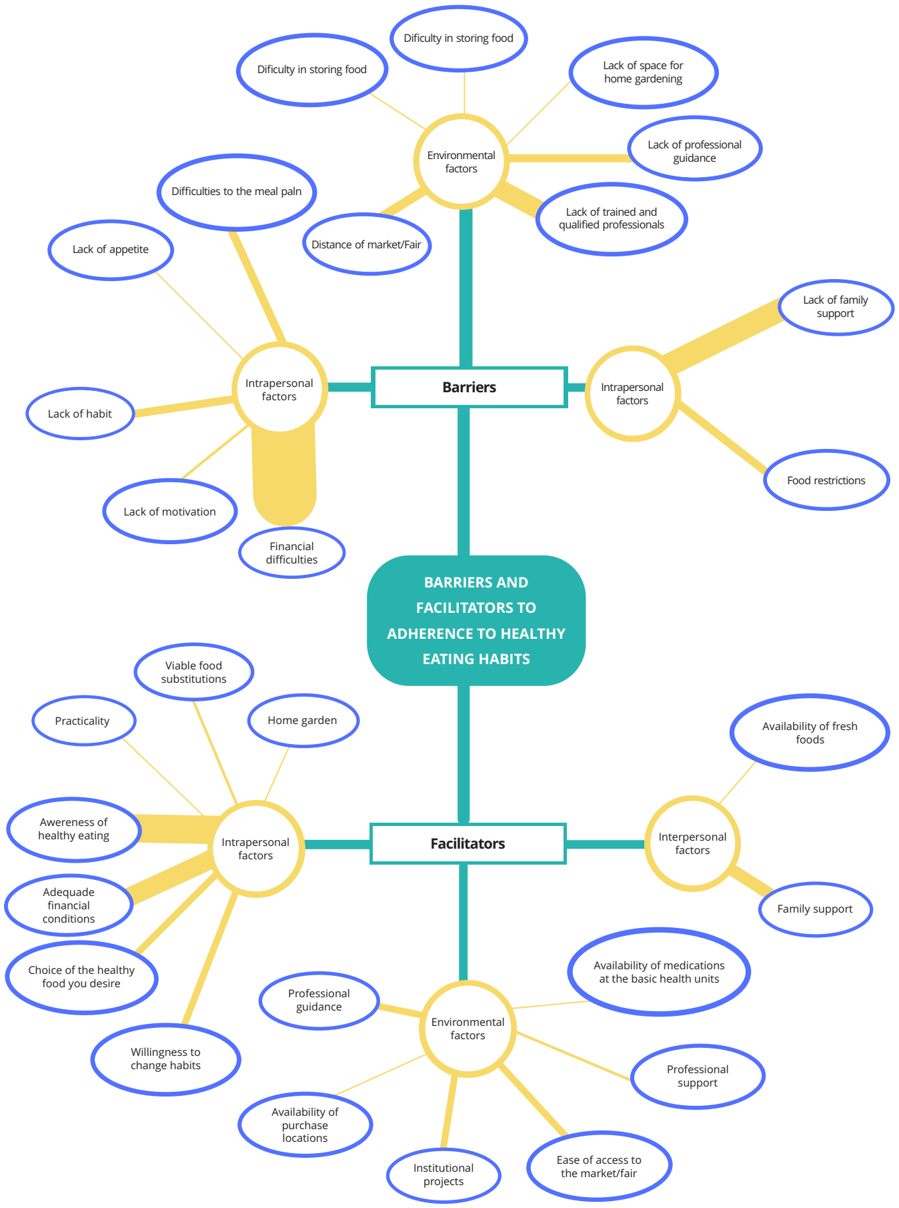
- Among 64 participants (47 type 2 diabetes patients and 17 CHWs), barriers included financial constraints—reported as the most frequently mentioned barrier—lack of family support, limited access to qualified professionals such as nutritionists, seasonal food shortages, and poor access to markets.
- Facilitators included personal motivation, dietary awareness, family support, and local food cultivation/home gardens.
- The thematic network comprised 13 basic codes for barriers and 15 for facilitators, organized into intrapersonal, interpersonal, and environmental factors.
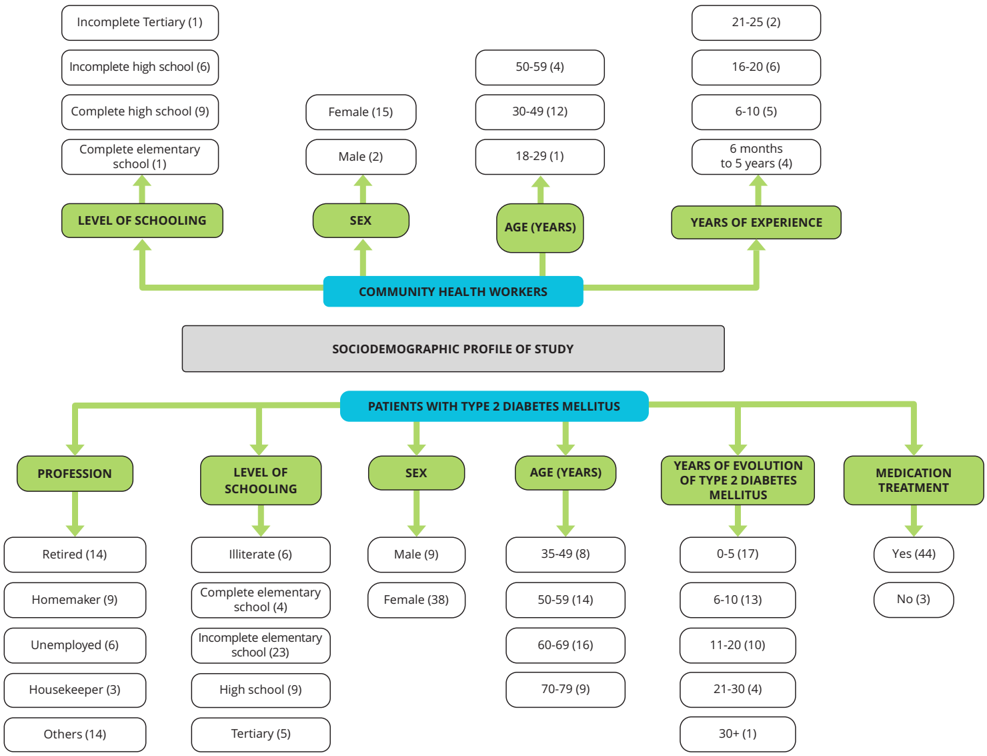
- Sample characteristics: 81.25% (52) were women; ages ranged from 30 to 79 years; among patients, 71.88% (23) had incomplete elementary school, while among CHWs, 52.94% (9) had complete high school.
Methods
- Qualitative participatory study conducted in Iranduba, Amazonas, 38.1 km from Manaus, using the COREQ checklist; participants were adult patients with type 2 diabetes diagnosed at least six months earlier and active CHWs linked to six primary health care units.
- Data collection used World Café discussion groups—separate sessions for patients and CHWs, with day 1 on barriers and day 2 on facilitators—plus semi-structured home interviews with 15 patients; total sample was 64 (47 patients, 17 CHWs), with theoretical saturation as the stopping criterion.
- Analysis used transcripts organized in ATLAS.ti, an initial deductive code set refined collaboratively, and thematic network analysis based on intrapersonal, interpersonal, and environmental levels of influence.
Limitations
- Stated: the study was conducted in a single municipality in Amazonas, which may limit applicability to other locations; qualitative work in a low-income population may involve distrust or hesitation to disclose personal information, and low literacy/communication difficulties may hinder participation.
- Evident in the text: the sample was predominantly women (81.25%) and patients had mostly low education (71.88% incomplete elementary school), which may limit transferability to men or higher-literacy groups.
- Evident in the text: the semi-structured interview script’s second part is described as exploring perceived barriers to physical activity, although the study focus is healthy eating, which may limit dietary-specific depth from the interviews.
Model-written summary. Check it against the paper before relying on it.
Integrity signals
Registry
Cites
Statistics
Figures
Verification
Claims the paper makes
10 Valid · 3 Not valid · 9 Not checked · 35 Own results and interpretations
The cited sources that could be checked couldn’t confirm or dispute this claim.
In the paper
“This limitation makes patients dependent on simpler communication from PHC units 13.”
§ Healthy eating among people with type 2 diabetes in the Brazilian Amazon: a qualitative study in primary health care > Discussion
What the sources say
- Could not verifycites [13] Nunes LB Santos JC Reis IA Torres HC Atitudes para o autocuidado em diabetes mellitus tipo 2 na atenção primária Acta Paul Enferm 2021 34 sourceExperimental — accuracy not yet measured
The Introduction discusses tailoring diabetes self-care programs to patients’ attitudes and life circumstances, while the Discussion addresses emotional and cognitive factors. Neither states that low health literacy makes patients dependent on simpler communication from primary health care units. Searches for health literacy, letramento, and simplified communication found no passage addressing that relationship. (LLM, conf=0.73)
plainstates a cause- Asserted: passes — The authors put it forward as true.
- Checkable: passes — It can be checked against evidence.
- Load-bearing: passes — The paper’s conclusions depend on it.
- Based: passes — The paper gives a reason why it holds.
- Could not verify
The cited sources support only part of this claim — read each source’s verdict below.
In the paper
“Mendes et al. 20 and Polhuis et al. 8 also addressed family participation, showing that family involvement contributes to adherence and self-management of type 2 diabetes mellitus, especially outside supervised settings.”
§ Healthy eating among people with type 2 diabetes in the Brazilian Amazon: a qualitative study in primary health care > Discussion
What the sources say
- Supportedcites [20] Mendes GF Rezende ALG Dullius J Nogueira JAD Barreiras e facilitadores da adesão a um programa de educação em diabetes a visão do usuário Rev Bras Ativ Fís Saúde 2017 22 278 289 source
The Discussion states that family involvement contributes to adherence and self-management of type 2 diabetes, particularly outside supervised settings. It also identifies family support as a facilitator of adherence to the program. Page numbers are not provided in the supplied copy. (LLM, conf=0.95)
- Partly supportedcites [8] Polhuis KCMM Vaandrager L Soedamah-Muthu SS Koelen MA Development of a salutogenic intervention for healthy eating among Dutch type 2 diabetes mellitus patients Health Promot Int 2021 36 1694 1704 33667316 PMC8827024 sourceExperimental — accuracy not yet measured
The Discussion links social support to adherence to self-management, and the Results (Phase 2: validation and adjustment) describe plans to invite partners to intervention sessions. The paper does not show that family involvement improves adherence or self-management, nor does it establish a particular benefit outside supervised settings; it describes an intervention being developed, not an observed effect. (LLM, conf=0.86)
plainstates a cause- Asserted: passes — The authors put it forward as true.
- Checkable: passes — It can be checked against evidence.
- Load-bearing: unclear — It is unclear whether the paper’s conclusions depend on it.
- Based: passes — The paper gives a reason why it holds.
- Supported
The cited sources support only part of this claim — read each source’s verdict below.
In the paper
“This study found a psychological resistance that manifest itself by an aversion to foods considered healthy − which are frequently associated with restrictive and unappealing diets in contrast to a preference for ultra-processed foods, which are often considered more palatable 37 , 38 .”
§ Healthy eating among people with type 2 diabetes in the Brazilian Amazon: a qualitative study in primary health care > Discussion
What the sources say
- Not matchedcites [37] Espinosa JNS Malagón MYR Granados SPL Clavijo OSA Herrera MCG Heredia LPD Barriers and facilitators that influence on adopting healthy lifestyles in people with cardiovascular disease Invest Educ Enferm 2021 39 e04 PMC8912159 34822231
We searched by its title and found no matching paper.
- Partly supportedcites [38] Seguin R Connor L Nelson M Lacroix A Eldridge G Understanding barriers and facilitators to healthy eating and active living in rural communities J Nutr Metab 2014 14 146502 146502 PMC4276670 25574386 sourceExperimental — accuracy not yet measured
The Results (§3.3; page unavailable) report difficulty changing long-standing cooking and eating habits, including one participant’s description of a mindset that was hard to change. They do not report an aversion to healthy foods, an association of healthy eating with restrictive or unappealing diets, or a preference for ultra-processed foods because they are more palatable. (LLM, conf=0.83)
plain- Asserted: passes — The authors put it forward as true.
- Checkable: passes — It can be checked against evidence.
- Load-bearing: passes — The paper’s conclusions depend on it.
- Based: passes — The paper gives a reason why it holds.
- Not matched
The cited sources support only part of this claim — read each source’s verdict below.
In the paper
“However, previous research in the region suggests that various municipalities in Amazonas share similar demographic and social characteristics 24 , 52 .”
§ Healthy eating among people with type 2 diabetes in the Brazilian Amazon: a qualitative study in primary health care > Discussion > Limitations
What the sources say
- Not matchedcites [24] Leon EB Cardoso MN Campos HLM da Rocha MLC Magalhães CMC Envelhecimento humano na Amazônia e outras regiões no Brasil Perfil socioeconômico e demográfico do envelhecimento no Amazonas 2022 São José dos Pinhais Brazilian Journals Publicação de Periódicos e Editora 13 33
We searched by its title and found no matching paper.
- Partly supportedcites [52] de Leon EB Campos HLM Brito FA Almeida FA Study of health in primary care of the Amazonas population protocol for an observational study on diabetes management in Brazil JMIR Res Protoc 2022 11 e37572 36107477 PMC9523521 sourceExperimental — accuracy not yet measured
The Discussion (page unavailable) says that the included cities other than Manaus share a role supplying the capital and have lower development and economic and social fragility. This supports shared social characteristics, but it does not establish that the municipalities have similar demographic characteristics. (LLM, conf=0.82)
hedged- Asserted: passes — The authors put it forward as true.
- Checkable: passes — It can be checked against evidence.
- Load-bearing: passes — The paper’s conclusions depend on it.
- Based: passes — The paper gives a reason why it holds.
- Not matched
The cited sources support only part of this claim — read each source’s verdict below.
In the paper
“It is worth considering that the desire to maintain family cohesion and local traditions − such as the excessive consumption of carbohydrates, especially cassava flour 3 , 41 , 42 , 43 − suppresses individuals’ willingness to change their habits.”
§ Healthy eating among people with type 2 diabetes in the Brazilian Amazon: a qualitative study in primary health care > Discussion
What the sources say
- Partly supportedcites [3] Gama ASM Corona LP Tavares BM Secoli SR Padrões de consumo alimentar nas comunidades ribeirinhas da região do médio rio Solimões - Amazonas - Brasil Ciênc Saúde Colet 2022 27 2609 2620 35730832 sourceExperimental — accuracy not yet measured
The Introduction (page unavailable) says cassava flour is a dietary staple and may account for up to 34% of total energy intake; the Discussion describes frequent consumption of fish and cassava flour. These passages support the cited example of a traditional food habit, but the paper does not say that a desire for family cohesion or tradition suppresses willingness to change habits. (LLM, conf=0.85)
- Not checked — no full text of the sourcecites [41] Silva RJ Garavello MEPE Nardoto GB Mazzi EA Martinelli LA Factors influencing the food transition in riverine communities in the Brazilian Amazon Environ Dev Sustain 2017 19 1087 1102 source
- Not checked — no full text of the sourcecites [42] Silva LS Alves HS Silva DW Romano MLPC Alimentação na várzea amazônica estudo dos hábitos alimentares de famílias ribeirinhas no município de Alenquer-PA Revista Ciências da Sociedade 2020 4 177 206 source
hedgedstates a cause- Asserted: passes — The authors put it forward as true.
- Checkable: passes — It can be checked against evidence.
- Load-bearing: passes — The paper’s conclusions depend on it.
- Based: passes — The paper gives a reason why it holds.
- Partly supported
19 more claims
Create a free account to see all 57 claims and to verify the 6 references still open.
- Probably not a substantial claim. 14
- It may state two separate claims as one. 25
- The quote only partly states this claim. 1
Self-check
Percentages, sums and reported differences re-computed from the paper’s own numbers.
Each contradiction between two passages listed here was confirmed by an independent check.
Rated minor: it would not touch a result — a value no result rests on, a p-value that stays on the same side of the significance level, or a conflict that is clerical, resolved elsewhere in the paper, or outside its own findings.
In the paper
§ Healthy eating among people with type 2 diabetes in the Brazilian Amazon: a qualitative study in primary health care > Materials and methods > Study location and population
“the requirement of prior non-participation in the World Café”
§ Healthy eating among people with type 2 diabetes in the Brazilian Amazon: a qualitative study in primary health care > Materials and methods > Data collection
“semi-structured home interviews were conducted with patients with type 2 diabetes mellitus who participated in the World Café session.”
Citations
Cites
Thematic networks: an analytic tool for qualitative research
Attride-Stirling, J. (2001) · Qualitative Research · doi:10.1177/146879410100100307 · Cited by 5,506 · cited 1×
“Thicker lines indicate more frequent mentions, highlighting the themes that were most salient in the dataset 30 .”
Theoretical saturation in qualitative research an experience report in interview with schoolchildren
Nascimento, L. D. C. N., Souza, T. V. D., Oliveira, I. C. D. S., Moraes, J. R. M. M. D., Aguiar, R. C. B. D., & Silva, L. F. D. (2018) · Revista Brasileira de Enfermagem · doi:10.1590/0034-7167-2016-0616 · Cited by 430
Turner-Bowker, D. M., Lamoureux, R. E., Stokes, J., Litcher-Kelly, L., Galipeau, N., Yaworsky, A., Solomon, J., & Shields, A. L. (2018) · Value in Health · doi:10.1016/j.jval.2017.11.014 · Cited by 233 · cited 1×
“Theoretical saturation was adopted as the criterion for concluding data collection, defined as the point at which no new insights emerged to alter the understanding of the studied phenomenon 27,28,29 .”
Understanding barriers and facilitators to healthy eating and active living in rural communities
Seguin, R., Connor, L., Nelson, M., LaCroix, A., & Eldridge, G. (2014) · Journal of Nutrition and Metabolism · doi:10.1155/2014/146502 · Cited by 185
Skoglund, G., Nilsson, B. B., Olsen, C. F., Bergland, A., & Hilde, G. (2022) · BMC Public Health · doi:10.1186/s12889-022-12885-8 · Cited by 137
ISAAC, V. J., ALMEIDA, M. C., GIARRIZZO, T., DEUS, C. P., VALE, R., KLEIN, G., & BEGOSSI, A. (2015) · Anais da Academia Brasileira de Ciências · doi:10.1590/0001-3765201520140250 · Cited by 119
Sebire, S. J., Toumpakari, Z., Turner, K. M., Cooper, A. R., Page, A. S., Malpass, A., & Andrews, R. C. (2018) · BMC Public Health · doi:10.1186/s12889-018-5114-5 · Cited by 94 · cited 1×
“Autonomous motivation factor is important for regular physical activity and healthy eating practices 50 .”
Applying the Social Ecological Theory to Type 2 Diabetes Prevention and Management
Whittemore, R., Melkus, G. D., & Grey, M. (2004) · Journal of Community Health Nursing · doi:10.1207/s15327655jchn2102_03 · Cited by 87 · cited 1×
“The barriers and facilitators for adopting healthy habits in people with type 2 diabettes mellitus were categorized in light of the concepts by Whittlemore et al. 31 , which highlight multiple levels of influence that can affect behavior change.”
Severe droughts reduce river navigability and isolate communities in the Brazilian Amazon
Santos de Lima, L., Silva, F. E. O. E., Dorio Anastácio, P. R., Kolanski, M. M. D. P., Pires Pereira, A. C., Menezes, M. S. R., Cunha, E. L. T. P., & Macedo, M. N. (2024) · Communications Earth & Environment · doi:10.1038/s43247-024-01530-4 · Cited by 82 · cited 1×
“Droughts, wildfire smoke, and difficulty accessing healthy foods due to scarcity and rising prices further exacerbate the local food situation 44 .”
Barreiras percebidas para o consumo de frutas e de verduras ou legumes em adultos brasileiros
dos Santos, G. M. G. C., Silva, A. M. R., de Carvalho, W. O., Rech, C. R., & Loch, M. R. (2019) · Ciência & Saúde Coletiva · doi:10.1590/1413-81232018247.19992017 · Cited by 67
O cuidado à pessoa diabética e as repercussões na família
Zanetti, M. L., Biagg, M. V., Santos, M. A. D., Péres, D. S., & Teixeira, C. R. D. S. (2008) · Revista Brasileira de Enfermagem · doi:10.1590/s0034-71672008000200007 · Cited by 50 · cited 1×
“For patients with type 2 diabetes mellitus, adopting a diet unlike that of others generates emotional distress and a feeling of social exclusion 39,40 .”
Fatores associados à adesão ao tratamento de pacientes com diabetes mellitus
Faria, H. T. G., Rodrigues, F. F. L., Zanetti, M. L., Araújo, M. F. M. D., & Damasceno, M. M. C. (2013) · Acta Paulista de Enfermagem · doi:10.1590/s0103-21002013000300005 · Cited by 48
Factors influencing the food transition in riverine communities in the Brazilian Amazon
de Jesus Silva, R., de Paula Eduardo Garavello, M. E., Nardoto, G. B., Mazzi, E. A., & Martinelli, L. A. (2017) · Environment, Development and Sustainability · doi:10.1007/s10668-016-9783-x · Cited by 46 · cited 1×
“It is worth considering that the desire to maintain family cohesion and local traditions − such as the excessive consumption of carbohydrates, especially cassava flour 3,41,42,43 − suppresses individuals’ willingness to change their habits.”
Siopis, G., Colagiuri, S., & Allman-Farinelli, M. (2021) · Journal of Nutrition Education and Behavior · doi:10.1016/j.jneb.2020.09.003 · Cited by 37 · cited 1×
“This was also emerged in the statements of participants in Siopis et al. 51 , who reported that facilitating adherence to healthy eating habits requires improving food and nutritional literacy, providing social and family support, and performing follow-up by nutritionists.”
Interfaces participativas na pesquisa metodológica para as investigações em enfermagem
Teixeira, E. (2019) · Revista de Enfermagem da UFSM · doi:10.5902/2179769236334 · Cited by 33
Barriers and enablers to make lifestyle changes among type 2 diabetes patients a review
Mohamed Nor, N., Mohd Shukri, N. A., Mohd Yassin, N. Q. A., Sidek, S., & Azahari, N. (2019) · Sains Malaysiana · doi:10.17576/jsm-2019-4807-18 · Cited by 30 · cited 1×
“For better disease management and community engagement, health interventions must integrate and respect local knowledge and cultural practices 15,16,17 .”
Bento, I. C., Esteves, J. M. D. M., & França, T. E. (2015) · Ciência & Saúde Coletiva · doi:10.1590/1413-81232015208.16052014 · Cited by 24
Atitudes para o autocuidado em diabetes mellitus tipo 2 na atenção primária
Nunes, L. B., Santos, J. C. D., Reis, I. A., & Torres, H. D. C. (2021) · Acta Paulista de Enfermagem · doi:10.37689/acta-ape/2021ao001765 · Cited by 23
Caracterização da atenção ao paciente com diabetes na atenção primária a partir do PMAQ-AB
Muzy, J., Campos, M. R., Emmerick, I. C. M., & de Avelar, F. G. (2022) · Ciência & Saúde Coletiva · doi:10.1590/1413-81232022279.17542021 · Cited by 22
Espinosa, J. N. S., Malagón, M. Y. R., Granados, S. P. L., Clavijo, O. S. A., Herrera, M. C. G., & Heredia, L. P. D. (2021) · Investigación y Educación en Enfermería · doi:10.17533/udea.iee.v39n3e04 · Cited by 19
Gama, A. S. M., Corona, L. P., Tavares, B. M., & Secoli, S. R. (2022) · Ciência & Saúde Coletiva · doi:10.1590/1413-81232022277.20362021 · Cited by 17
de Leon, E. B., Campos, H. L. M., Brito, F. A., & Almeida, F. A. (2022) · JMIR Research Protocols · doi:10.2196/37572 · Cited by 15
Self-citationEnvironmental and Lifestyle Determinants of Type 2 Diabetes MellitusPreprint
Siddiqui, I., Baig, M. M., & Khan, N. A. (2024) · Research Square · doi:10.21203/rs.3.rs-4738489/v1 · Cited by 13
Falqueto, J. M. Z., Hoffmann, V. E., & Farias, J. S. (2018) · Revista de Ciências da Administração · doi:10.5007/2175-8077.2018v20n52p40 · Cited by 10
Polhuis, K. C. M. M., Vaandrager, L., Soedamah-Muthu, S. S., & Koelen, M. A. (2021) · Health Promotion International · doi:10.1093/heapro/daab020 · Cited by 10
Food systems and access to healthy food in an Amazonian context
Maluf, R. S., Burlandy, L., Cintrão, R. P., Tribaldos, T., & Jomalinis, E. (2024) · Sustainability · doi:10.3390/su16072652 · Cited by 9
de Leon, E. B., Campos, H. L. M., Santos, N. B., Brito, F. A., & Almeida, F. A. (2024) · BMC Health Services Research · doi:10.1186/s12913-023-10529-0 · Cited by 8
Self-citationPERCEPÇÃO DE USUÁRIOS COM DIABETES ACERCA DA ASSISTÊNCIA RECEBIDA NA ATENÇÃO PRIMÁRIA À SAÚDE
Santos, A. D. L., Andrade, C. J. D. N., Dos Santos, M. S., Da Silva Neto, M. F., & Porto, T. D. (2018) · Revista de APS · doi:10.34019/1809-8363.2018.v21.16042 · Cited by 6 · cited 3×
“As a result, type 2 diabetes mellitus has become a priority in the Brazilian primary health care (PHC) system 9 , which plays a key role in preventing acute and chronic complications 10,11 .”
MICROVERDES: CULTIVO DOMÉSTICO NA PROMOÇÃO DA SAÚDE E BEM-ESTAR
Dode, L. B., Chaves, A. L. S., Zanusso, J. T., & Torsian, W. S. (2020) · Expressa Extensão · doi:10.15210/ee.v26i1.19664 · Cited by 5
Hovadick, A. C. D. A., Moreira, S. M., Rodrigues, C. Z., Clarisse de Oliveira, V., & Cardoso, M. A. (2025) · Appetite · doi:10.1016/j.appet.2024.107833 · Cited by 5
Barreiras e facilitadores da adesão a um programa de educação em diabetes a visão do usuário
Mendes, G., Dullius, J., Rezende, A., & Nogueira, J. (2017) · Revista Brasileira de Atividade Física & Saúde · doi:10.12820/rbafs.v.22n3p278-289 · Cited by 4 · cited 2×
“…role of a balanced, fiber-rich, low-fat diet combined with regular physical activity in reducing the risk of type 2 diabetes mellitus 18,19,20,21 , no increase in the acquisition of healthy behaviors (including dietary ones) 18 occurs despite the participation of patients in activities to…”
Santos da Silva, L., Da Silva Alves, H., Wagner Silva, D., & Padinha Correa Romano, M. L. (2020) · REVISTA CIÊNCIAS DA SOCIEDADE · doi:10.30810/rcs.v4i7.1406 · Cited by 4 · cited 2×
“It is worth considering that the desire to maintain family cohesion and local traditions − such as the excessive consumption of carbohydrates, especially cassava flour 3,41,42,43 − suppresses individuals’ willingness to change their habits.”
Guimarães, P. D. S., Costa, G. D. S., Lopes, A. F., Chamy, M. N. C. L., & Santos, V. L. C. D. G. (2024) · Cadernos de Saúde Pública · doi:10.1590/0102-311xpt110223 · Cited by 4
Silva, D. O. E., Ell, E., Frozi, D. S., & Capella, C. (2017) · Comunicação em Ciências da Saúde · doi:10.51723/ccs.v27i02.92 · Cited by 2
A visão dos agentes comunitários de saúde sobre a importância do nutricionista na atenção básica
Silva Lima, M. R., Paiva, D. P., Silva, J. V., Morais, R. R. M., Silva, L. R., Cardoso, A. A. R., Nogueira, M. D. D. A., & Soares, A. C. N. (2019) · Brazilian Journal of Health Review · doi:10.34119/bjhrv2n6-098 · Cited by 2
Prática de campo em saúde das populações amazônicas um relato de experiência
Fernandez, A. C., Oliveira, S. A. D., Lobato, T. C. L., Matos, S. D. A., Xavier, M. V., Albuquerque, F. H. S., & Monteiro, C. E. B. (2020) · Revista Eletrônica Acervo Saúde · doi:10.25248/reas.e3242.2020 · Cited by 2 · cited 1×
“…protective role of a balanced, fiber-rich, low-fat diet combined with regular physical activity in reducing the risk of type 2 diabetes mellitus 18,19,20,21 , no increase in the acquisition of healthy behaviors (including dietary ones) 18 occurs despite the participation of patients in activities…”
Lopes, C. G. D. S., Rocha, T. A. H., Thomaz, É. B. A. F., Tonello, A. S., Rocha, N. C. D. S., Duarte, K. M. M., & Queiroz, R. C. D. S. (2022) · Saúde em Debate · doi:10.1590/0103-1104202213309 · Cited by 2 · cited 2×
“As a result, type 2 diabetes mellitus has become a priority in the Brazilian primary health care (PHC) system 9 , which plays a key role in preventing acute and chronic complications 10,11 .”
Dieta saudável na Amazônia com nutrientes e substâncias bioativas partir dos frutos tropicais
Rolim, C. C., & Andrade, J. S. (2022) · Research Society and Development · doi:10.33448/rsd-v11i15.37494 · Cited by 2
Fruits of the Amazon: a window of opportunity
Aguiar, J. P. L., & Souza, F. D. C. D. A. (2020) · Horticulture International Journal · doi:10.15406/hij.2020.04.00155 · Cited by 1 · cited 1×
“The Brazilian Amazon (rich in natural resources, particularly in its diverse fish and fruits) could support excellent health and nutrition by the adequate intake of essential nutrients 1,2 .”
Research works printed but not linked: 8
- Tonosaki LMD Rech CR Mazo GZ Antunes GA Benedetti TRB Barriers and facilitators to participate in behavior change program analysis of focus groups Rev Bras Ciênc Esporte 2018 40 138 145
- Souza RMF Ferreira JCS Freitas FMNO Diabetes mellitus tipo 2 percepção da intervenção alimentar como causa e tratamento Res Soc Dev 2022 11 e138111537186
- Leon EB Fernandes LS Campos HLM Almeida FA Management and prevention of diabetes in primary health care in Amazonas Rev Bras Ativ Fís Saúde 2022 27 e0271
- Leon EB Cardoso MN Campos HLM da Rocha MLC Magalhães CMC Envelhecimento humano na Amazônia e outras regiões no Brasil Perfil socioeconômico e demográfico do envelhecimento no Amazonas 2022 São José dos Pinhais Brazilian Journals Publicação de Periódicos e Editora 13 33
- Gonçalves RM Domingos IM Riverside population in Amazonas and inequality in access to health Revista de Estudos Constitucionais, Hermeneutica e Teoria do Direito 2019 11 99 108
- Almeida LRS Silva AAN Rossetti FX Tamasia GA As dificuldades de adesão ao tratamento dietoterápico em pacientes idosos diabéticos Rev Saúde Foco 2022 14 543 556
- Rodrigues ES Bezerra ENC Sousa LRB Pereira IC Monte ZLO Macedo JL Fatores que dificultam a adesão à terapia nutricional em indivíduos com diabetes mellitus tipo 2 uma revisão integrativa Revista Brasileira de Obesidade, Nutrição e Emagrecimento 2024 18 143 151
- Silva BCS Santos VS Almeida MEF Hortas domésticas uma fonte de saúde dentro de casa Res Soc Dev 2021 10 e338101119683
Metadata
- Authors
- Farias, T. A. D. S., Ueno, T. M. R. L., Monteiro, W. F., Campos, H. L. M., & Leon, E. B. D.
- Affiliations
- Universidade Federal do Amazonas (BR)
- Universidade do Estado do Amazonas (BR)
- Universidade Federal dos Vales do Jequitinhonha e Mucuri (BR)
- ORCID
- Venue
- Cadernos de Saúde Pública
- Publisher
- FapUNIFESP (SciELO)
- Published
- 2026
- Volume
- 42
- Pages
- e00175125-e00175125
- ISSN
- 0102-311X (ISSN-L)
- 1678-4464
- PMC
- PMC13505638
- OpenAlex
- W7203900850
- Cited by
- 0
- References
- 35
- FWCI
- 0.00
- Type
- journal article
- Language
- en
- Open access
- diamond
- doi.org
- Licence
- cc-by
- creativecommons.org/licenses/by/4.0/ (vor)
- creativecommons.org/licenses/by/4.0/ (am)
- creativecommons.org/licenses/by/4.0/ (tdm)
- Locations
- Cadernos de Saúde Pública (publishedVersion, cc-by)
- PubMed (publishedVersion)
- PubMed Central (publishedVersion, cc-by)
- DOAJ (DOAJ: Directory of Open Access Journals) (submittedVersion)
- Funders
- Amazonas State Research Foundation (003/2022, 012/2022, 001)
- Brazilian Unified National Health System (003/2022, 012/2022, 001)
- Brazilian National Research Council (003/2022, 012/2022, 001)
- Brazilian Coordination for the Improvement of Higher Education Personnel (003/2022, 012/2022, 001)
- Topics
- Health Sciences › Medicine › Endocrinology, Diabetes and Metabolism › Diabetes Management and Education
- Health Sciences › Nursing › Nutrition and Dietetics › Nutrition, Health and Food Behavior
- Health Sciences › Health Professions › General Health Professions › Health, Nursing, Elderly Care
- Keywords
- type 2 diabetes, healthy eating, dietary behavior, barriers and facilitators, community health workers, primary care, Brazilian Amazon, food access, financial constraints, family support, seasonal food shortage, dietary adherence, culturally sensitive interventions
- MeSH terms
- Diet, Healthy, Adult, Aged, Brazil, Community Health Workers, Diabetes Mellitus, Type 2, Feeding Behavior, Female, Humans, Male, Middle Aged, Primary Health Care, Socioeconomic Factors, Qualitative Research
About these checks
Registry, retraction, Cites and statistics results are computed, not judged, with one exception: a printed reference that no index lists is read once by a model before it counts as a citation error. Claims are extracted by a model and kept only when their quote appears verbatim in the text; each cited source is then checked, with a model’s help, for whether it says what the claim relies on. Those verdicts can be wrong — read the claim’s quote and the cited source before relying on one.
The claim verdicts this report counts are experimental: their accuracy is not yet measured.
A language model drew the claims from the paper on 2026-10-10, under version 3 of the claim definition (model deepseek-v4.1-flash, prompt extract-v3).
A second model labelled each claim on 2026-10-10 (model jev-1.13-20260917, definition revision gold-guideline-v0.2).
Cited sources are checked with a language model’s help (gpt-6-sol).
Statistics and arithmetic are recomputed, not judged.
Confidence bands are shown only for fields calibrated on our annotated test set. None is calibrated yet, so no band is shown.
What counts as a claim ›How we measure confidence ›How we check this ›
Are you an author, or do you see a problem with this page? Request a review
Data sources
Bibliographic data: Semantic Scholar, OpenAlex, Crossref.
Contains information from the Semantic Scholar Academic Graph Datasets, made available under the ODC Attribution License (ODC-BY 1.0).
Semantic Scholar’s data is described in: Kinney, R., et al. (2023). The Semantic Scholar Open Data Platform. arXiv:2301.10140.
