

The Brazilian version of the telehealth usability questionnaire (telehealth usability questionnaire Brazil): translation, cross-cultural adaptation, and psychometric properties
Open accessThe DOI matches its Crossref record; 24 of the 25 references it cites were found in a registry or an index, and 1 are not checked yet.
Abstract
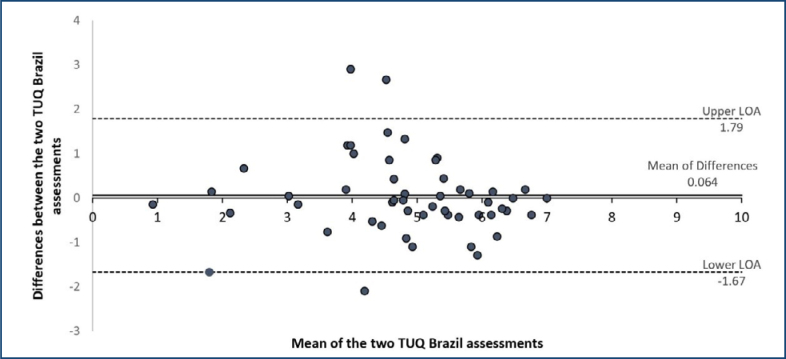
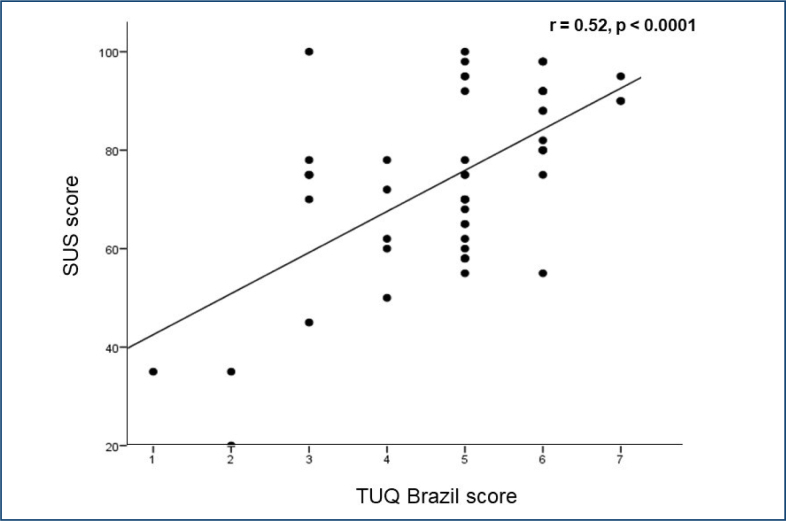
OBJECTIVE: The objectives of this study were to translate and cross-culturally adapt the telehealth usability questionnaire into Brazilian Portuguese and to evaluate its psychometric properties. METHODS: This was a methodological validation study carried out in two phases. In phase 1, the telehealth usability questionnaire was cross-culturally adapted with 10 participants comprising the expert committee members, including 5 healthcare professionals with theoretical and practical knowledge of telehealth, 1 methodologist, and 4 translators. This phase was performed at Universidade Federal de Juiz de Fora Physiotherapy Clinic School. In phase 2, the psychometric properties of telehealth usability questionnaire Brazil were analyzed. This phase included in-person assessments at Márcio Cunha Hospital, Minas Gerais. The recruitment period for both phases was from April 2020 to February 2021. Content validity, reliability, internal consistency, and criterion validity were analyzed. The criterion validity was evaluated using correlation with a validated instrument: the system usability scale. RESULTS: The telehealth usability questionnaire was adequately translated and cross-culturally adapted. The telehealth usability questionnaire Brazil presented an excellent content validity index of 0.96 with percentages of understanding higher than 90%. The telehealth usability questionnaire Brazil demonstrated great internal consistency (α=0.94 and ω=0.94), excellent intra-rater reliability (intraclass correlation coefficient=0.85, 95%CI 0.75-0.91), no difference between the test and retest [T (0.425), p>0.673], and no proportional bias (p=0.205). There was a moderate correlation between telehealth usability questionnaire Brazil and the system usability scale (r=0.52, p<0.0001). CONCLUSION: The telehealth usability questionnaire was adequately translated and cross-culturally adapted into Brazilian Portuguese and showed adequate psychometric properties for use in telehealth clinical practice and research in Brazilian-Portuguese-speaking individuals.
Overview
The claims and statistics of this paper haven’t been checked yet.
Free: it reads the open-access text and checks the first 5 claims that cite a source we can check. Create a free account to check every claim.
Integrity signals
Registry
Cites
Statistics
Figures
Verification
Claims the paper makes
The claims and statistics of this paper haven’t been checked yet.
Free: it reads the open-access text and checks the first 5 claims that cite a source we can check. Create a free account to check every claim.
Claims other papers make about this one
Each is checked against this paper’s own text: does it say what the citing paper says it does?
The source backs part of the claim, not all of it — or backs it for a different population, condition or comparison.
In the citing paper
“There was a moderate correlation between the TUQ and the System Usability Scale (r = 0.52, p < 0.0001 [45].”
From Comparing face-to-face and online LSVT®LOUD speech training using LSVT®Coach in patients with Parkinson’s disease: a pilot randomised controlled trial (2025) · cites this paper as [45]
Experimental — accuracy not yet measuredThe source backs part of the claim, not all of it — or backs it for a different population, condition or comparison.
In the citing paper
“The TUG demonstrated good content validity, and all its usability attributes exhibited good to excellent reliability (α = 0.81–0.93) [44] and no difference between test and retest (p = 0.673) [45].”
From Comparing face-to-face and online LSVT®LOUD speech training using LSVT®Coach in patients with Parkinson’s disease: a pilot randomised controlled trial (2025) · cites this paper as [45]
Experimental — accuracy not yet measured
Self-check
Percentages, sums and reported differences re-computed from the paper’s own numbers.
The self-check needs the paper’s full text.
Citations
Cites
STATISTICAL METHODS FOR ASSESSING AGREEMENT BETWEEN TWO METHODS OF CLINICAL MEASUREMENT
Martin Bland, J., & Altman, D. (1986) · The Lancet · doi:10.1016/s0140-6736(86)90837-8 · Cited by 47,965
Guidelines for the process of cross-cultural adaptation of self-report measures
Beaton, D. E., Bombardier, C., Guillemin, F., & Ferraz, M. B. (2000) · Spine · doi:10.1097/00007632-200012150-00014 · Cited by 14,542 · cited 6×
“The expert committee analyzed the semantic, idiomatic, conceptual, linguistic, and contextual discrepancies and the questionnaire structure, layout, and user instructions 7,9,11 .”
BackgroundMethodInfluentialCorrelation Coefficients: Appropriate Use and Interpretation
Schober, P., Boer, C., & Schwarte, L. A. (2018) · Anesthesia & Analgesia · doi:10.1213/ane.0000000000002864 · Cited by 10,986 · cited 1×
“Correlation coefficients were interpreted according to Schober et al. 18”
MethodQuality criteria were proposed for measurement properties of health status questionnaires
Terwee, C. B., Bot, S. D. M., de Boer, M. R., van der Windt, D. A. W. M., Knol, D. L., Dekker, J., Bouter, L. M., & de Vet, H. C. W. (2007) · Journal of Clinical Epidemiology · doi:10.1016/j.jclinepi.2006.03.012 · Cited by 10,764 · cited 1×
“Studies recommend a minimum of 50 participants as the sample size required to test reliability 16 .”
BackgroundMokkink, L. B., Terwee, C. B., Patrick, D. L., Alonso, J., Stratford, P. W., Knol, D. L., Bouter, L. M., & de Vet, H. C. W. (2010) · Journal of Clinical Epidemiology · doi:10.1016/j.jclinepi.2010.02.006 · Cited by 4,465 · cited 1×
“Second, analyses of the TUQ Brazil psychometric properties followed the recommendations of the Consensus-based Standards for selecting health Measurement Instruments (COSMIN) 8 .”
MethodEpstein, J., Santo, R. M., & Guillemin, F. (2015) · Journal of Clinical Epidemiology · doi:10.1016/j.jclinepi.2014.11.021 · Cited by 990 · cited 2×
“( iv) An expert committee of 10 participants 7,9,11 conducted the content validity assessment.”
BackgroundGjersing, L., Caplehorn, J. R., & Clausen, T. (2010) · BMC Medical Research Methodology · doi:10.1186/1471-2288-10-13 · Cited by 879 · cited 5×
“The expert committee analyzed the semantic, idiomatic, conceptual, linguistic, and contextual discrepancies and the questionnaire structure, layout, and user instructions 7,9,11 .”
BackgroundInfluentialThe mHealth App Usability Questionnaire (MAUQ): Development and Validation Study
Zhou, L., Bao, J., Setiawan, I. M. A., Saptono, A., & Parmanto, B. (2019) · JMIR mHealth and uHealth · doi:10.2196/11500 · Cited by 675 · cited 3×
“Of note, the TUQ Brazil internal consistency was close to the ones reported for other questionnaires on telehealth systems usability 21-23 .”
ResultInfluentialSelf-citationDevelopment of the Telehealth Usability Questionnaire (TUQ)
Parmanto, B., Lewis, Jr., Graham, K. M., & Bertolet, M. H. (2016) · International Journal of Telerehabilitation · doi:10.5195/ijt.2016.6196 · Cited by 624
Self-citationConstrução de instrumentos de medida na área da saúde
Coluci, M. Z. O., Alexandre, N. M. C., & Milani, D. (2015) · Ciência & Saúde Coletiva · doi:10.1590/1413-81232015203.04332013 · Cited by 547 · cited 6×
“The agreement was verified quantitatively using the content validity index (CVI) 12 .”
BackgroundMethodInfluentialOperacionalização de adaptação transcultural de instrumentos de aferição usados em epidemiologia
Reichenheim, M. E., & Moraes, C. L. (2007) · Revista de Saúde Pública · doi:10.1590/s0034-89102006005000035 · Cited by 545
Caetano, R., Silva, A. B., Guedes, A. C. C. M., Paiva, C. C. N. D., Ribeiro, G. D. R., Santos, D. L., & Silva, R. M. D. (2020) · Cadernos de Saúde Pública · doi:10.1590/0102-311x00088920 · Cited by 387 · cited 2×
“The final version of TUQ Brazil kept a similar format to the original questionnaire and is available in the electronic repository: https://data.mendeley.com/datasets/p8d3xyvfnp/4.”
BackgroundMethodEuropean Portuguese Validation of the System Usability Scale (SUS)
Martins, A. I., Rosa, A. F., Queirós, A., Silva, A., & Rocha, N. P. (2015) · Procedia Computer Science · doi:10.1016/j.procs.2015.09.273 · Cited by 326
Yip, M. P., Chang, A. M., Chan, J., & MacKenzie, A. E. (2003) · Journal of Telemedicine and Telecare · doi:10.1258/135763303321159693 · Cited by 288 · cited 1×
“Conversely, a strong correlation was reported between the TUQ and the Telemedicine Satisfaction Questionnaire 24 , as both are telehealth-specific questionnaires instead of a general technology usability scale like the SUS 20 .”
BackgroundBakken, S., Grullon-Figueroa, L., Izquierdo, R., Lee, N.-J., Morin, P., Palmas, W., Teresi, J., Weinstock, R. S., Shea, S., Starren, J., et al. (2006) · Journal of the American Medical Informatics Association · doi:10.1197/jamia.m2146 · Cited by 247 · cited 1×
“Of note, the TUQ Brazil internal consistency was close to the ones reported for other questionnaires on telehealth systems usability 21-23 .”
ResultWaller, M., & Stotler, C. (2018) · Current Allergy and Asthma Reports · doi:10.1007/s11882-018-0808-4 · Cited by 207
The most used questionnaires for evaluating telemedicine services
Hajesmaeel-Gohari, S., & Bahaadinbeigy, K. (2021) · BMC Medical Informatics and Decision Making · doi:10.1186/s12911-021-01407-y · Cited by 186 · cited 2×
“In addition, the TUQ has no segmentation or domains and examines fewer items compared with other TUQs 6 ; this may facilitate its use in population studies and services in public health.”
BackgroundMethodCaetano, R., Silva, A. B., Guedes, A. C. C. M., de Paiva, C. C. N., Ribeiro, G. D. R., Santos, D. L., & da Silva, R. M. (2021) · Figshare · doi:10.6084/m9.figshare.14280692 · Cited by 162
Demiris, G., Speedie, S., & Finkelstein, S. (2000) · Journal of Telemedicine and Telecare · doi:10.1258/1357633001935914 · Cited by 151
Usability, accessibility and ambient-assisted living: a systematic literature review
Queirós, A., Silva, A. G., Alvarelhão, J., Rocha, N. P., & Teixeira, A. J. S. (2013) · Universal Access in the Information Society · doi:10.1007/s10209-013-0328-x · Cited by 134 · cited 1×
“Good usability has several benefits, including fewer frequent errors, reduced user training time, acceptance, and greater efficiency and productivity when operating The Brazilian version of the telehealth usability questionnaire a particular system 3 .”
BackgroundProceso de traducción y adaptación cultural de instrumentos de medición en salud
Ortíz‐Gutiérrez, S., & Cruz-Avelar, A. (2017) · Actas Dermo-Sifiliográficas · doi:10.1016/j.ad.2017.09.012 · Cited by 105
Translation and Cross-Cultural Adaptation of Health Assessment Tools
Ortíz‐Gutiérrez, S., & Cruz-Avelar, A. (2018) · Actas Dermo-Sifiliográficas · doi:10.1016/j.adengl.2018.02.003 · Cited by 71 · cited 2×
“(v ) The evaluation of the final version or pilot study was performed, when telehealth users were interviewed for the understanding of each TUQ Brazil item 9,13 .”
BackgroundRapid Implementation of an Inpatient Telehealth Program during the COVID-19 Pandemic
Hron, J. D., Parsons, C. R., Williams, L. A., Harper, M. B., & Bourgeois, F. C. (2020) · Applied Clinical Informatics · doi:10.1055/s-0040-1713635 · Cited by 56
Özden, F., Özkeskin, M., Sarı, Z., Ekmekçi, Ö., & Yüceyar, N. (2021) · Neurological Sciences and Neurophysiology · doi:10.4103/nsn.nsn_41_21 · Cited by 13 · cited 12×
“The concurrent criterion validity was tested using Spearman’s correlation coefficient between the TUQ Brazil and the SUS.”
BackgroundMethodInfluential[Validation of a Spanish questionnaire on telemedicine usability].
Bibiloni, N., Torre, A. C., Angles, M. V., Terrasa, S., Peña, F. R. V., Sommer, J., Plazzotta, F., Luna, D. R., & Mazzuoccolo, L. D. (2020) · PubMed · Cited by 6
Cited by
Zimmermann, J., Morf, H., Scharf, F., Knitza, J., Möller, H., Muehlensiepen, F., Nathrath, M., Orlemann, T., Voelker, T., & Deckers, M. (2024) · JMIR Human Factors · doi:10.2196/57771 · Cited by 16
Dolničar, V., Petrovčič, A., Škafar, M., Laznik, J., Prevodnik, K., & Touzery, S. H. (2024) · International Journal of Medical Informatics · doi:10.1016/j.ijmedinf.2024.105537 · Cited by 11
Evaluation of Psychometric Properties of Thai Version Telehealth Usability Questionnaire (T-TUQ)
Hirunwiwatkul, P., Pongpanich, P., Tulvatana, W., Jariyakosol, S., Phuenpathom, W., Krittanupong, S., Chonramak, R., Pichedvanichok, T., Bhidayasiri, R., & Nimnuan, C. (2023) · International Journal of Telerehabilitation · doi:10.5195/ijt.2023.6577 · Cited by 9
“The Brazilian TUQ (n=64) also demonstrated excellent internal consistency (alpha=0.94) (Santos et al., 2023).”
BackgroundInfluentialKratz, E., Scheffer, J., Volc, D., & Seebacher, B. (2025) · BMC Neurology · doi:10.1186/s12883-025-04161-0 · Cited by 5
“The TUG demonstrated good content validity, and all its usability attributes exhibited good to excellent reliability (α = 0.81–0.93) [44] and no difference between test and retest ( p = 0.673) [45].”
InfluentialValenzuela, E. D. J., da Silva, V. Y. H., Dias, E. D., Rosa, R. M., de Moraes, Í. A. P., Ré, A. H. N., Martinez, J. P., Magalhães, F. H., Takara, E. K., da Silva, T. D., et al. (2025) · World Leisure Journal · doi:10.1080/16078055.2025.2516644 · Cited by 3
“Higher scores indicate better system usability (Klug, 2017; Martins et al., 2015; Santos et al., 2023).”
Metadata
- Authors
- Santos, M. R., Malaguti, C., Cabral, L. A., Soares, A. L., Neves, L. H. G., Sena, L. D. A., Parmanto, B., Sauers, A. L., José, A., & Oliveira, C. C.
- Affiliations
- Universidade Federal de Juiz de Fora (BR)
- University of Pittsburgh (US)
- Midwestern University (US)
- Corresponding author
- Oliveira, Cristino Carneiro
- ORCID
- Venue
- Revista da Associação Médica Brasileira
- Publisher
- FapUNIFESP (SciELO)
- Published
- 2023
- Volume
- 69
- Issue
- 12
- Pages
- e20230228-e20230228
- ISSN
- 0004-5241 (ISSN-L)
- 1806-9282
- 0104-4230
- PMC
- PMC10645180
- OpenAlex
- W4388641701
- Cited by
- 6
- References
- 25
- Citations by year
- 2026: 1 · 2025: 2 · 2024: 2 · 2023: 1
- FWCI
- 1.53
- Type
- journal article
- Language
- en
- Open access
- diamond
- doi.org
- Licence
- cc-by
- creativecommons.org/licenses/by-nc/4.0/ (vor)
- creativecommons.org/licenses/by-nc/4.0/ (am)
- creativecommons.org/licenses/by-nc/4.0/ (tdm)
- Locations
- Revista da Associação Médica Brasileira (publishedVersion, cc-by)
- PubMed Central (publishedVersion, cc-by)
- PubMed (publishedVersion)
- Funders
- Coordenação de Aperfeiçoamento de Pessoal de Nível Superior
- Conselho Nacional de Desenvolvimento Científico e Tecnológico (424542/2018-8)
- Topics
- Health Sciences › Medicine › Public Health, Environmental and Occupational Health › Telemedicine and Telehealth Implementation
- Health Sciences › Nursing › Research and Theory › Health Education and Validation
- Physical Sciences › Computer Science › Human-Computer Interaction › Usability and User Interface Design
- Keywords
- Telehealth Usability Questionnaire, telemedicine, usability evaluation, cross-cultural adaptation, Brazilian Portuguese translation, psychometric properties, content validity, internal consistency, criterion validity, System Usability Scale, physiotherapy
- MeSH terms
- Brazil, Cross-Cultural Comparison, Humans, Psychometrics, Surveys and Questionnaires, Translations, Reproducibility of Results, Telemedicine
About these checks
Registry, retraction, Cites and statistics results are computed, not judged, with one exception: a printed reference that no index lists is read once by a model before it counts as a citation error. Claims are extracted by a model and kept only when their quote appears verbatim in the text; each cited source is then checked, with a model’s help, for whether it says what the claim relies on. Those verdicts can be wrong — read the claim’s quote and the cited source before relying on one.
Statistics and arithmetic are recomputed, not judged.
Confidence bands are shown only for fields calibrated on our annotated test set. None is calibrated yet, so no band is shown.
What counts as a claim ›How we measure confidence ›How we check this ›
Are you an author, or do you see a problem with this page? Request a review
Data sources
Bibliographic data: Semantic Scholar, OpenAlex, Crossref.
Contains information from the Semantic Scholar Academic Graph Datasets, made available under the ODC Attribution License (ODC-BY 1.0).
Semantic Scholar’s data is described in: Kinney, R., et al. (2023). The Semantic Scholar Open Data Platform. arXiv:2301.10140.
