

Executive functions as a potential neurocognitive endophenotype in anxiety disorders: A systematic review considering DSM-IV and DSM-5 diagnostic criteria classification
Open accessThe DOI matches its Crossref record; 67 of the 67 references it cites were found in a registry or an index.
Abstract
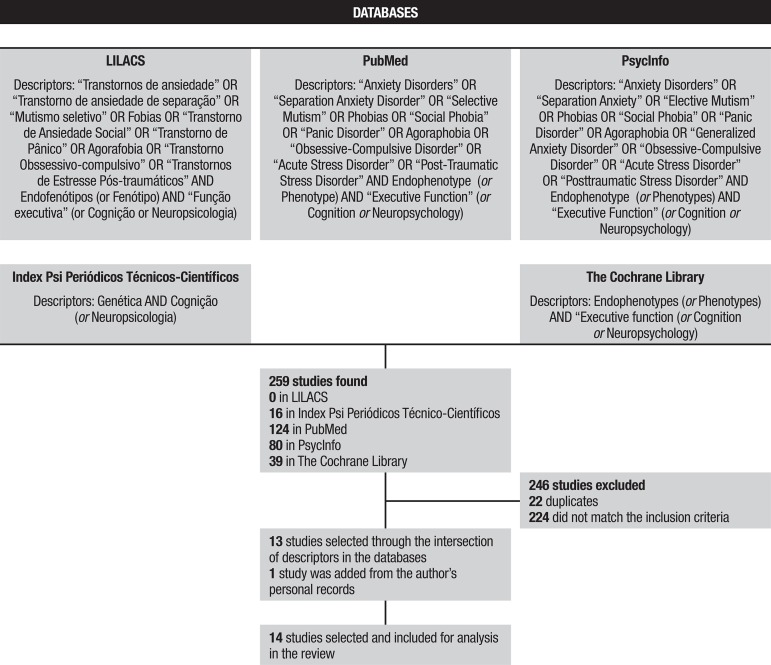
Evidence in the literature indicates that neurocognitive impairments may represent endophenotypes in psychiatric disorders. Objective: This study aimed to conduct a systematic review on executive functions as a potential neurocognitive endophenotype in anxiety disorder diagnosis according to the DSM-IV and DSM-5 classifications. Methods: A literature search of the LILACS, Cochrane Library, Index Psi Periódicos Técnico-Científicos, PubMed and PsycInfo databases was conducted, with no time limits. Of the 259 studies found, 14 were included in this review. Results: Only studies on obsessive-compulsive disorder (OCD) were found. The executive function components of decision-making, planning, response inhibition, behavioral reversal/alternation, reversal learning and set-shifting/cognitive flexibility were considered to be a neurocognitive endophenotypes in OCD. Conclusion: Further studies on executive functions as a neurocognitive endophenotype in other anxiety disorders are needed since these may have different neurocognitive endophenotypes and require other prevention and treatment approaches.
Overview
The claims and statistics of this paper haven’t been checked yet.
Free: it reads the open-access text and checks the first 5 claims that cite a source we can check. Create a free account to check every claim.
Integrity signals
Registry
Cites
Statistics
Figures
Verification
Claims the paper makes
The claims and statistics of this paper haven’t been checked yet.
Free: it reads the open-access text and checks the first 5 claims that cite a source we can check. Create a free account to check every claim.
Claims other papers make about this one
Each is checked against this paper’s own text: does it say what the citing paper says it does?
The cited source says what the claim attributes to it.
In the citing paper
“neurocognitive markers may be more reliable, consistent and enduring than the variably expressed symptoms of a disorder 118-120”
From The clinical characterization of the adult patient with an anxiety or related disorder aimed at personalization of management (2021) · cites this paper as [120]
Self-check
Percentages, sums and reported differences re-computed from the paper’s own numbers.
The self-check needs the paper’s full text.
Citations
Cites
Insensitivity to future consequences following damage to human prefrontal cortex
Bechara, A., Damasio, A. R., Damasio, H., & Anderson, S. W. (1994) · Cognition · doi:10.1016/0010-0277(94)90018-3 · Cited by 6,128
The Endophenotype Concept in Psychiatry: Etymology and Strategic Intentions
Gottesman, I. I., & Gould, T. D. (2003) · American Journal of Psychiatry · doi:10.1176/appi.ajp.160.4.636 · Cited by 5,615
Assessment of executive functions: Review of instruments and identification of critical issues.
CHAN, R., SHUM, D., TOULOPOULOU, T., & CHEN, E. (2008) · Archives of Clinical Neuropsychology · doi:10.1016/j.acn.2007.08.010 · Cited by 1,401
Selective processing of threat cues in anxiety states
Mathews, A., & MacLeod, C. (1985) · Behaviour Research and Therapy · doi:10.1016/0005-7967(85)90104-4 · Cited by 1,001
Chamberlain, S. R., Blackwell, A. D., Fineberg, N. A., Robbins, T. W., & Sahakian, B. J. (2005) · Neuroscience & Biobehavioral Reviews · doi:10.1016/j.neubiorev.2004.11.006 · Cited by 830
Vasterling, J. J., Duke, L. M., Brailey, K., Constans, J. I., Allain, A. N., & Sutker, P. B. (2002) · Neuropsychology · doi:10.1037//0894-4105.16.1.5 · Cited by 556
Chamberlain, S. R., Menzies, L., Hampshire, A., Suckling, J., Fineberg, N. A., del Campo, N., Aitken, M., Craig, K., Owen, A. M., Bullmore, E. T., et al. (2008) · Science · doi:10.1126/science.1154433 · Cited by 550
A quantitative meta-analysis of neurocognitive functioning in posttraumatic stress disorder.
Scott, J. C., Matt, G. E., Wrocklage, K. M., Crnich, C., Jordan, J., Southwick, S. M., Krystal, J. H., & Schweinsburg, B. C. (2015) · Psychological Bulletin · doi:10.1037/a0038039 · Cited by 513
Gilbert, S. J., & Burgess, P. W. (2008) · Current Biology · doi:10.1016/j.cub.2007.12.014 · Cited by 455
A review of longitudinal studies of cognitive functions in schizophrenia patients
Rund, B. R. (1998) · Schizophrenia Bulletin · doi:10.1093/oxfordjournals.schbul.a033337 · Cited by 451
Neurocognitive endophenotypes of obsessive-compulsive disorder
Menzies, L., Achard, S., Chamberlain, S. R., Fineberg, N., Chen, C.-H., del Campo, N., Sahakian, B. J., Robbins, T. W., & Bullmore, E. (2007) · Brain · doi:10.1093/brain/awm205 · Cited by 443 · cited 1×
“Considering response inhibition, Chamberlain et al. (2007)52 and Menzies et al. (2007)20 found lower performance on the Stop Signal Task (reaction times) in UFDR and OCD patients.”
MethodChamberlain, S. R., Fineberg, N. A., Menzies, L. A., Blackwell, A. D., Bullmore, E. T., Robbins, T. W., & Sahakian, B. J. (2007) · American Journal of Psychiatry · doi:10.1176/ajp.2007.164.2.335 · Cited by 438 · cited 3×
“…studies, patients were free of medication, 53,55,61 however, in five studies the majority or all patients were on medication.20,50,54,58,60 The studies of Cavedini et al. (2010)23 and Chamberlain et al. (2007)52 evaluated patients with OCD and provided no information about the use of medications.”
BackgroundMethodNeuropsychological performance in obsessive-compulsive disorder: a critical review
Kuelz, A. K., Hohagen, F., & Voderholzer, U. (2004) · Biological Psychology · doi:10.1016/j.biopsycho.2003.07.007 · Cited by 436
Endophenotypes in the Genetic Analyses of Mental Disorders
Cannon, T. D., & Keller, M. C. (2006) · Annual Review of Clinical Psychology · doi:10.1146/annurev.clinpsy.2.022305.095232 · Cited by 399
Brand, M., Fujiwara, E., Borsutzky, S., Kalbe, E., Kessler, J., & Markowitsch, H. J. (2005) · Neuropsychology · doi:10.1037/0894-4105.19.3.267 · Cited by 395
Mental Disorders in Megacities: Findings from the São Paulo Megacity Mental Health Survey, Brazil
Andrade, L. H., Wang, Y.-P., Andreoni, S., Silveira, C. M., Alexandrino-Silva, C., Siu, E. R., Nishimura, R., Anthony, J. C., Gattaz, W. F., Kessler, R. C., et al. (2012) · PLoS ONE · doi:10.1371/journal.pone.0031879 · Cited by 370
Cognitive functioning in obsessive-compulsive disorder: A meta-analysis
Shin, N. Y., Lee, T. Y., Kim, E., & Kwon, J. S. (2014) · Psychological Medicine · doi:10.1017/s0033291713001803 · Cited by 334 · cited 1×
“However, according to the findings of Shin et al. (2014),31 further studies with the computerized version could further understanding on the role of this ability as an endophenotype of OCD.”
BackgroundAiraksinen, E., Larsson, M., & Forsell, Y. (2005) · Journal of Psychiatric Research · doi:10.1016/j.jpsychires.2004.06.001 · Cited by 328
Impaired attention as an endophenotype for molecular genetic studies of schizophrenia
Cornblatt, B. A., & Malhotra, A. K. (2001) · American Journal of Medical Genetics · doi:10.1002/1096-8628(20010108)105:1<11::aid-ajmg1045>3.0.co;2-g · Cited by 259
A neuropsychological comparison of obsessive–compulsive disorder and trichotillomania
Chamberlain, S. R., Fineberg, N. A., Blackwell, A. D., Clark, L., Robbins, T. W., & Sahakian, B. J. (2007) · Neuropsychologia · doi:10.1016/j.neuropsychologia.2006.07.016 · Cited by 212 · cited 3×
“…studies, patients were free of medication, 53,55,61 however, in five studies the majority or all patients were on medication.20,50,54,58,60 The studies of Cavedini et al. (2010)23 and Chamberlain et al. (2007)52 evaluated patients with OCD and provided no information about the use of medications.”
BackgroundMethodAttentional networks reveal executive function deficits in posttraumatic stress disorder.
Leskin, L. P., & White, P. M. (2007) · Neuropsychology · doi:10.1037/0894-4105.21.3.275 · Cited by 208
Glahn, D. C., Almasy, L., Barguil, M., Hare, E., Peralta, J. M., Kent, J. W., Dassori, A., Contreras, J., Pacheco, A., Lanzagorta, N., et al. (2010) · Archives of General Psychiatry · doi:10.1001/archgenpsychiatry.2009.184 · Cited by 205
Allard, C. B. (2012) · Archives of General Psychiatry · doi:10.1001/archgenpsychiatry.2011.1539 · Cited by 203
de Vries, F. E., de Wit, S. J., Cath, D. C., van der Werf, Y. D., van der Borden, V., van Rossum, T. B., van Balkom, A. J. L. M., van der Wee, N. J. A., Veltman, D. J., & van den Heuvel, O. A. (2014) · Biological Psychiatry · doi:10.1016/j.biopsych.2013.11.021 · Cited by 177
Cavedini, P., Zorzi, C., Piccinni, M., Cavallini, M. C., & Bellodi, L. (2010) · Biological Psychiatry · doi:10.1016/j.biopsych.2010.02.012 · Cited by 167 · cited 1×
“…studies, patients were free of medication, 53,55,61 however, in five studies the majority or all patients were on medication.20,50,54,58,60 The studies of Cavedini et al. (2010)23 and Chamberlain et al. (2007)52 evaluated patients with OCD and provided no information about the use of medications.”
Background(1996) · The Journal of Neuropsychiatry and Clinical Neurosciences · doi:10.1176/jnp.8.1.82 · Cited by 155
Tambs, K., Czajkowsky, N., R⊘ysamb, E., Neale, M. C., Reichborn-Kjennerud, T., Aggen, S. H., Harris, J. R., ⊘rstavik, R. E., & Kendler, K. S. (2009) · British Journal of Psychiatry · doi:10.1192/bjp.bp.108.059485 · Cited by 144
The Sounds of Silence: Language, Cognition, and Anxiety in Selective Mutism
Manassis, K., Tannock, R., Garland, E., MINDE, K. K., McInnes, A., & Clark, S. L. (2007) · Journal of the American Academy of Child & Adolescent Psychiatry · doi:10.1097/chi.0b013e318076b7ab · Cited by 138
Shucard, J. L., McCabe, D. C., & Szymanski, H. V. (2008) · Biological Psychology · doi:10.1016/j.biopsycho.2008.05.005 · Cited by 136
Are neuropsychological deficits trait markers in OCD?
Rao, N. P., Reddy, Y. C. J., Kumar, K. J., Kandavel, T., & Chandrashekar, C. R. (2008) · Progress in Neuro-Psychopharmacology and Biological Psychiatry · doi:10.1016/j.pnpbp.2008.05.026 · Cited by 136 · cited 5×
“…et al. (2009)51 found that unaffected relatives of OCD probands showed significant deficits on the test as compared to healthy controls whereas Rao et al. (2008)50 showed that patients in the recovered phase of the disorder performed poorly when compared to healthy controls i.e., deficits in…”
BackgroundMethodResultInfluentialWeiller, E., Bisserbe, J.-C., Maier, W., & Lecrubier, Y. (1998) · British Journal of Psychiatry · doi:10.1192/s0007125000293471 · Cited by 132
Delorme, R., Goussé, V., Roy, I., Trandafir, A., Mathieu, F., Mouren-Siméoni, M.-C., Betancur, C., & Leboyer, M. (2007) · European Psychiatry · doi:10.1016/j.eurpsy.2006.05.002 · Cited by 128
Current research on cognitive aspects of anxiety disorders
Ferreri, F., Lapp, L. K., & Peretti, C.-S. (2011) · Current Opinion in Psychiatry · doi:10.1097/yco.0b013e32833f5585 · Cited by 125
Dissociation of decisions in ambiguous and risky situations in obsessive–compulsive disorder
Starcke, K., Tuschen-Caffier, B., Markowitsch, H. J., & Brand, M. (2010) · Psychiatry Research · doi:10.1016/j.psychres.2008.10.022 · Cited by 105
Aycicegi, A., Dinn, W. M., Harris, C. L., & Erkmen, H. (2003) · European Psychiatry · doi:10.1016/s0924-9338(03)00065-8 · Cited by 105
Cognitive endophenotypes in OCD: A study of unaffected siblings of probands with familial OCD
Viswanath, B., Reddy, Y. C. J., Kumar, K. J., Thennarasu, K., & Chandrashekar, C. R. (2009) · Progress in Neuro-Psychopharmacology and Biological Psychiatry · doi:10.1016/j.pnpbp.2009.02.018 · Cited by 99 · cited 3×
“Besides this study, others have assessed sustained attention with the Continuous Performance Test – omission errors (e.g. Viswanath et al., 2009),51 the Colour Trails Test – part 153 and the Digit Vigilance Test.53 With the exception of Abramovitch et al. (2015),57 all other studies indicated that…”
MethodResultInfluentialNeuropsychological function in obsessive-compulsive disorder
Tükel, R., Gürvit, H., Ertekin, B. A., Oflaz, S., Ertekin, E., Baran, B., Kalem, Ş. A., Kandemir, P. E., Özdemiroğlu, F. A., & Atalay, F. (2012) · Comprehensive Psychiatry · doi:10.1016/j.comppsych.2011.03.007 · Cited by 89
Rajender, G., Bhatia, M. S., Kanwal, K., Malhotra, S., Singh, T. B., & Chaudhary, D. (2011) · Acta Psychiatrica Scandinavica · doi:10.1111/j.1600-0447.2011.01733.x · Cited by 84
Abramovitch, A., Dar, R., Schweiger, A., & Hermesh, H. (2011) · Archives of Clinical Neuropsychology · doi:10.1093/arclin/acr022 · Cited by 82
da Rocha, F. F., Malloy‐Diniz, L. F., Lage, N. V., Romano‐Silva, M. A., Marco, L. A. D., & Corrêa, H. (2008) · Behavioural Brain Research · doi:10.1016/j.bbr.2008.05.015 · Cited by 73 · cited 2×
“…time part A (e. g. Lennertz et al., 2012; Rao et al., 2008),50,58 Trail Making Test – reaction time part B minus reaction time part A (e.g. da Rocha et al., 2008)54 and Continuous Perfor- mance Test – reaction time (e.g. Rao et al., 2008).50 However, none of the studies that investigated…”
BackgroundWorking memory capacity in generalized social phobia.
Amir, N., & Bomyea, J. (2011) · Journal of Abnormal Psychology · doi:10.1037/a0022849 · Cited by 71
Posttraumatic Stress Disorder and Cognitive Function: Findings From the Mind Your Heart Study
Cohen, B. E., Neylan, T. C., Yaffe, K., Samuelson, K. W., Li, Y., & Barnes, D. E. (2013) · The Journal of Clinical Psychiatry · doi:10.4088/jcp.12m08291 · Cited by 69
Current research on cognitive aspects of anxiety disorders.
Ferreri, F. A. D. T., Lapp, L. K., & Peretti, C.-S. (2011) · HAL (Le Centre pour la Communication Scientifique Directe) · doi:10.1097/yco.obo13e32833f5585 · Cited by 69
Hashimoto, N., Nakaaki, S., Omori, I. M., Fujioi, J., Noguchi, Y., Murata, Y., Sato, J., Tatsumi, H., Torii, K., Mimura, M., et al. (2011) · Psychiatry Research · doi:10.1016/j.psychres.2010.08.001 · Cited by 63
Lennertz, L., Rampacher, F., Vogeley, A., Schulze-Rauschenbach, S., Pukrop, R., Ruhrmann, S., Klosterkötter, J., Maier, W., Falkai, P., & Wagner, M. (2012) · European Archives of Psychiatry and Clinical Neuroscience · doi:10.1007/s00406-012-0311-1 · Cited by 62 · cited 4×
“Lennertz et al. (2012)58 also indicated impaired response inhibition in UFDR and OCD patients, evaluated using the anti-saccade task.”
BackgroundMethodInfluentialPeterson, B. S., Wang, Z., Horga, G., Warner, V., Rutherford, B., Klahr, K. W., Graniello, B., Wickramaratne, P., Garcia, F., Yu, S., et al. (2014) · JAMA Psychiatry · doi:10.1001/jamapsychiatry.2013.4048 · Cited by 61
Leppänen, J. M., Niehaus, D. J. H., Koen, L., Toit, E. D., Schoeman, R., & Emsley, R. A. (2007) · Schizophrenia Research · doi:10.1016/j.schres.2007.11.003 · Cited by 60
Kadri, N., Agoub, M., El Gnaoui, S., Berrada, S., & Moussaoui, D. (2007) · Annals of General Psychiatry · doi:10.1186/1744-859x-6-6 · Cited by 59
A systematic review of neuropsychological performance in social anxiety disorder
O'Toole, M. S., & Pedersen, A. D. (2011) · Nordic Journal of Psychiatry · doi:10.3109/08039488.2011.565801 · Cited by 59
Zhang, L., Dong, Y., Ji, Y., Zhu, C., Yu, F., Ma, H., Chen, X., & Wang, K. (2015) · Progress in Neuro-Psychopharmacology and Biological Psychiatry · doi:10.1016/j.pnpbp.2014.09.005 · Cited by 59 · cited 3×
“…should be noted, however, that different versions of the Wisconsin Card Sorting Test were used by the different studies, for example, Viswanath et al. (2009)51 assessed their sample with a computerized version, while Zhang et al. (2015)55 and Rao et al. (2008)50 used a non-computerized version.”
BackgroundMethodCognitive deficits in obsessive–compulsive disorder on tests of frontal lobe functions
Fenger, M. M., Gade, A., Adams, K. H., Hansen, E. S., Bolwig, T. G., & Knudsen, G. M. (2005) · Nordic Journal of Psychiatry · doi:10.1080/08039480510018814 · Cited by 56
Rampacher, F., Lennertz, L., Vogeley, A., Schulze‐Rauschenbach, S., Kathmann, N., Falkai, P., & Wagner, M. (2010) · Progress in Neuro-Psychopharmacology and Biological Psychiatry · doi:10.1016/j.pnpbp.2010.05.008 · Cited by 45
Response inhibition in a subclinical obsessive-compulsive sample
Abramovitch, A., Shaham, N., Levin, L., Bar-Hen, M., & Schweiger, A. (2014) · Journal of Behavior Therapy and Experimental Psychiatry · doi:10.1016/j.jbtep.2014.09.001 · Cited by 35 · cited 3×
“…Test – omission errors (e.g. Viswanath et al., 2009),51 the Colour Trails Test – part 153 and the Digit Vigilance Test.53 With the exception of Abramovitch et al. (2015),57 all other studies indicated that sustained attention deficits are not associated with OCD.50,51,53,54 On the other…”
BackgroundMethodResultInfluentialModerators of Neuropsychological Mechanism in Attention-Deficit Hyperactivity Disorder
Nikolas, M. A., & Nigg, J. T. (2015) · Journal of Abnormal Child Psychology · doi:10.1007/s10802-014-9904-7 · Cited by 35
Identifying endophenotypes of autism: a multivariate approach
Segovia, F., Holt, R., Spencer, M., Górriz, J. M., RamÃrez, J., Puntonet, C. G., Phillips, C., Chura, L., Baron-Cohen, S., & Suckling, J. (2014) · Frontiers in Computational Neuroscience · doi:10.3389/fncom.2014.00060 · Cited by 34 · cited 1×
“Dement Neuropsychol 2015 September;9(3):285-294”
Searching for Alternative Phenotypes in Psychiatric Genetics
Leboyer, M. (2003) · Psychiatric Genetics · doi:10.1385/1-59259-348-8:145 · Cited by 31
Cognitive functions in patients with panic disorder: a literature review
Alves, M. R. P., Pereira, V. M., Machado, S. E. D. C., Nardi, A. E., & Silva, A. C. D. O. E. (2013) · Brazilian Journal of Psychiatry · doi:10.1590/1516-4446-2012-1000 · Cited by 27
Evaluación de funciones cognitivas: atención y memoria en pacientes con trastorno de pánico
Castillo-Villanueva, E., Coy, P. E. C., Shejet, F. O., Durán, E. T., & Cabrera, D. M. (2010) · Salud Mental · Cited by 26
Memory and strategic processing in first-degree relatives of obsessive compulsive patients
Segalàs, C., Alonso, P., Real, E., Garcia, A., Miñambres, A., Labad, J., Pertusa, A., Bueno, B., Jiménez-Murcia, S., & Menchón, J. M. (2010) · Psychological Medicine · doi:10.1017/s0033291710000310 · Cited by 26
Two Sets of Twins with Selective Mutism: Neuropsychological Findings
Gray, R. M., Jordan, C. M., Ziegler, R. S., & Livingston, R. B. (2002) · Child Neuropsychology · doi:10.1076/chin.8.1.41.8717 · Cited by 25
Zhu, C., Yu, F., Ye, R., Chen, X., Dong, Y., Li, D., Zhang, L., Li, D., & Wang, K. (2014) · PLoS ONE · doi:10.1371/journal.pone.0090874 · Cited by 22
[Assessment of executive functions in social phobia patients using the Wisconsin Card Sorting Test].
Topçuoğlu, V., Fıstikçı, N., Ekıncı, O., Gönentür, A. G., & Agouridas, B. C. (2009) · PubMed · Cited by 19
An experimental investigation of the effect of worry on responses to a discrimination learning task
Salters-Pedneault, K., Suvak, M., & Roemer, L. (2008) · Behavior Therapy · doi:10.1016/j.beth.2008.01.001 · Cited by 16
Docherty, A. R., Coleman, M. J., Tu, X., Deutsch, C. K., Mendell, N. R., & Levy, D. L. (2012) · Schizophrenia Research · doi:10.1016/j.schres.2012.06.033 · Cited by 12
Invariant Recognition of Visual Objects: Some Emerging Computational Principles
Bart, E., & Hegdé, J. (2012) · Frontiers in Computational Neuroscience · doi:10.3389/fncom.2012.00060 · Cited by 8
Funções cognitivas no transtorno do pânico: um estudo comparativo com controles saudáveis
Vieira, M. B. G., Greca, D. V., Nardi, A. E., Cheniaux, E., Fonseca, R. P., & Fernandez, J. L. (2011) · Psico · Cited by 6
Cognitive status of Croatian combat veterans and their compensation-seeking
Kozarić‐Kovačić, D., Meštrović, A. H., Rak, D., Mužinić, L., & Marinić, I. (2013) · Journal of Forensic Psychiatry and Psychology · doi:10.1080/14789949.2013.815257 · Cited by 3
Research works printed but not linked: 3
- American Psychiatric Association DSM-5. Manual Diagnóstico e Estatístico de Transtornos Mentais 5. ed Porto Alegre Artmed 2014 992 992
- American Psychiatric Association DSM-IV-TR: Manual Diagnóstico e Estatístico de Transtornos Mentais 4a ed texto revisado Porto Alegre Artmed 2003 880 880
- Malloy-Diniz LF Sedo M Fuentes D Leite WB Neuropsicologia das Funções Executivas Fuentes D Malloy-Diniz LF Carmargo CHP Cosenza R Neuropsicologia, Teoria e Prática Porto Alegre Artmed 2008 187 206
Cited by
Stein, D. J., Craske, M. G., Rothbaum, B. O., Chamberlain, S. R., Fineberg, N. A., Choi, K. W., de Jonge, P., Baldwin, D. S., & Maj, M. (2021) · World Psychiatry · doi:10.1002/wps.20919 · Cited by 60
Kanchanatawan, B., Thika, S., Anderson, G., Gałecki, P., & Maes, M. H. J. (2017) · Progress in Neuro-Psychopharmacology and Biological Psychiatry · doi:10.1016/j.pnpbp.2017.06.031 · Cited by 65
Marceau, E. M., Kelly, P. J., & Solowij, N. (2017) · Drug and Alcohol Dependence · doi:10.1016/j.drugalcdep.2017.10.008 · Cited by 49
“…populations, despite clear deficits in each of these domains being widely reported (e.g., EF deficits in depression (Snyder, 2013); anxiety (de Lima Muller et al., 2015); bipolar disorder (Cullen et al., 2016); schizophrenia (Kluwe-Schiavon et al., 2013); post-traumatic stress disorder (Polak et…”
BackgroundAlmulla, A. F., Al-Rawi, K. F., Maes, M. H. J., & Al‐Hakeim, H. K. (2021) · Journal of Affective Disorders · doi:10.1016/j.jad.2021.03.062 · Cited by 36
Neurocognitive risk markers in pediatric obsessive–compulsive disorder
Negreiros, J., Belschner, L., Best, J. R., Lin, S., Franco Yamin, D., Joffres, Y., Selles, R. R., Jaspers‐Fayer, F., Miller, L. D., Woodward, T. S., et al. (2020) · Journal of Child Psychology and Psychiatry · doi:10.1111/jcpp.13153 · Cited by 24
Metadata
- Authors
- Muller, J. D. L., Torquato, K. I., Manfro, G. G., & Trentini, C. M.
- Affiliations
- Federal University of Rio Grande do Sul, Brazil
- Universidade Federal de Ciências da Saúde de Porto Alegre (BR)
- Universidade Federal do Rio Grande do Sul (BR)
- ORCID
- Manfro, Gisele Gus
- Venue
- Dementia & Neuropsychologia
- Publisher
- FapUNIFESP (SciELO)
- Published
- 2015-09
- Volume
- 9
- Issue
- 3
- Pages
- 285-294
- ISSN
- 1980-5764 (ISSN-L)
- PMC
- PMC5619371
- OpenAlex
- W2288332870
- Cited by
- 10
- References
- 67
- Citations by year
- 2025: 1 · 2021: 2 · 2020: 1 · 2019: 3 · 2017: 2 · 2016: 1
- FWCI
- 0.13
- Type
- journal article
- Language
- en
- Open access
- diamond
- doi.org
- Licence
- cc-by
- Locations
- Dementia & Neuropsychologia (publishedVersion, cc-by)
- Europe PMC (PubMed Central) (publishedVersion, cc-by)
- PubMed Central (publishedVersion, cc-by)
- PubMed (publishedVersion)
- LA Referencia (Red Federada de Repositorios Institucionales de Publicaciones Científicas) (publishedVersion, other-oa)
- Americanae (AECID Library) (submittedVersion, cc-by-nc-sa)
- Americanae (AECID Library) (submittedVersion, cc-by)
- DOAJ (DOAJ: Directory of Open Access Journals) (submittedVersion, cc-by-sa)
- Redalyc (Universidad Autónoma del Estado de México) (submittedVersion)
- Funders
- Coordenação de Aperfeiçoamento de Pessoal de Nível Superior
- Fundação Instituto de Pesquisas Econômicas
- Topics
- Social Sciences › Psychology › Experimental and Cognitive Psychology › Anxiety, Depression, Psychometrics, Treatment, Cognitive Processes
- Life Sciences › Neuroscience › Cognitive Neuroscience › Neural and Behavioral Psychology Studies
- Social Sciences › Psychology › Clinical Psychology › Obsessive-Compulsive Spectrum Disorders
- Keywords
- executive function, neurocognitive endophenotypes, anxiety disorders, obsessive-compulsive disorder, DSM-IV diagnostic criteria, DSM-5 diagnostic criteria, response inhibition, cognitive flexibility, decision-making, planning, reversal learning
About these checks
Registry, retraction, Cites and statistics results are computed, not judged, with one exception: a printed reference that no index lists is read once by a model before it counts as a citation error. Claims are extracted by a model and kept only when their quote appears verbatim in the text; each cited source is then checked, with a model’s help, for whether it says what the claim relies on. Those verdicts can be wrong — read the claim’s quote and the cited source before relying on one.
Statistics and arithmetic are recomputed, not judged.
Confidence bands are shown only for fields calibrated on our annotated test set. None is calibrated yet, so no band is shown.
What counts as a claim ›How we measure confidence ›How we check this ›
Are you an author, or do you see a problem with this page? Request a review
Data sources
Bibliographic data: Semantic Scholar, OpenAlex, Crossref.
Contains information from the Semantic Scholar Academic Graph Datasets, made available under the ODC Attribution License (ODC-BY 1.0).
Semantic Scholar’s data is described in: Kinney, R., et al. (2023). The Semantic Scholar Open Data Platform. arXiv:2301.10140.
