

The DOI matches its Crossref record; 17 of the 18 references it cites were found in a registry or an index.
Effective Approaches to Attention-based Neural Machine Translation
Open accessAbstract
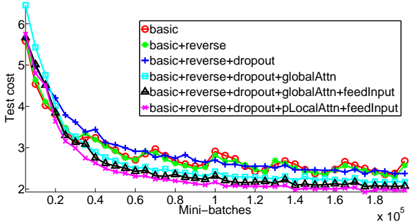
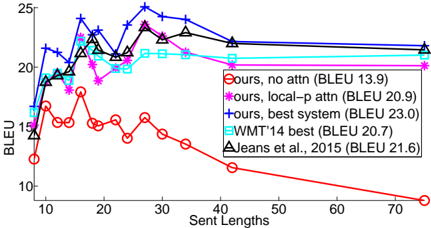
An attentional mechanism has lately been used to improve neural machine translation (NMT) by selectively focusing on parts of the source sentence during translation.However, there has been little work exploring useful architectures for attention-based NMT.This paper examines two simple and effective classes of attentional mechanism: a global approach which always attends to all source words and a local one that only looks at a subset of source words at a time.We demonstrate the effectiveness of both approaches on the WMT translation tasks between English and German in both directions.With local attention, we achieve a significant gain of 5.0 BLEU points over non-attentional systems that already incorporate known techniques such as dropout.Our ensemble model using different attention architectures yields a new state-of-the-art result in the WMT'15 English to German translation task with 25.9 BLEU points, an improvement of 1.0 BLEU points over the existing best system backed by NMT and an n-gram reranker.1
Overview
The claims and statistics of this paper haven’t been checked yet.
Run the check — free, no account needed. It reads the open-access text and checks the sources it cites.
Integrity signals
Registry
Cites
Statistics
Figures
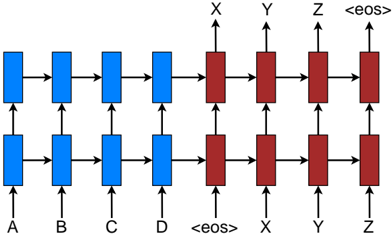
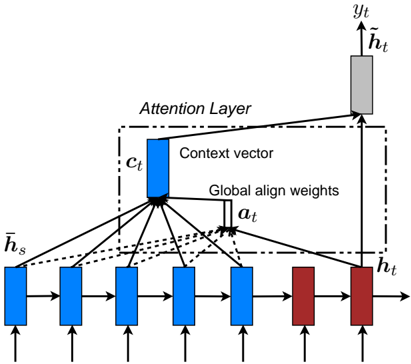
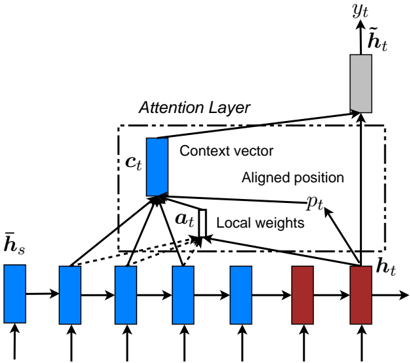
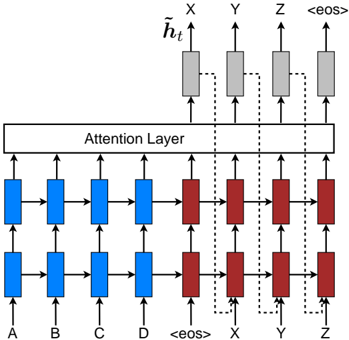
Verification
Claims the paper makes
The claims and statistics of this paper haven’t been checked yet.
Run the check — free, no account needed. It reads the open-access text and checks the sources it cites.
Claims other papers make about this one
Each is checked against this paper’s own text: does it say what the citing paper says it does?
The cited source says what the claim attributes to it.
In the citing paper
“Since then, various enhancements have been proposed, such as local attention (Luong et al. 2015), supervised attention (Mi et al. 2016; Liu et al. 2016), hierarchical attention (Zhao et al. 2018), and self-attention (Vaswani et al. 2017; Yang et al. 2018).”
From Large language models (LLMs): survey, technical frameworks, and future challenges (2024) · cites this paper as Luong et al. 2015
Self-check
Percentages, sums and reported differences re-computed from the paper’s own numbers.
The self-check needs the paper’s full text.
Citations
Cites
Learning Phrase Representations using RNN Encoder–Decoder for Statistical Machine Translation
Cho, K., van Merrienboer, B., Gulcehre, C., Bahdanau, D., Bougares, F., Schwenk, H., & Bengio, Y. (2014) · Proceedings of the 2014 Conference on Empirical Methods in Natural Language Processing (EMNLP) · doi:10.3115/v1/d14-1179 · Cited by 25,545
BLEU: a method for automatic evaluation of machine translation
Papineni, K., Roukos, S., Ward, T., & Zhu, W.-J. (2001) · Proceedings of the 40th Annual Meeting on Association for Computational Linguistics - ACL '02 · doi:10.3115/1073083.1073135 · Cited by 21,344
Sequence to Sequence Learning with Neural Networks
Sutskever, I., Vinyals, O., & Le, Q. V. (2014) · arXiv · doi:10.48550/arxiv.1409.3215 · Cited by 17,766
Neural Machine Translation by Jointly Learning to Align and Translate
Bahdanau, D., Cho, K., & Bengio, Y. (2014) · arXiv · doi:10.48550/arxiv.1409.0473 · Cited by 16,213
Show, Attend and Tell: Neural Image Caption Generation with Visual Attention
Xu, K., Ba, J., Kiros, R., Cho, K., Courville, A., Salakhutdinov, R., Zemel, R., & Bengio, Y. (2015) · arXiv · doi:10.48550/arxiv.1502.03044 · Cited by 8,248
Recurrent Models of Visual AttentionPreprint
Mnih, V., Heess, N., Graves, A., & Kavukcuoglu, K. (2014) · arXiv (Cornell University) · doi:10.48550/arxiv.1406.6247 · Cited by 3,393
Statistical phrase-based translation
Koehn, P., Och, F. J., & Marcu, D. (2003) · Conference of the North American Chapter of the Association for Computational Linguistics: Human Language Technologies (NAACL-HLT) · doi:10.3115/1073445.1073462 · Cited by 3,265
Recurrent Neural Network RegularizationPreprint
Zaremba, W., Sutskever, I., & Vinyals, O. (2014) · arXiv (Cornell University) · doi:10.48550/arxiv.1409.2329 · Cited by 3,174
Recurrent Continuous Translation Models
Kalchbrenner, N., & Blunsom, P. (2013) · Conference on Empirical Methods in Natural Language Processing (EMNLP) · doi:10.18653/v1/d13-1176 · Cited by 1,277
Statistical Phrase-Based Translation
Koehn, P., Och, F. J., & Marcu, D. (2003) · doi:10.21236/ada461156 · Cited by 970
Research works printed but not linked: 1
- Percy Liang, Ben Taskar, and Dan Klein. 2006. Align- ment by agreement. In NAACL.
Cited by
Sorted by citations
Items 401–500 of 1,045
Zhou, F., Zhou, H., Yang, Z., & Yang, L. (2018) · Expert Systems with Applications · doi:10.1016/j.eswa.2018.07.065 · Cited by 157
Phan, H., Andreotti, F., Cooray, N., Chén, O. Y., & Vos, M. D. (2018) · Annual International Conference of the IEEE Engineering in Medicine and Biology Society (EMBC) · doi:10.1109/embc.2018.8512480 · Cited by 152
GCNAX: A Flexible and Energy-efficient Accelerator for Graph Convolutional Neural Networks
Li, J., Louri, A., Karanth, A., & Bunescu, R. (2021) · IEEE International Symposium on High-Performance Computer Architecture (HPCA) · doi:10.1109/hpca51647.2021.00070 · Cited by 160
Xie, F., Yuan, H., Ning, Y., Ong, M. E. H., Feng, M., Hsu, W., Chakraborty, B., & Liu, N. (2021) · Journal of Biomedical Informatics · doi:10.1016/j.jbi.2021.103980 · Cited by 176
COGS: A Compositional Generalization Challenge Based on Semantic Interpretation
Kim, N., & Linzen, T. (2020) · Proceedings of the 2020 Conference on Empirical Methods in Natural Language Processing (EMNLP) · doi:10.18653/v1/2020.emnlp-main.731 · Cited by 153
Automatically Neutralizing Subjective Bias in Text
Pryzant, R., Martinez, R. D., Dass, N., Kurohashi, S., Jurafsky, D., & Yang, D. (2020) · Proceedings of the AAAI Conference on Artificial Intelligence · doi:10.1609/aaai.v34i01.5385 · Cited by 171
How to Find Your Friendly Neighborhood: Graph Attention Design with Self-SupervisionPreprint
Kim, D., & Oh, A. H. (2022) · arXiv (Cornell University) · doi:10.48550/arxiv.2204.04879 · Cited by 211
Deep Neural Network Initialization With Decision Trees
Humbird, K., Peterson, J. L., & McClarren, R. G. (2018) · IEEE Transactions on Neural Networks and Learning Systems · doi:10.1109/tnnls.2018.2869694 · Cited by 153
Zhu, M., Zhang, T., Gu, Z., & Xie, Y. (2019) · IEEE/ACM International Symposium on Microarchitecture (MICRO) · doi:10.1145/3352460.3358269 · Cited by 157
Multi-channel Transformers for Multi-articulatory Sign Language Translation
Camgöz, N. C., Koller, O., Hadfield, S., & Bowden, R. (2020) · Lecture notes in computer science · doi:10.1007/978-3-030-66823-5_18 · Cited by 156
Stock Selection via Spatiotemporal Hypergraph Attention Network: A Learning to Rank Approach
Sawhney, R., Agarwal, S., Wadhwa, A., Derr, T., & Shah, R. R. (2021) · Proceedings of the AAAI Conference on Artificial Intelligence · doi:10.1609/aaai.v35i1.16127 · Cited by 171
A Long-Text Classification Method of Chinese News Based on BERT and CNN
Chen, X., Cong, P., & Lv, S. (2022) · IEEE Access · doi:10.1109/access.2022.3162614 · Cited by 168
Benchmarking and Analyzing Deep Neural Network Training
Zhu, H., Akrout, M., Zheng, B., Pelegris, A., Jayarajan, A., Phanishayee, A., Schroeder, B., & Pekhimenko, G. G. (2018) · IEEE International Symposium on Workload Characterization · doi:10.1109/iiswc.2018.8573476 · Cited by 203
Deep Learning for Aspect-Level Sentiment Classification: Survey, Vision, and Challenges
Zhou, J., Huang, J. X., Chen, Q., Hu, Q., Wang, T., & He, L. (2019) · IEEE Access · doi:10.1109/access.2019.2920075 · Cited by 157
El-Hajj, C., & Kyriacou, P. A. (2020) · Biomedical Signal Processing and Control · doi:10.1016/j.bspc.2020.102301 · Cited by 156
A Comprehensive Review of Deep Learning-Based PCB Defect Detection
Chen, X., Wu, Y., He, X., & Ming, W. (2023) · IEEE Access · doi:10.1109/access.2023.3339561 · Cited by 167
Generating Responses with a Specific Emotion in Dialog
Song, Z., Zheng, X., Liu, L., Xu, M., & Huang, X. (2019) · Proceedings of the conference - Association for Computational Linguistics. Meeting · doi:10.18653/v1/p19-1359 · Cited by 156
Global Encoding for Abstractive Summarization
Lin, J., Sun, X., Ma, S., & Su, Q. (2018) · Proceedings of the conference - Association for Computational Linguistics. Meeting · doi:10.18653/v1/p18-2027 · Cited by 150
An Attentional Model for Speech Translation Without Transcription
Duong, L., Anastasopoulos, A., Chiang, D., Bird, S., & Cohn, T. (2016) · Conference of the North American Chapter of the Association for Computational Linguistics: Human Language Technologies (NAACL-HLT) · doi:10.18653/v1/n16-1109 · Cited by 158
Coevolutionary Recommendation Model
Lu, Y., Dong, R., & Smyth, B. (2018) · International World Wide Web Conference (WWW) · doi:10.1145/3178876.3186158 · Cited by 165
GTC: Guided Training of CTC towards Efficient and Accurate Scene Text Recognition
Hu, W., Cai, X., Hou, J. Y., Yi, S., & Lin, Z. (2020) · Proceedings of the AAAI Conference on Artificial Intelligence · doi:10.1609/aaai.v34i07.6735 · Cited by 149
Generate Neural Template Explanations for Recommendation
Li, L., Zhang, Y., & Chen, L. (2020) · Proceedings of the 29th ACM International Conference on Information & Knowledge Management · doi:10.1145/3340531.3411992 · Cited by 149
Speech emotion recognition using recurrent neural networks with directional self-attention
Li, D., Liu, J., Yang, Z., Sun, L., & Wang, Z. (2021) · Expert Systems with Applications · doi:10.1016/j.eswa.2021.114683 · Cited by 154
SeaFormer++: Squeeze-Enhanced Axial Transformer for Mobile Visual Recognition
Wan, Q., Huang, Z., Lu, J., Yu, G., & Zhang, L. (2025) · International Journal of Computer Vision · doi:10.1007/s11263-025-02345-2 · Cited by 182
Applying Deep Learning to the Cache Replacement Problem
Shi, Z., Huang, X., Jain, A., & Lin, C. (2019) · IEEE/ACM International Symposium on Microarchitecture (MICRO) · doi:10.1145/3352460.3358319 · Cited by 169
Dreem Open Datasets: Multi-Scored Sleep Datasets to Compare Human and Automated Sleep Staging
Guillot, A., Sauvet, F., During, E., & Thorey, V. (2020) · IEEE Transactions on Neural Systems and Rehabilitation Engineering · doi:10.1109/tnsre.2020.3011181 · Cited by 148
Xiang, S., Qin, Y., Zhu, C., Wang, Y., & Chen, H. (2020) · Engineering Applications of Artificial Intelligence · doi:10.1016/j.engappai.2020.103587 · Cited by 151
Code smell detection by deep direct-learning and transfer-learning
Sharma, T., Efstathiou, V., Λουρίδας, Π., & Spinellis, D. D. (2021) · Journal of Systems and Software · doi:10.1016/j.jss.2021.110936 · Cited by 167
IoMT-Enabled Real-Time Blood Glucose Prediction With Deep Learning and Edge Computing
Zhu, T., Kuang, L., Daniels, J., Herrero, P., Li, K., & Georgiou, P. (2022) · IEEE Internet of Things Journal · doi:10.1109/jiot.2022.3143375 · Cited by 164
Contextual Parameter Generation for Universal Neural Machine Translation
Platanios, E. A., Sachan, M., Neubig, G., & Mitchell, T. M. (2018) · Conference on Empirical Methods in Natural Language Processing (EMNLP) · doi:10.18653/v1/d18-1039 · Cited by 147
DQNViz: A Visual Analytics Approach to Understand Deep Q-Networks
Wang, J., Gou, L., Shen, H., & Yang, H. (2018) · IEEE Transactions on Visualization and Computer Graphics · doi:10.1109/tvcg.2018.2864504 · Cited by 153
An LSTM-Based Method with Attention Mechanism for Travel Time Prediction
Ran, X., Shan, Z., Fang, Y., & Lin, C. (2019) · Sensors · doi:10.3390/s19040861 · Cited by 148
CAM-RNN: Co-Attention Model Based RNN for Video Captioning
Zhao, B., Li, X., & Lu, X. (2019) · IEEE Transactions on Image Processing · doi:10.1109/tip.2019.2916757 · Cited by 147
RAIM: Recurrent Attentive and Intensive Model of Multimodal Patient Monitoring Data
Xu, Y., Biswal, S., Deshpande, S. R., Maher, K. O., & Sun, J. (2018) · Proceedings of the 24th ACM SIGKDD International Conference on Knowledge Discovery & Data Mining · doi:10.1145/3219819.3220051 · Cited by 144
“Extensive attention-based deep models have been developed for images [14, 21, 36, 48], audios and videos [23, 49], machine translations [1, 30, 46].”
BackgroundLi, F., Jin, Y., Liu, W., Rawat, B. P. S., Cai, P., & Yu, H. (2019) · JMIR Medical Informatics · doi:10.2196/14830 · Cited by 161
Automatic Dialogue Generation with Expressed Emotions
Huang, C., Zai͏̈ane, O. R., Trabelsi, A., & Dziri, N. (2018) · Conference of the North American Chapter of the Association for Computational Linguistics: Human Language Technologies (NAACL-HLT) · doi:10.18653/v1/n18-2008 · Cited by 146
Graph2Seq: Graph to Sequence Learning with Attention-based Neural NetworksPreprint
Xu, K., Wu, L., Wang, Z., Feng, Y., Witbrock, M., & Sheinin, V. (2018) · arXiv (Cornell University) · doi:10.48550/arxiv.1804.00823 · Cited by 225
Xu, J., Ren, X., Lin, J., & Sun, X. (2018) · Conference on Empirical Methods in Natural Language Processing (EMNLP) · doi:10.18653/v1/d18-1428 · Cited by 208
Reinforced Self-Attention Network: a Hybrid of Hard and Soft Attention for Sequence Modeling
Shen, T., Zhou, T., Long, G., Jiang, J. B., Wang, S., & Chengqi Zhang, B. (2018) · International Joint Conference on Artificial Intelligence · doi:10.24963/ijcai.2018/604 · Cited by 154
Learning to Parse and Translate Improves Neural Machine Translation
Eriguchi, A., Tsuruoka, Y., & Cho, K. (2017) · Proceedings of the conference - Association for Computational Linguistics. Meeting · doi:10.18653/v1/p17-2012 · Cited by 152
Coverage Embedding Models for Neural Machine Translation
Mi, H., Sankaran, B., Wang, Z., & Ittycheriah, A. (2016) · Conference on Empirical Methods in Natural Language Processing (EMNLP) · doi:10.18653/v1/d16-1096 · Cited by 144
Neural machine translation: A review of methods, resources, and tools
Tan, Z., Wang, S., Yang, Z., Chen, G., Huang, X., Sun, M., & Liu, Y. (2020) · AI Open · doi:10.1016/j.aiopen.2020.11.001 · Cited by 193
Protein sequence design with deep generative models
Wu, Z., Johnston, K. E., Arnold, F. H., & Yang, K. (2021) · Current Opinion in Chemical Biology · doi:10.1016/j.cbpa.2021.04.004 · Cited by 152
State of health estimation for lithium-ion batteries based on hybrid attention and deep learning
Zhao, H., Chen, Z., Shu, X., Shen, J., Lei, Z., & Zhang, Y. (2022) · Reliability Engineering & System Safety · doi:10.1016/j.ress.2022.109066 · Cited by 142
Born, J., & Manica, M. (2023) · Nature Machine Intelligence · doi:10.1038/s42256-023-00639-z · Cited by 169
An attention-based effective neural model for drug-drug interactions extraction
Zheng, W., Lin, H., Luo, L., Zhao, Z., Li, Z., Zhang, Y., Yang, Z., & Wang, J. (2017) · BMC Bioinformatics · doi:10.1186/s12859-017-1855-x · Cited by 148
Neural Open Information Extraction
Cui, L., Wei, F., & Zhou, M. (2018) · Proceedings of the conference - Association for Computational Linguistics. Meeting · doi:10.18653/v1/p18-2065 · Cited by 158
Automatically learning construction injury precursors from text
Baker, H., Hallowell, M. R., & Tixier, A. J. ‐. (2020) · Automation in Construction · doi:10.1016/j.autcon.2020.103145 · Cited by 155
Yao, H., Zhang, X., Zhou, X., & Liu, S. (2019) · Cancers · doi:10.3390/cancers11121901 · Cited by 143
Zhu, Y., Zhang, W., Chen, Y., & Gao, H. (2019) · EURASIP Journal on Wireless Communications and Networking · doi:10.1186/s13638-019-1605-z · Cited by 151
Multi-level attention network: application to brain tumor classification
Shaik, N. S., & Cherukuri, T. K. (2021) · Signal Image and Video Processing · doi:10.1007/s11760-021-02022-0 · Cited by 144
DanceFormer: Music Conditioned 3D Dance Generation with Parametric Motion Transformer
Li, B., Zhao, Y., Shi, Z., & Sheng, L. (2022) · Proceedings of the AAAI Conference on Artificial Intelligence · doi:10.1609/aaai.v36i2.20014 · Cited by 143
Is Word Segmentation Necessary for Deep Learning of Chinese Representations?
Li, X., Meng, Y., Sun, X., Han, Q., Yuan, A., & Li, J. (2019) · Proceedings of the conference - Association for Computational Linguistics. Meeting · doi:10.18653/v1/p19-1314 · Cited by 153
Domain Control for Neural Machine Translation
SYSTRAN International, P., Kobus, C., Crego, J., & Sénellart, J. (2017) · International conference Recent advances in natural language processing · doi:10.26615/978-954-452-049-6_049 · Cited by 143
Learning context-aware structural representations to predict antigen and antibody binding interfaces
Pittala, S., & Bailey‐Kellogg, C. (2020) · Bioinformatics · doi:10.1093/bioinformatics/btaa263 · Cited by 142
Transformer Encoder With Multi-Modal Multi-Head Attention for Continuous Affect Recognition
Chen, H., Jiang, D., & Hichem Sahli, B. (2020) · IEEE Transactions on Multimedia · doi:10.1109/tmm.2020.3037496 · Cited by 146
Aspect-level Sentiment Classification with HEAT (HiErarchical ATtention) Network
Cheng, J., Zhao, S., Zhang, J., King, I., Zhang, X., & Wang, H. (2017) · ACM International Conference on Information and Knowledge Management (CIKM) · doi:10.1145/3132847.3133037 · Cited by 141
Evaluating Sequence-to-Sequence Models for Handwritten Text Recognition
Michael, J., Labahn, R., Grüning, T., & Zollner, J. (2019) · IAPR International Conference on Document Analysis and Recognition (ICDAR) · doi:10.1109/icdar.2019.00208 · Cited by 170
Listening while speaking: Speech chain by deep learning
Tjandra, A., Sakti, S., & Nakamura, S. (2017) · IEEE Workshop on Automatic Speech Recognition and Understanding (ASRU) · doi:10.1109/asru.2017.8268950 · Cited by 141
Ye, H., Jiang, X., Luo, Z., & Chao, W. (2018) · Conference of the North American Chapter of the Association for Computational Linguistics: Human Language Technologies (NAACL-HLT) · doi:10.18653/v1/n18-1168 · Cited by 159
Feature Extraction Using an RNN Autoencoder for Skeleton-Based Abnormal Gait Recognition
Jun, K., Lee, D.-W., Lee, K., Lee, S., & Kim, M. S. (2020) · IEEE Access · doi:10.1109/access.2020.2967845 · Cited by 145
KVT: k-NN Attention for Boosting Vision Transformers
Wang, P., Wang, X., Wang, F., Lin, M., Chang, S., Li, H., & Jin, R. (2022) · Lecture notes in computer science · doi:10.1007/978-3-031-20053-3_17 · Cited by 142
HTC-Net: A hybrid CNN-transformer framework for medical image segmentation
Tang, H., Chen, Y., Wang, T., Zhou, Y., Zhao, L., Gao, Q., Du, M., Tan, T., Zhang, X., & Tong, T. (2023) · Biomedical Signal Processing and Control · doi:10.1016/j.bspc.2023.105605 · Cited by 147
Deeper Attention to Abusive User Content Moderation
Pavlopoulos, J., Malakasiotis, P., & Androutsopoulos, I. (2017) · Conference on Empirical Methods in Natural Language Processing (EMNLP) · doi:10.18653/v1/d17-1117 · Cited by 151
On the diversity of multi-head attention
Li, J., Wang, X., Tu, Z., & Lyu, M. R.-T. (2021) · Neurocomputing · doi:10.1016/j.neucom.2021.04.038 · Cited by 147
A Position-aware Bidirectional Attention Network for Aspect-level Sentiment Analysis
Gu, S., Zhang, L., Hou, Y., & Song, Y. (2018) · International Conference on Computational Linguistics · Cited by 139
Machine translation from text to sign language: a systematic review
Kahlon, N. K., & Singh, W. (2021) · Universal Access in the Information Society · doi:10.1007/s10209-021-00823-1 · Cited by 139
Eom, H., Lee, D., Han, S., Hariyani, Y. S., Lim, Y., Sohn, I., Park, K., & Park, C. (2020) · Sensors · doi:10.3390/s20082338 · Cited by 144
Modeling Source Syntax for Neural Machine Translation
Li, J., Xiong, D., Tu, Z., Zhu, M., Zhang, M., & Zhou, G. (2017) · Proceedings of the conference - Association for Computational Linguistics. Meeting · doi:10.18653/v1/p17-1064 · Cited by 137
Chatterjee, J., & Dethlefs, N. (2021) · Renewable and Sustainable Energy Reviews · doi:10.1016/j.rser.2021.111051 · Cited by 155
Deep reinforcement and transfer learning for abstractive text summarization: A review
Alomari, A., Idris, N. B., Sabri, A. Q. M., & Alsmadi, I. M. (2021) · Computer Speech & Language · doi:10.1016/j.csl.2021.101276 · Cited by 149
Benaggoune, K., Yue, M., Jemeï, S., & Noureddine Zerhouni, A. (2022) · Applied Energy · doi:10.1016/j.apenergy.2022.118835 · Cited by 137
Efficient Hardware Architectures for Accelerating Deep Neural Networks: Survey
Pudi, D., Boppu, S., Manikandan, M. S., & Cenkeramaddi, L. R. (2022) · IEEE Access · doi:10.1109/access.2022.3229767 · Cited by 153
C 2 SLR: Consistency-enhanced Continuous Sign Language Recognition
Zuo, R., & Mak, B. K.-W. (2022) · IEEE Computer Society Conference on Computer Vision and Pattern Recognition/Proceedings - IEEE Computer Society Conference on Computer Vision and Pattern Recognition/Proceedings · doi:10.1109/cvpr52688.2022.00507 · Cited by 146
A Dataset for Multi-Target Stance Detection
Sobhani, P., Inkpen, D. Z., & Zhu, X. (2017) · Conference of the European Chapter of the Association for Computational Linguistics · doi:10.18653/v1/e17-2088 · Cited by 136
Deep Reinforcement Learning for Safe Local Planning of a Ground Vehicle in Unknown Rough Terrain
Josef, S., & Degani, A. (2020) · IEEE Robotics and Automation Letters · doi:10.1109/lra.2020.3011912 · Cited by 136
Zhu, T., Li, K., Herrero, P., & Georgiou, P. (2022) · IEEE Transactions on Biomedical Engineering · doi:10.1109/tbme.2022.3187703 · Cited by 156
Storey, V. C., Yue, W. T., Zhao, J. L., & Lukyanenko, R. (2025) · Information Systems Frontiers · doi:10.1007/s10796-025-10581-7 · Cited by 208
Sign Language Transformers: Joint End-to-End Sign Language Recognition and Translation
Camgöz, N. C., Koller, O., Hadfield, S., & Bowden, R. (2020) · IEEE Computer Society Conference on Computer Vision and Pattern Recognition/Proceedings - IEEE Computer Society Conference on Computer Vision and Pattern Recognition/Proceedings · doi:10.1109/cvpr42600.2020.01004 · Cited by 198
A Copy-Augmented Sequence-to-Sequence Architecture Gives Good Performance on Task-Oriented Dialogue
Eric, M., & Manning, C. D. (2017) · Conference of the European Chapter of the Association for Computational Linguistics · doi:10.18653/v1/e17-2075 · Cited by 142
Self-citationSupervised Attentions for Neural Machine Translation
Mi, H., Wang, Z., & Ittycheriah, A. (2016) · Conference on Empirical Methods in Natural Language Processing (EMNLP) · doi:10.18653/v1/d16-1249 · Cited by 134
Federated Continual Learning via Knowledge Fusion: A Survey
Yang, X., Yu, H., Gao, X., Wang, H., Zhang, J., & Li, T. (2024) · IEEE Transactions on Knowledge and Data Engineering · doi:10.1109/tkde.2024.3363240 · Cited by 146
The New Trend of State Estimation: From Model-Driven to Hybrid-Driven Methods
Jin, X.-B., Robert Jeremiah, R. J., Su, T.-L., Bai, Y.-T., & Kong, J.-L. (2021) · Sensors · doi:10.3390/s21062085 · Cited by 137
Retrospective Encoders for Video Summarization
Zhang, K., Grauman, K. L., & Sha, F. (2018) · Lecture notes in computer science · doi:10.1007/978-3-030-01237-3_24 · Cited by 132
Xiao, X., Zhang, D., Hu, G., Jiang, Y., & Xia, S. (2020) · Neural Networks · doi:10.1016/j.neunet.2020.02.013 · Cited by 136
Sequence-to-Sequence Acoustic Modeling for Voice Conversion
Zhang, J.-X., Ling, Z.-H., Liu, L.-J., Jiang, Y., & Dai, L.-R. (2019) · IEEE/ACM Transactions on Audio Speech and Language Processing · doi:10.1109/taslp.2019.2892235 · Cited by 134
Introduction to machine and deep learning for medical physicists
Cui, S., Tseng, H., Pakela, J. M., Haken, R. K. T., & Naqa, I. E. (2020) · Medical Physics · doi:10.1002/mp.14140 · Cited by 133
Neural Machine Translation with Deep Attention
Zhang, B., Xiong, D., & Su, J. (2018) · IEEE Transactions on Pattern Analysis and Machine Intelligence · doi:10.1109/tpami.2018.2876404 · Cited by 138
Irony detection via sentiment-based transfer learning
Zhang, S., Zhang, X., Chan, J., & Rosso, P. (2019) · Information Processing & Management · doi:10.1016/j.ipm.2019.04.006 · Cited by 139
Instance Weighting for Neural Machine Translation Domain Adaptation
Wang, R., Utiyama, M., Liu, L., Chen, K., & Sumita, E. (2017) · Conference on Empirical Methods in Natural Language Processing (EMNLP) · doi:10.18653/v1/d17-1155 · Cited by 130
Exploring Trajectory Prediction Through Machine Learning Methods
Wang, C., Ma, L., Li, R., Durrani, T. S., & Zhang, H. (2019) · IEEE Access · doi:10.1109/access.2019.2929430 · Cited by 130
Neural Machine Translation With GRU-Gated Attention Model
Zhang, B., Xiong, D., Xie, J., & Su, J. (2020) · IEEE Transactions on Neural Networks and Learning Systems · doi:10.1109/tnnls.2019.2957276 · Cited by 133
A reinforcement learning approach for optimizing multiple traveling salesman problems over graphs
Hu, Y., Yao, Y., & Lee, W. S. (2020) · Knowledge-Based Systems · doi:10.1016/j.knosys.2020.106244 · Cited by 130
An Attentional Recurrent Neural Network for Personalized Next Location Recommendation
Guo, Q., Sun, Z., Zhang, J., & Theng, Y. L. (2020) · Proceedings of the AAAI Conference on Artificial Intelligence · doi:10.1609/aaai.v34i01.5337 · Cited by 130
A long video caption generation algorithm for big video data retrieval
Ding, S., Qu, S., Xi, Y., & Wan, S. (2018) · Future Generation Computer Systems · doi:10.1016/j.future.2018.10.054 · Cited by 128
A Neural Architecture for Generating Natural Language Descriptions from Source Code Changes
Loyola, P., Marrese-Taylor, E., & Matsuo, Y. (2017) · Proceedings of the 55th Annual Meeting of the Association for Computational Linguistics (Volume 2: Short Papers) · doi:10.18653/v1/p17-2045 · Cited by 128
Learning Private Neural Language Modeling with Attentive Aggregation
Ji, S., Pan, S., Long, G., Li, X., Jiang, J., & Huang, Z. H. (2019) · International Joint Conference on Neural Networks (IJCNN) · doi:10.1109/ijcnn.2019.8852464 · Cited by 172
IARM: Inter-Aspect Relation Modeling with Memory Networks in Aspect-Based Sentiment Analysis
Majumder, N., Poria, S., Gelbukh, A. F., Akhtar, M. S., Cambria, E., & Ekbal, A. (2018) · Conference on Empirical Methods in Natural Language Processing (EMNLP) · doi:10.18653/v1/d18-1377 · Cited by 127
SemStyle: Learning to Generate Stylised Image Captions Using Unaligned Text
Mathews, A., Xie, L., & He, X. (2018) · IEEE Computer Society Conference on Computer Vision and Pattern Recognition/Proceedings - IEEE Computer Society Conference on Computer Vision and Pattern Recognition/Proceedings · doi:10.1109/cvpr.2018.00896 · Cited by 123
Stack-Pointer Networks for Dependency Parsing
Ma, X., Hu, Z., Liu, J., Peng, N., Neubig, G., & Hovy, E. H. (2018) · Proceedings of the conference - Association for Computational Linguistics. Meeting · doi:10.18653/v1/p18-1130 · Cited by 151
Metadata
- Authors
- Luong, T., Pham, H., & Manning, C. D.
- Affiliations
- Stanford University (US)
- Venue
- Proceedings of the 2015 Conference on Empirical Methods in Natural Language Processing
- Published
- 2015
- Pages
- 1412-1421
- OpenAlex
- W1902237438
- Cited by
- 8,382
- References
- 18
- Citations by year
- 2026: 177 · 2025: 454 · 2024: 586 · 2023: 839 · 2022: 985 · 2021: 1356 · 2020: 1354 · 2019: 1372 · 2018: 783 · 2017: 337 · 2016: 133 · 2015: 5
- FWCI
- 236.52
- Type
- conference paper
- Language
- en
- Open access
- hybrid
- doi.org
- Licence
- cc-by
- Locations
- Conference on Empirical Methods in Natural Language Processing (EMNLP) (publishedVersion, cc-by)
- Funders
- Bloomberg L.P.
- Nvidia (Tesla K40)
- Topics
- Physical Sciences › Computer Science › Artificial Intelligence › Natural Language Processing Techniques
- Physical Sciences › Computer Science › Artificial Intelligence › Topic Modeling
- Physical Sciences › Computer Science › Artificial Intelligence › Speech Recognition and Synthesis
- Keywords
- attention mechanism, neural machine translation, local attention, global attention, English-German translation, ensemble learning, dropout
About these checks
Registry, retraction, Cites and statistics results are computed, not judged, with one exception: a printed reference that no index lists is read once by a model before it counts as a citation error. Claims are extracted by a model and kept only when their quote appears verbatim in the text; each cited source is then checked, with a model’s help, for whether it says what the claim relies on. Those verdicts can be wrong — read the claim’s quote and the cited source before relying on one.
Statistics and arithmetic are recomputed, not judged.
Confidence bands are shown only for fields calibrated on our annotated test set. None is calibrated yet, so no band is shown.
What counts as a claim ›How we measure confidence ›How we check this ›
Are you an author, or do you see a problem with this page? Request a review
