

The DOI matches its Crossref record; 17 of the 18 references it cites were found in a registry or an index.
Effective Approaches to Attention-based Neural Machine Translation
Open accessAbstract
An attentional mechanism has lately been used to improve neural machine translation (NMT) by selectively focusing on parts of the source sentence during translation.However, there has been little work exploring useful architectures for attention-based NMT.This paper examines two simple and effective classes of attentional mechanism: a global approach which always attends to all source words and a local one that only looks at a subset of source words at a time.We demonstrate the effectiveness of both approaches on the WMT translation tasks between English and German in both directions.With local attention, we achieve a significant gain of 5.0 BLEU points over non-attentional systems that already incorporate known techniques such as dropout.Our ensemble model using different attention architectures yields a new state-of-the-art result in the WMT'15 English to German translation task with 25.9 BLEU points, an improvement of 1.0 BLEU points over the existing best system backed by NMT and an n-gram reranker.1
Overview
The claims and statistics of this paper haven’t been checked yet.
Run the check — free, no account needed. It reads the open-access text and checks the sources it cites.
Integrity signals
Registry
Cites
Statistics
Figures
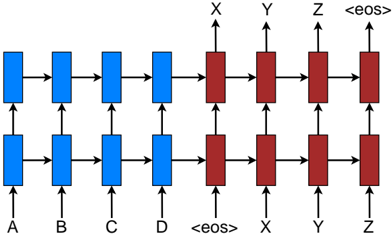
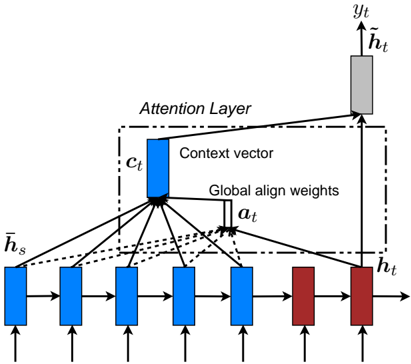
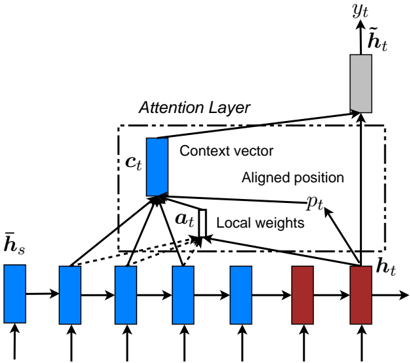
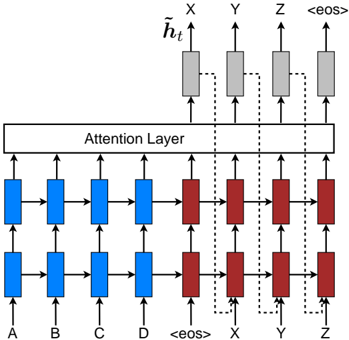
Verification
Claims the paper makes
The claims and statistics of this paper haven’t been checked yet.
Run the check — free, no account needed. It reads the open-access text and checks the sources it cites.
Claims other papers make about this one
Each is checked against this paper’s own text: does it say what the citing paper says it does?
The cited source says what the claim attributes to it.
In the citing paper
“Since then, various enhancements have been proposed, such as local attention (Luong et al. 2015), supervised attention (Mi et al. 2016; Liu et al. 2016), hierarchical attention (Zhao et al. 2018), and self-attention (Vaswani et al. 2017; Yang et al. 2018).”
From Large language models (LLMs): survey, technical frameworks, and future challenges (2024) · cites this paper as Luong et al. 2015
Self-check
Percentages, sums and reported differences re-computed from the paper’s own numbers.
The self-check needs the paper’s full text.
Citations
Cites
Learning Phrase Representations using RNN Encoder–Decoder for Statistical Machine Translation
Cho, K., van Merrienboer, B., Gulcehre, C., Bahdanau, D., Bougares, F., Schwenk, H., & Bengio, Y. (2014) · Proceedings of the 2014 Conference on Empirical Methods in Natural Language Processing (EMNLP) · doi:10.3115/v1/d14-1179 · Cited by 25,545
BLEU: a method for automatic evaluation of machine translation
Papineni, K., Roukos, S., Ward, T., & Zhu, W.-J. (2001) · Proceedings of the 40th Annual Meeting on Association for Computational Linguistics - ACL '02 · doi:10.3115/1073083.1073135 · Cited by 21,344
Sequence to Sequence Learning with Neural Networks
Sutskever, I., Vinyals, O., & Le, Q. V. (2014) · arXiv · doi:10.48550/arxiv.1409.3215 · Cited by 17,766
Neural Machine Translation by Jointly Learning to Align and Translate
Bahdanau, D., Cho, K., & Bengio, Y. (2014) · arXiv · doi:10.48550/arxiv.1409.0473 · Cited by 16,213
Show, Attend and Tell: Neural Image Caption Generation with Visual Attention
Xu, K., Ba, J., Kiros, R., Cho, K., Courville, A., Salakhutdinov, R., Zemel, R., & Bengio, Y. (2015) · arXiv · doi:10.48550/arxiv.1502.03044 · Cited by 8,248
Recurrent Models of Visual AttentionPreprint
Mnih, V., Heess, N., Graves, A., & Kavukcuoglu, K. (2014) · arXiv (Cornell University) · doi:10.48550/arxiv.1406.6247 · Cited by 3,393
Statistical phrase-based translation
Koehn, P., Och, F. J., & Marcu, D. (2003) · Conference of the North American Chapter of the Association for Computational Linguistics: Human Language Technologies (NAACL-HLT) · doi:10.3115/1073445.1073462 · Cited by 3,265
Recurrent Neural Network RegularizationPreprint
Zaremba, W., Sutskever, I., & Vinyals, O. (2014) · arXiv (Cornell University) · doi:10.48550/arxiv.1409.2329 · Cited by 3,174
Recurrent Continuous Translation Models
Kalchbrenner, N., & Blunsom, P. (2013) · Conference on Empirical Methods in Natural Language Processing (EMNLP) · doi:10.18653/v1/d13-1176 · Cited by 1,277
Statistical Phrase-Based Translation
Koehn, P., Och, F. J., & Marcu, D. (2003) · doi:10.21236/ada461156 · Cited by 970
Research works printed but not linked: 1
- Percy Liang, Ben Taskar, and Dan Klein. 2006. Align- ment by agreement. In NAACL.
Cited by
Sorted by citations
Items 1,001–1,045 of 1,045
Reliable customer analysis using federated learning and exploring deep-attention edge intelligence
Ahmed, U., Srivastava, G., & Lin, J. C.-W. (2022) · Future Generation Computer Systems · doi:10.1016/j.future.2021.08.028 · Cited by 52
Teaching Machines to Ask Questions
Yao, K., Zhang, L., Luo, T., Tao, L., & Wu, Y. (2018) · Proceedings of the Twenty-Seventh International Joint Conference on Artificial Intelligence · doi:10.24963/ijcai.2018/632 · Cited by 44
Generating Question-Answer Hierarchies
Krishna, K., & Iyyer, M. (2019) · Proceedings of the 57th Annual Meeting of the Association for Computational Linguistics · doi:10.18653/v1/p19-1224 · Cited by 44
Controlling hallucinations at word level in data-to-text generation
Rebuffel, C., Roberti, M., Soulier, L., Scoutheeten, G., Cancelliere, R., & Gallinari, P. (2022) · Data Mining and Knowledge Discovery · doi:10.1007/s10618-021-00801-4 · Cited by 50
A Holistic Feature Selection Method for Enhanced Short-term Load Forecasting of Power System
Jiang, B., Liu, Y., Geng, H., Wang, Y., Zeng, H., & Ding, J. (2022) · IEEE Transactions on Instrumentation and Measurement · doi:10.1109/tim.2022.3219499 · Cited by 46
PAtt-Lite: Lightweight Patch and Attention MobileNet for Challenging Facial Expression Recognition
Ngwe, J. L., Lim, K. M., Lee, C. P., Ong, T. S., & Alqahtani, A. (2024) · IEEE Access · doi:10.1109/access.2024.3407108 · Cited by 45
Direct speech reconstruction from sensorimotor brain activity with optimized deep learning models
Berezutskaya, J., Freudenburg, Z. V., Vansteensel, M. J., Aarnoutse, E. J., Ramsey, N. F., & van Gerven, M. A. J. (2023) · Journal of Neural Engineering · doi:10.1088/1741-2552/ace8be · Cited by 42
Do Long-Range Language Models Actually Use Long-Range Context?
Sun, S., Krishna, K., Mattarella-Micke, A., & Iyyer, M. (2021) · Proceedings of the 2021 Conference on Empirical Methods in Natural Language Processing · doi:10.18653/v1/2021.emnlp-main.62 · Cited by 43
Not All Attention Is Needed: Gated Attention Network for Sequence Data
Xue, L., Li, X., & Zhang, N. L. (2020) · Proceedings of the AAAI Conference on Artificial Intelligence · doi:10.1609/aaai.v34i04.6129 · Cited by 43
Generating Product Descriptions from User Reviews
Novgorodov, S., Guy, I., Elad, G., & Radinsky, K. (2019) · The World Wide Web Conference · doi:10.1145/3308558.3313532 · Cited by 41
Reinforced Dynamic Reasoning for Conversational Question Generation
Pan, B., Li, H., Yao, Z., Cai, D., & Sun, H. (2019) · Proceedings of the 57th Annual Meeting of the Association for Computational Linguistics · doi:10.18653/v1/p19-1203 · Cited by 40
Interconnected Question Generation with Coreference Alignment and Conversation Flow Modeling
Gao, Y., Li, P., King, I., & Lyu, M. R. (2019) · Proceedings of the 57th Annual Meeting of the Association for Computational Linguistics · doi:10.18653/v1/p19-1480 · Cited by 44
Nagaraj, M. B., Namazi, B., Sankaranarayanan, G., & Scott, D. J. (2023) · Surgical Endoscopy · doi:10.1007/s00464-022-09509-y · Cited by 40
A Semantic Role-based Approach to Open-Domain Automatic Question Generation
Flor, M., & Riordan, B. (2018) · Proceedings of the Thirteenth Workshop on Innovative Use of NLP for Building Educational Applications · doi:10.18653/v1/w18-0530 · Cited by 39
SynShine: Improved Fixing of Syntax Errors
Ahmed, T., Ledesma, N. R., & Devanbu, P. (2023) · IEEE Transactions on Software Engineering · doi:10.1109/tse.2022.3212635 · Cited by 38
LightSeq: A High Performance Inference Library for Transformers
Wang, X., Xiong, Y., Wei, Y., Wang, M., & Li, L. (2021) · Proceedings of the 2021 Conference of the North American Chapter of the Association for Computational Linguistics: Human Language Technologies: Industry Papers · doi:10.18653/v1/2021.naacl-industry.15 · Cited by 36
Revisiting Challenges in Data-to-Text Generation with Fact Grounding
Wang, H. (2019) · Proceedings of the 12th International Conference on Natural Language Generation · doi:10.18653/v1/w19-8639 · Cited by 34
Co-Attention Hierarchical Network: Generating Coherent Long Distractors for Reading Comprehension
Zhou, X., Luo, S., & Wu, Y. (2020) · Proceedings of the AAAI Conference on Artificial Intelligence · doi:10.1609/aaai.v34i05.6522 · Cited by 34
Wu, Y., Liu, Q., Qiu, Y., & Xie, L. (2022) · PLOS Computational Biology · doi:10.1371/journal.pcbi.1010367 · Cited by 34
A channel-spatial-temporal attention-based network for vibration-based damage detection
Liao, S., Liu, H., Yang, J., & Ge, Y. (2022) · Information Sciences · doi:10.1016/j.ins.2022.05.042 · Cited by 31
Yi, S., Goel, R., Khatri, C., Cervone, A., Chung, T., Hedayatnia, B., Venkatesh, A., Gabriel, R., & Hakkani-Tur, D. (2019) · Proceedings of the 12th International Conference on Natural Language Generation · doi:10.18653/v1/w19-8608 · Cited by 26
QuickEdit: Editing Text and Translations by Crossing Words Out
Grangier, D., & Auli, M. (2018) · Proceedings of the 2018 Conference of the North American Chapter of the Association for Computational Linguistics: Human Language Technologies, Volume 1 (Long Papers) · doi:10.18653/v1/n18-1025 · Cited by 20
Shelley: A Crowd-sourced Collaborative Horror Writer
Yanardag, P., Cebrian, M., & Rahwan, I. (2021) · Creativity and Cognition · doi:10.1145/3450741.3465251 · Cited by 20
Weiss, G., Goldberg, Y., & Yahav, E. (2021) · arXiv · doi:10.48550/arxiv.2106.06981 · Cited by 18
Extracting Cause of Death from Verbal Autopsy with Deep Learning interpretable methods
Blanco, A., Perez, A., Casillas, A., & Cobos, D. (2021) · IEEE Journal of Biomedical and Health Informatics · doi:10.1109/jbhi.2020.3005769 · Cited by 17
Zhang, Z., Wang, T., Hu, Z., Yang, L.-Z., & Li, H. (2025) · IEEE Journal of Biomedical and Health Informatics · doi:10.1109/jbhi.2024.3509620 · Cited by 17
Question Generation With Doubly Adversarial Nets
Bao, J., Gong, Y., Duan, N., Zhou, M., & Zhao, T. (2018) · IEEE/ACM Transactions on Audio, Speech, and Language Processing · doi:10.1109/taslp.2018.2859777 · Cited by 14
Fine-grained talking face generation with video reinterpretation
Huang, X., Wang, M., & Gong, M. (2021) · The Visual Computer · doi:10.1007/s00371-020-01982-7 · Cited by 11
Attention Mechanism for Human Motion Prediction
Al-aqel, A. F., & Ali Khan, M. (2020) · 2020 3rd International Conference on Computer Applications & Information Security (ICCAIS) · doi:10.1109/iccais48893.2020.9096777 · Cited by 7
Irie, K., Csordás, R., & Schmidhuber, J. (2022) · arXiv · doi:10.48550/arxiv.2202.05798 · Cited by 6
“Obviously, referring to the equations above as attention (or unnormalised attention) emphasizes the relation to the regular softmax normalised dot product attention (Luong et al., 2015; Bahdanau et al., 2015) which is V softmax( K (cid:124) q ) using the notations above.”
MethodDirect Speech Reconstruction from Sensorimotor Brain Activity with Optimized Deep Learning Models
Berezutskaya, J., Freudenburg, Z. V., Vansteensel, M. J., Aarnoutse, E. J., Ramsey, N. F., & van Gerven, M. A. J. (2022) · doi:10.1101/2022.08.02.502503 · Cited by 42
Unsupervised Quality Estimation for Neural Machine Translation
Fomicheva, M., Sun, S., Yankovskaya, L., Blain, F., Guzmán, F., Fishel, M., Aletras, N., Chaudhary, V., & Specia, L. (2020) · Transactions of the Association for Computational Linguistics · doi:10.1162/tacl_a_00330 · Cited by 10
Latent Execution for Neural Program Synthesis
Chen, X., Song, D., & Tian, Y. (2021) · arXiv · doi:10.48550/arxiv.2107.00101 · Cited by 2
Birwadkar, R. (2025) · Journal of Computer and Forensic Sciences · doi:10.5937/jcfs4-64419
Found in the Middle: Calibrating Positional Attention Bias Improves Long Context Utilization
Hsieh, C.-Y., Chuang, Y.-S., Li, C.-L., Wang, Z., Le, L. T., Kumar, A., Glass, J., Ratner, A., Lee, C.-Y., Krishna, R., et al. (2024) · arXiv · doi:10.48550/arxiv.2406.16008
“The attention mechanism is initially introduced in RNN-based encoder-decoder architectures (Bahdanau et al., 2015; Luong et al., 2015).”
Vaswani, A., Shazeer, N., Parmar, N., Uszkoreit, J., Jones, L., Gomez, A. N., Kaiser, L., & Polosukhin, I. (2017) · arXiv · doi:10.48550/arxiv.1706.03762 · Cited by 120,404
“Numerous efforts have since continued to push the boundaries of recurrent language models and encoder-decoder architectures [38, 24, 15].”
BackgroundAttention U-Net: Learning Where to Look for the Pancreas
Oktay, O., Schlemper, J., Folgoc, L. L., Lee, M., Heinrich, M., Misawa, K., Mori, K., McDonagh, S., Hammerla, N. Y., Kainz, B., et al. (2018) · arXiv · doi:10.48550/arxiv.1804.03999 · Cited by 5,458
How Attentive are Graph Attention Networks?
Brody, S., Alon, U., & Yahav, E. (2021) · arXiv · doi:10.48550/arxiv.2105.14491 · Cited by 789
Unsupervised Neural Machine Translation
Artetxe, M., Labaka, G., Agirre, E., & Cho, K. (2017) · arXiv · doi:10.48550/arxiv.1710.11041 · Cited by 632
(2020) · arXiv (Cornell University) · Cited by 461
Are Sixteen Heads Really Better than One?
Michel, P., Levy, O., & Neubig, G. (2019) · arXiv · doi:10.48550/arxiv.1905.10650 · Cited by 404
Synthesizer: Rethinking Self-Attention in Transformer Models
Tay, Y., Bahri, D., Metzler, D., Juan, D.-C., Zhao, Z., & Zheng, C. (2020) · arXiv · doi:10.48550/arxiv.2005.00743 · Cited by 251
SPoC: Search-based Pseudocode to Code
Kulal, S., Pasupat, P., Chandra, K., Lee, M., Padon, O., Aiken, A., & Liang, P. (2019) · arXiv · doi:10.48550/arxiv.1906.04908 · Cited by 103
Data Movement Is All You Need: A Case Study on Optimizing Transformers
Ivanov, A., Dryden, N., Ben-Nun, T., Li, S., & Hoefler, T. (2020) · arXiv · doi:10.48550/arxiv.2007.00072 · Cited by 78
Metadata
- Authors
- Luong, T., Pham, H., & Manning, C. D.
- Affiliations
- Stanford University (US)
- Venue
- Proceedings of the 2015 Conference on Empirical Methods in Natural Language Processing
- Published
- 2015
- Pages
- 1412-1421
- OpenAlex
- W1902237438
- Cited by
- 8,382
- References
- 18
- Citations by year
- 2026: 177 · 2025: 454 · 2024: 586 · 2023: 839 · 2022: 985 · 2021: 1356 · 2020: 1354 · 2019: 1372 · 2018: 783 · 2017: 337 · 2016: 133 · 2015: 5
- FWCI
- 236.52
- Type
- conference paper
- Language
- en
- Open access
- hybrid
- doi.org
- Licence
- cc-by
- Locations
- Conference on Empirical Methods in Natural Language Processing (EMNLP) (publishedVersion, cc-by)
- Funders
- Bloomberg L.P.
- Nvidia (Tesla K40)
- Topics
- Physical Sciences › Computer Science › Artificial Intelligence › Natural Language Processing Techniques
- Physical Sciences › Computer Science › Artificial Intelligence › Topic Modeling
- Physical Sciences › Computer Science › Artificial Intelligence › Speech Recognition and Synthesis
- Keywords
- attention mechanism, neural machine translation, local attention, global attention, English-German translation, ensemble learning, dropout
About these checks
Registry, retraction, Cites and statistics results are computed, not judged, with one exception: a printed reference that no index lists is read once by a model before it counts as a citation error. Claims are extracted by a model and kept only when their quote appears verbatim in the text; each cited source is then checked, with a model’s help, for whether it says what the claim relies on. Those verdicts can be wrong — read the claim’s quote and the cited source before relying on one.
Statistics and arithmetic are recomputed, not judged.
Confidence bands are shown only for fields calibrated on our annotated test set. None is calibrated yet, so no band is shown.
What counts as a claim ›How we measure confidence ›How we check this ›
Are you an author, or do you see a problem with this page? Request a review
