

The DOI matches its Crossref record; 43 of the 43 references it cites were found in a registry or an index.
Efficient Contextualized Representation: Language Model Pruning for Sequence Labeling
Open accessAbstract
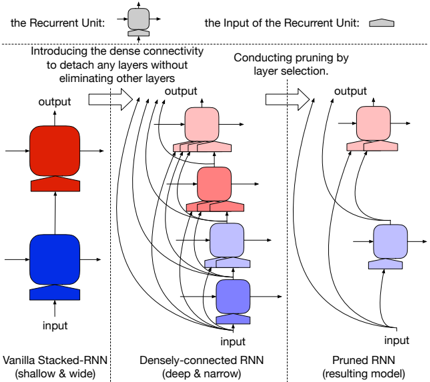
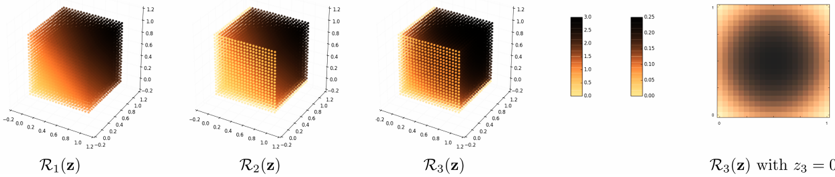
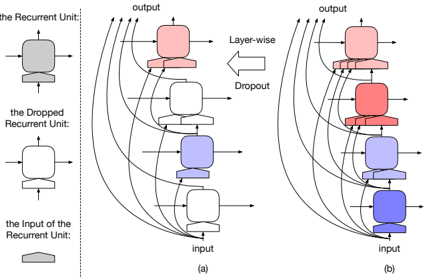
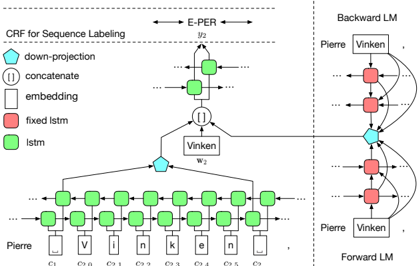
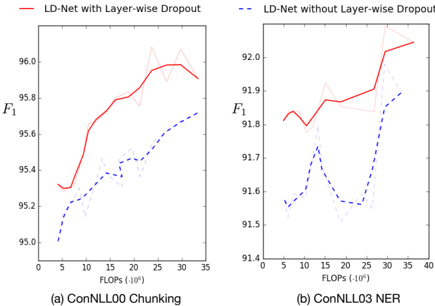
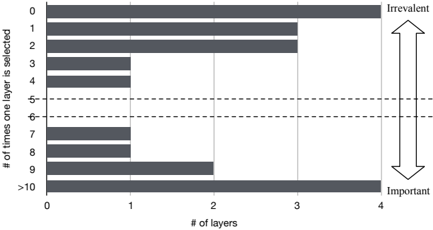
Many efforts have been made to facilitate natural language processing tasks with pre-trained language models (LMs), and brought significant improvements to various applications.To fully leverage the nearly unlimited corpora and capture linguistic information of multifarious levels, large-size LMs are required; but for a specific task, only parts of these information are useful.Such large-sized LMs, even in the inference stage, may cause heavy computation workloads, making them too time-consuming for large-scale applications.Here we propose to compress bulky LMs while preserving useful information with regard to a specific task.As different layers of the model keep different information, we develop a layer selection method for model pruning using sparsityinducing regularization.By introducing the dense connectivity, we can detach any layer without affecting others, and stretch shallow and wide LMs to be deep and narrow.In model training, LMs are learned with layerwise dropouts for better robustness.Experiments on two benchmark datasets demonstrate the effectiveness of our method.
Overview
The claims and statistics of this paper haven’t been checked yet.
Free: it reads the open-access text and checks the first 5 claims that cite a source we can check. Create a free account to check every claim.
Integrity signals
Registry
Cites
Statistics
Figures
Verification
Claims the paper makes
The claims and statistics of this paper haven’t been checked yet.
Free: it reads the open-access text and checks the first 5 claims that cite a source we can check. Create a free account to check every claim.
Claims other papers make about this one
Each is checked against this paper’s own text: does it say what the citing paper says it does?
The check wasn’t confident either way, so it gives no verdict — never disputed.
In the citing paper
“Prompt-based methods have shown great power in few-shot setting [199, 200, 70, 72], zero-shot setting [129, 201], and even fully-supervised setting [74, 75].”
From Pre-trained models for natural language processing: A survey (2020) · cites this paper as [201]
Experimental — accuracy not yet measured
Self-check
Percentages, sums and reported differences re-computed from the paper’s own numbers.
The self-check needs the paper’s full text.
Citations
Cites
Adam: A Method for Stochastic Optimization
Kingma, D. P., & Ba, J. (2014) · arXiv · doi:10.48550/arxiv.1412.6980 · Cited by 98,946
Densely Connected Convolutional Networks
Huang, G., Liu, Z., Van Der Maaten, L., & Weinberger, K. Q. (2017) · 2017 IEEE Conference on Computer Vision and Pattern Recognition (CVPR) · doi:10.1109/cvpr.2017.243 · Cited by 48,566
Distilling the Knowledge in a Neural Network
Hinton, G., Vinyals, O., & Dean, J. (2015) · arXiv · doi:10.48550/arxiv.1503.02531 · Cited by 14,204
(2010) · Cited by 14,134
Deep Contextualized Word Representations
Peters, M., Neumann, M., Iyyer, M., Gardner, M., Clark, C., Lee, K., & Zettlemoyer, L. (2018) · Proceedings of the 2018 Conference of the North American Chapter of the Association for Computational Linguistics: Human Language Technologies, Volume 1 (Long Papers) · doi:10.18653/v1/n18-1202 · Cited by 11,983
Identity mappings in deep residual networks
He, K., Zhang, X., Ren, S., & Sun, J. (2016) · Lecture Notes in Computer Science · doi:10.1007/978-3-319-46493-0_38 · Cited by 10,741
Neural Architectures for Named Entity Recognition
Lample, G., Ballesteros, M., Subramanian, S., Kawakami, K., & Dyer, C. (2016) · Proceedings of the 2016 Conference of the North American Chapter of the Association for Computational Linguistics: Human Language Technologies · doi:10.18653/v1/n16-1030 · Cited by 4,401
FitNets: Hints for Thin Deep Nets
Romero, A., Ballas, N., Kahou, S. E., Chassang, A., Gatta, C., & Bengio, Y. (2014) · arXiv · doi:10.48550/arxiv.1412.6550 · Cited by 2,859
Introduction to the CoNLL-2003 Shared Task: Language-Independent Named Entity Recognition
Tjong Kim Sang, E. F., & De Meulder, F. (2003) · Proceedings of the seventh conference on Natural language learning at HLT-NAACL 2003 - · doi:10.3115/1119176.1119195 · Cited by 2,788
End-to-end Sequence Labeling via Bi-directional LSTM-CNNs-CRF
Ma, X., & Hovy, E. (2016) · Proceedings of the 54th Annual Meeting of the Association for Computational Linguistics (Volume 1: Long Papers) · doi:10.18653/v1/p16-1101 · Cited by 2,567
Research works printed but not linked: 4
- Xavier Glorot and Yoshua Bengio. 2010. Understand- ing the difficulty of training deep feedforward neu- ral networks. In Proceedings of the Thirteenth In- ternational Conference on Artificial Intelligence and Statistics.
- Song Han, Jeff Pool, John Tran, and William Dally. 2015. Learning both weights and connections for efficient neural network. In Advances in neural in- formation processing systems, pages 1135-1143.
- Gao Huang, Zhuang Liu, Laurens Van Der Maaten, and Kilian Q Weinberger. 2017. Densely connected con- volutional networks. In CVPR.
- Walter Murray and Kien-Ming Ng. 2010. An algo- rithm for nonlinear optimization problems with bi- nary variables. Computational Optimization and Applications, 47(2):257-288.
Cited by
A Survey on Deep Learning for Named Entity Recognition
Li, J., Sun, A., Han, J., & Li, C. (2022) · IEEE Transactions on Knowledge and Data Engineering · doi:10.1109/tkde.2020.2981314 · Cited by 1,567
Self-citationPre-trained models for natural language processing: A survey
Qiu, X., Sun, T., Xu, Y., Shao, Y., Dai, N., & Huang, X. (2020) · Science China Technological Sciences · doi:10.1007/s11431-020-1647-3 · Cited by 1,591
“[107] used layer-wise pruning and dense connection to speed up ELMo’s inference on NER.”
MethodOn the Variance of the Adaptive Learning Rate and Beyond
Liu, L., Jiang, H., He, P., Chen, W., Liu, X., Gao, J., & Han, J. (2019) · arXiv (Cornell University) · doi:10.48550/arxiv.1908.03265 · Cited by 595
Self-citationMoverScore: Text Generation Evaluating with Contextualized Embeddings and Earth Mover Distance
Zhao, W., Peyrard, M., Liu, F., Gao, Y., Meyer, C. M., & Eger, S. (2019) · Proceedings of the 2019 Conference on Empirical Methods in Natural Language Processing and the 9th International Joint Conference on Natural Language Processing (EMNLP-IJCNLP) · doi:10.18653/v1/d19-1053 · Cited by 490
Dissecting Contextual Word Embeddings: Architecture and Representation
Peters, M., Neumann, M., Zettlemoyer, L., & Yih, W.-T. (2018) · Proceedings of the 2018 Conference on Empirical Methods in Natural Language Processing · doi:10.18653/v1/d18-1179 · Cited by 434
Metadata
- Authors
- Liu, L., Ren, X., Shang, J., Gu, X., Peng, J., & Han, J.
- Affiliations
- University of Illinois Urbana-Champaign (US)
- University of Southern California (US)
- Venue
- Proceedings of the 2018 Conference on Empirical Methods in Natural Language Processing
- Published
- 2018
- Pages
- 1215-1225
- OpenAlex
- W2963972328
- Cited by
- 45
- References
- 43
- Citations by year
- 2026: 1 · 2025: 2 · 2024: 1 · 2023: 5 · 2022: 8 · 2021: 3 · 2020: 13 · 2019: 11 · 2018: 1
- FWCI
- 2.86
- Type
- conference paper
- Language
- en
- Open access
- hybrid
- doi.org
- Licence
- cc-by
- Locations
- Conference on Empirical Methods in Natural Language Processing (EMNLP) (publishedVersion, cc-by)
- arXiv (Cornell University) (submittedVersion)
- arXiv (Cornell University)
- Funders
- Army Research Laboratory (Cooperative Agreement Number W911NF-09-2-0053 (the, W911NF, W911NF-09-2-0053)
- Topics
- Physical Sciences › Computer Science › Artificial Intelligence › Topic Modeling
- Physical Sciences › Computer Science › Computer Vision and Pattern Recognition › Advanced Neural Network Applications
- Physical Sciences › Computer Science › Artificial Intelligence › Natural Language Processing Techniques
- Keywords
- sequence labeling, layer selection, sparsity-promoting regularization, dense connections, model compression, pre-trained language models, inference efficiency
About these checks
Registry, retraction, Cites and statistics results are computed, not judged, with one exception: a printed reference that no index lists is read once by a model before it counts as a citation error. Claims are extracted by a model and kept only when their quote appears verbatim in the text; each cited source is then checked, with a model’s help, for whether it says what the claim relies on. Those verdicts can be wrong — read the claim’s quote and the cited source before relying on one.
Statistics and arithmetic are recomputed, not judged.
Confidence bands are shown only for fields calibrated on our annotated test set. None is calibrated yet, so no band is shown.
What counts as a claim ›How we measure confidence ›How we check this ›
Are you an author, or do you see a problem with this page? Request a review
How to cite
Cite CoChat for the checks on this page, and the paper for its own findings.
- This page
- CoChat. (2026). Citation check: Efficient Contextualized Representation: Language Model Pruning for Sequence Labeling. https://app.cochat.ai/papers/10.18653/v1/d18-1153
- The paper
- Liu, L., Ren, X., Shang, J., Gu, X., Peng, J., & Han, J. (2018). Efficient Contextualized Representation: Language Model Pruning for Sequence Labeling. Proceedings of the 2018 Conference on Empirical Methods in Natural Language Processing. https://doi.org/10.18653/v1/d18-1153
Data sources
Bibliographic data: Semantic Scholar, OpenAlex, Crossref.
Contains information from the Semantic Scholar Academic Graph Datasets, made available under the ODC Attribution License (ODC-BY 1.0).
Semantic Scholar’s data is described in: Kinney, R., et al. (2023). The Semantic Scholar Open Data Platform. arXiv:2301.10140.
