

A Multiscale Visualization of Attention in the Transformer Model
Open accessThe DOI matches its Crossref record; 22 of the 22 references it cites were found in a registry or an index.
Abstract
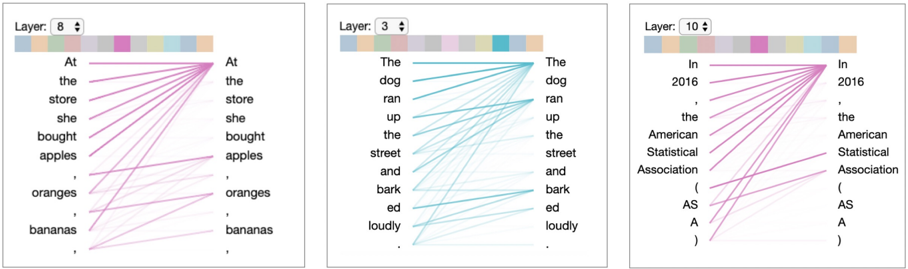
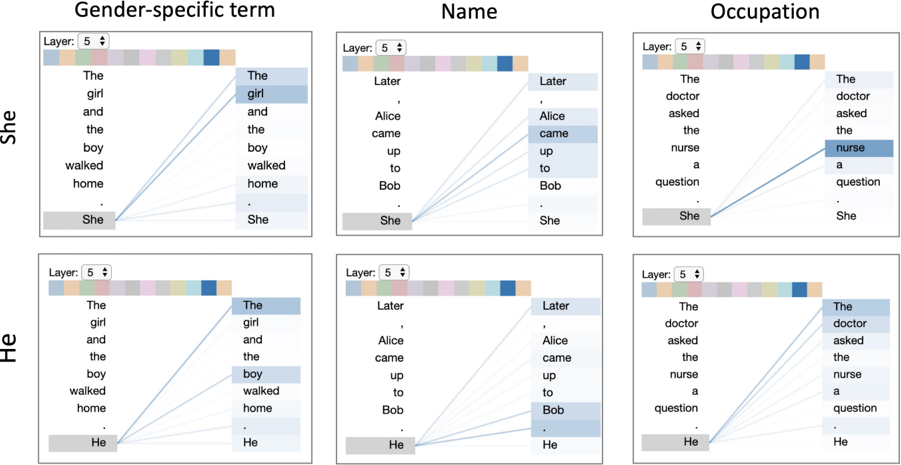
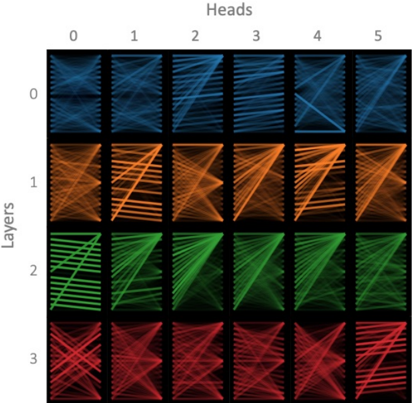
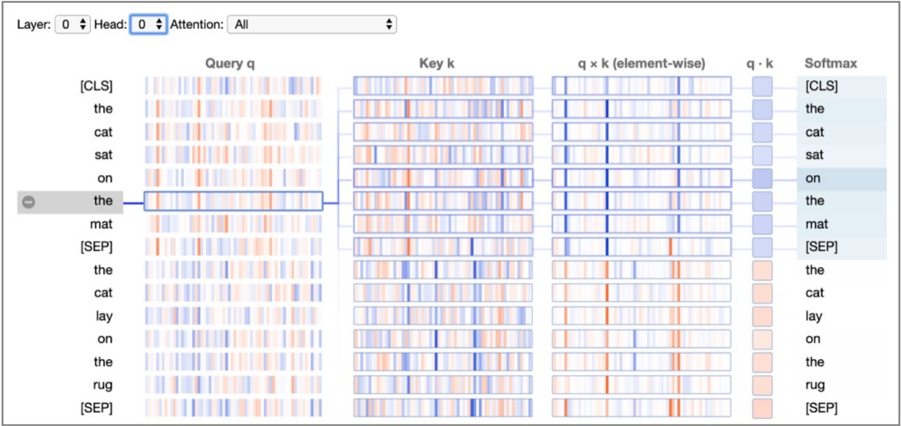
The Transformer is a sequence model that forgoes traditional recurrent architectures in favor of a fully attention-based approach.Besides improving performance, an advantage of using attention is that it can also help to interpret a model by showing how the model assigns weight to different input elements.However, the multi-layer, multi-head attention mechanism in the Transformer model can be difficult to decipher.To make the model more accessible, we introduce an open-source tool that visualizes attention at multiple scales, each of which provides a unique perspective on the attention mechanism.We demonstrate the tool on BERT and OpenAI GPT-2 and present three example use cases: detecting model bias, locating relevant attention heads, and linking neurons to model behavior.
Overview
The claims and statistics of this paper haven’t been checked yet.
Free: it reads the open-access text and checks the first 5 claims that cite a source we can check. Create a free account to check every claim.
Integrity signals
Registry
Cites
Statistics
Figures
Verification
Claims the paper makes
The claims and statistics of this paper haven’t been checked yet.
Free: it reads the open-access text and checks the first 5 claims that cite a source we can check. Create a free account to check every claim.
Claims other papers make about this one
Each is checked against this paper’s own text: does it say what the citing paper says it does?
The source backs part of the claim, not all of it — or backs it for a different population, condition or comparison.
In the citing paper
“Prior work has shown how to use attention weights to visually depict which words in an input sequence, plus which words in previously-generated output, were responsible for a given token's output [95,96].”
From Investigating Explainability of Generative AI for Code through Scenario-based Design (2022) · cites this paper as [95]
Experimental — accuracy not yet measuredThe source backs part of the claim, not all of it — or backs it for a different population, condition or comparison.
In the citing paper
“Attention distribution is a popular approach to explain an individual prediction made by a neural networks model, by the relative importance of parts of input to determine the output [95,96].”
From Investigating Explainability of Generative AI for Code through Scenario-based Design (2022) · cites this paper as [95]
Experimental — accuracy not yet measured
Self-check
Percentages, sums and reported differences re-computed from the paper’s own numbers.
The self-check needs the paper’s full text.
Citations
Cites
Vaswani, A., Shazeer, N., Parmar, N., Uszkoreit, J., Jones, L., Gomez, A. N., Kaiser, L., & Polosukhin, I. (2017) · arXiv · doi:10.48550/arxiv.1706.03762 · Cited by 120,404 · cited 2×
“Jones (2017) designed a visualization tool specifically for multihead attention, which visualizes attention over multiple heads in a layer by superimposing their attention patterns (Vaswani et al., 2017, 2018).”
MethodBERT: Pre-training of Deep Bidirectional Transformers for Language Understanding
Devlin, J., Chang, M.-W., Lee, K., & Toutanova, K. (2018) · arXiv · doi:10.48550/arxiv.1810.04805 · Cited by 73,173 · cited 1×
“In 2018, the BERT (Bidirectional Encoder Representations from Transformers) language representation model achieved state-of-the-art performance across NLP tasks ranging from sentiment analysis to question answering (Devlin et al., 2018).”
BackgroundBERT: Pre-training of Deep Bidirectional Transformers for Language Understanding
Devlin, J., Chang, M.-W., Lee, K., & Toutanova, K. (2019) · Proceedings of the 2019 Conference of the North American Chapter of the Association for Computational Linguistics: Human Language Technologies, Volume 1 (Long and Short Papers) · doi:10.18653/v1/n19-1423 · Cited by 54,325 · cited 1×
“In 2018, the BERT (Bidirectional Encoder Representations from Transformers) language representation model achieved state-of-the-art performance across NLP tasks ranging from sentiment analysis to question answering (Devlin et al., 2018).”
BackgroundNeural Machine Translation by Jointly Learning to Align and Translate
Bahdanau, D., Cho, K., & Bengio, Y. (2014) · arXiv · doi:10.48550/arxiv.1409.0473 · Cited by 16,213 · cited 3×
“Various tools have been developed to visualize attention in NLP models, ranging from attention-matrix heatmaps (Bahdanau et al., 2015; Rush et al., 2015; Rocktäschel et al., 2016) to bipartite graph representations (Liu et al., 2018; Lee et al., 2017; Strobelt et al., 2018).”
BackgroundMethodKemp, C. D., & Tufte, E. R. (1992) · Biometrics · doi:10.2307/2532323 · Cited by 2,713
A Neural Attention Model for Abstractive Sentence Summarization
Rush, A. M., Chopra, S., & Weston, J. (2015) · Proceedings of the 2015 Conference on Empirical Methods in Natural Language Processing · doi:10.18653/v1/d15-1044 · Cited by 2,656 · cited 2×
“Various tools have been developed to visualize attention in NLP models, ranging from attention-matrix heatmaps (Bahdanau et al., 2015; Rush et al., 2015; Rocktäschel et al., 2016) to bipartite graph representations (Liu et al., 2018; Lee et al., 2017; Strobelt et al., 2018).”
MethodJain, S., & Wallace, B. (2019) · Conference of the North American Chapter of the Association for Computational Linguistics: Human Language Technologies (NAACL-HLT) · doi:10.18653/v1/n19-1357 · Cited by 2,037 · cited 1×
“, 2015; Belinkov and Glass, 2019), although its value in explaining individual predictions may be limited (Jain and Wallace, 2019).”
BackgroundAnalyzing Multi-Head Self-Attention: Specialized Heads Do the Heavy Lifting, the Rest Can Be Pruned
Voita, E., Talbot, D., Moiseev, F., Sennrich, R., & Titov, I. (2019) · Proceedings of the 57th Annual Meeting of the Association for Computational Linguistics · doi:10.18653/v1/p19-1580 · Cited by 1,146 · cited 2×
“Recent work shows that attention in the Transformer correlates with syntactic constructs such as dependency relations and part-of-speech tags (Raganato and Tiedemann, 2018; Voita et al., 2019; Vig and Belinkov, 2019).”
BackgroundGender bias in coreference resolution: Evaluation and debiasing methods
Zhao, J., Wang, T., Yatskar, M., Ordonez, V., & Chang, K.-W. (2018) · Proceedings of the 2018 Conference of the North American Chapter of the Association for Computational Linguistics: Human Language Technologies, Volume 2 (Short Papers) · doi:10.18653/v1/n18-2003 · Cited by 684 · cited 1×
“This suggests that the model’s coreference mechanism may encode gender bias (Zhao et al., 2018; Lu et al., 2018).”
BackgroundTensor2Tensor for Neural Machine TranslationPreprint
Vaswani, A., Bengio, S., Brevdo, E., Chollet, F., Gomez, A. N., Gouws, S., Jones, L., Kaiser, Ł., Kalchbrenner, N., Parmar, N., et al. (2018) · arXiv (Cornell University) · doi:10.48550/arxiv.1803.07416 · Cited by 656 · cited 1×
“Jones (2017) designed a visualization tool specifically for multi-head attention, which visualizes attention over multiple heads in a layer by superimposing their attention patterns (Vaswani et al., 2017, 2018).”
Research works printed but not linked: 1
- [18]18. Jesse Vig. 2019. BertViz: A tool for visualizing multi- head self-attention in the BERT model. In ICLR Workshop: Debugging Machine Learning Models.
Cited by
Items 701–797 of 797
Von Wörtern zu Wundern: Die Technologie großer Sprachmodelle und ihre Grenzen
Simbeck, K. (2025) · Literatur - Medien - Didaktik · doi:10.57088/978-3-7329-8796-2_1 · Cited by 4
Pendse, S. R., Gergle, D., Kornfield, R., Kruzan, K. P., Mohr, D., Schleider, J. L., Suh, J., Wescott, A., & Meyerhoff, J. (2026) · Proceedings of IASEAI Conference · doi:10.1609/iaseai.v2i1.43049
Novel Deep Learning Models for Spatiotemporal Predictive Tasks
Le, Q. D. (2022) · uO Research (University of Ottawa) · doi:10.20381/ruor-28516
Ahlers, V. (2024) · SerWisS (University of Applied Sciences and Arts Hannover) · doi:10.25968/opus-3449
Self-Explaining Transformers for Cell Population Detection in Flow Cytometry Data
Kowarsch, F. (2023) · reposiTUm (TU Wien) · doi:10.34726/hss.2023.102742
Boutet, P. (2023) · cIRcle (University of British Columbia) · doi:10.14288/1.0422968
Optimizing the Cost-Effectiveness Tradeoff in Neural Ranking
Hofstätter, S. (2023) · reposiTUm (TU Wien) · doi:10.34726/hss.2023.109581
Dabek, F. (2020) · Maryland Shared Open Access Repository (USMAI Consortium) · doi:10.13016/m2fecs-qjyx · Cited by 1
Resilience assessment of machine learning applications under hardware faults
Agarwal, U. K. (2023) · cIRcle (University of British Columbia) · doi:10.14288/1.0435699 · Cited by 2
Bert-pohjainen etävalvottu relaatioluokittelija suomenkieliselle tekstille
Tohni, P. (2020) · Tampere University Institutional Repository (Tampere University)
In Silico Design of Drug-Like Molecules with Evolutionary Algorithms and Transformers
Cofala, T. (2023) · Carl von Ossiezky University of Oldenburg · Cited by 1
Explainability of Transformer-Based Reinforcement Learning
Ali, H. (2024) · KTH Publication Database DiVA (KTH Royal Institute of Technology) · Cited by 2
TALK COMMONSENSE TO ME! ENRICHING LANGUAGE MODELS WITH COMMONSENSE KNOWLEDGE
Vicente, F. M. G. P. P. (2022) · Portuguese National Funding Agency for Science, Research and Technology (RCAAP Project by FCT)
Using natural language to predict bias and factuality in media with a study on rationalization
Tangri, K. (2021) · DSpace@MIT (Massachusetts Institute of Technology) · Cited by 1
Investigating cross-document event coreference for Dutch
Langhe, L. D., Clercq, O. D., & Hoste, V. (2022) · Ghent University Academic Bibliography (Ghent University)
Natural Language Interface for Operational Forestry Data with Snowflake Cortex Analyst
Heinoja, P. (2024) · Theseus (Ammattikorkeakoulujen) · Cited by 2
Interpreting Reading and Writing Process of Neural Models using Eye-gaze Information
IKHWANTRI, F., & Ikhwantri, F. (2024) · Institutional Repositories DataBase (IRDB)
Buric, F. (2021) · Chalmers Research (Chalmers University of Technology)
A Straightforward Pipeline for Targeted Entailment and Contradiction DetectionPreprint
Sulc, A. (2025) · arXiv (Cornell University) · doi:10.48550/arxiv.2508.17127
“Finally, a third line of work involves the interpretation and visualization of attention mechanisms themselves [7].”
Guidotti, R., Schmid, U., & Longo, L. (2025) · Communications in computer and information science · doi:10.1007/978-3-032-08327-2
Predicción de generación de energía fotovoltaica mediante Transformers
Martínez Vila, A. (2024) · Communities in ADDI (University of the Basque Country)
Riskförutsägelse för arbetsohälsa på basen av patientjournaltexter med hjälp av djup maskininlärning
Hansson, J. (2022) · Aaltodoc (Aalto University)
大規模言語モデルにおけるアテンションダイナミクスの解明と活用 : 対話能力・推論能力・効率性向上のためのフレームワーク
Liao, B. (2025) · Institutional Repositories DataBase (IRDB)
Semantic Pathway: An Interactive Visualization of Hidden States and Token Influence in LLMs
Singh, M. K., & Mueller, K. D. (2025) · Visualization · doi:10.1109/vis60296.2025.00017
“Attention visualization tools such as AttentionViz [21] and Vig’s multiscale approach [17] (also known as BERTViz) highlight attention distributions at different granularities.”
Alignment Via Interpretability: Layerwise Counterfactuals To Detect Maladaptive Llm BehaviorsPreprint
Ugwumba, N. K., & Contreras, J. S. M. (2026) · Research Square · doi:10.21203/rs.3.rs-8714712/v1
Memory Retrieval in Transformers: Insights from The Encoding Specificity PrinciplePreprint
Dinh, V. H., Ding, M., Qu, Y., & Thilakarathna, K. (2026) · arXiv (Cornell University) · doi:10.48550/arxiv.2601.20282
Cai, L., Zhang, T., Beets‐Tan, R. G. H., Brunekreef, J., & Teuwen, J. (2026) · medRxiv · doi:10.64898/2026.01.23.26344428
Sensing Odors: Food Classification Using a Lightweight Transformer
Rossoni, M., Meacci, L., Stefanone, A., & Colombo, G. (2026) · Lecture notes in mechanical engineering · doi:10.1007/978-3-032-14953-4_27
Disentangling Intrinsic Importance from Emergent Structure in Multi-Expert Orchestration
Ghosh, S., Nath, S., Manchanda, S., & Chakraborty, T. (2026) · Transactions on machine learning research · doi:10.48550/arxiv.2602.04291
“Interpretability research has made substantial progress in understanding Transformer-based models through attention visualization, probing classifiers, and attribution methods [36–38].”
Beyond Learning on Molecules by Weakly Supervising on MoleculesPreprint
Prastalo, G., & Jablonka, K. M. (2026) · arXiv (Cornell University) · doi:10.48550/arxiv.2602.04696
Disentangling LLM Predictions: A Framework for Transparent Decision-Making in NLP
Mishra, R., & Kumar, D. (2025) · IEEE Pune Section International Conference (PuneCon) · doi:10.1109/punecon67554.2025.11373924
“In visualization methods, such as those suggested by [19], one attempts to make attention weights more interpretable by charting out interactions between tokens, but such methods fail to provide links between low-level token significance and high-level decisions.”
Tutoring Large Language Models to be Domain-adaptive, Precise and SafePreprint
Banerjee, S. (2026) · arXiv (Cornell University) · doi:10.48550/arxiv.2602.13860
Yıldırım, B., Alsan, H. F., & Arsan, T. (2026) · ACM Transactions on Asian and Low-Resource Language Information Processing · doi:10.1145/3798051
“Tools like BertViz [120] roll out attention weights to visualize token interactions, while others critique attention’s reliability as explanation [125], including adversarial studies that manipulate attention without changing outputs [89].”
Kale, D. R., Shirke-Deshmukh, S., Sutar, S. G., & Tadasare, A. S. (2025) · IEEE International Conference on Green Industrial Electronics and Sustainable Technologies (GIEST) · doi:10.1109/giest66547.2025.11387591 · Cited by 1
Linear Separability and Feature Importance Analysis in Large Language Model Representation Spaces
Kim, J., & Lee, S. (2026) · IEEE International Conference on Big Data and Smart Computing (BigComp) · doi:10.1109/bigcomp68355.2026.00027
Stracqualursi, L., & Agati, P. (2026) · Statistics · doi:10.1080/02331888.2026.2636122 · Cited by 1
“Several XAI methods have been proposed to address this, including attention-based visualization [6], Local In-terpretable Model-agnostic Explanations (LIME) [7], SHapley Additive exPlanations (SHAP) [8], Integrated Gradients [9], and model-specific methods for attention attribution.”
(2024) · Language Resources and Evaluation Conference (LREC) · doi:10.63317/4b546asxrjr6
Paying attention to the words: explaining readability prediction for French as a foreign language
Wilkens, R., Watrin, P., & François, T. (2024) · Language Resources and Evaluation Conference (LREC) · doi:10.63317/39pasw2mx2h6 · Cited by 2
“Indeed, the inspection of attention heads and attention weights assigned to words is a common method applied in explanatory visualization systems such as Vig (2019); Braşoveanu and An-donie (2020).”
MethodRepresentation learning and deep neural approaches for international trade product classification
Anggoro, A. W. (2025) · ORCA Online Research @Cardiff (Cardiff University)
Autogenerating Material Databases and Language Models for Stress Engineering Materials Science
Kumar, P. (2024) · Apollo (University of Cambridge) · doi:10.17863/cam.128312
Classification of health product defect reports by deep learning
Sancenón, V., Huang, Y., Zou, L., Teo, D. C. H., Dorajoo, S. R., Ang, P. S., Goh, H. L., & Ta, A. W. A. (2026) · Scientific Reports · doi:10.1038/s41598-026-43961-3
Bhattacharya, I. (2023) · UvA-DARE (University of Amsterdam) · Cited by 1
Interpreting Transformer-Based Classifiers via Clustering
Gritsai, G., & Grabovoy, A. (2025) · Doklady Mathematics · doi:10.1134/s1064562425700401
Materials Transformer‐based Models
Jiang, X., & Su, Y. (2026) · Wiley eBooks · doi:10.1002/9783527855841.ch05
Temporal Attention Network With Particle Swarm Optimization for High-Frequency Order Book Prediction
Huang, R., & Jena, S. P. (2026) · International Journal of Swarm Intelligence Research · doi:10.4018/ijsir.405434
Punchihewa, Y. (2026) · International Conference on Advanced Research in Computing (ICARC) · doi:10.1109/icarc68737.2026.11454006
“We integrate two main visualization approaches: a) BertViz Integration: (Vig [3]) to create interactive visualizations of attention patterns within the transformer architecture.”
A Straightforward Approach to Construct “Lightweight” Token Graphs from Transformers
Pimentel, J., Amorim, J., & Rudzicz, F. (2026) · Computational Linguistics · doi:10.1162/coli.a.618
Intégration de données textuelles pour la détection des risques naturels en agriculture
Jiang, S. (2022) · theses.fr (ABES) · doi:10.70675/4f90cd87zefffz4b51z84b4zfc08012c5ea2
Deep learning interpretability with visual analytics : Exploring reasoning and bias exploitation
Jaunet, T. (2022) · theses.fr (ABES) · doi:10.70675/a754696bzcd37z49a2zb2a7z2ad1bfd9b620 · Cited by 1
Text mining of aviation occurrence reports
Kierszbaum, S. (2022) · theses.fr (ABES) · doi:10.70675/d744df4az0e21z46acz9736z3727d1ed22ab
Delaforge, A. (2022) · theses.fr (ABES) · doi:10.70675/247fd43fz90d1z4c24za5eazca169f1ba4c1 · Cited by 3
Prédiction et caractérisation des biais textuels basés sur le discours
Devatine, N. (2023) · theses.fr (ABES) · doi:10.70675/870ecec5z9a02z4e8bza751z67ce09f2e85c
Détection des éléments générés automatiquement Contenu académique
Liyanage, V. P. (2024) · theses.fr (ABES) · doi:10.70675/80dff7a0z6e58z4151zb20cz6f0bc537ce85
Dual attention multi-scale network for anomaly detection of intelligent vehicles
Xu, W., He, Z., Chen, Y., & Zhang, D. (2026) · Signal Image and Video Processing · doi:10.1007/s11760-026-05323-4
Improving control of neural networks facing visual perturbations
Cordier, T. (2025) · theses.fr (ABES) · doi:10.70675/a4edd425ze27ez4df1z890dz111029659b3b
Concatenation-based positional encoding for transformer models: proposal and performance analysis
Kim, H., & Lee, J. (2026) · Korean Journal of Applied Statistics · doi:10.5351/kjas.2026.39.2.179
TRuST-M: Evaluating User Trust and Explainability in LLM-Based Web Moderation Systems
Ravi, K., Surale, H. B., & Yuan, J.-S. (2026) · ACM International Conference on Web Search and Data Mining (WSDM) · doi:10.1145/3779211.3793172
Chen, S., Zhu, Y., Liu, J., Liu, Y., He, S., & Zhu, X. (2026) · European Journal of Medicinal Chemistry · doi:10.1016/j.ejmech.2026.118945
Liu, H., Yu, Y., Jiang, M., Zhao, Q., Li, J., Qi, H., Zhai, W., Yang, B. X., Wang, X., & Fu, G. (2026) · Lecture notes in computer science · doi:10.1007/978-981-95-7394-3_21
Adversarial Abductive Dialogue Framework with Reinforcement for Tackling LLM Hallucination
Galitsky, B. (2026) · Springer eBooks · doi:10.1007/978-3-032-16524-4_3
Arous, I., Chehbouni, K., Cheng, Z., & Dossou, B. F. P. (2026) · Springer eBooks · doi:10.1007/978-981-95-3658-0_85
From Answer to Audio: Visual Traceability for AI-Assisted Meeting Retrieval
Nakata, T., & Nakamura, M. (2026) · International Conference on Advanced Visual Interfaces (AVI) · doi:10.1145/3811427.3811496
Sahu, H. K., Bissoyi, S., & Das, S. K. (2026) · International Conference on Intelligent Computing, Networks, and Security (IC-ICNS) · doi:10.1109/ic-icns68863.2026.11537976
Explainability of Large Language Models in Healthcare Information Systems: A Review
Sullivan, R., & Elsayed, N. (2026) · IEEE International Conference on Computing and Machine Intelligence (ICMI) · doi:10.1109/icmi68585.2026.11539937
“In [41], SHAP and LIME, were combined with BertViz [48], to visualize the attention mechanism itself.”
Zhu, H., Pan, Y., & Yang, T. (2026) · International Journal of Financial Engineering · doi:10.1142/s2424786326500271
Kumar, N., Mishra, P., Tripathi, P., Singh, L., & Choudhary, P. (2026) · International Conference on Innovations in Computational Intelligence (ICICI) · doi:10.1109/icici68867.2026.11565033
“[36], [37] All these numbers show the improvement obtained by means of blending and show temporal and con-intermodal consistence of text.”
Exposing the Unsaid: Visualizing Hidden LLM Bias through Stochastic Path AggregationPreprint
Pelossi, M., Sevastjanova, R., Spinner, T., & El‐Assady, M. (2026) · arXiv (Cornell University) · doi:10.48550/arxiv.2606.19344 · Cited by 1
“Although existing visual analytics approaches support language model analysis, such as exploring embedding spaces [4,19,25,26] and attention mechanisms [8,36], methods for visually comparing model-generated outputs remain limited.”
N-GLARE: An Non-Generative Latent Representation-Efficient LLM Safety Evaluator
Lin, Z., Yang, J., Qiu, Y., Bao, Y., Guo, H., & Guan, Y. (2026) · Proceedings of the conference - Association for Computational Linguistics. Meeting · doi:10.18653/v1/2026.acl-long.1334
Safety-Utility Conflicts Are Not Global: Surgical Alignment via Head-Level Diagnosis
Cai, W., Wen, Y., Hou, J., Su, D., Wang, G., Lv, Z., Bao, C., & Wu, Y. (2026) · Proceedings of the conference - Association for Computational Linguistics. Meeting · doi:10.18653/v1/2026.acl-long.340 · Cited by 1
Beyond Sentiment: Detecting Sarcasm in Financial Cash Tag Discourse Using BERT
Ahmed, F., Dahri, K., Aquib, M., Khan, R. S., & Koondhar, M. Y. (2026) · International Journal of Innovations in Science and Technology · doi:10.33411/ijist/1858
Özsönmez, D. B., Bozkaya, F., Acarman, T., Parlak, İ. B., & Adel, M. (2026) · IEEE Access · doi:10.1109/access.2026.3711902
“This attention head visualization is created by a tool called BERTVIZ [34].”
IR Lens: A Tool for Interpreting Cross-Encoder Models
Branga-Peicu, M., Vast, M., Cooten, B. V., Soulier, L., Françoise, J., Piwowarski, B., & Caramiaux, B. (2026) · International ACM SIGIR Conference on Research and Development in Information Retrieval (SIGIR) · doi:10.1145/3805712.3808382
Cost-Sensitive Greenwashing Detection with Validated Explainability
Sakrani, C., Jlifi, B., & Saïd, L. B. (2026) · Intelligence in Business and Industry (IBI) · doi:10.1109/ibi68858.2026.11604099
“Attention-based methods [24] visualize which tokens receive high attention weights during prediction.”
Explaining and Tuning Transformer-based LLMs in Arithmetic Tasks with Human StrategiesPreprint
Qiu, L., Li, J., Kim, H., Wei, X., Zheng, Y., Hsiao, J. H., & Chen, L. (2026) · arXiv (Cornell University) · doi:10.48550/arxiv.2607.17166
“Furthermore, the inherent complexity of multilayered self-attention architectures poses significant challenges in explaining how trans-formers produce specific outputs [9].”
Klimp, C. S. (2026) · Digital Commons-DePaul (DePaul University)
Reporting and Discussing Findings
Kovač, N., Ratković, K., Simeunović, M., Farahani, H., & Watson, P. (2026) · Springer eBooks · doi:10.1007/978-3-032-18312-5_24
Tsurimoto, S., Nomura, A., Nagata, Y., Noguchi, M., Hirai, T., Takeji, Y., Tada, H., Sakata, K., soichiro, U., Okada, S., et al. (2026) · medRxiv · doi:10.64898/2026.08.24.26361274
Politi, F. (2026) · AMS Dottorato Institutional Doctoral Theses Repository (University of Bologna) · doi:10.48676/unibo/amsdottorato/13116
Aleb, N. (2026) · International journal of intelligent engineering and systems · doi:10.22266/ijies2026.1031.11
Large Language Models Create Hallucinations in Response to Negated Text
Seo, J., Moon, H., & Lim, H. (2026) · ACM Transactions on Knowledge Discovery from Data · doi:10.1145/3849694
“We also analyzed the self-attention distributions across all transformer layers [60].”
A Comparative Explainability Framework for DeBERTa-v3 in Zero-Shot Medical Abstract ClassificationPreprint
Esteban-Herreros, J. D., Muñoz-Valero, D., Martínez‐España, R., Juárez, J. M., & Moreno‐García, J. (2026) · arXiv (Cornell University) · doi:10.48550/arxiv.2610.02116
“Inseq (Sarti, Feldhus, Sickert and van der Wal, 2023) targets sequence generation models and exposes feature attribution utilities, while Ecco (Alammar, 2021) and BertViz (Vig, 2019) emphasize visualization of attention and latent representations for encoder-only models.”
Culture del riciclo: strategie narrative e approcci semiotici nei waste studies
Pezzini, L. (n.d.) · Institutional Research Information System University of Turin (University of Turin)
A foundation for systematic analysis of transformers and RNNs for tractography
Renauld, E., Poulin, P., Larochelle, H., Théberge, A., & Descoteaux, M. (2026) · Imaging Neuroscience · doi:10.1162/imag.a.1471
Towards Transparent Fake News Detection Systems Using Large Language Models
Rani, U., & Mittal, K. (2026) · International Journal of Convergent Research
Zhou, X. (2026) · Spectrum Research Repository (Concordia University)
Teaching AI, teaching bias: addressing gender inequality in public health education
Dietrich, A., Czok, K., & Ilskens, K. (2026) · Frontiers in Public Health · doi:10.3389/fpubh.2026.1952627
“BertViz visualizes attention in transformer models (41), while research on implicit knowledge extraction considers how information encoded in neural networks can be examined (42).”
Interpreting Language Model ParametersPreprint
Bushnaq, L., Braun, D., Clive-Griffin, O., Bussmann, B., Hu, N., Ivanitskiy, M., Linsefors, L., & Sharkey, L. (2026) · arXiv (Cornell University) · doi:10.48550/arxiv.2610.20748 · Cited by 5
TIE: Training-free CLIP Embedding Guidance for Compositional Text-to-Image AlignmentPreprint
Hong, S., Choi, T. E., Jun, Y., Yoon, C., & Hwang, S. J. (2026) · arXiv (Cornell University) · doi:10.48550/arxiv.2610.32407
“Motivated by observations that different Transformer layers play distinct functional roles [8, 40, 41], we instead examine self-attention throughout the CLIP text encoder.”
Data-driven Toolkit To Combat Cyberbullying amongst Teens
Verma, K. (2026) · Dublin City University Open Access Institutional Repository (Dublin City University)
Wu, Y., Yuan, Y., Pan, H., Wen, Z., Xu, C., Zhu, M., Feng, Y., & Chen, W. (2026) · ACM Symposium on User Interface Software and Technology (UIST) · doi:10.1145/3830398.3830623
“Attention-centered tools such as BertViz [55, 56], Do-drio [58], and AttentionViz [65] enable multi-granularity inspection of attention patterns.”
The New Perspectiva Artificialis: From the Mechanical Eye to the Algorithmic Symbolic Form
Hutson, J., & Plate, D. (2026) · Routledge eBooks · doi:10.4324/9781042013173
Understanding AI from the Inside: The State of Mechanistic Interpretability for AI SafetyPreprint
Barez, F., Wu, T.-Y., Batra, H., Dominici, G., Draye, F., Elazar, Y., Fornasiere, D., García, A., Harrasse, A., Harris, R., et al. (2026) · arXiv (Cornell University) · doi:10.48550/arxiv.2611.08438 · Cited by 1
Multimorbidity Measurement Strategies for Predicting Hospital Visits
Neves, B., Moreira, J. M., Gonçalves, S., Cerejo, J., Mota, I., Silva, N. A., Leite, F., & Silva, M. J. (2025) · doi:10.21203/rs.3.rs-6515465/v1
Metadata
- Authors
- Vig, J.
- Affiliations
- Palo Alto Research Center (US)
- Corresponding author
- Vig, Jesse
- ORCID
- Vig, Jesse
- Venue
- Proceedings of the 57th Annual Meeting of the Association for Computational Linguistics: System Demonstrations
- Published
- 2019
- Pages
- 37-42
- OpenAlex
- W2949202705
- Semantic Scholar
- 0de0a44b859a3719d11834479112314b4caba669
- Cited by
- 600
- References
- 17
- Citations by year
- 2026: 46 · 2025: 87 · 2024: 79 · 2023: 112 · 2022: 84 · 2021: 112 · 2020: 71 · 2019: 9
- FWCI
- 26.40
- Type
- conference paper
- Language
- en
- Open access
- hybrid
- doi.org
- Licence
- cc-by
- Locations
- Annual Meeting of the Association for Computational Linguistics: System Demonstrations (ACL Demo) (publishedVersion, cc-by)
- arXiv (Cornell University) (submittedVersion)
- arXiv (Cornell University)
- Topics
- Physical Sciences › Computer Science › Artificial Intelligence › Explainable Artificial Intelligence (XAI)
- Physical Sciences › Computer Science › Artificial Intelligence › Topic Modeling
- Physical Sciences › Computer Science › Computer Graphics and Computer-Aided Design › Data Visualization and Analytics
- Keywords
- attention visualization, transformer models, multi-scale visualization, interpretability, multi-head attention, BERT, GPT-2, attention heads, open-source visualization tool
About these checks
Registry, retraction, Cites and statistics results are computed, not judged, with one exception: a printed reference that no index lists is read once by a model before it counts as a citation error. Claims are extracted by a model and kept only when their quote appears verbatim in the text; each cited source is then checked, with a model’s help, for whether it says what the claim relies on. Those verdicts can be wrong — read the claim’s quote and the cited source before relying on one.
Statistics and arithmetic are recomputed, not judged.
Confidence bands are shown only for fields calibrated on our annotated test set. None is calibrated yet, so no band is shown.
What counts as a claim ›How we measure confidence ›How we check this ›
Are you an author, or do you see a problem with this page? Request a review
Data sources
Bibliographic data: Semantic Scholar, OpenAlex, Crossref.
Contains information from the Semantic Scholar Academic Graph Datasets, made available under the ODC Attribution License (ODC-BY 1.0).
Semantic Scholar’s data is described in: Kinney, R., et al. (2023). The Semantic Scholar Open Data Platform. arXiv:2301.10140.
